
Life, 1913-05-29 · page 24 of 44
Life — May 29, 1913 — page 24: what you’re looking at
What you’re looking at
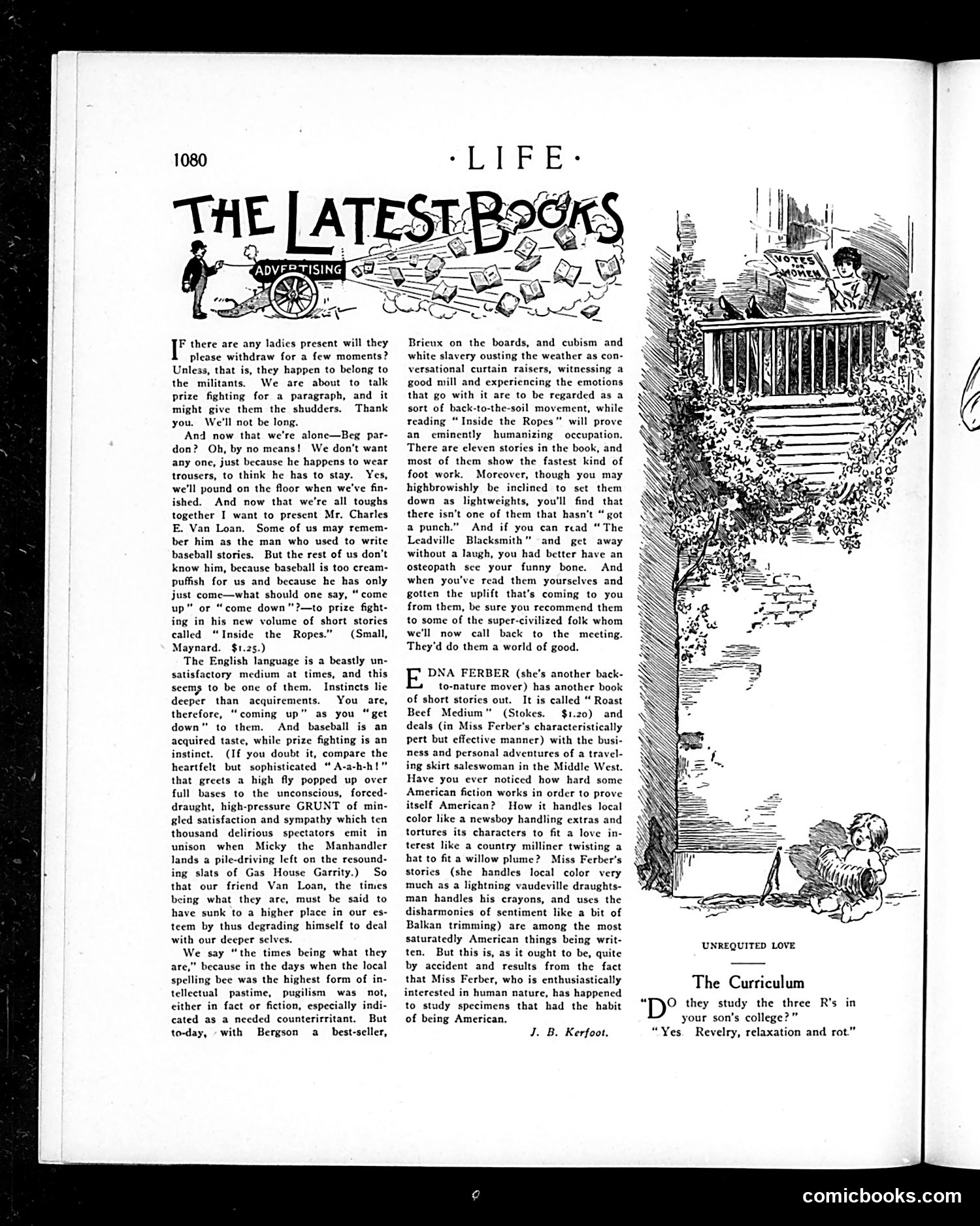
This page reviews recent literature, satirizing early 1900s intellectual trends. The author criticizes how modern "highbrow" culture (referencing philosopher Bergson and playwright Brieux) has made prizefighting literature fashionable as a pseudo-intellectual "back-to-the-soil movement"—a return to primal instincts after over-civilization. The review presents Charles E. Van Loan's boxing story collection "Inside the Ropes" as more authentic than his previous baseball writing, because boxing supposedly appeals to deeper human nature than acquired tastes. The author mocks this pretension: intellectual society now reads boxing stories to appear humanized and authentic. A second review discusses Edna Ferber's "Roast Beef Medium," criticizing how American fiction self-consciously emphasizes "local color" and Americana to prove its credentials, awkwardly forcing characters and romance into predetermined regional types. Both reviews employ sardonic humor about literary fashion and middle-class aspirations toward authenticity and sophistication.
📄 Transcribed text from this page (OCR, searchable)
Machine-transcribed from the original scan — historical spelling and the odd misread are preserved.
F there are any ladies present will they please withdraw for a few moments? Unless, that is, they happen to belong to the militants. We are about to talk prize fighting for a paragraph, and it might give them the shudders. Thank you. We'll not be long. And now that we're alone—Beg par- don? Oh, by no means! We don’t want any one, just because he happens to wear trousers, to think he has to stay. Yes, we'll pound on the floor when we've fin- ished. And now that we're all toughs together I want to present Mr. Charles E. Van Loan, Some of us may remem- ber him as the man who used to write baseball stories. But the rest of us don’t know him, because baseball is too cream- puffish for us and because he has only just come—what should one say, “come up" or “come down” ?—to prize fight- ing in his new volume of short stories called “Inside the Ropes.” (Small, Maynard. $1.25.) The English language is a beastly un- satisfactory medium at times, and this seems to be one of them. Instincts lie deeper than acquirements. You are, therefore, “coming up” as you “get down" to them, And baseball is an acquired taste, while prize fighting is an instinct. (If you doubt it, compare the heartfelt’ but sophisticated “ A-a-h-h!” that greets a high fly popped up over full bases to the unconscious, forced- draught, high-pressure GRUNT of min- gled satisfaction and sympathy which ten thousand delirious spectators emit in unison when Micky the Manhandler lands a pile-driving left on the resound- ing slats of Gas House Garrity.) So that our friend Van Loan, the times being what they are, must be said to have sunk to a higher place in our es- teem by thus degrading himself to deal with our deeper selves. We say “the times being what they are,” because in the days when the local spelling bee was the highest form of in- tellectual pastime, pugilism was not, either in fact or fiction, especially indi- cated as a necded counterirritant. But to-day, with Bergson a_ best-seller, Brieux on the boards, and cubism and white slavery ousting the weather as con- versational curtain raisers, witnessing a good mill and experiencing the emotions that go with it are to be regarded as a sort of back-to-the-soil movement, while reading “Inside the Ropes” will prove an eminently humanizing occupation. There are eleven stories in the book, and most of them show the fastest kind of foot work. Moreover, though you may highbrowishly be inclined to set them down as lightweights, you'll find that there isn’t one of them that hasn't “ got a punch.” And if you can read “ The Leadville Blacksmith” and get away without a laugh, you had better have an osteopath sce your funny bone. And when you've read them yourselves and gotten the uplift that’s coming to you from them, be sure you recommend them to some of the super-civilized folk whom we'll now call back to the meeting. They'd do them a world of good. DNA FERBER (she's another back- to-nature mover) has another book of short stories out. It is called “ Roast Beef Medium” (Stokes. $1.20) and deals (in Miss Ferber’s characteristically Pert but effective manner) with the busi- ness and personal adventures of a travel- ing skirt saleswoman in the Middle West. Have you ever noticed how hard some American fiction works in order to prove itself American? How it handles local color like a newsboy handling extras and tortures its characters to fit a love in- terest like a country milliner twisting a hat to fit a willow plume? Miss Ferber’s stories (she handles local color very much as a lightning vaudeville draughts- man handles his crayons, and uses the disharmonies of sentiment like a bit of Balkan trimming) are among the most saturatedly American things being writ- ten. But this is, as it ought to be, quite by accident and results from the fact that Miss Ferber, who is enthusiastically interested in human nature, has happened to study specimens that had the habit of being American, J. B. Kerfoot. UNREQUITED LOVE The Curriculum “T)O they study the three R's in your son’s college?” “Yes. Revelry, relaxation and rot.” comicbooks.com