
Life, 1913-05-29 · page 25 of 44
Life — May 29, 1913 — page 25: what you’re looking at
What you’re looking at
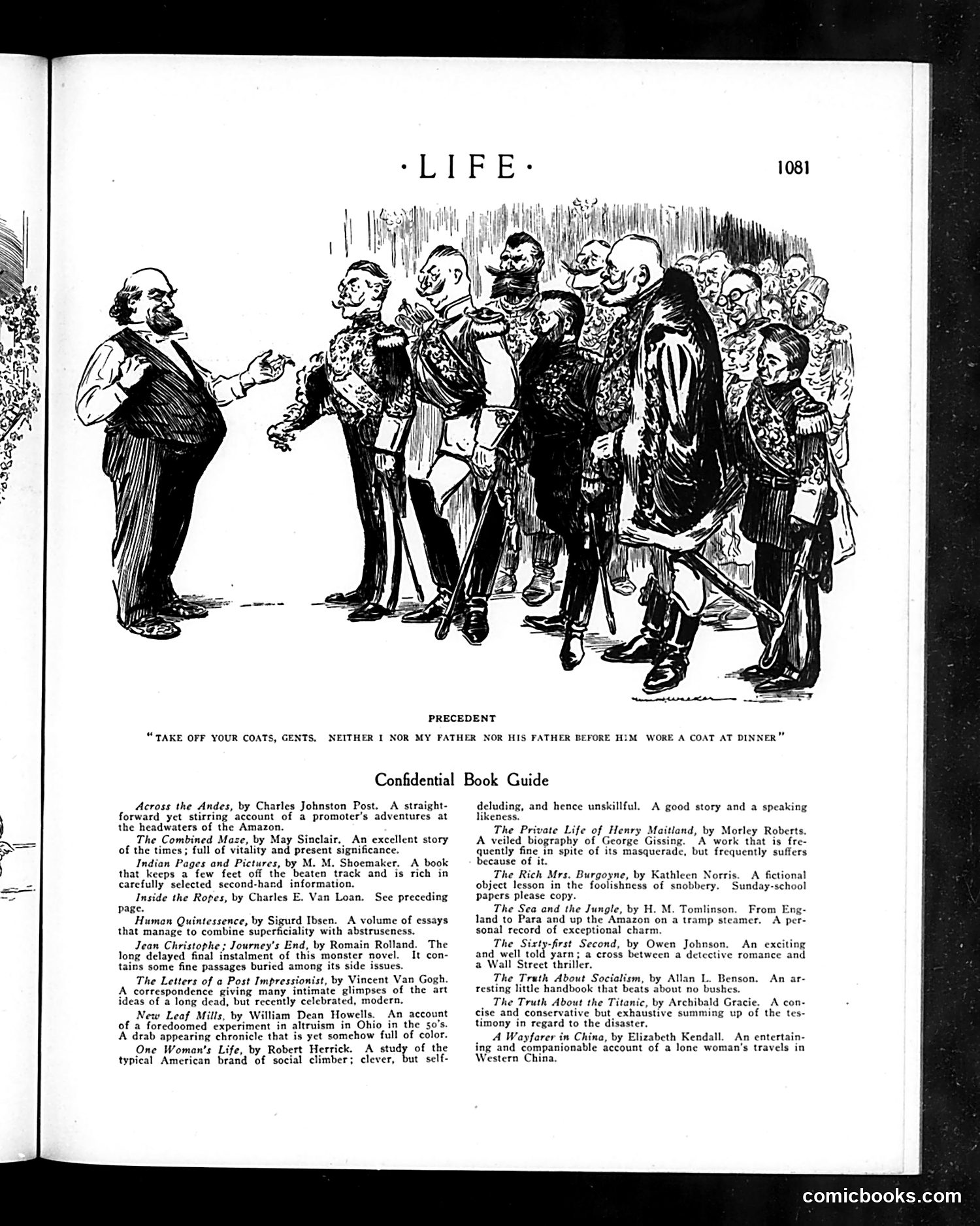
This satirical cartoon, titled "Precedent," mocks upper-class pretension about inherited tradition. A portly gentleman on the left addresses a group of formally dressed men (military officers, nobles, and dignitaries), instructing them to remove their dinner jackets because "neither I nor my father nor his father before him wore a coat at dinner." The joke is the obvious contradiction: the speaker himself is dressed in formal attire, undermining his claim of family tradition. The satire targets how the wealthy invoke spurious "precedent" and invented customs to justify snobbish behavior—essentially making up rules retroactively and presenting them as ancient family practice. The page also includes a "Confidential Book Guide" reviewing contemporary literature, suggesting this is from an early 20th-century *Life* magazine focused on cultural commentary and social satire.
📄 Transcribed text from this page (OCR, searchable)
Machine-transcribed from the original scan — historical spelling and the odd misread are preserved.
PRECEDENT “TAKE OFF YOUR COATS, GENTS. NEITHER I NOR MY FATHER NOR HIS FATHER BEFORE HIM WORE A COAT AT DIN Confidential Book Guide Across the Andes, by Charles Johnston Post. A straight- forward yet stirring account of a promoter’s adventures at the headwaters of the Amazon. The Combined Maze, by May Sinclair. An excellent story of the times; full of vitality and present significance. Indian Pages and Pictures, by M. M. Shoemaker. A book that keeps a few feet off the beaten track and is rich in carefully selected second-hand information, Inside the Ropes, by Charles E. Van Loan. Sce preceding page. Human Quintessence, by Sigurd Ibsen. A volume of essays that manage to combine superficiality with abstruseness. Jean Christophe ; Journey's End, by Romain Rolland. The long delayed final instalment of this monster novel. It con- tains some fine passages buried among its side issues. The Letters of a Post Impressionist, by Vincent Van Gogh. A correspondence giving many intimate glimpses of the art ideas of a long dead, but recently celebrated, modern, New Leaf Mills, by William Dean Howells, An account of a foredoomed experiment in altruism in Ohio in the o's. A drab appearing chronicle that is yet somehow full of color. One Woman's Life, by Robert Herrick. A sade of the typical American brand of social climber; clever, but self- deluding, and hence unskillful. A good story and a speaking likeness. The Private Life of Henry Maitland, by Morley Roberts. A veiled biography of George Gissing. "A work that is fre- quently fine in spite of its masquerade, but frequently suffers because of it. The Rich Mrs. Burgoyne, by Kathleen Norris. A fictional object lesson in the foolishness of snobbery. Sunday-school papers please copy. The Sea and the Jungle, by H. M. Tomlinson. From E: land to Para and up the Amazon on a tramp steamer. A per- sonal record of exceptional charm. The Sixty-first Second, by Owen Johnson. An exciting and well told yarn; a cross between a detective romance and a Wall Street ‘thriller. The Truth About Socialism, by Allan L. Benson. An ar- resting little handbook that beats about no bushes. The Truth About the Titanic, by Archibald Gracie, A con- cise and conservative but exhaustive summing up of the tes- timony in regard to the disaster. A Wayfarer in China, by Elizabeth Kendall. An entertain- ing and companionable account of a lone woman's travels in Western China. comicbooks.com