
Life, 1913-05-29 · page 8 of 44
Life — May 29, 1913 — page 8: what you’re looking at
What you’re looking at
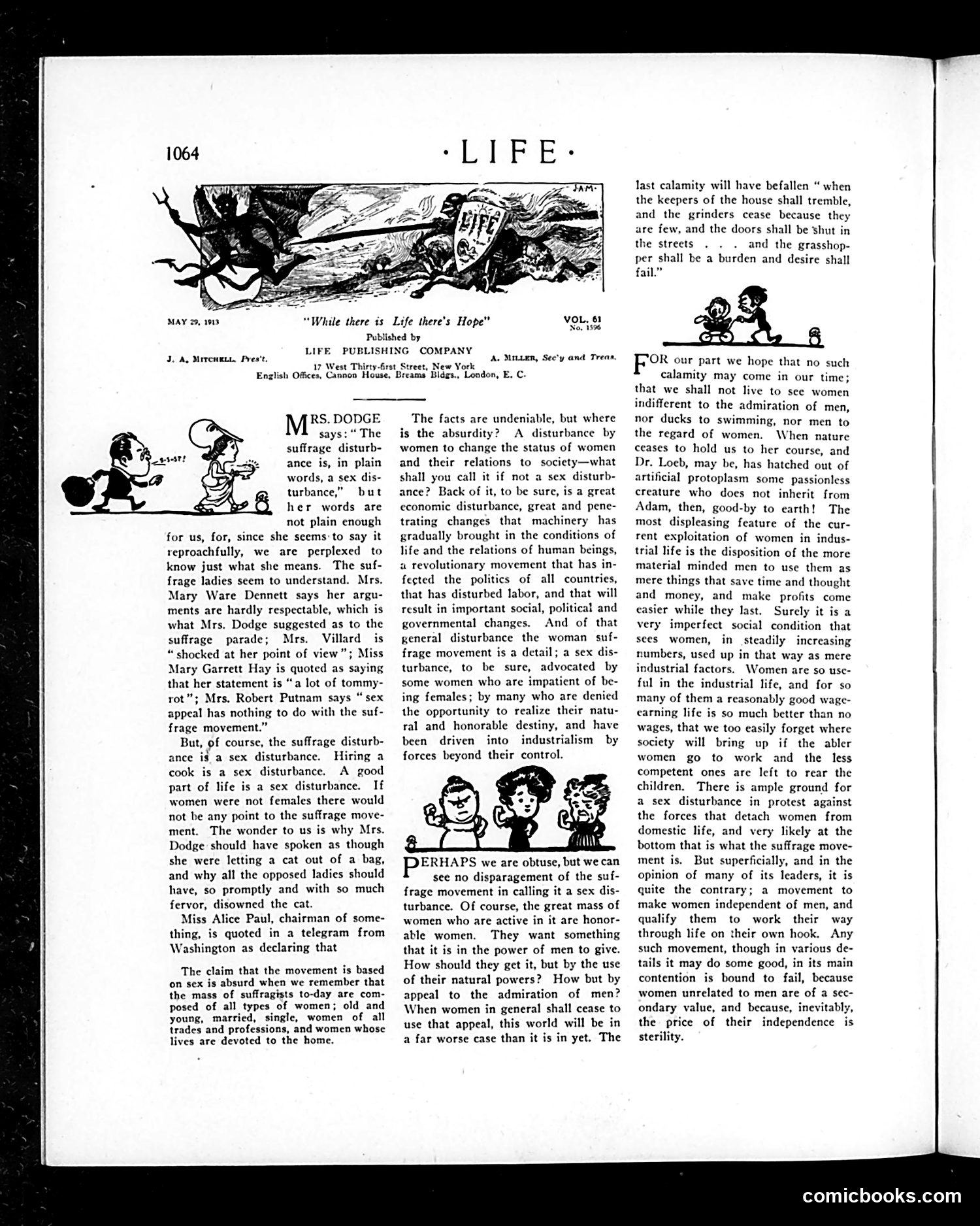
This page contains an editorial debate about women's suffrage disguised as a dialogue between "Mrs. Dodge" and other contributors. The cartoon shows a small figure (likely representing a woman or suffragist) confronting a larger man, illustrating the power imbalance in the suffrage debate. Mrs. Dodge argues that suffrage is a "sex disturbance" causing social upheaval. The magazine's editorial responds by defending the suffrage movement, noting that women's entry into industrial life has already created economic and social change—suffrage simply formalizes women's existing influence. The piece acknowledges women work in factories yet remain politically voiceless, suggesting independence and voting rights are logical extensions of their economic participation.
📄 Transcribed text from this page (OCR, searchable)
Machine-transcribed from the original scan — historical spelling and the odd misread are preserved.
MAY 29, 1913, “While there is Life there's Hope” Published by LIFE J. A, Mrrenent, Pres't, PUBLISHING COMPANY A. Miiten, See'y and Treas. 17 West Thirty-first, Street, New York English Offices, Cannon House, Breams’ Bldgs., London, E. C. RS, DODGE says: “ The suffrage disturb- ance is, in plain words, a sex dis- turbance,” but her words are not plain enough for us, for, since she seems: to say it reproachfully, we are perplexed to know just what she means. The suf- frage ladies seem to understand. Mrs. Mary Ware Dennett says her argu- ments are hardly respectable, which is what Mrs. Dodge suggested as to the suffrage parade; Mrs. Villard is “shocked at her point of view”; Miss Mary Garrett Hay is quoted as saying that her statement is “a lot of tommy- rot”; Mrs, Robert Putnam says “sex appeal has nothing to do with the suf- frage movement.” But, of course, the suffrage disturb- ance i$ a sex disturbance. Hiring a cook is a sex disturbance. A good part of life is a sex disturbance. If women were not females there would not be any point to the suffrage move- ment. The wonder to us is why Mrs. Dodge should have spoken as though she were letting a cat out of a bag, and why all the opposed ladies should have, so promptly and with so much fervor, disowned the cat. Miss Alice Paul, chairman of some- thing, is quoted in a telegram from Washington as declaring that The claim that the movement is based on sex is absurd when we remember that the mass of suffragists to-day are com- posed of all types of women; old and young, married, single, women of all trades and professions, and women whose lives are devoted to the home. The facts are undeniable, but where is the absurdity? A disturbance by women to change the status of women and their relations to society—what shall you call it if not a sex disturb- ance? Back of it, to be sure, is a great economic disturbance, great and pene- trating changes that machinery has gradually brought in the conditions of life and the relations of human beings, a revolutionary movement that has in- fected the politics of all countries, that has disturbed labor, and that will result in important social, political and governmental changes. And of that general disturbance the woman suf- frage movement is a detail; a sex dis- turbance, to be sure, advocated by some women who are impatient of be- ing females; by many who are denied the opportunity to realize their natu- ral and honorable destiny, and have been driven into industrialism by forces beyond their control. ERHAPS we are obtuse, but we can see no disparagement of the suf- frage movement in calling it a sex dis- turbance. Of course, the great mass of women who are active in it are honor- able women. They want something that it is in the power of men to give. How should they get it, but by the use of their natural powers? How but by appeal to the admiration of men? When women in general shall cease to use that appeal, this world will be in a far worse case than it is in yet. The last calamity will have befallen “ when the keepers of the house shall tremble, and the grinders cease because they are few, and the doors shall be shut in the streets and the grasshop- per shall be a burden and desire shall fail.” Foe our part we hope that no such calamity may come in our time; that we shall not live to see women indifferent to the admiration of men, nor ducks to swimming, nor men to the regard of women. When nature ceases to hold us to her course, and Dr. Loeb, may be, has hatched out of artificial protoplasm some passionless creature who does not inherit from Adam, then, good-by to earth! The most displeasing feature of the cur- rent exploitation of women in indus- trial life is the disposition of the more material minded men to use them as mere things that save time and thought and money, and make profits come easier while they last. Surely it is a very imperfect social condition that sees women, in steadily increasing numbers, used up in that way as mere industrial factors. Women are so use- ful in the industrial life, and for so many of them a reasonably good wage- earning life is so much better than no wages, that we too easily forget where society will bring up if the abler women go to work and the less competent ones are left to rear the children. There is ample ground for a sex disturbance in protest against the forces that detach women from domestic life, and very likely at the bottom that is what the suffrage move- ment is. But superficially, and in the opinion of many of its leaders, it is quite the contrary; a movement to make women independent of men, and qualify them to work their way through life on their own hook. Any such movement, though in various de- tails it may do some good, in its main contention is bound to fail, because women unrelated to men are of a sec- ondary value, and because, inevitably, the price of their independence is sterility. comicbooks.com