
A complete issue · 52 pages · 1913
Life — April 3, 1913
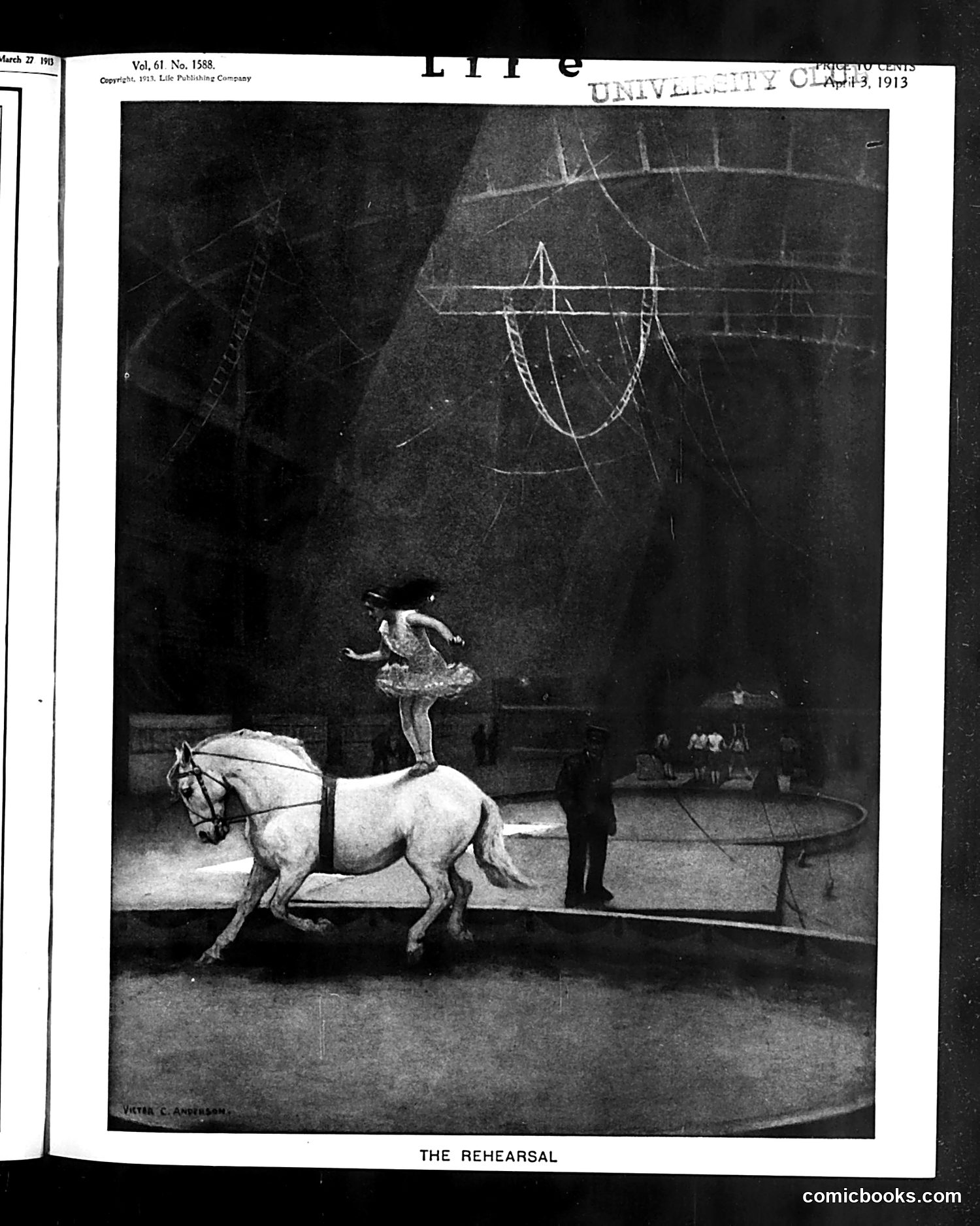
This circus photograph, captioned "The Rehearsal," depicts an acrobat performing a balancing act while standing on a horse in a circus ring. The image appears to be a documentary photograph rather than political satire—it showcases a circus performer demonstrating their skill during practice. The sketch-like drawings visible on the dark backdrop above appear to be technical diagrams or design notes, possibly showing rigging equipment or safety apparatus used in the performance. Without accompanying satirical text or caricatures, this page functions as straightforward entertainment journalism documenting circus performance techniques from 1913, rather than political or social commentary. It's unclear what satirical point, if any, the publication intended.
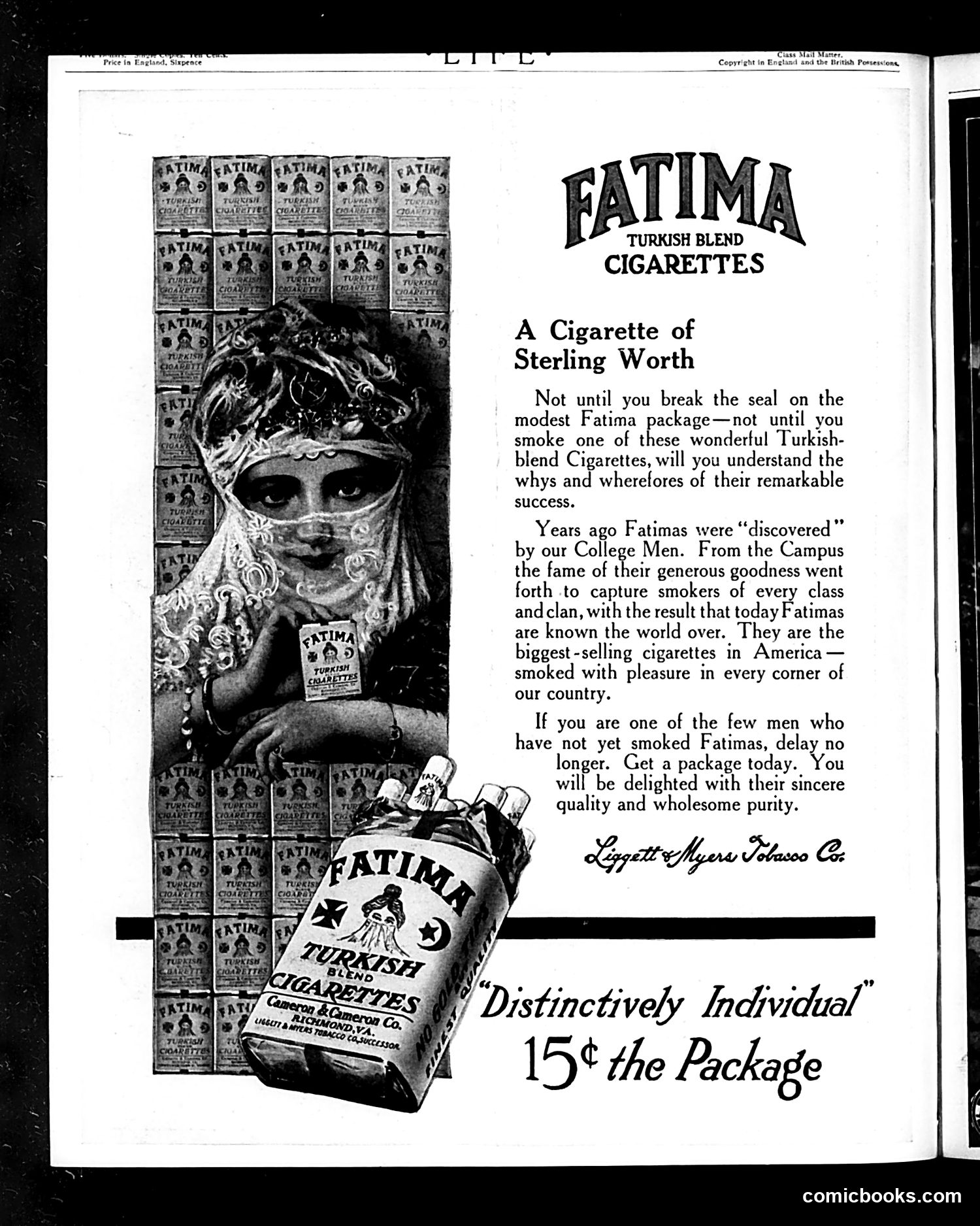
This is a **cigarette advertisement**, not satire or political commentary. It promotes Fatima Turkish Blend cigarettes, marketed as "A Cigarette of Sterling Worth." The ad features a **woman wearing an ornate veil or mask** — likely meant to evoke "exotic" Turkish imagery appealing to early 20th-century American consumers. The marketing emphasizes the cigarettes' popularity among "College Men" and claims Fatimas are "the biggest-selling cigarettes in America." The advertisement uses **orientalist stereotyping** common to the era, presenting Turkish/Middle Eastern imagery as glamorous and desirable. The price point of 15¢ per package and the tagline "Distinctly Individual" suggest marketing to middle-class male smokers. There is **no satire here** — this is straightforward product promotion using ethnic imagery as a sales tool.
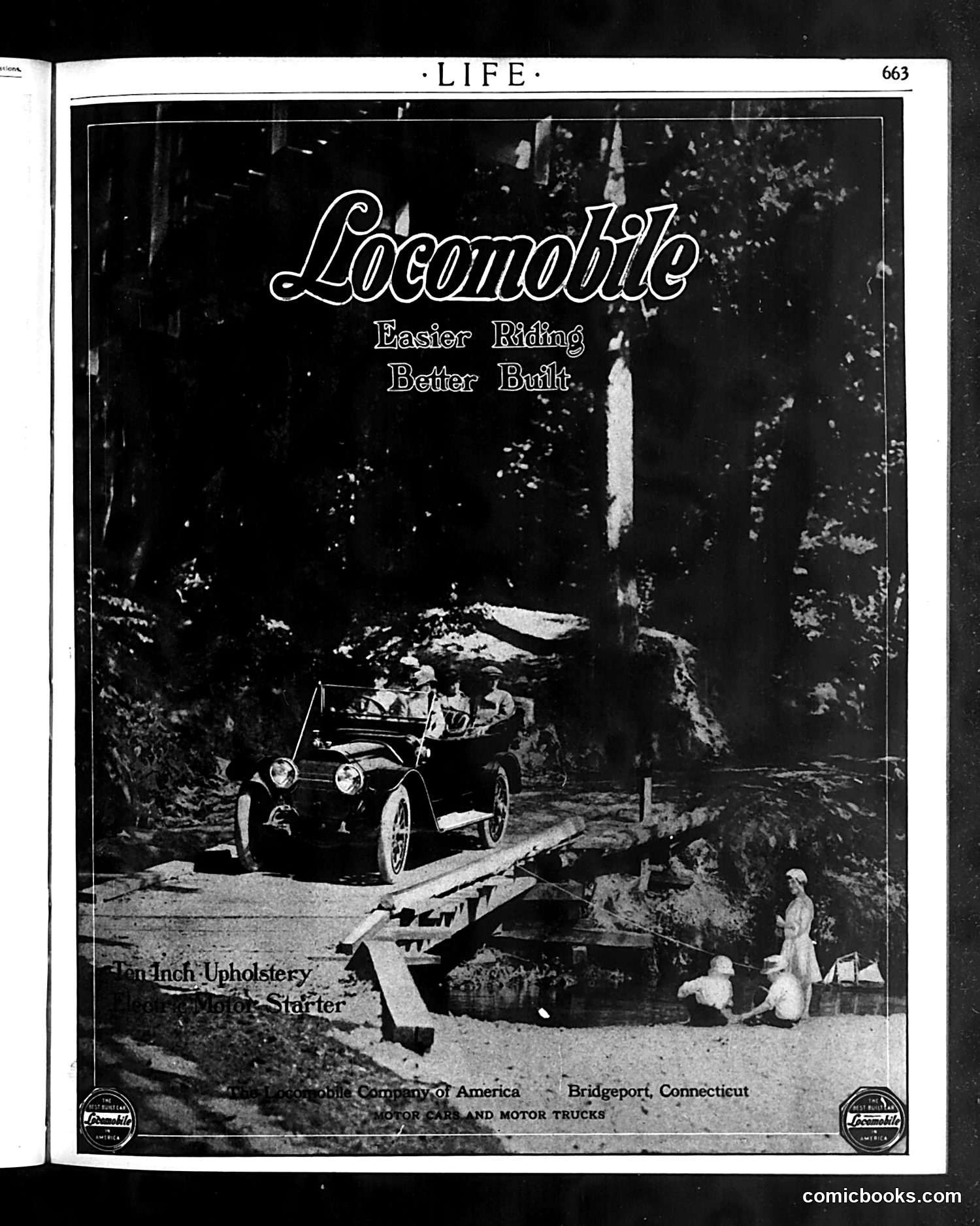
This page is **primarily an advertisement**, not satire or political commentary. It promotes the Locomobile automobile, manufactured by the Locomobile Company of America in Bridgeport, Connecticut. The ad features a touring car navigating a challenging forest terrain with a small wooden bridge, demonstrating the vehicle's capability and "easier riding" construction ("Better Built"). Passengers and onlookers are shown observing the automobile's performance on this difficult path. The tagline emphasizes the "7-inch Upholstery Starter"—a selling point highlighting comfort and construction quality. This represents typical early automotive advertising aimed at showcasing mechanical reliability and passenger comfort to prospective buyers during the early automobile era.
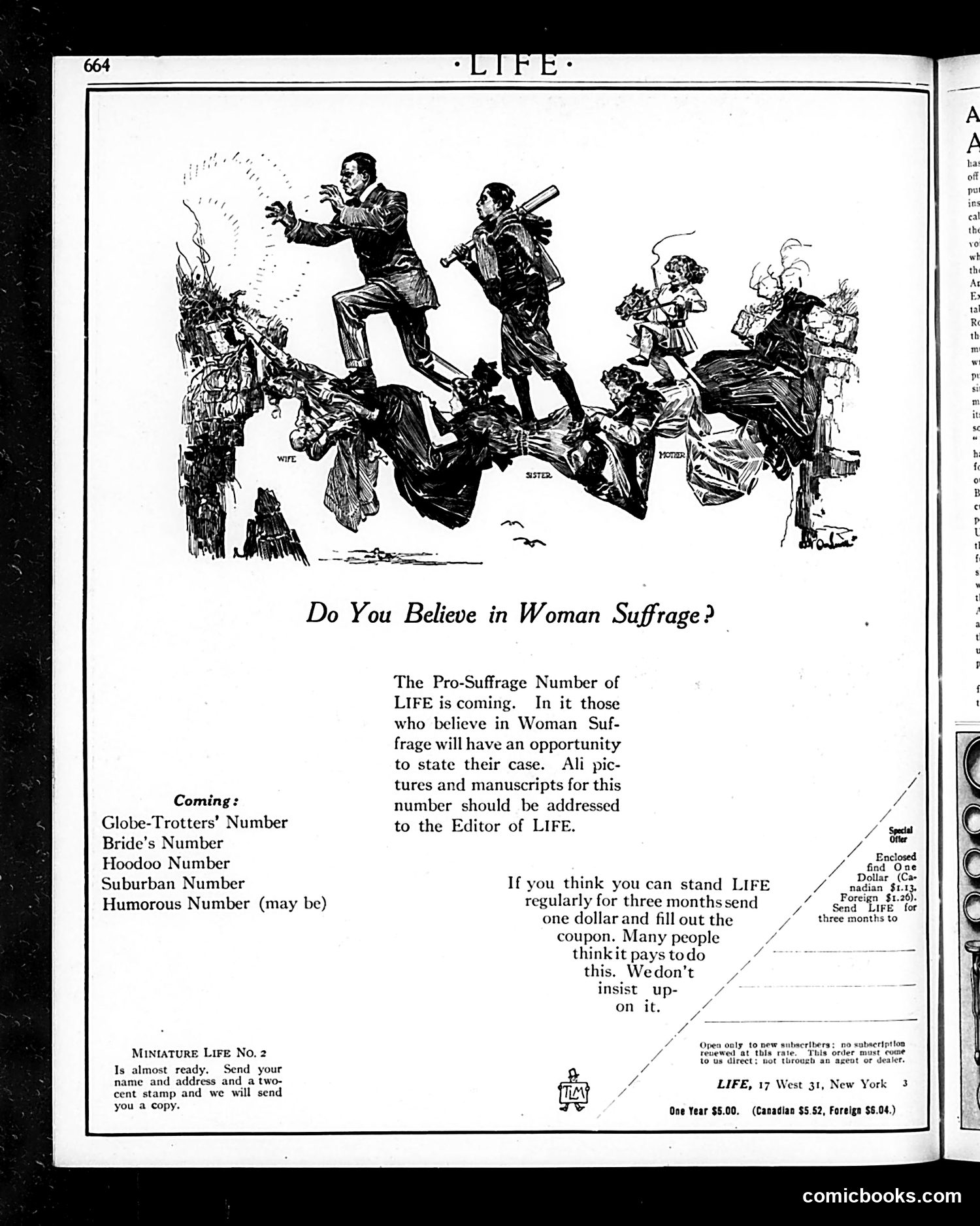
This page satirizes the women's suffrage debate through a chaotic cartoon depicting figures literally fighting over the issue. The central image shows men and women in combat—some wielding clubs and weapons—labeled "Wife," "Sister," and "Husband," suggesting domestic conflict ignited by suffrage advocacy. The cartoon's violence illustrates how contentious the suffrage question had become in American households and society. The question "Do You Believe in Woman Suffrage?" frames this as a divisive issue splitting families and communities. The page also advertises upcoming LIFE content (Globe-Trotters' Number, Bride's Number, etc.) and solicits pro-suffrage submissions for a special issue, indicating LIFE's editorial support for women's voting rights while mocking the heated rhetoric surrounding it.
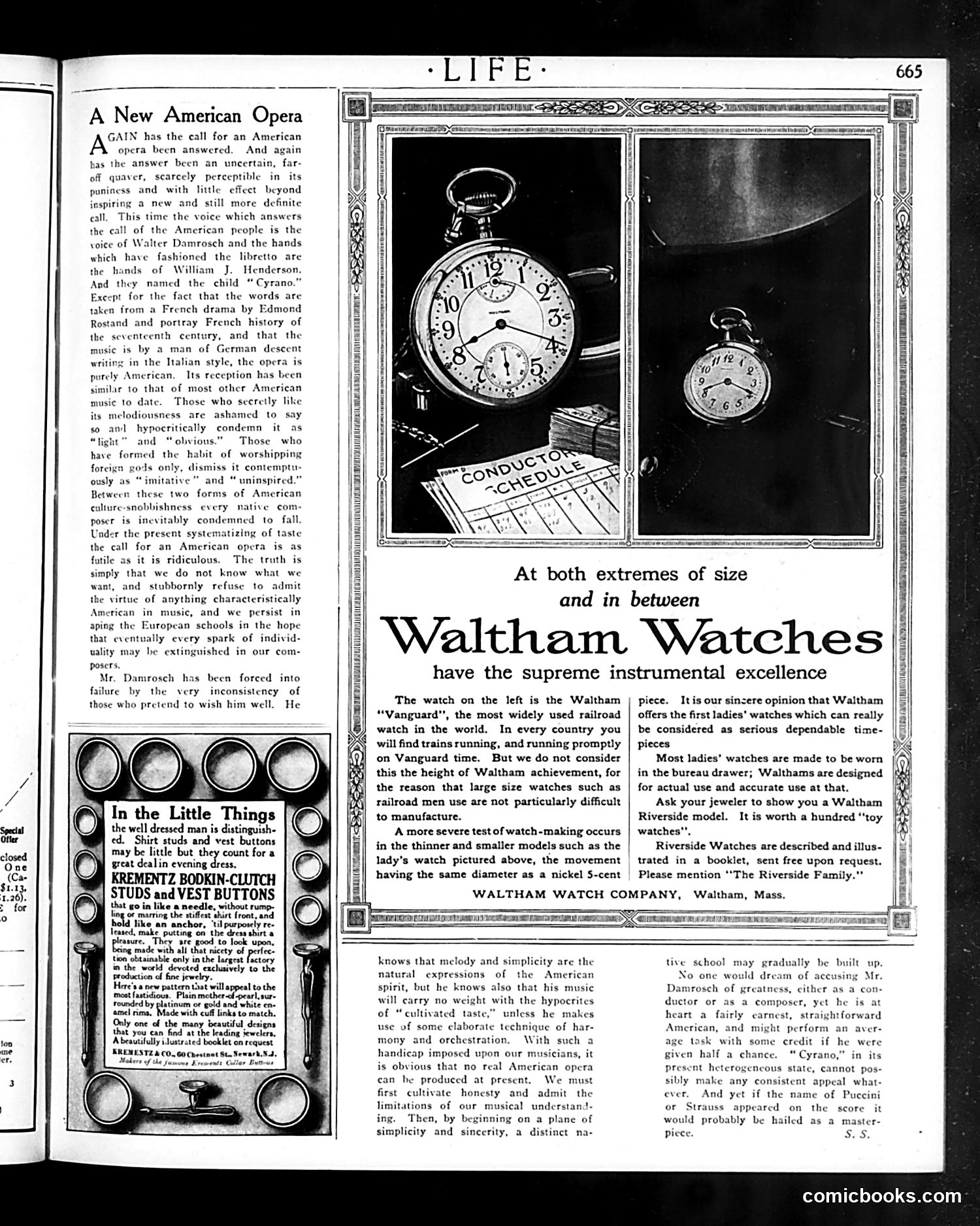
This page is primarily **advertising rather than satire or political commentary**. The left column contains an article titled "A New American Opera" discussing Walter Damrosch's opera "Cyrano" and debating American versus European musical taste. Below that is an advertisement for **Krementz Bodkin-Clutch Shirt Studs and Cuff Buttons**. The dominant right side features a **Waltham Watch Company advertisement** showing pocket watches of different sizes with the tagline "At both extremes of size and in between, Waltham Watches have the supreme instrumental excellence." The ad emphasizes the precision engineering required for both large railroad watches and smaller ladies' watches. There is no political cartoon or satire visible. This appears to be a standard magazine page mixing editorial content with period advertising.
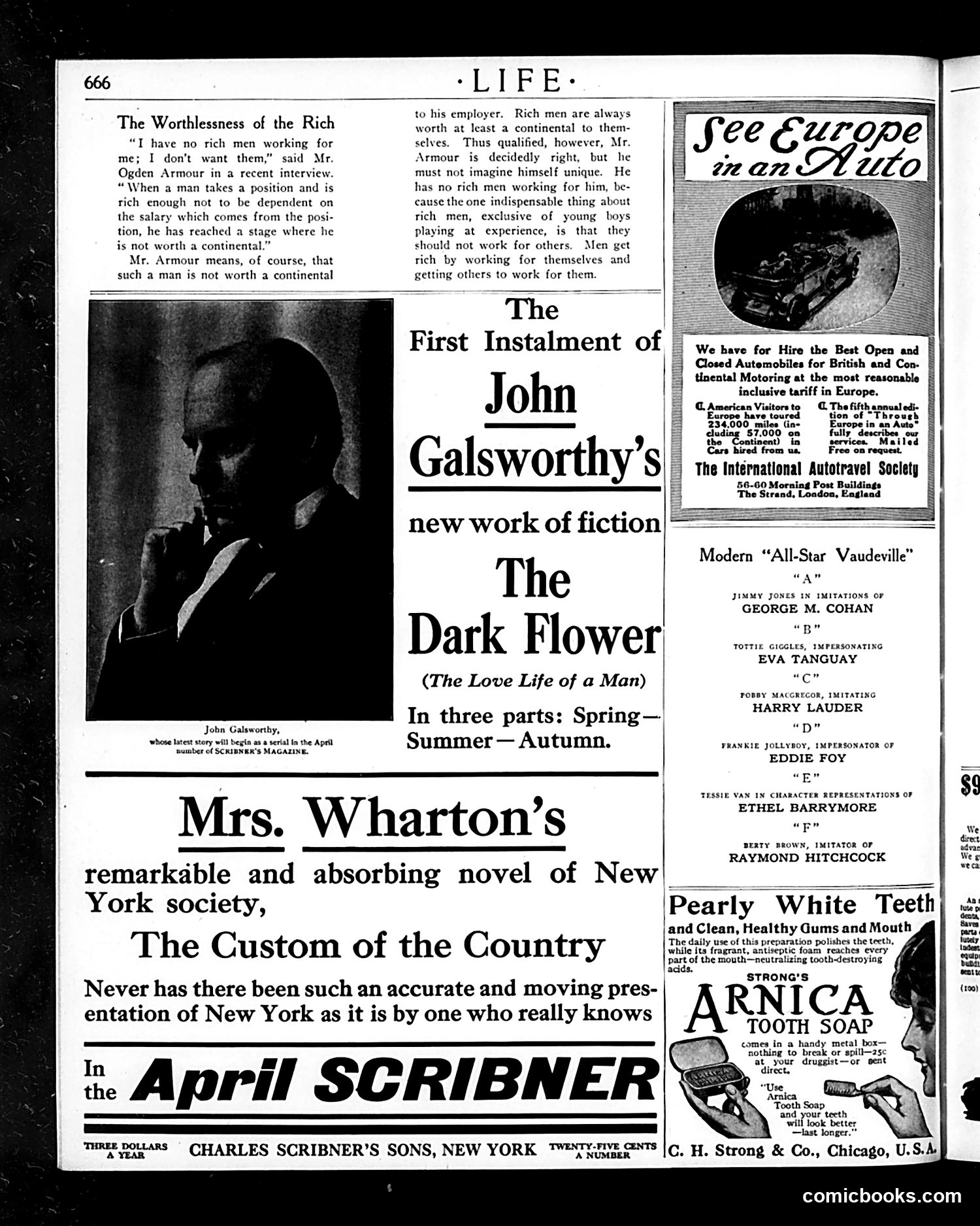
This page is primarily **literary advertising** rather than political satire or comics. The main content promotes three works of fiction: 1. **John Galsworthy's "The Dark Flower"** — a novel about love, serialized in three parts (Spring-Summer-Autumn) 2. **Mrs. Wharton's "The Custom of the Country"** — described as an accurate portrayal of New York society 3. **Scribner magazine** — promoting the April issue at three dollars per year The top section includes social commentary about wealthy men not being "worth a continental" unless they work for themselves rather than depending on inherited position—a mild critique of idle rich. The remaining space features period advertisements for automobiles and tooth soap. There are no identifiable political cartoons or caricatures on this page.
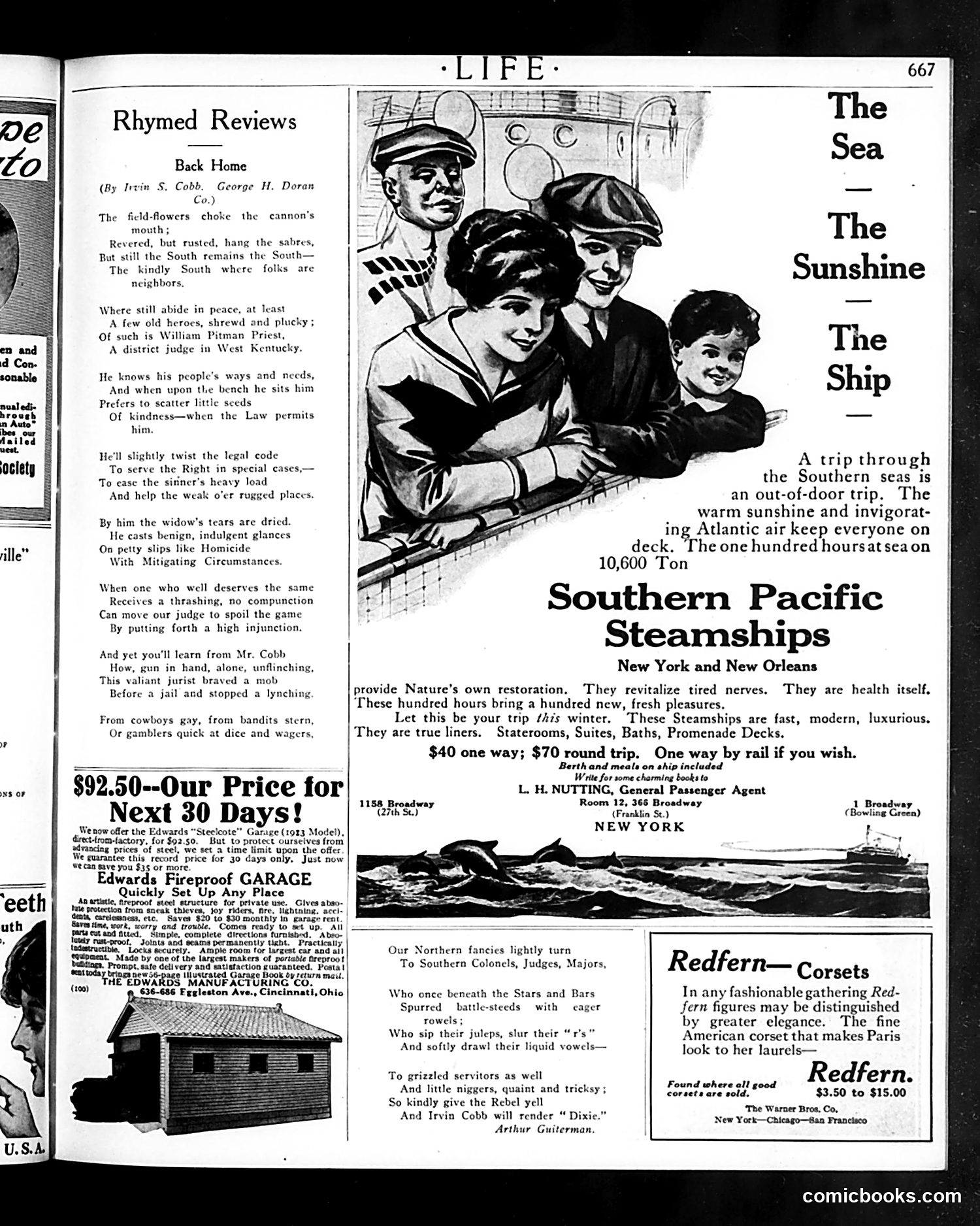
This page is primarily **advertising and entertainment content** rather than political satire. The main elements include: 1. **"Back Home" poem** by Irvin S. Cobb and George H. Doran—a sentimental verse about a Southern judge (William Pitman Priest) who shows mercy and kindness despite his legal authority. 2. **Southern Pacific Steamships advertisement** promoting luxury cruises from New York to New Orleans, emphasizing relaxation and health benefits. 3. **Fireproof garage advertisement** ($92.50 for 30 days). 4. **Redfern Corsets advertisement** claiming superior elegance compared to Paris fashions. The page reflects early 20th-century commercial culture with nostalgic Southern themes and marketed leisure travel for affluent readers.
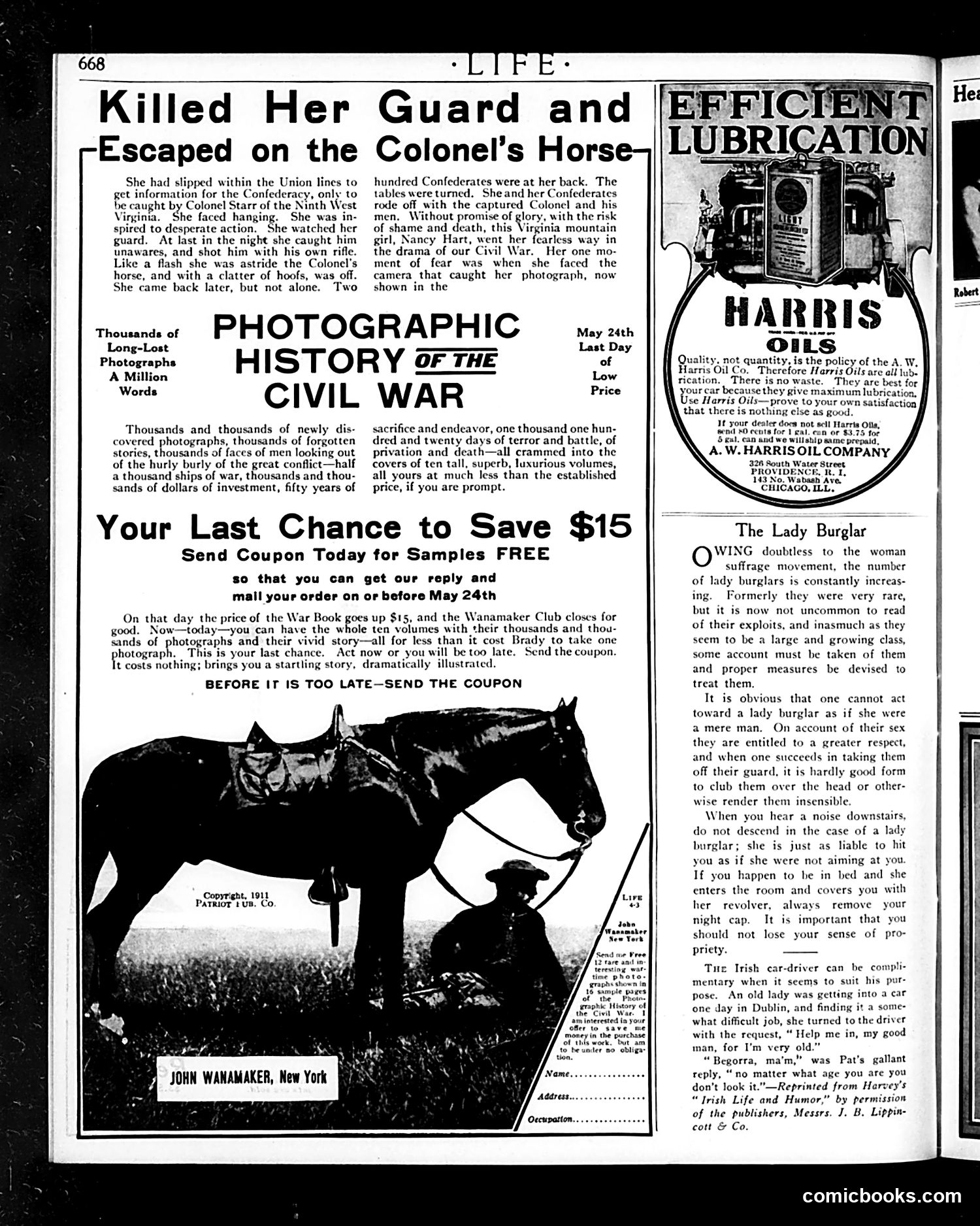
This Life magazine page (668) combines historical narrative with period advertising. **Main Content:** The left side features a Civil War story titled "Killed Her Guard and Escaped on the Colonel's Horse"—describing a Confederate woman (Nancy Hart) who allegedly killed a Union soldier and escaped. Below this runs an advertisement for a "Photographic History of the Civil War" book series, with an image of a horse and soldier, offering a May 24th deadline to save $15. **Advertisements:** The right side contains two ads: Harris Oils (lubricants) and "The Lady Burglar" (a satirical piece about female burglars, treating it almost comedically). The page reflects early 20th-century American culture: romanticized Civil War narratives, mail-order book marketing, and contemporary anxieties about women's changing social roles (sardonically presented in the burglar piece). The horse imagery connects the historical and commercial content.
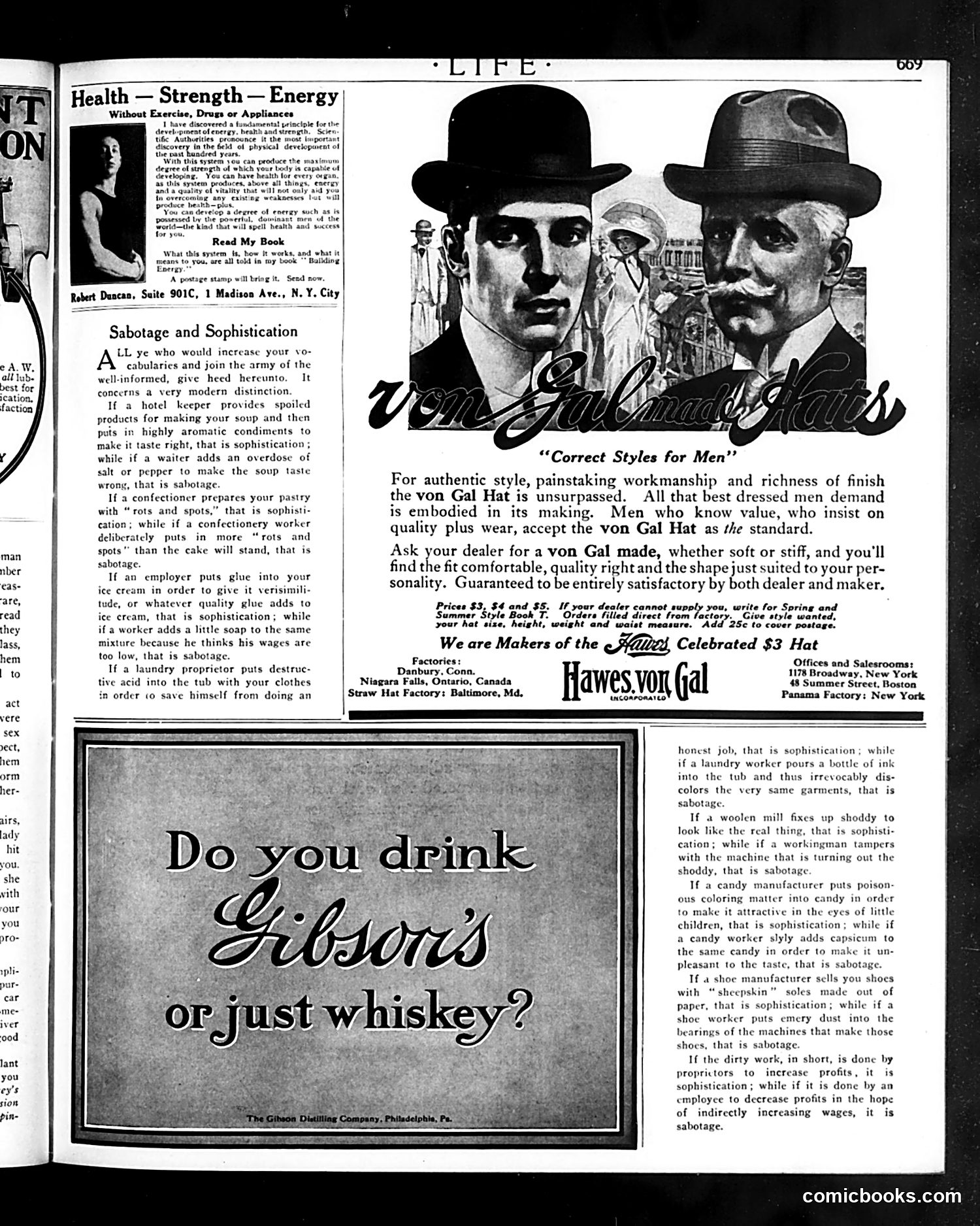
This page contains **advertisements and editorial content** from an early 20th-century *Life* magazine. The **top advertisement** for von Gal Hats features three men in formal attire—likely public figures of the era based on the styling—endorsing the hats as the standard for "correct styles for men." The specific identities are unclear from the image alone. The **editorial section** titled "Sabotage and Sophistication" satirizes the distinction between genuine sabotage (deliberate worker damage to reduce profits/wages) and fake sophistication (business owners blaming workers while engaging in their own cost-cutting that harms products). The **Gibson Distilling Company advertisement** at bottom asks "Do you drink Gibson's or just whiskey?"—a straightforward product pitch rather than satire. The page primarily showcases period advertising rather than political commentary.
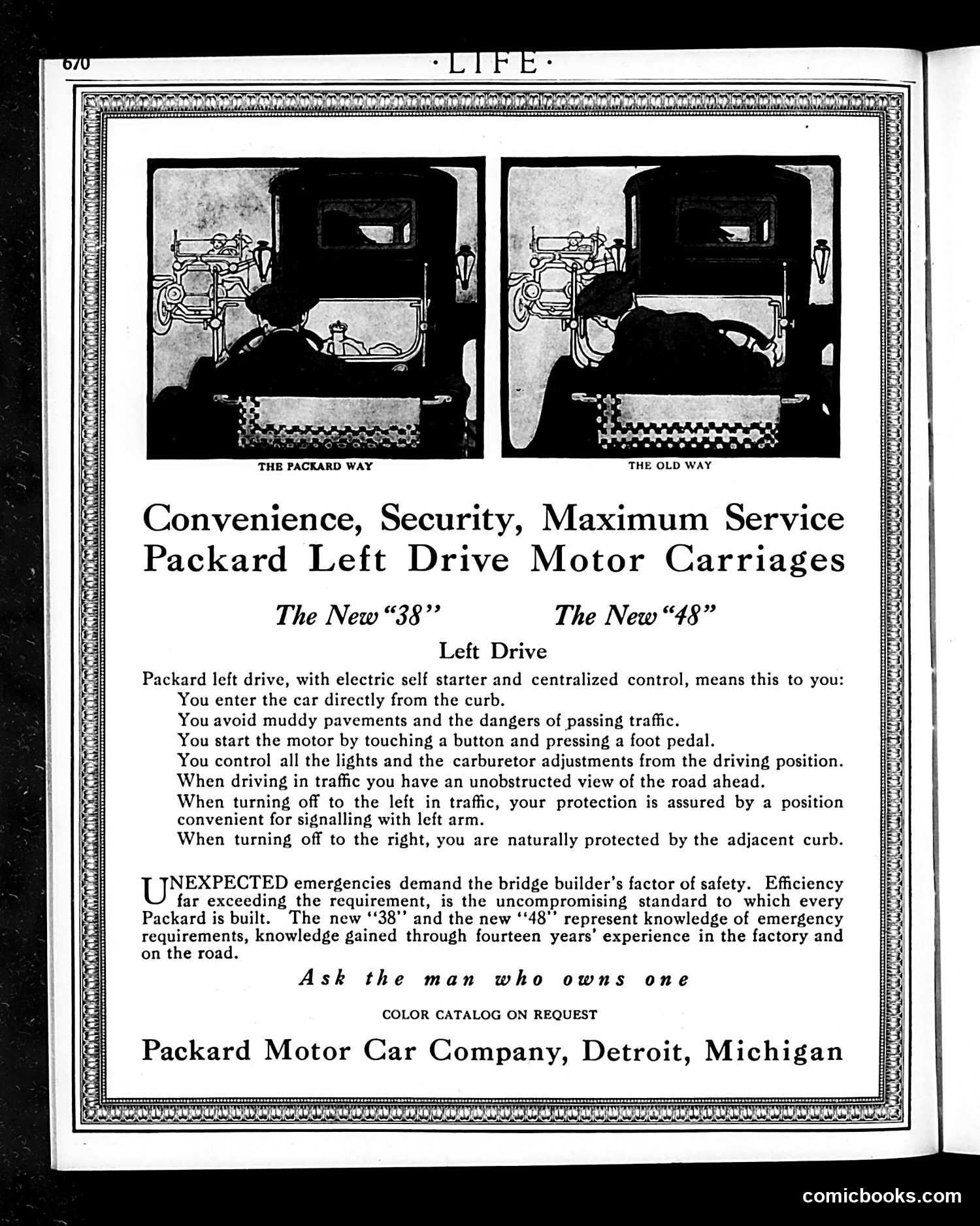
This is a **Packard Motor Car Company advertisement**, not satire or editorial content. The two illustrations compare driving positions: "The Packard Way" (left drive) versus "The Old Way" (right drive). The advertisement promotes Packard's new left-hand drive models (the "38" and "48") as modern improvements offering safety and convenience—drivers enter from the curb rather than traffic, gain better road visibility, and control all functions from a centralized position. The "Old Way" image shows a driver awkwardly positioned on the right side, implying outdated design. This reflects a real automotive industry shift in the early 20th century when left-hand drive became standard in America. The ad emphasizes Packard's engineering reputation built over "fourteen years' experience" and appeals to buyers to "ask the man who owns one"—a famous Packard slogan.
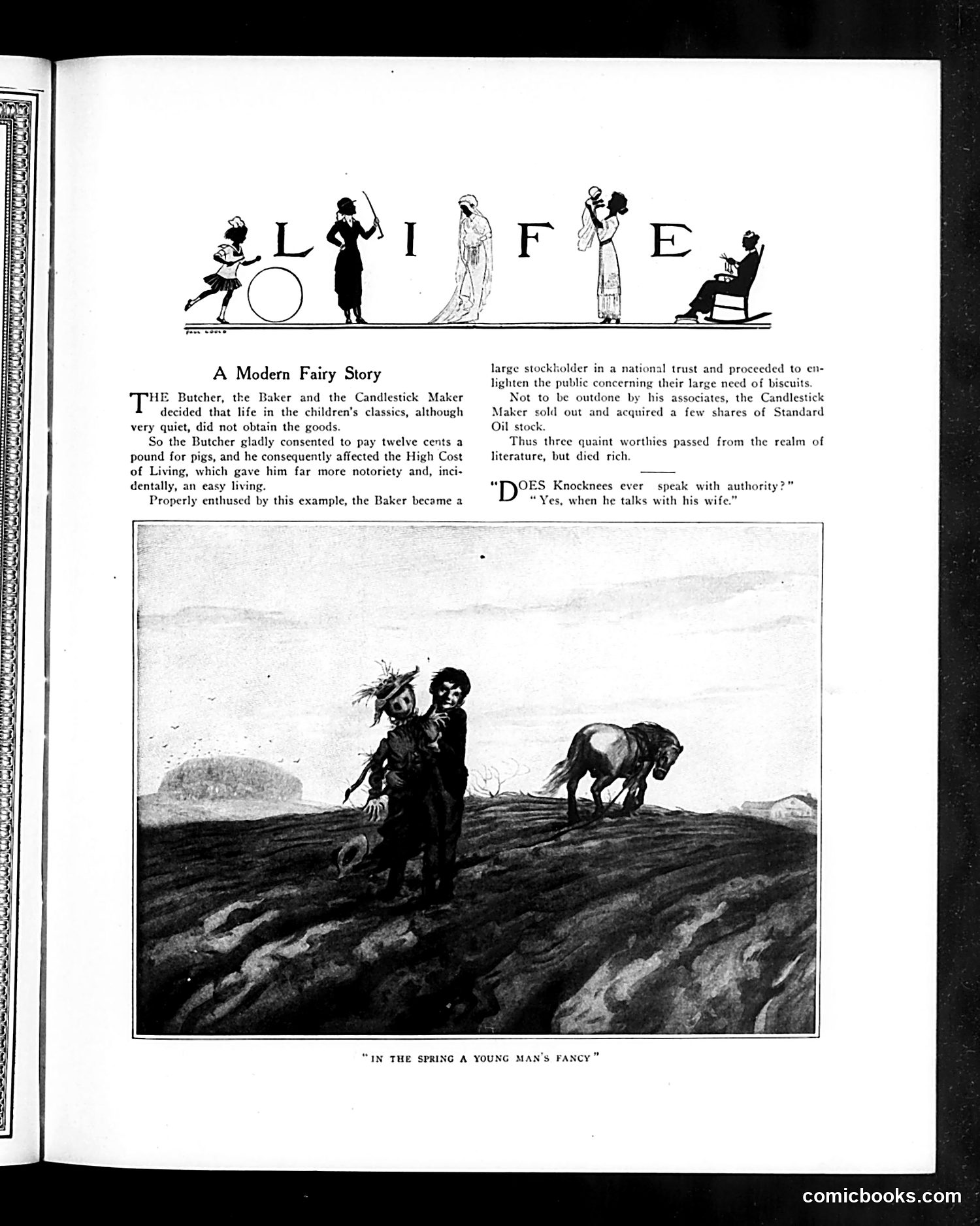
This satirical piece mocks the American financial elite's pursuit of wealth. "The Butcher, the Baker and the Candlestick Maker" (referencing the nursery rhyme) decided life in the country offered easy living. However, they discovered that obtaining goods required capital—the butcher needed twelve cents per pound for pigs, creating an unexpectedly high cost of living. Inspired by this lesson, the baker became a "large stockholder in a national trust" to acquire shares in Standard Oil. The candlestick maker similarly profited. The satire's moral: three "quaint worthies" from literature died poor, while modern businessmen grew wealthy through stock manipulation and financial schemes rather than honest labor. The accompanying illustration shows two figures in a rural landscape, captioned "In the Spring a Young Man's Fancy"—likely depicting romantic aspirations versus financial reality.
The main cartoon depicts **"While there is Life there's Hope"** and features a figure labeled "LIFE" as a beacon or lifeline. The article discusses **Mr. Richard Olney**, who declined President Taft's invitation to represent the U.S. Government at the Court of St. James (Britain). The text criticizes the difficulty of finding distinguished American men willing to serve as Ambassador to London. The satire targets the scarcity of qualified candidates—the article notes that while wealthy businessmen and lawyers exist, "very few conspicuous men of eminent intellectual distinction" are available or willing. It sarcastically argues that finding an American gentleman of "grace, distinction, sophistication" for such diplomatic posts remains surprisingly difficult, mocking both the available talent pool and their reluctance to serve.
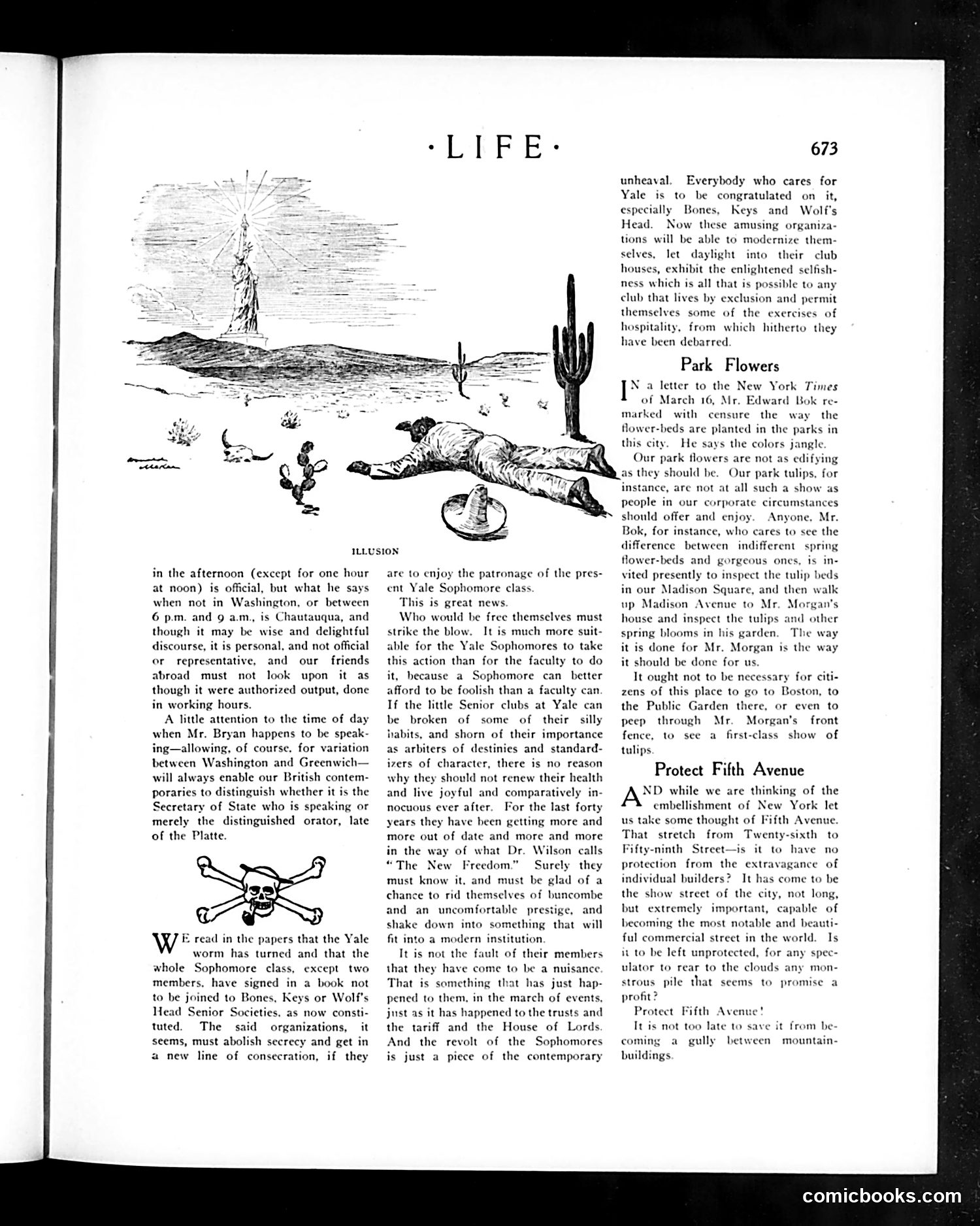
This page contains three distinct pieces of social commentary, not political cartoons: 1. **"Illusion"** - A sketch showing a man lying in a desert with cacti, commenting on Yale's administrative claims. The text critiques Yale's leadership for claiming Sophomores should "strike the blow" against faculty misconduct, while noting this is merely self-serving posturing. 2. **"Park Flowers"** - Discussion of spring flower displays in NYC parks, advocating for public enjoyment of natural beauty over ornamental shows. 3. **"Protect Fifth Avenue"** - Editorial urging protection of Fifth Avenue's architectural character against development by speculators, framed as preserving the city's notable beauty. The skull-and-crossbones illustration appears unrelated to the text sections. Overall, these pieces target institutional hypocrisy, commercialism, and urban development—typical Life magazine satirical concerns.
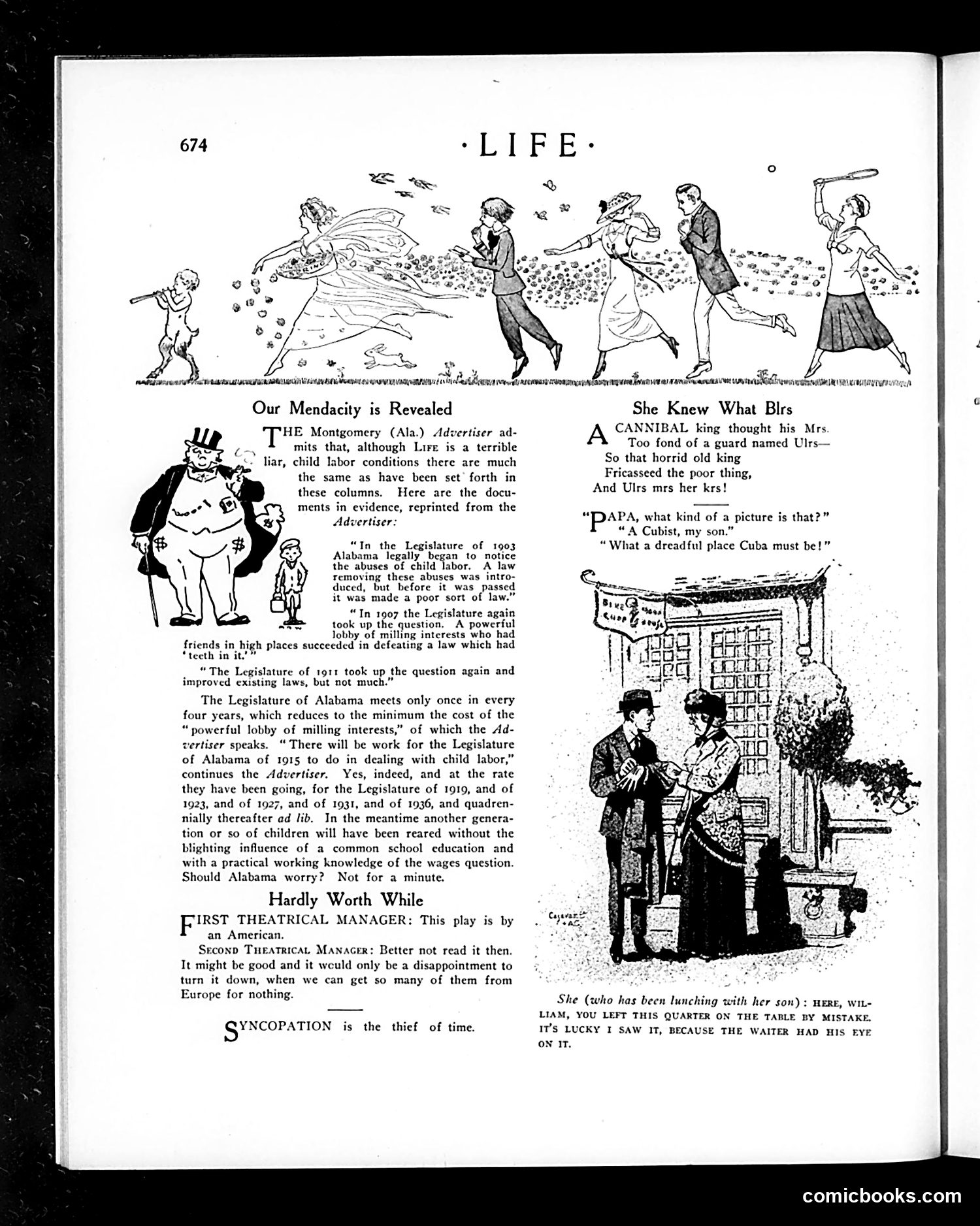
**Top Illustration**: "Our Mendacity is Revealed" depicts figures scattering coins or small objects—likely satirizing dishonesty or corruption being exposed. **Left Section** ("Hardly Worth While"): Critiques child labor abuses in Alabama. The caricatured fat figure wearing a top hat represents wealthy industrial interests or politicians. The text documents Alabama's legislature repeatedly failing to pass meaningful child labor protections between 1903-1931, despite mounting evidence of exploitation. The satire targets the "powerful lobby of milling interests" blocking reform legislation. **Right Section** ("She Knew What Birs"): A humorous domestic exchange between a mother and son about a "dreadful picture" (likely referring to Cuba), presented as a comedic cultural commentary rather than political satire. The page primarily attacks industrial corruption and legislative inaction on worker protection.
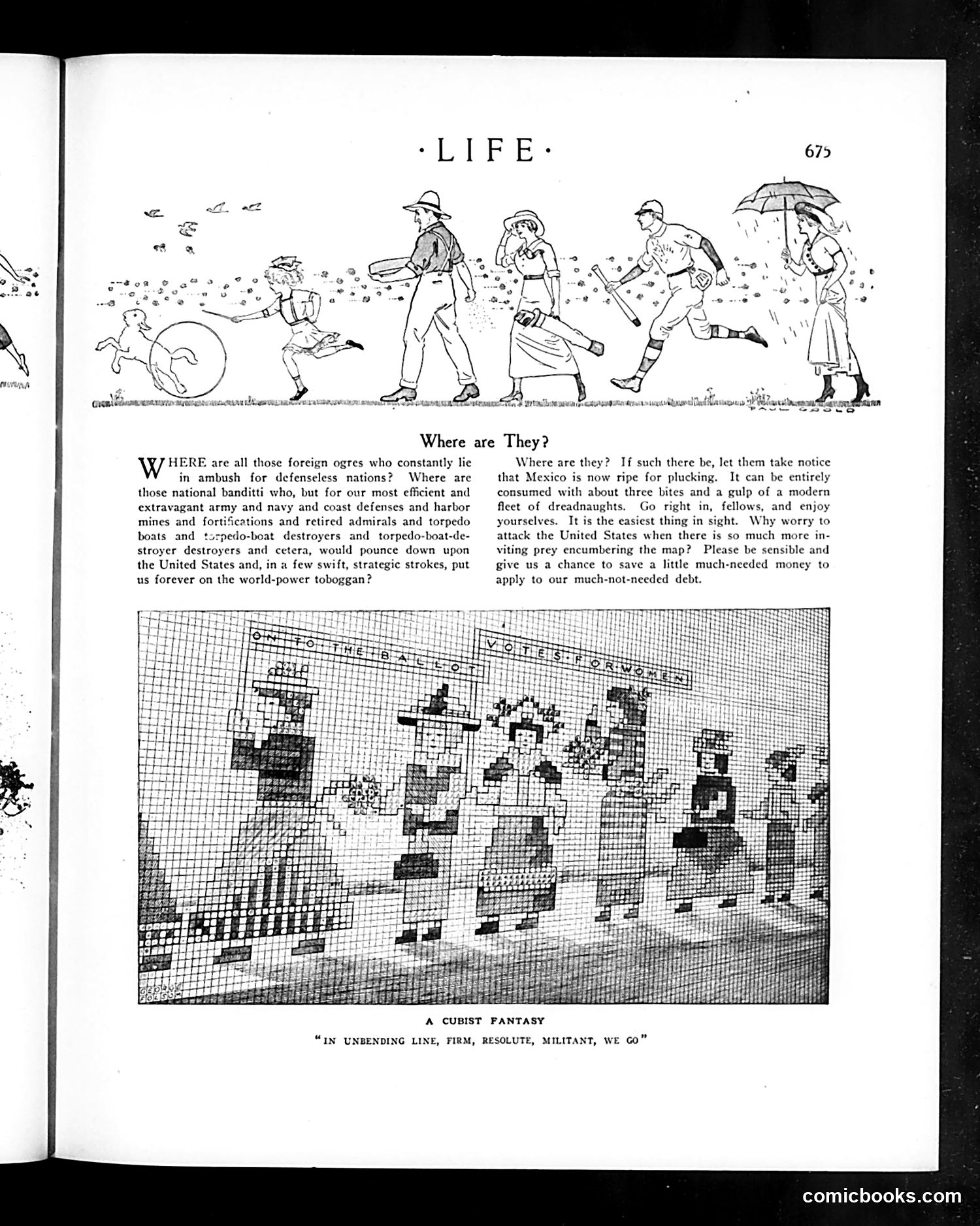
This page satirizes American military spending and interventionist foreign policy. The text mockingly questions where the "foreign ogres" are that supposedly justify massive expenditures on the navy, fortifications, and military defenses. The satire's point: these threats don't exist, yet America maintains expensive military infrastructure anyway. The author then sarcastically suggests that if warmongers truly want action, Mexico—depicted as vulnerable ("ripe for plucking")—is available, without needing to attack the stronger United States. The bottom illustration, a "cubist fantasy," appears to be abstract military imagery with the caption "In unbending line, firm, resolute, militant, we go"—likely mocking militaristic rhetoric and propagandistic language. The overall message critiques both unnecessary military spending and American imperial ambitions, suggesting resources should address the nation's "much-not-needed debt" instead.
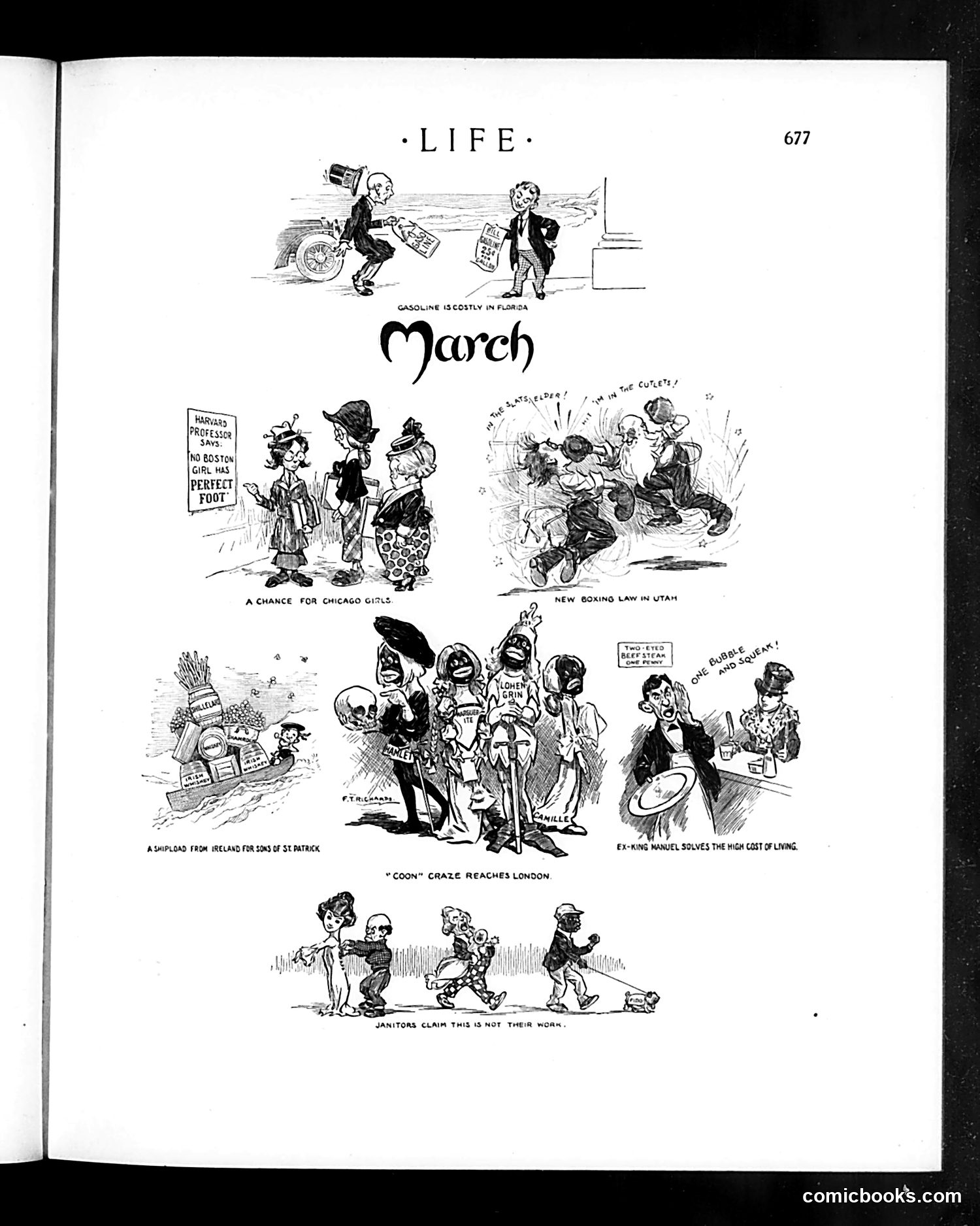
This Life magazine page from March contains six satirical cartoons commenting on contemporary issues. "Gasoline Is Costly in Florida" depicts someone struggling with fuel prices. "A Chance for Chicago Girls" references employment opportunities. "New Boxing Law in Utah" appears to satirize boxing regulations. "A Shipload from Ireland for Sons of St. Patrick" likely mocks Irish immigration. "'Coon' Craze Reaches London" uses period-inappropriate language reflecting the era's casual racism regarding a dance trend. "Ex-King Manuel Solves the High Cost of Living" references Portugal's exiled king. The final cartoon, "Janitors Claim This Is Not Their Work," shows cleaning staff denying responsibility for some mess, likely political satire. The cartoons employ caricature and exaggeration typical of early 20th-century American satirical humor targeting contemporary social and political topics.
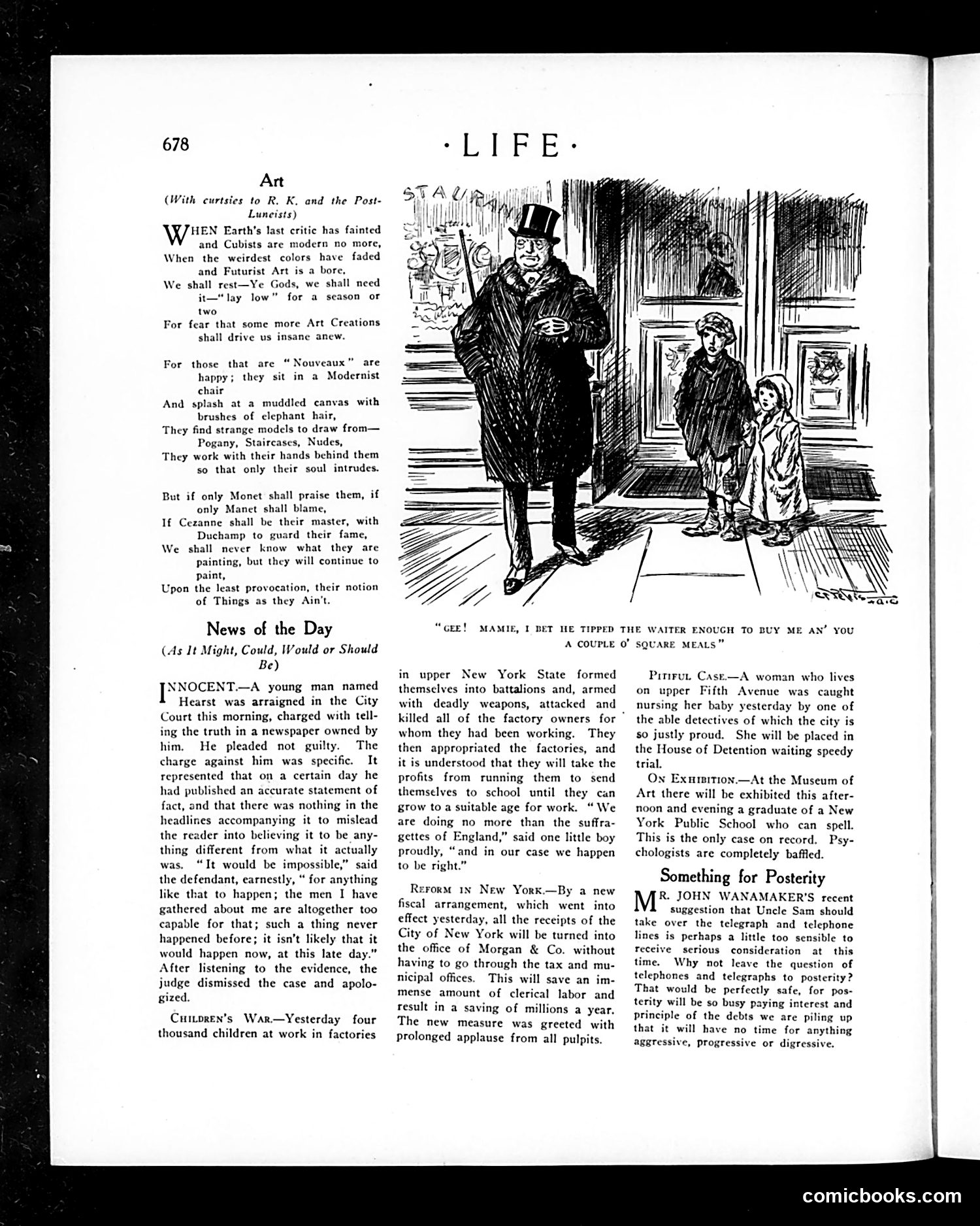
This page contains satirical commentary on early 20th-century American art and politics. The opening poem mocks modernist art movements—Cubism, Futurism, and "Nouveau" styles—suggesting they're incomprehensible nonsense that drives critics to madness. It targets artists like Monet and Cézanne while sarcastically praising artists' pretension ("work with their hands behind them / so that only their soul intrudes"). The "News of the Day" section uses absurdist humor to critique contemporary issues: - **"Innocent"** satirizes newspapers' sensationalism by ironically praising a publisher (seemingly William Randolph Hearst) for publishing *accurate* facts without misleading headlines—presenting honesty as shockingly rare. - **"Children's War"** darkly mocks child labor by imagining factory children violently overthrow owners and seize profits for education. - **"Reform in New York"** attacks financial corruption by suggesting all city revenue now goes directly to J.P. Morgan's banking house—exposing the perceived collusion between Wall Street and city government. The cartoon depicts a well-dressed man with children, likely illustrating class disparities or poverty.
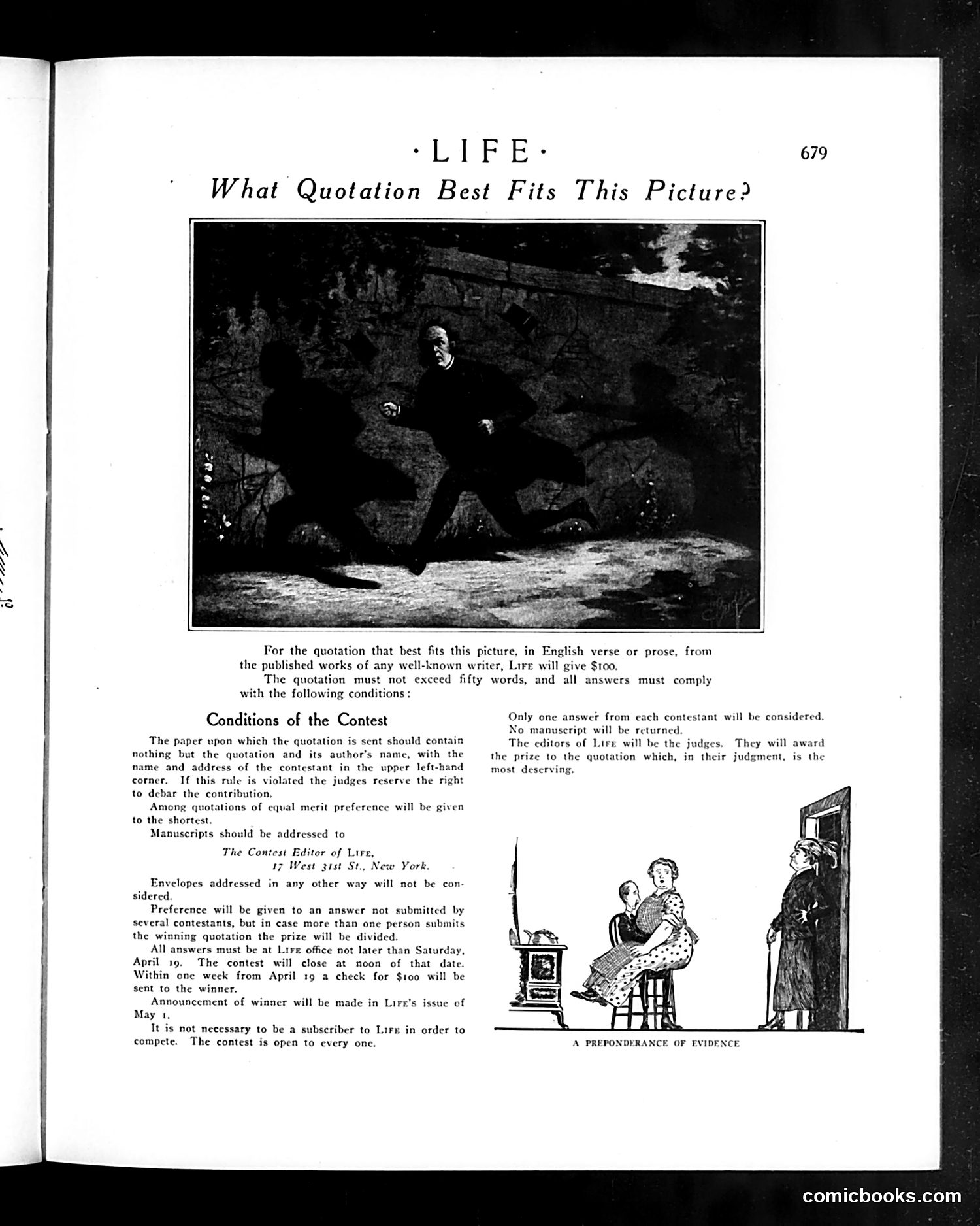
This page features a **quotation-matching contest** rather than a cartoon with political commentary. The main image shows two figures in dark clothing in what appears to be a dramatic or tense scene—possibly depicting conflict or confrontation near a stone wall. Readers were invited to submit literary quotations (under 50 words) from published writers that they believed best captured this picture's mood or narrative. The $100 prize incentivized engagement with classic literature. The small illustration at bottom right, captioned "A Preponderance of Evidence," appears to show someone presenting information to authority figures—likely a light joke about the contest's judging process. This was typical of *Life* magazine's interactive content: combining visual imagery with literary knowledge to engage educated readers while promoting familiarity with canonical works.
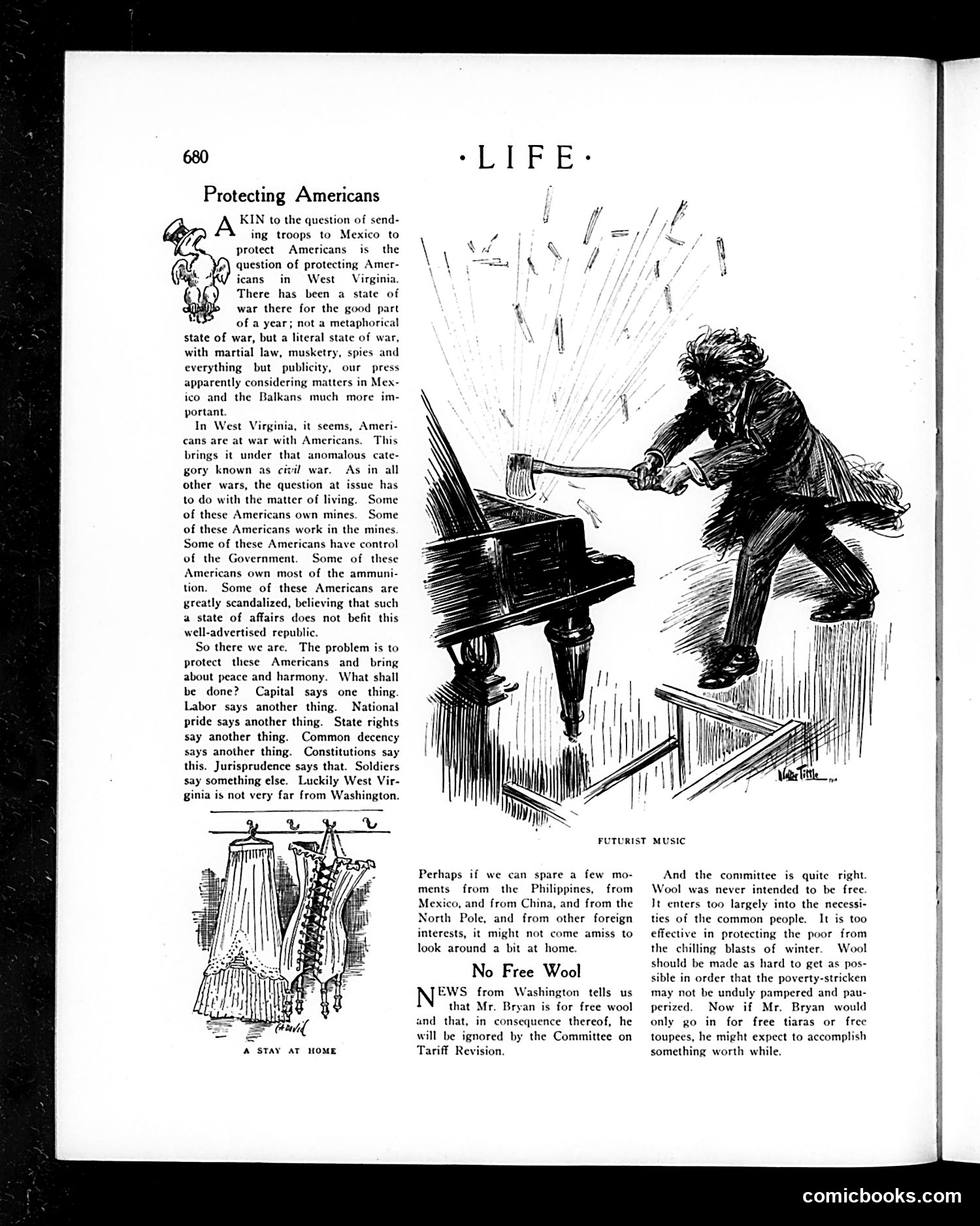
This page contains three satirical pieces critiquing American policy priorities and economic hypocrisy: **"Protecting Americans"** mocks the government's focus on foreign interventions (Mexico, Balkans) while ignoring literal civil war in West Virginia—a mining region torn by labor-capital conflict. The irony: Americans fight Americans while authorities debate constitutional justifications. **"Futurist Music"** (the right cartoon) appears to depict chaotic violence, sarcastically titled to suggest that domestic turmoil is treated as entertainment while policymakers obsess over foreign affairs. **"No Free Wool"** uses biting sarcasm to attack protectionist tariffs. The writer mocks the Committee on Tariff Revision for rejecting William Jennings Bryan's free-wool proposal, claiming wool *should* remain expensive to prevent poor people from being "unduly pampered"—exposing the absurdity of policies that harm working-class Americans while claiming moral superiority. The unifying theme: American leaders prioritize foreign entanglements and protect wealthy interests over domestic welfare and labor rights.
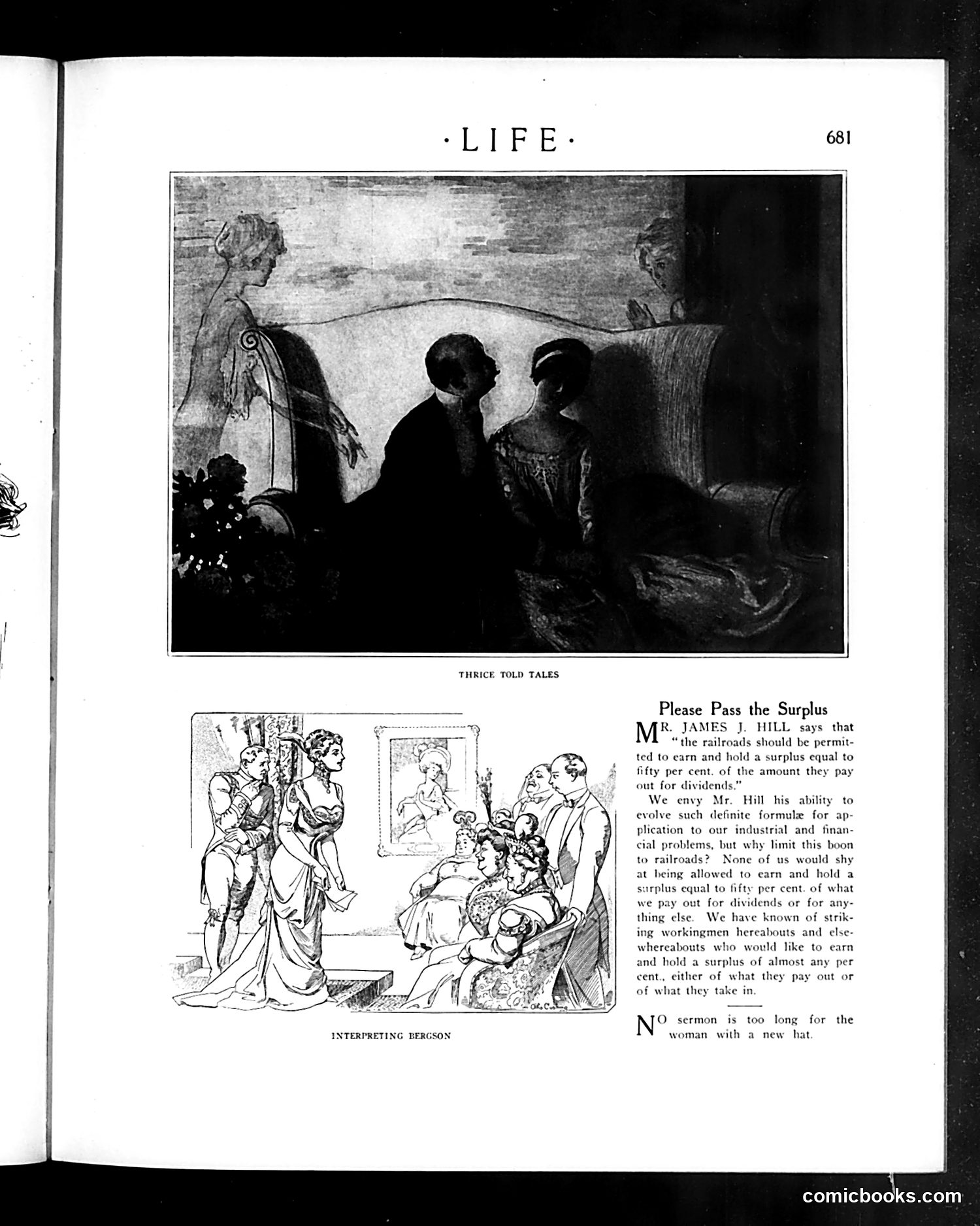
This page satirizes **James J. Hill**, a prominent railroad magnate, who proposed that railroads should retain surplus profits equal to 50% of their dividend payouts. **The satire's point:** Life mocks Hill's self-serving logic by extending it absurdly. If railroads deserve to accumulate such surplus wealth, why shouldn't *everyone*—workers, strikers, ordinary citizens—have the same right? The magazine argues Hill's formula is merely justification for corporate wealth-hoarding while workers struggle to earn *any* surplus. The bottom quip ("No sermon is too long for the woman with a new hat") is unrelated humor about vanity. The "Interpreting Bergson" illustration appears to be a separate satirical piece (likely about philosopher Henri Bergson), but lacks sufficient context here to explain fully. This reflects early 20th-century Progressive Era critiques of railroad monopolies and corporate inequality.
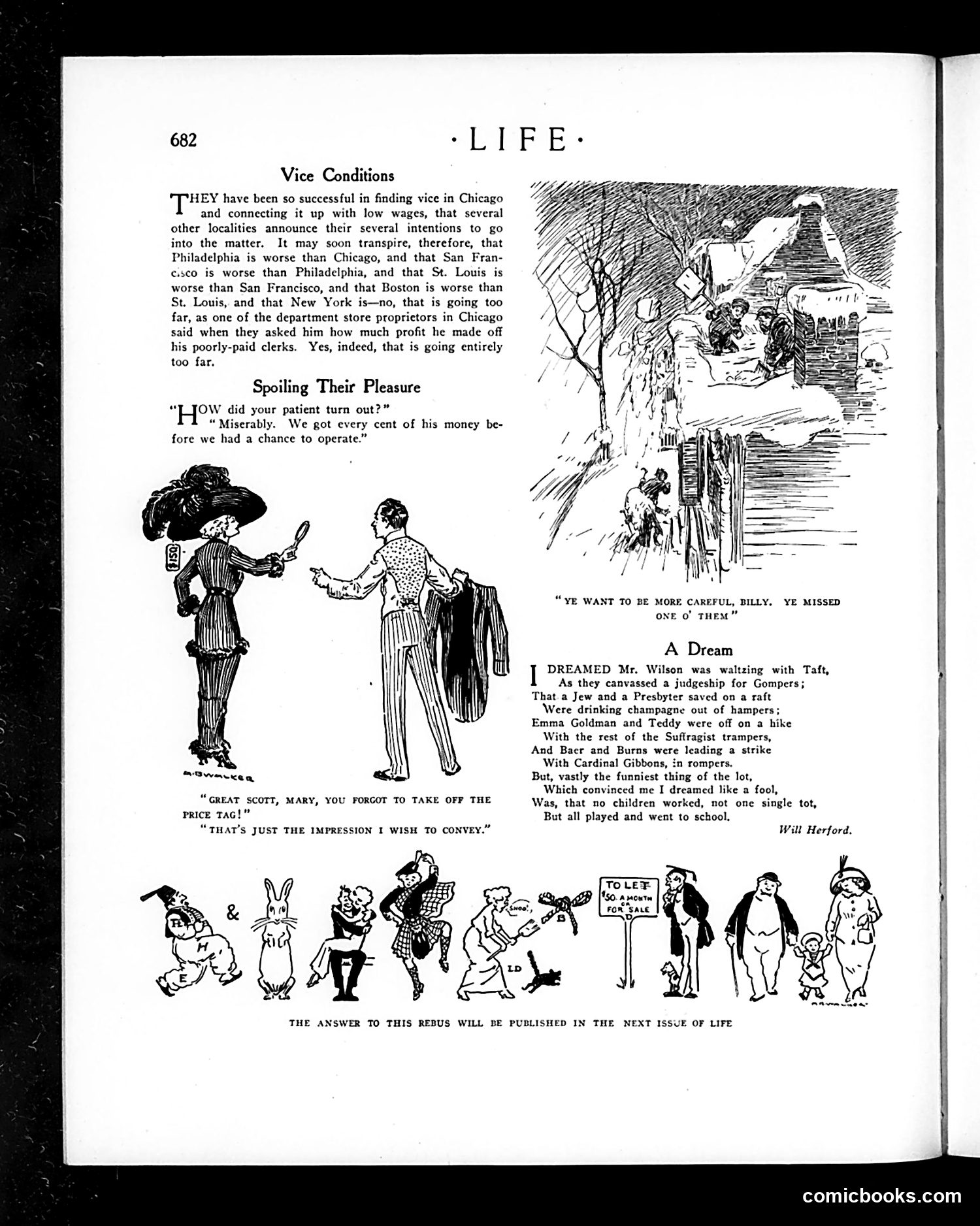
This satirical page contains three distinct pieces criticizing social and political hypocrisy circa 1910s America. **"Vice Conditions"** mocks cities' competitive blame-shifting over urban vice and corruption, suggesting they'll each claim to be worse than the last—except New York, where even Chicago store owners draw the line. The satire attacks hypocrisy: cities acknowledge vice exists while doing little. **"Spoiling Their Pleasure"** depicts a doctor lamenting that he extracted all a patient's money before surgery—suggesting medical exploitation of the sick and poor. **"A Dream"** by Will Herford presents an absurdist political fantasy where President Wilson waltzes with President Taft, radical Emma Goldman hikes with Theodore Roosevelt, boxer Jack Johnson leads strikes with Cardinal Gibbons, and—most importantly to Herford—*no children work*. This last detail is presented as the dream's most impossible element, satirizing America's acceptance of child labor as normal reality. The piece critiques widespread political corruption and social injustice as so entrenched that a world without child exploitation seems purely fantastical.
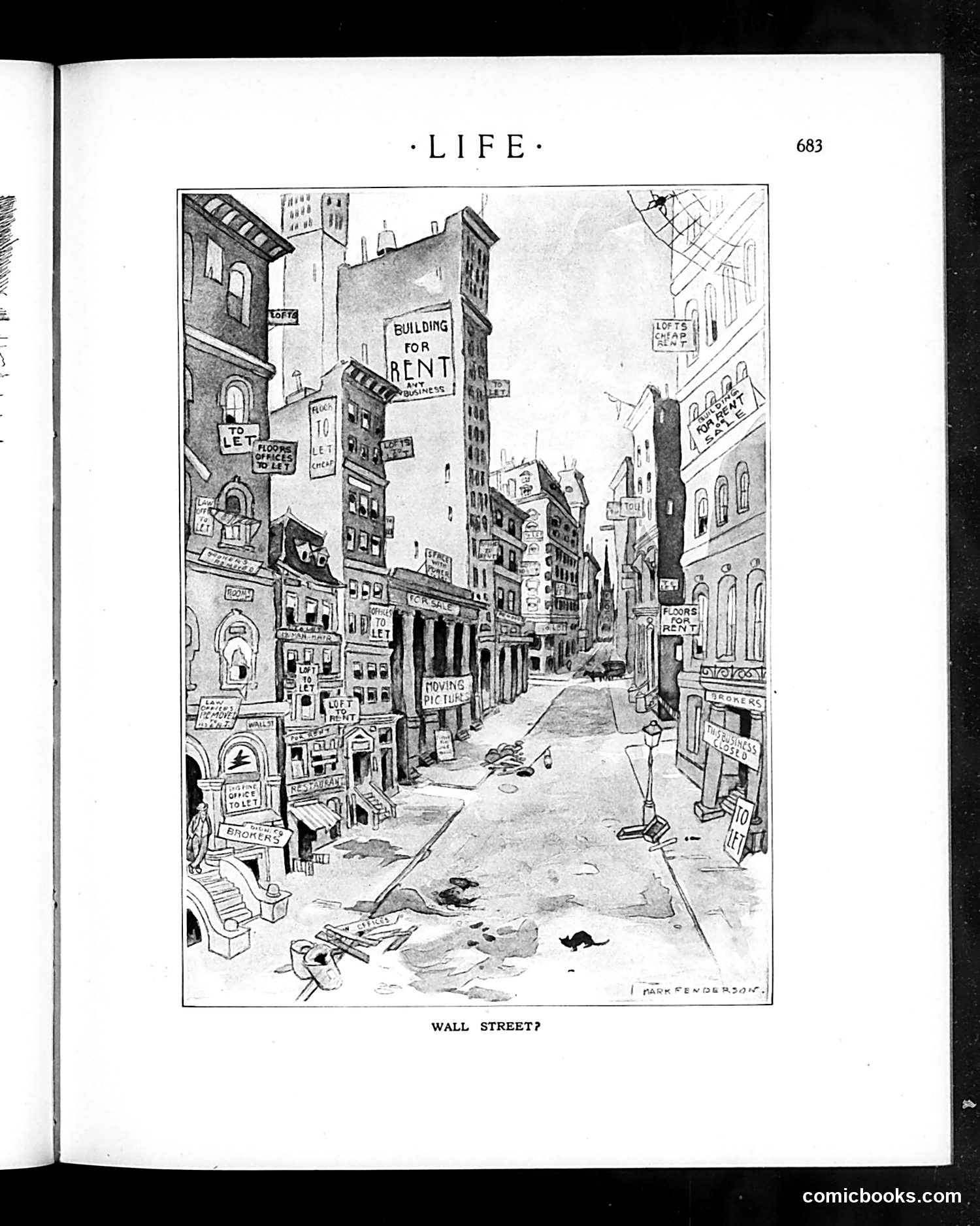
This satirical cartoon depicts a decimated urban street lined with empty buildings bearing "TO LET" and "FOR RENT" signs. The scene shows abandonment and decay—rubble, debris, and what appears to be a desolate, economically collapsed neighborhood. The caption "WALL STREET?" functions as ironic commentary. It suggests that this ruined street represents what Wall Street (the financial district and symbol of American capitalism) has become, or what it has caused. The cartoon likely critiques financial speculation, market collapse, or economic mismanagement—possibly referencing a banking crisis or recession. The visual devastation implies that financial recklessness has destroyed the broader economy and urban life. The work appears to be early-to-mid 20th century political satire targeting capitalist institutions.
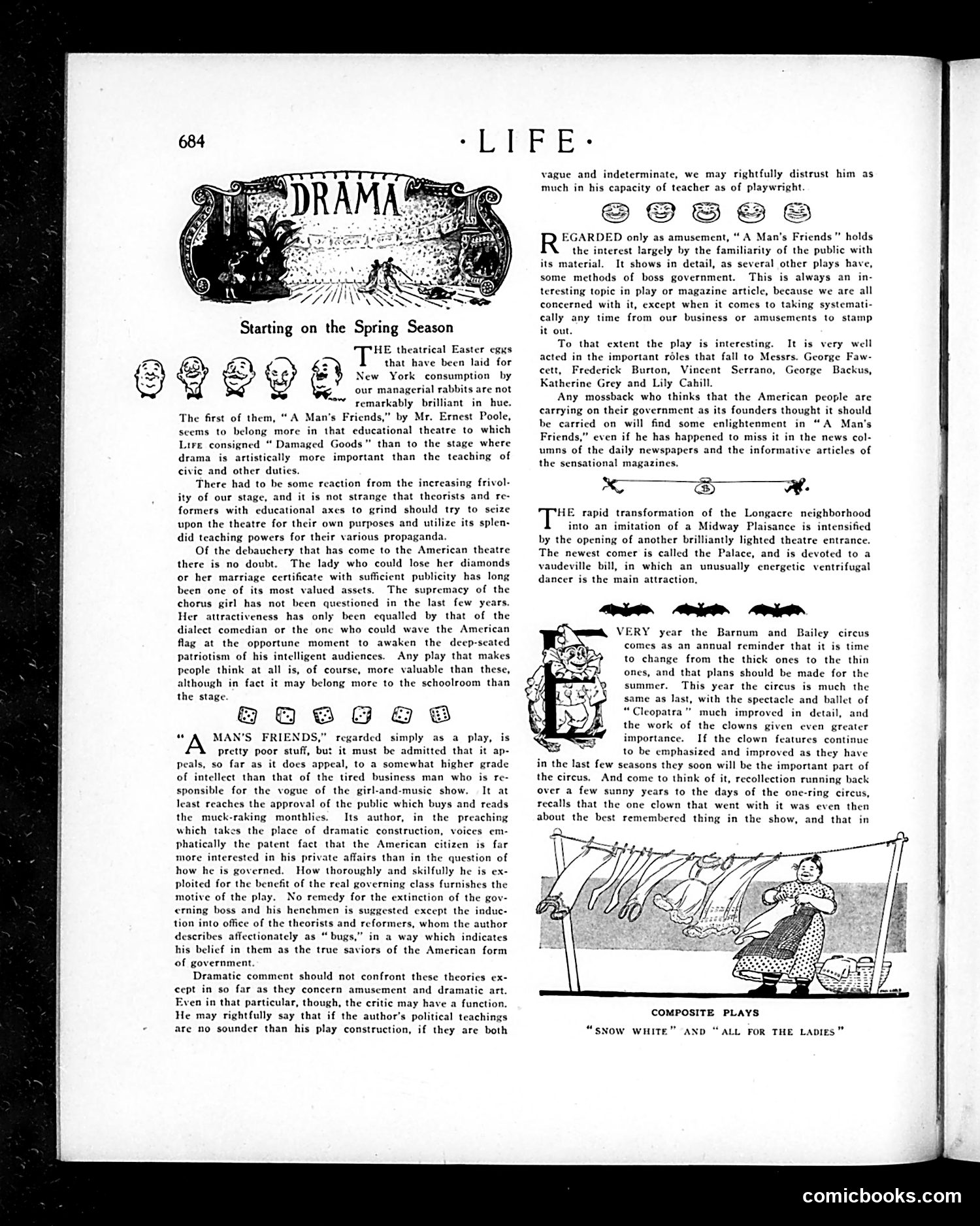
This page reviews Ernest Poole's play "A Man's Friends," opening for spring theater season. The critic dismisses it as "pretty poor stuff" dramatically, though acknowledging it appeals to educated audiences interested in serious topics. The satire targets both the play and broader theatrical trends: American theater has devolved into spectacle prioritizing chorus girls and patriotic flag-waving over substance. Yet the critic also mocks "muck-raking" reformers and their allies who use theater for political propaganda rather than art. The core critique: Poole's anti-corruption message about political bosses exploiting citizens is valid but poorly constructed theatrically. The reviewer warns that if Poole's playwriting is this weak, we should distrust his political theories equally. The cartoons (dice and clowns) likely mock both frivolous entertainment and earnest but clumsy didactic drama competing for spring audiences.
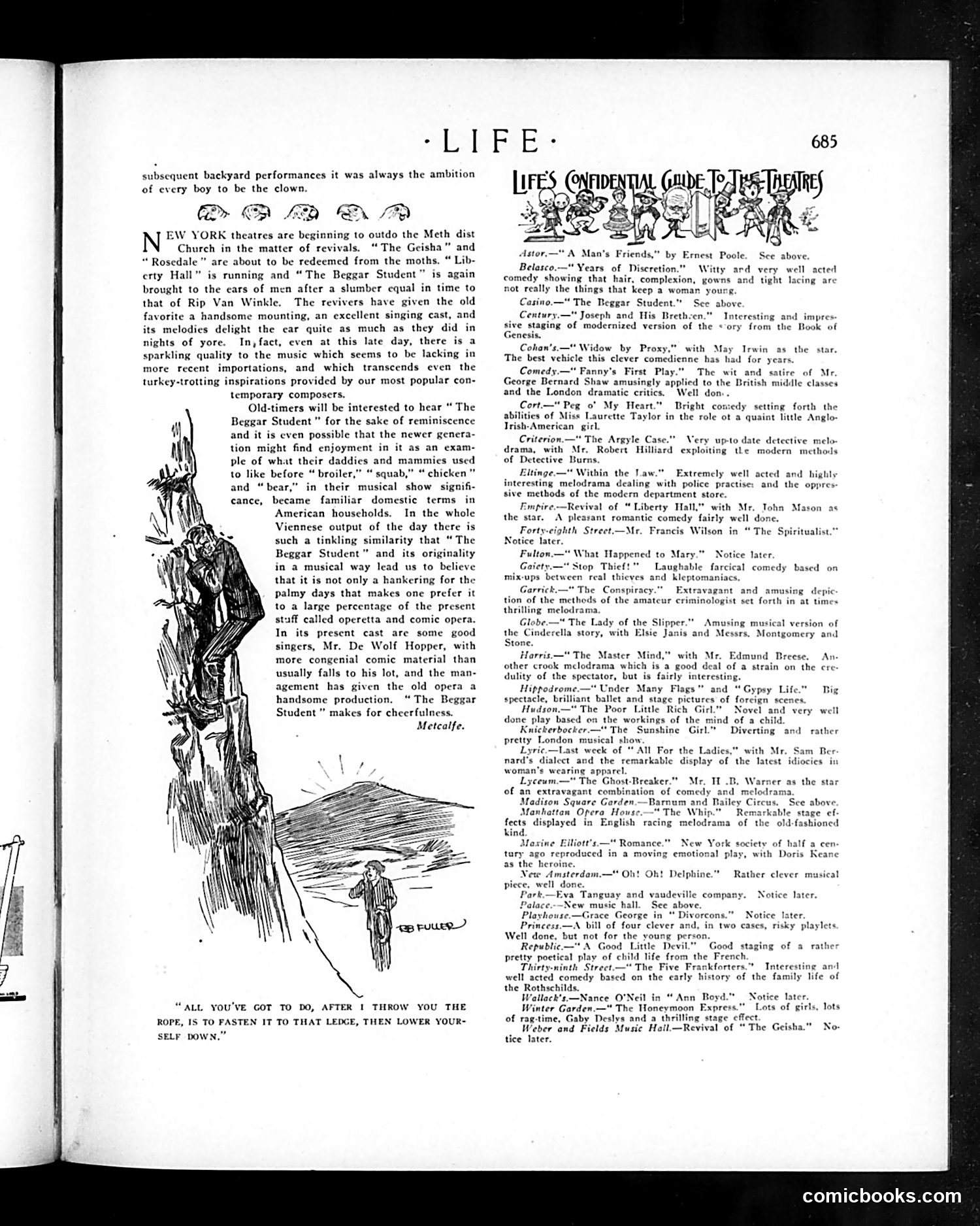
This page contains theatre reviews rather than political cartoons. The main illustration shows a figure on a precarious ledge—likely depicting a scene from one of the reviewed plays—with a caption about throwing rope and lowering oneself, suggesting dramatic peril or danger. The text is a column by Metcalfe reviewing New York theatrical productions. He discusses the revival of "The Beggar Student," a Viennese operetta, praising its "tinkling" charm compared to contemporary works. He notes that older operettas like this appeal to nostalgia ("palmy days") while maintaining genuine merit. The review celebrates the production's "handsome mounting" and cast, particularly praising De Wolf Hopper in comic roles. The accompanying brief theatre listings review various Broadway productions, ranging from comedies to melodramas, indicating the diverse offerings available in this theatrical season. The page reflects early 20th-century theatre culture and changing entertainment tastes.
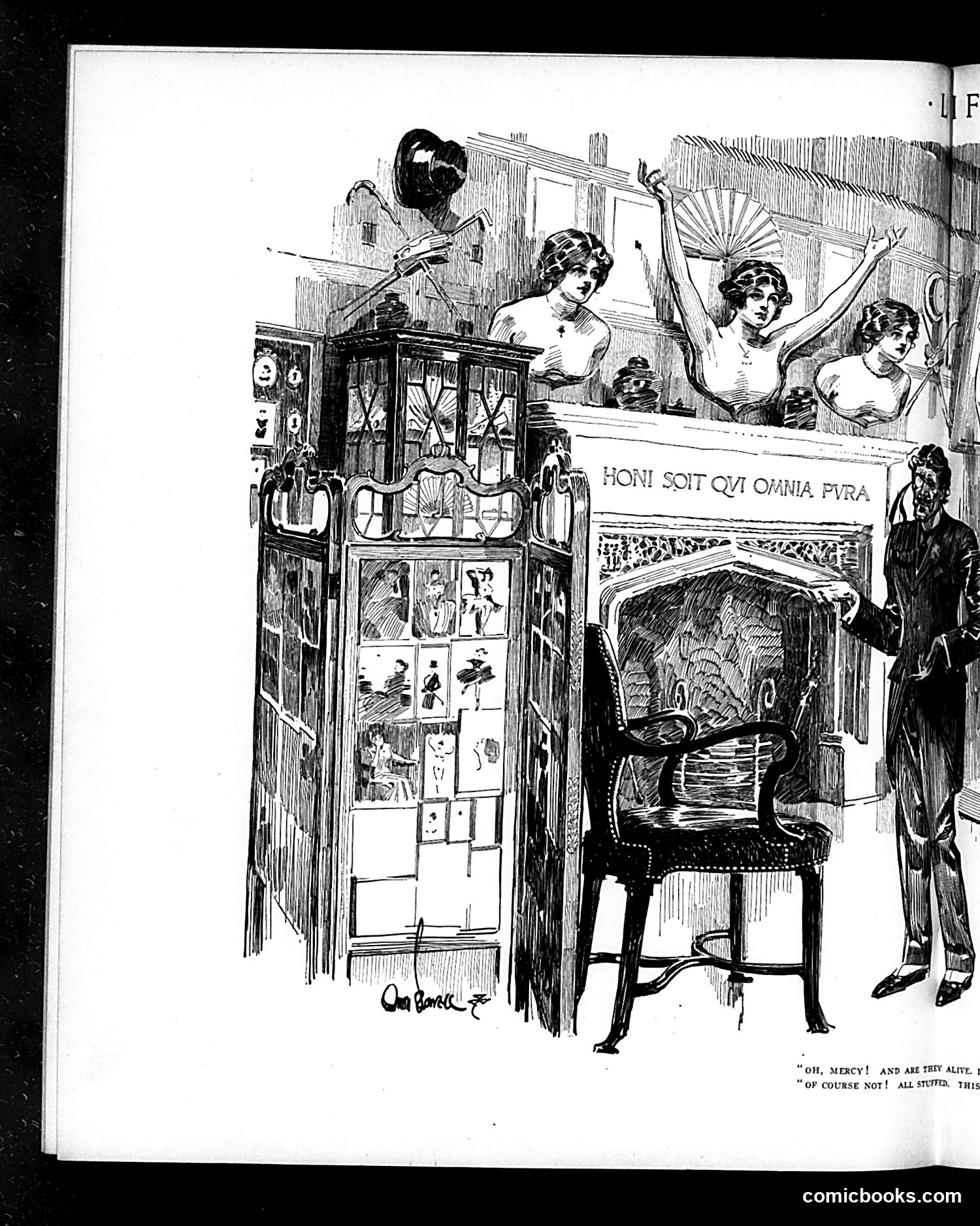
This is a satirical illustration depicting what appears to be a museum or exhibition of human figures. A man in dark clothing stands beside a chair, gesturing toward an ornate cabinet displaying multiple compartmented sections—each containing small illustrated scenes or figures. Above the cabinet, several women are positioned as if they are display pieces or mannequins. The Latin inscription "HONI SOIT QUI OMNIA PURA" (roughly "shame on those who see all things as pure") combined with the dialogue—"Oh mercy! Are they alive?" / "Of course not! All stuffed"—suggests satire about the objectification or "stuffing" of women, possibly critiquing how women were displayed, exhibited, or treated as decorative objects in society. The cartoon likely mocks attitudes toward women's agency and autonomy during this era.
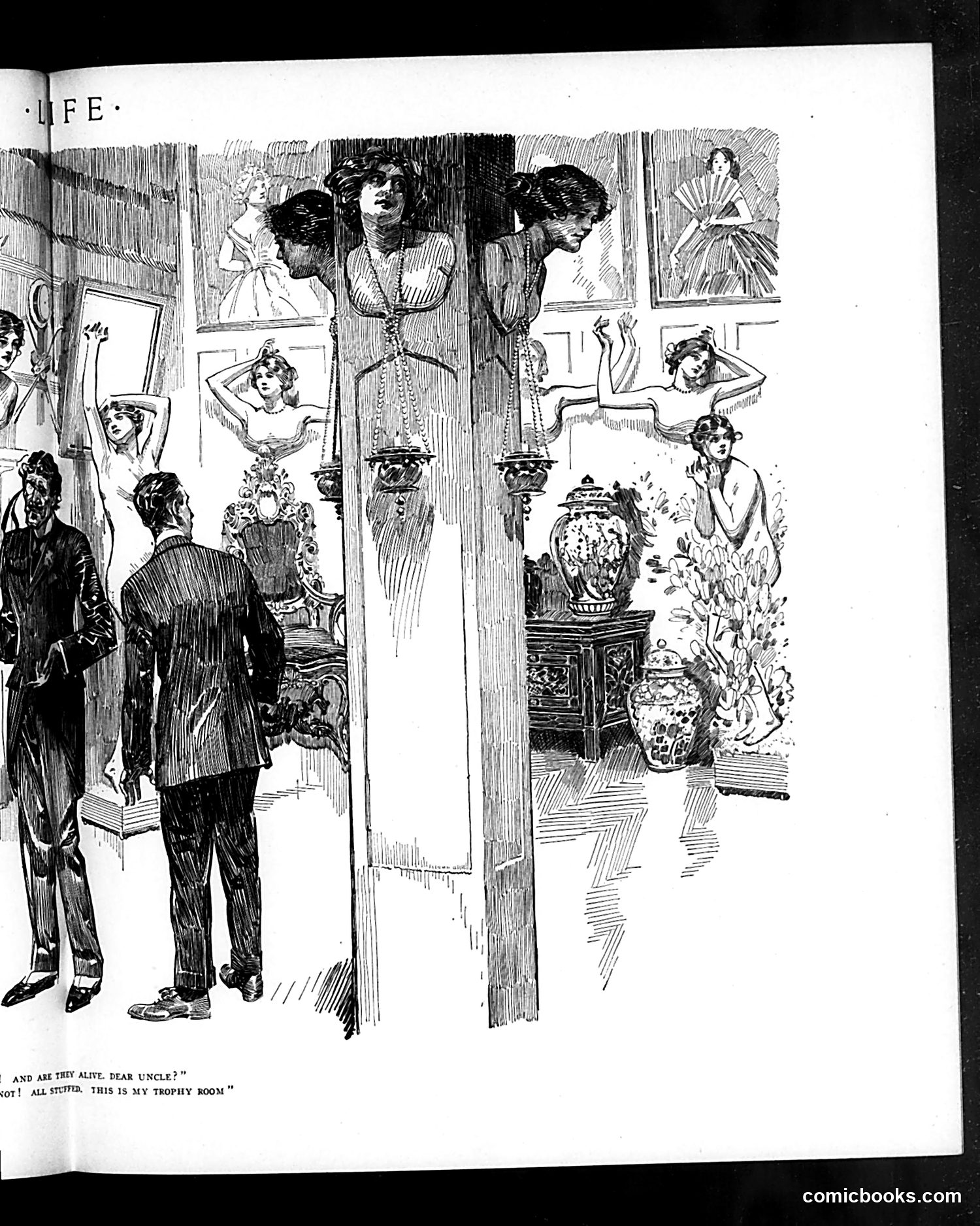
This is a satirical illustration about conspicuous wealth and status-seeking in the early 20th century. The scene depicts a wealthy person's "trophy room" filled with taxidermied figures of fashionable women in various poses—apparently displayed as decorative objects like hunting trophies or museum specimens. The joke targets the objectification of women in high society and the absurdity of treating them as collectible status symbols. The visitor's question "are they alive?" and the owner's casual response "all stuffed" emphasize how these women are reduced to decorative props, stripped of humanity. The cartoon satirizes both masculine attitudes toward women as possessions and the superficiality of wealthy society's social displays, where people are valued primarily for their appearance and fashionability rather than as individuals.
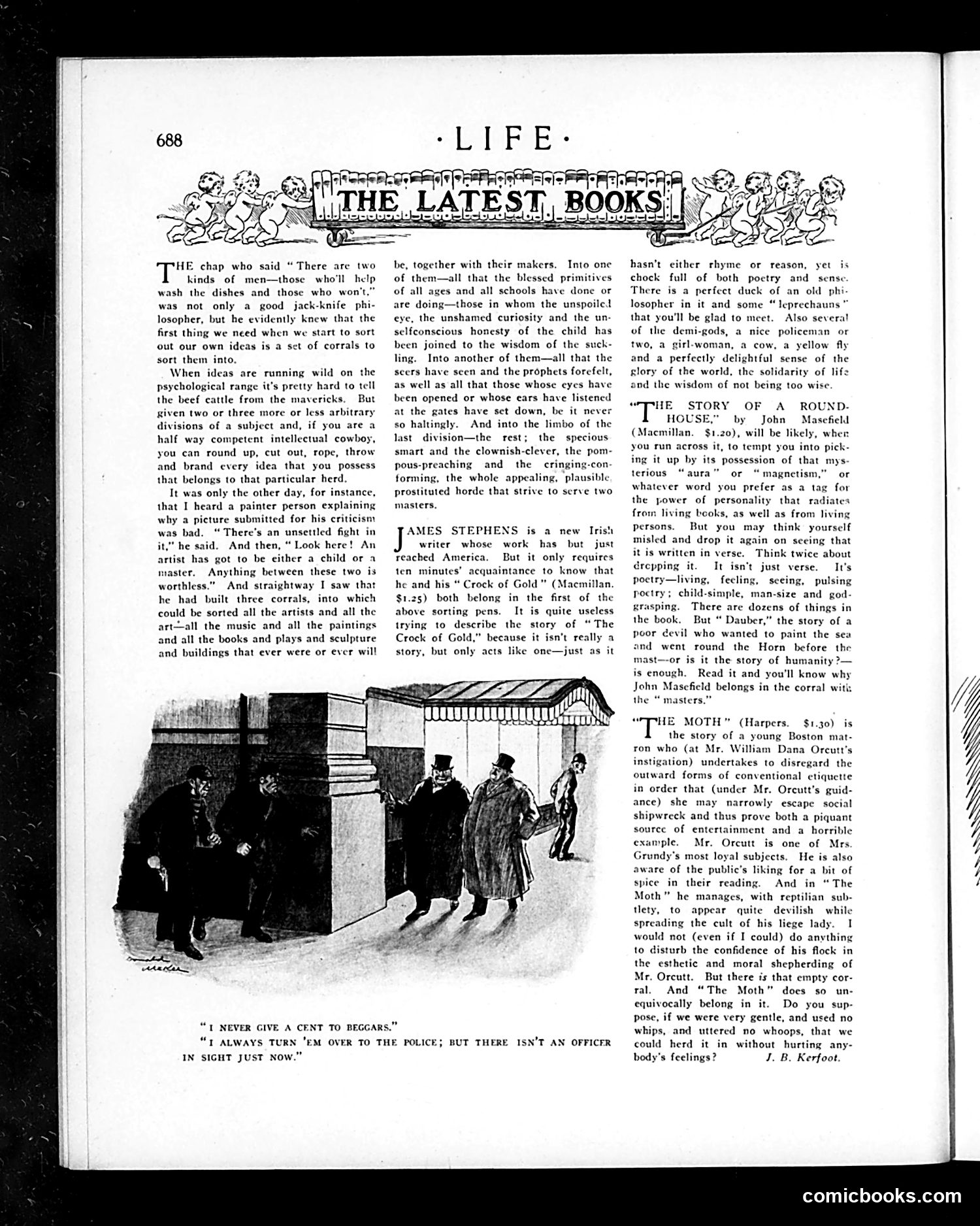
This page reviews three new books through literary criticism. The main text discusses James Stephens's *Crock of Gold* and John Masefield's *The Story of a Round-House*, praising both as genuine artistic works belonging among "primitives" and "seers" rather than derivative mediocrity. The small cartoon below depicts a beggar accosting well-dressed pedestrians outside what appears to be a theater or public building. The caption reveals the beggar's cynical strategy: "I never give a cent to beggars. I always turn 'em over to the police; but there isn't an officer in sight just now." **The joke:** The "respectable" man claims moral superiority by refusing beggars and turning them to authorities—yet when no police are present, he'll apparently give money anyway, exposing his stated principles as mere social posturing rather than genuine conviction. It's satire on Victorian hypocrisy and selective morality.
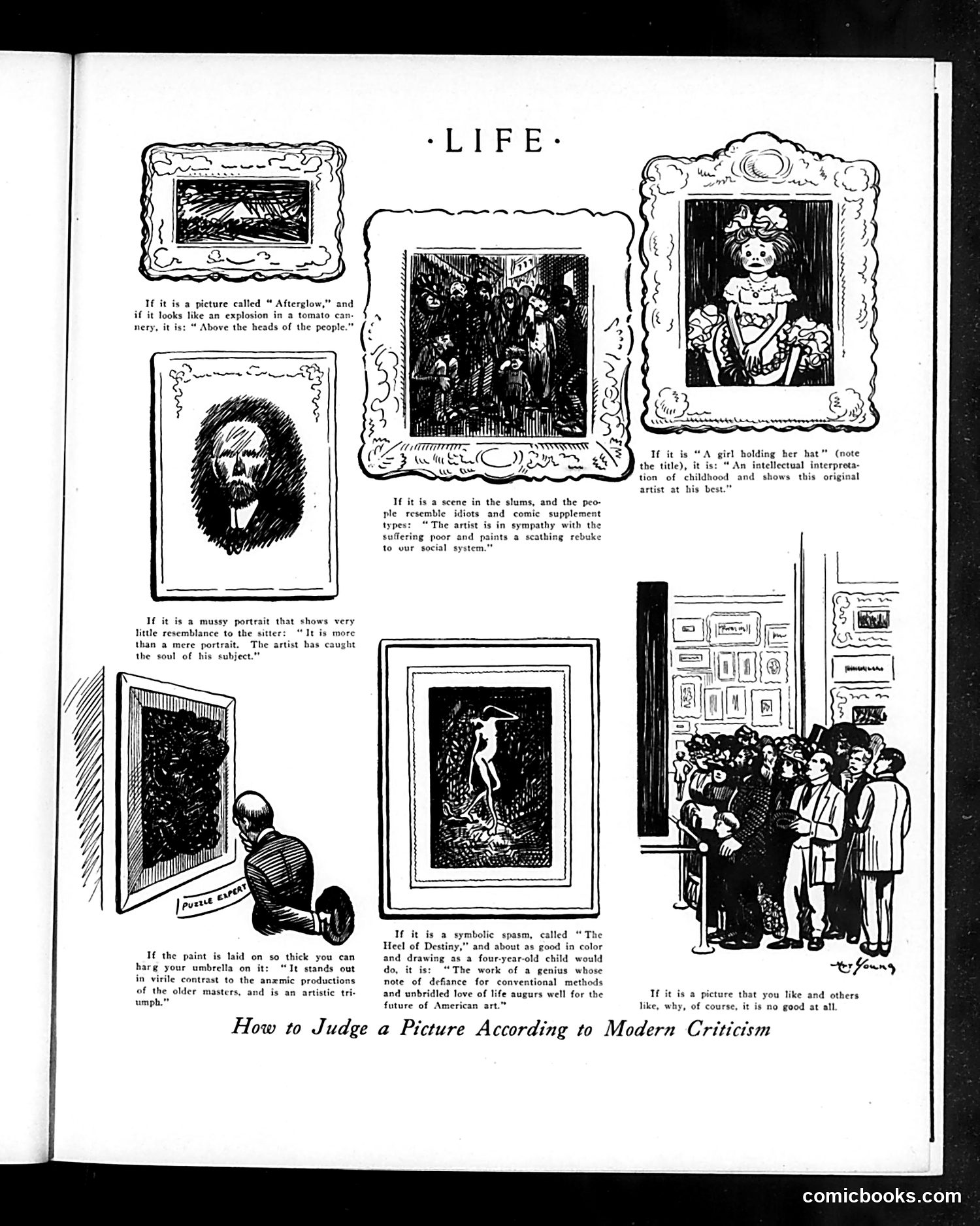
This satirical guide mocks early 20th-century modernist art criticism and its defenders. The page presents a series of tongue-in-cheek "rules" showing how critics praise abstract or poorly-executed work by using pretentious language that obscures lack of actual skill or coherence. The satire targets: - **Abstract/experimental art** disguised as profound ("Afterglow" looking like a tomato-cannery explosion) - **Vague critical jargon** elevating mediocre portraits as capturing "the soul" - **Sympathy claims** where crude depictions of poor people become "scathing social commentary" - **Intentional obscurity** praised as "genius" (the "four-year-old" symbolic work) - **Reverse snobbery** where popular, likable art is deemed worthless The final rule is the punchline: if ordinary people actually *like* a picture, it's automatically "no good at all." Life magazine is satirizing both pretentious modernism and the gatekeeping that dismisses accessible art in favor of bewildering work justified by impenetrable criticism.
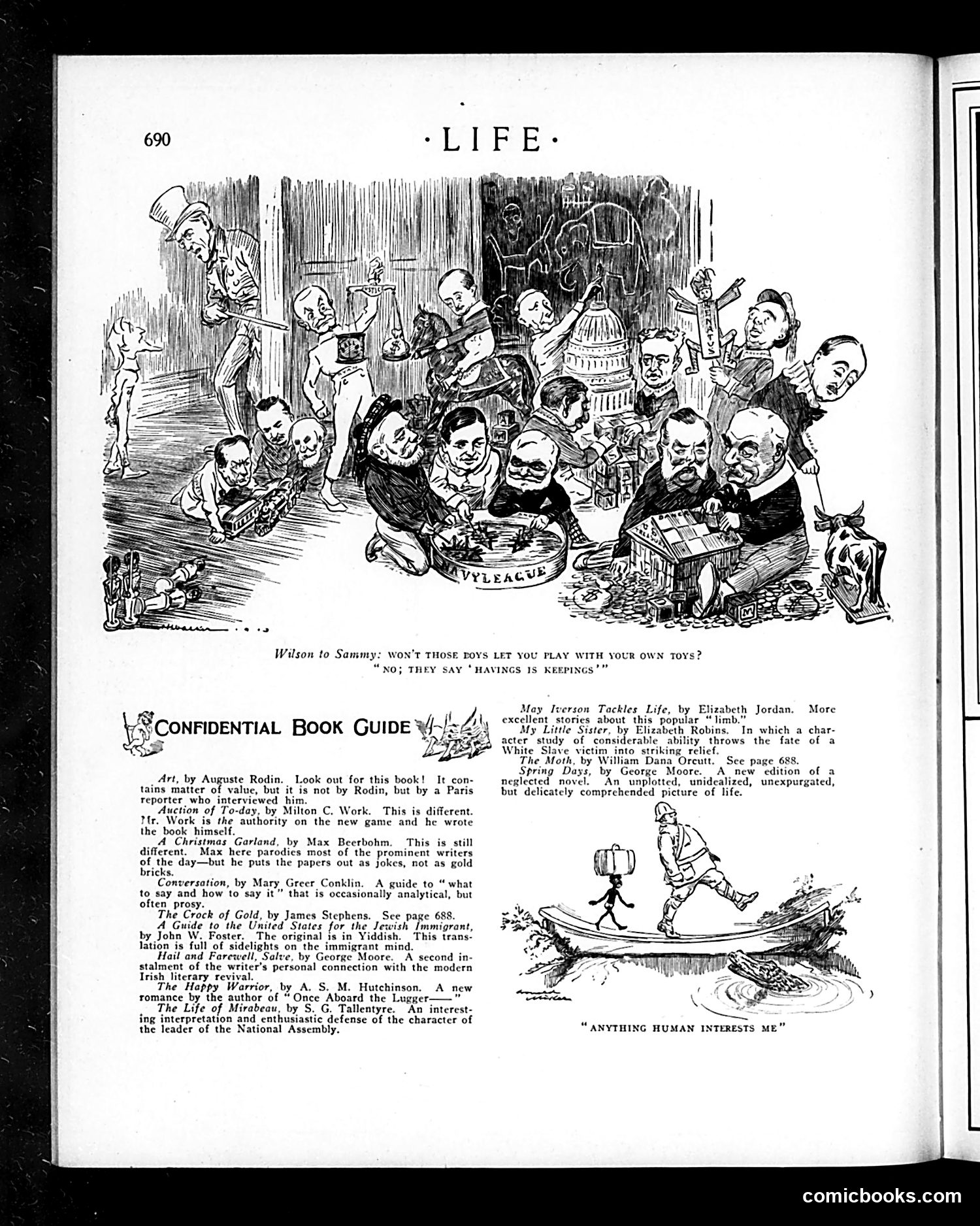
The main cartoon depicts a child ("Sammy") being kept from playing with his toys by older figures. President Wilson addresses the scene, asking why "those boys" won't let the child use his own toys. Sammy responds that they claim "havings is keepings"—a children's phrase meaning possession equals ownership. This appears to satirize **American neutrality and isolationism during World War I**. "Sammy" represents the United States; the "boys" are European powers attempting to control American resources and involvement despite America's desire to remain independent. The joke critiques how foreign nations treat America's neutrality—claiming American goods and support as their own through wartime demands. The page is primarily a book review section ("Confidential Book Guide"), with this cartoon serving as the visual introduction to literary recommendations from the era.
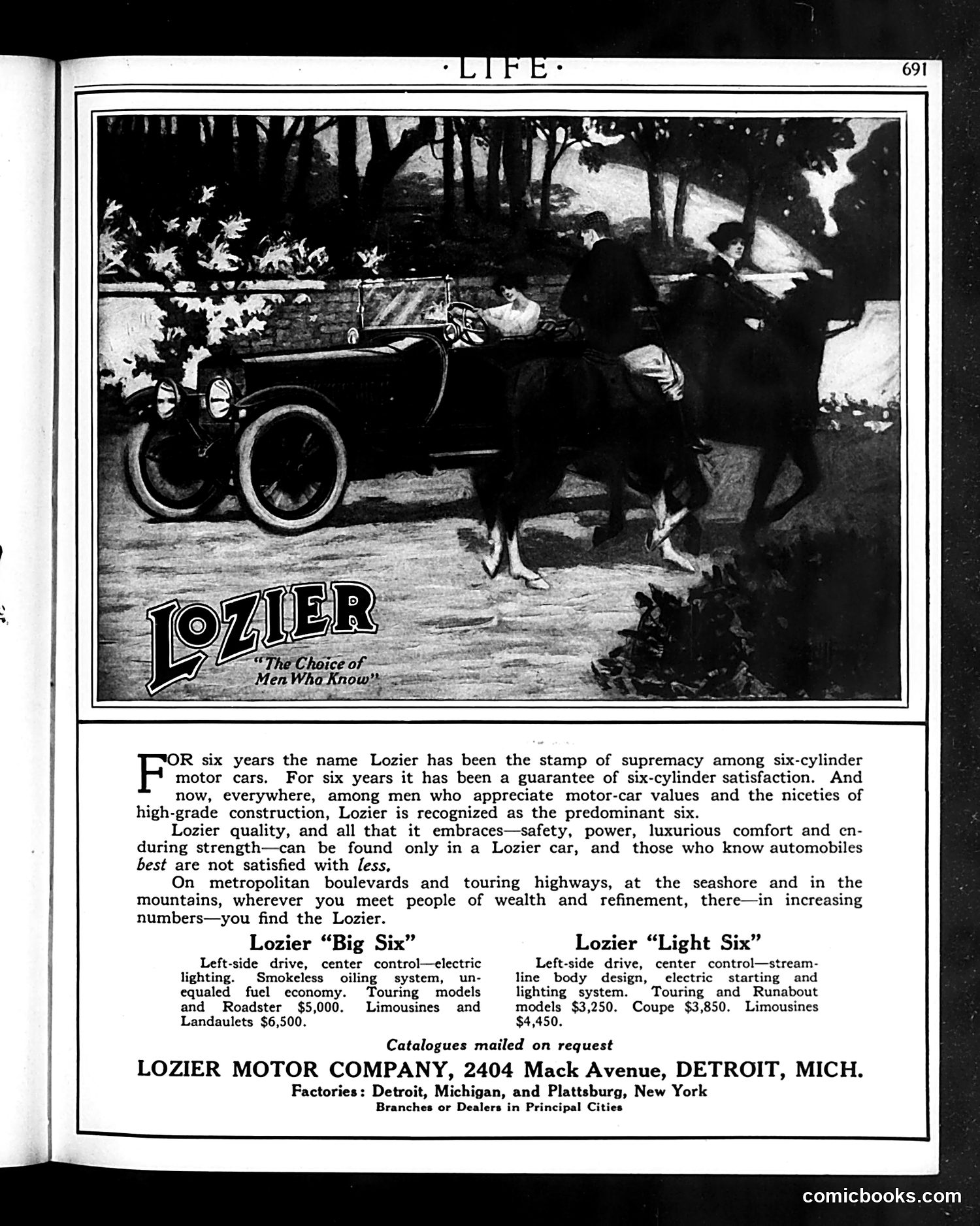
This is not a cartoon or satire—it's a **straight automobile advertisement** for Lozier Motor Company, published in *Life* magazine (likely early 1910s, based on the car design and technology references). The image shows a vintage touring car with passengers in period dress, positioned in an elegant outdoor setting to convey luxury and refinement. The advertisement uses class-based marketing: it emphasizes that wealthy, refined people ("people of wealth and refinement") choose Lozier automobiles, suggesting the car signals social status. The text highlights technical features (left-side drive, electric lighting, smokeless oiling) and two model lines with different price points ($3,250-$6,500), positioning Lozier as the premium six-cylinder choice for discriminating buyers. There is no political or satirical content here—it's period advertising that reveals early automotive marketing strategy: association with wealth and exclusivity.
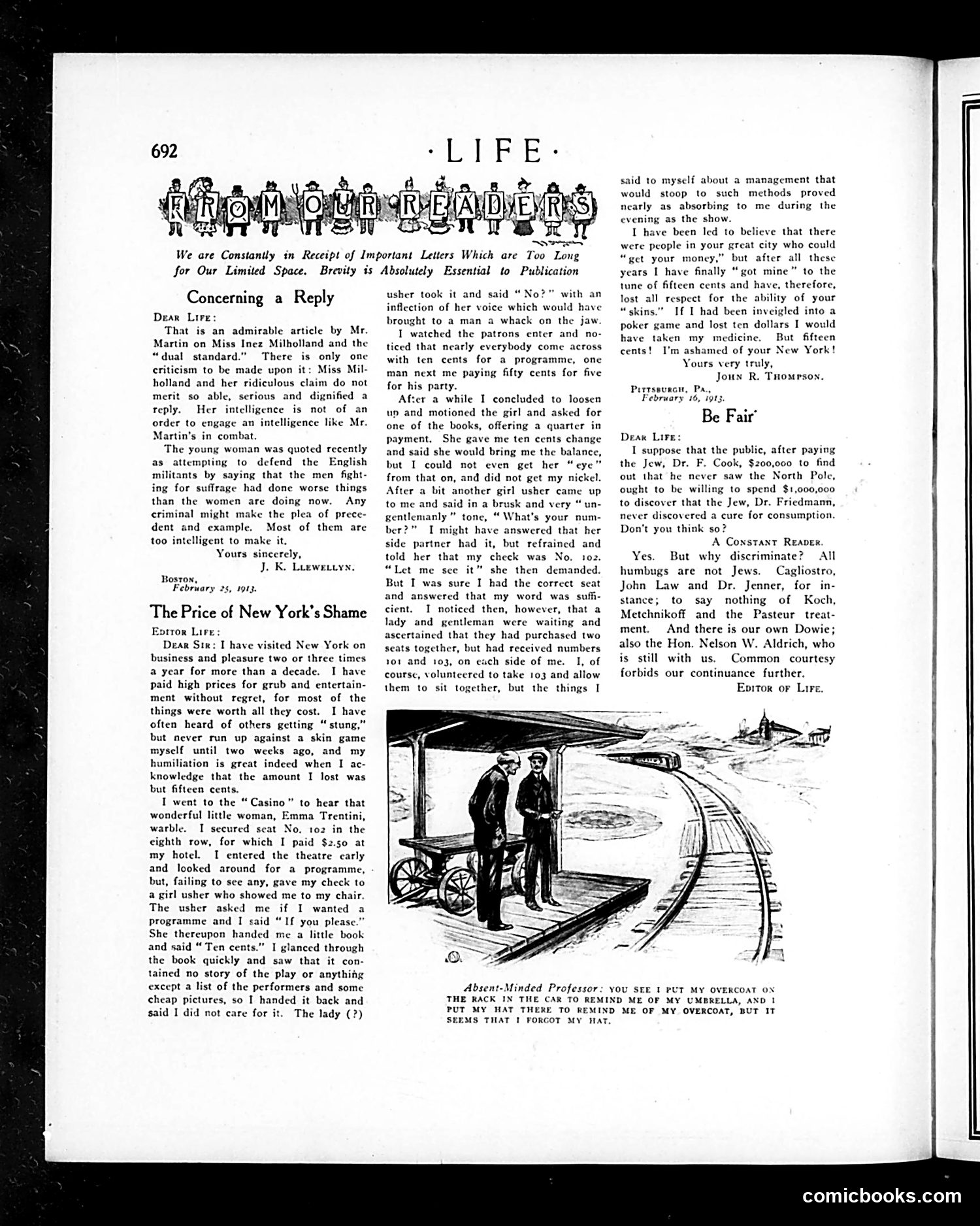
This page contains reader letters and a cartoon, typical of Life's editorial format. The letters complain about two New York City "con games": 1. **The Inez Milholland Letter**: References a contemporary women's suffrage activist whom the writer dismisses as unintelligent, criticizing her defense of English suffragettes' militant tactics. 2. **The Casino Theater Scam**: A detailed complaint about being systematically fleeced at Emma Trentini's theatrical performance—charged $2.50 for a seat, then pressured into buying a ten-cent program, and cheated out of change. The writer notes ushers deliberately collect dimes from nearly all patrons and higher amounts from some, suggesting orchestrated petty fraud. The cartoon (bottom) shows an absentminded professor at a train station, making a visual pun about forgetting his hat—a lighthearted contrast to the con-game complaints above. The page satirizes urban deception and exploitation of visitors to New York City.
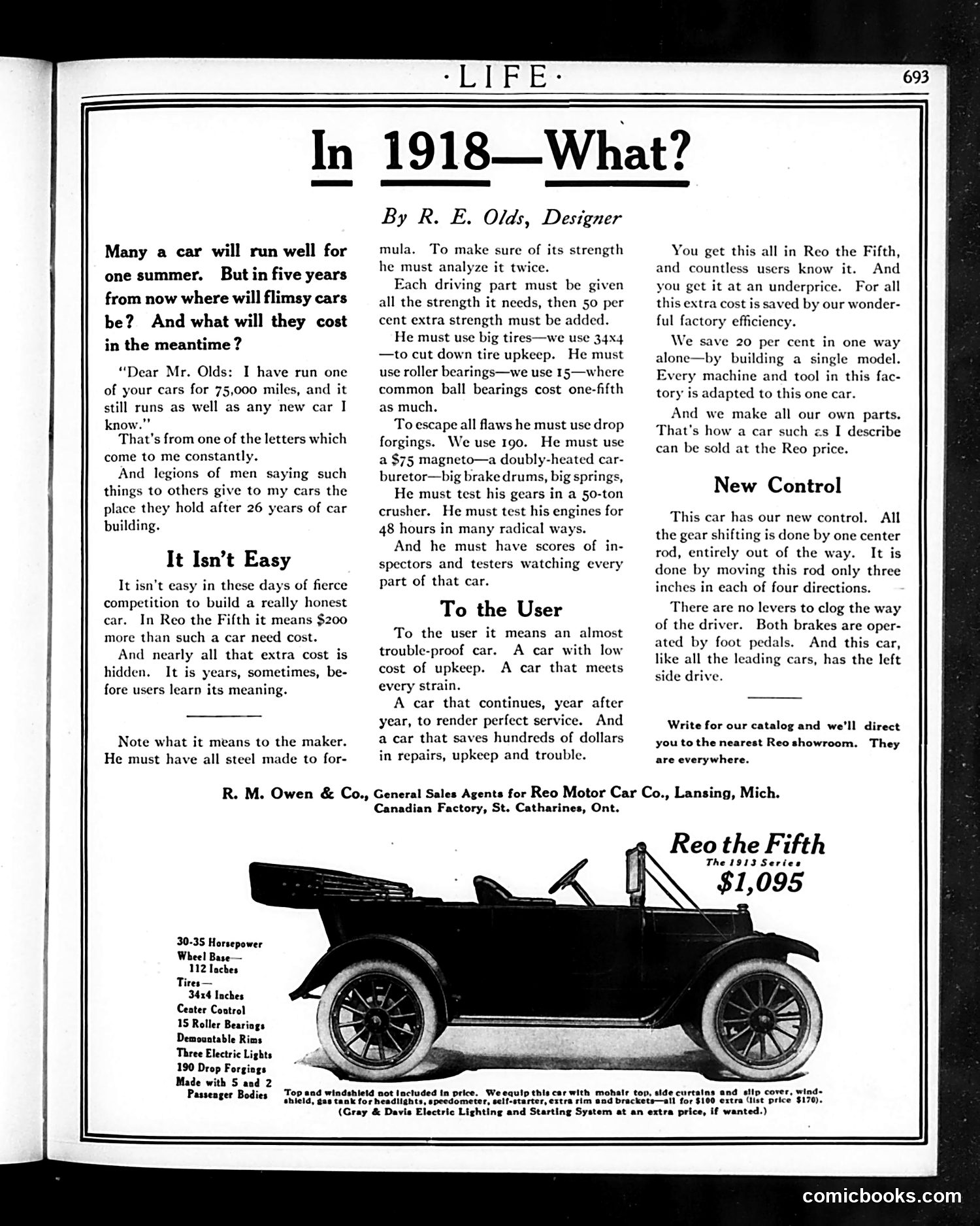
This is primarily **advertising copy**, not satire or political commentary. R.E. Olds, founder of the Reo Motor Car Company, personally pitches the Reo the Fifth automobile to readers. The "1918—What?" headline poses a rhetorical question: what will cheap, hastily-built cars be worth in five years? Olds argues his company charges $200 extra per vehicle to ensure durability through rigorous manufacturing—190 drop forgings, 50-ton gear testing, 48-hour engine trials, and 15 roller bearings versus competitors' one. The appeal targets practical buyers worried about long-term value and maintenance costs during an era of fierce automotive competition. Olds emphasizes that hidden manufacturing rigor translates to user benefits: reliability, low repair costs, and longevity. The new "center rod" gear shift and foot-operated brakes highlight modern convenience features. The price of **$1,095** anchors the pitch: quality engineering at competitive cost through efficient single-model production.
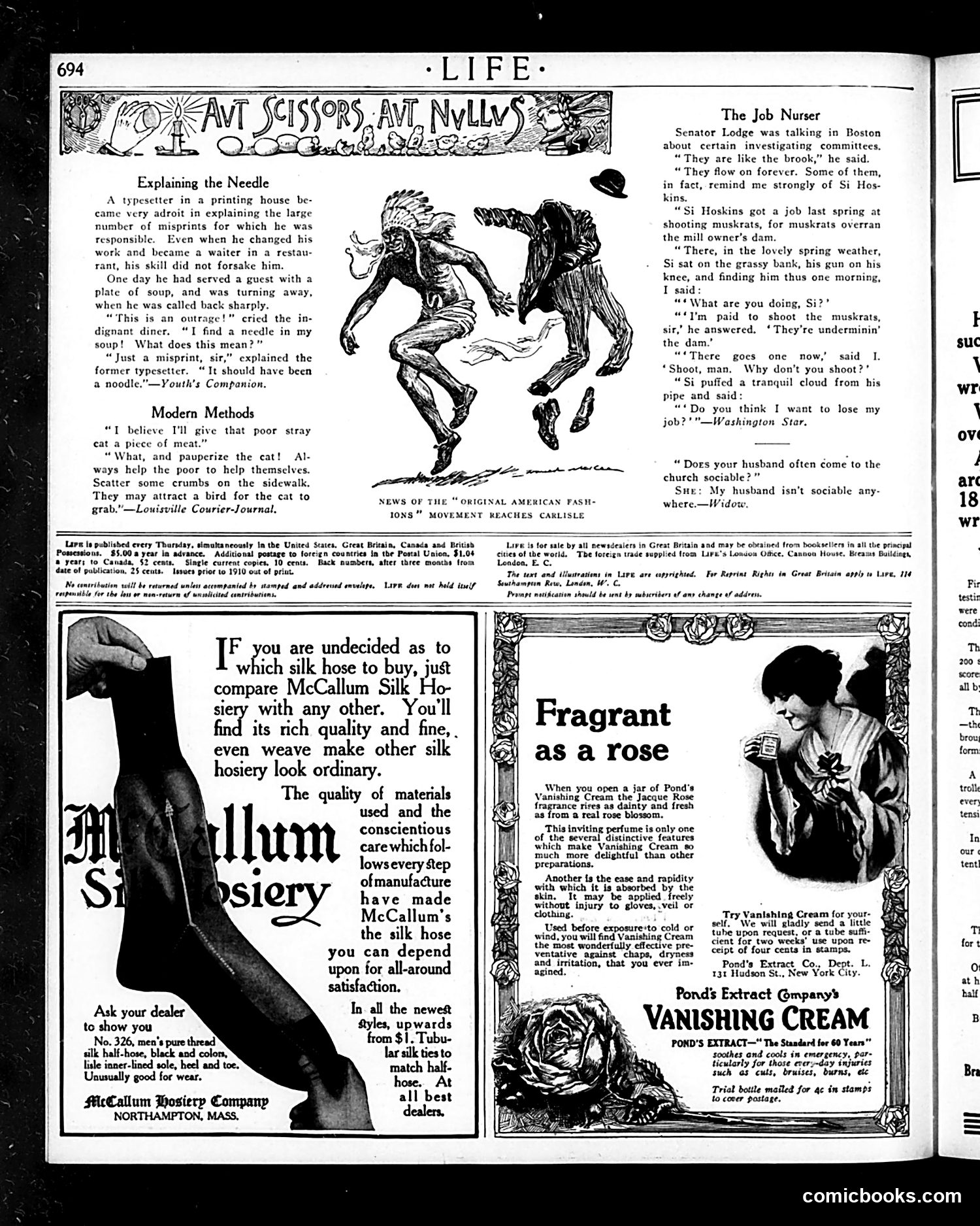
This page contains **three separate humorous anecdotes** plus advertisements—typical of Life's satirical format. **The Job Nurser**: Senator Lodge's parable about Si Hoskins, a muskrat shooter who refuses to actually shoot because killing the muskrats would cost him his job. The satire targets **congressional investigating committees**, comparing them to this self-perpetuating bureaucrat—they exist indefinitely not to solve problems but to maintain themselves. **Explaining the Needle**: A former typesetter, skilled at excusing misprints, becomes a waiter and serves soup containing a needle. He dismisses it as a "misprint" that "should have been a noodle." The joke mocks those who rationalize incompetence through absurd explanations. **Modern Methods**: Argues against helping poor stray cats, suggesting it "pauperizes" them—satirizing misguided charitable philosophy. The page also includes advertisements for **McCallum silk hosiery** and **Pond's Vanishing Cream**, with period-appropriate promotional photography.
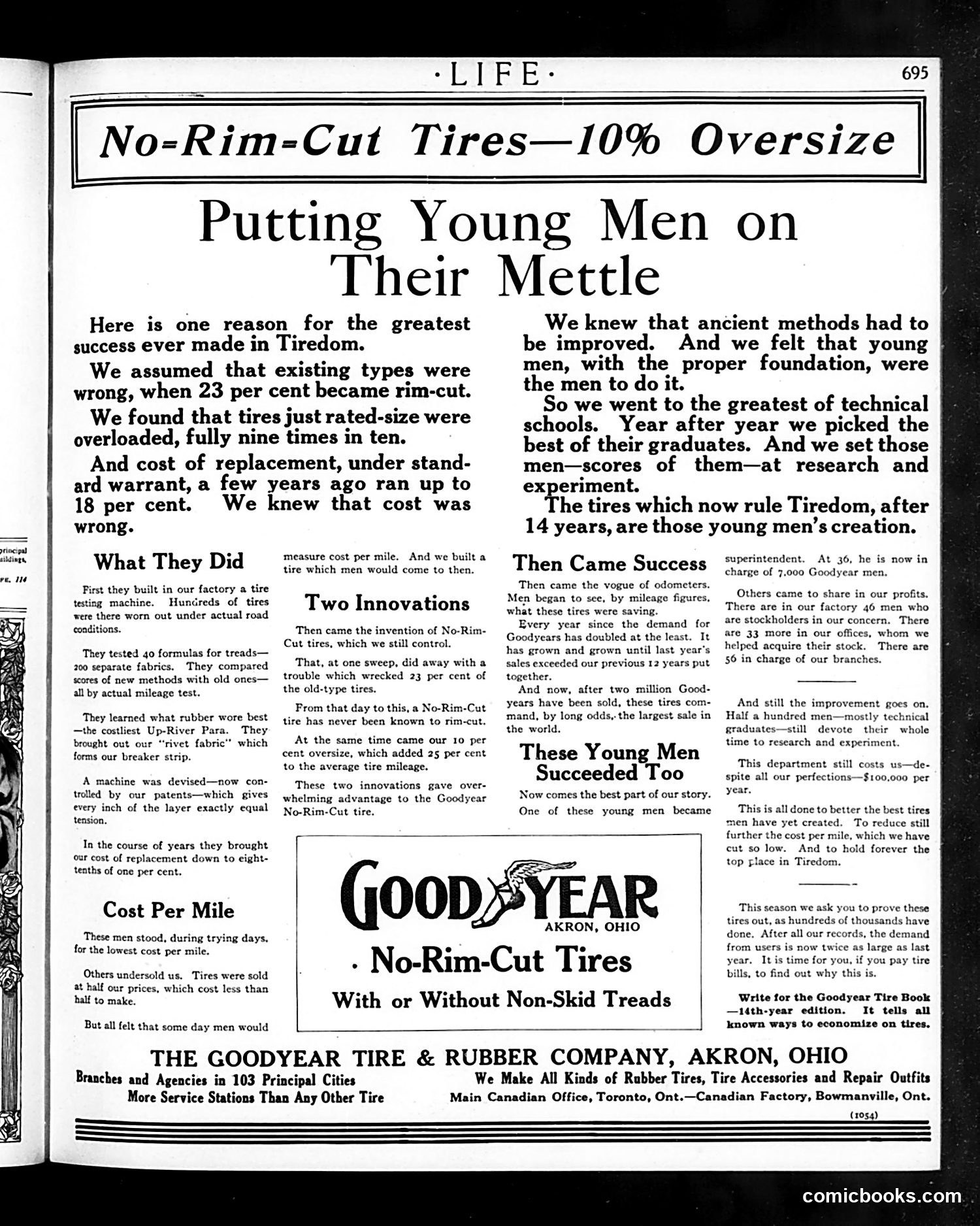
This is primarily a **corporate advertisement**, not political satire. The Goodyear Tire & Rubber Company uses this full page to promote its No-Rim-Cut tires by celebrating its own workforce development strategy. The narrative praises how Goodyear hired talented young engineering graduates from technical schools and gave them research responsibility. The company credits these young men with inventing the "No-Rim-Cut tire" and a 10% oversize innovation that solved major industry problems (23% of existing tires failed via rim-cutting). The advertisement emphasizes both the product's superiority and the company's progressive labor practices—notably that 46 factory workers and 33 office workers became stockholders, and 36 branch managers owned stock. This was presented as evidence of Goodyear's success-sharing and worker opportunity. The "putting young men on their mettle" theme celebrates meritocratic hiring and employee advancement as drivers of innovation and corporate success. This reflects early-20th-century "welfare capitalism" ideology.
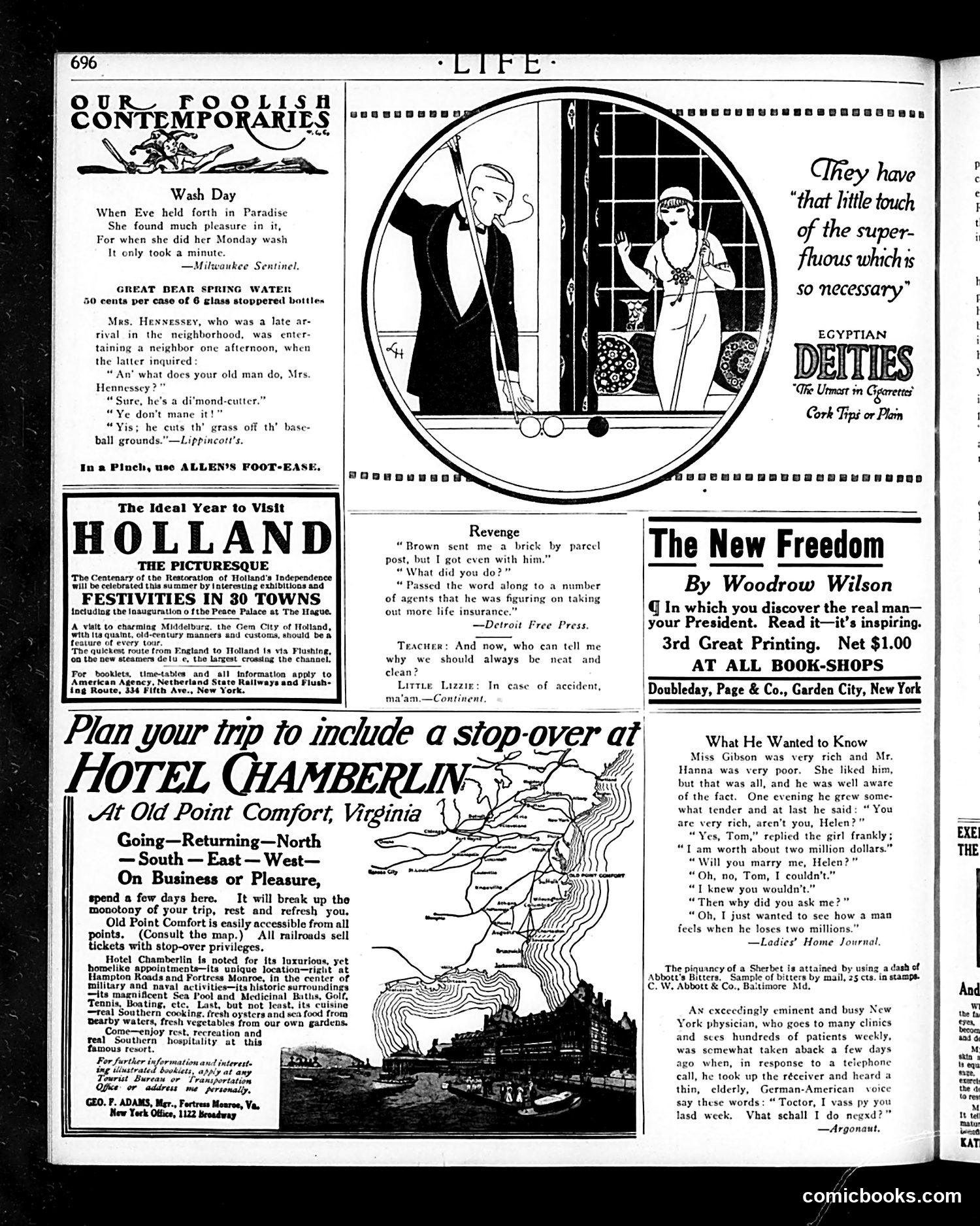
This page from *Life* magazine contains satirical humor pieces and advertisements typical of the early 20th century. The main cartoon shows a domestic scene where a woman at a window observes a man in formal attire, illustrating jokes about marriage and social roles. The accompanying "Wash Day" verse sarcastically contrasts Eve's effortless laundry in Paradise with modern domestic drudgery. Other humor pieces mock working-class Irish immigrants (the "Hennessey" joke about a "diamond-cutter" who cuts grass), include gentle classroom humor, and feature a revenge joke about life insurance. The advertisements promote travel (Holland, Old Point Comfort hotel), products (Egyptian cigarettes, Allen's Foot-Ease), and notably President Woodrow Wilson's book *The New Freedom*—suggesting this is from his presidency (1913-1921). The overall tone reflects early 1900s genteel satire: gentle mockery of marriage, class differences, and immigrant accents rather than sharper political critique.
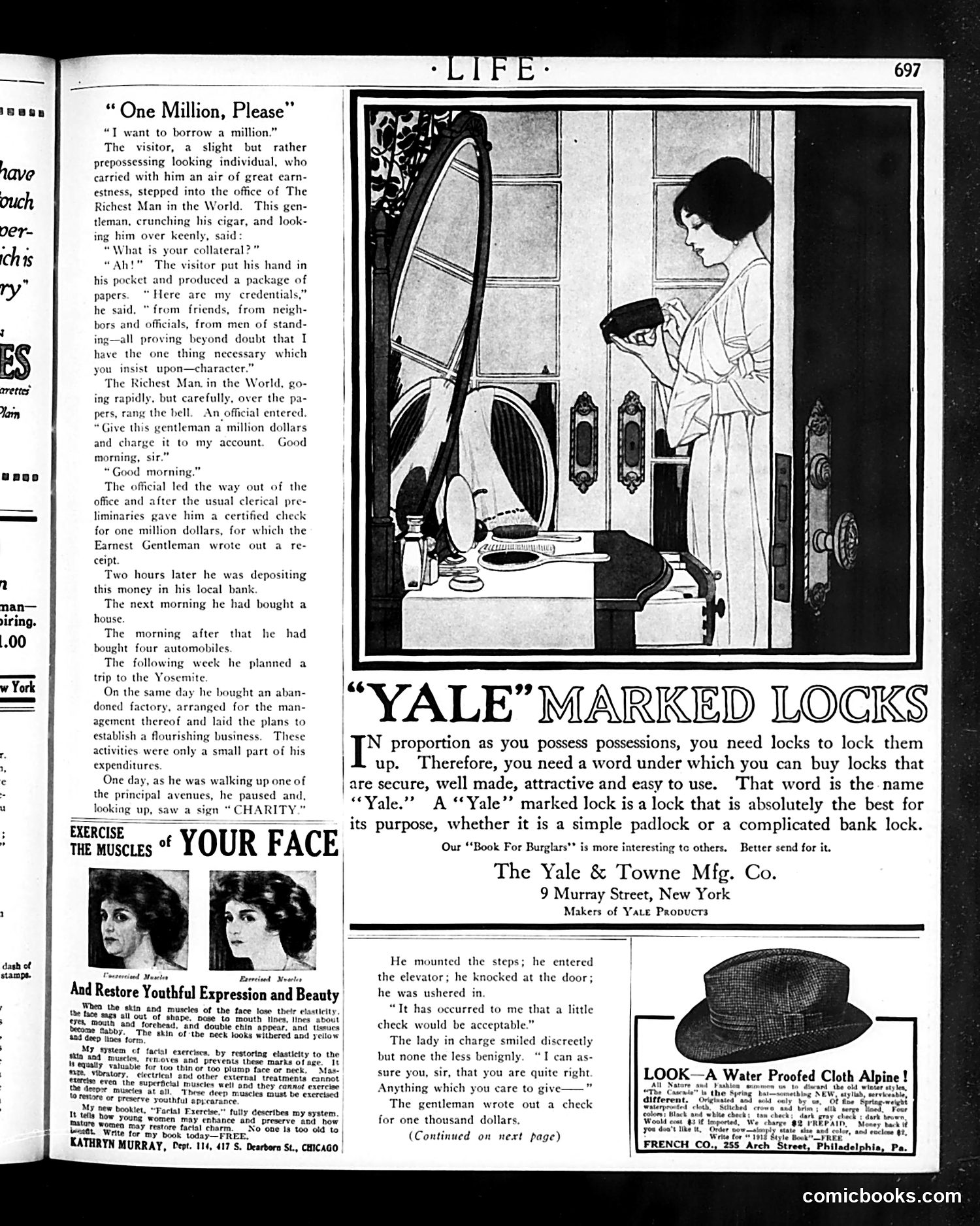
This story satirizes the corrupting influence of sudden wealth and the shallow nature of charity. A poor but morally upright man borrows a million dollars from "the Richest Man in the World" using only his reputation for good character as collateral. The satire unfolds as the man immediately squanders the money on houses, automobiles, and business ventures—indulgent consumption rather than meaningful investment. The punchline emerges when he encounters a charity sign and, now wealthy, donates $1,000 to it. The joke's point appears to be ironic: the man's "character"—the single quality valued enough to secure a fortune—is instantly abandoned once he has money. His charitable donation isn't genuine altruism but performative spending by a newly wealthy person. Life is mocking both the notion that character alone should guarantee credit, and the hypocrisy of the rich who pose as philanthropists while primarily serving themselves. The page also contains period advertisements (Yale locks, facial exercises) unrelated to the narrative.
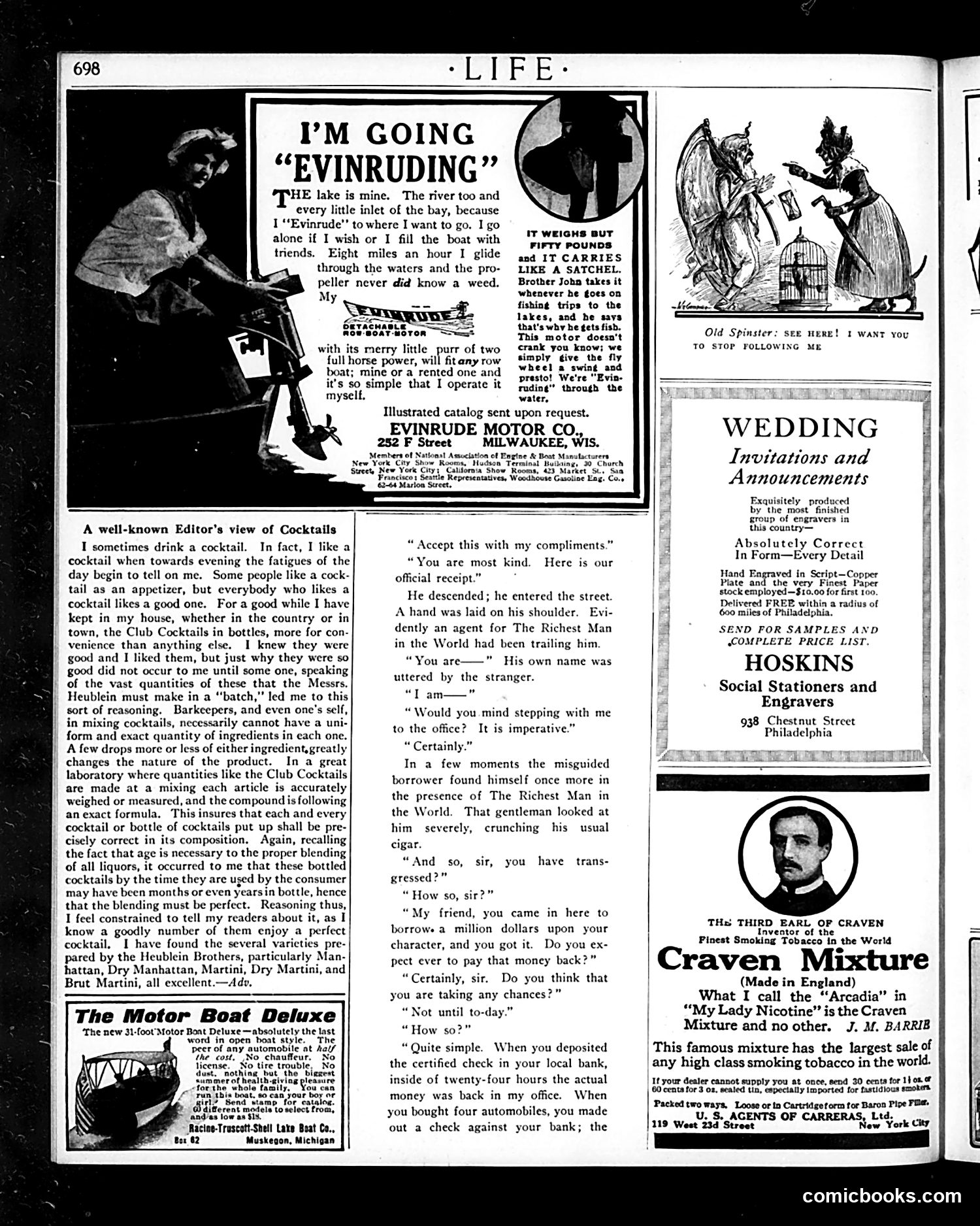
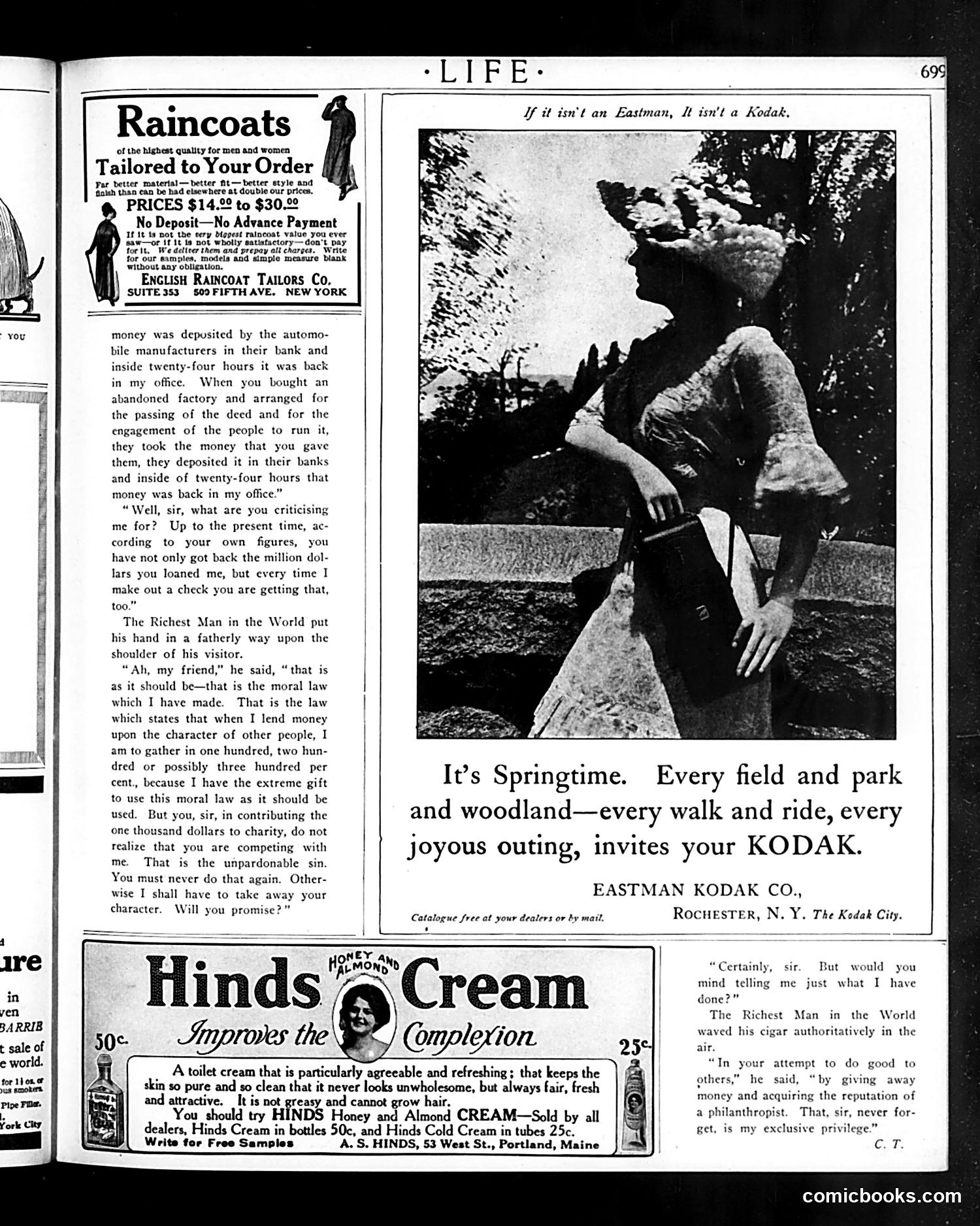
This page contains a **satirical short story** ("The Richest Man in the World") alongside period advertisements. The narrative mocks **wealthy industrialists and their moral hypocrisy** during the early 20th century. The story depicts a self-made magnate who has loaned money to a visitor and now claims moral superiority because he extracts 100-300% returns through banking practices. When the visitor donates to charity, the rich man becomes enraged, declaring that **philanthropy is his exclusive privilege**—revealing the satire's point: that wealthy elites viewed charitable giving not as moral duty but as personal power and social control. The unnamed "Richest Man" likely represents **turn-of-the-century American industrialists** (Carnegie, Rockefeller, etc.) who accumulated vast fortunes then selectively dispensed charity to control public perception and influence, rather than genuine altruism. The satire critiques how the wealthy monopolized the moral authority that charity conferred. The ads for raincoats, Kodak cameras, and Hinds Cream are typical period commercial content, unrelated to the story's social commentary.
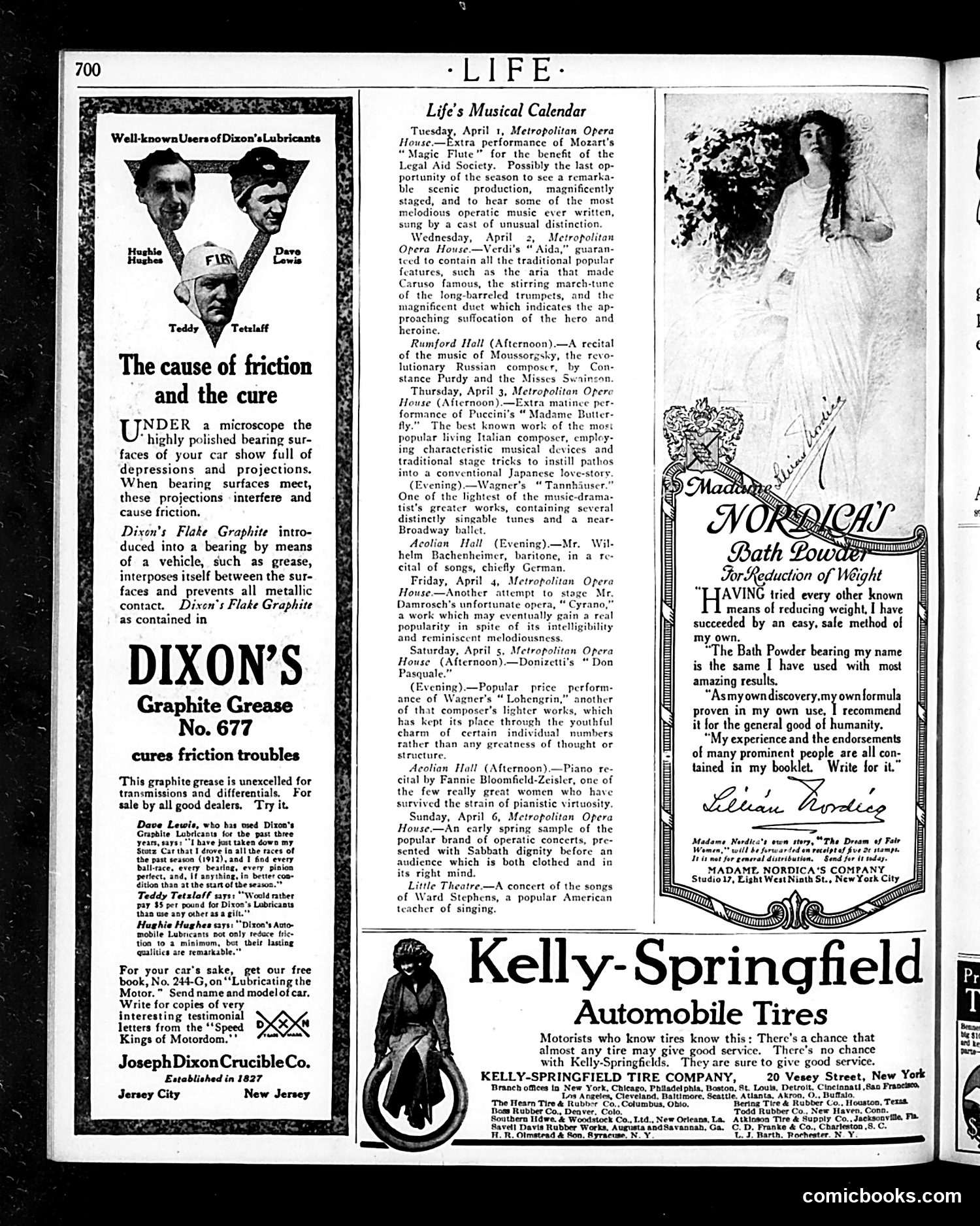
This page is primarily **advertising and cultural content**, not political satire. The left side features a **Dixon's Lubricants ad** with testimonials from racing drivers (Teddy Tetzlaff, Hughie Hughes, Dave Lewis). These were famous early auto-racing competitors whose endorsements lent credibility to the product. The ad uses technical language about bearing friction to sell graphite grease—a genuine automotive innovation. The center and right contain **Life's Musical Calendar** listing metropolitan opera performances and concerts for the week of April 1-6, and a **Madame Nordica Bath Powder advertisement** featuring the famous opera singer's endorsement. The bottom features a **Kelly-Springfield Automobile Tires ad** with an illustration of a woman in a car. There is **no political cartoon here**—this is a typical early-20th-century magazine page mixing consumer advertising with cultural entertainment listings, reflecting the era's priorities and consumer culture.
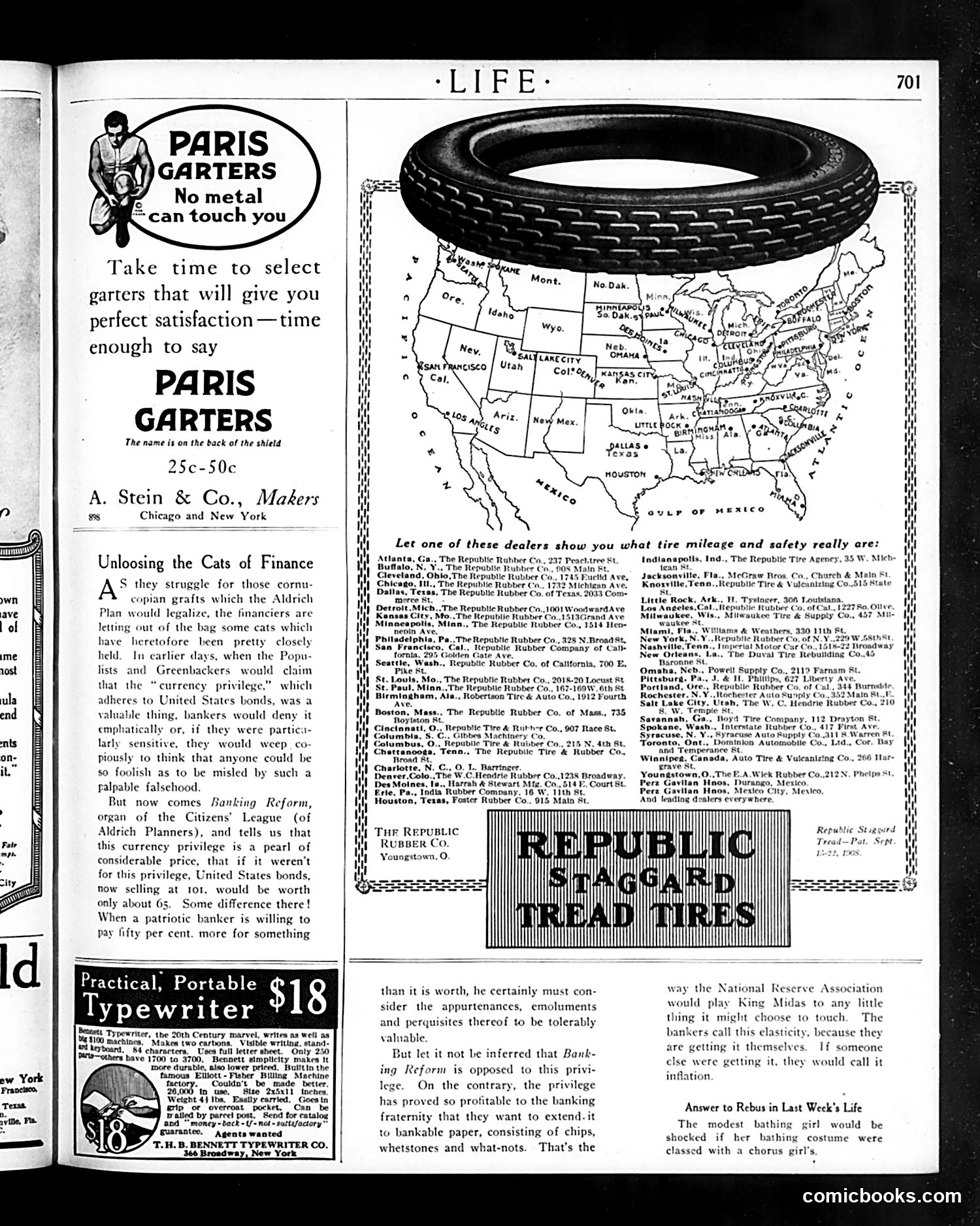
This page's main content is a satirical article titled "Unloosing the Cats of Finance," attacking the **Aldrich Plan** (a banking reform proposal). The satire targets financiers' hypocrisy: they previously **denied** that U.S. bonds carried a "currency privilege" (allowing them to be used as currency backing, increasing their value). Now, seeking the Aldrich Plan's benefits, bankers openly admit this privilege is worth roughly 36 points (bonds worth 101 would be worth only 65 without it). The author ridicules their sudden honesty as self-serving: bankers now want to **extend this profitable privilege to worthless paper** (chips, whetstones) to legitimize further financial manipulation. The satire equates the bankers' shifting claims to "ralpable falsehood"—they'll say whatever serves their interests, making them unreliable narrators in financial policy debates. The rest of the page contains period advertising (Paris Garters, Republic Rubber tires, typewriters).
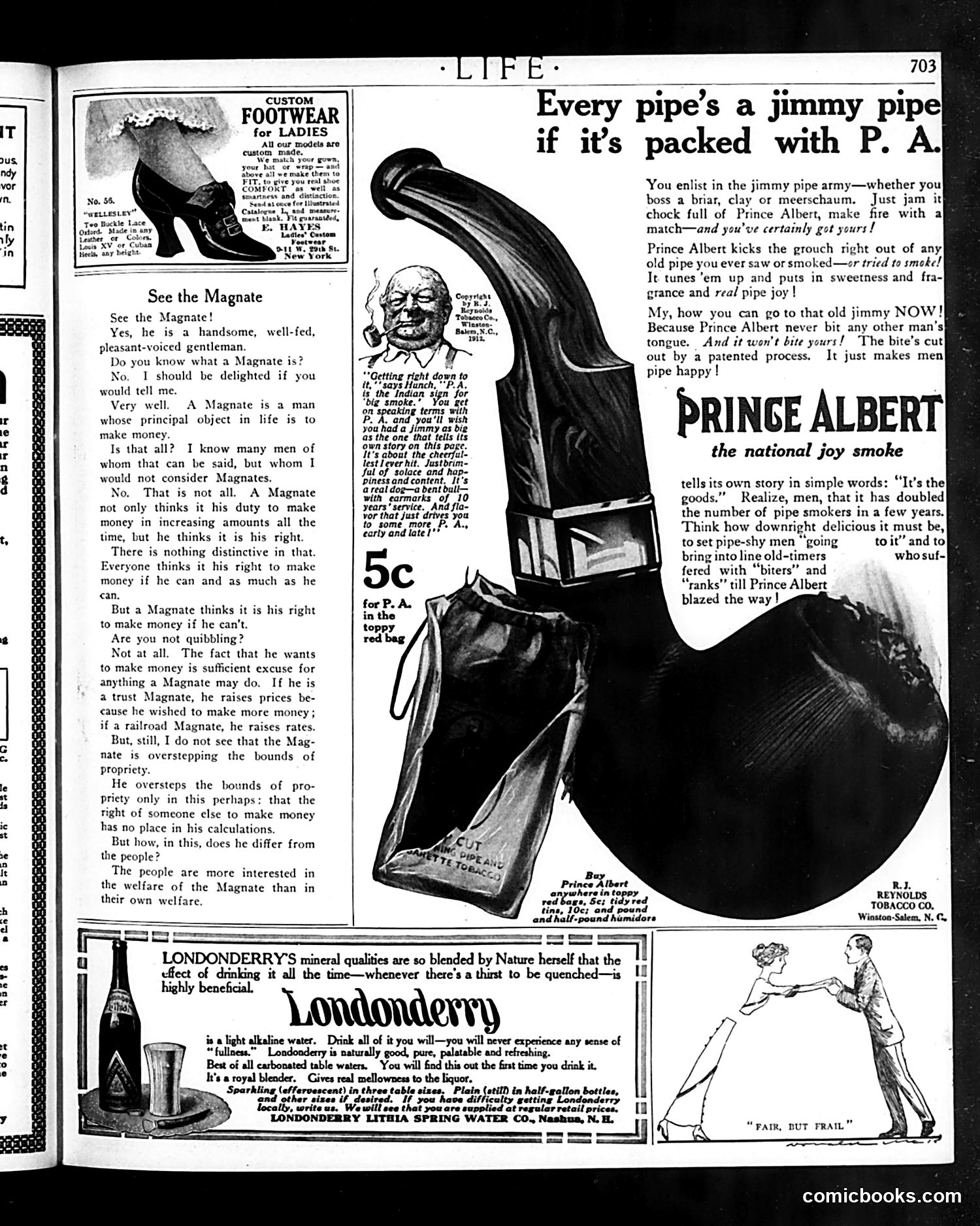
This page contains satirical commentary on wealth and ethics alongside vintage advertisements. **"See the Magnate"** is a brief satirical piece defining a "Magnate"—a wealthy industrialist whose sole principle is making money "by any means necessary." The satire's point: while a Magnate believes it his *right* to profit regardless of others' welfare, ordinary people paradoxically prioritize the Magnate's welfare over their own. It's social criticism of both rapacious capitalists and the public's misplaced allegiance to them. **The remaining content is advertising**: Prince Albert pipe tobacco (emphasizing it won't bite your tongue), custom footwear, Londonderry mineral water, and a small cartoon labeled "Fair, But Frail" showing two golfers. The advertisements reflect early 20th-century consumer culture and product claims (like Prince Albert's "patented process" against tongue-bite) that would seem quaint today.
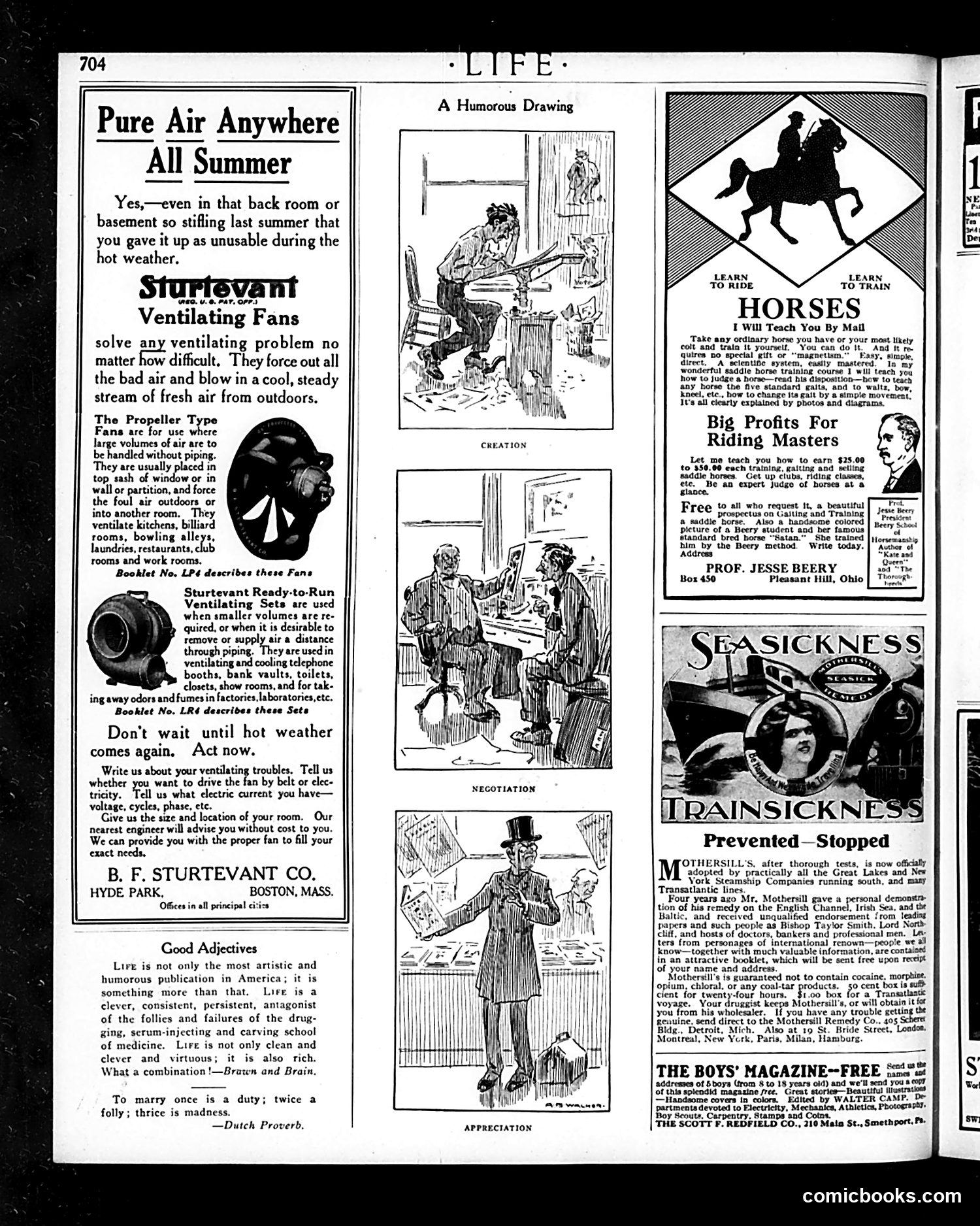
This page consists primarily of **advertisements and promotional content**, not political satire. The three humorous cartoon illustrations are generic comic vignettes without specific political or social commentary. The cartoons depict: - "Creation": A figure at a desk, apparently depicting artistic or creative work - "Negotiation": Two men in conversation, suggesting a business discussion - "Appreciation": A man in formal attire, possibly showing gratitude or satisfaction The advertisements promote **Sturtevant ventilating fans** (targeting summer heat discomfort), **horse training courses by mail**, and **Mothersill's seasickness remedy**. The page also includes testimonial quotes praising *Life* magazine itself as "artistic and humorous" and "antagonist of the follies...of the drug-injecting and carving school of medicine"—referencing contemporary debates over medical practices. **Bottom line**: This is a typical early 20th-century magazine page mixing light humor with commercial advertisements rather than political cartooning.
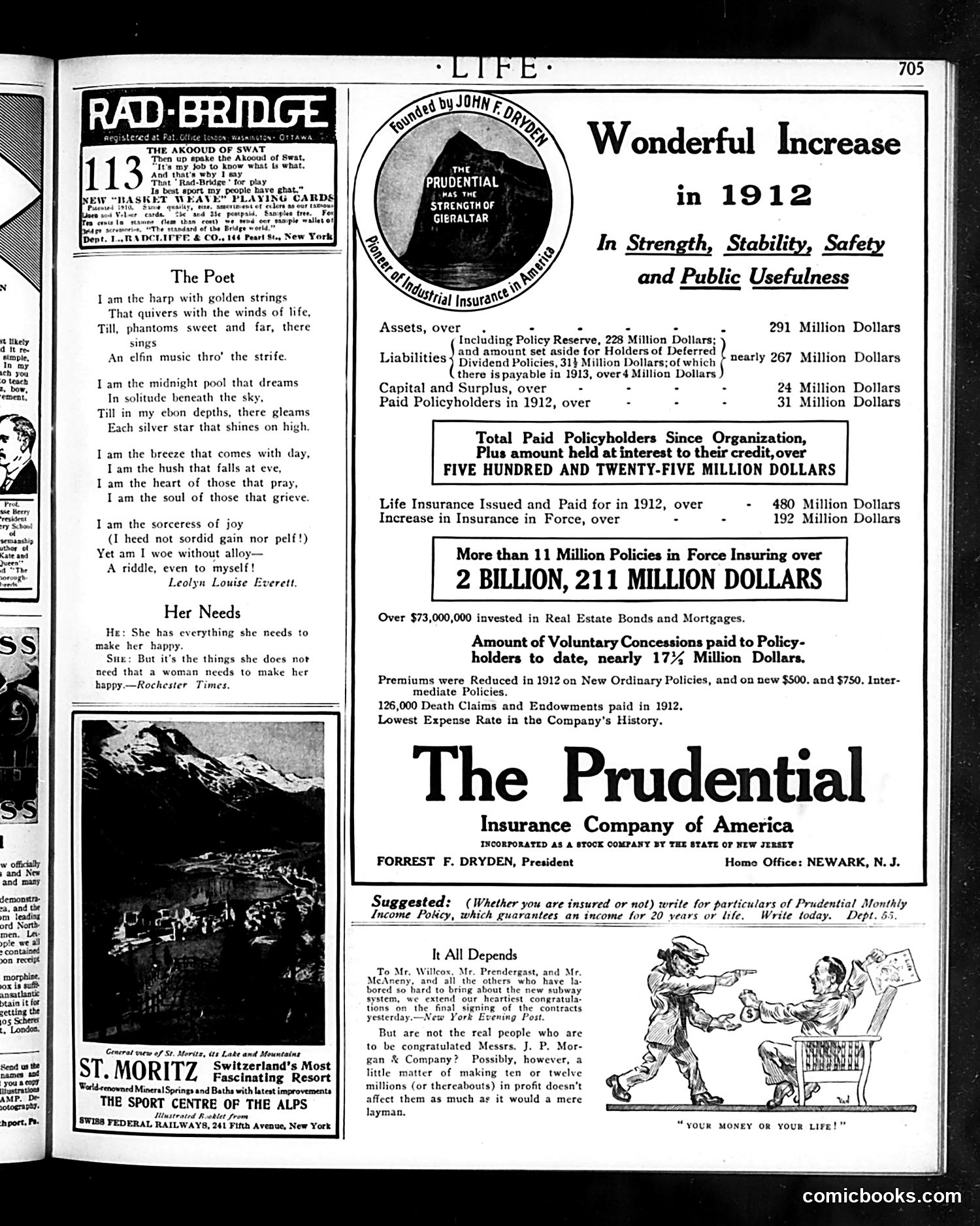
This page mixes literary content with advertising. The left side features poetry ("The Poet" by Leolyn Louise Everett) and a humorous gender-relations quip ("Her Needs"), plus a travel advertisement for St. Moritz ski resort. The dominant content is a large Prudential Insurance Company advertisement highlighting the company's 1912 financial growth—assets of 291 million dollars, policies worth over 2 billion dollars. The company logo depicts the Rock of Gibraltar, symbolizing strength and stability. At bottom, a small cartoon labeled "Your Money or Your Life!" appears to satirize the subway construction mentioned in the accompanying text. The cartoon likely criticizes J.P. Morgan & Company's financial interests in New York's new subway system, suggesting they profited enormously (ten to twelve million dollars) while politicians took public credit. The phrase "your money or your life" implies citizens bore the actual costs while financiers reaped rewards—a cynical commentary on who truly benefited from major infrastructure projects.
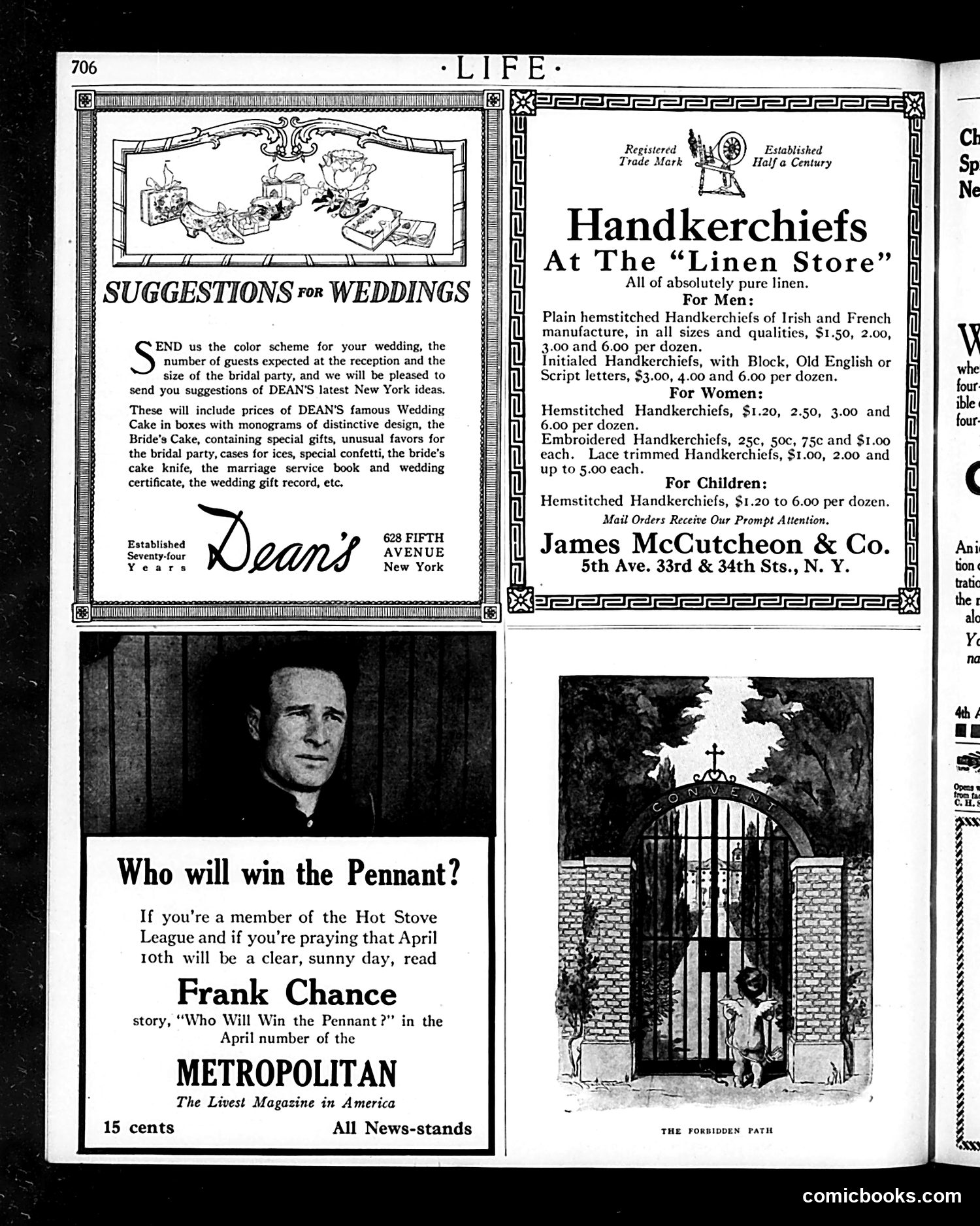
This page is primarily **advertising**, not satire or political commentary. It contains three main ads: 1. **Dean's Wedding Services** — offers comprehensive wedding planning, including custom cakes with monograms, favors, and marriage documents. 2. **Metropolitan Magazine ad** — promotes a story by **Frank Chance** (a famous baseball manager of the era) titled "Who Will Win the Pennant?" The ad references the "Hot Stove League"—a baseball term for off-season fan discussion about upcoming seasons. It appeals to baseball enthusiasts by suggesting the April 10th weather forecast matters to pennant predictions. 3. **James McCutcheon & Co.** — advertises fine Irish and French linen handkerchiefs at various price points for men, women, and children. The bottom illustration titled "The Forbidden Path" appears to be unrelated editorial content, not part of these advertisements. The page reflects early 20th-century consumer culture and leisure interests (weddings, baseball, luxury goods).
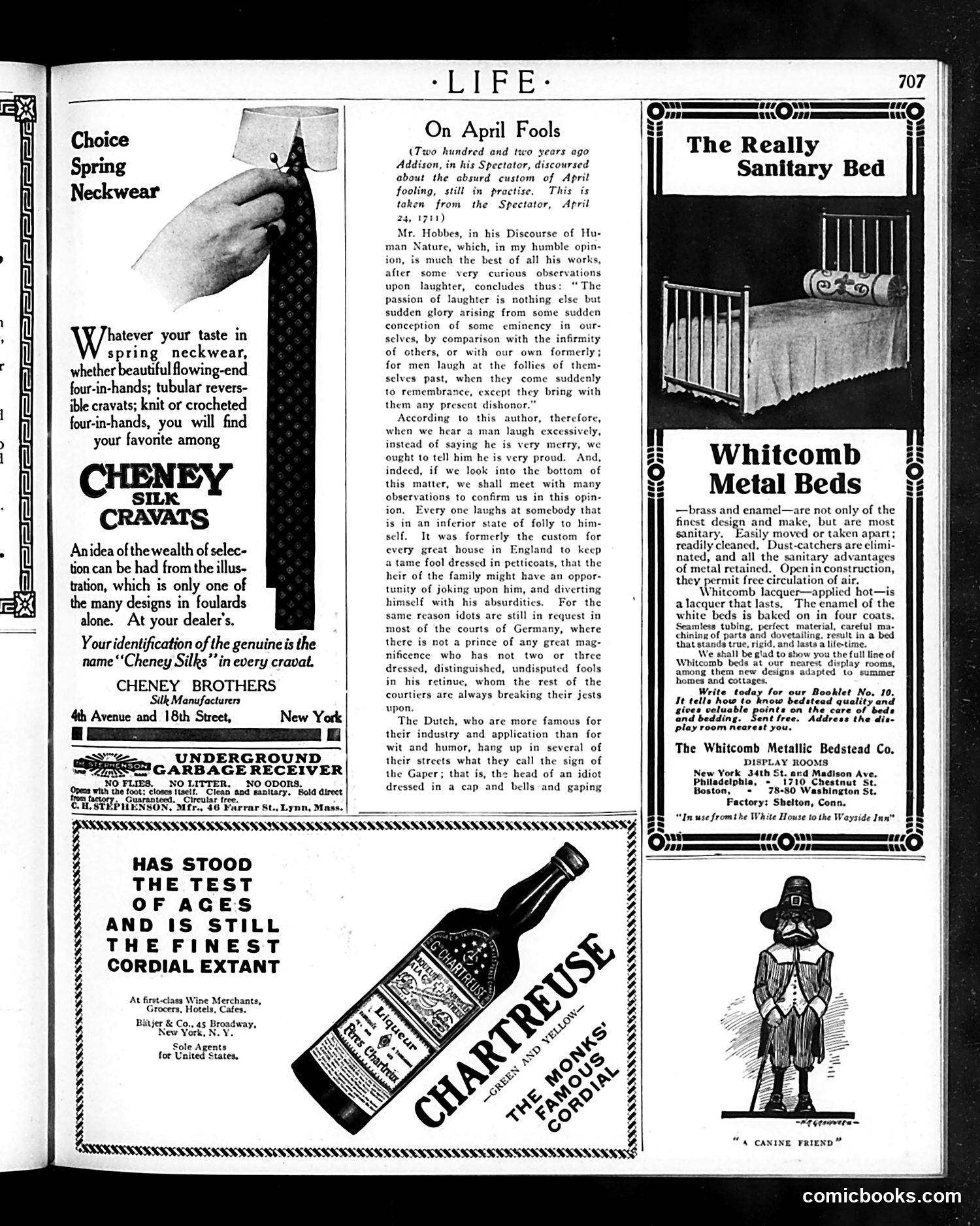
This page is primarily **advertising with one editorial essay**. The main content is Joseph Addison's 1711 essay "On April Fools," reprinted to mark the 202-year anniversary of its original publication. The essay discusses laughter's origins, citing philosopher Thomas Hobbes's theory that laughter stems from "sudden glory"—finding superiority in others' foolishness. Addison notes that April Fooling was a common custom and references historical practices like European courts keeping "tame fools" (disabled people) for entertainment and mockery. He describes Dutch "Gapers"—statues of gaping idiots displayed publicly. The **satire targets human cruelty disguised as humor**: societies institutionalized mockery of vulnerable people as entertainment, and Addison exposes how laughter often reveals pride and contempt rather than genuine joy. The surrounding advertisements (Cheney neckwear, metal beds, wine, garbage receivers) are typical early-20th-century magazine filler, unrelated to the essay's content.
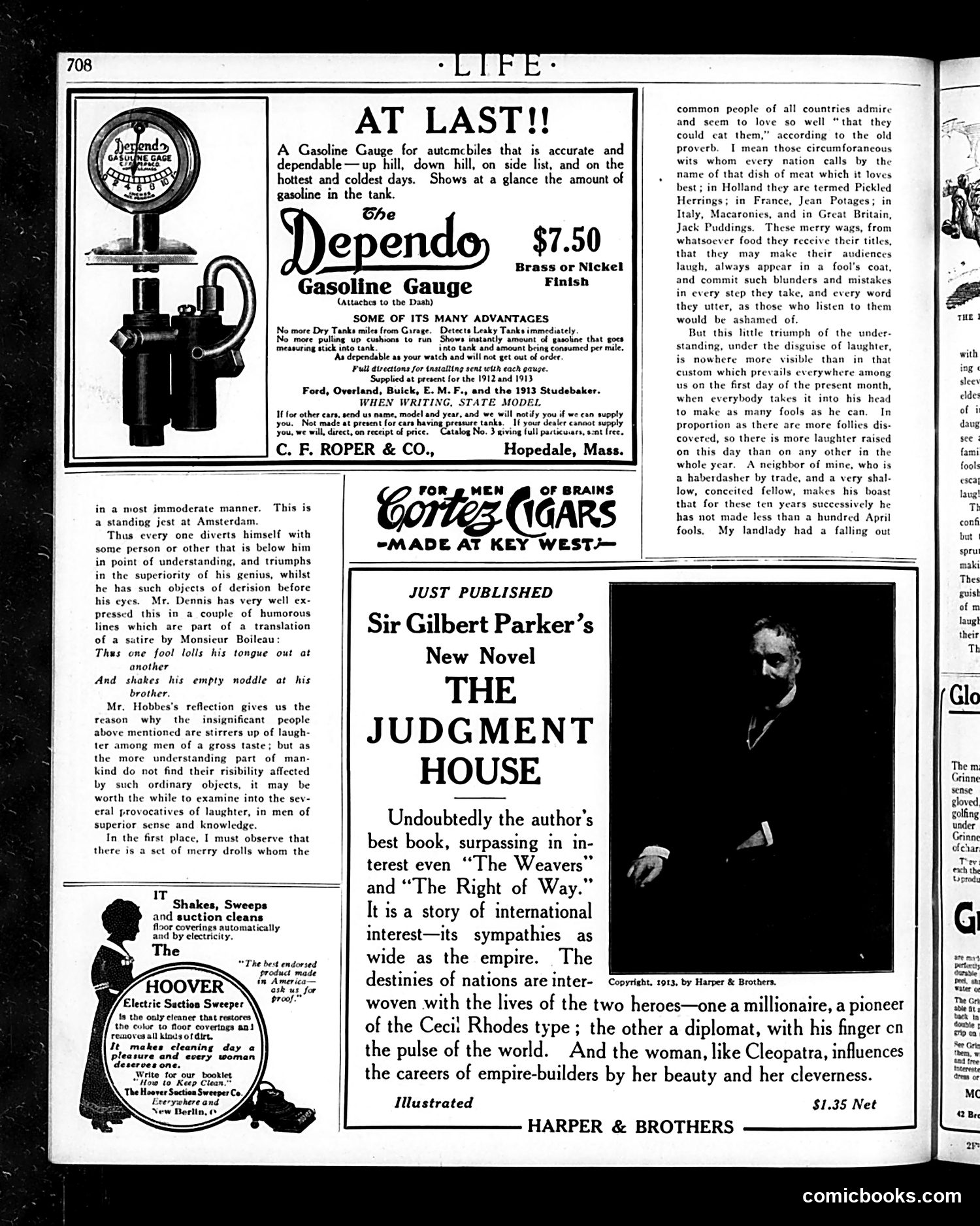
This page is primarily **advertising**, not satire. The main content includes three product advertisements: 1. **Dependo Gasoline Gauge** ($7.50) — a dashboard fuel meter for early automobiles (1912-1913 models), solving the problem of drivers running out of gas unexpectedly. This was a genuine innovation for the era. 2. **Cortez Cigars** — a simple product plug for Key West cigars. 3. **Hoover Electric Cleaner** — promoting an electric floor cleaning device. The lengthy text column discussing "merry drolls," jesters, and April Fools' Day appears to be editorial content, not related to the advertisements. It's a philosophical essay about why people enjoy foolishness and pranks. **For modern readers:** This shows how early 1900s automobiles lacked basic fuel gauges—drivers literally couldn't see how much gas remained. The Dependo gauge was a practical solution to a real problem that seems absurd today.
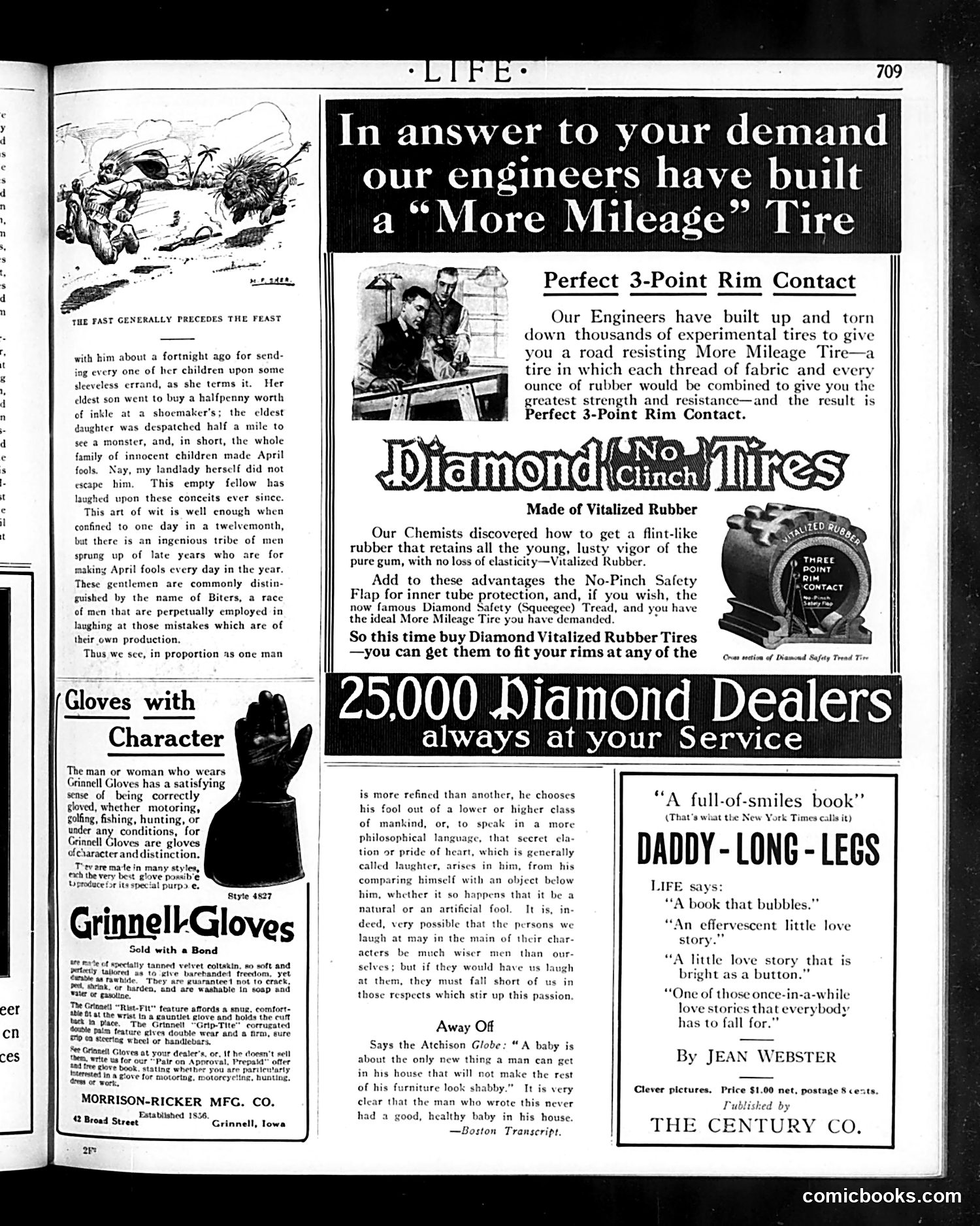
This page is primarily **advertising content** rather than political satire. It features three commercial advertisements from the early 20th century: 1. **Diamond "No-Clinch" Tires** (dominant): Promotes a new tire with "Perfect 3-Point Rim Contact" made from "Vitalized Rubber," claiming superior mileage and durability. The accompanying photograph shows engineers testing tires. 2. **Grinnell Gloves**: Markets quality leather gloves emphasizing character and craftsmanship, highlighting features like the "Fist-Fit" wrist design. 3. **"Daddy-Long-Legs" by Jean Webster**: A book advertisement quoting positive reviews. The text excerpt at page's left discusses April Fools' pranks and social commentary on "Biters"—people who habitually trick others—but this appears unrelated to the advertisements. The page demonstrates how *Life* magazine balanced satirical editorial content with commercial advertising revenue during this era.
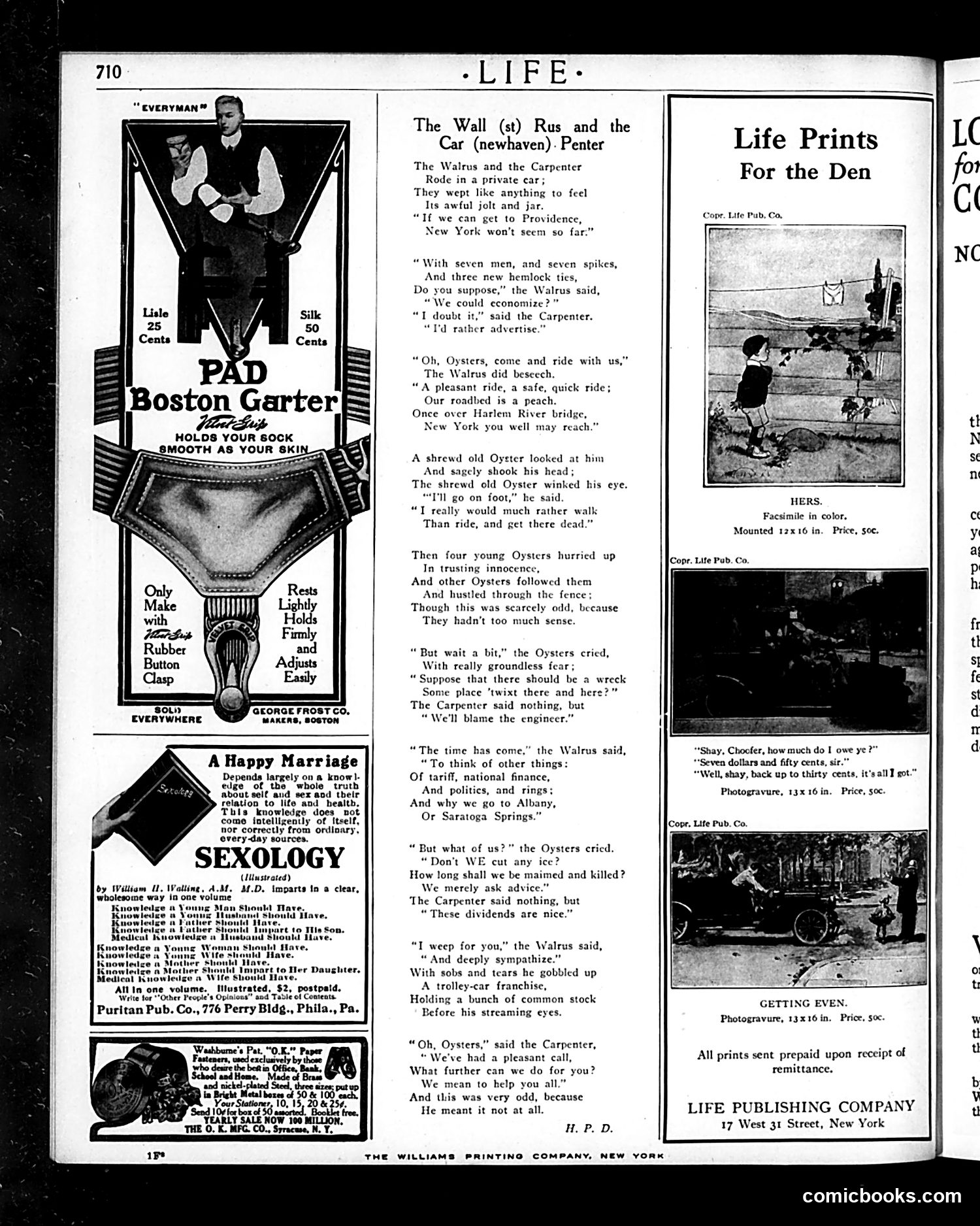
This page features a satirical poem titled "The Wall (st) Rus and the Car (newhaven) Penter"—a parody of Lewis Carroll's "Walrus and the Carpenter." The satire targets **railroad corruption and financial manipulation** in the Gilded Age. The Walrus and Carpenter represent railroad executives who deceive oysters (the common people) into riding their unsafe private railcar, promising convenience while actually seeking profits. The poem mocks their indifference to passenger safety ("We'll blame the engine"), their focus on financial schemes (tariffs, politics, dividends), and their hollow sympathy ("I weep for you...And deeply sympathize"). The twist on Carroll's original text transforms a whimsical tale into commentary on **corporate malfeasance**: trusting citizens are exploited by cynical business interests who openly admit they don't care about their welfare ("He meant it not at all"). The accompanying advertisements offer unrelated products and books, typical of *Life* magazine's mixed-content format.
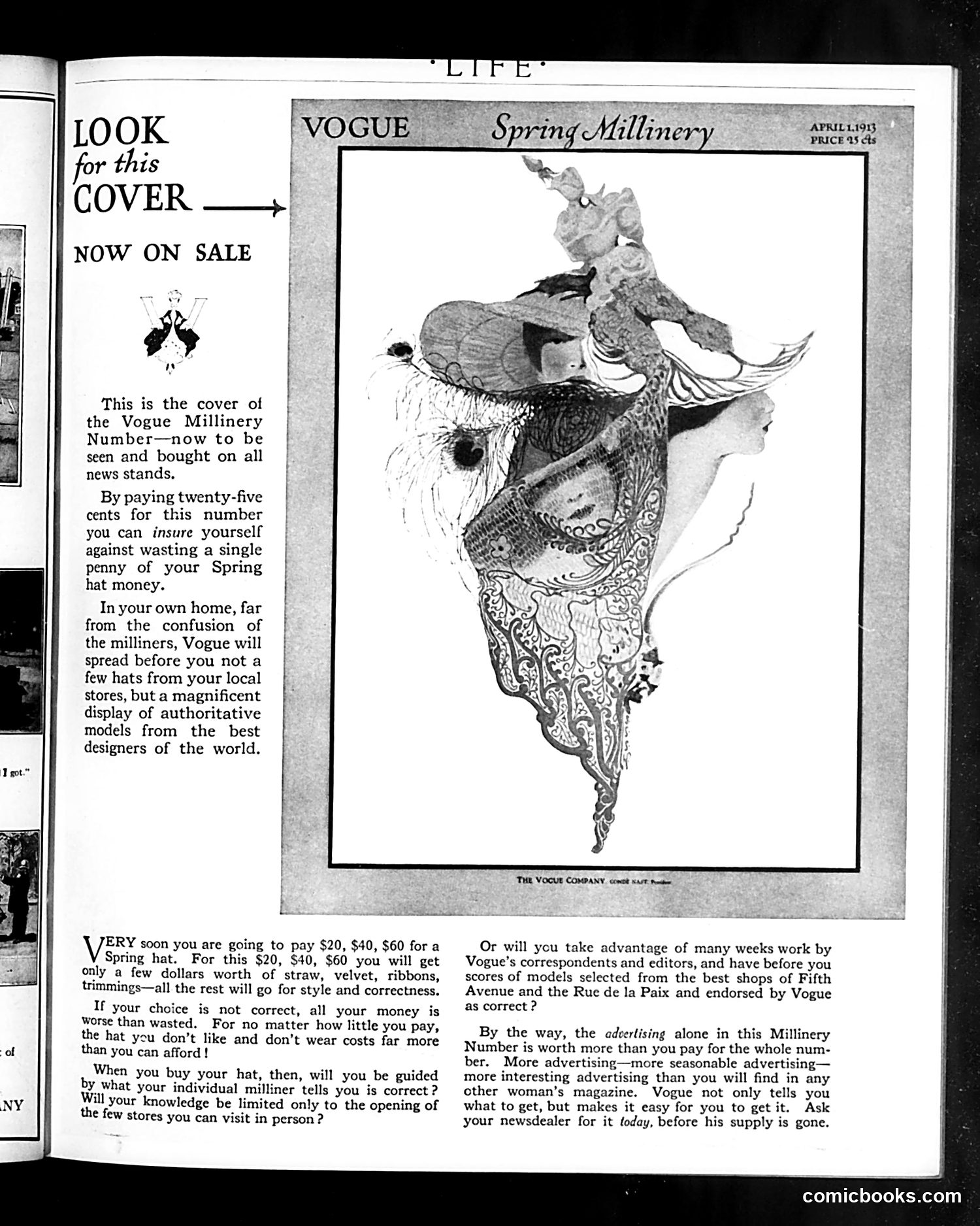
This is primarily a **Vogue magazine advertisement**, not political satire. The page promotes Vogue's special Spring Millinery issue (25 cents) by highlighting the problem women faced when buying hats. The central illustration shows an **elaborately decorated women's hat** — the kind fashionable in 1913, featuring feathers, ornamental fabric, and decorative elements. The satire targets **millinery shopping itself**: the ad argues that women waste money on hats because individual hat-shop salespeople give biased advice, and customers lack broader knowledge of available styles. The solution? Buy Vogue's Millinery Number, which showcases designs from Fifth Avenue and Parisian shops, letting women make informed choices at home rather than trusting a single local milliner's recommendations. This reflects genuine 1913 consumer anxiety: hats were expensive status symbols, and fashion magazines positioned themselves as trustworthy guides against exploitation by salespeople.
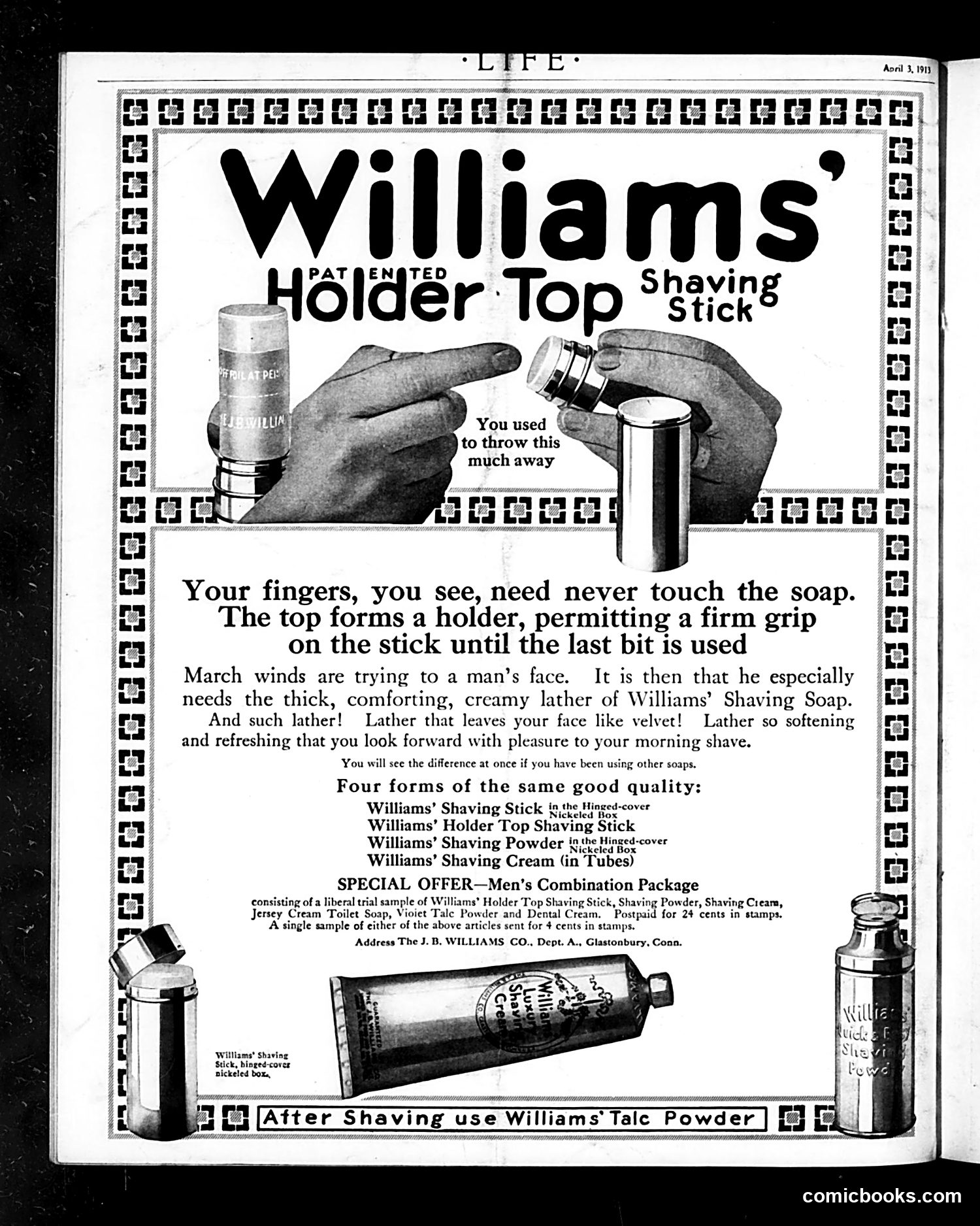
This is a **product advertisement**, not satire or political commentary. The J.B. Williams Company promotes their patented "Holder Top" shaving stick—a soap stick with a metal cap that functions as a grip, allowing users to shave without touching the soap directly as it diminishes. The advertisement emphasizes practical benefits: the holder keeps fingers clean, and the remaining soap is fully usable (addressing waste concerns). It appeals to masculine vanity by describing the lather's luxurious qualities and the pleasure of morning shaving. The page showcases four product formats (stick, powder, cream) and offers a "Special Offer" combination package for 24 cents in stamps, with individual samples available for 4 cents. The era's marketing strategy combined functional innovation with aspirational appeals to male grooming and self-care.