
Life, 1913-04-03 · page 24 of 52
Life — April 3, 1913 — page 24: what you’re looking at
What you’re looking at
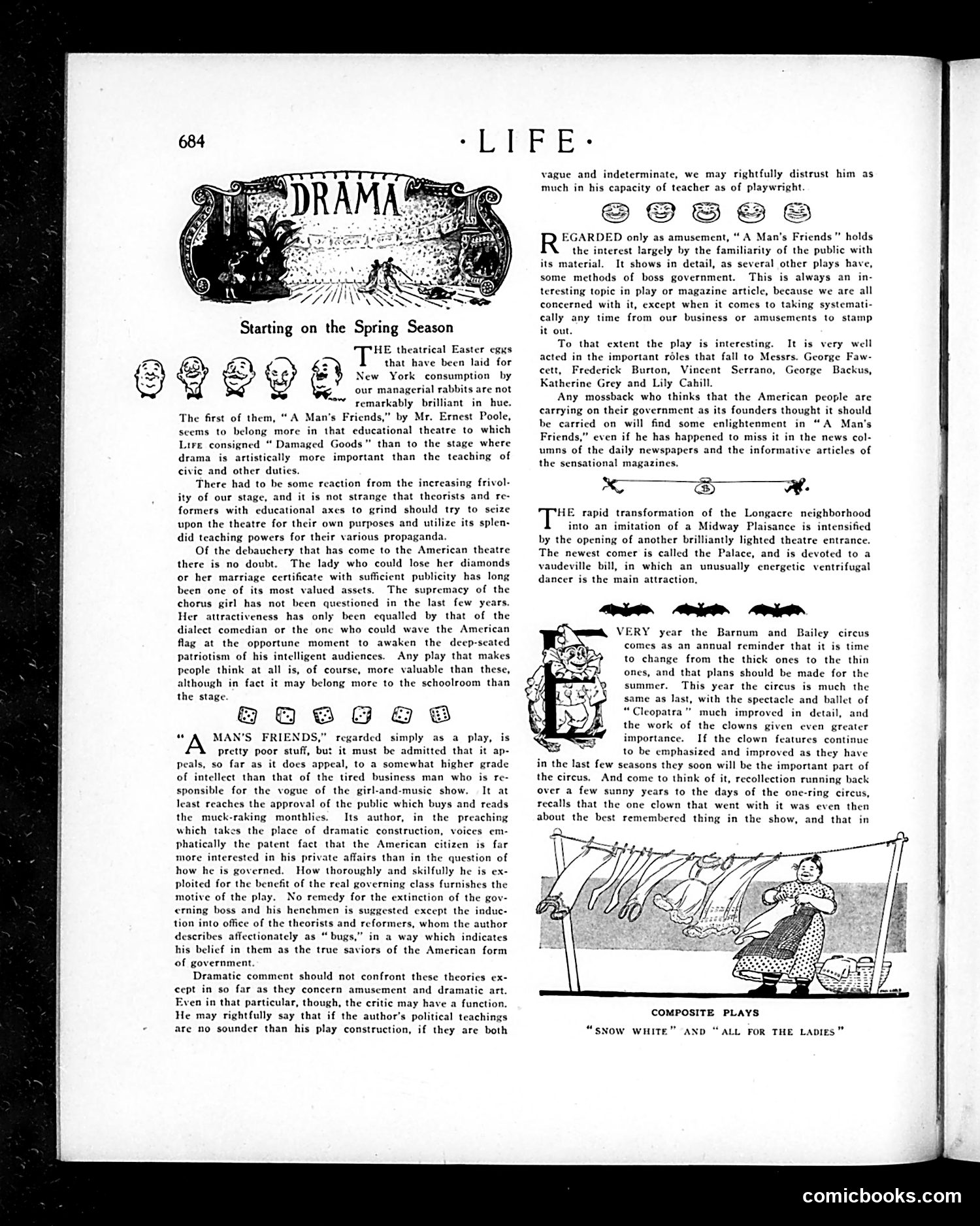
This page reviews Ernest Poole's play "A Man's Friends," opening for spring theater season. The critic dismisses it as "pretty poor stuff" dramatically, though acknowledging it appeals to educated audiences interested in serious topics. The satire targets both the play and broader theatrical trends: American theater has devolved into spectacle prioritizing chorus girls and patriotic flag-waving over substance. Yet the critic also mocks "muck-raking" reformers and their allies who use theater for political propaganda rather than art. The core critique: Poole's anti-corruption message about political bosses exploiting citizens is valid but poorly constructed theatrically. The reviewer warns that if Poole's playwriting is this weak, we should distrust his political theories equally. The cartoons (dice and clowns) likely mock both frivolous entertainment and earnest but clumsy didactic drama competing for spring audiences.
📄 Transcribed text from this page (OCR, searchable)
Machine-transcribed from the original scan — historical spelling and the odd misread are preserved.
me ARE mores MISS Starting on the Spring Season HE theatrical Easter egys Ge & that have been laid for ‘7 New York consumption by Ke our managerial rabbits are not remarkably brilliant in hue. The first of them, “A Man’s Friends,” by Mr. Ernest Poole, seems to belong more in that educational theatre to which Lire consigned “ Damaged Goods” than to the stage where drama is artistically more important than the teaching of civic and other duties. There had to be some reaction from the increasing frivol- ity of our stage, and it is not strange that theorists and re- formers with educational axes to grind should try to seize upon the theatre for their own purposes and utilize its splen- did teaching powers for their various propaganda. Of the debauchery that has come to the American theatre there is no doubt. The lady who could lose her diamonds or her marriage certificate with sufficient publicity has long been one of its most valued assets. The supremacy of the chorus girl has not been estioned in the last few years. Her attractiveness has only been equalled by that of the dialect comedian or the one who could wave the American flag at the opportune moment to awaken the deep-seated patriotism of his intelligent audiences. Any play that makes people think at all is, of course, more valuable than these, although in fact it may belong more to the schoolroom than the stage. G G ®& MAN'S FRIENDS,” regarded simply as a play, is pretty poor stuff, but it must be admitted that it ap- peals, so far as it does appeal, to a somewhat higher grade of intellect than that of the tired business man who is re- sponsible for the vogue of the girl-and-music show. It at least reaches the approval of the public which buys and reads the muck-raking monthlics. Its author, in the preaching which takes the place of dramatic construction, voices em- phatically the patent fact that the American citizen is far more interested in his private affairs than in the question of how he is governed. How thoroughly and skilfully he is ex- ploited for the benefit of the real governing class furnishes the motive of the play. No remedy for the extinction of the gov- cerning boss and his henchmen is suggested except the induc- tion into office of the theorists and reformers, whom the author describes affectionately as “bugs,” in a way which indicates his belief in them as the true saviors of the American form of government. Dramatic comment should not confront these theories ex- cept in so far as they concern amusement and dramatic art. Even in that particular, though, the critic may have a function. He may rightfully say that if the author's political teachings are no sounder than his play construction, if they are both vague and indeterminate, we may rightfully distrust him as much in his capacity of teacher as of playwright. RR EsARDED only as amusement, “A Man's Friends" holds the interest largely by the familiarity of the public with its material. It shows in detail, as several other plays have, some methods of boss government. This is always an in- teresting topic in play or magazine article, because we are all concerned with it, except when it comes to taking systemati- cally any time from our business or amusements to stamp it out. To that extent the play is interesting. It is very well acted in the important réles that fall to Messrs. George Faw- cett, Frederick Burton, Vincent Serrano, George Backus, Katherine Grey and Lily Cabill. Any mossback who thinks that the American people are carrying on their government as its founders thought it should be carried on will find some enlightenment in “A Man's Friends,” even if he has happened to miss it in the news col- umns of the daily newspapers and the informative articles of the sensational magazines. i <>) a. HE rapid transformation of the Longacre neighborhood into an imitation of a Midway Plaisance is intensified by the opening of another brilliantly lighted theatre entrance. The newest comer is called the Palace, and is devoted to a vaudeville bill, in which an unusually energetic ventrifugal dancer is the main attraction, Re Oe wim VERY year the Barnum and Bailey circus comes as an annual reminder that it is time to change from the thick ones to the thin ones, and that plans should be made for the summer. This year the circus is much the same as last, with the spectacle and ballet of Cleopatra” much improved in detail, and the work of the clowns given even greater importance. If the clown features continue to be emphasized and improved as they have in the last few seasons they soon will be the important part of the circus. And come to think of it, recollection running back over a few sunny years to the days of the one-ring circus, recalls that the one clown that went with it was even then about the best remembered thing in the show, and that in COMPOSITE PLAYS “SNOW WHITE” AND “ALL FOR THE LADIES” comicbooks.com