
Life, 1913-04-03 · page 14 of 52
Life — April 3, 1913 — page 14: what you’re looking at
What you’re looking at
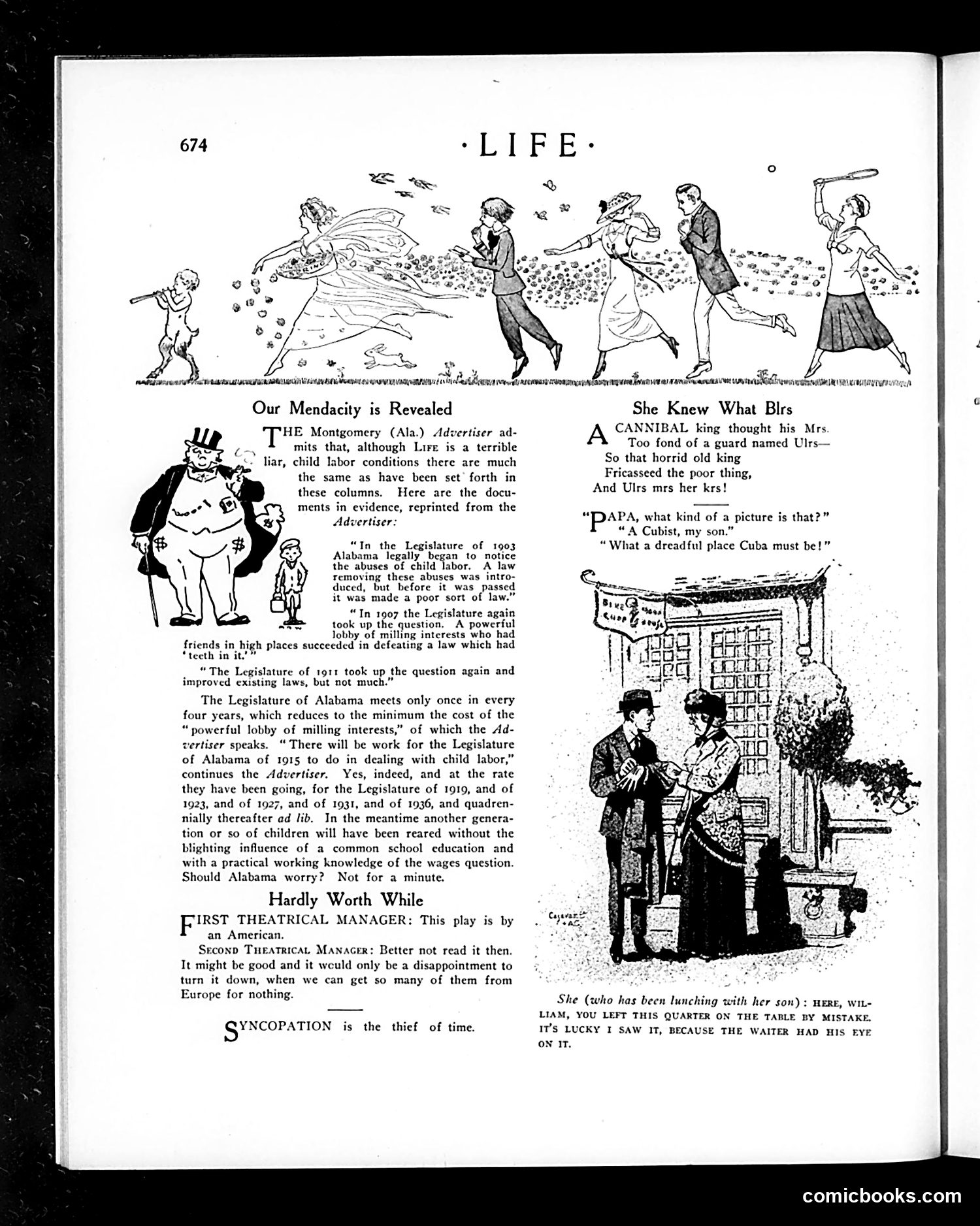
**Top Illustration**: "Our Mendacity is Revealed" depicts figures scattering coins or small objects—likely satirizing dishonesty or corruption being exposed. **Left Section** ("Hardly Worth While"): Critiques child labor abuses in Alabama. The caricatured fat figure wearing a top hat represents wealthy industrial interests or politicians. The text documents Alabama's legislature repeatedly failing to pass meaningful child labor protections between 1903-1931, despite mounting evidence of exploitation. The satire targets the "powerful lobby of milling interests" blocking reform legislation. **Right Section** ("She Knew What Birs"): A humorous domestic exchange between a mother and son about a "dreadful picture" (likely referring to Cuba), presented as a comedic cultural commentary rather than political satire. The page primarily attacks industrial corruption and legislative inaction on worker protection.
📄 Transcribed text from this page (OCR, searchable)
Machine-transcribed from the original scan — historical spelling and the odd misread are preserved.
2 . oo } i re) é as ra Wl RABUN NBA SI oe 5 UW URE EN LR AV ASERWRNE BRAIN AS ROUTE 8 i HE I MS ANA OR LHR NRT aa Our Mendacity is Revealed HE Montgomery (Ala.) Advertiser ad- \ mits that, although Lire is a terrible ‘. liar, child labor conditions there are much the same as have been set’ forth in these columns. Here are the docu- ments in evidence, reprinted from the Advertiser: “In the Legislature of 1903 Alabama legally began to notice the abuses of child labor. A law removing these abuses intro- duced, but before it was passed it was made a poor sort of law.” “In 1907 the Legislature again took up the question. A powerful lobby of milling interests who had friends in high places succeeded in defeating a law which had ‘teeth in it “The Legislature of 1911 took up the question again and improved existing laws, but not much.” The Legislature of Alabama meets only once in every four years, which reduces to the minimum the cost of the “powerful lobby of milling interests,” of which the Ad- vertiser speaks. “ There will be work for the Legislature of Alabama of 1915 to do in dealing with child labor,” continues the Advertiser. Yes, indeed, and at the rate they have been going, for the Legislature of 1919, and of 1923, and of 1927, and of 1931, and of 1936, and quadren- nially thereafter ad /ib. In the meantime another genera- tion or so of children will have been reared without the blighting influence of a common school education and with a practical working knowledge of the wages question. Should Alabama worry? Not for a minute. Hardly Worth While IRST THEATRICAL MANAGER: This play is by an American. Seconp THEATRICAL MANAGER: Better not read it then. It might be good and it weuld only be a disappointment to turn it down, when we can get so many of them from Europe for nothing. GEASOEATION is the thief of time. She Knew What Blrs CANNIBAL king thought his Mrs. Too fond of a guard named Ulrs— So that horrid old king Fricasseed the poor thing, And Ulrs mrs her krs! “PAPA, what kind of a picture is that?” “A Cubist, my son.” “What a dreadful place Cuba must be!” ae | acc ta sims ea eas 45 She (who has been lunching with her son): were, wiL- LIAM, YOU LEFT THIS QUARTER ON THE TABLE BY MISTAKE. 11'S LUCKY I SAW IT, BECAUSE THE WAITER HAD HIS EYE ON IT. comicbooks.com