
Life, 1913-04-03 · page 13 of 52
Life — April 3, 1913 — page 13: what you’re looking at
What you’re looking at
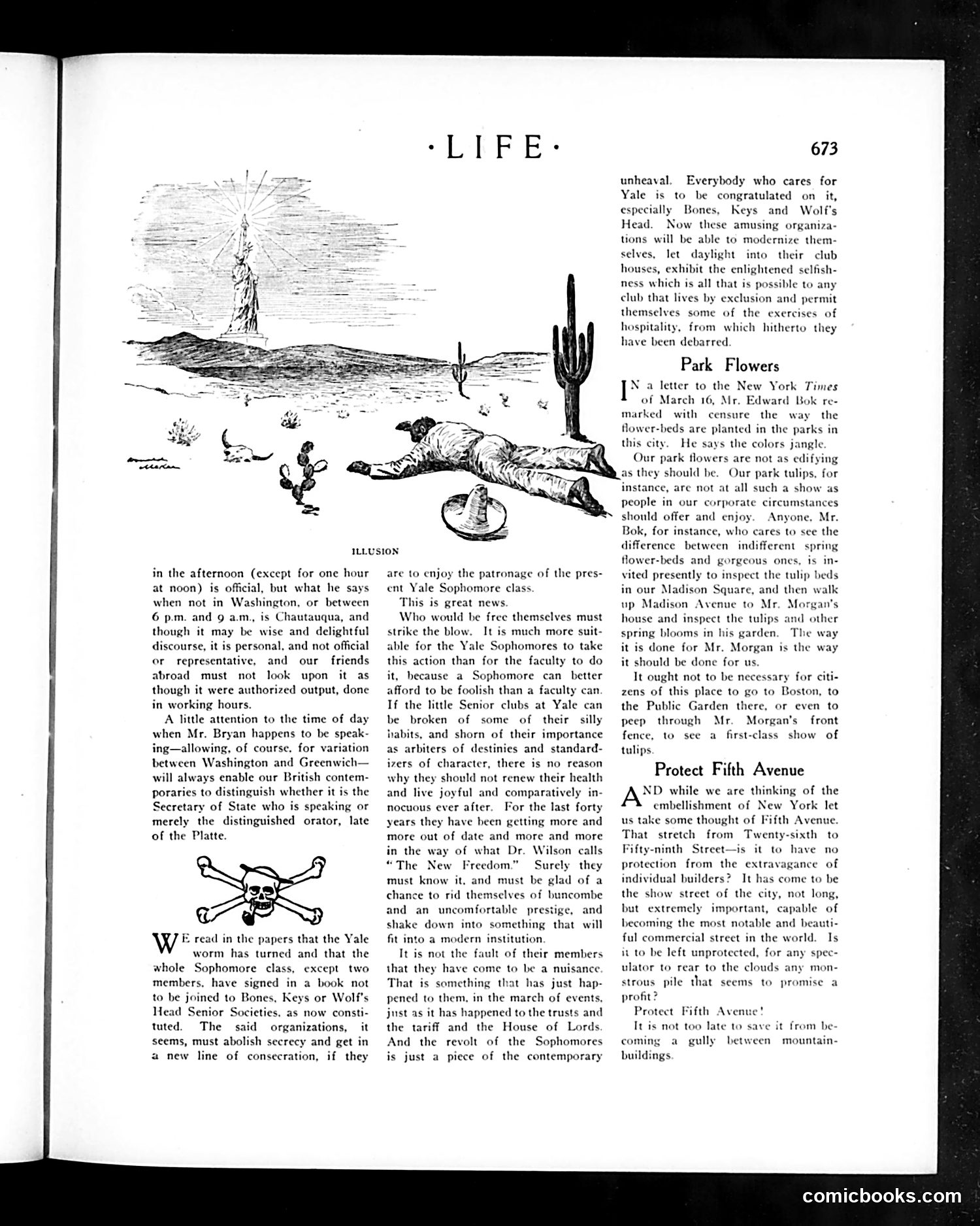
This page contains three distinct pieces of social commentary, not political cartoons: 1. **"Illusion"** - A sketch showing a man lying in a desert with cacti, commenting on Yale's administrative claims. The text critiques Yale's leadership for claiming Sophomores should "strike the blow" against faculty misconduct, while noting this is merely self-serving posturing. 2. **"Park Flowers"** - Discussion of spring flower displays in NYC parks, advocating for public enjoyment of natural beauty over ornamental shows. 3. **"Protect Fifth Avenue"** - Editorial urging protection of Fifth Avenue's architectural character against development by speculators, framed as preserving the city's notable beauty. The skull-and-crossbones illustration appears unrelated to the text sections. Overall, these pieces target institutional hypocrisy, commercialism, and urban development—typical Life magazine satirical concerns.
📄 Transcribed text from this page (OCR, searchable)
Machine-transcribed from the original scan — historical spelling and the odd misread are preserved.
ILLUSION in the afternoon (except for one hour at noon) is official, but what he says when not in Washington, or between 6 p.m. and 9 a.m, is Chautauqua, and though it may be wise and delightful discourse, it is personal, and not official or representative, and our friends abroad must not look upon it as though it were authorized output, done in working hours. A little attention to the time of day when Mr. Bryan happens to be speak- ing—allowing, of course, for variation between Washington and Greenwich— will always enable our British contem- poraries to distinguish whether it is the Secretary of State who is speaking or merely the distinguished orator, late of the Platte. W = read in the papers that the Yale worm has turned and that the whole Sophomore cla: except two members, have signed in a book not to be joined to Bones, Keys or Wolf's Head Senior Societies, as now consti- tuted. The said organizations, it seems, must abolish secrecy and get in a new line of consecration, if they are to enjoy the patronage of the pres- ent Yale Sophomore class. This is great news. Who would be free themselves must strike the blow. It is much more suit- able for the Yale Sophomores to take this action than for the faculty to do it, because a Sophomore can_ better afford to be foolish than a faculty can If the little Senior clubs at Yale can be broken of some of their’ silly habits, and shorn of their importance as arbiters of destinies and standard- izers of character, there is no reason why they should not renew their health and live joyful and comparatively in- nocuous ever after. For the last forty years they have been getting more and more out of date and more and more in the way of what Dr. Wilson calls “The New Freedom. Surely they must know it, and must be glad of a chance to rid themselves of buncombe and an uncomfortable prestige, and shake down into something that will fit into a modern institution It is not the fault of their members that they have come to be a nuisance. That is something that has just hap- pened to them, in the march of events, just as it has happened to the trusts and the tariff and the House of Lords And the revolt of the Sophomores is just a piece of the contemporary 673 unheaval. Everybody who cares for Yale is to be congratulated on it, especia Keys and Wolf's Head. Now these amusing organiza- tions will be able to modernize them- selves, let daylight into. their club houses, exhibit the enlightened selfish- ness which is all that is possible to a club that lives by exclusion and permit themselves some of the exercises of ly Bones, hospitality, from which hitherto. they have been debarred Park Flowers a a letter to the New York Time: of March 16, Mr. Edward Bok re- marked with censure the way the flower-beds are planted in the parks in this city. He says the colors jangle. Our park flowers are not as edifying as they should be. Our park tulips, for instance, are not at all such a show as people in our corporate circumstances should offer and enjoy. Anyone, Mr. Bok, for instance, who cares to see the difference between indifferent’ spring flower-beds and gorgeous ones, is in- vited presently to inspect the tulip beds in our Madison Square, and then walk up Madison Avenue to Mr. Morgan's house and inspect the tulips and other spring blooms in his garden. The way it is done for Mr. Morgan is the way it should be done for us. It ought not to be necessary for citi- zens of this place to go to Boston, to the Public Garden there, or even to peep through Mr. Morgan's front fence, to see a show of tulips. Protect Fifth Avenue D while we are thinking of the embellishment of New York let us take some thought of Fifth Avenue. That stretch from Twenty-sixth to Fifty-ninth Street—is it to have no protection from the extravagance of individual builders? It has come to be the show street of the city, not long, first s but extremely important, capable of becoming the most notable and beauti- ful commercial street in the world. Is it to be left unprotected, for any spec- ulator to rear to the clouds any mon- strous pile that seems to promise a profit? Protect Fifth It is not too late to save it from be- gully between mountain- Avenue! coming a buildings comicbooks.com