
Life, 1913-04-03 · page 28 of 52
Life — April 3, 1913 — page 28: what you’re looking at
What you’re looking at
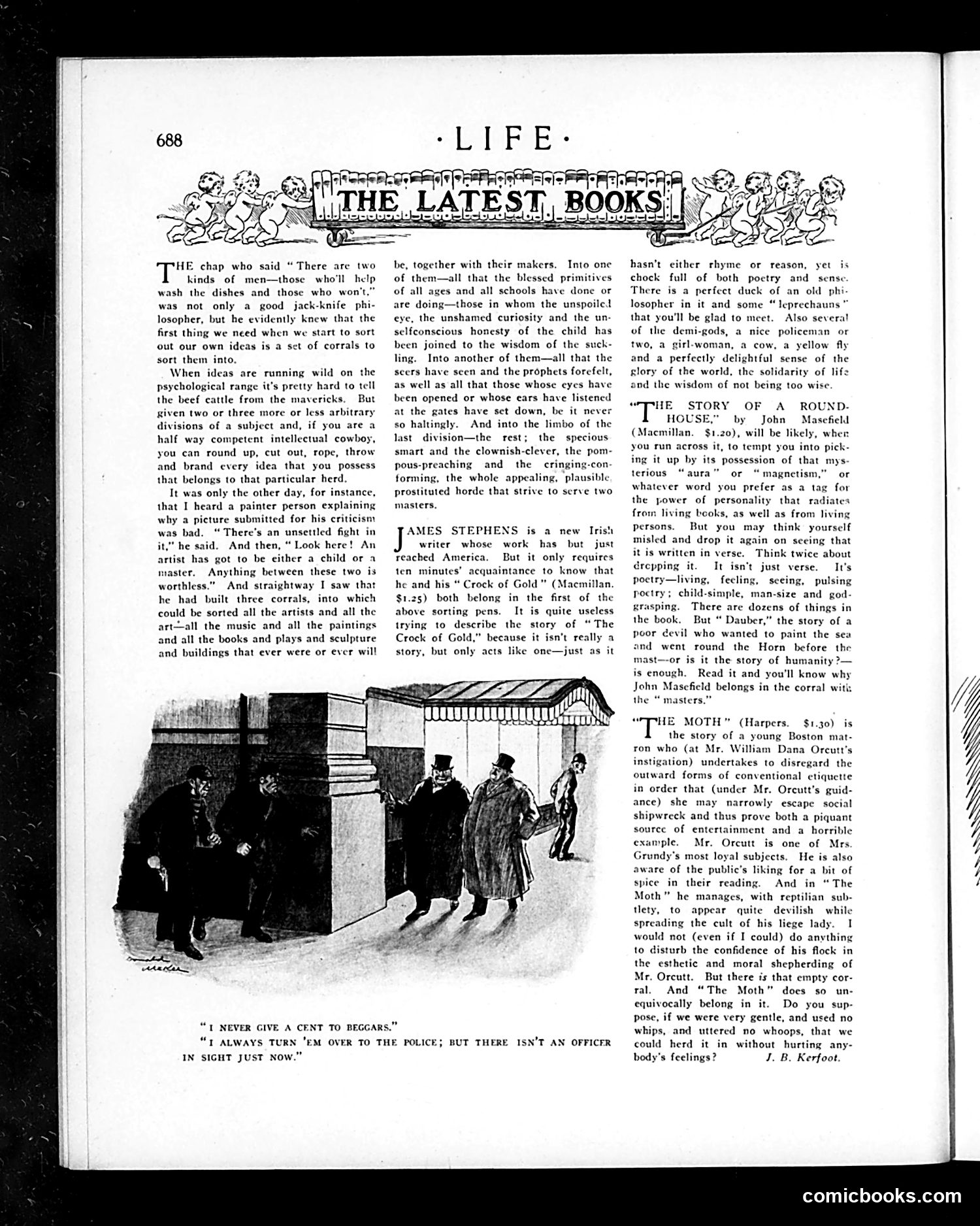
This page reviews three new books through literary criticism. The main text discusses James Stephens's *Crock of Gold* and John Masefield's *The Story of a Round-House*, praising both as genuine artistic works belonging among "primitives" and "seers" rather than derivative mediocrity. The small cartoon below depicts a beggar accosting well-dressed pedestrians outside what appears to be a theater or public building. The caption reveals the beggar's cynical strategy: "I never give a cent to beggars. I always turn 'em over to the police; but there isn't an officer in sight just now." **The joke:** The "respectable" man claims moral superiority by refusing beggars and turning them to authorities—yet when no police are present, he'll apparently give money anyway, exposing his stated principles as mere social posturing rather than genuine conviction. It's satire on Victorian hypocrisy and selective morality.
📄 Transcribed text from this page (OCR, searchable)
Machine-transcribed from the original scan — historical spelling and the odd misread are preserved.
HE chap who said “There are two kinds of men—those who'll help wash the dishes and those who won't,” was not only a good jack-knife ph losopher, but he evidently knew that the first thing we need when we start to sort out our own ideas is a set of corrals to sort them into, When ideas are running wild on the psychological range it’s pretty hard to tell the beef cattle from the mavericks. But given two or three more or less arbitrary divisions of a subject and, if you are a half way competent intellectual cowboy, you can round up, cut out, rope, throw and brand every idea that you possess that belongs to that particular herd. It was only the other day, for instance, that I heard a painter person explaining why a picture submitted for his crit was bad. “There's an unsettled fight in it," he said. And then, “Look here! An artist has got to be either a child or a master. Anything between these two is worthless.” And straightway I saw th he had built three corrals, into. which could be sorted all the artists and all the art—all the music and all the paintings and all the books and plays and sculpture and buildings that ever were or ever will be, together with their makers. Into one of them—all that the blessed primitives of all ages and all schools have done or are doing—those in whom the unspoiled eye, the unshamed curiosity and the un- selfconscious honesty of the child has been joined to the wisdom of the suck- ling. Into another of them—all that the scers have seen and the prophets forefelt, as well as all that those whose eyes have been opened or whose ears have listened at the gates have set down, be it never so haltingly. And into the limbo of the last. division—the rest; the specious smart and the clownish-clever, the pom- pous-preaching and the cringing-con forming, the whole appealing, ‘plausible prostituted horde that strive to serve two masters. AMES STEPHENS is writer whose work has but just reached America. But it only requires ten minutes’ acquaintance to know that he and his “ Crock of Gold" (Macmillan. $1.25) both belong in the first of the above sorting pens. It is quite useless trying to describe the story of “The Crock of Gold,” because it isn't really a story, but only acts like one—just as it a new Irish VER GIVE A CENT TO BEGGARS.” “T ALWAYS TUR: IN SIGHT JUST Now. ‘EM OVER TO THE POLICE; BUT THERE ISN’T AN OFFICER hasn't either rhyme or reason, yet is chock full of both poetry and sense There is a perfect duck of an old phi losopher in it and some “ leprechauns that you'll be glad to meet. Also several of the demi-gods, a nice policeman or two, a girl-woman, a cow, a yellow fly and a perfectly delightful sense of the glory of the world, the solidarity of life and the wisdom of not being too wise “THE STORY OF A ROUND- HOUSE,” by John Masefield (Macmillan. $1.20), will be likely, whe you run across it, to tempt you into pick- ing it up by its possession of that mys terious “aura” or “magnetism,” or whatever word you prefer as a tag for the power of personality that radiates from living beoks, as well as from living persons. But you may think yourself misled and drop it again on sceing that it is written in verse. Think twice about erepping it. It isn’t just verse. It's poctry—living, feeling, sceing, pulsing poctry; child-simple, man-size and god- grasping. There are dozens of things in the book. But “ Dauber,” the story of a poor devil who wanted to paint the sea and went round the Horn before the mast—or is it the story of humanity ?— is enough. Read it and you'll know why John Masefield belongs in the corral the “ masters.” “He MOTH” (Harpers. $1.30) is the story of a young Boston mat- ron who (at Mr. William Dana Oreutt’s instigation) undertakes to disregard the outward forms of conventional etiquette in order that (under Mr. Orcutt's guid- ance) she may narrowly escape social shipwreck and thus prove both a piquant source of entertainment and a horrible example. Mr. Orcutt is one of Mrs Grundy's most loyal subjects. He is also aware of the public’s liking for a bit of spice in their reading. And in ‘The Moth” he manages, with reptilian sub- tlety, to appear quite devilish while spreading the cult of his liege lady. 1 would not (even if I could) do anything to disturb the confidence of his flock in the esthetic and moral shepherding of Mr. Orcutt. But there is that empty cor- ral. And “The Moth” docs so un- equivocally belong in it. Do you sup- pose, if we were very gentle, and used no whips, and uttered no whoops, that we could herd it in without hurting any- body's feelings? J. B. Kerfoot comicbooks.com