
A complete issue · 36 pages · 1913
Life — January 30, 1913
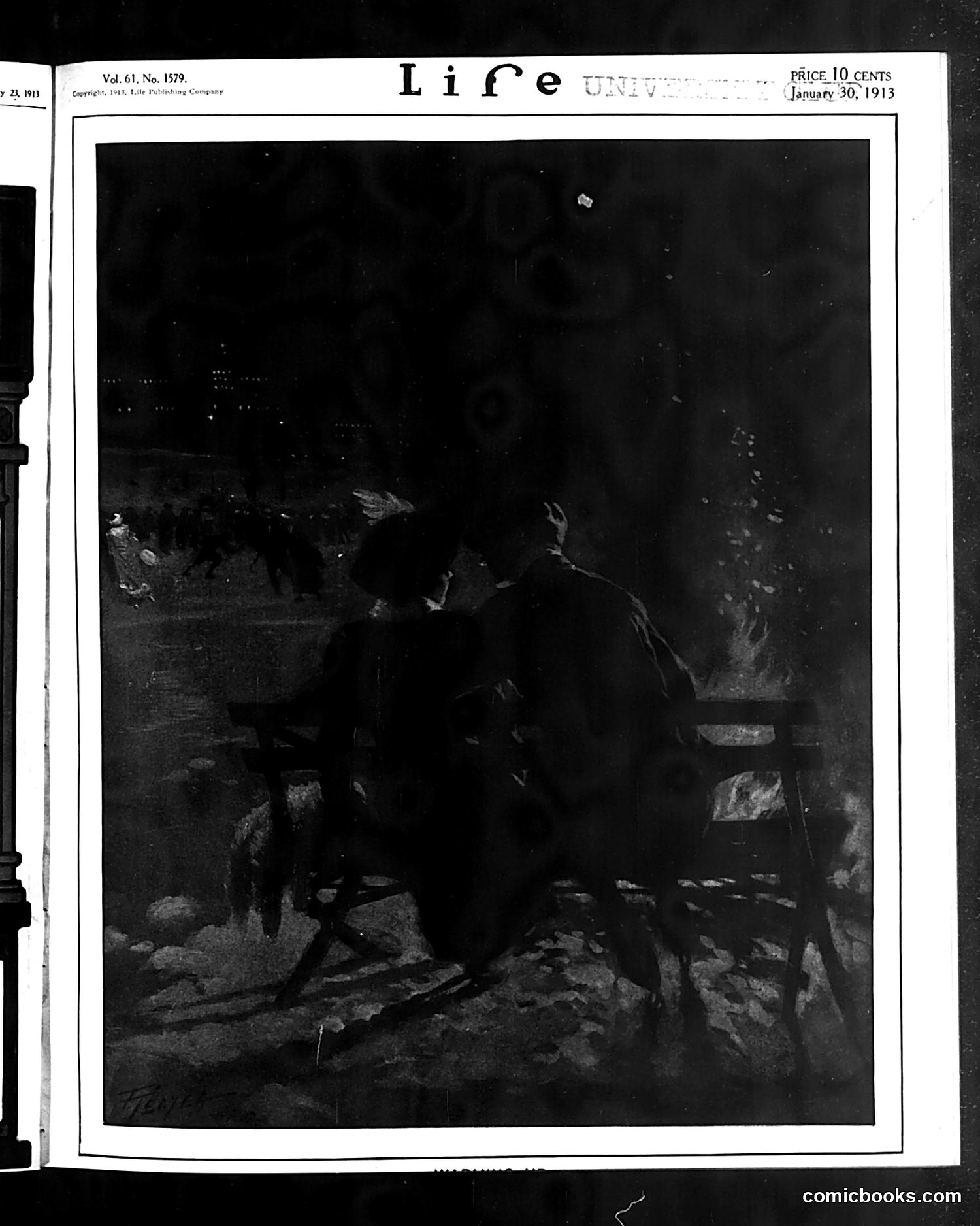
I can see this is a Life magazine cover from January 30, 1913, but the image quality is too dark and degraded to reliably identify specific figures or read any accompanying text that would explain the cartoon's meaning. The photograph appears to show several figures in an indoor setting at night or in low light, with what looks like furniture visible. Without clearer visibility of faces, clothing details, or legible caption text, I cannot confidently identify who is depicted or what political or social event this satirizes. To provide accurate historical context about this cartoon's references and satirical point, I would need either a higher-quality image or additional source documentation about this specific Life issue.
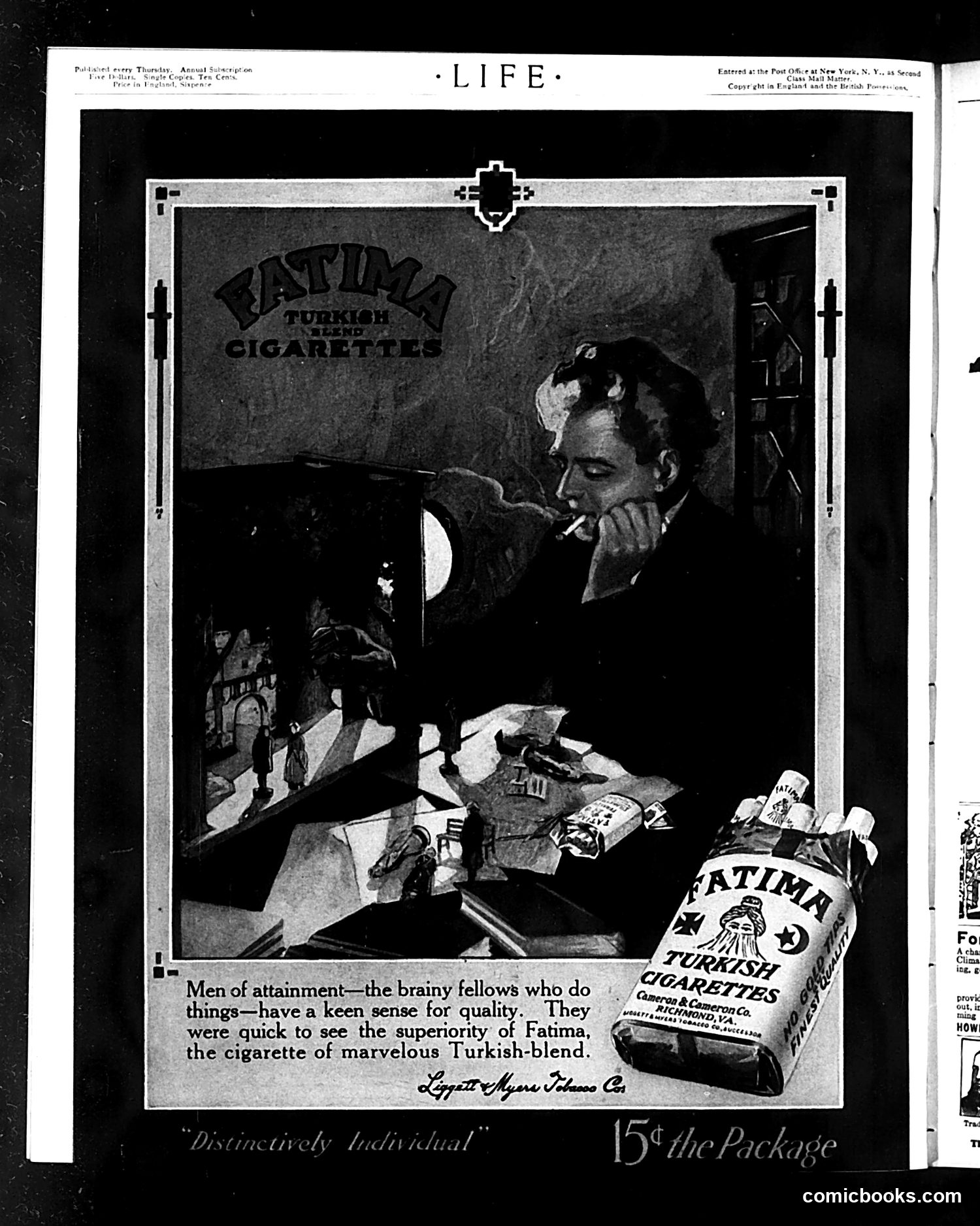
This is primarily a **cigarette advertisement**, not political satire. The ad promotes Fatima Turkish Cigarettes, featuring a well-dressed man examining a package by lamplight with an appreciative expression. The accompanying text claims that "men of attainment—the brainy fellows who do things" recognize Fatima's superior quality and "Turkish-blend" composition. This represents a common early 20th-century advertising strategy: associating consumer products with sophistication, intelligence, and social status. The phrase "Distinctly Individual" emphasizes the brand's exclusivity appeal. The price of "15¢ the Package" suggests a premium product marketed to affluent readers of Life magazine. There is no political commentary—this is straightforward vintage consumer marketing using aspirational messaging.
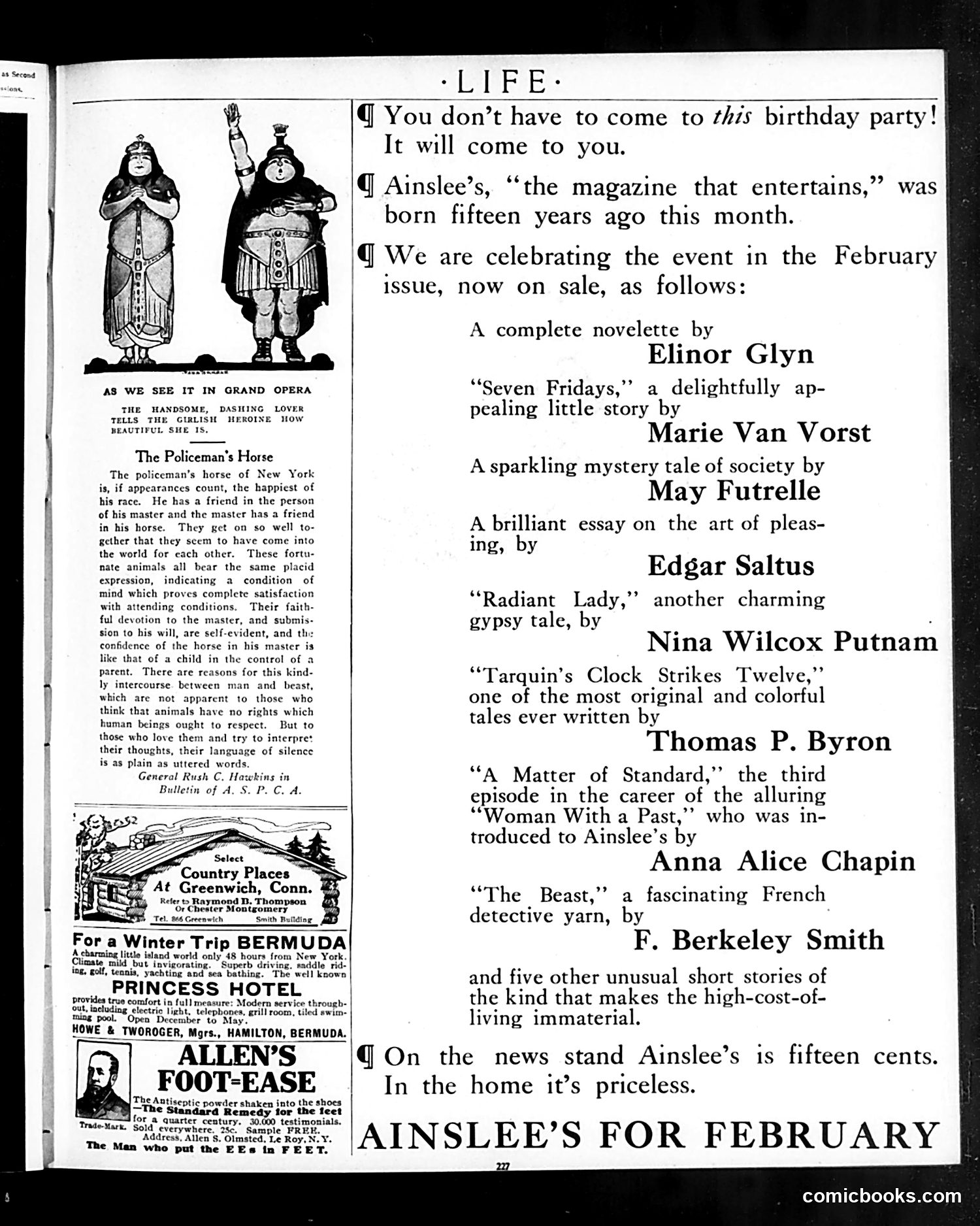
The top illustration labeled "AS WE SEE IT IN GRAND OPERA" depicts two figures in elaborate historical costumes—likely Egyptian or ancient royal dress. The caption reads "THE HANDSOME, DASHING LOVER TELLS THE GIRLISH HEROINE HOW BEAUTIFUL SHE IS." This appears to be satirizing operatic conventions: the exaggerated melodrama of grand opera, where characters deliver overwrought compliments in ornate settings. The joke targets the absurdity of opera's theatrical excess and artificial dialogue—the contrast between the grandiose staging and the simple, repetitive nature of romantic flattery. The remainder of the page advertises Ainslee's magazine's 15th birthday celebration, listing contributing authors and stories for the February issue. This is primarily advertising content rather than political or social satire.
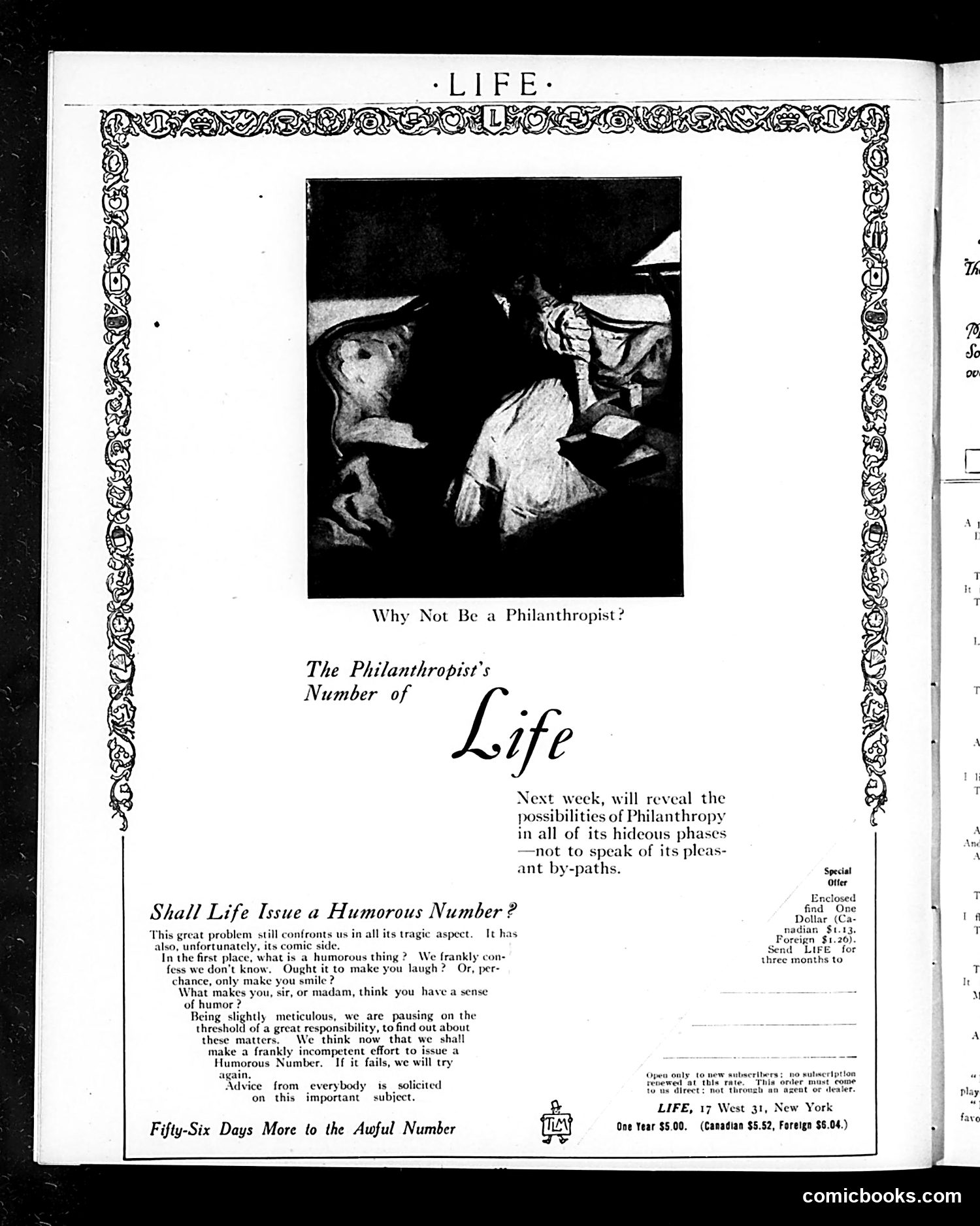
This page promotes an upcoming "Humorous Number" on philanthropy. The central image shows what appears to be a wealthy donor meeting with charity recipients or administrators—a visual commentary on charitable giving. The satirical framing asks "Why Not Be a Philanthropist?" and "Shall Life Issue a Humorous Number?"—suggesting philanthropy itself is worthy of humor. The text acknowledges the "comic side" of charitable work while claiming Life will explore philanthropy's "hideousness" and "pleasant by-paths," indicating satire about both the genuine good and hypocritical motivations behind wealthy donors. The page is essentially promotional material for a future issue, using satire to promise humorous examination of charitable practices and the social dynamics between rich benefactors and recipients.
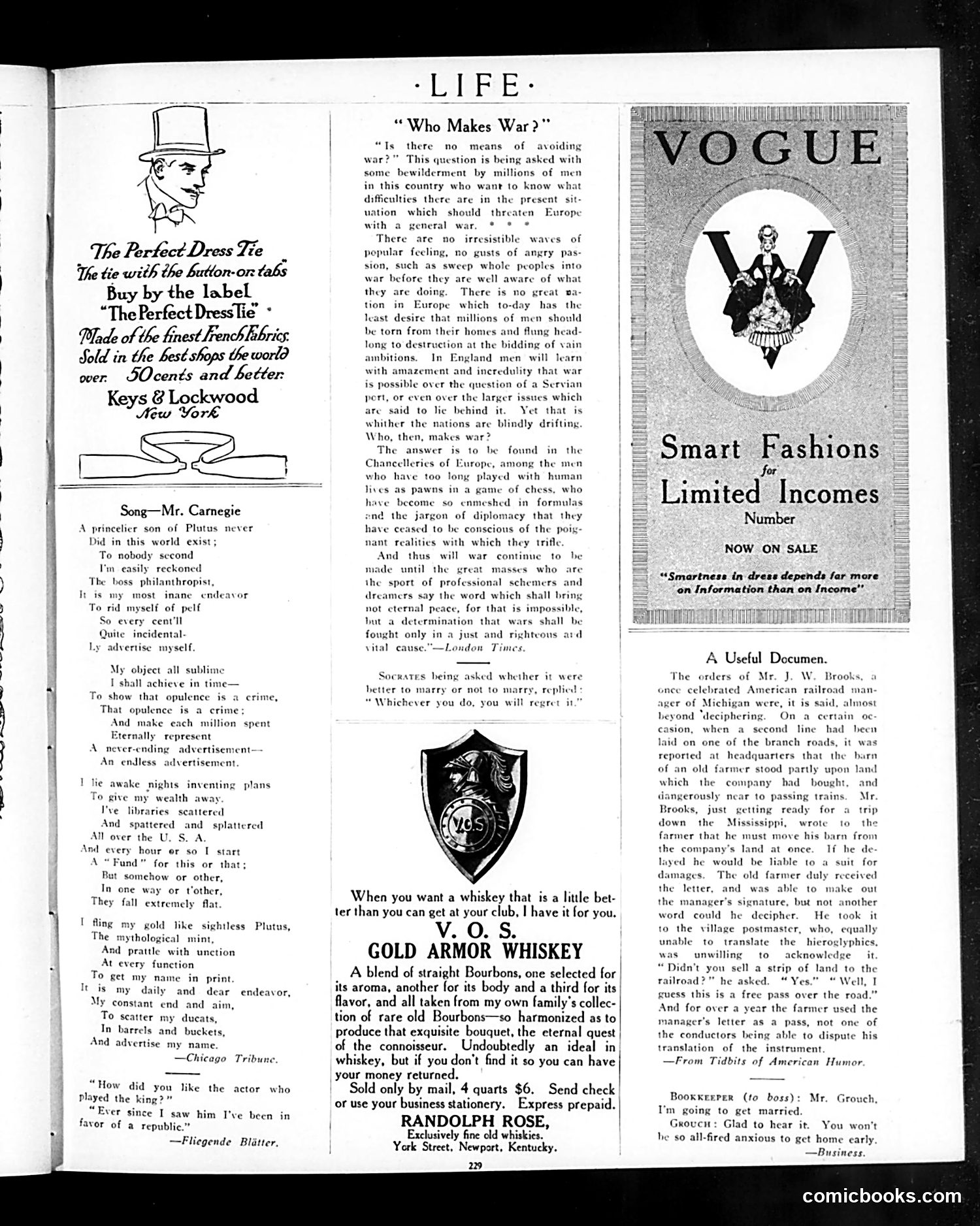
This page is primarily **advertising and miscellaneous content** rather than political satire. The main elements include: 1. **Advertisement for "The Perfect Dress Tie"** (top left) – a commercial pitch for neckwear, with an illustrated gentleman's head. 2. **"Who Makes War?" article** (center) – discussing European power structures and military ambitions, apparently debating whether ordinary citizens or political/diplomatic elites drive warfare decisions. 3. **Vogue advertisement** (right) – promoting fashionable clothing for budget-conscious women. 4. **Carnegie song and various advertisements** (bottom) – including V.O.S. Gold Armor Whiskey and other products. The page reflects early 20th-century Life magazine's mixed format of light humor, commentary, and commercial advertisements rather than focused political cartooning.
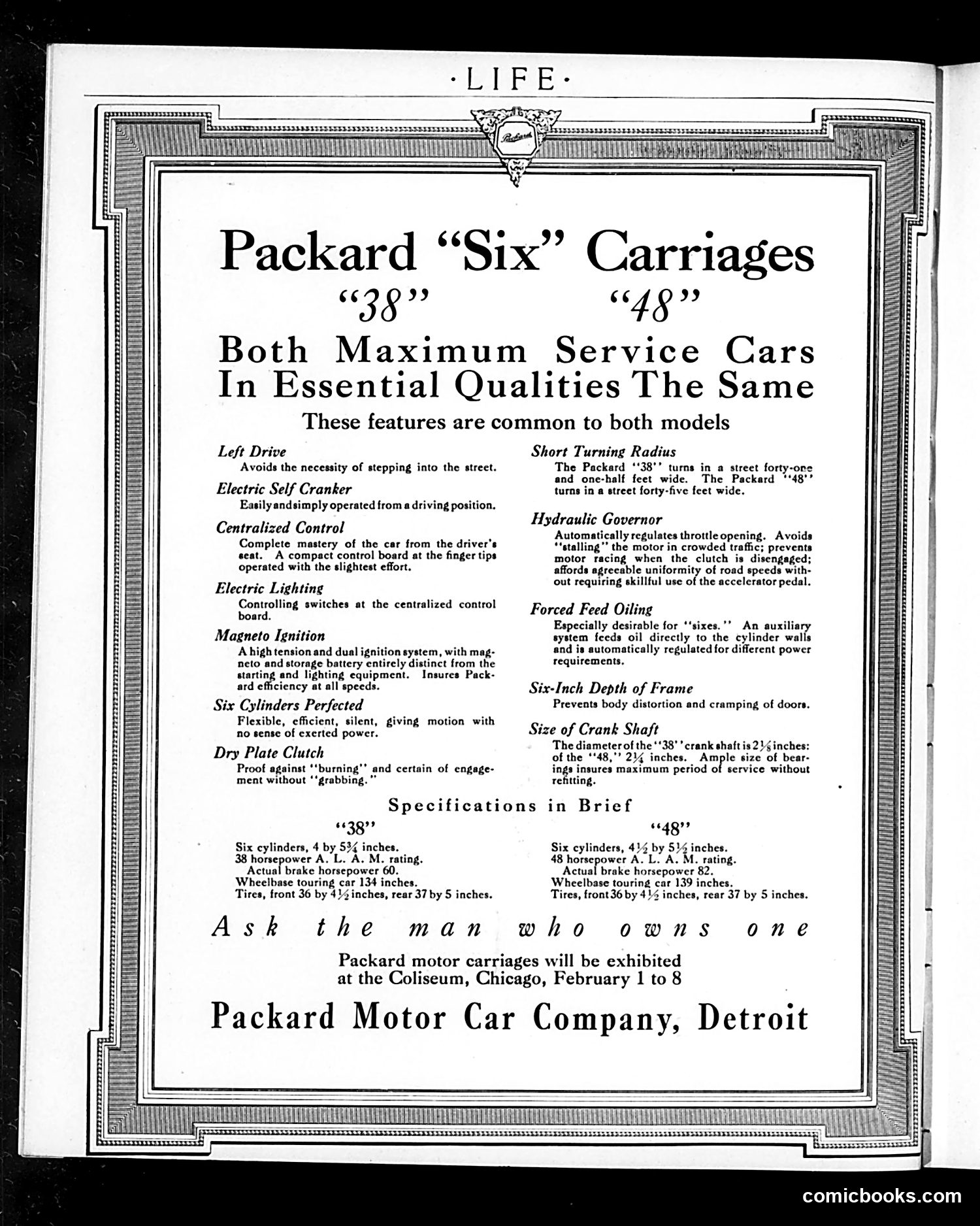
This page is **not a cartoon or satire**—it's a straightforward automobile advertisement from *Life* magazine for the Packard Motor Car Company of Detroit. The ad promotes two luxury car models: the "38" and "48," both six-cylinder vehicles marketed as "Maximum Service Cars." It highlights shared features like left-hand drive, electric self-starter, centralized controls, and hydraulic governor. Specifications compare the two models' dimensions and horsepower. The ad concludes with an announcement that Packard vehicles will be exhibited at the Coliseum in Chicago, February 1-8. This represents typical early-20th-century automotive advertising: emphasizing mechanical innovation and engineering details to appeal to affluent buyers. There is no political or satirical content present.
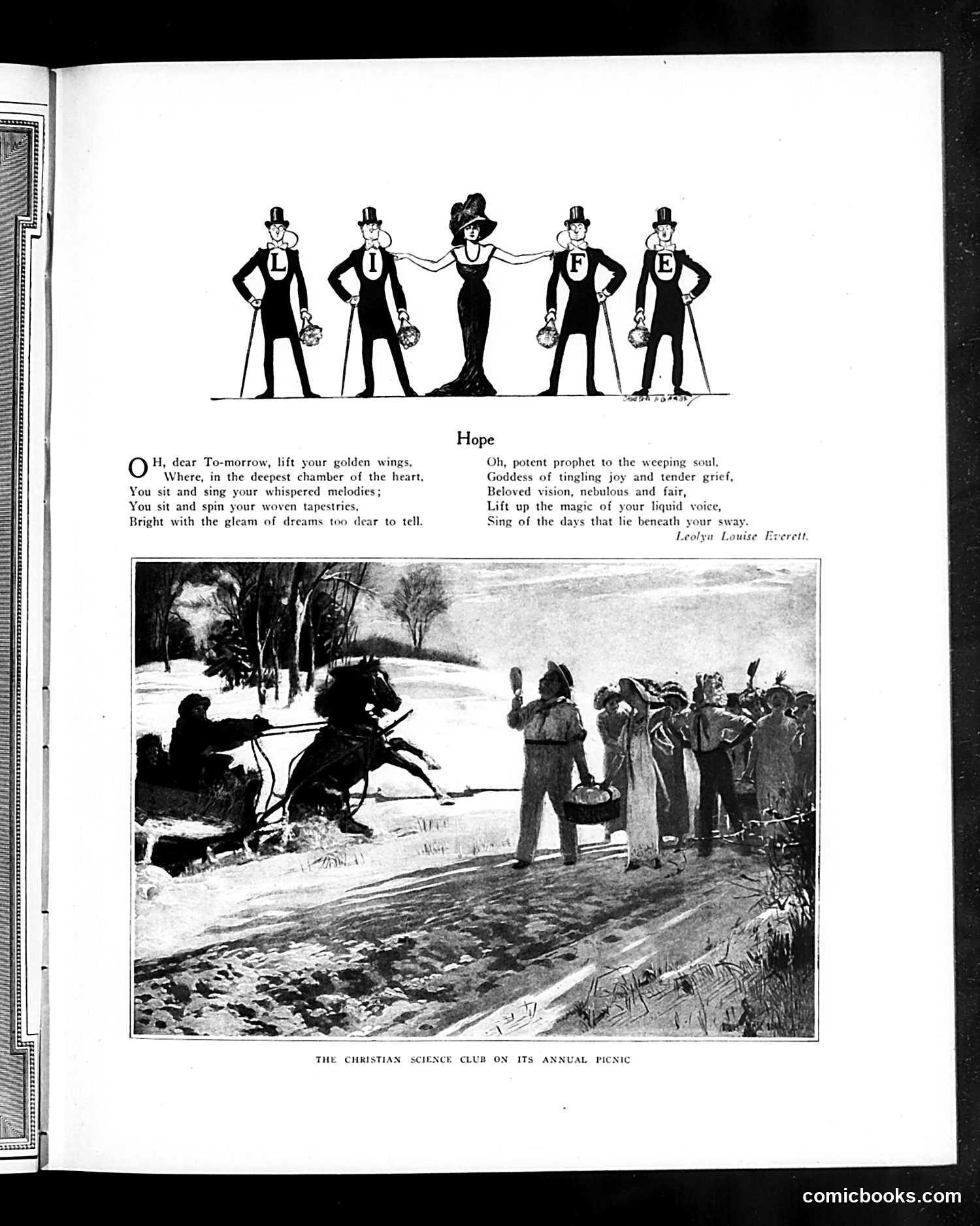
This page features a poem titled "Hope" by Leolya Louise Everett, accompanied by two images. The top illustration shows five figures in formal attire wearing letters spelling "LIFE," with the central figure (representing Hope) in an elegant gown holding hands with the others—a personification of abstract virtues common to early 20th-century satirical magazines. The photograph below depicts "The Christian Science Club on Its Annual Picnic," showing people in winter clothing by a frozen stream. The juxtaposition appears satirical: the idealistic poem about Hope contrasts with a mundane, cold reality of an actual club outing, likely mocking either Christian Science beliefs or the gap between aspirational rhetoric and ordinary lived experience.
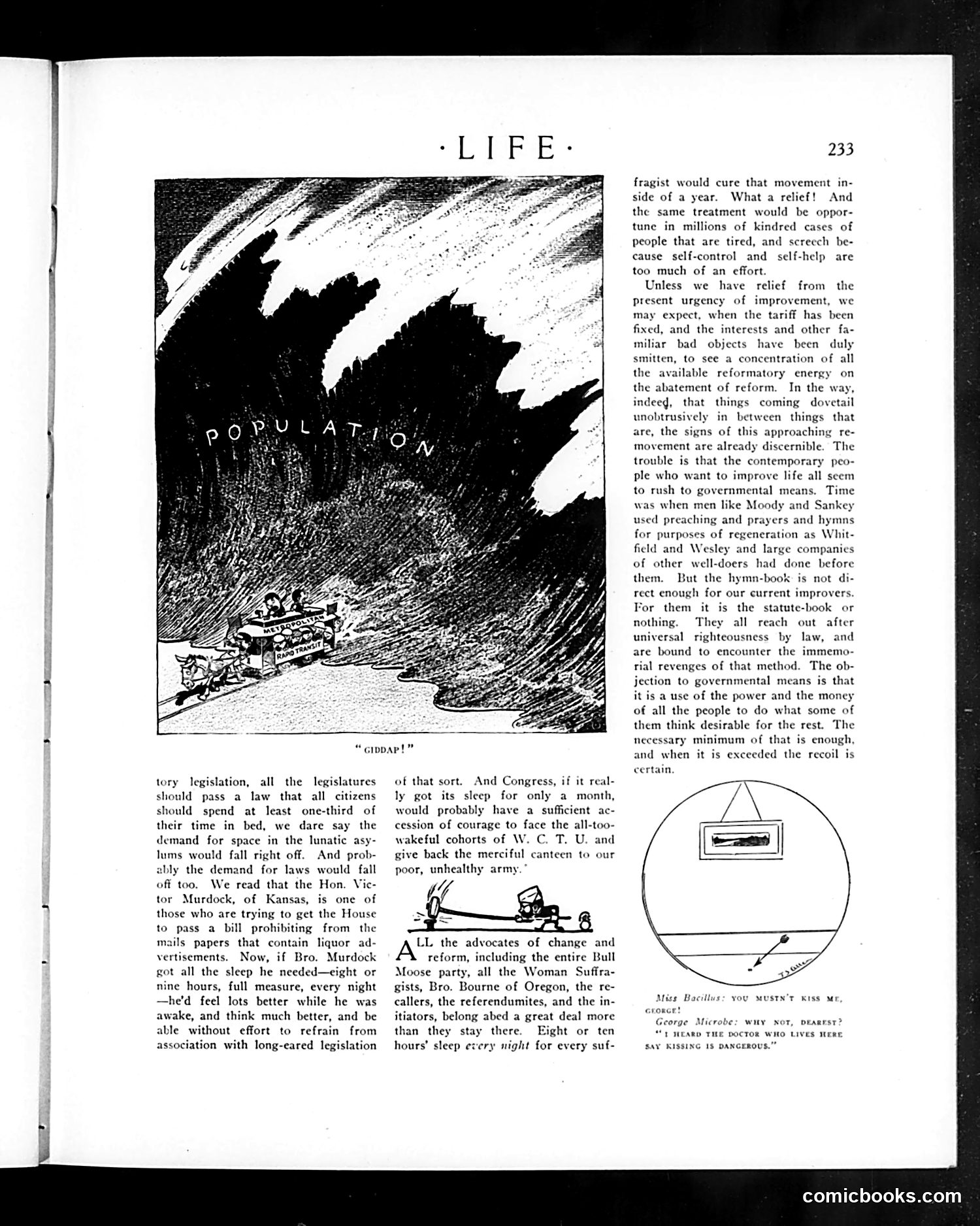
The main cartoon, titled "GIBBAP!" depicts a massive wave labeled "POPULATION" threatening tiny human figures below. The satire criticizes those advocating governmental intervention to solve social problems. The text argues that reformers—including "the Bull Moose party, all the Woman Suffragists, Bro. Bourne of Oregon, the recall advocates, and the initiators"—naively believe legislation alone can address population pressures and improve living conditions. The piece suggests their proposed governmental measures are inadequate against such overwhelming demographic forces. The small figures helplessly facing the enormous wave represent humanity's powerlessness against population growth, mocking reformers' optimism that laws and political changes can meaningfully solve systemic social problems. The cartoon expresses skepticism toward Progressive Era reform movements.
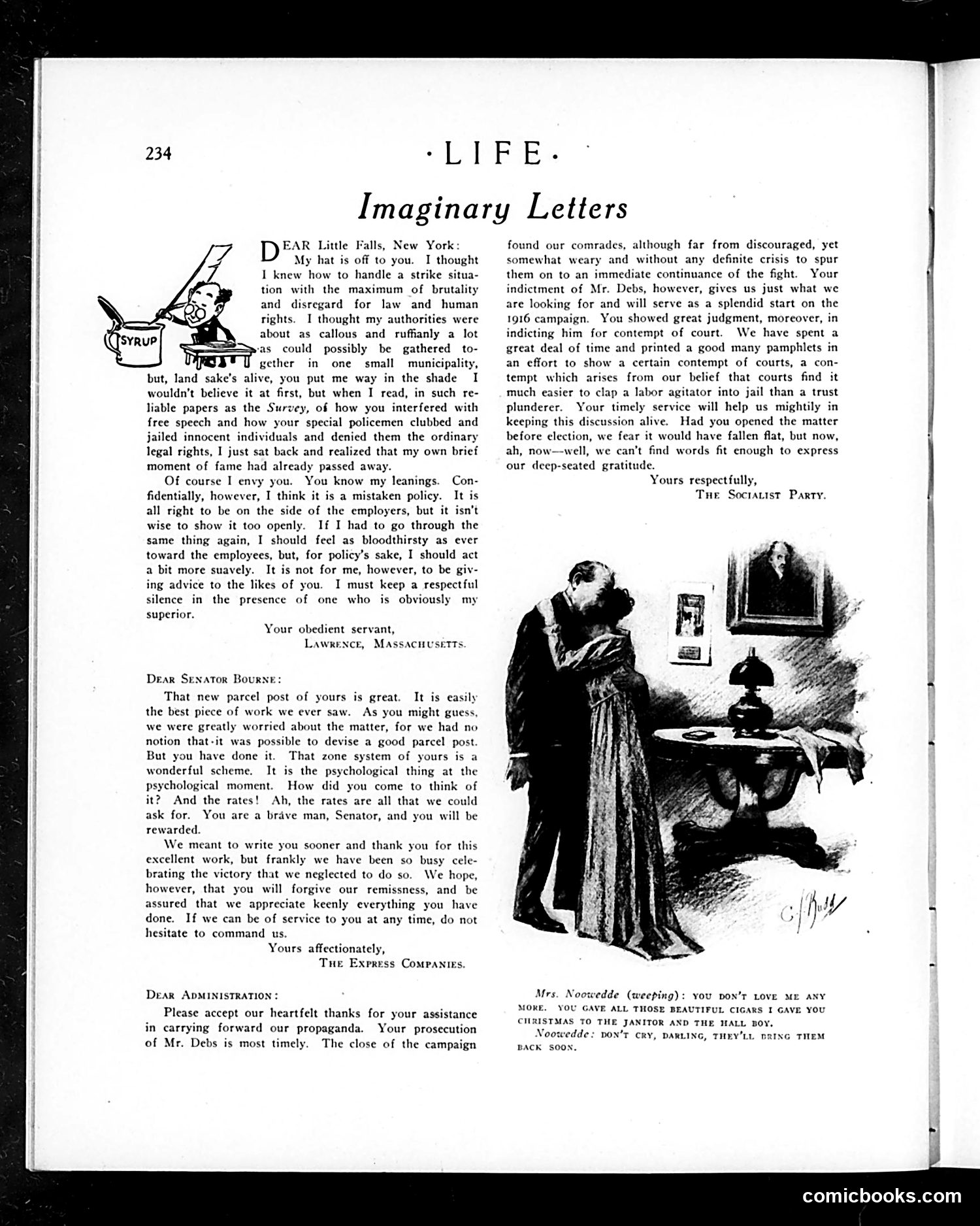
This page features satirical "letters" mocking political figures and events. The main illustration depicts a couple in an intimate moment, with the caption addressing "Mrs. Newcombe" about discarded cigars—likely a risqué joke about infidelity or hidden affairs. The letters themselves parody correspondence from various parties: one from Lawrence, Massachusetts complains about free speech restrictions and police brutality during labor disputes; another thanks "Senator Bourne" for creating a parcel post system; a third thanks the Administration for prosecuting "Mr. Debs" (likely Eugene V. Debs, the Socialist leader). The satire targets both labor suppression and political corruption of the early 20th century, using fake gratitude to expose hypocrisy. The cartoon style and tone suggest this is pre-1920s American political commentary.
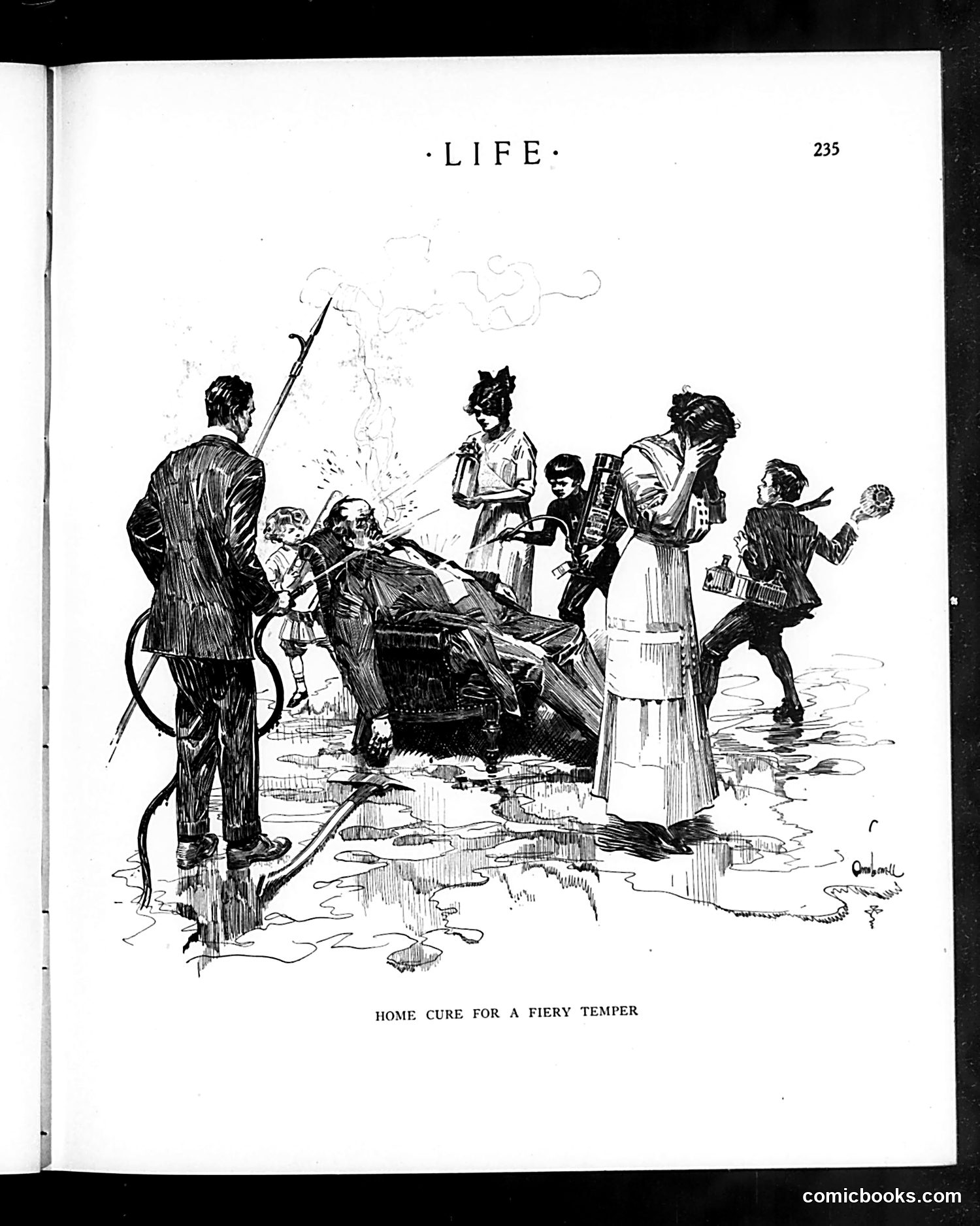
This satirical cartoon depicts a humorous "remedy" for childhood tantrums. A well-dressed man (likely a father) aims a fire hose at a child having an explosive outburst, while other family members—including what appears to be a mother and other children—watch or react nearby. The water spray is depicted as forceful and chaotic. The satire mocks outdated parenting philosophies of the early 20th century, likely commenting on harsh or extreme disciplinary methods. The cartoon suggests that such blunt, forceful approaches to managing children's emotions were both ineffective and absurd. The "cure" is presented as comically disproportionate to the problem, critiquing discipline methods considered overly severe or inappropriate.
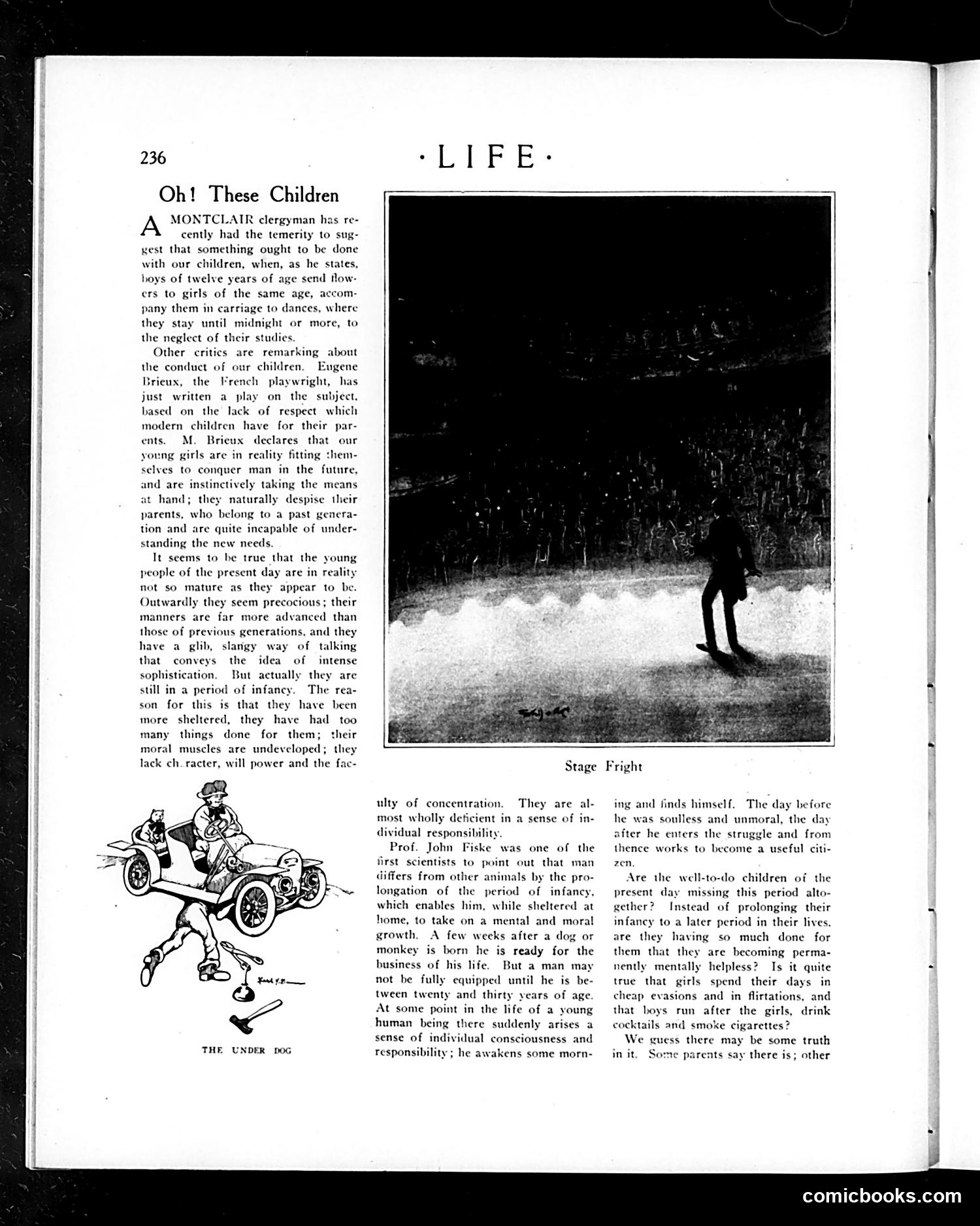
This page satirizes modern parenting and youth behavior. The article criticizes children's lack of respect for parents and insufficient moral development, citing French playwright Eugène Brieux's work on the subject. The cartoon labeled "The Under Dog" depicts a chauffeur or servant being dragged by a small child in an automobile—a visual joke about role reversal where children have become dominant over adults. The photograph titled "Stage Fright" shows a figure in formal attire, likely illustrating the article's broader point about children's premature sophistication and social anxiety. The piece argues that modern children appear precocious but are actually emotionally immature, having been overindulged and under-disciplined—a common Progressive-era social critique about generational decline and parenting failures.
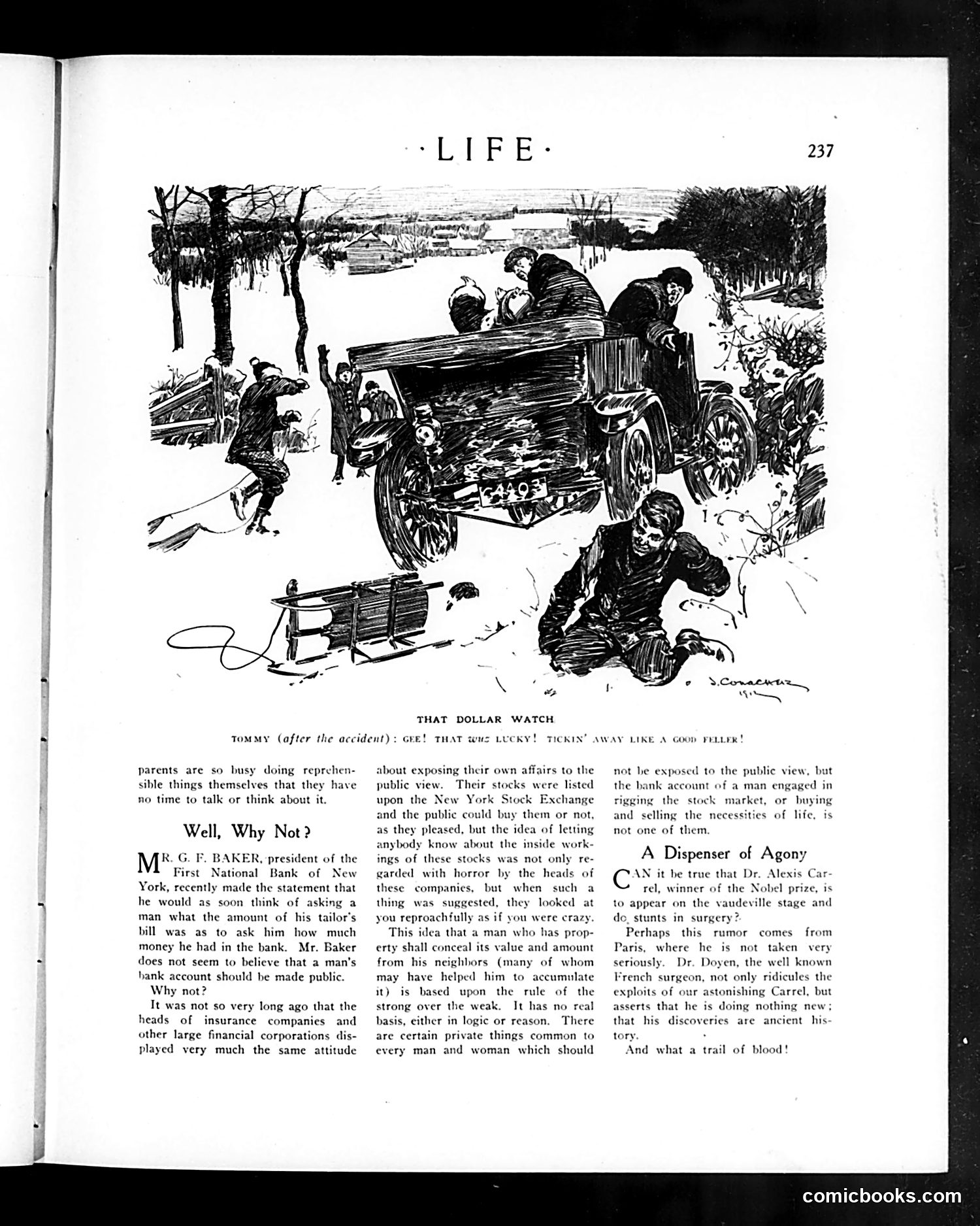
This cartoon depicts a winter accident scene involving an automobile. The caption shows "Tommy" (after an accident) exclaiming about a dollar watch ticking away "like a good feller" — suggesting the watch survived impact unscathed while the vehicle and occupants experienced misfortune. The satire targets early automobile safety concerns and the contrast between cheap, durable goods (the dollar watch) and expensive, fragile automobiles. The scene mocks the irony that an inexpensive timepiece proves more resilient than the costly machine designed for transportation. The accompanying article "Well, Why Not?" discusses banking transparency and financial disclosure, seemingly unrelated to the cartoon's automobile theme.
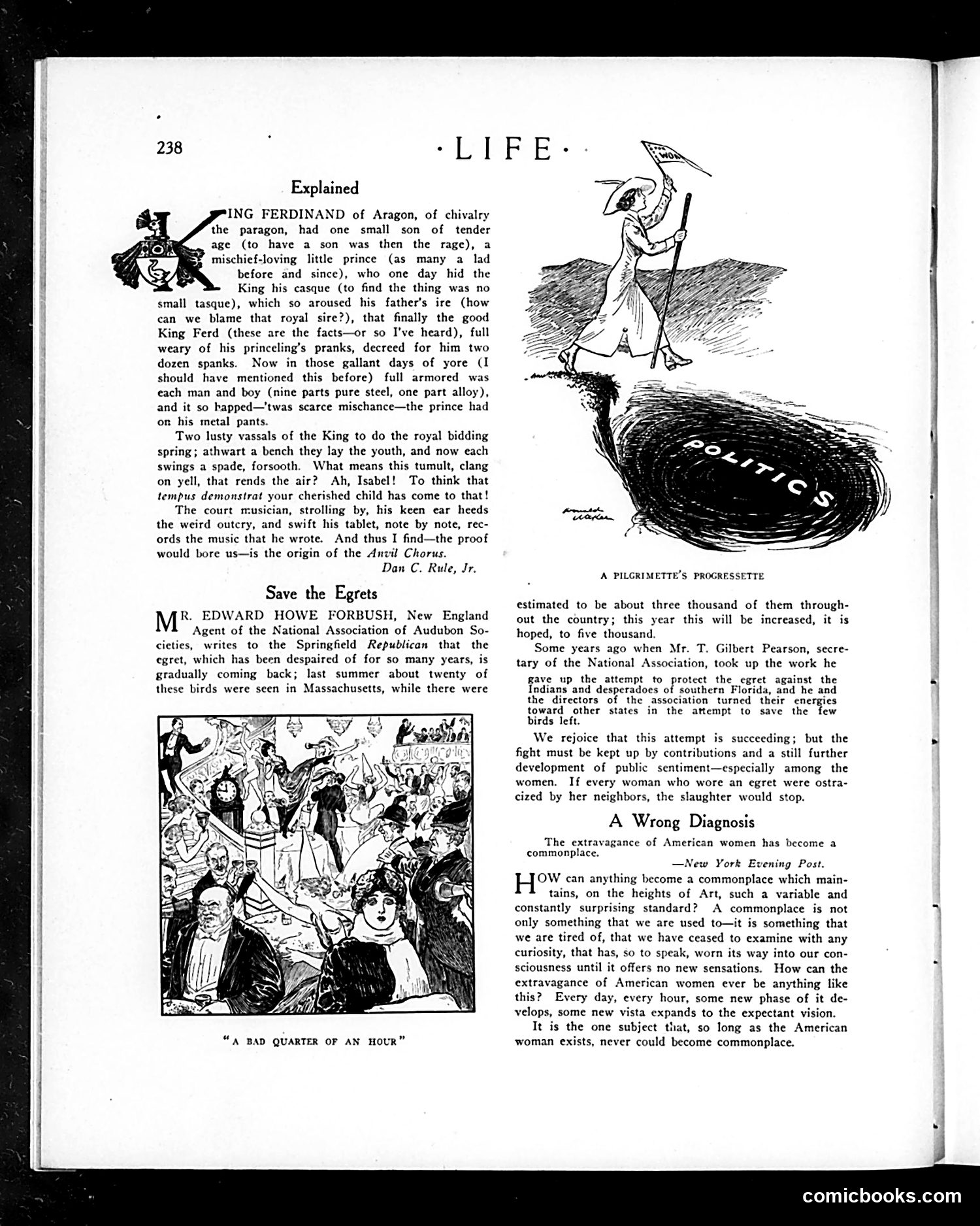
This page contains three distinct pieces: 1. **"Explained"** - A humorous story about King Ferdinand of Aragon and his mischievous son, written by Dan C. Rule, Jr. It's a whimsical historical anecdote about a prince hiding his father's casque, with an illustration showing a figure with a flag. 2. **"Save the Egrets"** - An advocacy piece by Edward Howe Forbush about protecting egrets from extinction. The accompanying illustration ("A Bad Quarter of an Hour") depicts a crowded scene, likely showing hunters or people pursuing egrets. 3. **"A Wrong Diagnosis"** - A social commentary critiquing the "extravagance of American women" as a cliché subject. It argues that women's constant evolution and varied interests prevent them from ever becoming truly commonplace. The page mixes lighthearted fiction, conservation advocacy, and social critique typical of Life's satirical format.
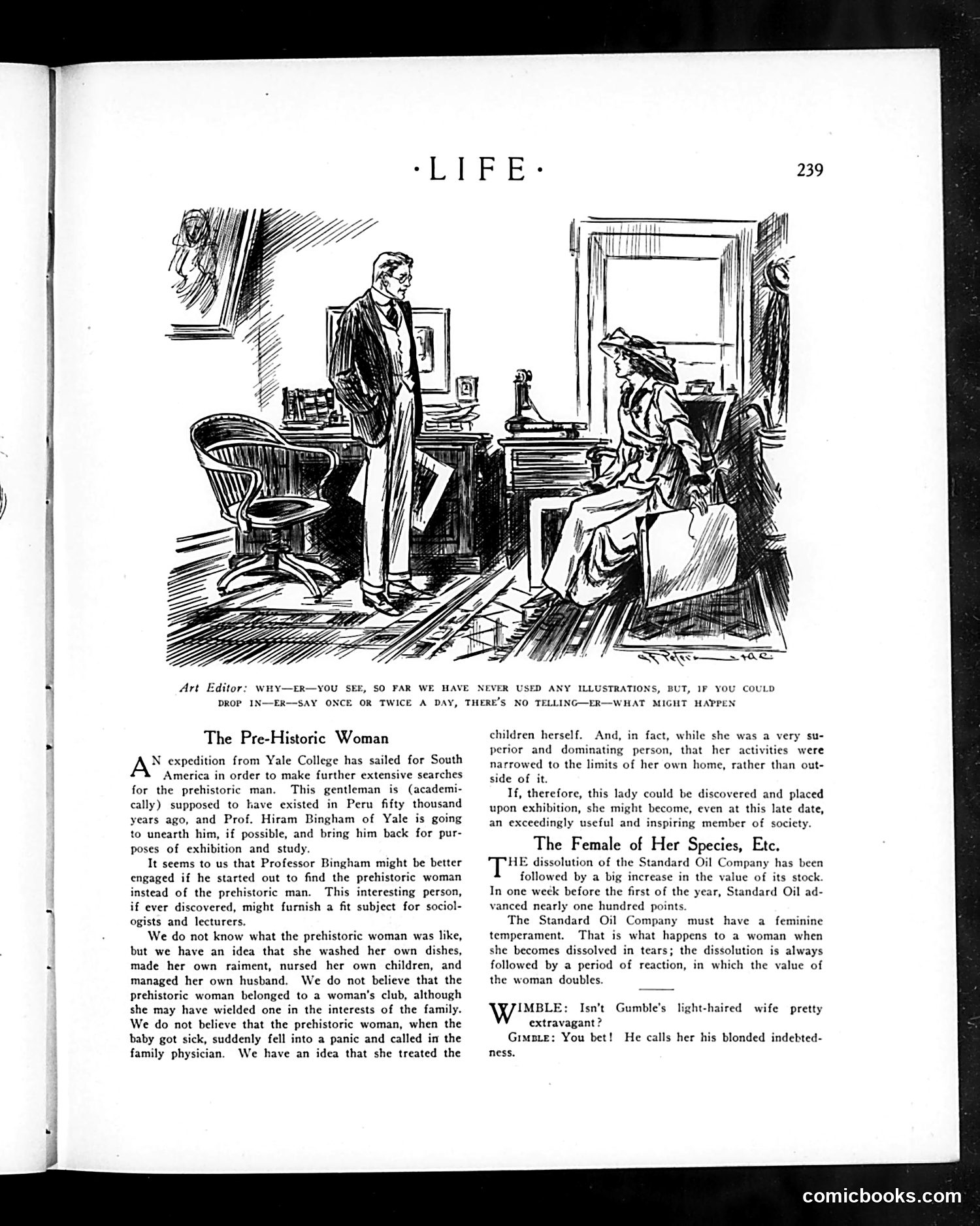
The top cartoon satirizes an art editor desperately seeking illustrations, offering vague promises of undefined possibilities if a contributor would visit "once or twice a day"—mocking editorial desperation and evasive pitch tactics. The main article humorously proposes that Yale's prehistoric-man expedition should instead search for a "prehistoric woman." The satire critiques early 1900s women's liberation: the piece idealizes a hypothetical prehistoric woman who managed her own household, children, and husband without relying on doctors or joining women's clubs—implying that contemporary women of means have become dependent, frivolous, and abandoning domestic duties for social organizations. The "Standard Oil" brief makes a crude joke equating corporate dissolution with feminine emotional breakdown: when Standard Oil Company dissolved (antitrust breakup), its stock value doubled, compared to how a woman's "value" supposedly increases after crying herself out. The final "Wimble/Gimple" dialogue jokes that Gumble calls his extravagant wife his "blonded indebtedness"—a pun on "blonde" and "indebted," suggesting wives cause financial ruin through spending.
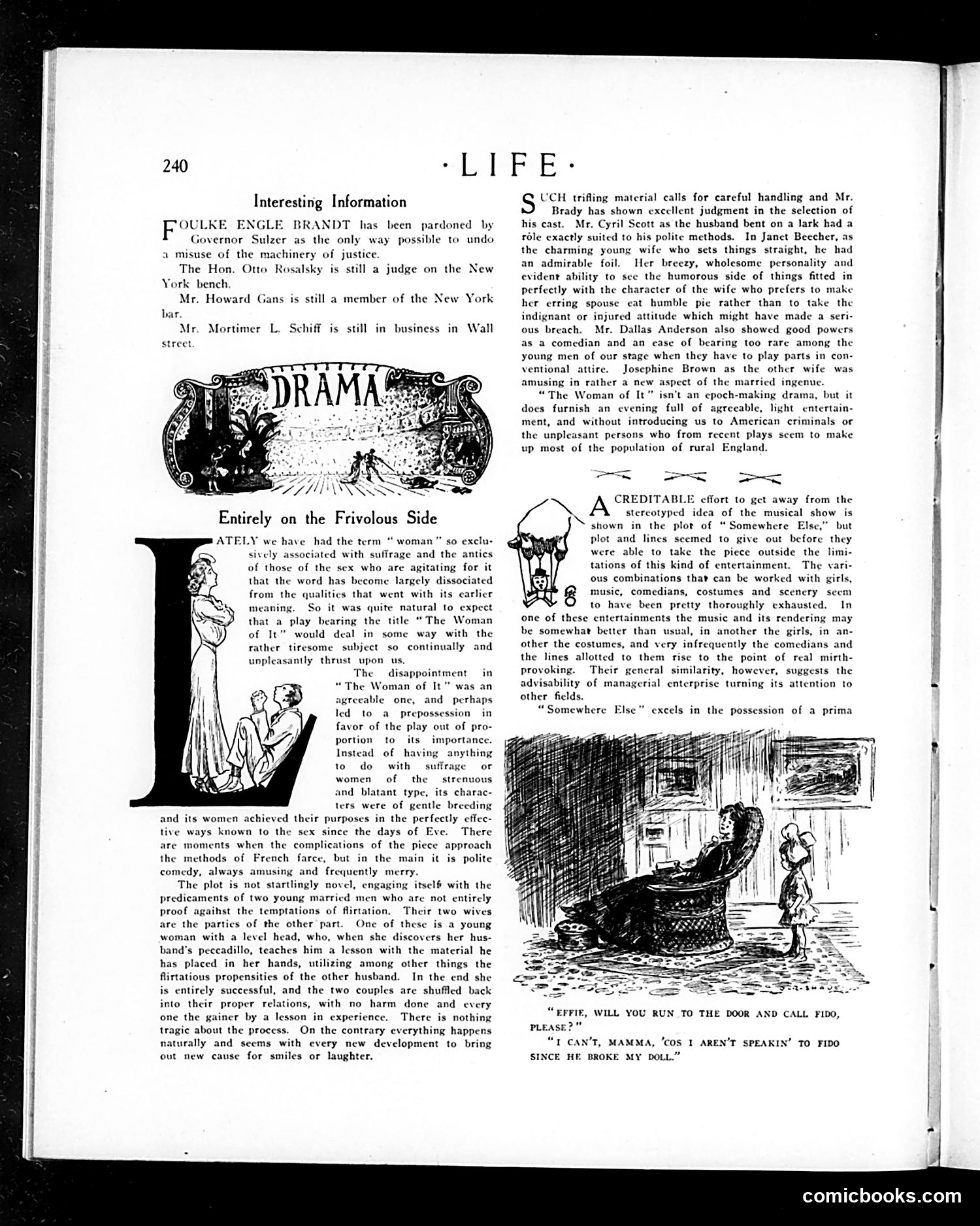
This page contains theater reviews rather than political cartoons. The "Interesting Information" section lists prominent figures (Foulke Engle Brandt, Governor Sulzer, Otto Rosalsky, Howard Gans, Mortimer L. Schiff) apparently to note their current whereabouts or status—a gossip column feature. The main content reviews two plays: "The Woman of It" and "Somewhere Else." The critic praises both for light entertainment. "The Woman of It" avoids the era's contentious suffrage debates by depicting women using traditional feminine wiles rather than political activism—notably, the reviewer seems relieved the play doesn't engage with "suffrage and the antics of those of the sex who are agitating for it." The illustration shows a domestic scene with dialogue about a broken doll, presumably from one of these comedies. The satire is subtle: Life's theater section reflects contemporary anxiety about changing women's roles, applauding entertainment that depicts women working through charm rather than demanding rights.
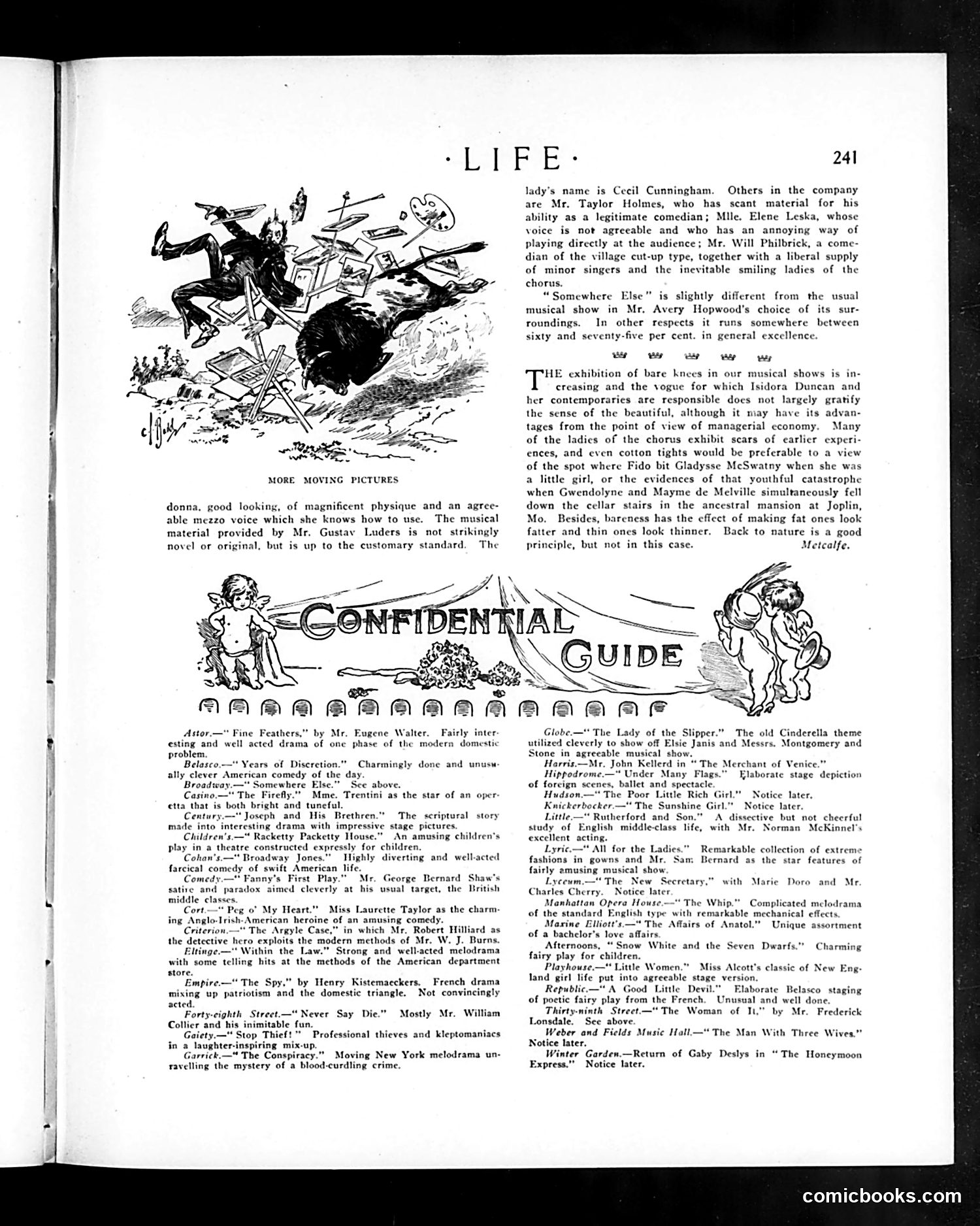
This page contains theater reviews and advertisements from Life magazine's "Confidential Guide" section. The main illustrated cartoon shows chaotic musical performance imagery—performers tumbling amid sheet music and instruments—satirizing the quality of contemporary Broadway musical productions. The text critiques several shows, particularly "Somewhere Else," praising some elements while mocking others. A notable satirical passage targets the increasing trend of female chorus performers displaying bare legs, influenced by Isadora Duncan's modern dance movement. The critic (Metcalfe) sarcastically suggests this "back to nature" approach reveals unflattering physical imperfections—scars, bruises, obesity—and argues that cotton tights would be more aesthetically preferable. This reflects early 20th-century anxieties about changing social mores and female performers' bodies becoming more visible on stage. The surrounding reviews assess various Broadway productions with mixed opinions on acting quality, material, and staging.
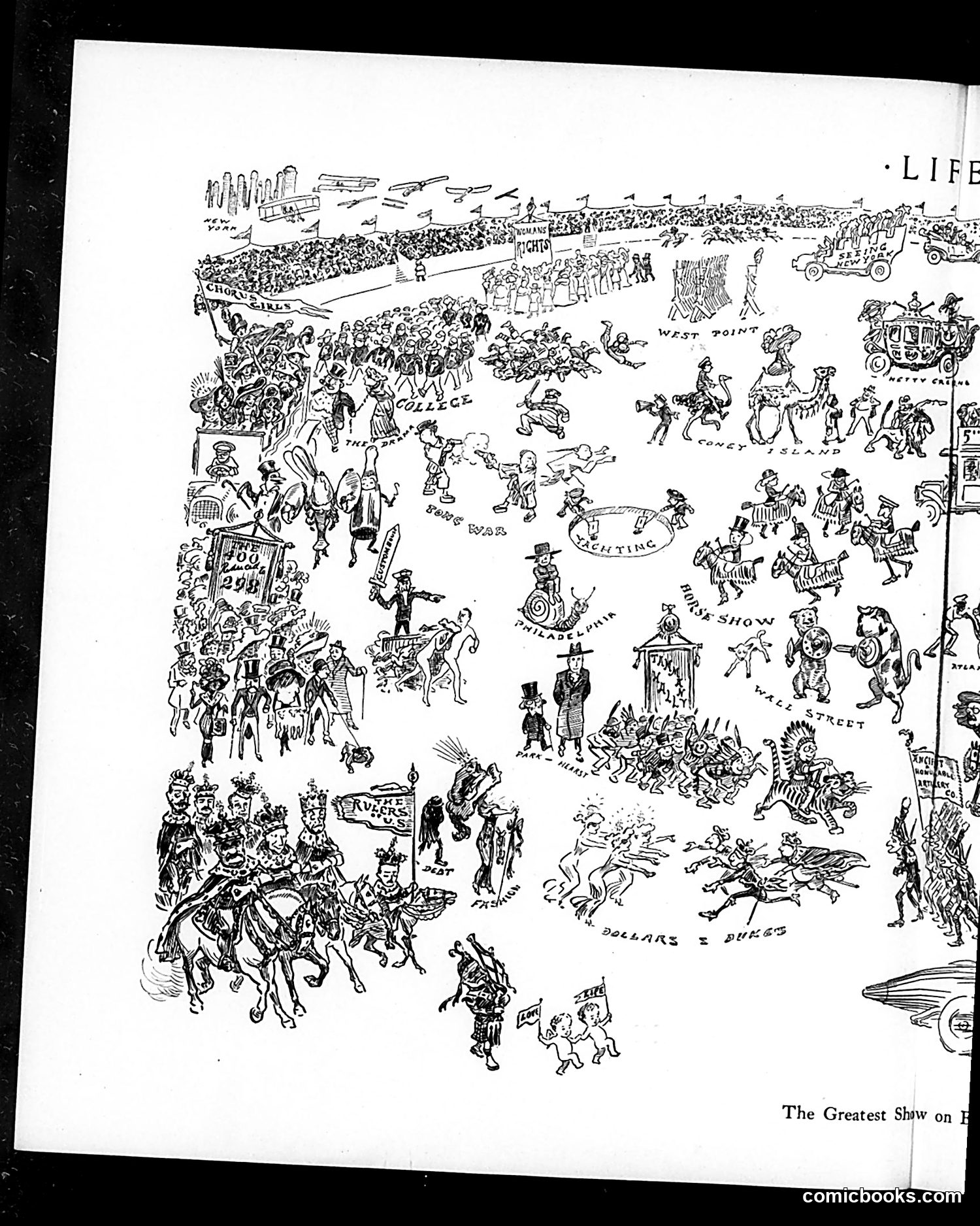
This is a satirical map-illustration titled "The Greatest Show on Earth," depicting what appears to be a circus or carnival grounds rendered as a bustling cityscape. The detailed pen-and-ink drawing shows labeled attractions including "College," "West Point," "Poney Island," "Fighting," "Wild West Show," "Dime Museum," and "Race Street." The satire likely critiques American society circa early-to-mid 20th century, presenting everyday institutions and social activities as if they were carnival attractions—suggesting these establishments are themselves spectacles or entertainment rather than serious endeavors. The crowded, chaotic composition emphasizes the sensationalism and disorder of modern American life. The specific institutions labeled (military academy, entertainment venues, urban areas) are treated as equal "attractions," mocking the commodification of culture and education into consumable entertainment.
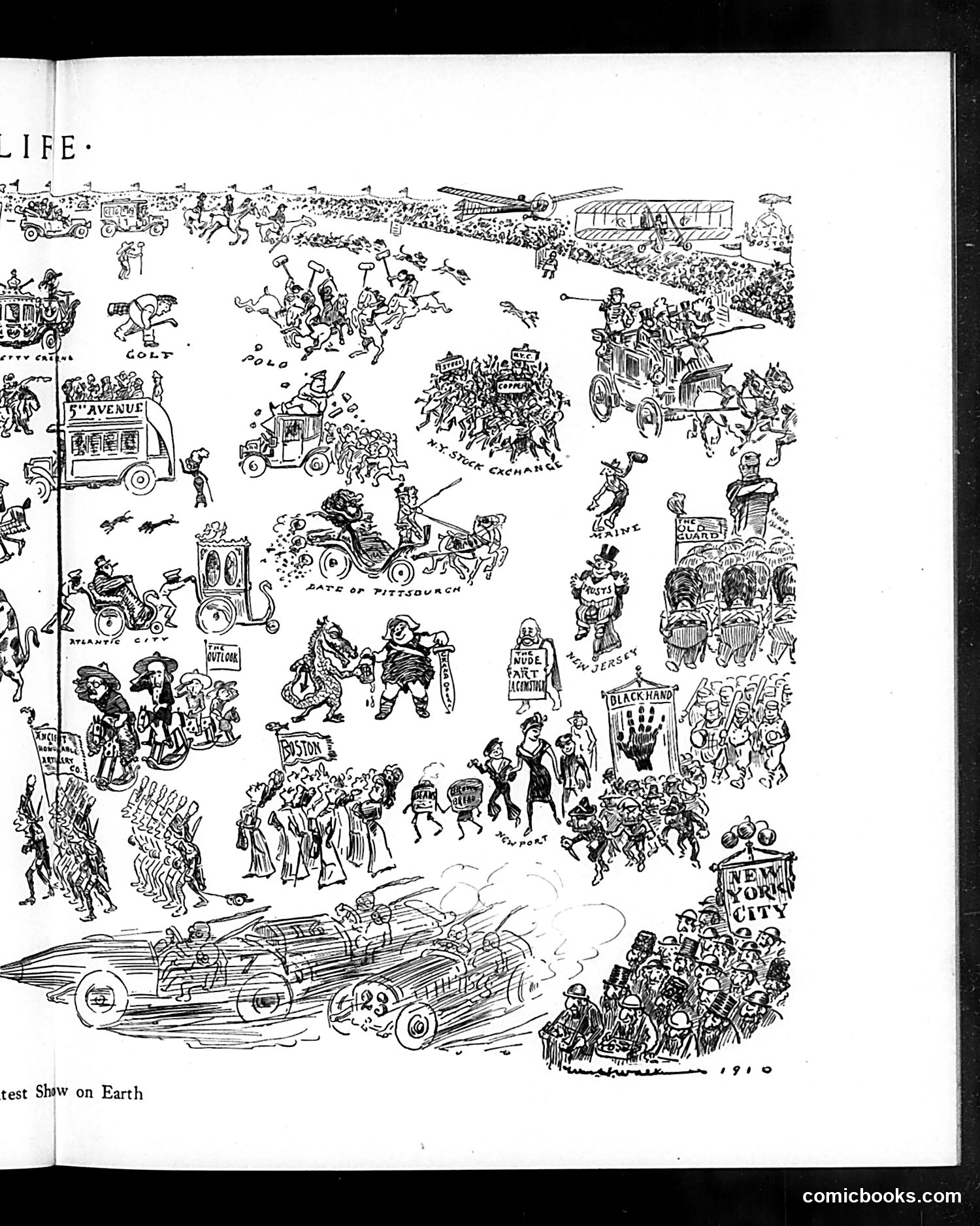
This 1910 satirical illustration depicts American life as a carnival or circus. The page is crowded with vignettes showing various attractions and activities: polo matches, racing cars, boxing, parades, crowds at "New York City," and various street entertainments and performances. The satire suggests that American society itself functions like a circus—chaotic, entertainment-focused, and featuring spectacle over substance. Various labeled scenes reference specific cities (Boston, Pittsburgh, Newark) and activities (polo, racing), implying that regardless of location, American life is fundamentally a staged show for public consumption. The drawing style and crowded composition emphasize the frenetic, sensational nature of modern American culture, mocking its obsession with excitement and display.
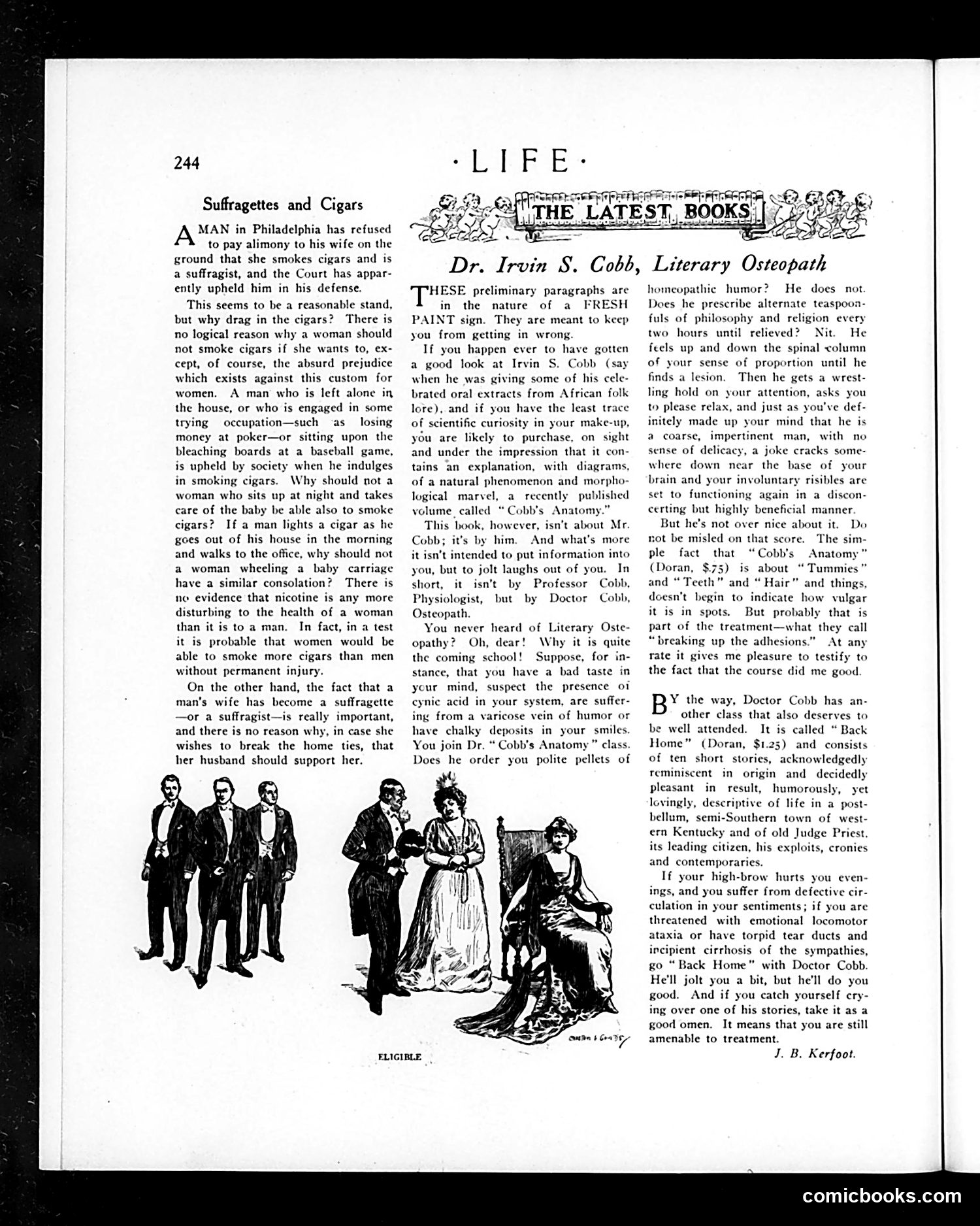
This page contains two distinct articles satirizing contemporary social issues circa 1910s-1920s. **"Suffragettes and Cigars"** (left column): The article mocks a Philadelphia court case where a man refused alimony, claiming his wife's cigar-smoking and suffragism made her unfit. The author sarcastically argues there's no logical reason women shouldn't smoke cigars if men do, but agrees the real problem is her being a suffragist—someone advocating women's voting rights. The satire targets both the absurd gender double-standard and (implicitly) husbands' resistance to women's rights activism. **"Dr. Irvin S. Cobb, Literary Osteopath"** (right): A humorous book review of humorist Irvin S. Cobb's "Cobb's Anatomy." The critic playfully compares Cobb's comedy writing to osteopathic treatment—cracking jokes like a doctor manipulating the spine to "cure" readers' poor humor and cynicism. It's praise wrapped in elaborate metaphor, acknowledging Cobb can be crude but effective. The illustration shows a social gathering with well-dressed figures, likely representing the "suffragette" controversy.
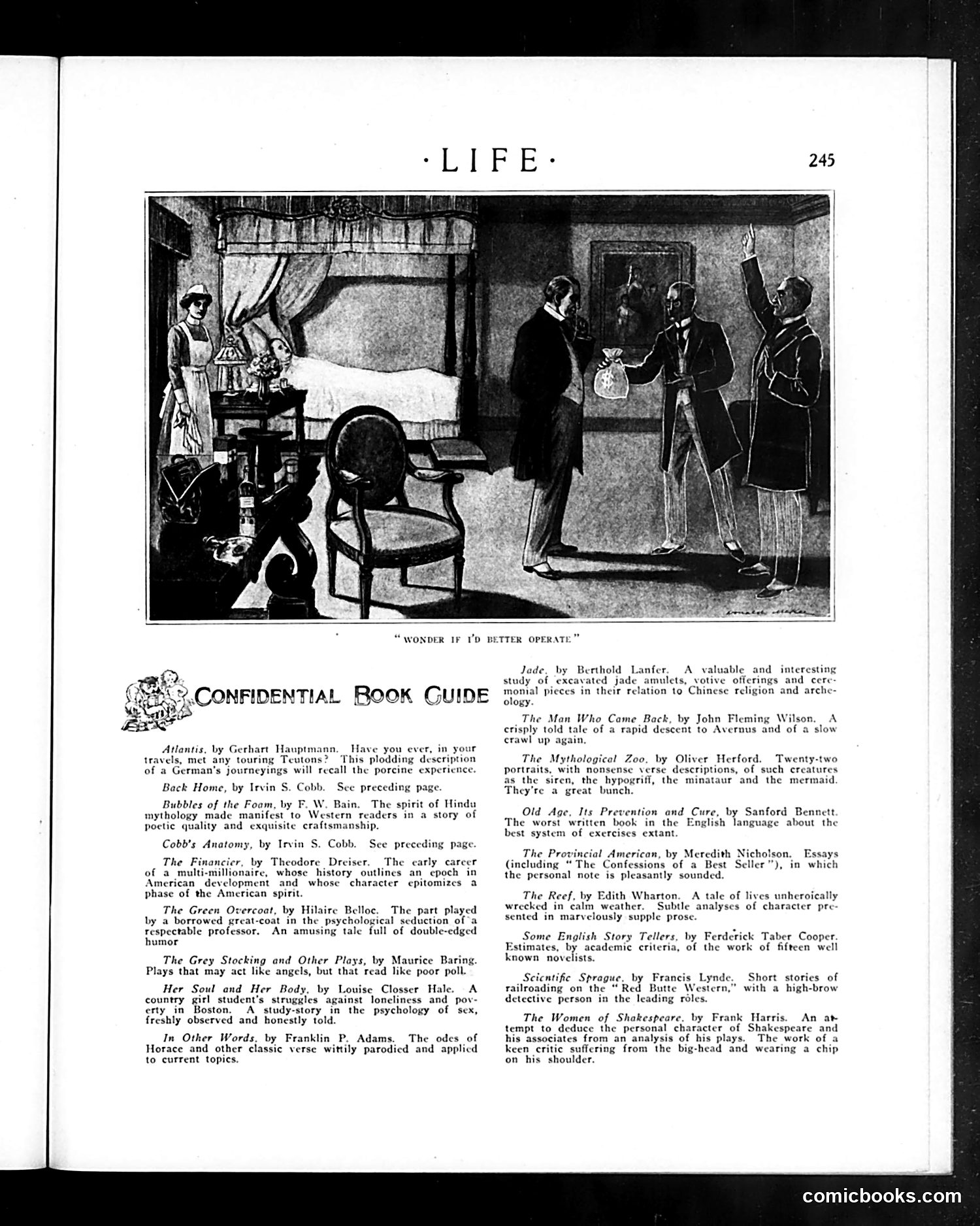
This cartoon satirizes surgical decision-making. A doctor stands uncertainly in a patient's bedroom, while military officers (appearing to be German, based on their uniforms) stand at the door with what looks like official documentation or orders. The caption suggests the doctor is conflicted about whether to proceed with an operation—implying external pressure or authority figures are influencing medical judgment. The satire likely critiques how non-medical authorities (government, military, bureaucrats) intrude upon physicians' professional autonomy and clinical decisions. The humorous tension comes from the absurdity of uniformed officials appearing to pressure a doctor at a patient's bedside, suggesting that politics or hierarchy override medical ethics and expertise. This reflects early 20th-century anxieties about institutional overreach into professional practice.
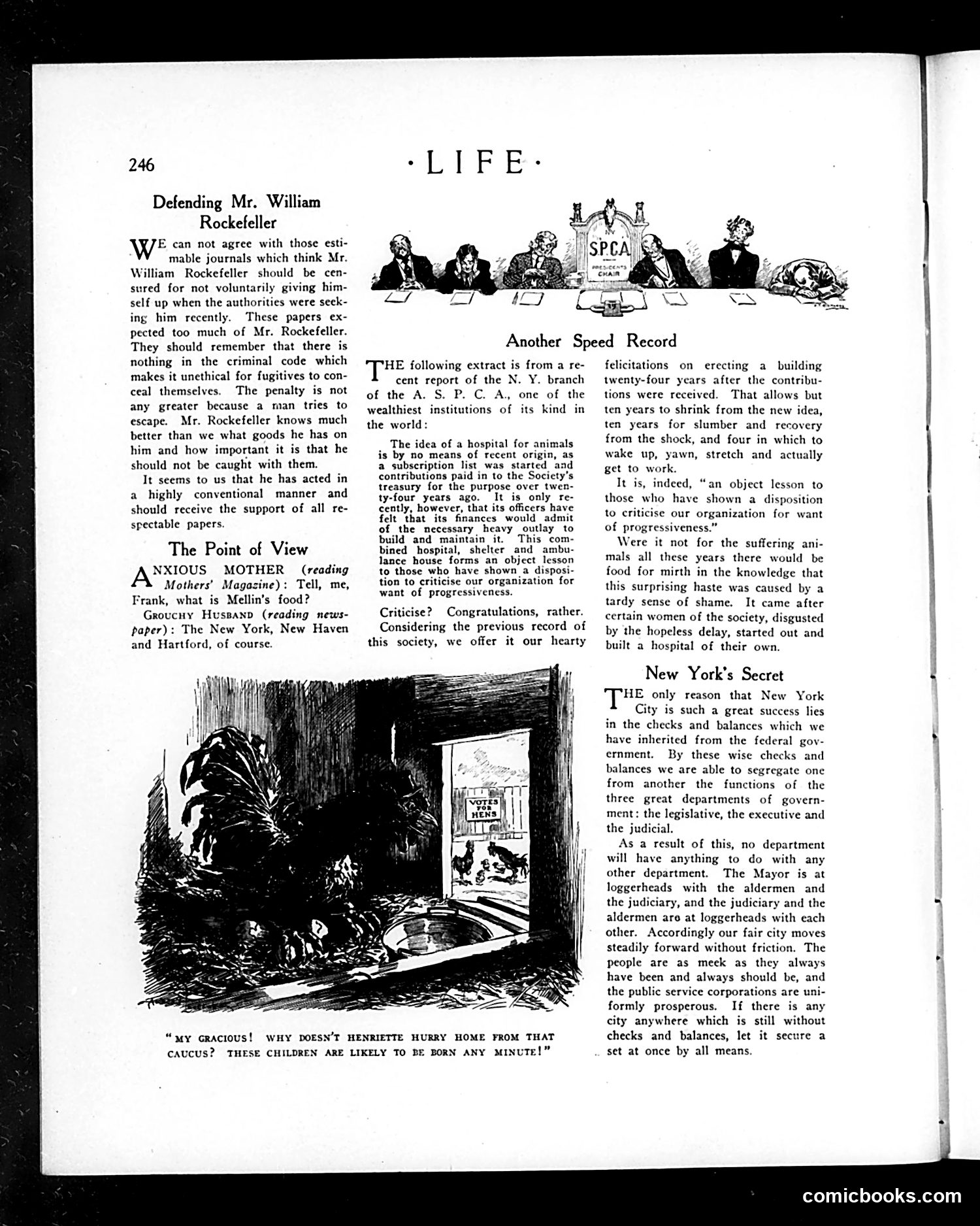
This page contains three satirical pieces mocking institutional hypocrisy and incompetence: **"Defending Mr. William Rockefeller"** sarcastically defends the wealthy industrialist for evading authorities, implying that the rich operate above legal standards—respectable papers shouldn't criticize his evasion because concealment isn't technically illegal. **"The Point of View"** jokes that "Mellin's food" (a baby formula brand) is actually the "New York, New Haven and Hartford" railroad—a dark quip suggesting the railroad is as digestible/trustworthy as baby food, likely referencing corporate malfeasance. **"Another Speed Record"** mocks the ASPCA's 24-year delay building an animal hospital after donations arrived, sarcastically praising their "speed." The text reveals women donors eventually built their own hospital out of frustration—exposing the organization's negligence and male institutional lethargy. **"New York's Secret"** ironically praises the city's "checks and balances" while describing complete governmental dysfunction and corruption, suggesting the system enables rather than prevents chaos. All pieces target institutional corruption and incompetence dressed in respectability.
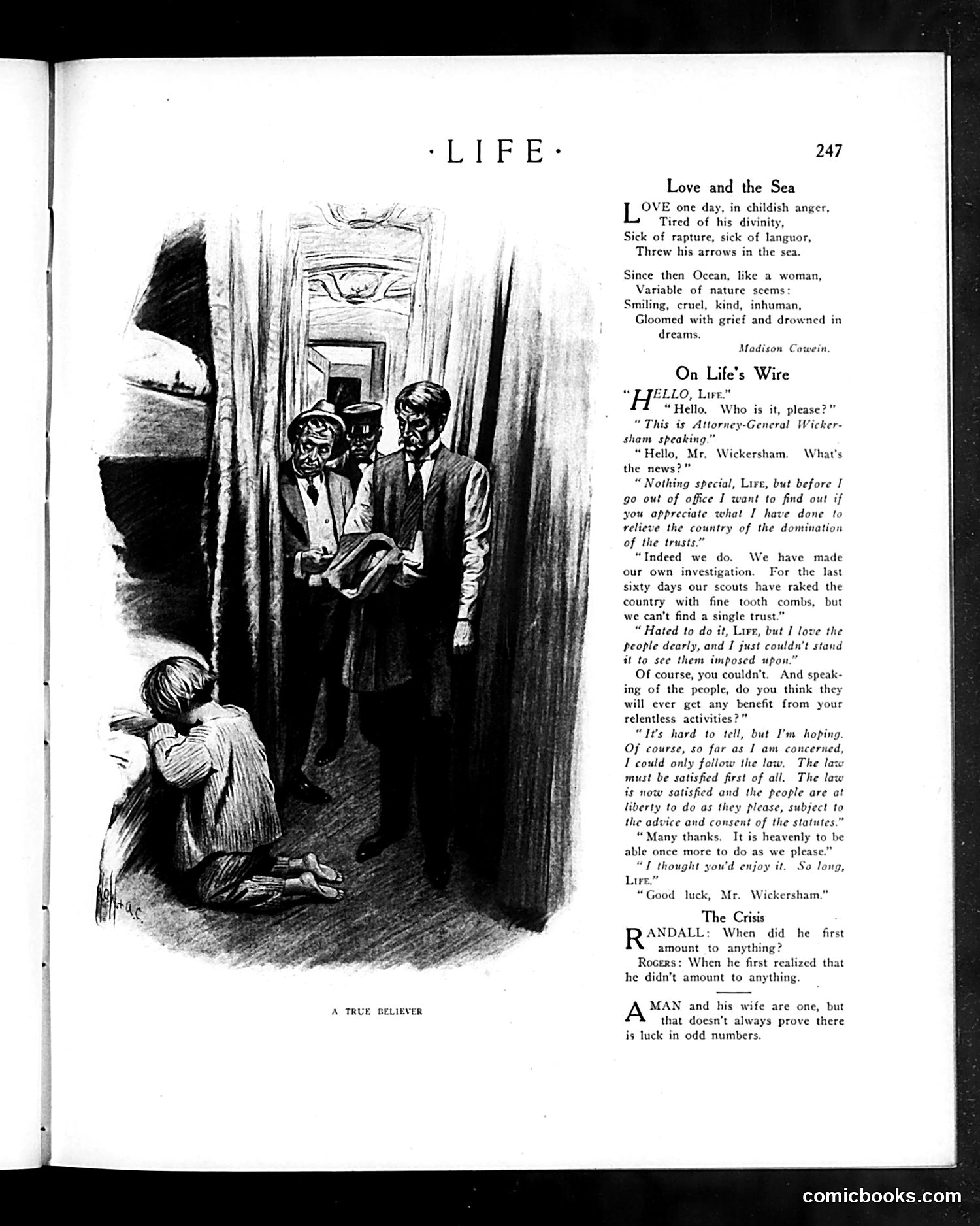
**Main Cartoon - "A True Believer":** This depicts Attorney-General James C. Wickersham in a conversation with "Life" (the magazine personified). The satire mocks Wickersham's anti-trust efforts during the Progressive era. Despite claiming sixty days of investigation and boasting of trust-busting accomplishments, Wickersham admits they "can't find a single trust"—suggesting his much-publicized legal crusade was ineffective theater. The cartoon ridicules how he credits "the law" for satisfaction while ordinary people remain powerless, bound by statutes they didn't consent to. The joke is that he prioritized legal formalism over actual relief for the people he claimed to help. **Smaller items:** Brief satirical quips about relationships and personal crises round out the page, typical of Life's humorous miscellany. The page reflects Progressive-era skepticism toward trust-busting claims and government bureaucratic posturing.
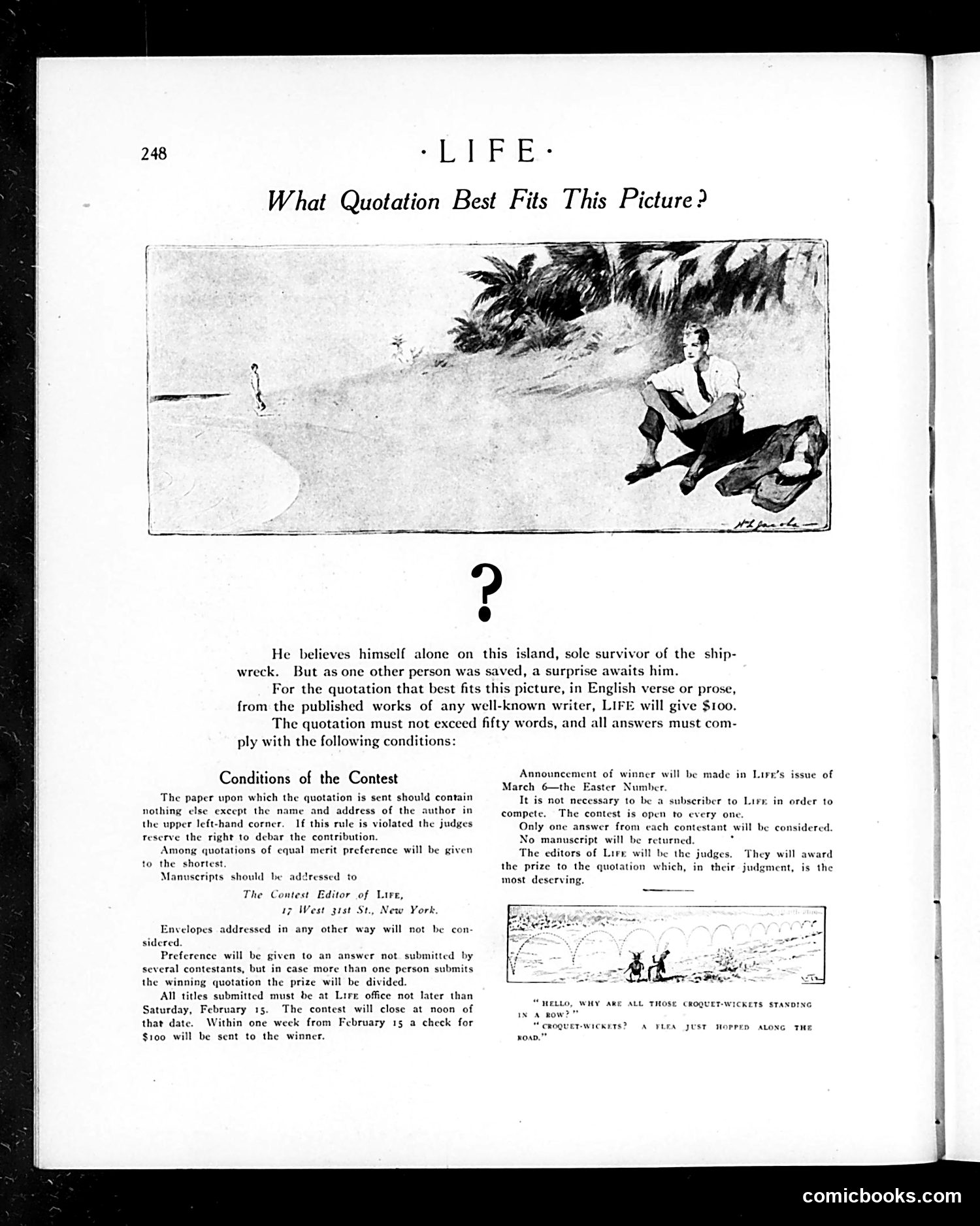
This page presents a reader-submission contest from *Life* magazine. The main cartoon shows a man on an island who believes himself the sole shipwreck survivor—until discovering another person present, creating an unexpected plot twist. Readers were invited to submit quotations (under 50 words) from published literature that best fit the illustration. The winner would receive $100. The contest had specific rules: submissions required the author's name and address, preference went to shortest entries, and multiple identical answers would split the prize. A secondary cartoon at bottom depicts two figures observing croquet wickets in a row along a road; one mistakes them for fleas. This appears to be a separate humorous illustration, likely from another contest or feature. The page essentially crowdsources literary interpretation while offering cash incentive—a common *Life* magazine engagement strategy.
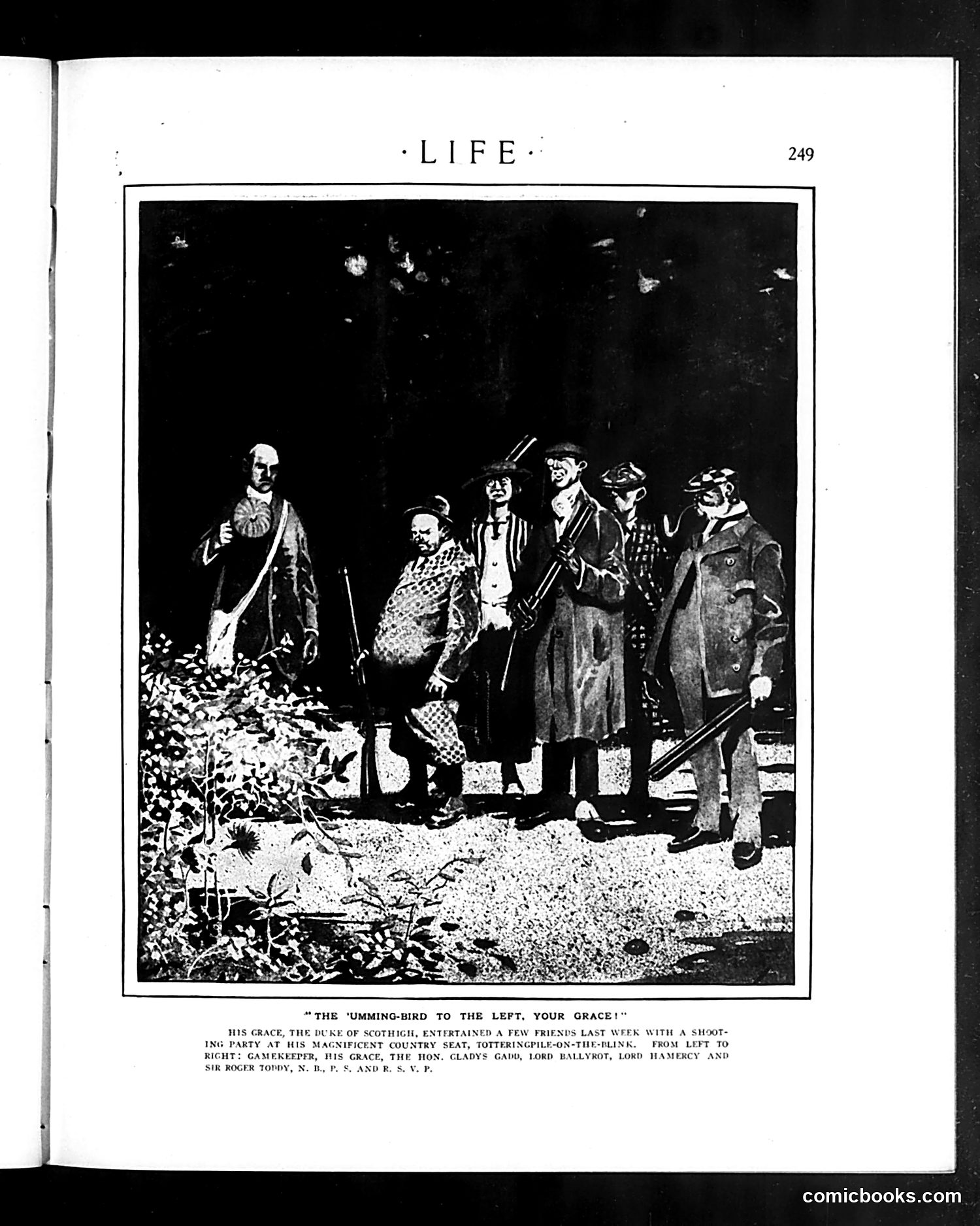
This is a satirical hunting scene depicting British aristocrats on a shooting party. The caption's play on "humming-bird" (likely a mishearing or mispronunciation by a gamekeeper) suggests comic incompetence or class pretension among the nobility. The figures identified in the caption include the Duke of Scotch, Lord Ballyrot, Lord Hamercy, and Sir Robert Toddy, along with a gamekeeper and the Hon. Gladys Gabb. The satire appears to mock upper-class hunting traditions and the pomposity of titled British gentry, particularly through their formal dress and affected manner during what should be a practical country activity. The humor relies on early 20th-century British class-based comedy typical of *Life* magazine's satirical approach.
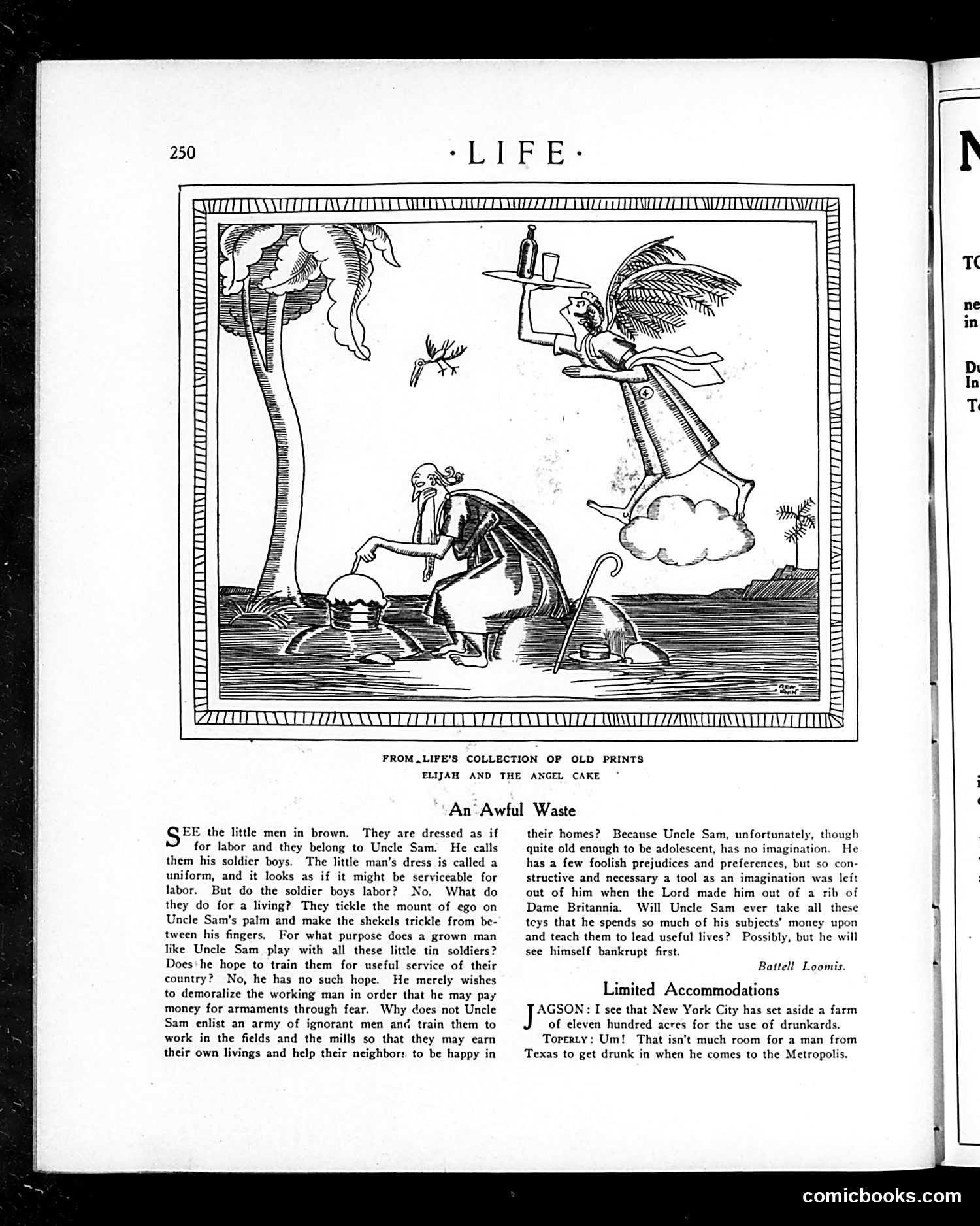
This is a political cartoon criticizing American military spending and militarism. The image depicts Uncle Sam (personified America) playing with toy soldiers while standing in water—a biblical reference to "Elijah and the Angel Cake" (the old print title). The satirical text argues that the U.S. government wastes resources training soldiers for warfare rather than productively employing working men in fields and mills. The author attacks Uncle Sam's "foolish prejudices" and lack of imagination, suggesting he deliberately demoralizes civilian workers through military fear-mongering to extract tax money for armaments. The cartoon mocks militarism as wasteful ego-gratification—soldiers are "tin soldiers" serving no useful purpose. The author sarcastically questions why Uncle Sam won't redirect military spending toward productive labor that benefits both workers and neighbors. This reflects anti-militarism sentiment common in early 20th-century American progressive circles.
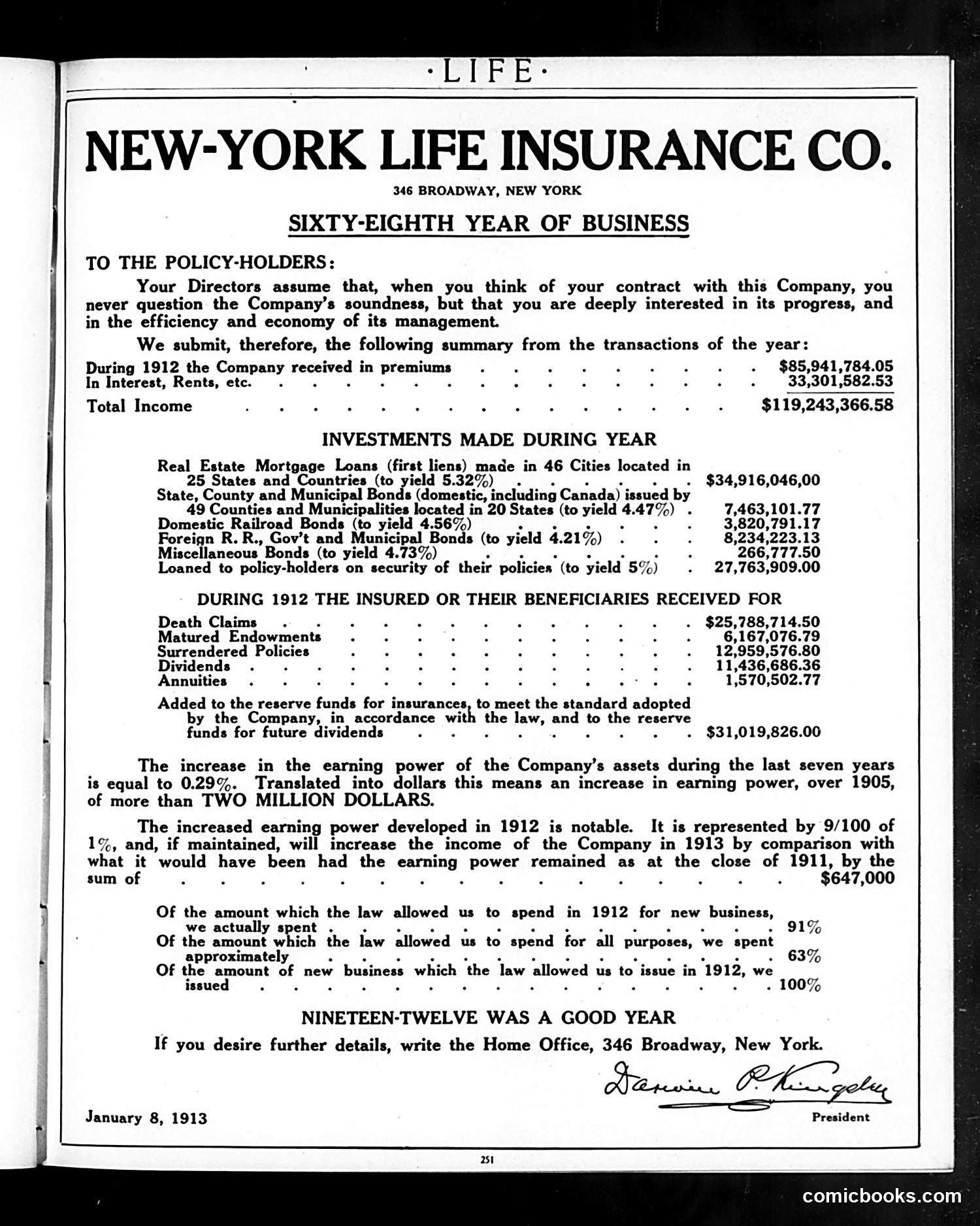
This is **not a cartoon or satire page** — it's a corporate advertisement/annual report from the New York Life Insurance Company addressed to policyholders, dated January 8, 1913. The page presents the company's financial performance for 1912 (their 68th year of business), detailing: - Total income of $119 million from premiums and interest - Investment allocations across mortgages, bonds, and loans - Payouts to beneficiaries ($25.7 million in death claims alone) - Reserve fund additions The tone is reassuring corporate communication, emphasizing the company's financial soundness and efficient management. The final statistics (91%, 63%, 100%) suggest the company operated within or maximized legal spending limits for business expansion. **For modern readers:** This represents how major insurance companies marketed stability and trustworthiness to customers during the early 20th century, before modern financial disclosure regulations. The detailed accounting aimed to convince policyholders their premiums were safely invested.
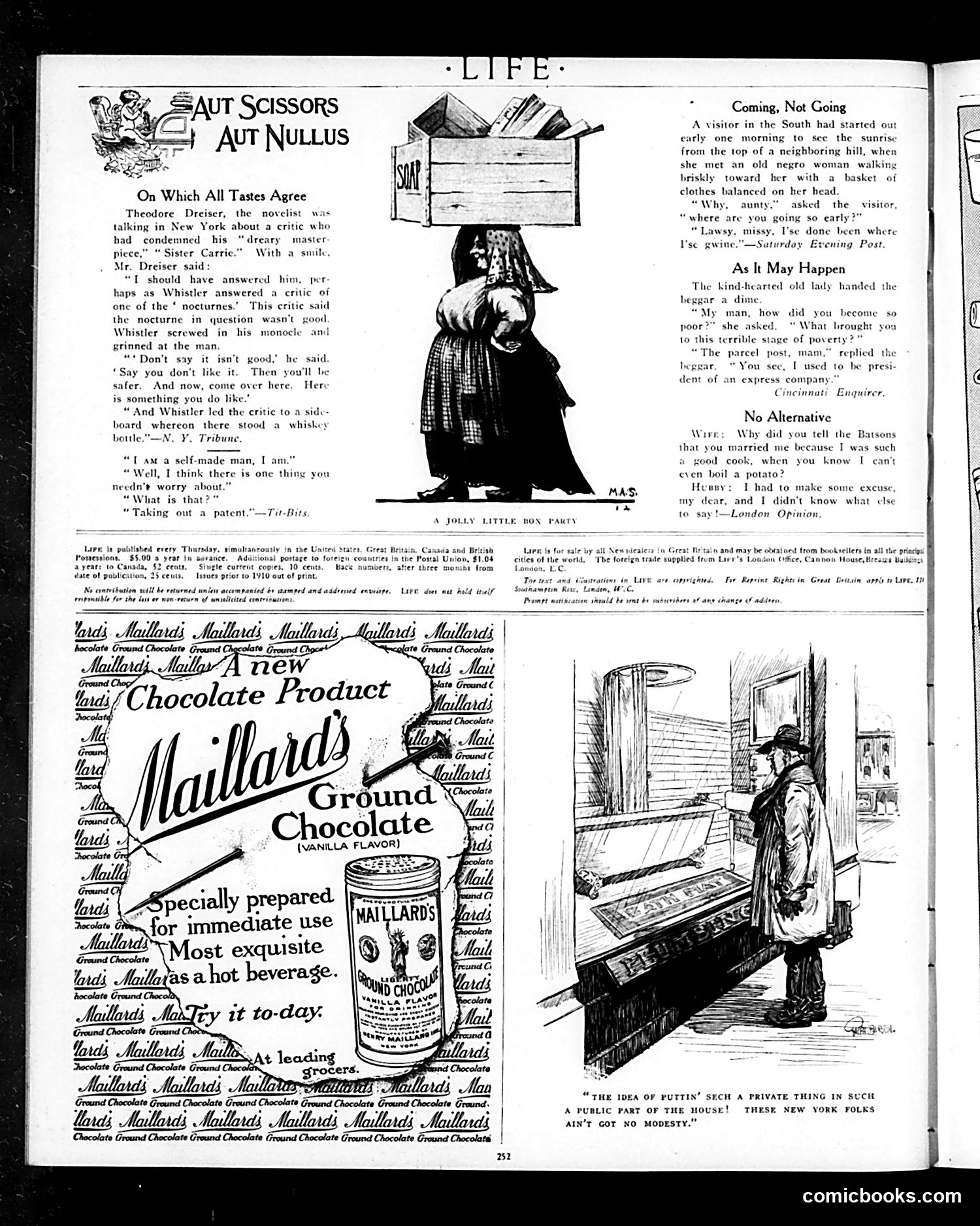
This page contains multiple satirical pieces typical of early 1900s Life magazine: **Top Section - "Aut Scissors Aut Nullus":** Anecdotes about famous figures (Theodore Dreiser and James McNeill Whistler) illustrating that taste is subjective. Dreiser's novel *Sister Carrie* was condemned as dreary; Whistler's witty response suggests critics should say "I don't like it" rather than declaring something objectively "bad." **Middle Cartoons:** Three brief humor pieces about poverty, marriage excuses, and Southern dialect—typical period humor, including a condescending depiction of a Black woman using exaggerated dialect ("Lawsy, missy," "I'se gwine"). **Bottom Section:** Advertisement for Maillard's Ground Chocolate. **Right Illustration:** Shows a New York woman shocked by a man carrying a chamber pot in public, captioned with satirical criticism of New York's lack of modesty compared to Southern propriety—reversing expected stereotypes of the era. The page reflects early 20th-century magazine humor: celebrity gossip, relationship satire, and regional/racial caricature.
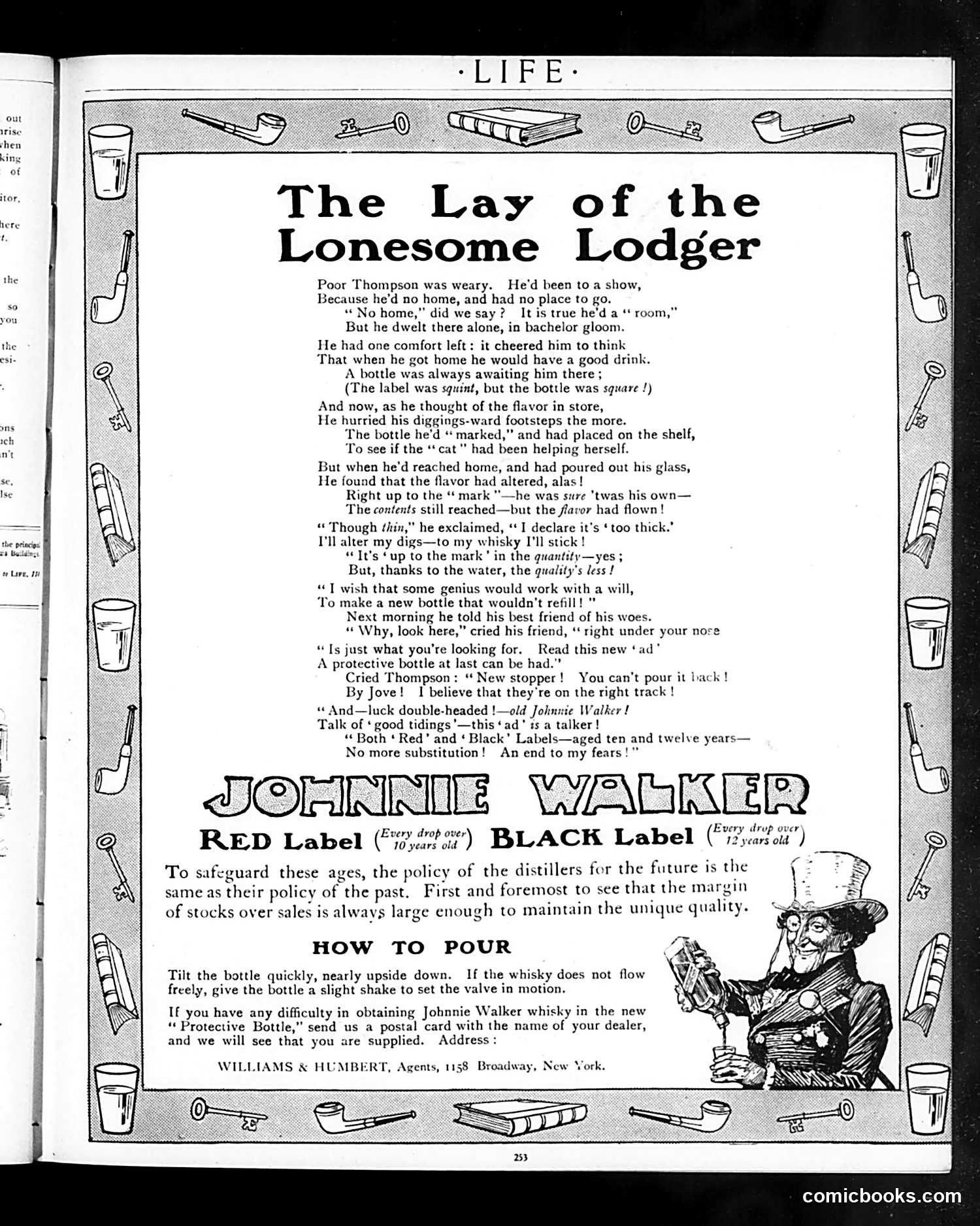
This is a satirical advertisement disguised as humorous verse, targeting a specific problem of the era: **watered-down whisky**. The protagonist, Thompson, discovers his bottle of whisky has been diluted—likely by evaporation or, humorously suggested, by his cat. The "mark" on the bottle shows the original level, but the flavor has disappeared. The joke hinges on a real consumer frustration: purchased spirits losing quality through unknown means. The satire mocks both the problem and the solution: a new "Protective Bottle" from **Johnnie Walker** whisky that features a special stopper preventing refilling. Thompson's relief is comedic—he'd rather switch entirely to whisky than trust his liquor's integrity. This appears designed for post-Prohibition America, when whisky quality and authenticity were legitimate consumer concerns. The ad weaponizes the joke against competitors' inferior products while promoting the superiority of aged, protected Johnnie Walker bottles.
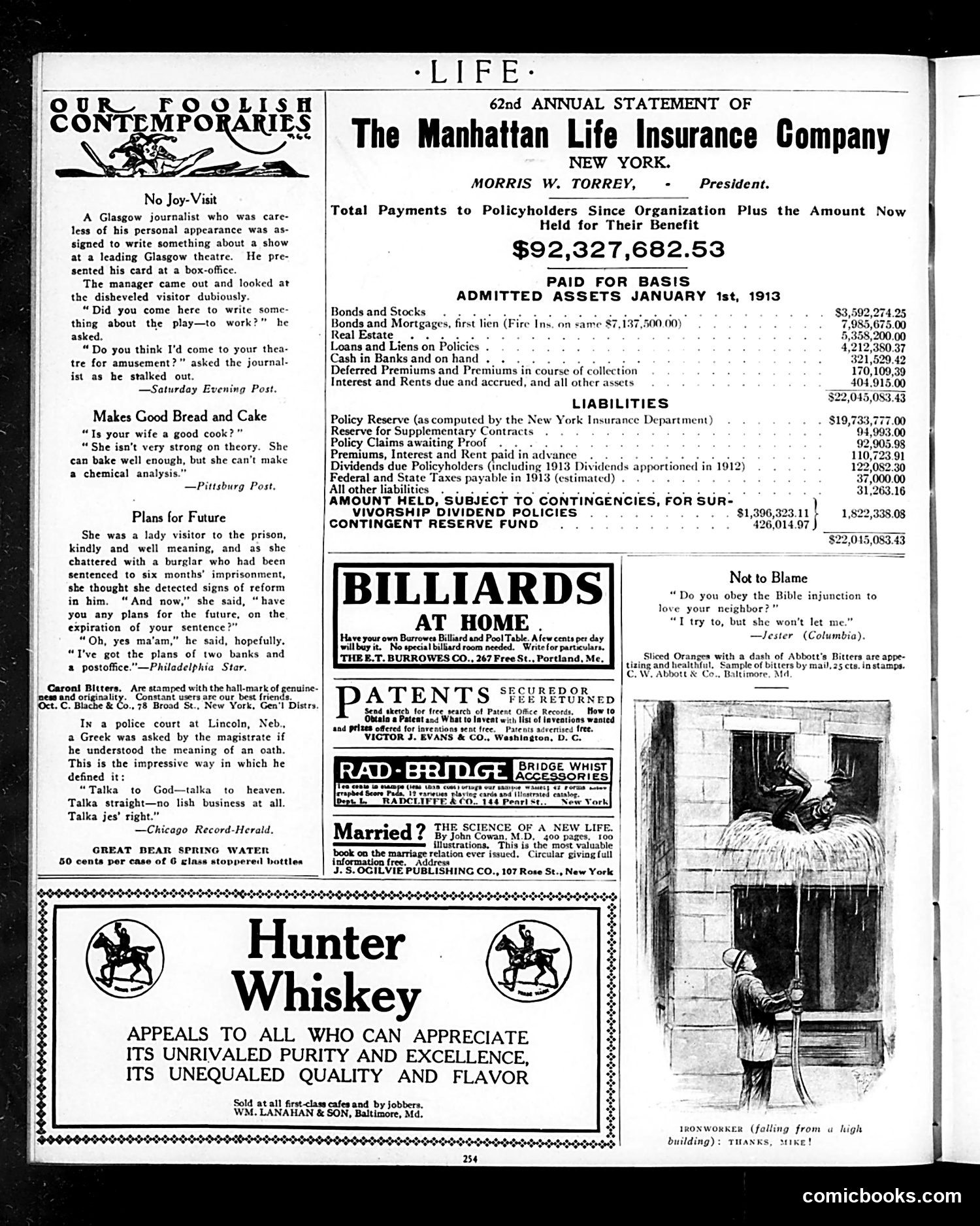
This page is primarily a **financial statement and advertisements** rather than political satire. The dominant content is the Manhattan Life Insurance Company's 62nd annual report (center), showing total payments to policyholders of $92,327,682.53. The left column contains **brief humorous anecdotes** rather than political cartoons: - A journalist too shabby-looking for a theater - A wife who bakes well but can't explain chemistry - A burglar planning to rob "two banks and a postoffice" upon release - A Greek immigrant's literal interpretation of swearing an oath to God These are gentle social humor pieces—poking fun at workplace pretension, domestic gender roles, criminal behavior, and immigrant communication—rather than sharp satire. The page fills remaining space with product advertisements (Hunter Whiskey, billiards tables, patent services, Abbott's Bitters, dental work, and a marriage manual), typical of Life magazine's revenue model in this era.
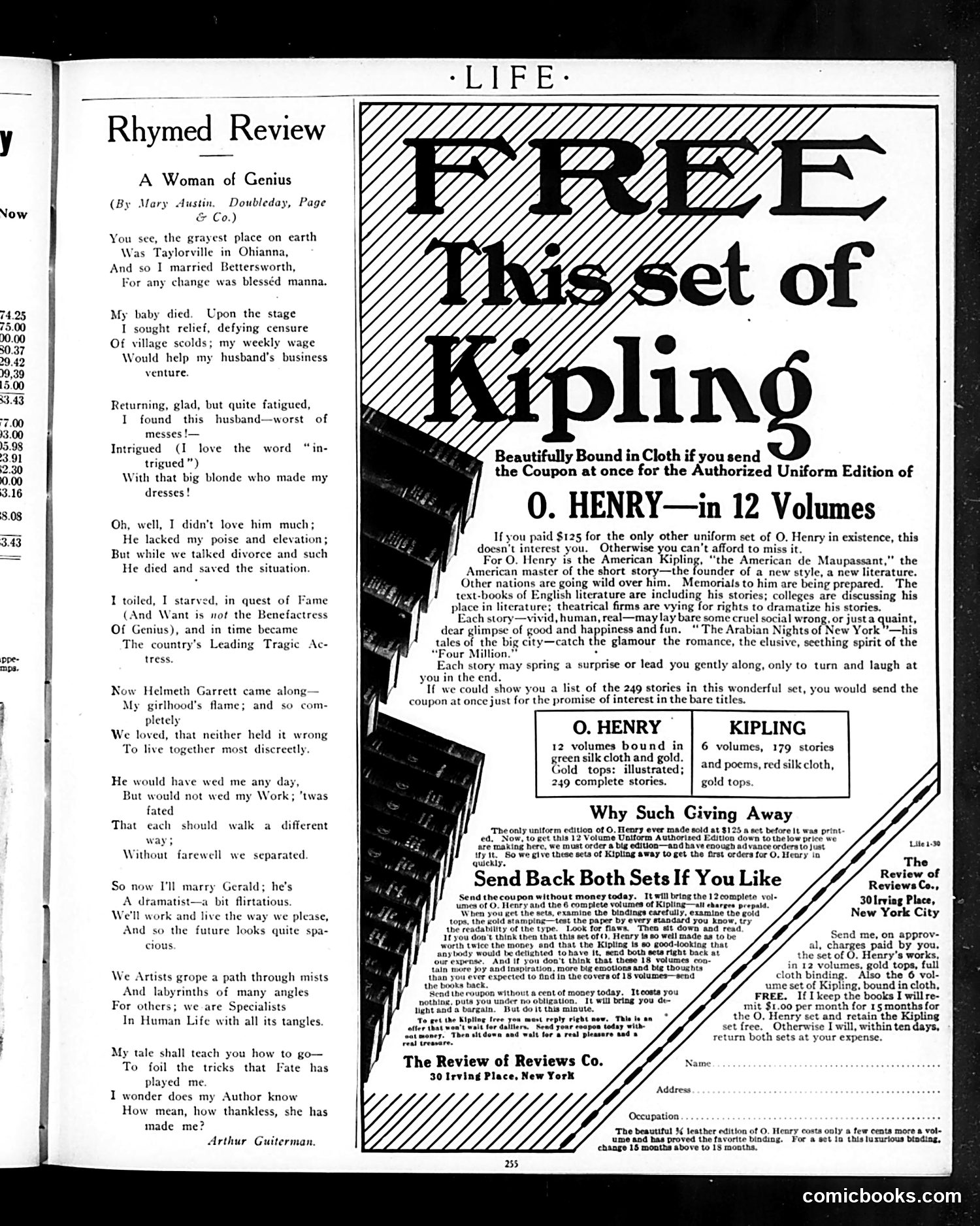
This page contains a **book review in verse** (left) and a **major advertising campaign** (right). The poem reviews Mary Austin's novel *A Woman of Genius*. It satirizes a woman's life trajectory: trapped in gray Taylorville, Ohio, she marries an unfaithful, uninspiring husband. After his convenient death, she pursues theatrical fame, takes a discreet lover (her childhood flame Helmeth Garrett), and finally plans to marry Gerald—a dramatist—for a promising future. The satire targets both the limitations society imposed on women and the romantic compromises they made to escape provincial mediocrity. The advertisement dominates the right side, promoting O. Henry's 12-volume uniform edition by offering a free 6-volume Kipling set as incentive. This aggressive marketing strategy—"Send Back Both Sets If You Like"—reflects early 20th-century book-club competition. O. Henry (1862-1910) was hugely popular, called the "American Kipling" and master of the short story. The appeal emphasizes his literary importance: colleges studied him, theaters adapted his work, and his 249 stories captured American life, especially urban New York ("The Arabian Nights of New York").
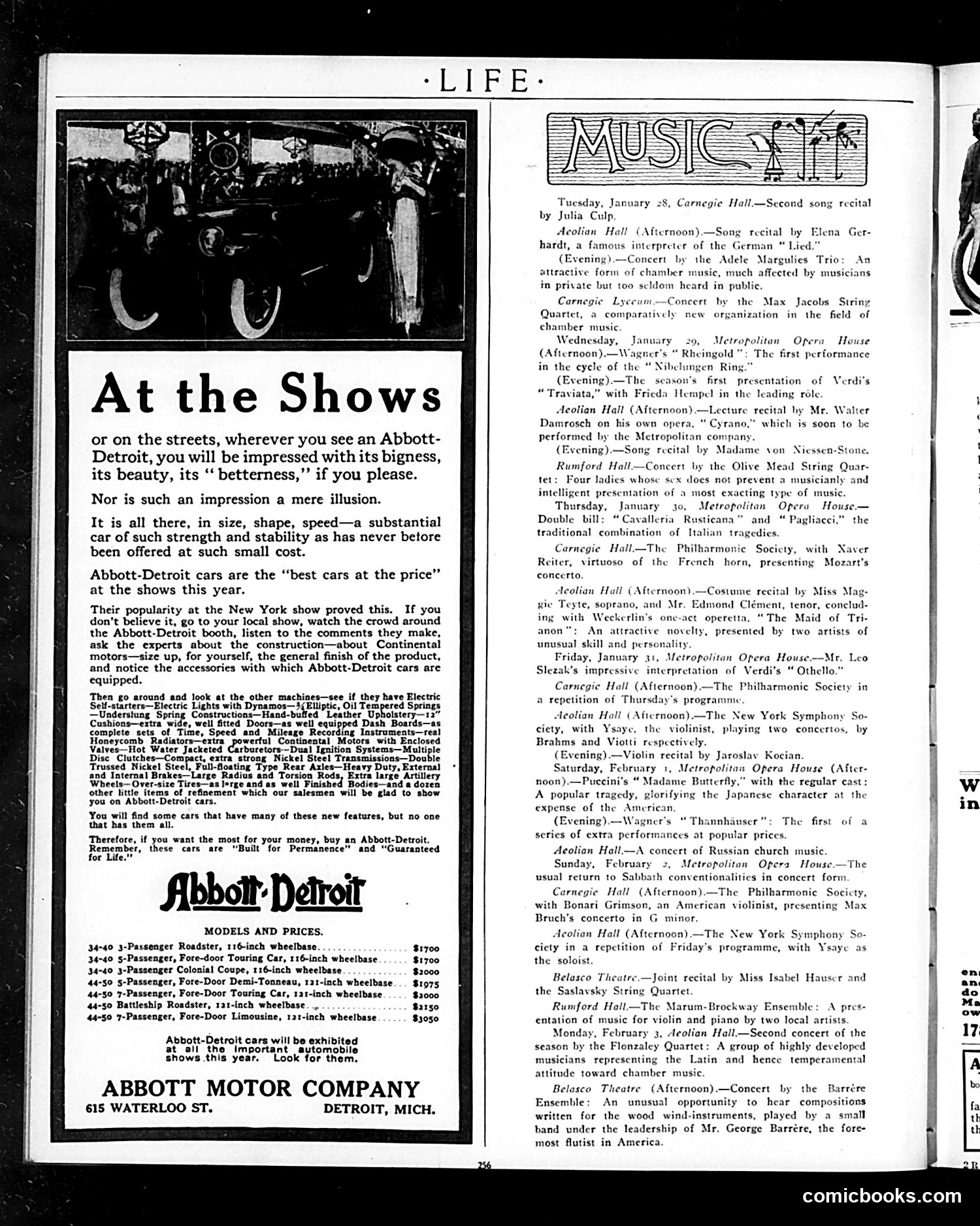
This page is primarily **advertising**, not satire. The left side features a full-page advertisement for Abbott-Detroit automobiles, promoting their cars as "best cars at the price" with detailed specifications and model listings. The right side contains a "Music" section listing upcoming concert and opera performances in New York venues (Carnegie Hall, Metropolitan Opera House, Aeolian Hall, etc.) for late January and early February, featuring classical musicians and performances. There are **no political cartoons or satirical commentary** visible on this page. The content is straightforward commercial and cultural reporting typical of Life magazine's format during this era—mixing advertising with entertainment listings. The Abbott-Detroit ad emphasizes technical features and value proposition rather than employing satire or caricature.
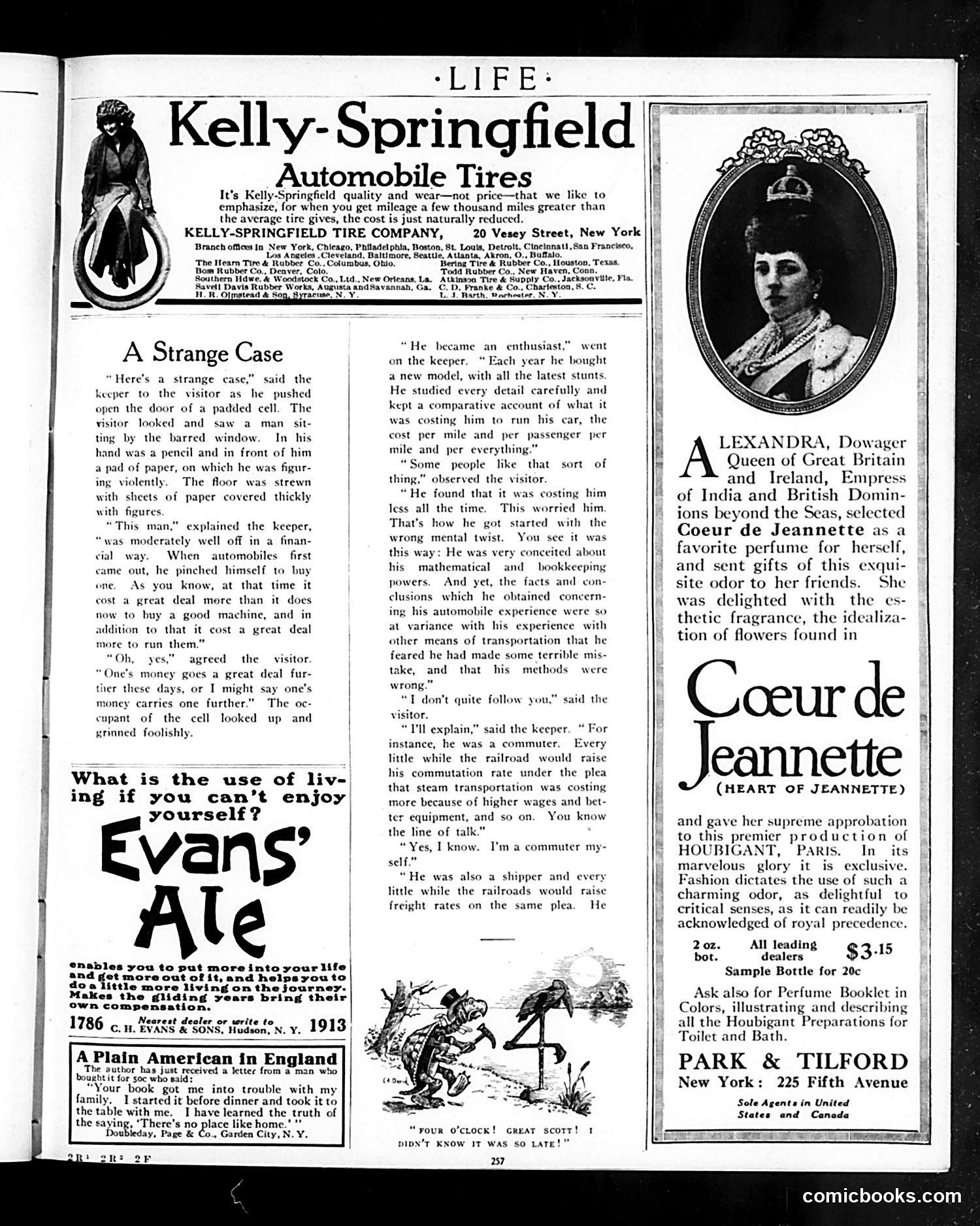
This page primarily contains **advertisements and a short satirical story**, not political cartoons. **"A Strange Case"** tells of a man institutionalized in an asylum obsessing over automobile costs. The satire targets early 1900s automobile enthusiasm—specifically men who became irrationally consumed with calculating their cars' running expenses (cost-per-mile, per-passenger, etc.). The joke is that this man's mathematical obsession with accounting for every penny drove him literally mad. It reflects contemporary anxiety about automobiles being expensive status symbols that could financially ruin the overzealous owner. The remainder consists of period advertisements: Kelly-Springfield Tires, Evans' Ale, and luxury perfume "Coeur de Jeannette" (endorsed by Queen Alexandra). The perfume ad exemplifies Edwardian marketing linking products to royal approval and exclusivity. No political figures or substantive satire appear on this page—it's primarily commercial content typical of *Life* magazine's mixed editorial-advertising format.
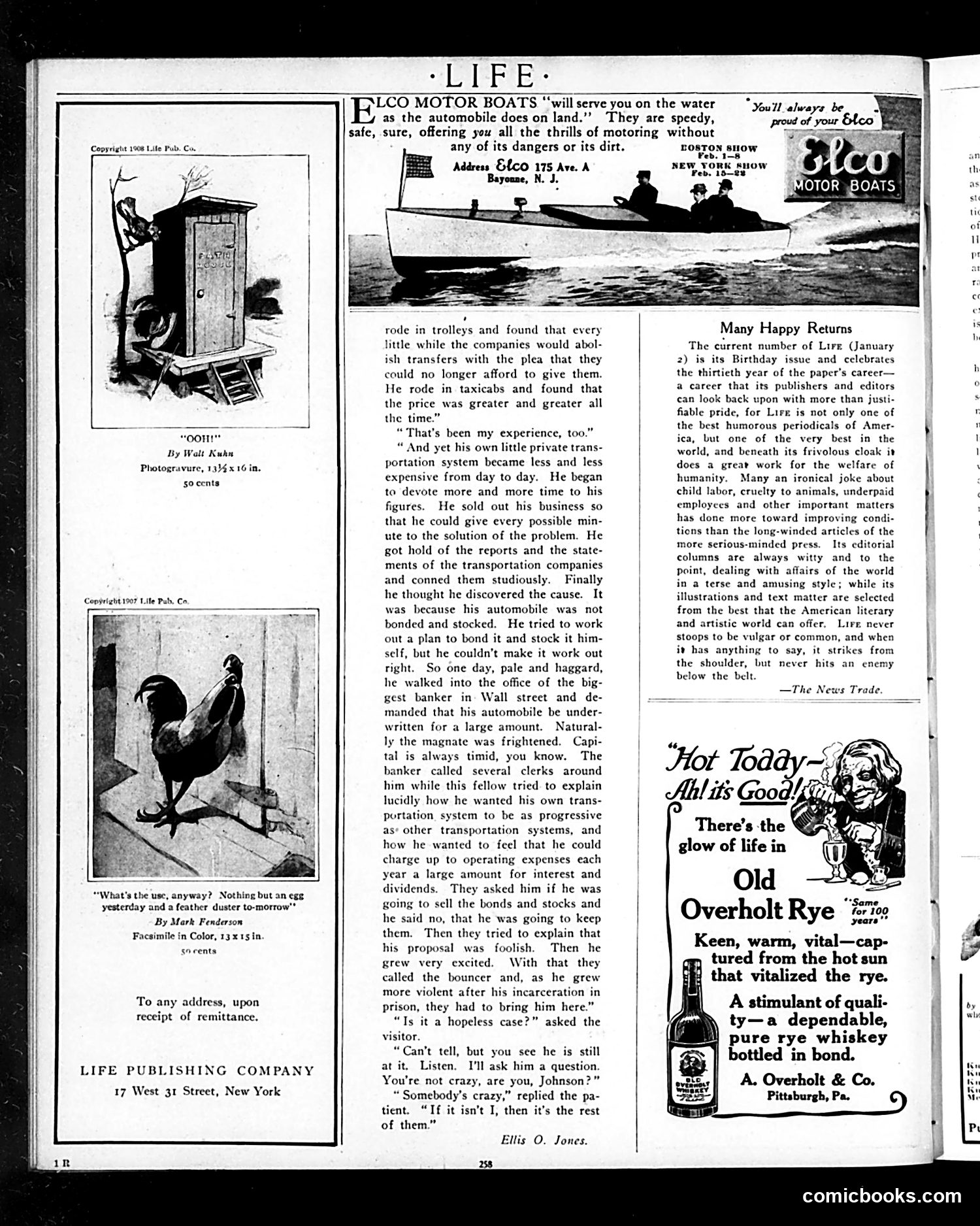
This page contains two satirical cartoons and editorial content celebrating Life's 30th anniversary. **"Ooh!" by Walt Kuhn** depicts a figure being startled by what appears to be a ghost or supernatural apparition—likely satirizing public anxieties about modern technology or urban dangers. **"What's the use, anyway?" by Mark Fenderson** shows a rooster expressing despair about life's futility ("nothing but an egg yesterday and a feather duster tomorrow"). This appears to be dark social commentary on mortality and meaningless cyclical existence. The main text describes a man who becomes obsessed with understanding why transportation companies constantly raise prices and eliminate services. He attempts to convince a Wall Street banker to underwrite his personal automobile as if it were a legitimate transportation company. The banker has him institutionalized, viewing the scheme as delusional—satirizing both capitalist absurdity and society's dismissal of unconventional thinking. The page also contains advertisements for Elco Motor Boats and Old Overholt Rye whiskey.
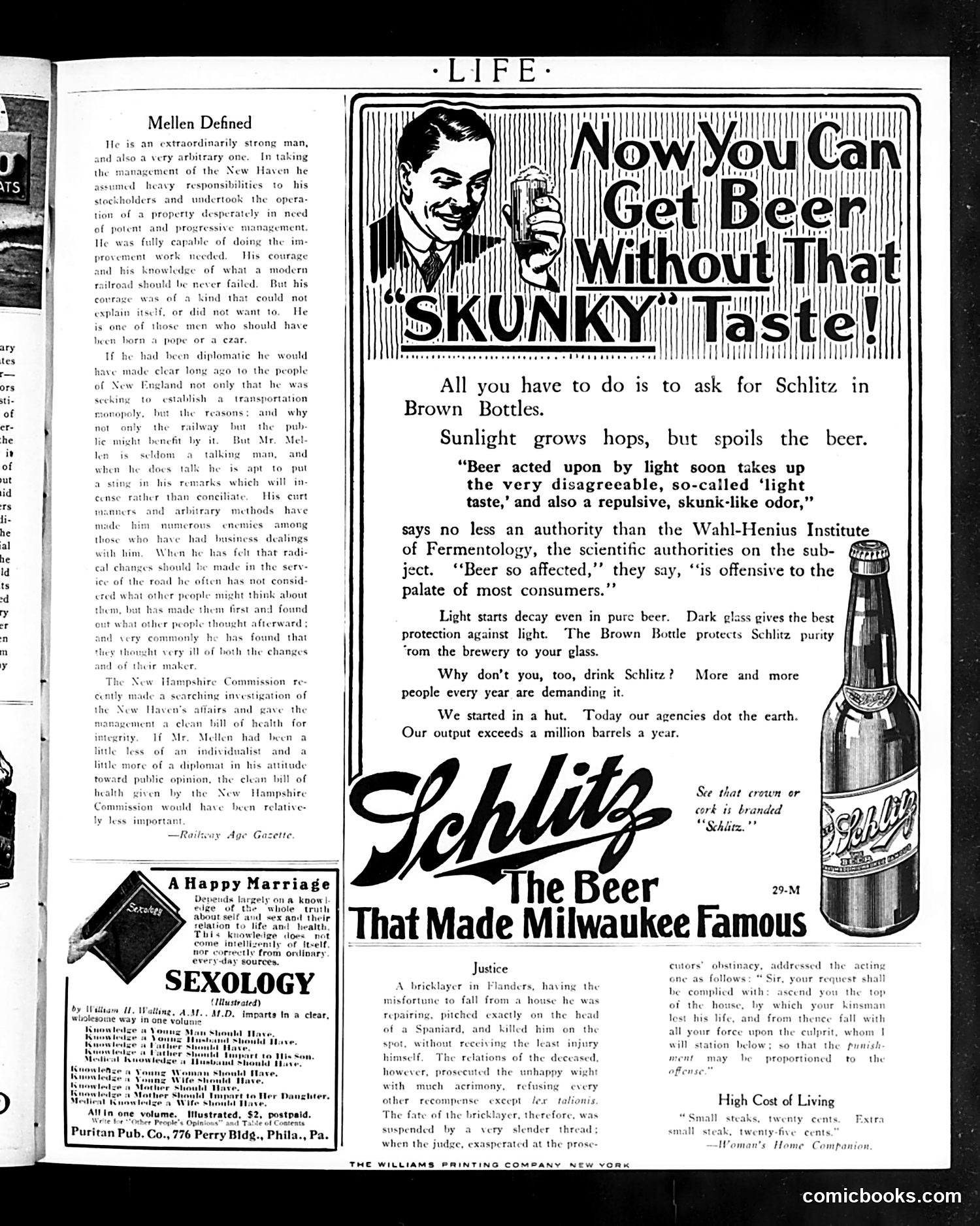
This page combines **editorial content with period advertising**. The left column profiles "Mellen Defined"—Charles Mellen, president of the New York, New Haven & Hartford Railroad. The piece characterizes him as "extraordinarily strong" but "arbitrary," praising his railroad improvements while criticizing his inability to explain himself diplomatically to the public. This appears to be straightforward business commentary, not satire. The dominant feature is a **Schlitz beer advertisement** using pseudo-scientific authority to market brown bottles. It references the "Wahl-Henius Institute of Fermentology" (likely real) to argue that sunlight causes beer to develop an offensive "skunky" taste, positioning dark glass bottles as superior protection. The ad claims Schlitz dominates the market due to this advantage. Below are smaller sections on "A Happy Marriage" (advertising a sexology book) and "Justice" (a brief anecdotal story about legal proportionality). The page reflects early 20th-century commercial culture: mixing serious business analysis with aggressive marketing claims dressed in scientific language.
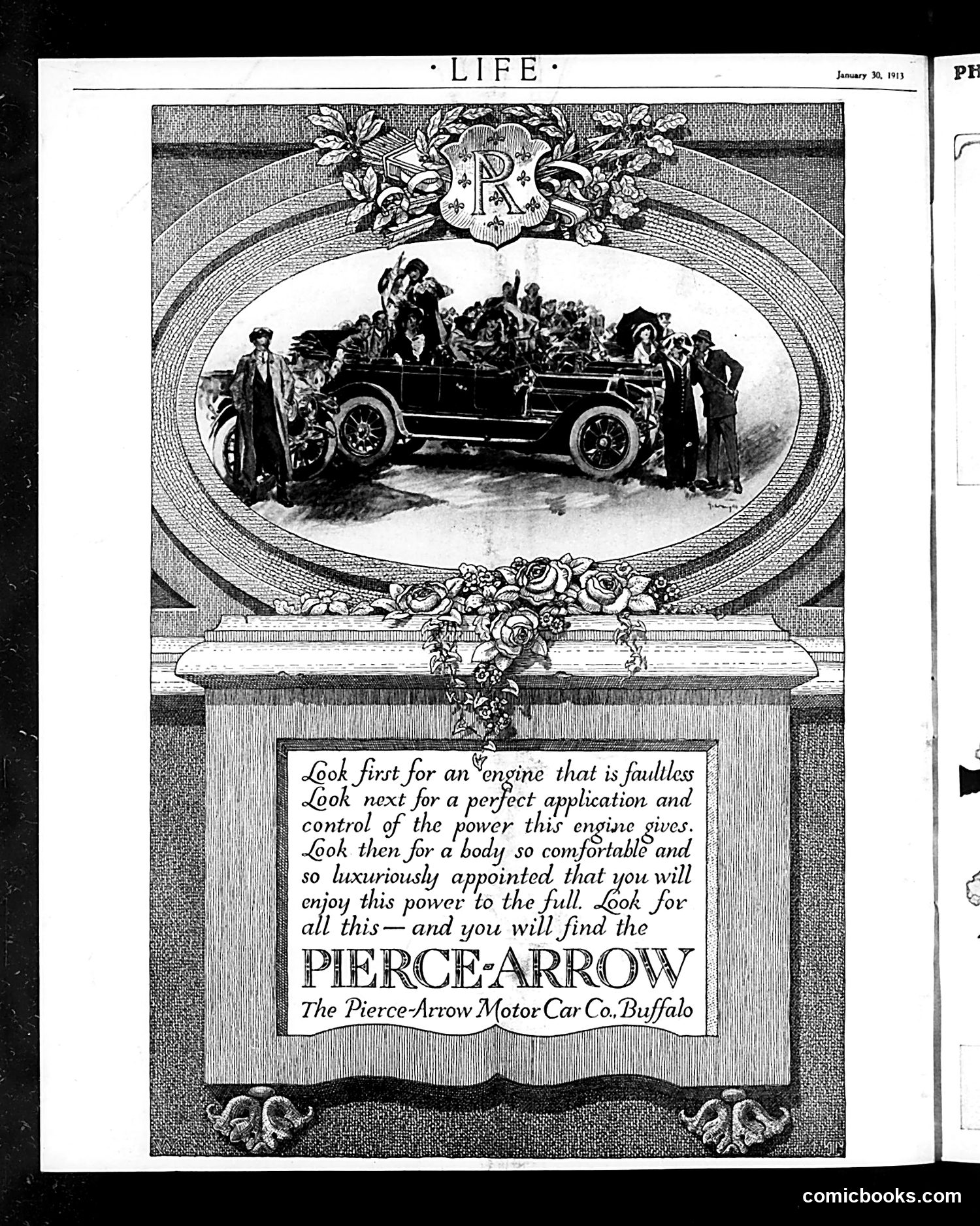
This page is primarily a **Pierce-Arrow automobile advertisement**, not political satire. Dated January 30, 1913, it shows an elegant motorcar filled with well-dressed passengers, flanked by formally attired men. The ad emphasizes the car's "faultless engine," superior power application, and luxurious comfort—targeting wealthy consumers. The ornate decorative border with floral motifs reinforces the product's association with elegance and sophistication. This represents early 20th-century automotive marketing positioning cars as status symbols for the affluent. No political figures or satirical commentary appear to be present; this is straightforward consumer advertising in *Life* magazine's pages.