
Life, 1913-01-30 · page 16 of 36
Life — January 30, 1913 — page 16: what you’re looking at
What you’re looking at
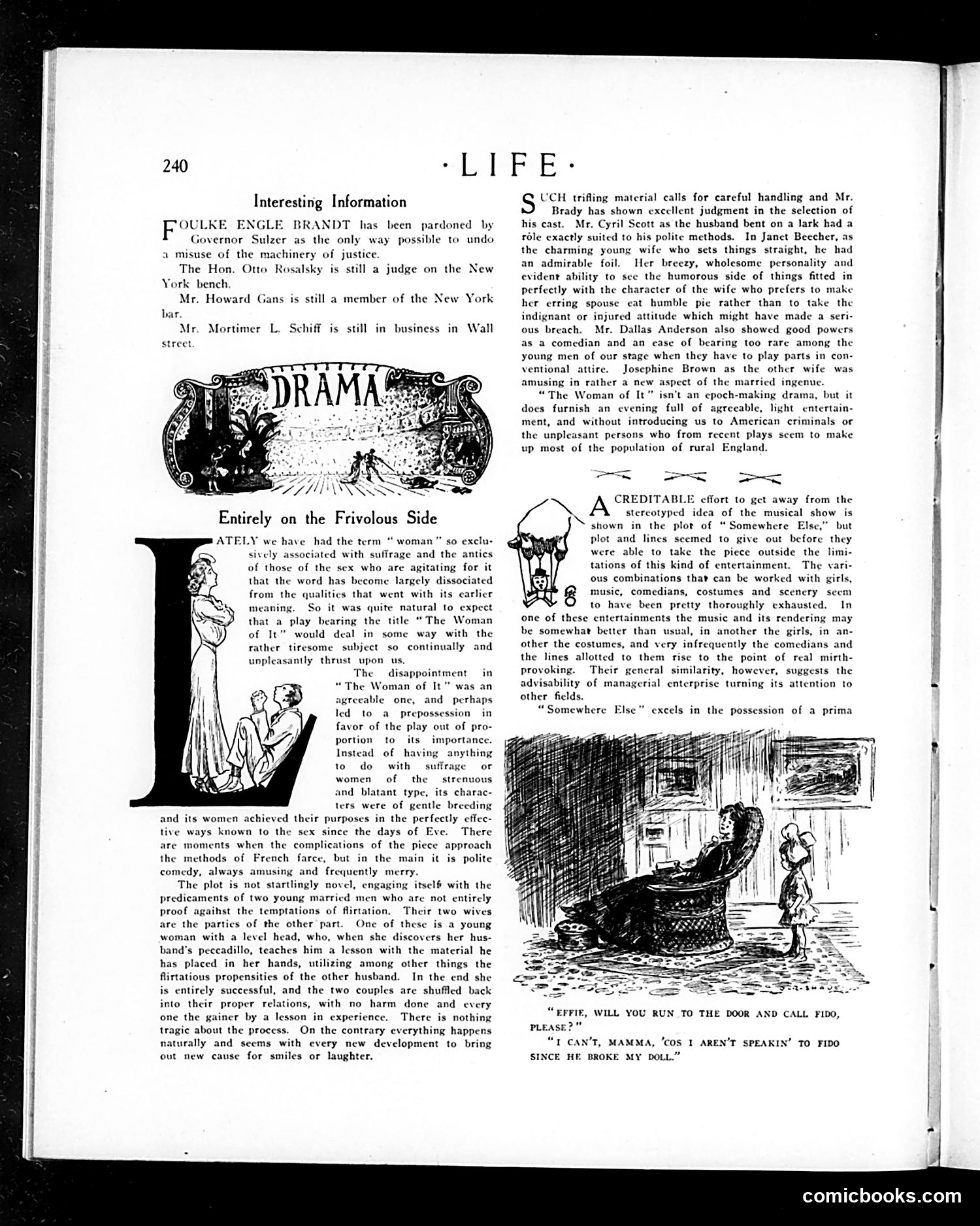
This page contains theater reviews rather than political cartoons. The "Interesting Information" section lists prominent figures (Foulke Engle Brandt, Governor Sulzer, Otto Rosalsky, Howard Gans, Mortimer L. Schiff) apparently to note their current whereabouts or status—a gossip column feature. The main content reviews two plays: "The Woman of It" and "Somewhere Else." The critic praises both for light entertainment. "The Woman of It" avoids the era's contentious suffrage debates by depicting women using traditional feminine wiles rather than political activism—notably, the reviewer seems relieved the play doesn't engage with "suffrage and the antics of those of the sex who are agitating for it." The illustration shows a domestic scene with dialogue about a broken doll, presumably from one of these comedies. The satire is subtle: Life's theater section reflects contemporary anxiety about changing women's roles, applauding entertainment that depicts women working through charm rather than demanding rights.
📄 Transcribed text from this page (OCR, searchable)
Machine-transcribed from the original scan — historical spelling and the odd misread are preserved.
240 -LIFE- UCH trifling material calls for careful handling and Mr. Brady has shown excellent judgment in the selection of OULKE ENGLE BRANDT has been pardoned by his cast. Mr. Cyril Scott as the husband bent on a lark had a réle exactly suited to his polite methods. In Janet Beecher, as the charming young wife who sets things straight, he had an admirable foil. Her breezy, wholesome personality and evident ability to sec the humorous side of things fitted in Interesting Information Governor Sulzer as the only way possible to undo a misuse of the machinery of justice. i The Hon. Otto Rosalsky is still a judge on the New i York bench . ow perfectly with the character of the wife who prefers to make Mr. Howard Gans is still a member of the New York her erring spouse cat humble pic rather than to take the bar. indignant or injured attitude which might have made a seri- Mr. Mortimer L. Schiff is still in business in Wall ous breach. Mr. Dallas Anderson also showed good powers ; street as a comedian and an case of bearing too rare among the young men of our stage when they have to play parts in con- ventional attire. Josephine Brown as the other wife was amusing in rather a new aspect of the married ingenue. “The Woman of It” isn’t an epoch-making drama, but it docs furnish an evening full of agreeable, light entertain- ment, and without introducing us to American criminals or the unpleasant persons who from recent plays seem to make up most of the population of rural England. ad > >< CREDITABLE effort to get away from the stereotyped idea of the musical show is shown in the plot of “Somewhere Else,” but plot and lines seemed to give out before they were able to take the piece outside the limi- tations of this kind of entertainment. The vari- ous combinations thar can be worked with girls, music, comedians, costumes and scenery seem to have been pretty thoroughly exhausted. In one of these entertainments the music and its rendering may of It” would deal in some way with the be somewhat better than usual, in another the girls, in an- so continually and other the costumes, and very infrequently the comedians and the lines allotted to them rise to the point of real mirth- in Provoking, Their general similarity, however, suggests the crial enterprise turning its attention to Entirely on the Frivolous Side ATELY we have had the term “ woman” so exclu- sively associated with suffrage and the antics of those of the sex who are agitating for it that the word has become largely dissociated from the qualities that went with its earlier meaning. So it was quite natural to expect that a play bearing the title “The Woman rather tiresome subject unpleasantly thrust upon us. The disappointment The Woman of It” was an advisability of mana other fields. Somewhere Else” excels in the possession of a prima agreeable one, and perhaps led to a prepossession in favor of the play out of pro- portion to its importance. Instead of having anything to do with suffrage or women of the strenuous and blatant type, its charac- ters were of gentle breeding and its women achieved their purposes in the perfectly effec- tive ways known to the sex since the days of Eve. There are moments when the complications of the piece approach ] the methods of French farce, but in the main it is polite ] comedy, always amusing and frequently merry. The plot is not startlingly novel, engaging itself with the ] predicaments of two young married men who are not entirely proof agaihst the temptations of flirtation, Their two wives are the partics of the other part. One of these is a young woman with a level head, who, when she discovers her hus- band’s peccadillo, teaches him a lesson with the material he has placed in her hands, utilizing among other things the flirtatious propensities of the other husband. In the end she entirely successful, and the two couples are shuffled back into their proper relations, with no harm done and every one the gainer by a lesson in experience. There is nothing tragic about the process. On the contrary everything happens naturally and seems with every new development to bring “1 CAN'T, MAMM out new cause for smiles or laughter. SINCE HE BROKE MY DOLL.” PLEASE comicbooks.com