
Life, 1913-01-30 · page 14 of 36
Life — January 30, 1913 — page 14: what you’re looking at
What you’re looking at
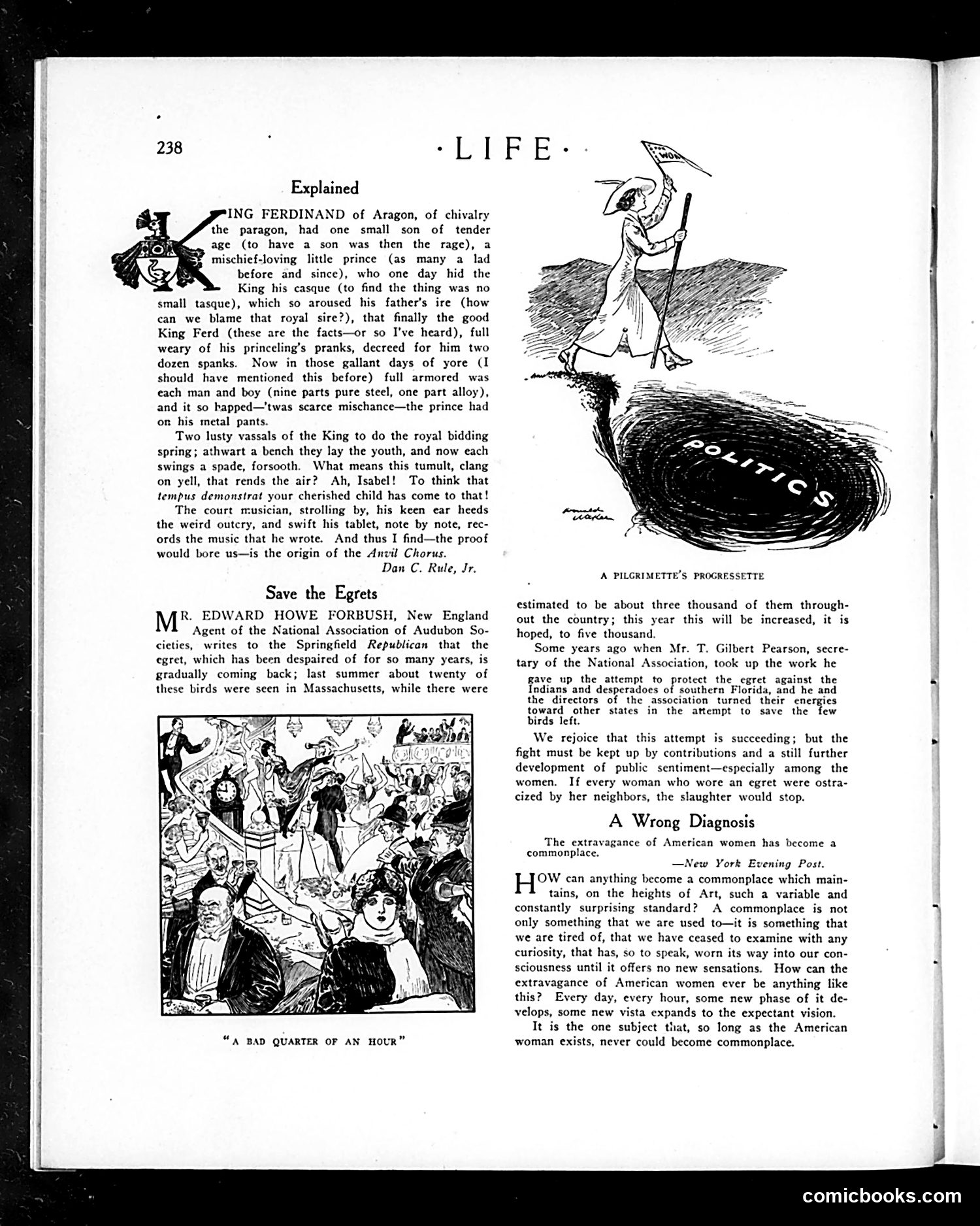
This page contains three distinct pieces: 1. **"Explained"** - A humorous story about King Ferdinand of Aragon and his mischievous son, written by Dan C. Rule, Jr. It's a whimsical historical anecdote about a prince hiding his father's casque, with an illustration showing a figure with a flag. 2. **"Save the Egrets"** - An advocacy piece by Edward Howe Forbush about protecting egrets from extinction. The accompanying illustration ("A Bad Quarter of an Hour") depicts a crowded scene, likely showing hunters or people pursuing egrets. 3. **"A Wrong Diagnosis"** - A social commentary critiquing the "extravagance of American women" as a cliché subject. It argues that women's constant evolution and varied interests prevent them from ever becoming truly commonplace. The page mixes lighthearted fiction, conservation advocacy, and social critique typical of Life's satirical format.
📄 Transcribed text from this page (OCR, searchable)
Machine-transcribed from the original scan — historical spelling and the odd misread are preserved.
Explained ING FERDINAND of Aragon, of chivalry the paragon, had one small son of tender age (to have a son was then the rage), a mischief-loving little prince (as many a lad before and since), who one day hid the King his casque (to find the thing was no small tasque), which so aroused his father’s ire (how can we blame that royal sire?), that finally the good King Ferd (these are the facts—or so I've heard), full weary of his princeling’s pranks, decreed for him two dozen spanks. Now in those gallant days of yore (I should have mentioned this before) full armored was each man and boy (nine parts pure steel, one part alloy), and it so happed—'twas scarce mischance—the prince had : on his metal pants. : Two lusty vassals of the King to do the royal bidding j spring; athwart a bench they lay the youth, and now each swings a spade, forsooth. What means this tumult, clang on yell, that rends the air? Ah, Isabel! To think that tempus demonstrat your cherished child has come to that! The court musician, strolling by, his keen ear heeds the weird outcry, and swift his tablet, note by note, rec- ords the music that he wrote. And thus I find—the proof would bore us—is the origin of the Anvil Chorus. Dan C. Rule, Jr. Save the Egrets M*® EDWARD HOWE FORBUSH, New England Agent of the National Association of Audubon So- cieties, writes to the Springfield Republican that the egret, which has been despaired of for so many years, is gradually coming back; last summer about twenty of these birds were seen in Massachusetts, while there were “A BAD QUARTER OF AN HOUR” -CPPE: - estimated to be about three thousand of them through- out the country; this year this will be increased, it is hoped, to five thousand. Some years ago when Mr. T. Gilbert Pearson, secre- tary of the National Association, took up the work he gave up the attempt to Protect the egret against the Indians and desperadoes of southern Florida, and he and the directors of the association turned their energies toward other states in the attempt to save the few birds left. We rejoice that this attempt is succeeding; but the fight must be kept up by contributions and a still further development of public sentiment—especially among the women. If every woman who wore an egret were ostra- cized by her neighbors, the slaughter would stop. A Wrong Diagnosis The extravagance of American women has become a commonplace. —New York Evening Post. OW can anything become a commonplace which main- tains, on the heights of Art, such a variable and constantly surprising standard? A commonplace is not only something that we are used to—it is something that we are tired of, that we have ceased to examine with any curiosity, that has, so to speak, worn its way into our con- sciousness until it offers no new sensations. How can the extravagance of American women ever be anything like this? Every day, every hour, some new phase of it de- velops, some new vista expands to the expectant vision. It is the one subject that, so long as the American woman exists, never could become commonplace. comicbooks.com