
Life, 1913-01-30 · page 12 of 36
Life — January 30, 1913 — page 12: what you’re looking at
What you’re looking at
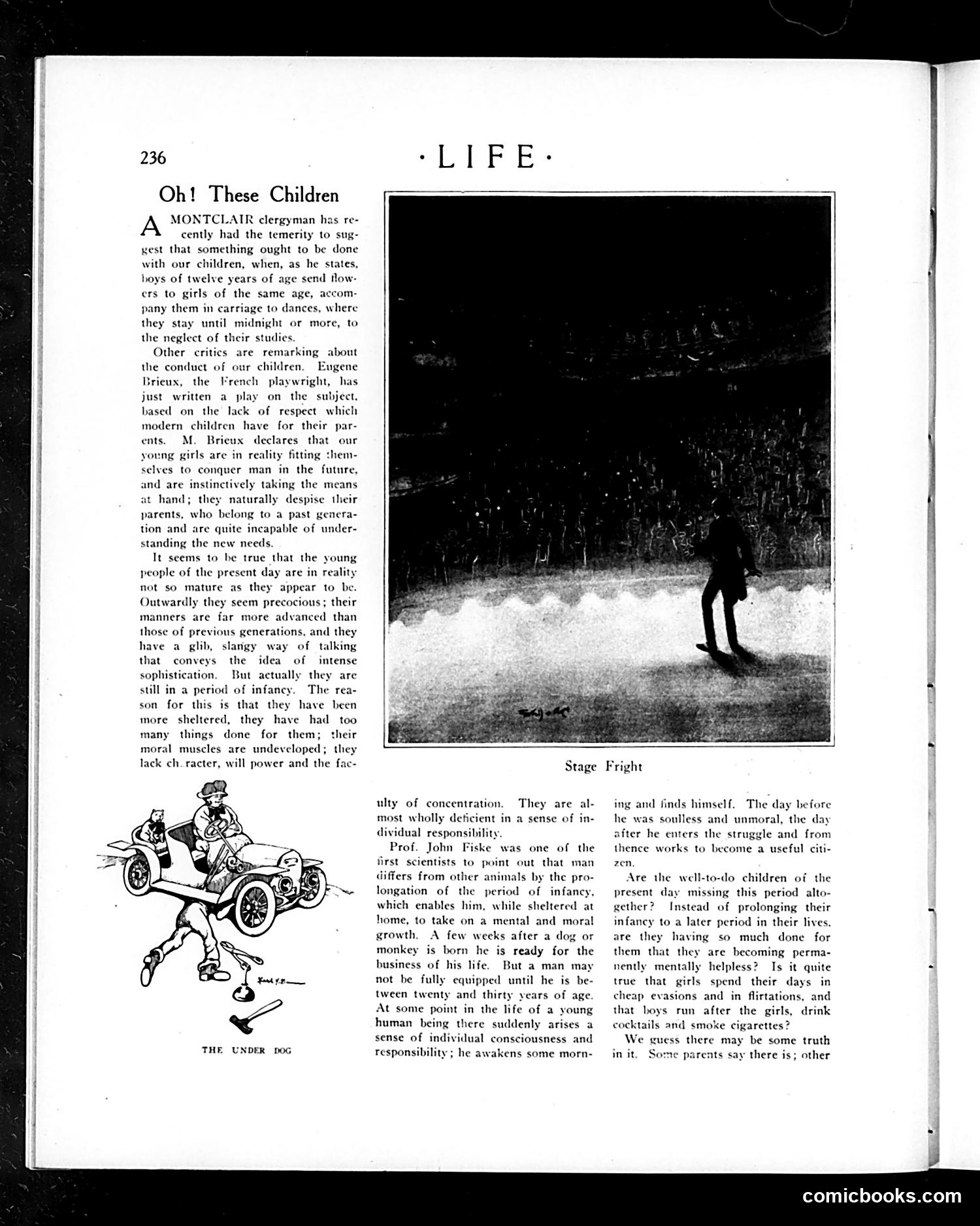
This page satirizes modern parenting and youth behavior. The article criticizes children's lack of respect for parents and insufficient moral development, citing French playwright Eugène Brieux's work on the subject. The cartoon labeled "The Under Dog" depicts a chauffeur or servant being dragged by a small child in an automobile—a visual joke about role reversal where children have become dominant over adults. The photograph titled "Stage Fright" shows a figure in formal attire, likely illustrating the article's broader point about children's premature sophistication and social anxiety. The piece argues that modern children appear precocious but are actually emotionally immature, having been overindulged and under-disciplined—a common Progressive-era social critique about generational decline and parenting failures.
📄 Transcribed text from this page (OCR, searchable)
Machine-transcribed from the original scan — historical spelling and the odd misread are preserved.
236 Oh! These Children A MONTCLAIR clergyman has re- cently had the temerity to sug- gest that something ought to be done with our children, when, as he states, hoys of twelve years of age send fow- ers to girls of the same ag om- pany them in carriage to dances, where they stay until midnight or more, to the neglect of their studies. Other critics are remarking about the conduct of our children. Eugene Brieux, the French playwright, has just written a play on the subject, based on the lack of respect which modern children have for their par- ents. M. Brieux declares that our young girls are in reality fitting them- selves to conquer man in the future, and are instinctively taking the means at hand; they naturally despise their parents, who belong to a past genera- tion and are quite incapable of under- standing the new needs. It seems to be true that the young people of the present day are in reality not so mature as they appear to be. Outwardly they seem precocious; their manners are far more advanced than those of previous generations, and they have a glib, slangy way of talking that conveys the idea of intense sophistication, But actually they are still in a period of infancy. The rea. son for this is that they have been more sheltered, they have had too many things done for them; their moral muscles are undeveloped; they lack ch. racter, will power and the fac- THE UNDER Doc Stage Fright ulty of concentration. They are al- most wholly deticient in a sense of in- dividual responsibility Prof. John Fiske was one of the first scientists to point out that man fiers from other animals by the pro- longation of the period of infancy, which enables him, while sheltered at home, to take on a mental and moral growth. A few weeks after a dog or monkey is born he is ready for the business of his life. But a man may not be fully equipped until he is be- tween twenty and thirty years of age. At some point in the life of a young human being there suddenly arises a sense of individual consciousness and responsibility ; he awakens some morn- ing and finds himself. The day before he was soulless and unmoral, the ¢ fter he enters the struggle and from thence works to become a useful citi- zen Are the well-to-do children of the present day missing this period alto- gether? Instead of prolonging their infancy to a later period in their lives, are they having so much done for them that they are becoming perma- nently mentally helple Is it quite true that girls spend their days in cheap evasions and in flirtations, and that boys run after the girls, drink cocktails and smoke cigarettes? We guess there may be some truth in it. Some parents say there is; other comicbooks.com