
Life, 1913-01-30 · page 20 of 36
Life — January 30, 1913 — page 20: what you’re looking at
What you’re looking at
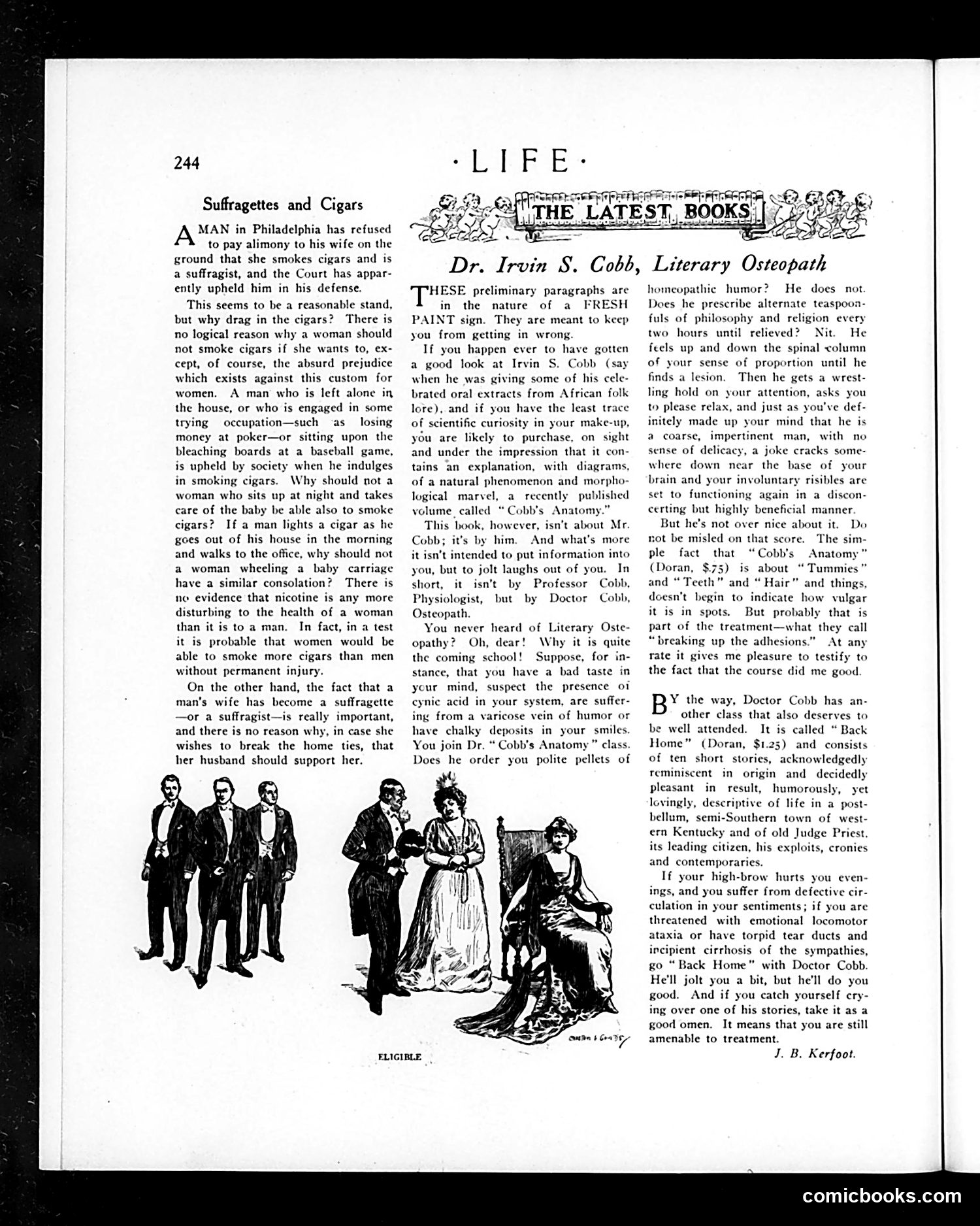
This page contains two distinct articles satirizing contemporary social issues circa 1910s-1920s. **"Suffragettes and Cigars"** (left column): The article mocks a Philadelphia court case where a man refused alimony, claiming his wife's cigar-smoking and suffragism made her unfit. The author sarcastically argues there's no logical reason women shouldn't smoke cigars if men do, but agrees the real problem is her being a suffragist—someone advocating women's voting rights. The satire targets both the absurd gender double-standard and (implicitly) husbands' resistance to women's rights activism. **"Dr. Irvin S. Cobb, Literary Osteopath"** (right): A humorous book review of humorist Irvin S. Cobb's "Cobb's Anatomy." The critic playfully compares Cobb's comedy writing to osteopathic treatment—cracking jokes like a doctor manipulating the spine to "cure" readers' poor humor and cynicism. It's praise wrapped in elaborate metaphor, acknowledging Cobb can be crude but effective. The illustration shows a social gathering with well-dressed figures, likely representing the "suffragette" controversy.
📄 Transcribed text from this page (OCR, searchable)
Machine-transcribed from the original scan — historical spelling and the odd misread are preserved.
244 Suffragettes and Cigars MAN in Philadelphia has refused to pay alimony to his wife on the ground that she smokes cigars and is a suffragist, and the Court has appar- ently upheld him in his defense. This seems to be a reasonable stand, but why drag in the cigars? There is no logical reason why a woman should not smoke cigars if she wants to, ex- cept, of course, the absurd prejudice which exists against this custom for women. A man who is left alone in the house, or who is engaged in some trying occupation—such as__ losing money at poker—or sitting upon the bleaching boards at a baseball game, is upheld by society when he indulges in smoking cigars. Why should not a woman who sits up at night and takes care of the baby be able also to smoke cigars? If a man lights a cigar as he goes out of his house in the morning and walks to the office, why should not a woman wheeling a baby carriage have a similar consolation? There is no evidence that nicotine is any more disturbing to the health of a woman than it is to a man. In fact, in a test it is probable that women would be able to smoke more cigars than men without permanent injury. On the other hand, the fact that a man’s wife has become a suffragette —or a suffragist—is really important, and there is no reason why, in case she wishes to break the home ties, that her husband should support her. Dr. Irvin S. Cobb, Literary Osteopath HESE preliminary paragraphs are in the nature of a FRESH PAINT sign. They are meant to keep you from getting in wrong If you happen ever to have gotten a good look at Irvin S. Cobb (say when he was giving some of his cele- brated oral extracts from African folk lore), and if you have the least trace of scientific curiosity in your make-up, you are likely to purchase, on sight and under the impression that it con- tains an explanation, with diagrams, of a natural phenomenon and morpho- logical. marvel, a recently published volume called “Cobb's Anatomy.” This book, however, isn’t about Mr. Cobb; it’s by him. And what's more it isn’t intended to put information into you, but to jolt laughs out of you. In short, it isn’t by Professor Cobb, Physiologist, but by Doctor Cobb, Osteopath. You never heard of Literary Oste- opathy? Oh, dear! Why it is quite the coming school! Suppose, for in- stance, that you have a bad taste in your mind, suspect the presence of cynic acid in your system, are suffer- ing from a varicose vein of humor or have chalky deposits in your smiles. You join Dr. “ Cobb's Anatomy ” class. Does he order you polite pellets of homeopathic humor? He does not. Does he prescribe alternate teaspoon- fuls of philosophy and religion every two hours until relieved? Nit. He feels up and down the spinal column of your sense of proportion until he finds a lesion, Then he gets a wrest- ling hold on your attention, asks you to please relax, and just as you've def- initely made up your mind that he is coarse, impertinent man, with no sense of delicacy, a joke cracks some- where down near the base of brain and your involuntary set to functioning your risible: again in a discon- certing but highly beneficial manner. But he’s not over nice about it. Do not be misled on that score. The sim. ple fact that “Cobb's Anatomy (Doran, $75) is about “Tummie and “Teeth” and “ Hair” and things, doesn’t begin to indicate how vulgar it is in spots. But probably that is part of the treatment—what they call “breaking up the adhesions.” At any rate it gives me pleasure to testify to the fact that the course did me good. BY the way, Doctor Cobb has an- other class that also deserves to be well attended. It is called “ Back Home” (Doran, $1.23) and consists of ten short stories, acknowledgedly reminiscent in igin and decidedly pleasant in result, humorously, yet lovingly, descriptive of life in a post- bellum, semi-Southern town of west- ern Kentucky and of old Judge Priest. its leading citizen, his exploits, cronies and contemporaries. If your high-brow hurts you even- ings, and you suffer from defective cir- culation in your sentiments; if you are threatened with emotional locomotor ataxia or have torpid tear ducts and incipient cirrhosis of the sympathies, go “Back Home” with Doctor Cobb. He'll jolt you a bit, but he'll do you good. And if you catch yourself cry- ing over one of his stories, take it as a good omen. It means that you are still amenable to treatment. J. B. Kerfoot. comicbooks.com