
A complete issue · 48 pages · 1912
Life — December 12, 1912
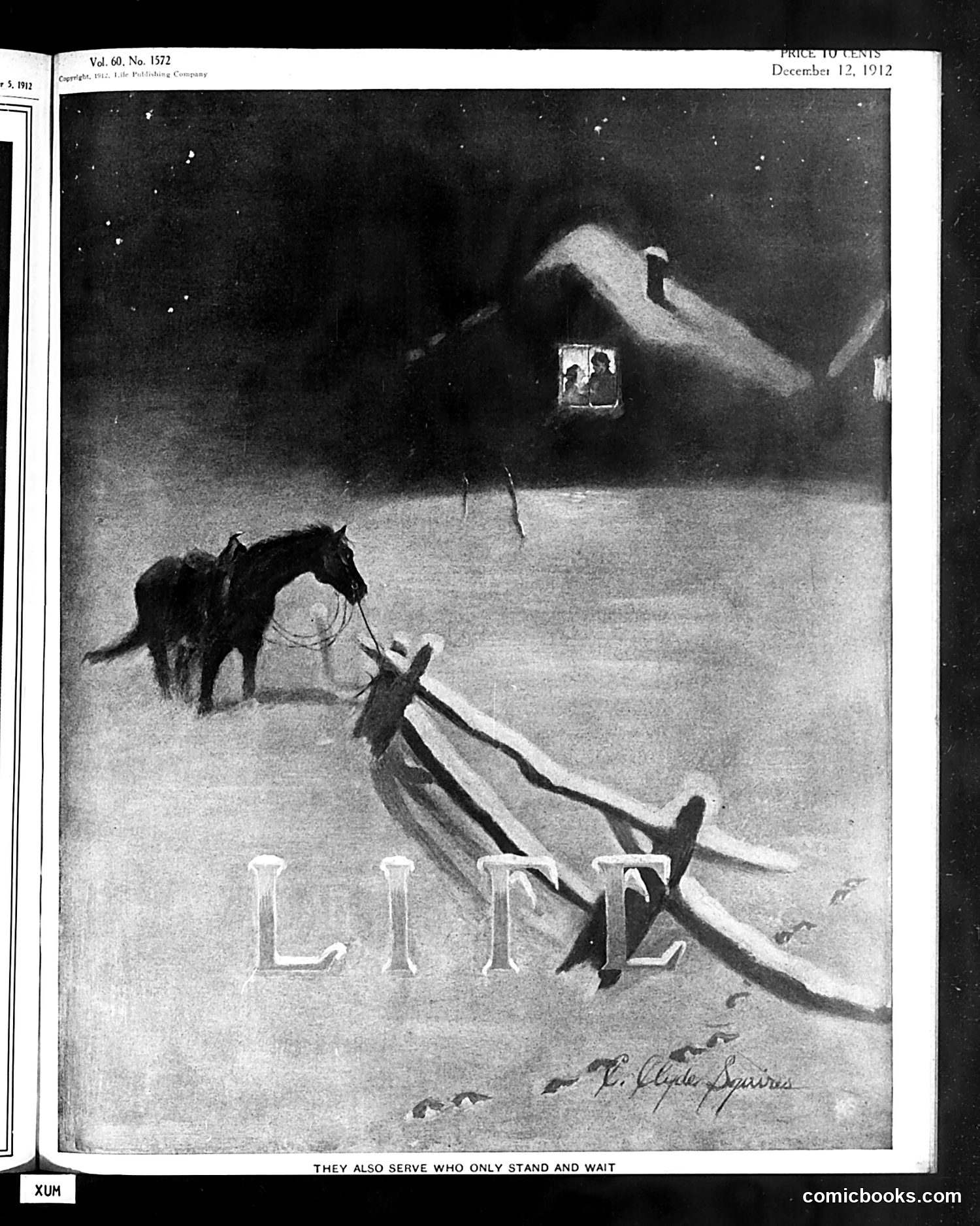
This cover illustrates the caption "They Also Serve Who Only Stand and Wait" through a winter scene showing a horse pulling a sleigh toward a snow-covered house with lit windows. The composition suggests waiting and patience during harsh conditions. The phrase references Milton's *Sonnett on His Blindness* ("They also serve who only stand and wait"), likely applying it to domestic or civilian duty during winter hardship. The horse, a working animal enduring difficult conditions, becomes a metaphor for those performing unglamorous but necessary service. The signature appears to be by illustrator F. Uchel Squires. Without additional context from the issue, the specific social or political commentary remains unclear, though it may relate to labor, duty, or wartime service given the 1912 date.
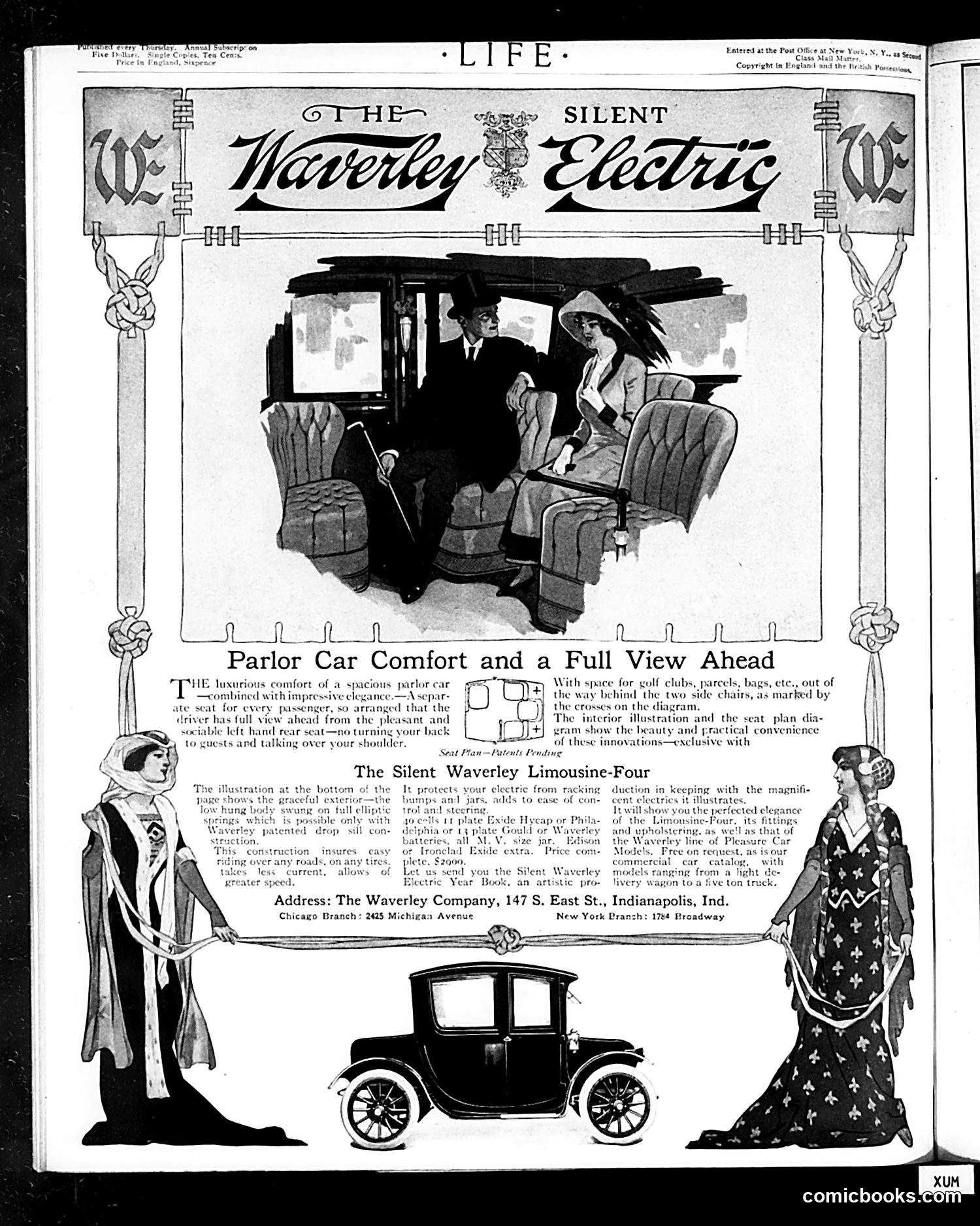
This page is primarily **automobile advertising**, not political satire. It promotes the Waverley, an electric car manufactured by the Waverley Company of Indianapolis. The ad emphasizes luxury features: a spacious parlor-car interior with comfortable seating, large windows providing "full view ahead," and storage for golf clubs and luggage. The decorative illustrations of fashionably-dressed women in period clothing (likely early 1900s) appeal to affluent buyers, suggesting the vehicle's sophisticated appeal. The "silent" aspect of the electric engine—a major selling point for early electric vehicles—is highlighted as providing smooth, quiet operation without the noise and vibration of gasoline engines. This represents early automotive marketing targeting wealthy consumers who valued comfort and elegance over speed.
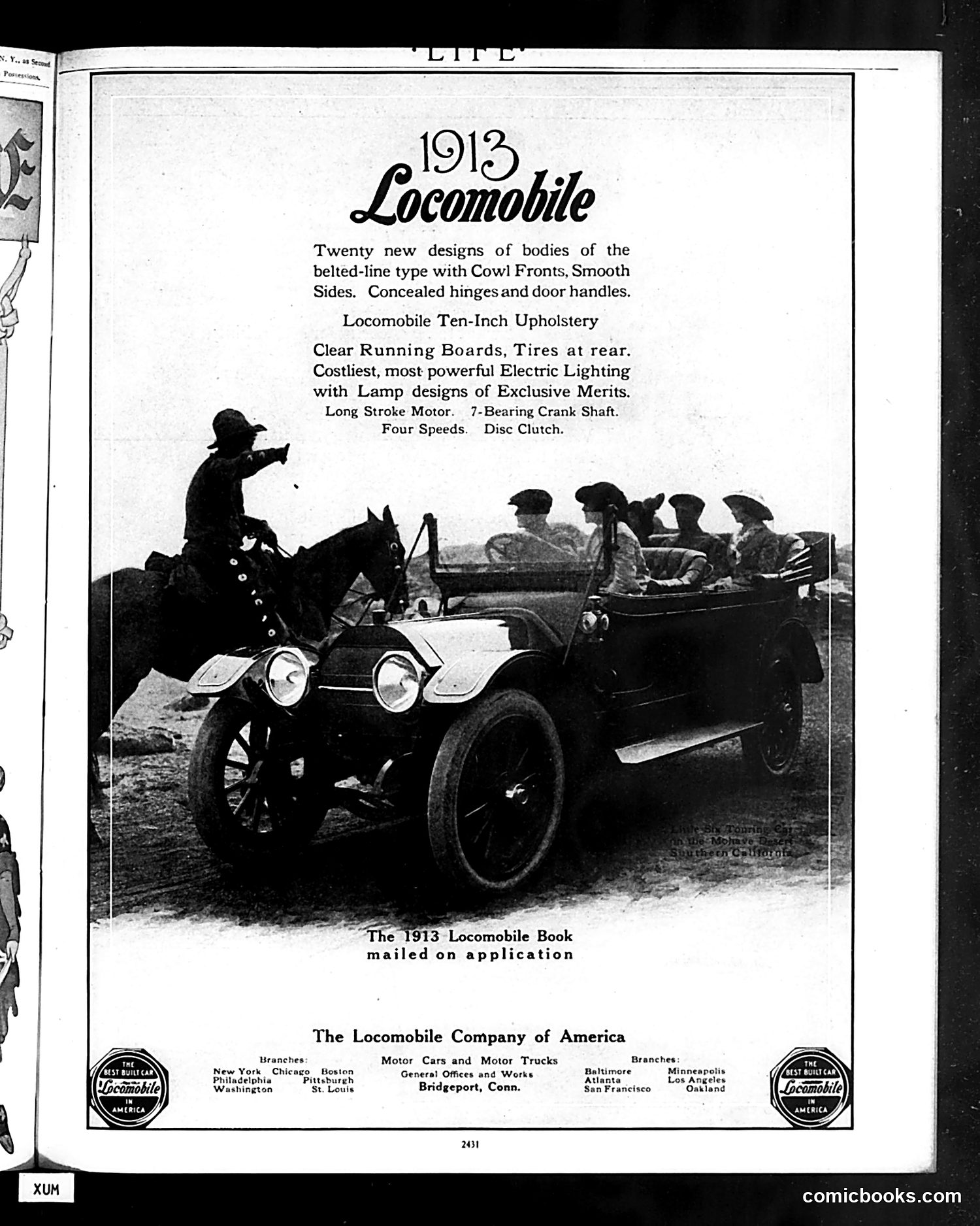
This is **not a political cartoon**, but rather a full-page advertisement for the 1913 Locomobile automobile. The image shows two vehicles: a smaller touring car in the foreground and a larger passenger vehicle behind it, with fashionably dressed figures in early-1900s clothing and caps. The ad highlights luxury features: twenty body designs, electric lighting, concealed hinges, clear running boards, and a long-stroke motor with disc clutch. The photograph demonstrates the automobile's capability and style to wealthy potential buyers—the intended audience for this premium vehicle. This represents typical *Life* magazine content of the era: satirical editorial material alongside upscale advertising targeting middle and upper-class readers.
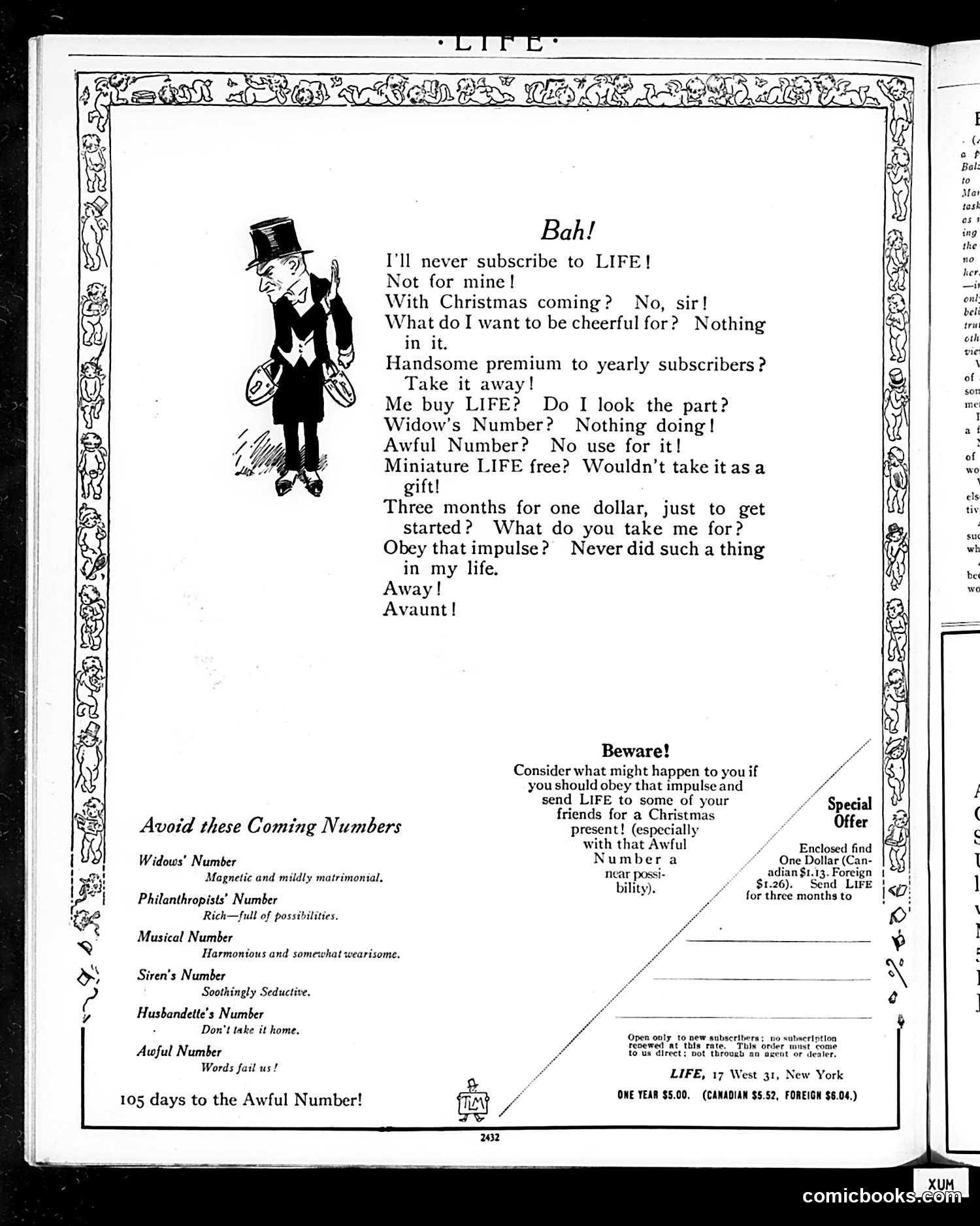
This page is primarily a **satirical advertisement for LIFE magazine itself**, using humor to mock potential subscribers who resist subscribing. The cartoon shows a **curmudgeonly figure in top hat and formal wear**—appearing to represent a stereotypical grumpy, miserly old man—explicitly rejecting LIFE magazine subscription. His complaints are comedically exaggerated: he won't be cheerful, dismisses the premium offer, questions whether he "looks the part," and rejects the discounted trial offer as suspicious. The satire works by **inverting typical advertising logic**: rather than selling benefits, it humorously lists reasons NOT to subscribe, then warns readers to "beware" and avoid sending subscriptions to "friends for a Christmas present"—actually encouraging exactly that through reverse psychology. The "Awful Number" and other satirical issue titles ("Widow's Number," "Siren's Number") further mock predictable magazine content formulas.
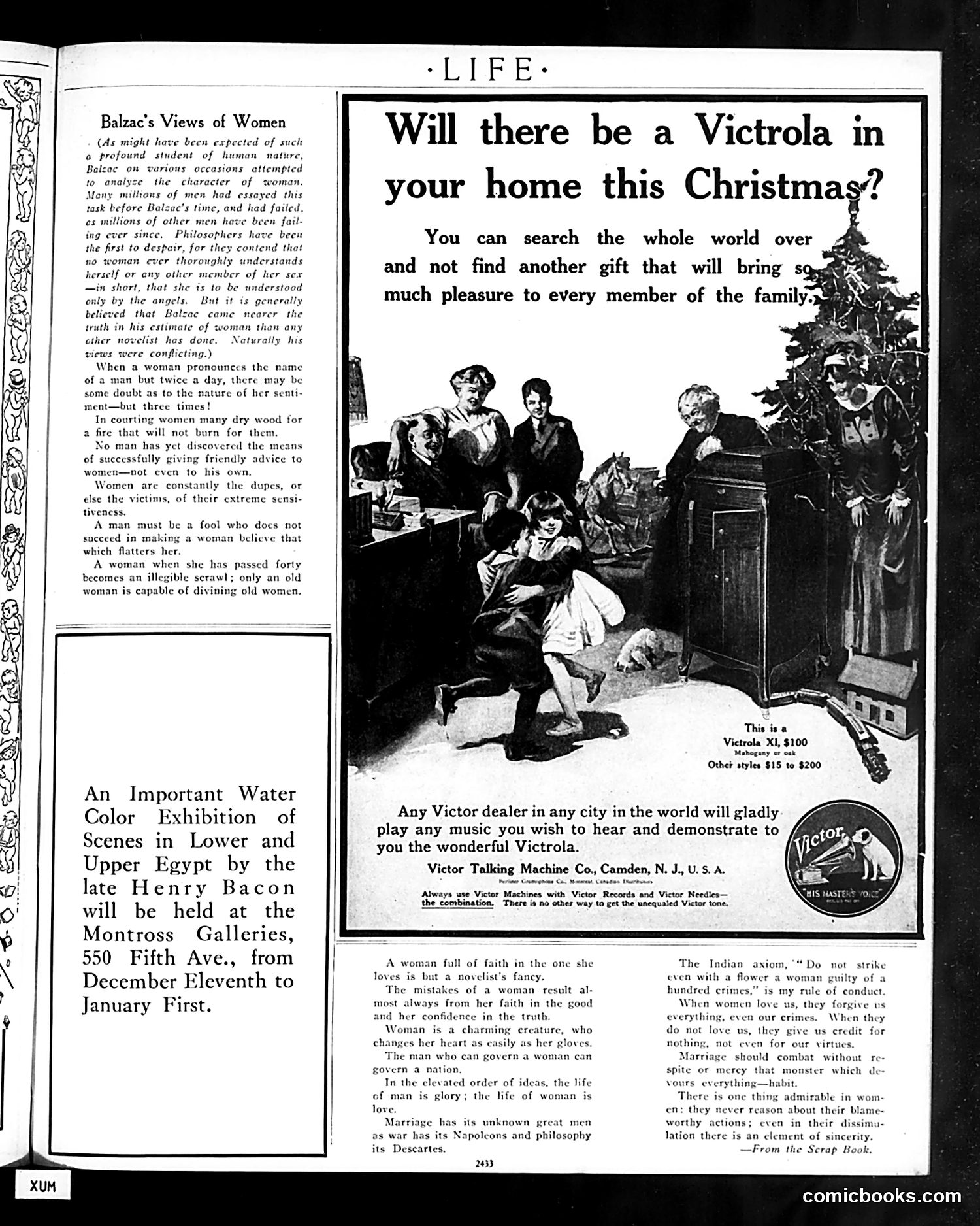
This page is primarily **advertising**, not satire or political commentary. The large advertisement promotes the **Victrola**, a phonograph manufactured by Victor Talking Machine Co. The illustration shows a family gathered around the device during Christmas, with children and adults listening to music. The ad's pitch emphasizes the Victrola as an ideal gift that brings "pleasure to every member of the family." The left column contains unrelated content: philosophical musings on women attributed to Balzac, and an announcement about an Egyptian watercolor exhibition at the Montross Galleries. The bottom of the page includes moral aphorisms about women and marriage, attributed to "The Scrap Book." This appears to be a typical early-20th-century Life magazine layout mixing advertising, cultural announcements, and editorial filler rather than satirical content.
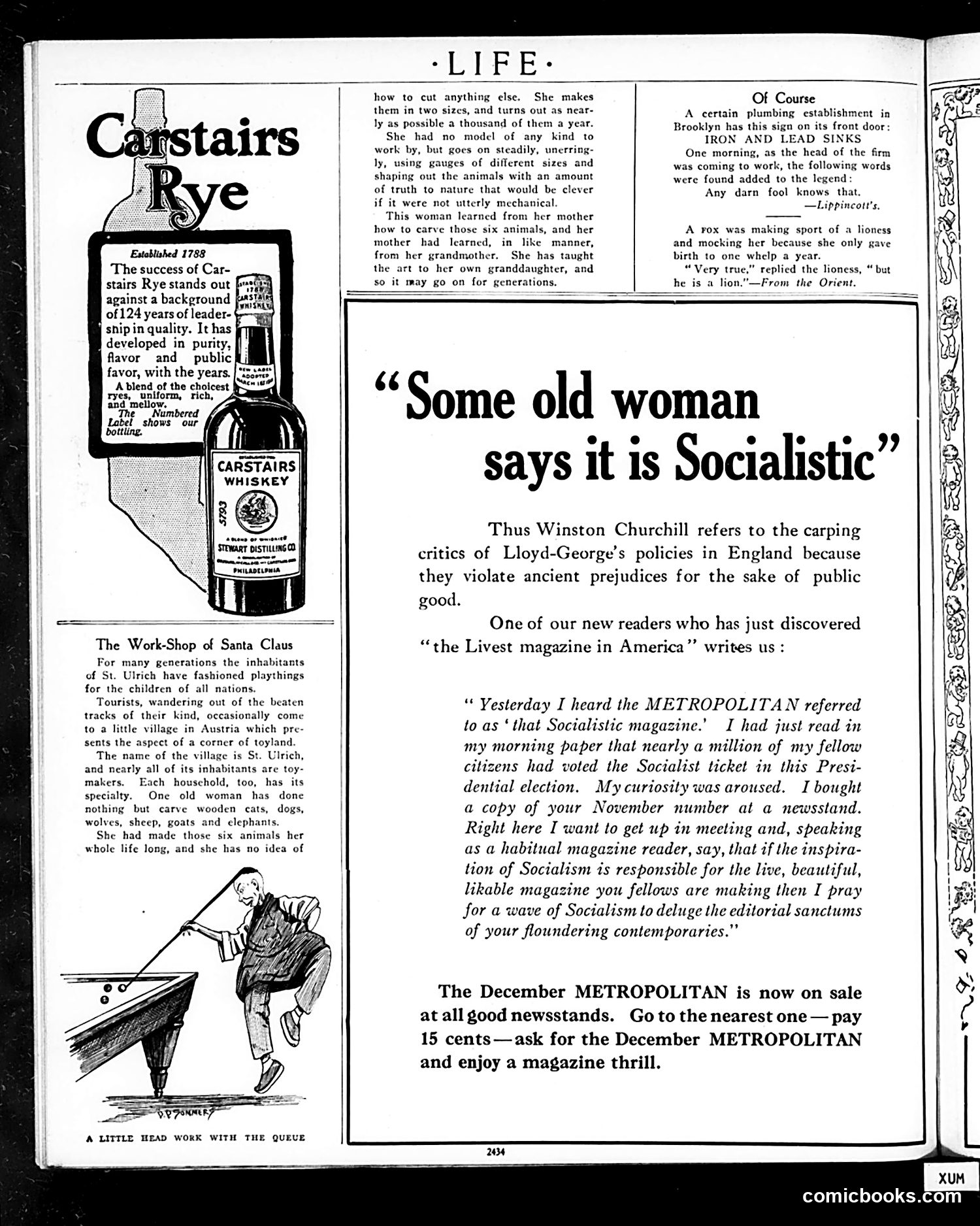
This page is primarily **advertising and promotional content** rather than political satire. The left side features a **Carstairs Rye whiskey advertisement** (established 1783), emphasizing its 124-year heritage and quality. Below that is a humorous piece about "The Work-Shop of Santa Claus" in St. Ulrich, Austria—a tourist village where inhabitants craft wooden toys and animals. The accompanying illustration shows a craftsman carving, labeled "A LITTLE HEAD WORK WITH THE QUEUE," playing on the phrase "queue" (line/waiting). The right side contains a **Metropolitan magazine advertisement**, featuring a reader's letter praising the magazine and humorously referencing Winston Churchill's criticism of Lloyd George's policies as "Socialistic." The ad promotes the December issue for 15 cents, framing socialism as editorially inspiring rather than threatening—likely tongue-in-cheek satire of contemporary political anxieties.
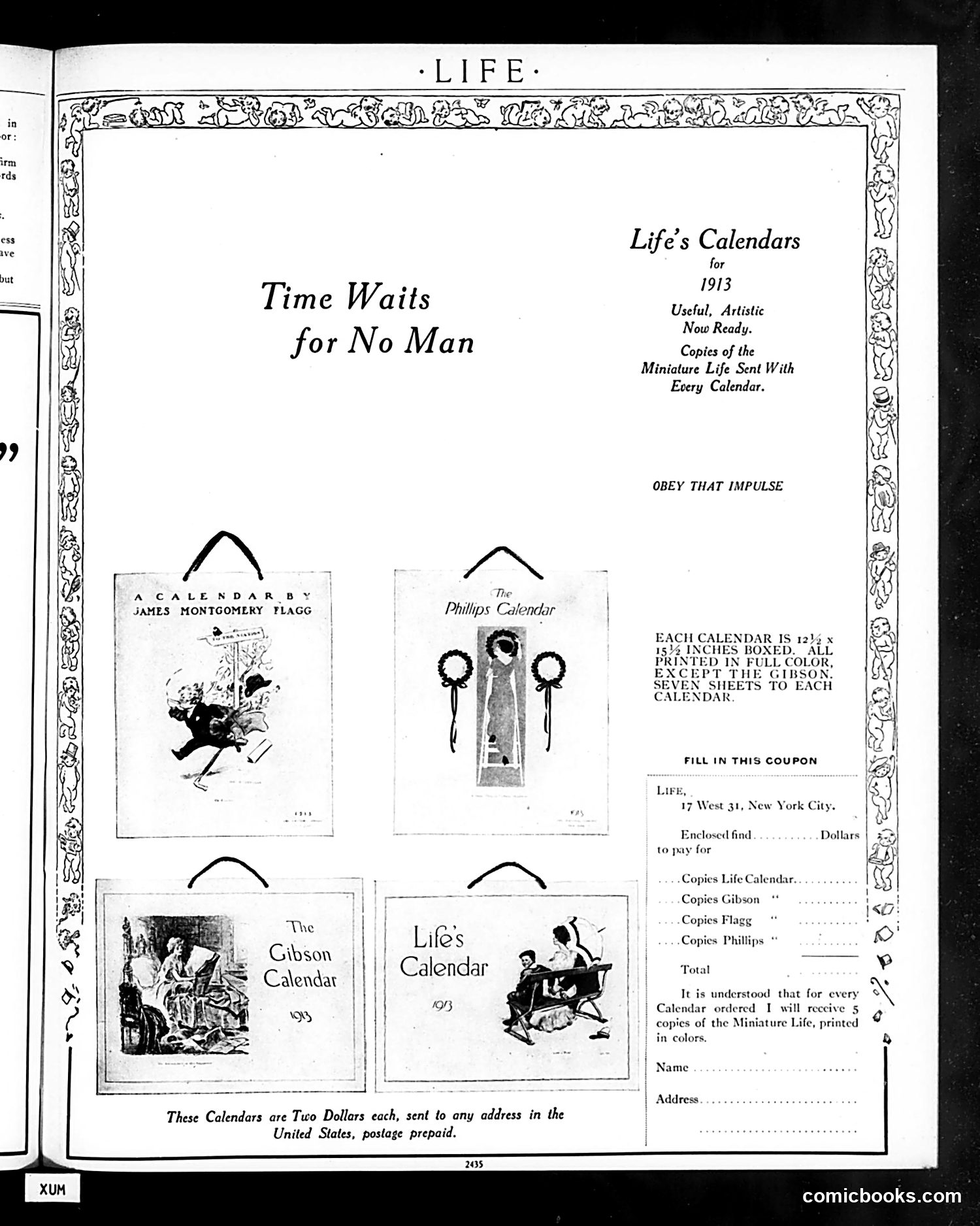
This is primarily an **advertisement page**, not a political cartoon. The page sells four decorative calendars for 1913, marketed as "Life's Calendars" — "Useful, Artistic, Now Ready." The four calendar options shown are: 1. **"A Calendar by James Montgomery Flagg"** (top left) 2. **"The Phillips Calendar"** (top right) 3. **"The Gibson Calendar"** (bottom left) 4. **"Life's Calendar"** (bottom right) Each calendar costs two dollars, postage prepaid within the United States. The page includes an order coupon for customers to specify which calendars they want. A promotional note states that for every calendar ordered, the purchaser receives five miniature Life magazines in color. The decorative illustrations on each calendar sample reflect popular early-1900s artistic styles but aren't satirical commentary — they're simply product marketing imagery.
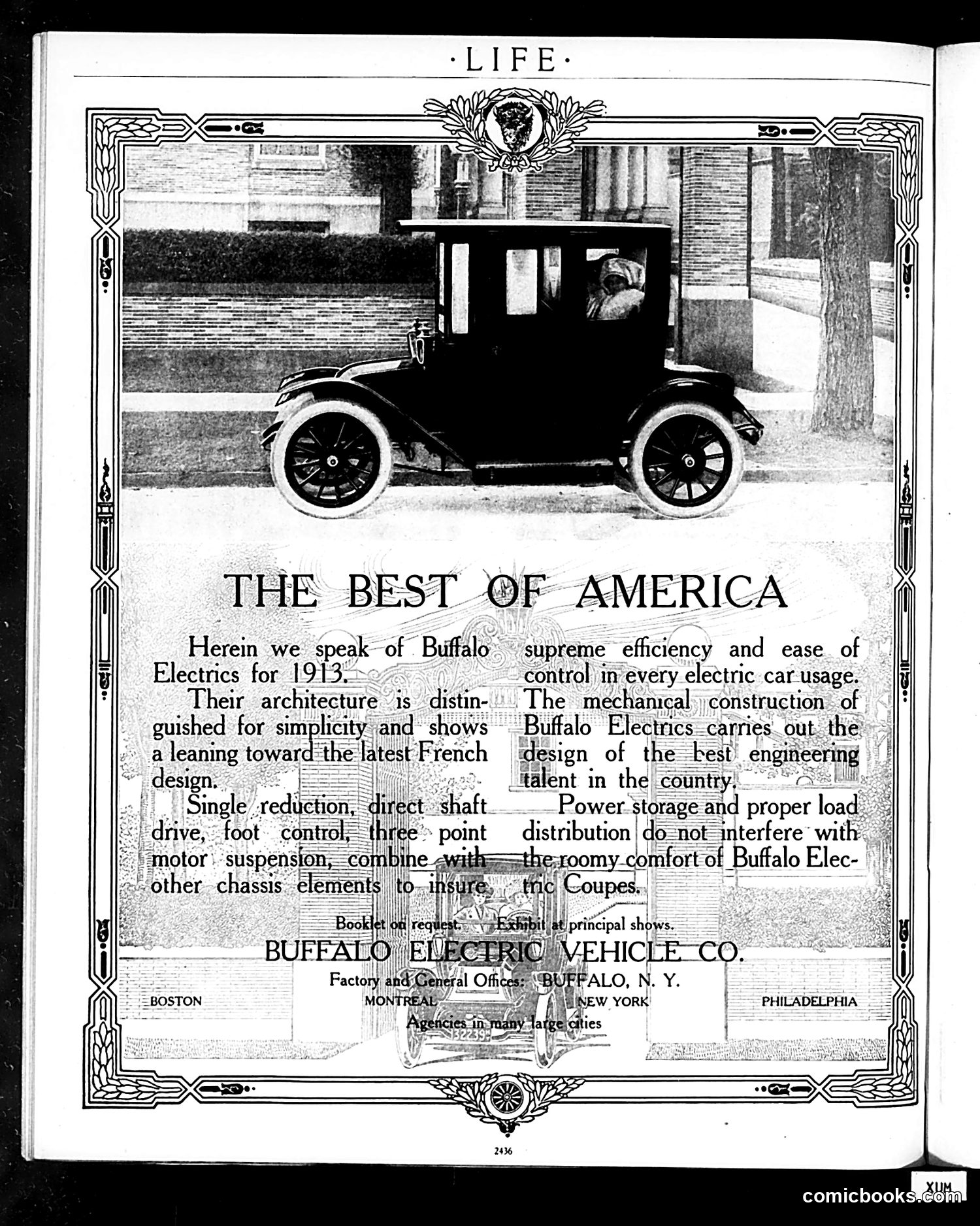
This is primarily a **product advertisement**, not satire or political commentary. It appears in *Life* magazine promoting the **Buffalo Electric Vehicle** for 1913. The ad emphasizes the car's advantages: French-influenced design, single-reduction direct-shaft drive, foot control, motor suspension, and efficient power storage. It highlights "supreme efficiency and ease of control in every electric car usage" and boasts of "best engineering talent in the country." The phrase "**The Best of America**" is marketing copy positioning the vehicle as quintessentially American quality. **Historical context**: Electric vehicles were a serious commercial competitor to gasoline cars in the 1910s, marketed as cleaner, quieter, and easier to operate—particularly appealing to wealthy women drivers. This advertisement represents that pre-Model T era when electric automobiles seemed potentially dominant.
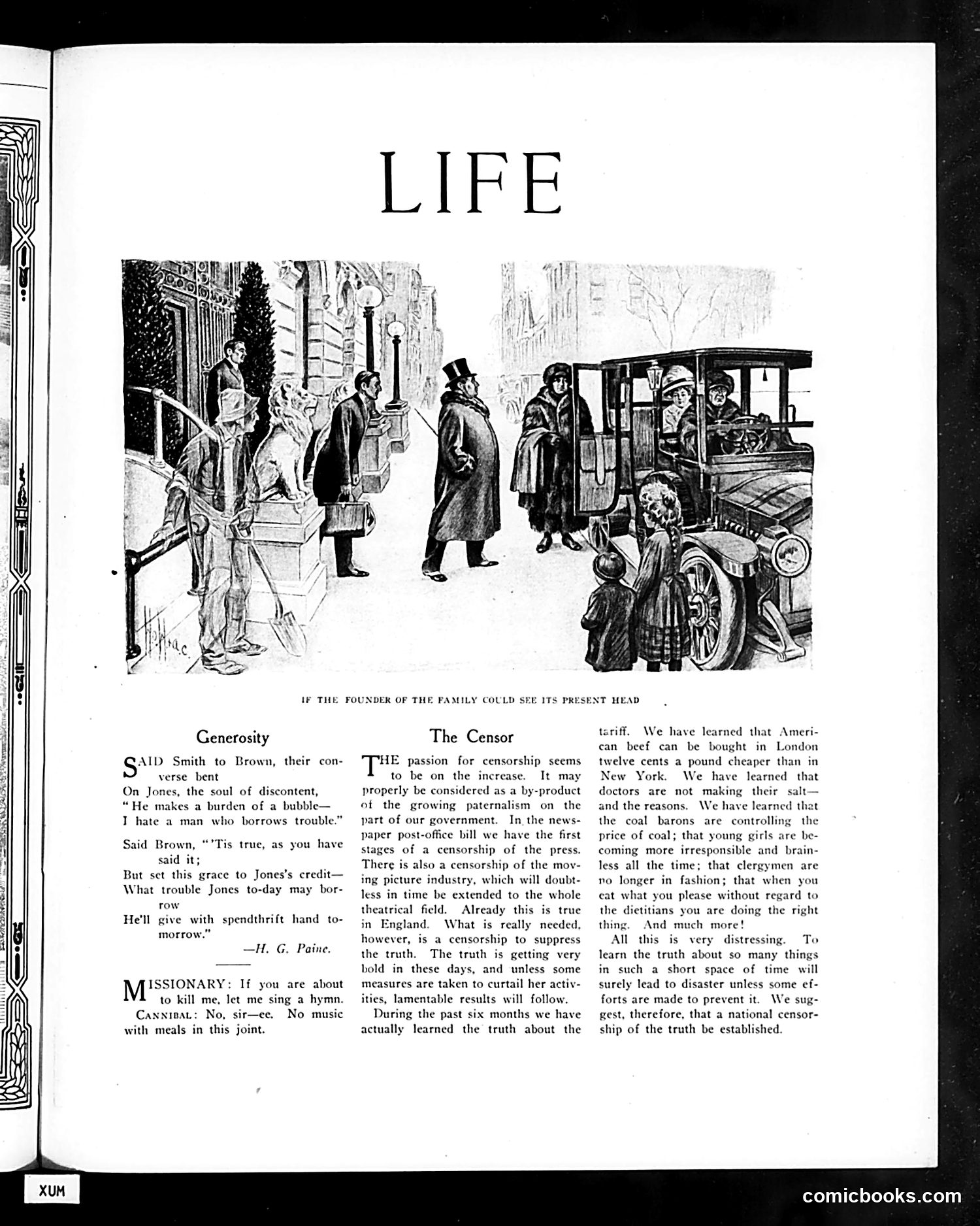
This page satirizes early 20th-century American social hypocrisy and censorship. The headline illustration depicts a street scene contrasting wealth (left, with well-dressed figures) and working-class life (right, with a crowded trolley). The text sections mock: 1. **"Generosity"**: A dialogue where Smith condemns Jones's discontent, but admits borrowing troubles—satirizing how the wealthy dismiss poor workers' legitimate grievances. 2. **"The Censor"**: This section criticizes growing press censorship and government control, noting that censorship of industrial disputes is expanding to theatrical productions. It warns that unchecked censorship threatens truth itself. The overall message: American society preaches virtue while practicing exploitation and suppressing dissent about economic inequality.
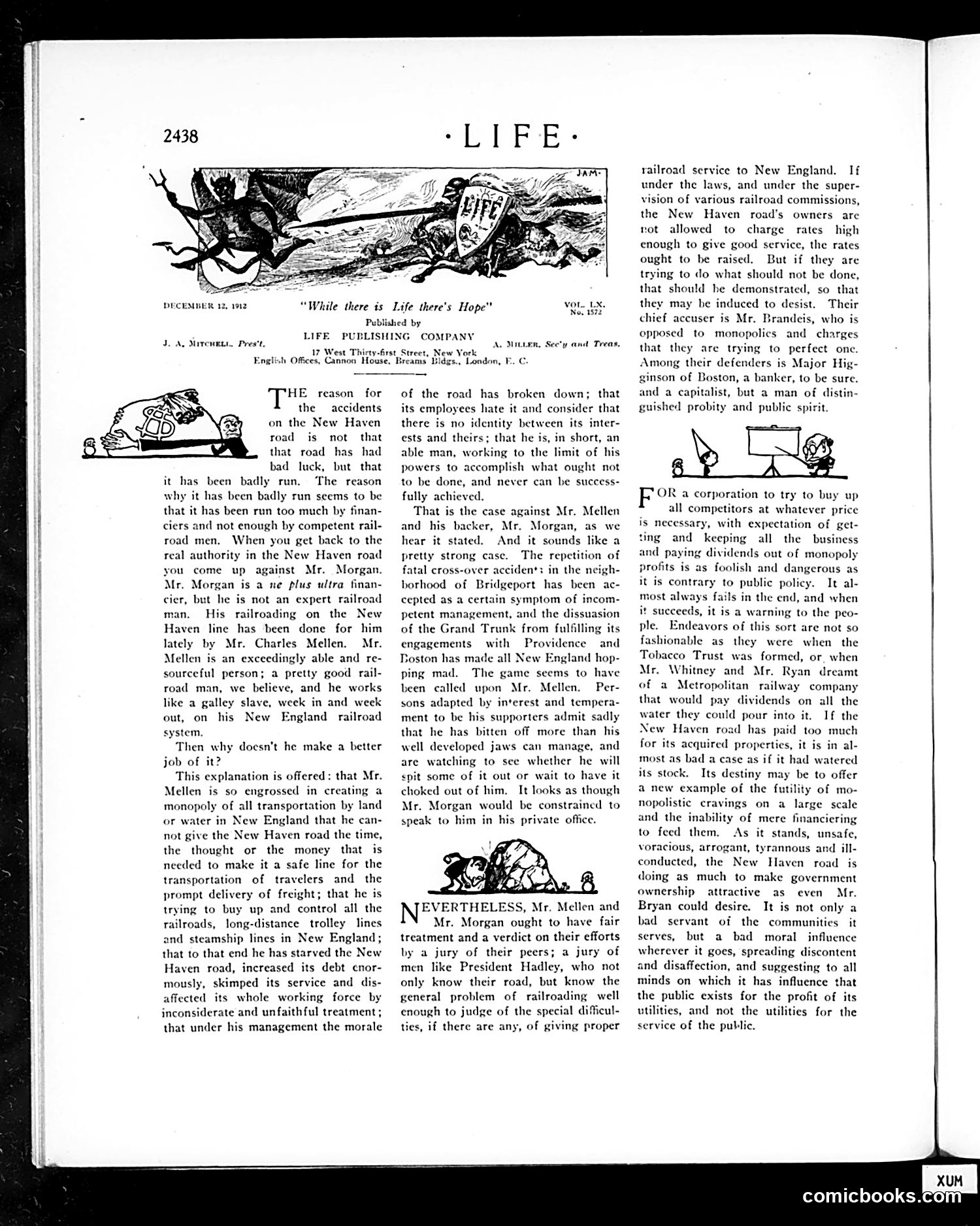
This editorial cartoon critiques the management of the New Haven Railroad. The text identifies the central conflict: railroad magnate **Mr. Mellen** (appears to be the primary target) and **Mr. Morgan** are accused of mismanaging the line through incompetent leadership and financial prioritization over service quality. The cartoon depicts a skeletal or dying figure labeled "LIFE," suggesting the railroad is failing under their stewardship. The article argues that Mellen prioritizes creating monopolies and controlling competitors rather than improving actual railroad operations, employee welfare, or public service. The satire criticizes how wealthy industrialists pursue profit and market dominance at the expense of functional, ethical business practices—a common Progressive Era critique of monopolistic corporate behavior.
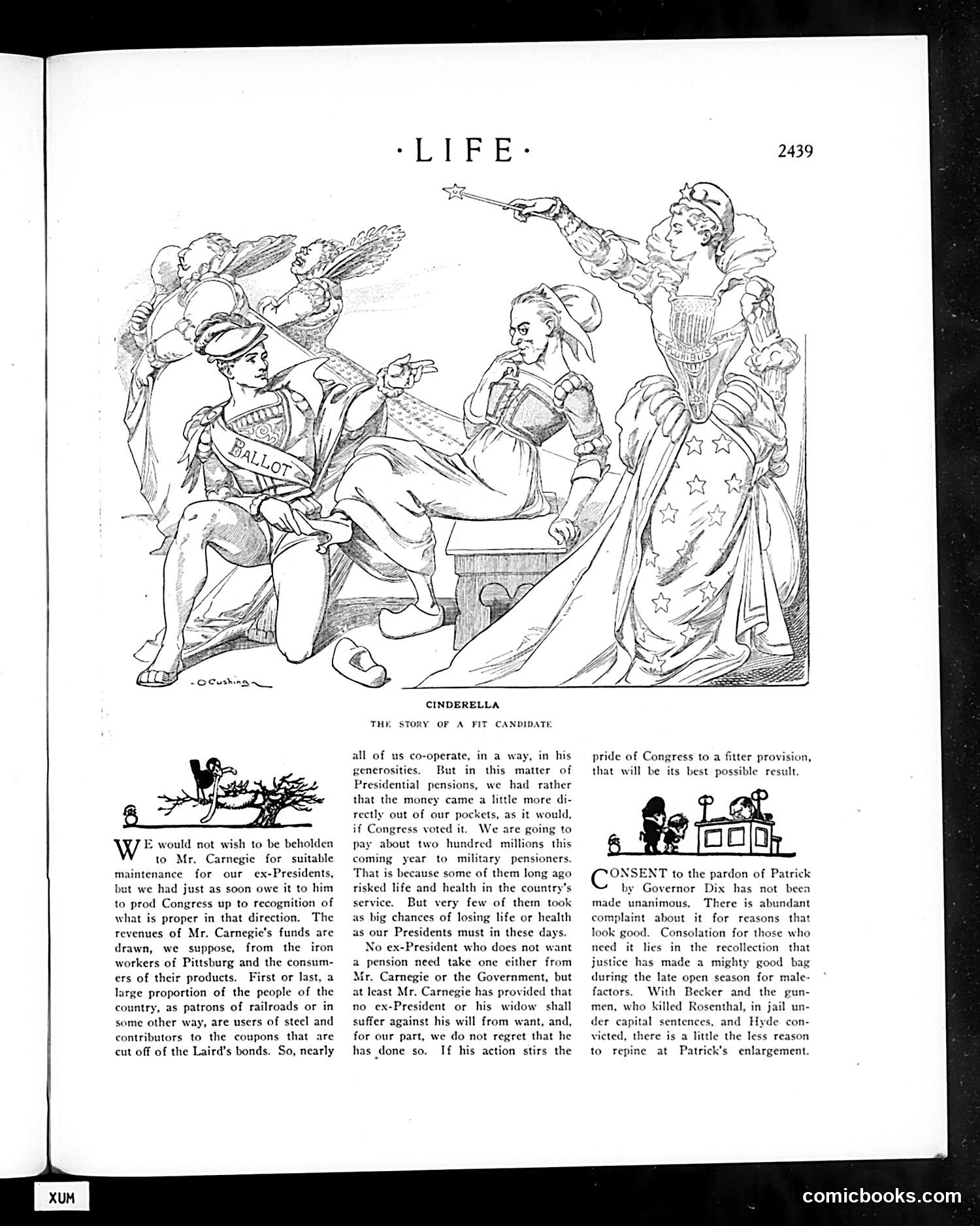
This political cartoon satirizes a presidential candidate's sudden transformation into an acceptable figure—hence the "Cinderella" reference. The illustration shows a figure being dressed and primped by attendants, suggesting artificial makeover or staging for public consumption. The accompanying article discusses Congressional pensions for ex-Presidents and mentions Patrick Governor (appears to relate to a pardon controversy). The text critiques how candidates are packaged for voters, comparing the process to Cinderella's magical transformation. The satire suggests that political viability requires cosmetic reshaping rather than genuine qualification—that voters are being sold an artificially constructed image rather than evaluating authentic merit.
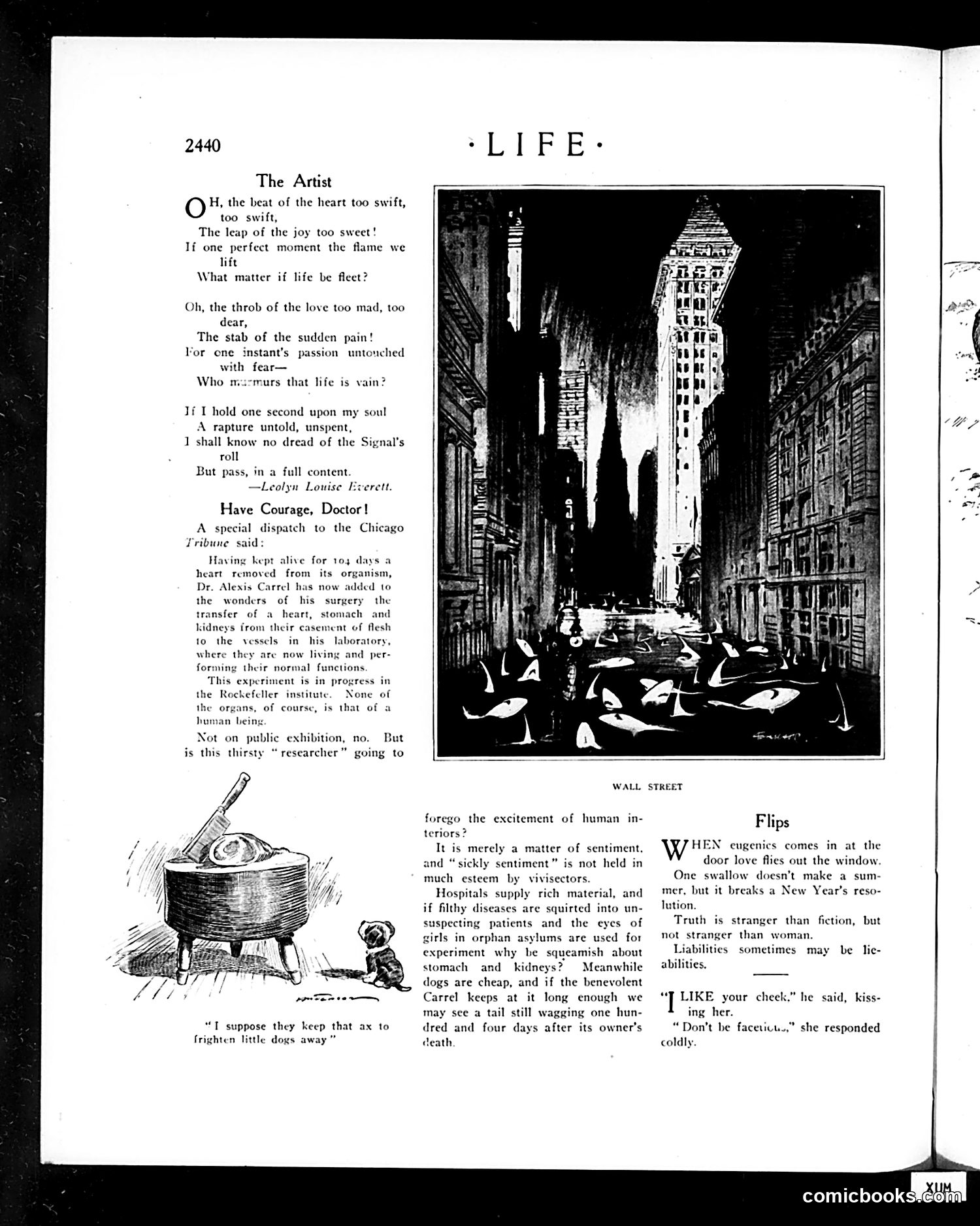
The dramatic black-and-white illustration depicts a New York City street canyon dominated by towering skyscrapers, with human figures appearing tiny and prostrate on the ground below. This visual metaphor critiques Wall Street's dominance over ordinary people—the buildings literally dwarf the humans, suggesting financial institutions' overwhelming power. The accompanying text sections ("Have Courage, Doctor!" and "Flips") discuss medical experiments and romantic encounters, appearing unrelated to the main image. However, the juxtaposition suggests Life magazine's satirical commentary on American society: while doctors experiment boldly and people pursue fleeting romantic encounters, Wall Street's massive financial structures loom indifferently above, dominating urban life and human concerns.
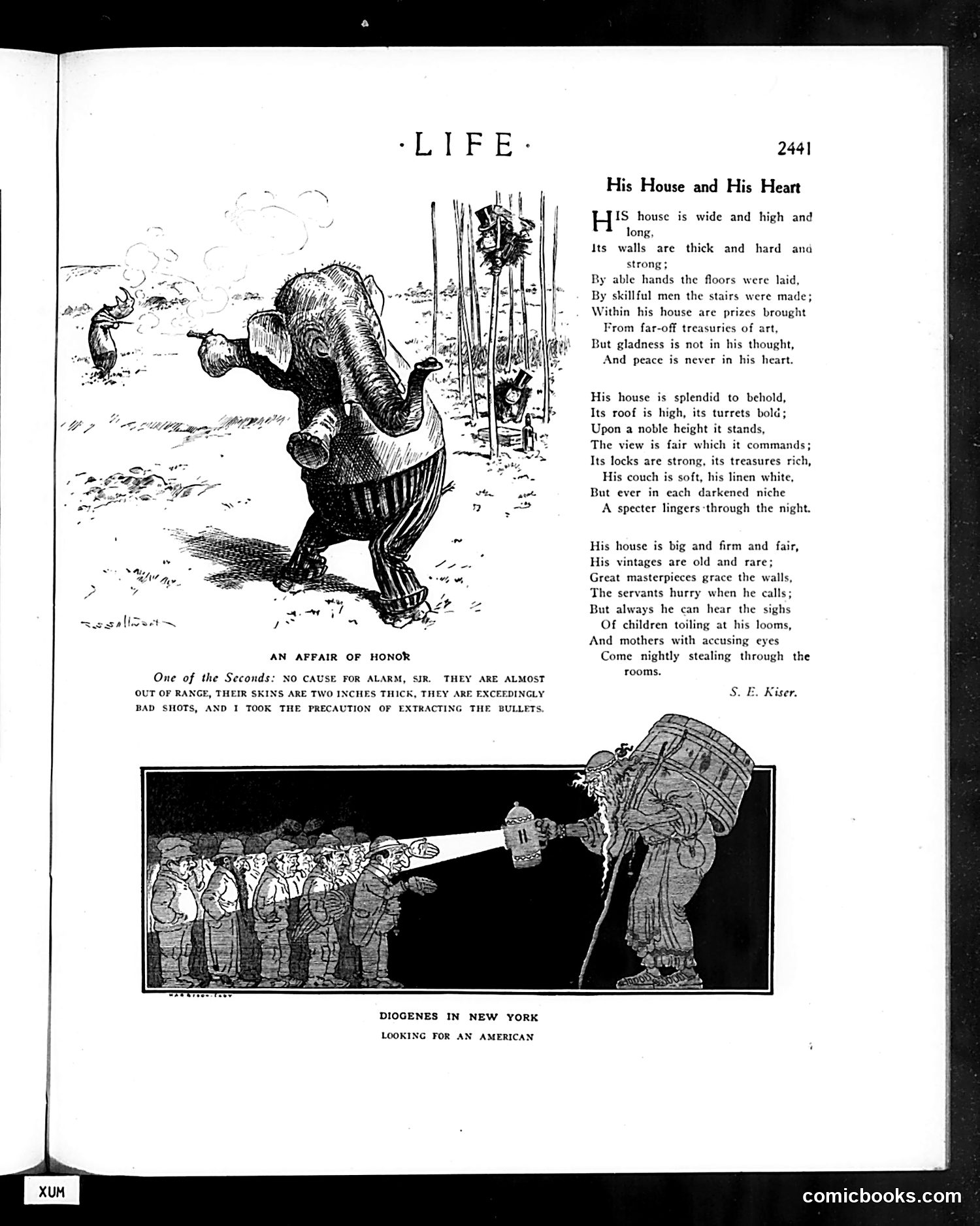
The page contains two satirical pieces: **"An Affair of Honor"** (top): A caricatured figure in formal dress duels with pistols. The caption suggests a humorous take on a duel where the shooter claims the opponent's skin is "two inches thick" and shots were "bad," justifying bullet extraction as a precaution. **"Diogenes in New York Looking for an American"** (bottom): This references the ancient Greek philosopher Diogenes, famous for searching with a lantern for an honest man. Here, a figure holds a searchlight toward a crowd, suggesting satirical commentary on American morality or integrity—implying such qualities are as rare as Diogenes's quest. The cartoon critiques contemporary American society's lack of virtue or authenticity. Both pieces employ classical allusions for social satire.
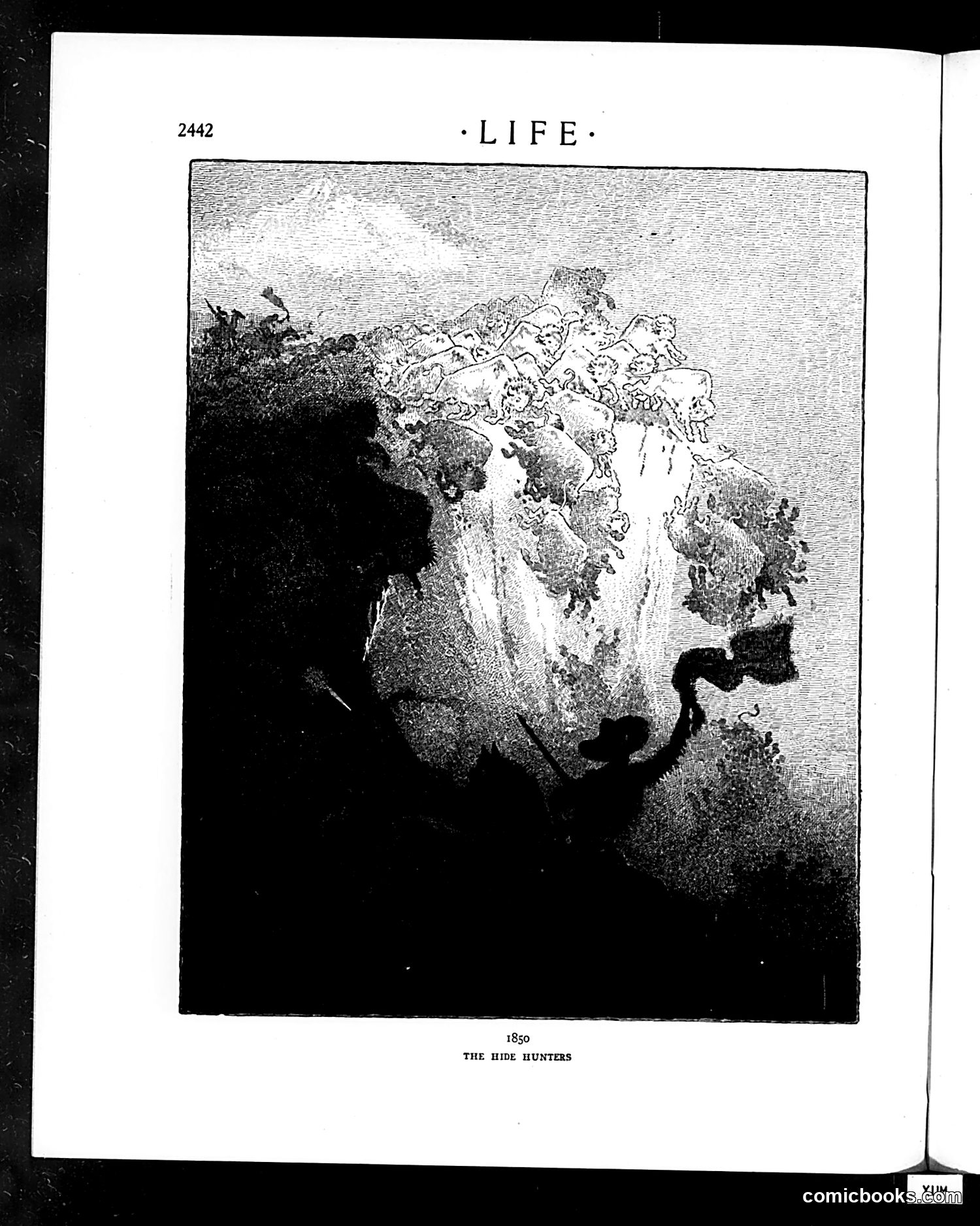
This satirical illustration depicts a scene of hunters pursuing what appears to be a large animal or figure across a landscape. The title "The Hide Hunters" suggests commentary on commercial hunting practices of the 1890 era. Given Life magazine's satirical nature, this likely critiques the hide-hunting industry that was decimating buffalo and other wildlife populations in the American West during this period. The exaggerated, dramatic composition—with the pursued figure dominating the composition and hunters in pursuit—emphasizes the predatory nature of commercial hunting operations. The harsh contrast between light and dark areas creates an ominous tone, suggesting the cartoonist viewed this hunting practice as destructive rather than noble frontier activity. This appears critical of the ecological devastation wrought by 19th-century commercial hunting expansion.
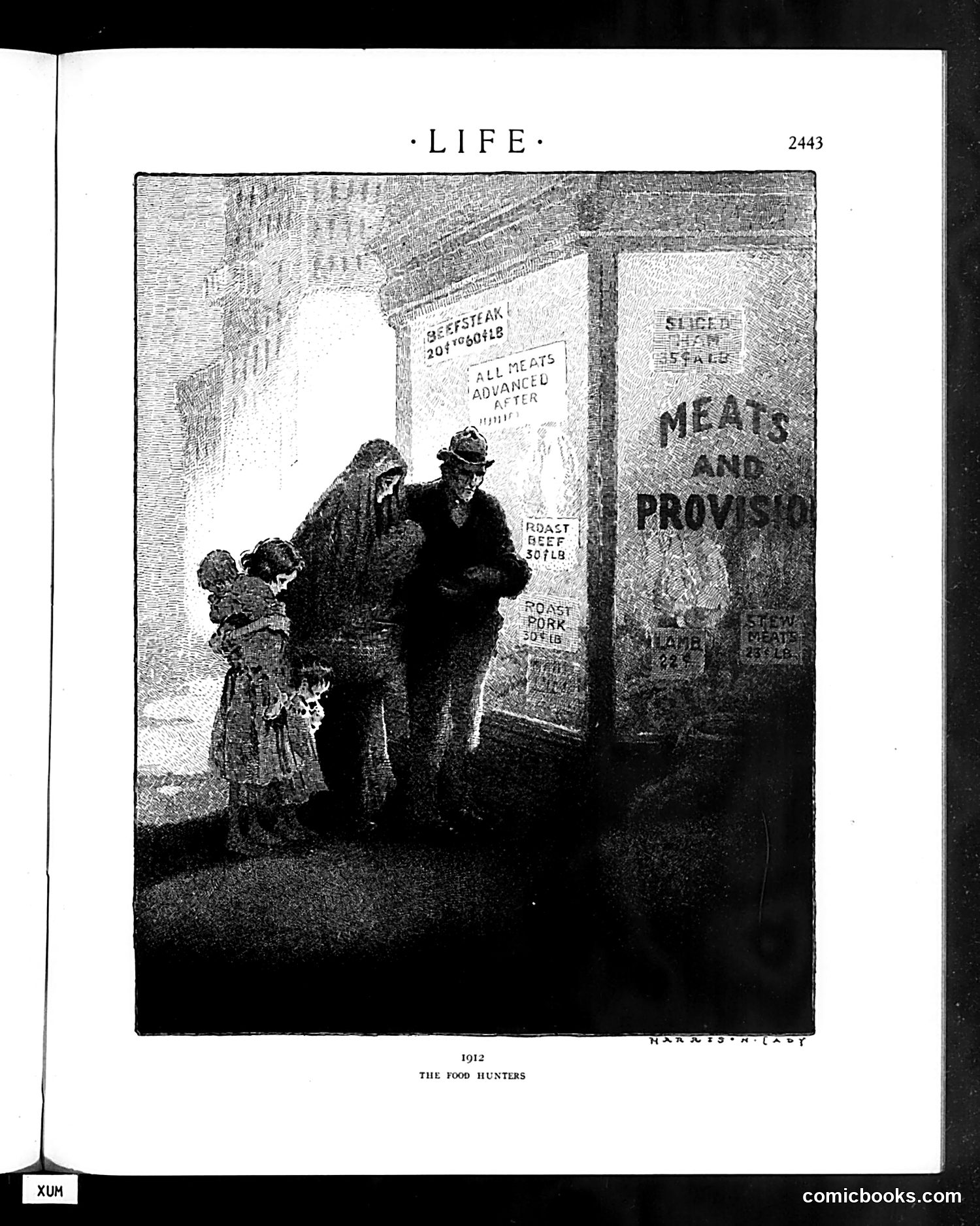
This cartoon depicts a family of four—a man, woman, and two children—studying the window of a butcher shop advertising meats and provisions. The signs visible include "BEEFSTEAK," "ALL MEATS ADVANCED AFTER," "ROAST PORK," and "MEATS AND PROVISION." The satire comments on **rising food prices** around 1912, a period of significant inflation affecting working-class families. The family's intent focus on the shop window suggests they are "hunting" for affordable food amid price increases. The somber tone and silhouetted figures emphasize the struggle of ordinary people dealing with economic hardship. This reflects real economic tensions of the Progressive Era, when food cost increases sparked public concern and political debate about cost of living and economic justice.
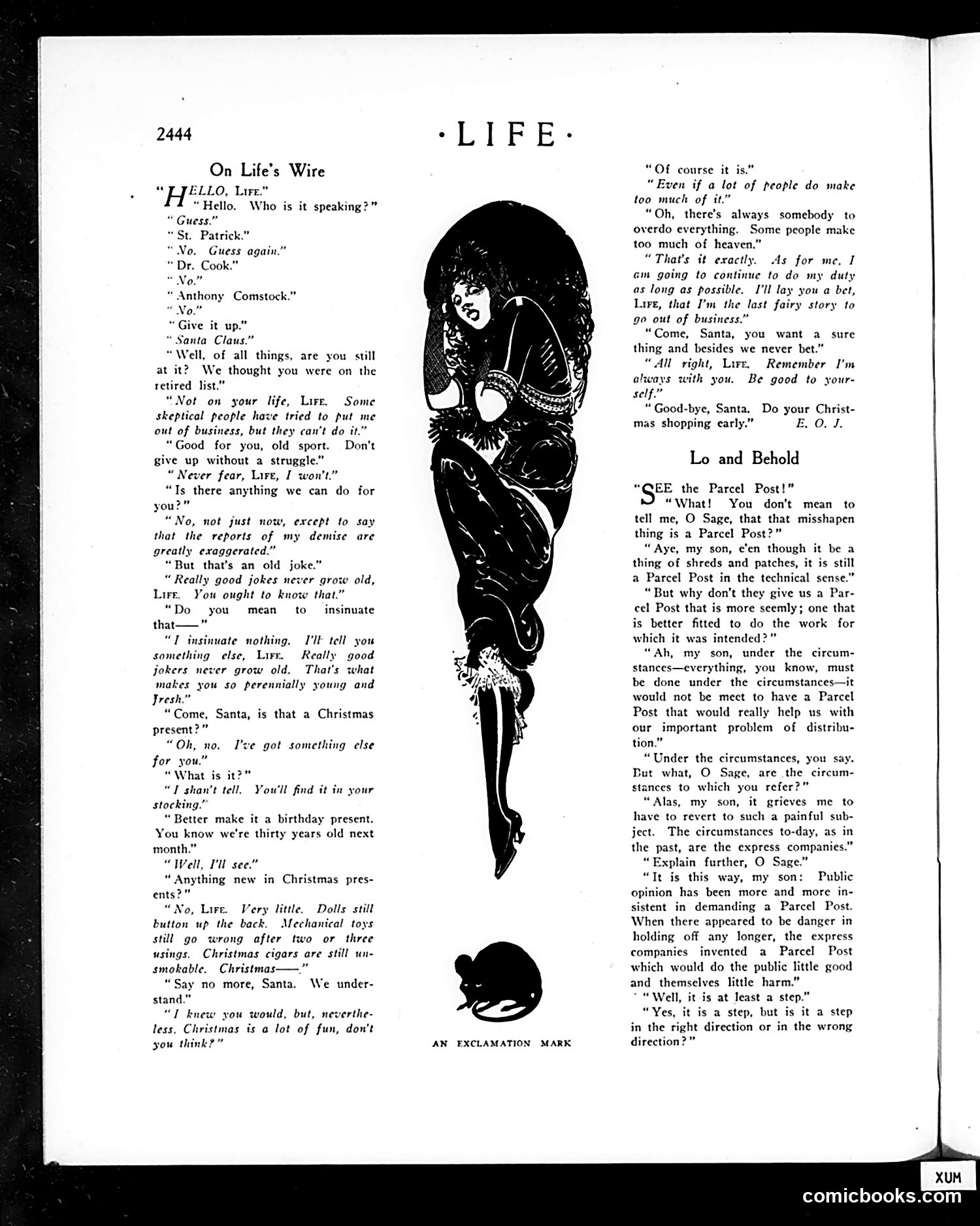
This page contains two satirical dialogues typical of Life's early 20th-century humor. **"On Life's Wire"** features a conversation between Life magazine and "Santa Claus," who is revealed to be **Anthony Comstock**, the famous anti-obscenity crusader. The joke is that Comstock—who had been largely sidelined—claims he's still active fighting indecency, despite rumors of his irrelevance. The satire mocks his persistence and self-importance, with the closing quip about Santa being "the last fairy story to go out of business" playing on Comstock's reputation for suppressing literature he deemed immoral. **"Lo and Behold"** satirizes the U.S. Parcel Post system (established 1913), which the text suggests was deliberately weakened by express companies' political influence. The sage character explains that while public pressure forced the government to create a parcel service, the express companies ("the circumstances") ensured it would be ineffectual enough not to threaten their profits—a critique of corporate lobbying undermining reform. Both dialogues exemplify Life's sharp political and social commentary through mock-serious exchanges.
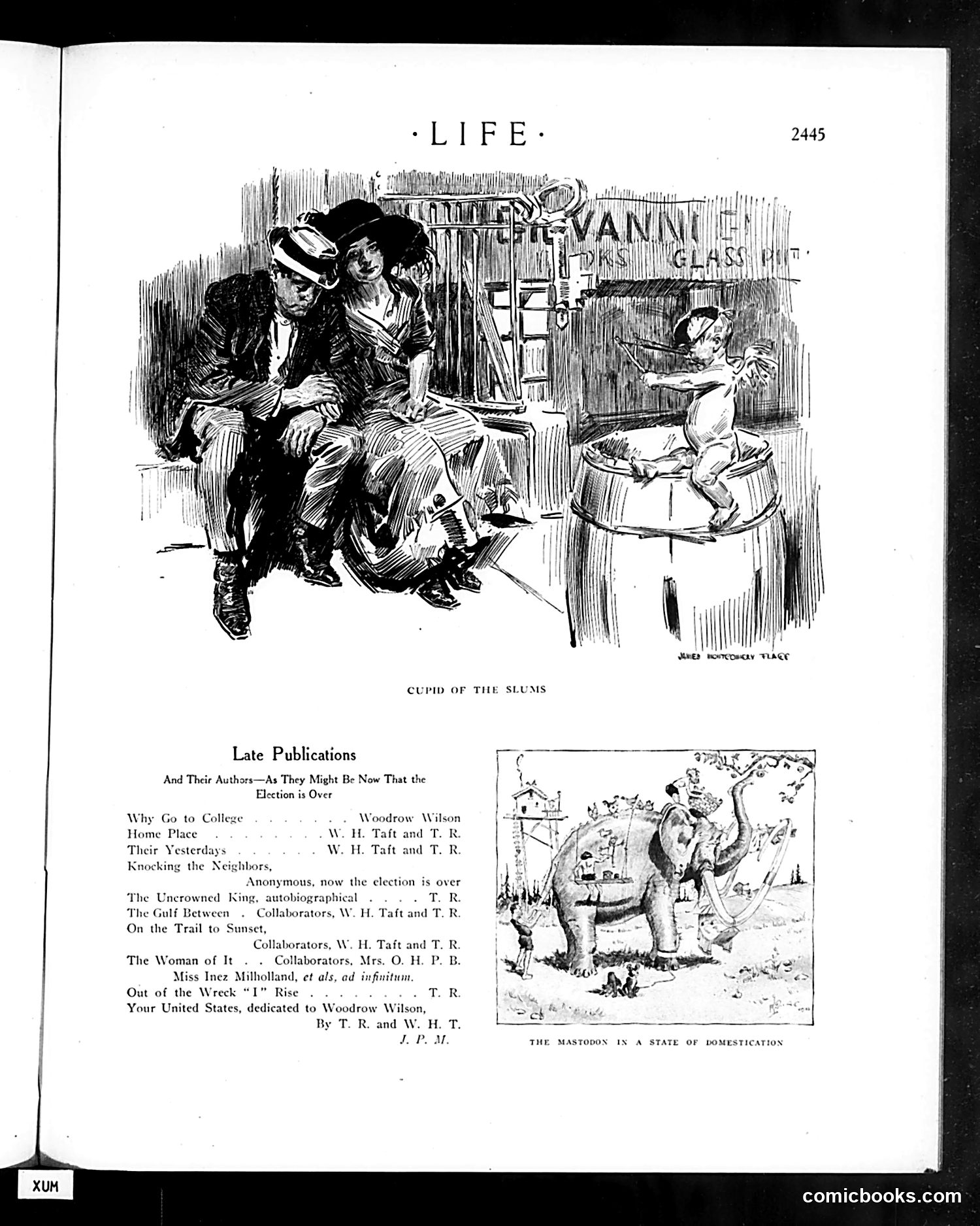
**Top Cartoon:** Shows two well-dressed men (appearing to be politicians or wealthy figures) observing a child in a barrel or tub. The title satirizes romantic notions about poverty—suggesting "Cupid" (love/romance) exists even in the slums, likely mocking sentimental depictions of poor life. **"Late Publications" Section:** This is post-election satire (text notes "now the election is over"). It mocks political figures by proposing ironic book titles: - Theodore Roosevelt ("T.R.") getting an autobiography called "The Uncrowned King" - Taft and Roosevelt as co-authors of "The Gulf Between" (referencing their actual political split) - Anonymous authorship of "Knocking the Neighbors" (suggesting politicians were attacking each other) The humor relies on readers recognizing these as thinly-veiled jabs at real political figures and their recent campaign behavior. The cartoonist suggests that once elections end, politicians' competitive rhetoric becomes laughable fodder for satirical "book titles."
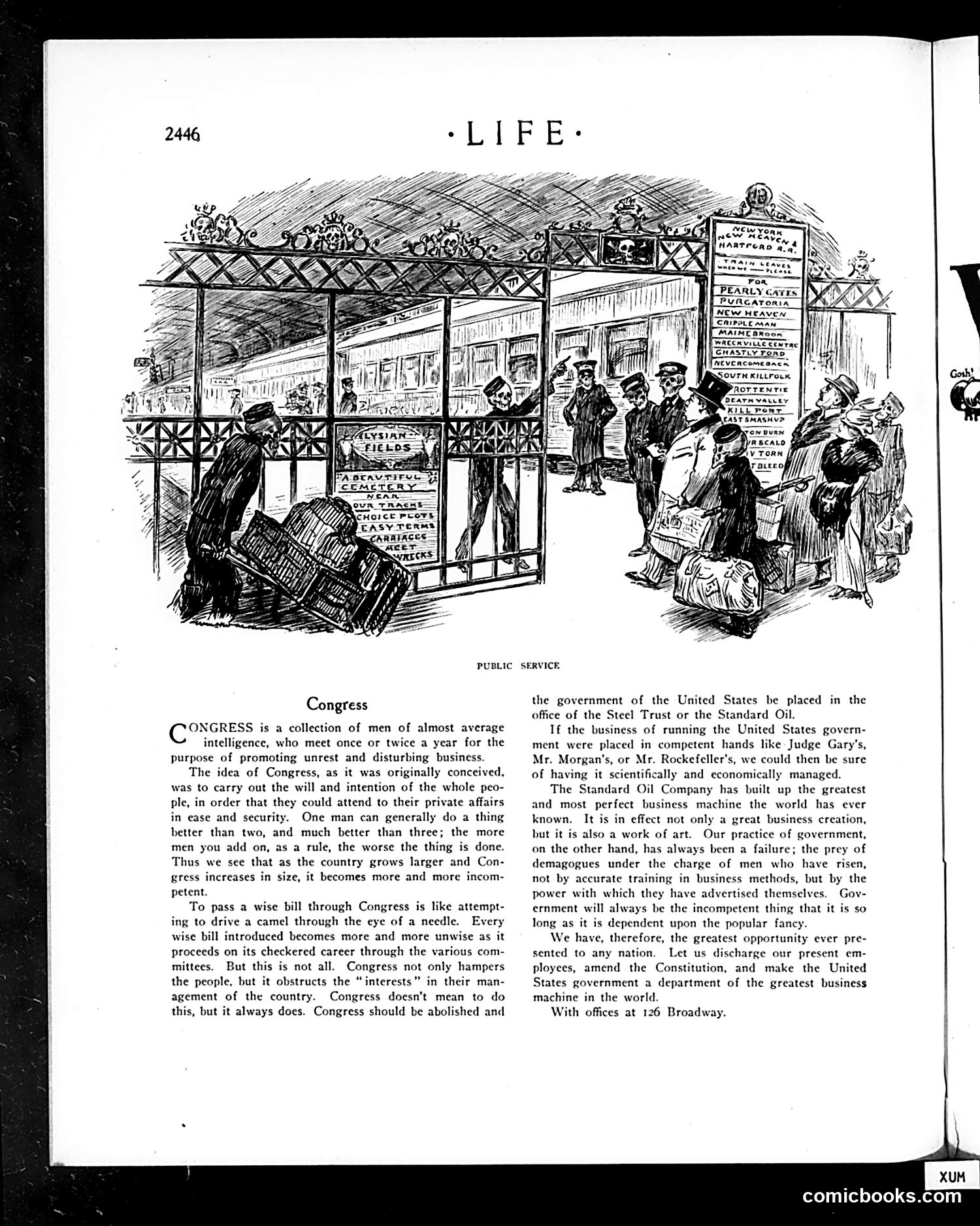
This is a satirical attack on Congress paired with a biting critique of corporate power. The text argues Congress is incompetent and proposes replacing democratic government with rule by major industrialists—specifically naming J.P. Morgan and John D. Rockefeller of Standard Oil. The accompanying illustration shows a crowded railway station (labeled with destinations like "Elysian Fields" and various towns), depicting Congress as a chaotic public institution—the visual metaphor for governmental disorder. The satire's irony is sharp: the author sarcastically praises Standard Oil's "perfection" while condemning government's failures, then concludes by proposing corporations literally run the country. The final line—"With offices at 126 Broadway"—likely references a corporate office, completing the joke that business efficiency should replace electoral democracy. This reflects early-20th-century tensions between progressive reformers (who saw Congress as corrupt) and robber barons (who claimed superior management). The satire cuts both ways, mocking both incompetent politicians and plutocratic arrogance.
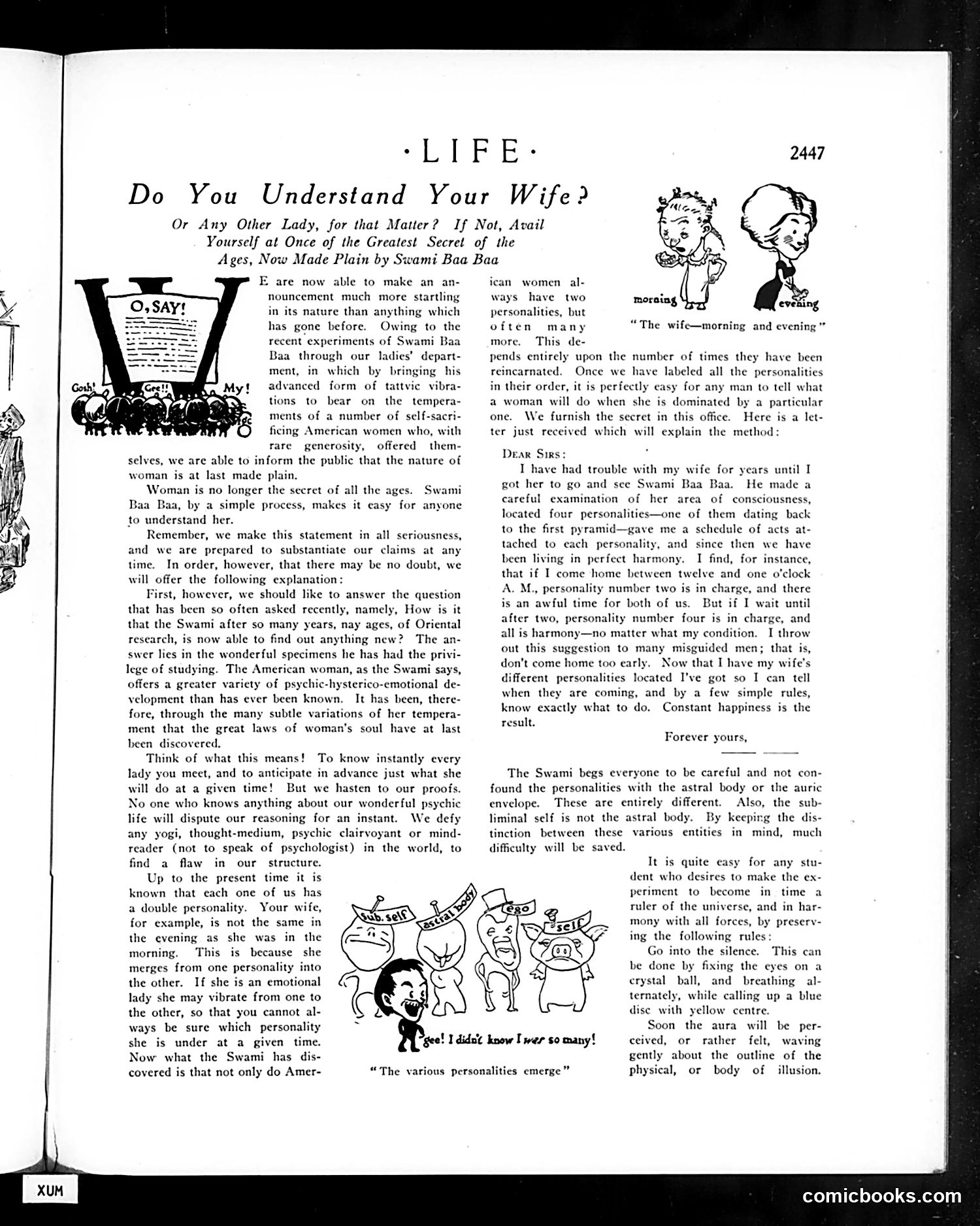
This 1920s Life magazine satirizes pseudoscientific mysticism and patronizing attitudes toward women's behavior. "Swami Baa Baa" is a fictional charlatan claiming to have discovered that American women possess multiple personalities (beyond the accepted "double personality" theory of the era). The joke mocks both the absurd pseudo-Eastern spiritualism popular in that period and men's bafflement at women's moods. A letter from a supposedly satisfied customer describes scheduling his homecoming around his wife's different "personalities"—implying women are unpredictable and require mystical diagnosis rather than simple human understanding. The cartoons showing various female figures represent these supposed distinct personalities. The satire targets credulous men who'd pay for such nonsense rather than actually try understanding their wives as complex human beings. It's simultaneously mocking both trendy occultism and marital gender dynamics of the era.
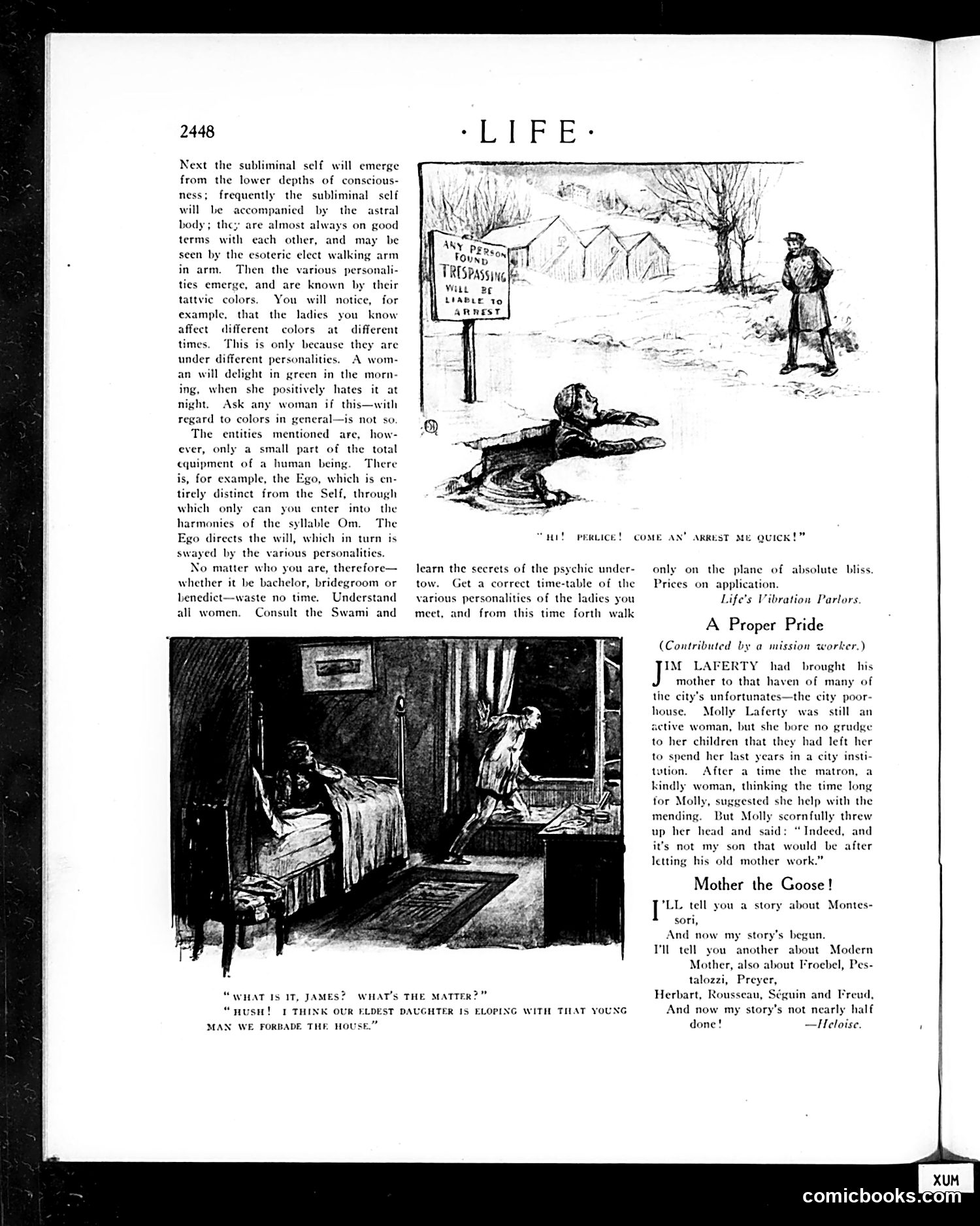
This page contains three distinct pieces satirizing early-20th-century trends: **Top illustration**: A cartoon mocking mysticism and occultism. A "Swami" peddles pseudo-scientific advice about "subliminal selves," "astral bodies," and "tattvic colors"—promising to help men understand women through esoteric knowledge. The satire targets the era's faddish fascination with Eastern spiritualism and occult personality theories, presented as absurd charlatanism. **Middle illustration**: A domestic crisis scene where parents discover their daughter eloping. The caption captures the scandal—a forbidden suitor—reflecting Victorian anxiety about parental authority and courtship norms. **"A Proper Pride"**: A brief story mocking Irish working-class pride. An elderly mother in a poorhouse refuses to do mending work, insisting her son wouldn't allow it—valuing dignity over practical necessity, even in poverty. **"Mother the Goose"**: A humorous poem lamenting educational fads (Montessori, Froebel, Pestalozzi, etc.), suggesting endless trendy pedagogical theories make stories never-ending.
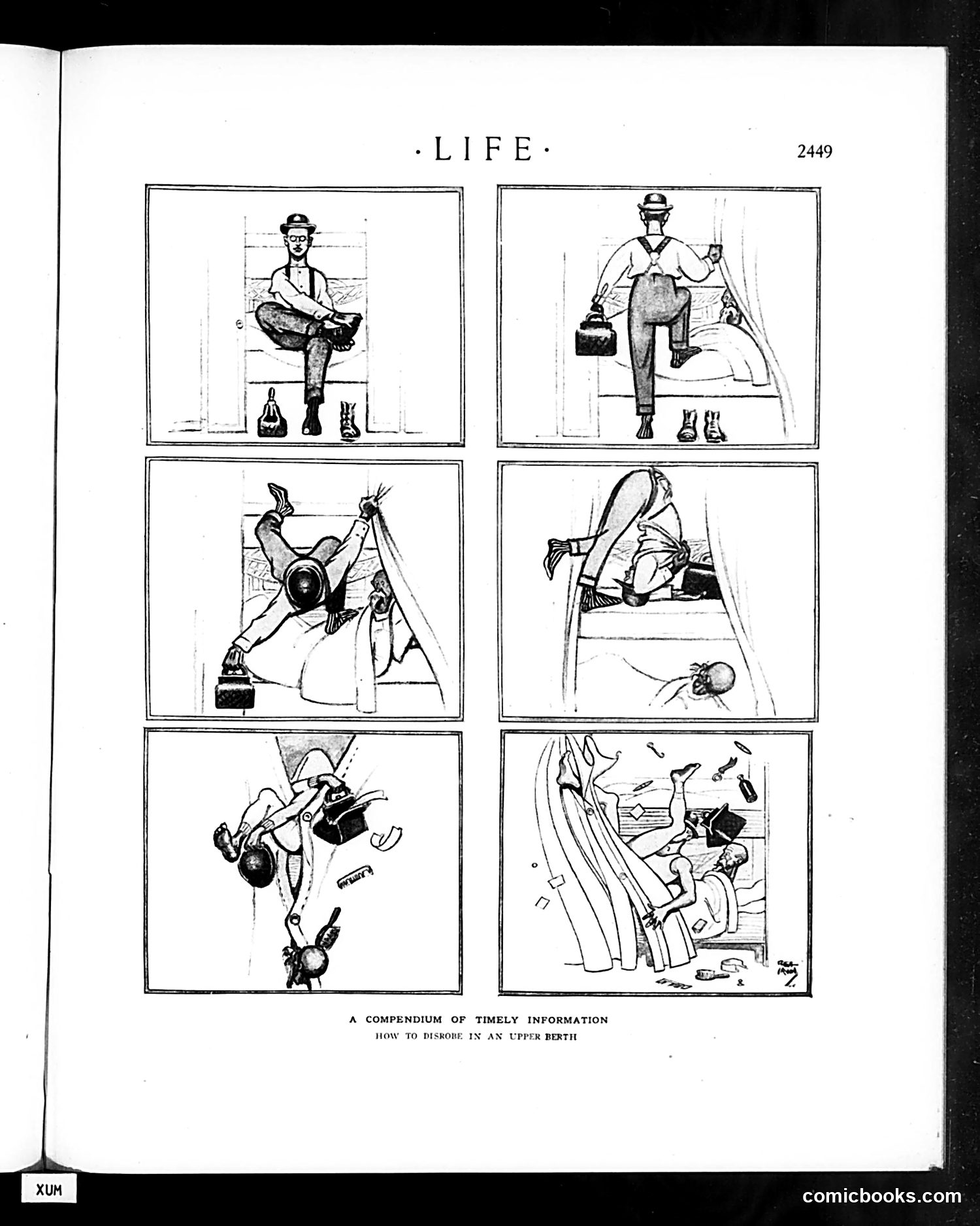
This is a humorous instructional comic strip titled "How to Disrobe in an Upper Berth," depicting the physical comedy of undressing in the cramped space of a train's upper sleeping compartment—a common travel scenario of the era. The six panels progressively show a man attempting to remove his clothing while confined above, with increasingly awkward and contorted positions. He struggles with his jacket, shirt, and trousers while managing luggage and maintaining balance in the tight space. The final panel shows the inevitable result: clothes and personal items scattered chaotically around the berth. The satire targets the absurdity of train travel accommodations and the undignified predicament passengers faced in these confined spaces. This reflects early-20th-century concerns about railroad travel practicality—a relatable complaint for contemporary readers familiar with such journeys.
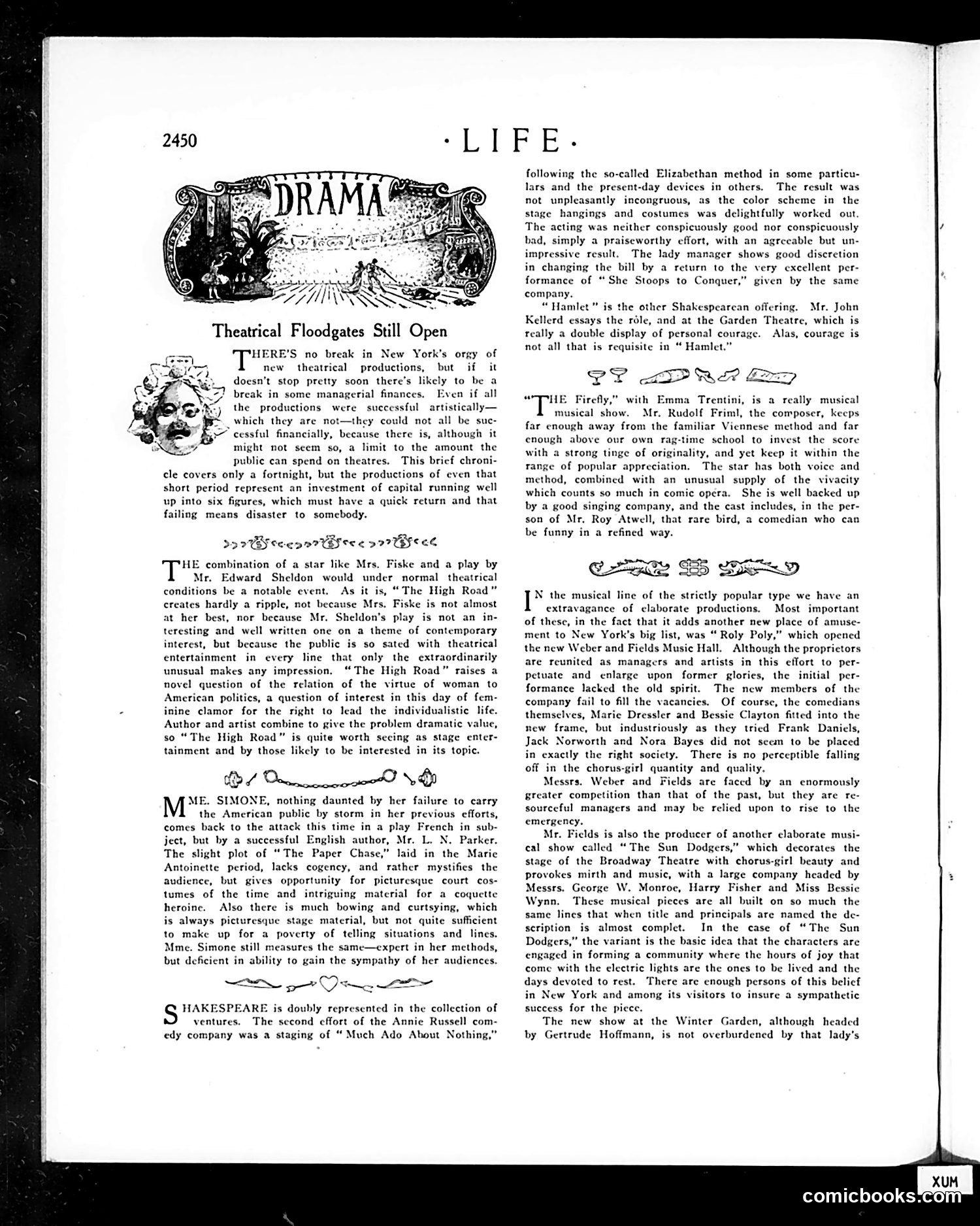
This is a theater review criticizing New York's oversaturated theatrical market. The piece argues that while individual productions may be artistically worthy, the sheer volume of simultaneous shows creates a financial crisis—there's only so much money and audience attention available. The critic observes that even star-studded productions (like Mrs. Fiske in "The High Road") barely make an impact because theatergoers are exhausted by endless entertainment options. Notable mentioned productions include Edward Sheldon's play addressing women's political participation—a contemporary feminist issue—and various Shakespeare adaptations. The cartoon appears to be a caricatured face, likely representing the theatrical establishment overwhelmed by this flood of productions. The satire targets both producers' greed and the public's limited capacity for consumption, warning that financial disaster looms unless the theatrical industry moderates its output.
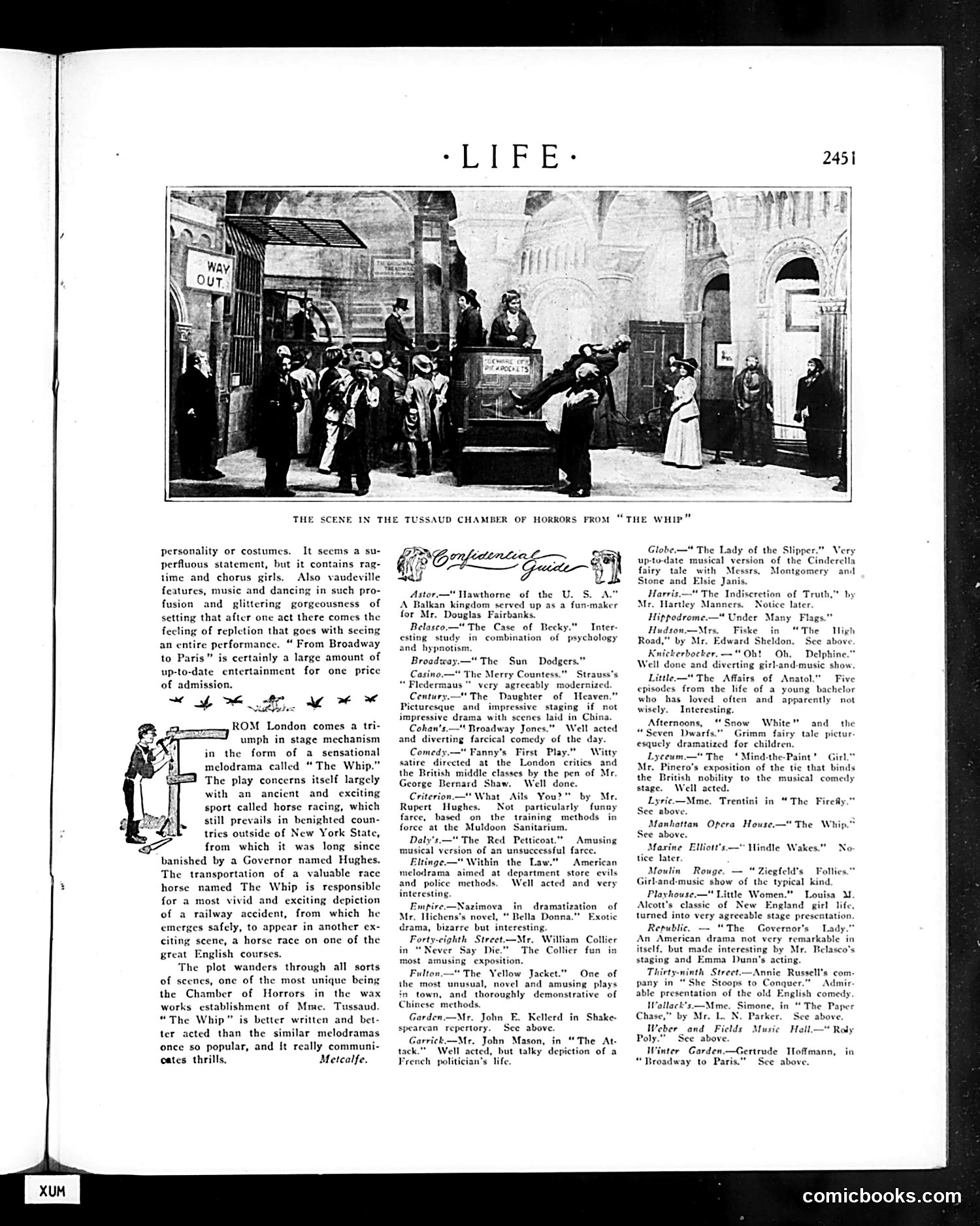
This page reviews current Broadway and London theatrical productions. The illustration shows a scene from the melodrama **"The Whip,"** a London import about a valuable racehorse, featuring a famous sequence in **Madame Tussaud's Chamber of Horrors** wax museum. The critic (Metcalfe) praises "The Whip" as superior melodrama—better written and acted than similar plays that were once popular. He notes it delivers genuine thrills through elaborate staging, including a vivid railway accident scene. The page also references Governor Hughes's ban on horse racing in New York State (presented humorously as evidence of backwardness), and lists dozens of current theatrical offerings ranging from Shakespeare to vaudeville. The reviews emphasize spectacle, staging, and entertainment value—typical concerns for early 20th-century theatre criticism targeting affluent audiences seeking escapist amusement.
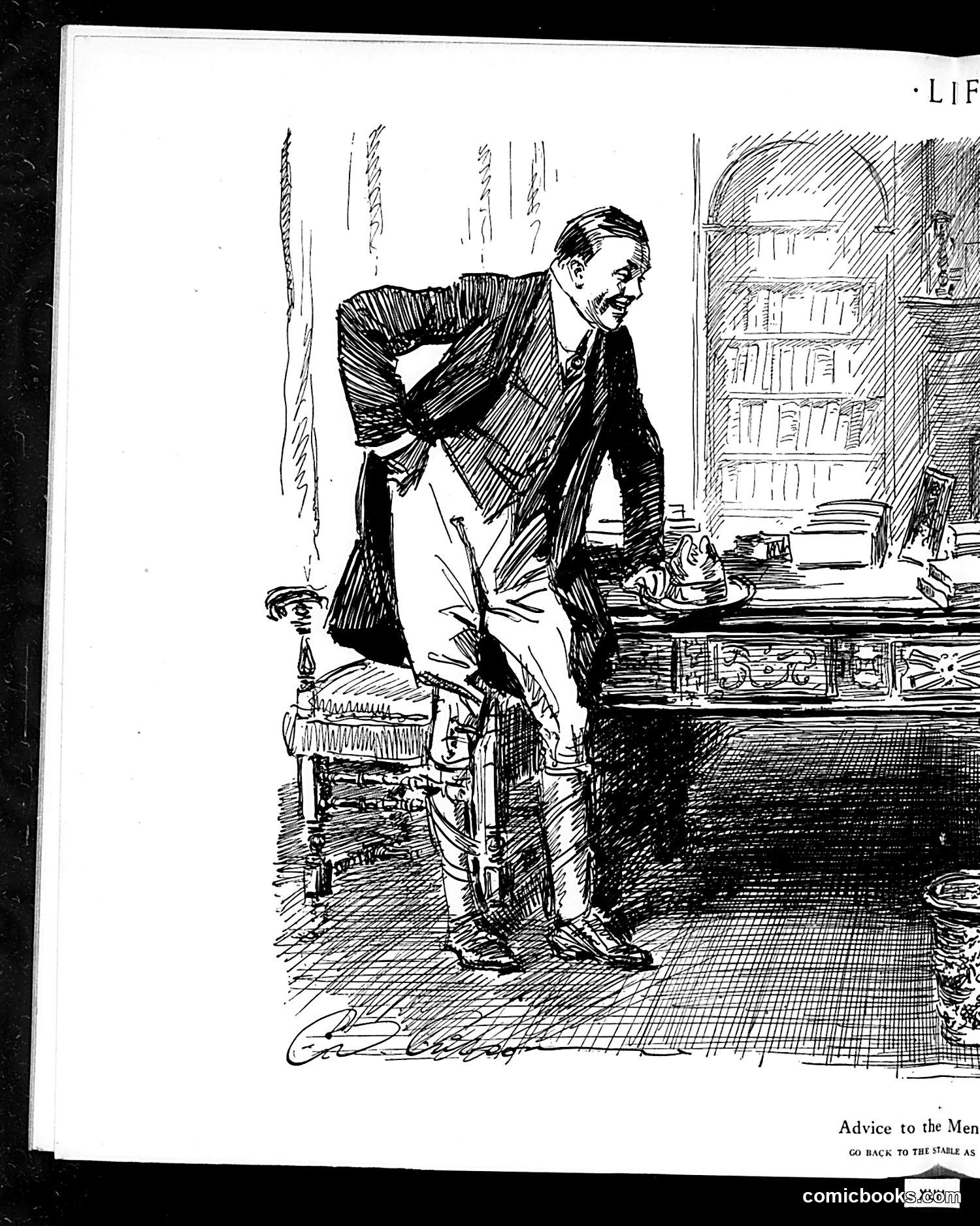
This appears to be a Life magazine illustration titled "Advice to the Men" with the subtitle "GO BACK TO THE STABLE AS[...]" (text cut off). The cartoon depicts a well-dressed man in formal business attire standing in what appears to be a library or office, looking somewhat uncomfortable or conflicted. The setting suggests professional/intellectual work, while the caption's reference to "the stable" implies a suggestion that he should return to manual or agricultural labor instead. The satire likely comments on class tensions or employment anxieties of the era—possibly critiquing either the pretensions of working-class men aspiring to white-collar positions, or conversely, mocking those who believe educated men belong in offices rather than manual work. Without the complete caption, the specific political target remains unclear.
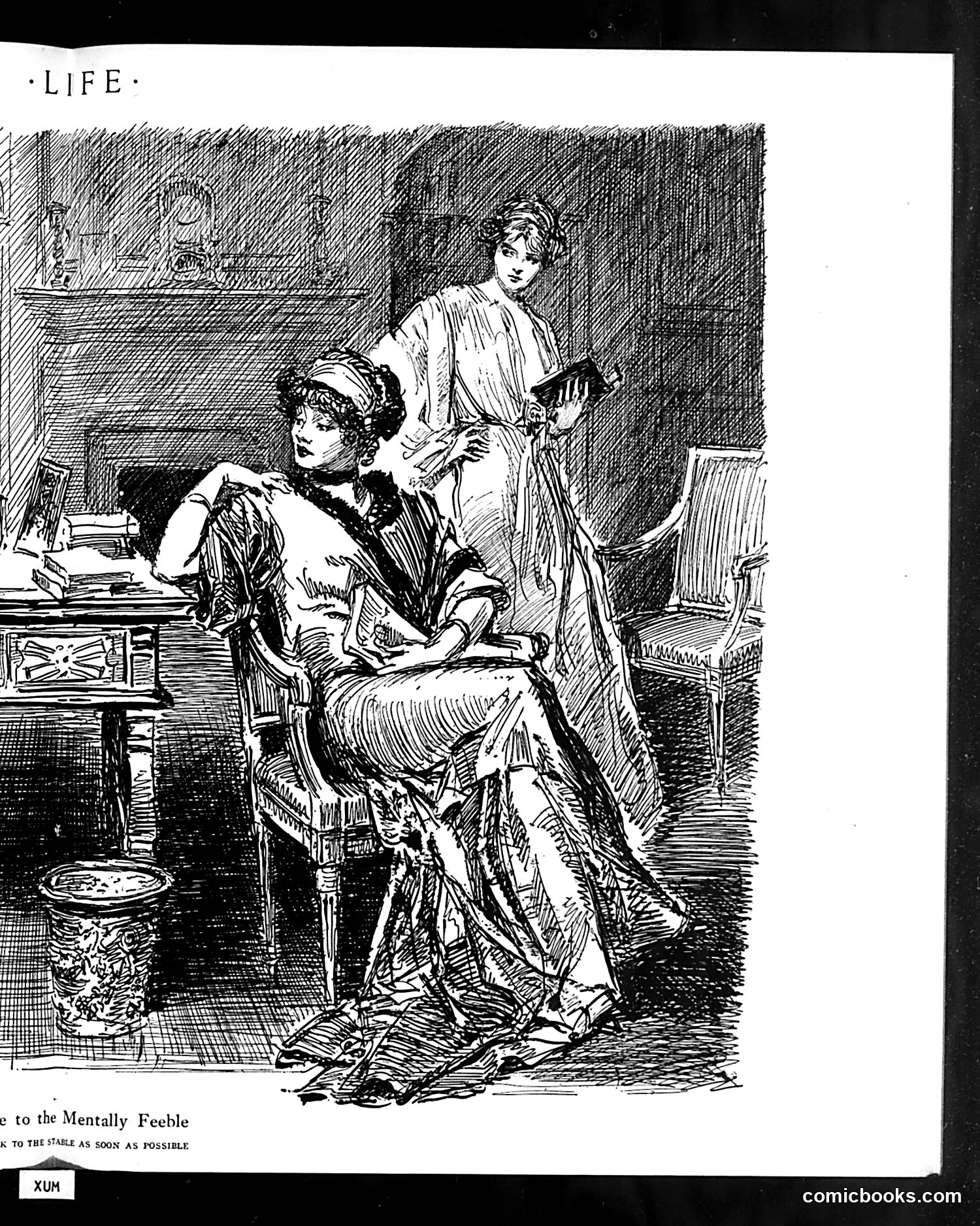
This appears to be a satirical illustration from Life magazine depicting two women in an elegant interior setting. The seated woman, dressed in dark formal attire, is positioned prominently while a standing woman in lighter clothing holds a book or document. The OCR'd text references "the Mentally Feeble" and "back to the stable as soon as possible," suggesting social commentary, likely about class distinctions or women's roles. The caption's crude language and the juxtaposition of the elegantly-dressed figures with disparaging language suggests satire about pretension, social climbing, or critiques of women attempting to rise above their "station." Without clearer text or additional context, the specific political or social target remains unclear, though the satire appears to mock assumptions about intelligence or social propriety.
This page is a literary review, not a political cartoon. The headline metaphorically describes Maurice Hewlett's novel *Mrs. Lancelot* as a promising story that fails at its conclusion—"wrecked at a cross-over" suggests a journey that derails at a critical junction. The reviewer criticizes the book for starting with genuine promise and emotional conviction but ending in "anti-climax" that merely masquerades as intentional artistry. The author compares the failed novel to a work of art that "gone astray on the road"—suggesting Hewlett possessed artistic talent but lost his way narratively. The page also includes a "Confidential Book Guide" listing contemporary 1910s-era novels with brief descriptions, providing context for readers about available literature.
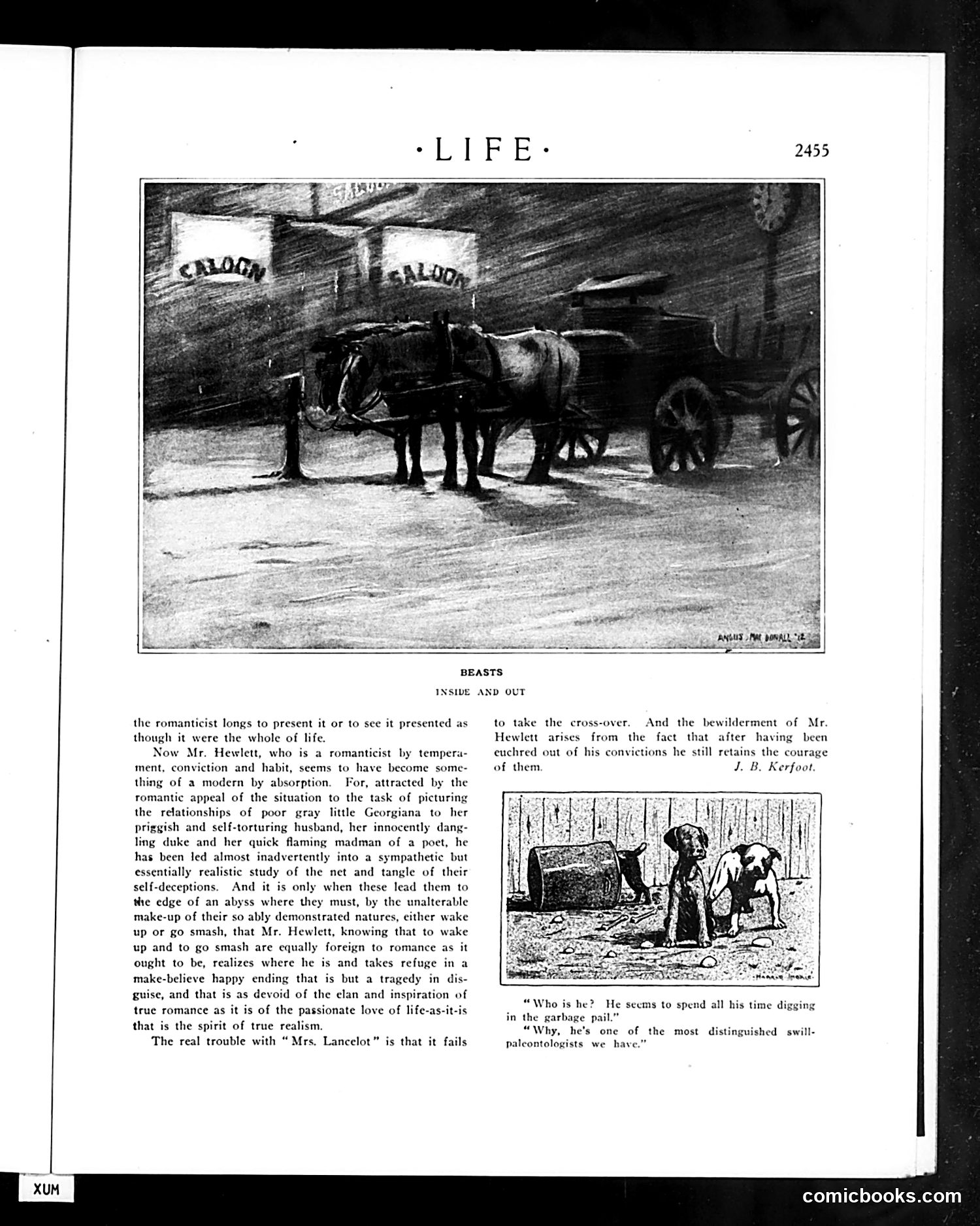
This page contains a literary review of "Mrs. Lancelot" (likely a novel by Maurice Hewlett) alongside two unrelated images and captions. The top photograph shows a horse-drawn cart outside a saloon—a straightforward Old West scene. Below is a cartoon depicting a man digging in a garbage pail while another observes. The joke is a pun: the observer mockingly calls the man a "distinguished swill-paleontologist"—combining "swill" (garbage) with "paleontologist" (scientist who studies ancient life). It's satire on pseudo-intellectual pretension: someone engaged in worthless activity is jokingly elevated with absurd academic credentials. The review criticizes author Hewlett for retreating into romantic convention rather than following his realistic instincts. The critic argues the novel should have embraced either true romance or true realism but instead compromises with a false happy ending—essentially "digging in garbage" rather than producing genuine art.
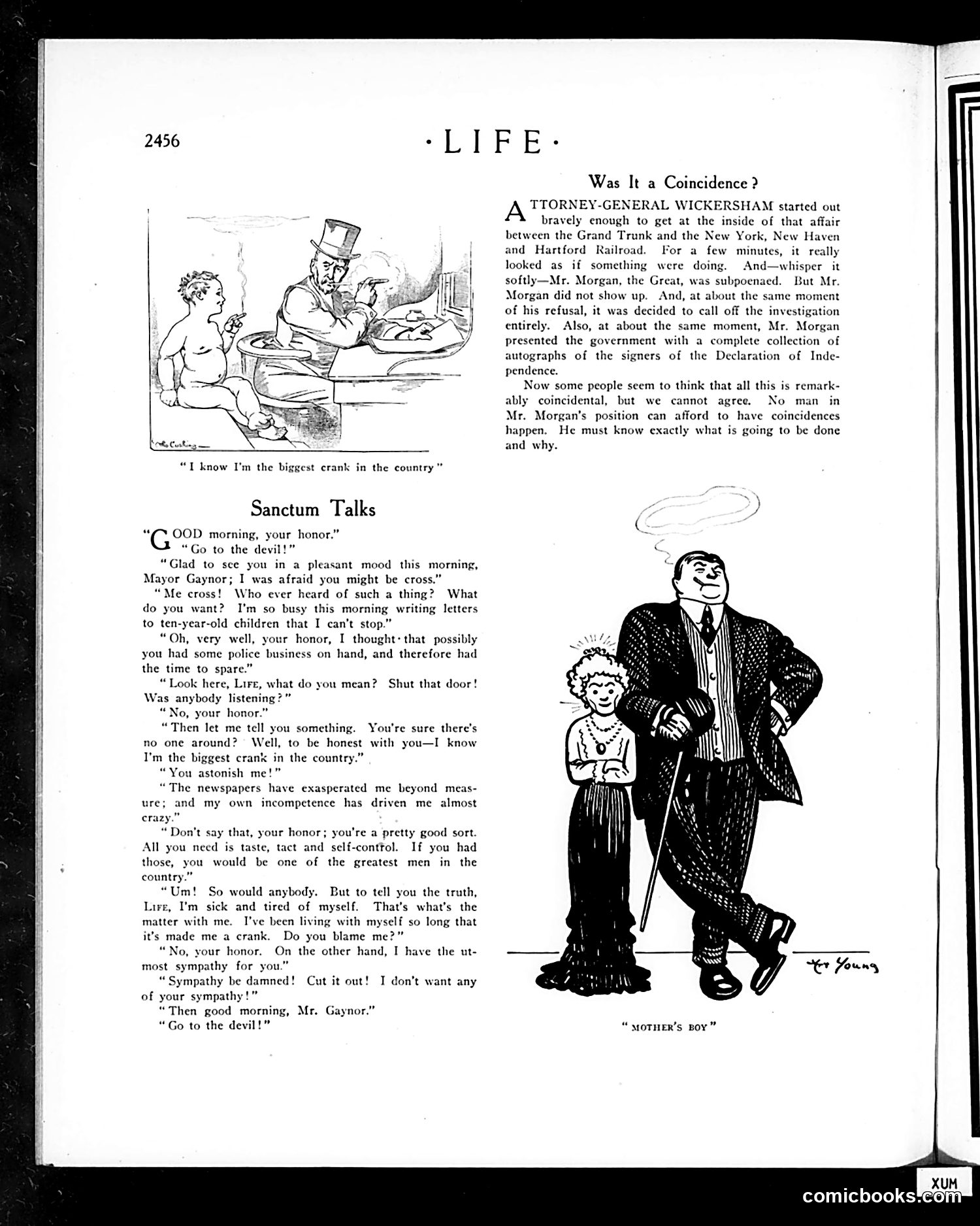
**Top Section ("Was It a Coincidence?")**: This satirizes Attorney-General Wickersham's investigation into railroad dealings involving J.P. Morgan, the powerful banker. Morgan was subpoenaed but didn't appear; the investigation was mysteriously dropped shortly after. The article sarcastically notes Morgan then donated Declaration of Independence autographs to the government—suggesting he essentially bought his way out of trouble. The satire's point: a man of Morgan's wealth and power doesn't experience mere "coincidences"; he controls outcomes through influence. **"Sanctum Talks" Section**: Features Mayor Gaynor of New York in a conversation with "Life" magazine's editor. Gaynor confesses to being mentally exhausted and self-critical, acknowledging his own "incompetence" and crankiness. The cartoon mocks his volatile personality while he complains about press exaggeration. The smaller cartoon, "Mother's Boy," appears to be a separate satirical sketch about privilege or maternal indulgence. The page critiques both unchecked wealth (Morgan) and unstable municipal leadership (Gaynor).
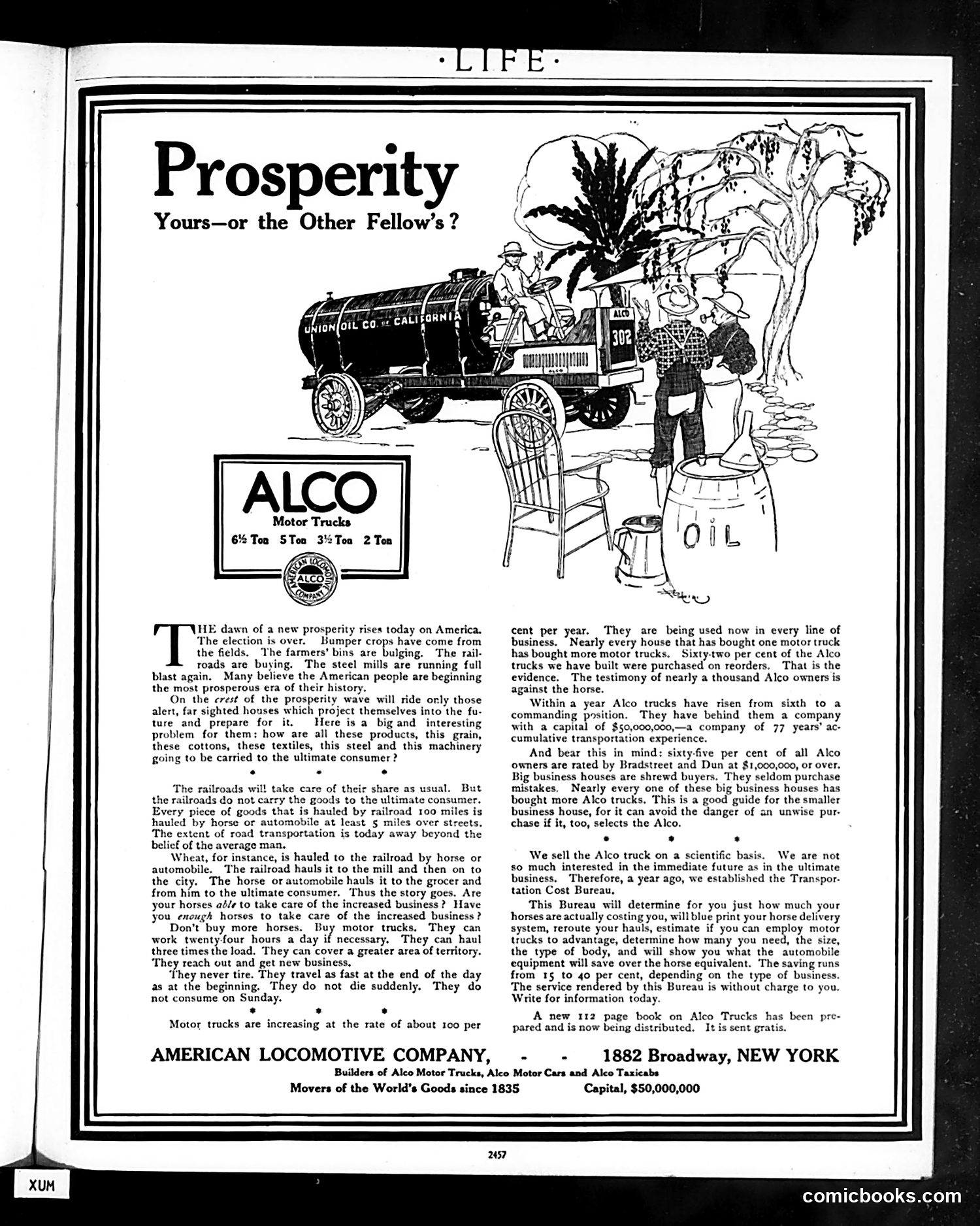
This is primarily **advertising for Alco Motor Trucks**, not satire. The "Prosperity" headline references post-election economic optimism (likely following a 1910s election), promoting motor trucks as essential to America's industrial growth. The cartoon shows a delivery truck alongside traditional horse-drawn methods and farm imagery, illustrating the text's central argument: horses are obsolete for modern commerce. The page argues that while railroads handle long-distance freight, the "last mile" delivery to consumers still relies on horses—an inefficiency that motor trucks solve. The subtext targets **business owners**: buying Alco trucks signals you're forward-thinking and prosperous. By noting that 62% of Alco purchases are repeat orders and that major companies (rated at $1,000,000+) prefer them, the ad uses social proof to suggest trucks equal business success. The free "Transportation Cost Bureau" offering quantifies potential savings, making modernization irresistible to competitive businesses. This reflects genuine 1910s-1920s industrial transition from animal to mechanical power.
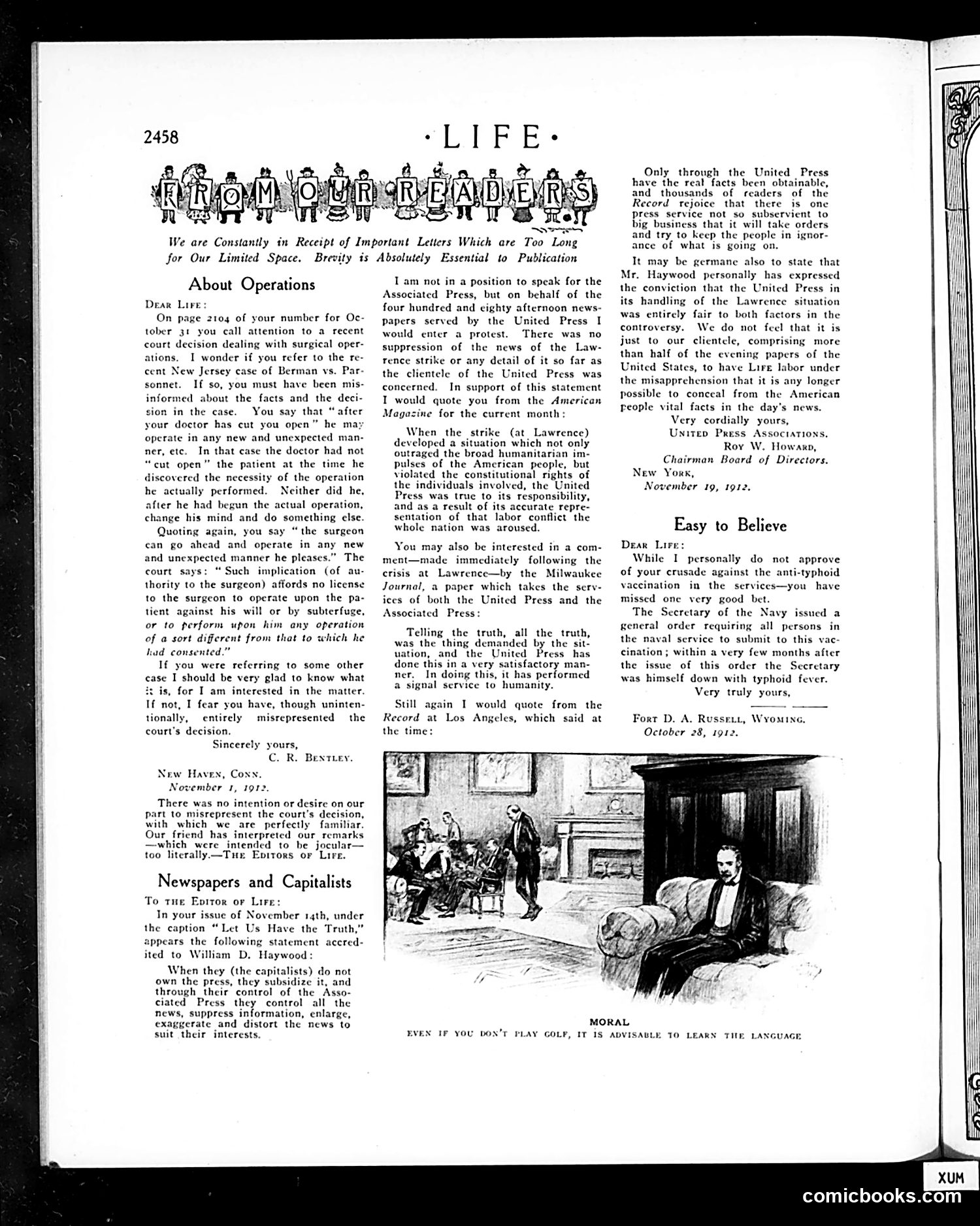
This page consists primarily of **reader letters and editorial responses**, not political cartoons. The main content addresses press freedom and corporate influence: **"Newspapers and Capitalists"** section quotes William D. Haywood (labor activist) accusing capitalists of controlling the Associated Press to suppress news unfavorable to their interests. The United Press responds defensively, citing praise from the *American Magazine* and other publications for their coverage of the **Lawrence textile strike** (1912)—a major labor conflict where workers sought better conditions. The satire is subtle: while Haywood claims capitalist press censorship, the United Press defends its independence by quoting favorable reviews of its own coverage, somewhat ironically proving the complexity of the issue rather than settling it. **The cartoon below** (captioned "MORAL") shows golfers; its connection to the letters above is unclear from the visible text. The page reflects genuine 1912 anxieties about whether large news organizations could report impartially on labor disputes and capitalist interests.
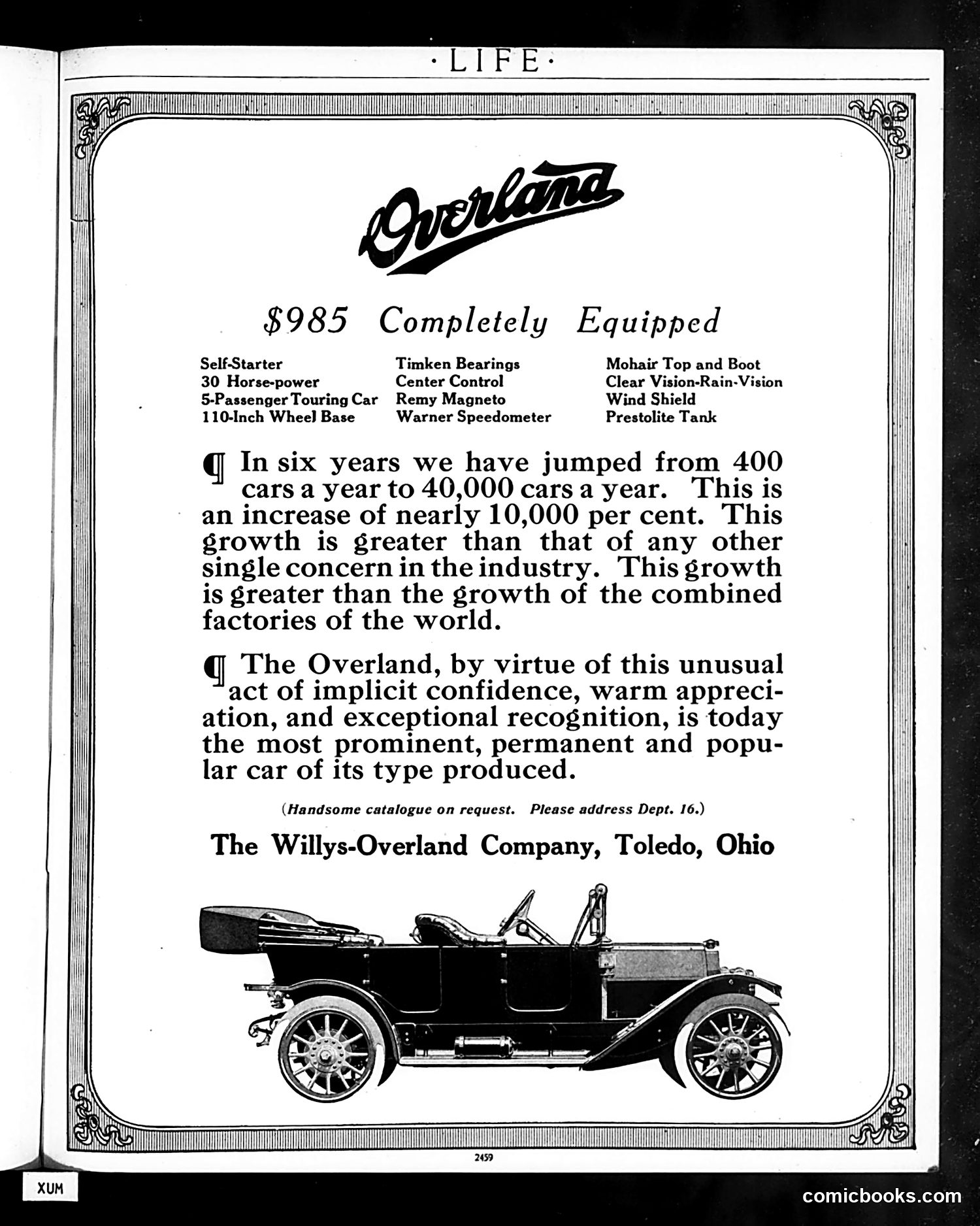
This is not a political cartoon but a **product advertisement** for the Overland automobile, made by the Willys-Overland Company of Toledo, Ohio. The ad promotes a $985 touring car with modern features (self-starter, magneto, speedometer, etc.). The text boasts extraordinary growth: from 400 to 40,000 cars annually in six years—a 10,000% increase claimed to exceed all competitors combined. This reflects the **early automotive boom** (appears to be circa 1910s), when automobiles were still relatively new luxury goods. The hyperbolic claims about market dominance were typical of period advertising. The elegantly framed layout and detailed mechanical specifications reflect how manufacturers marketed cars as sophisticated, technologically advanced products to affluent buyers. There is no satire here—this is straightforward commercial promotion in *Life* magazine's advertising section.
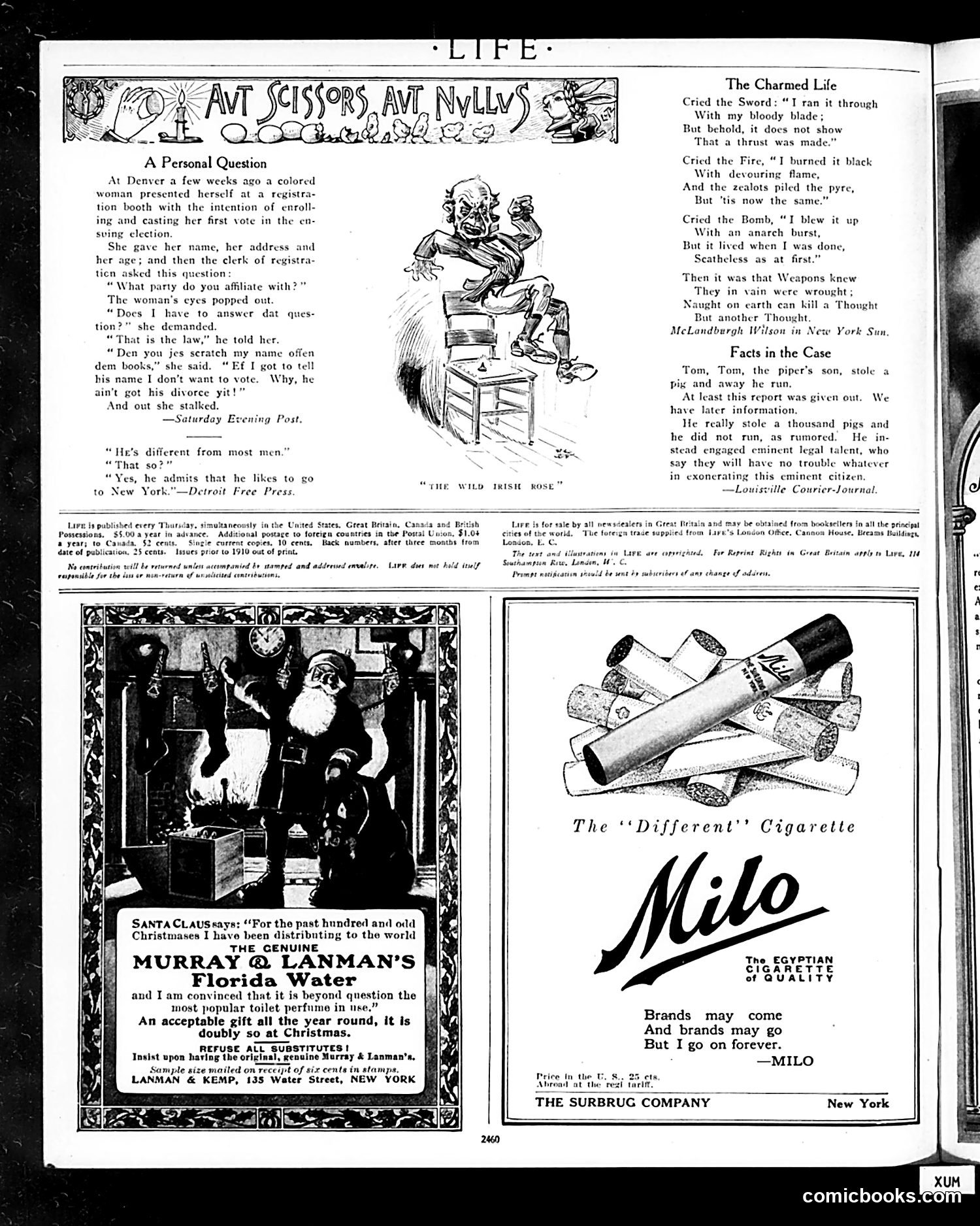
This page's main cartoon satirizes racial discrimination in voter registration. At Denver, a Black woman attempts to register to vote but is asked her party affiliation. She refuses, demanding her name be struck from the rolls—revealing her husband hasn't yet obtained his divorce. The joke operates on multiple levels: the woman's personal marital complication masks the deeper absurdity that she's being questioned about party affiliation as a gatekeeping mechanism. In the early 1900s, such questions were used to discourage Black voters. The satire exposes how registration requirements functioned as tools of disenfranchisement while the anecdote's humorous framing (her concern about her husband's divorce status) makes the discrimination seem almost casual—which was precisely the point Life was making about systemic racism embedded in ostensibly neutral procedures. The page also contains period poetry, humor pieces, and advertisements (typical for Life magazine).
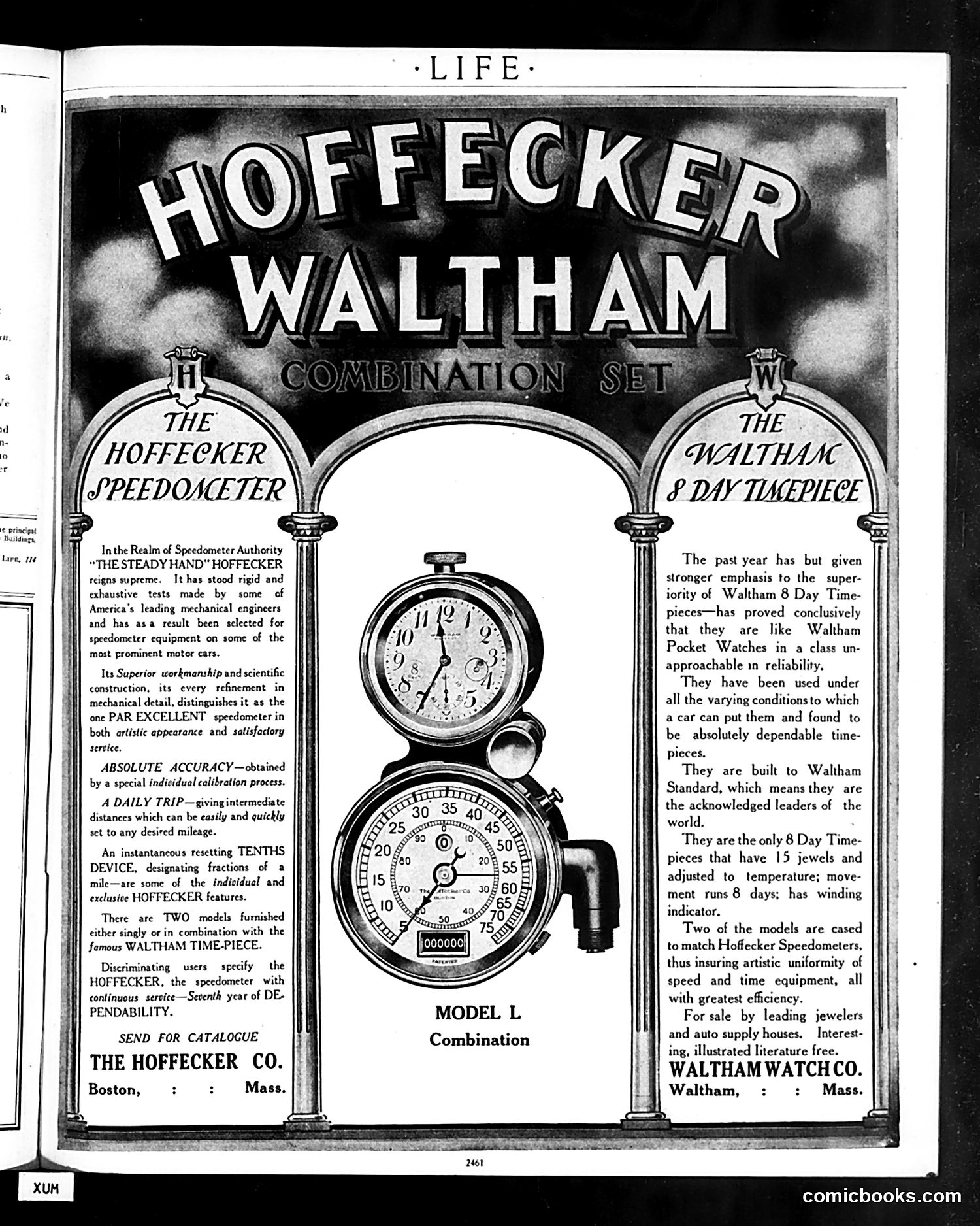
This is **not a cartoon or satire**, but rather a **dual product advertisement** from Life magazine's advertising pages. The page promotes a "Combination Set" pairing two automotive instruments: the Hoffecker Speedometer (left) and the Waltham 8-Day Timepiece (right). The central image shows "Model L," displaying both devices integrated together. The copy emphasizes precision engineering and reliability—key selling points for early automobile owners. The Hoffecker speedometer claims "absolute accuracy" and "seven years of dependability," while the Waltham timepiece boasts superior craftsmanship, temperature adjustment, and prestigious use in luxury cars. This reflects the era when accurate speedometers and reliable timekeeping were luxury features in automobiles. The pairing suggests complementary functionality: knowing both speed and precise time while driving was valuable to motorists. There is no political satire or hidden meaning—this is straightforward commercial promotion targeting "discriminating users" and "leading jewelers and auto supply houses."
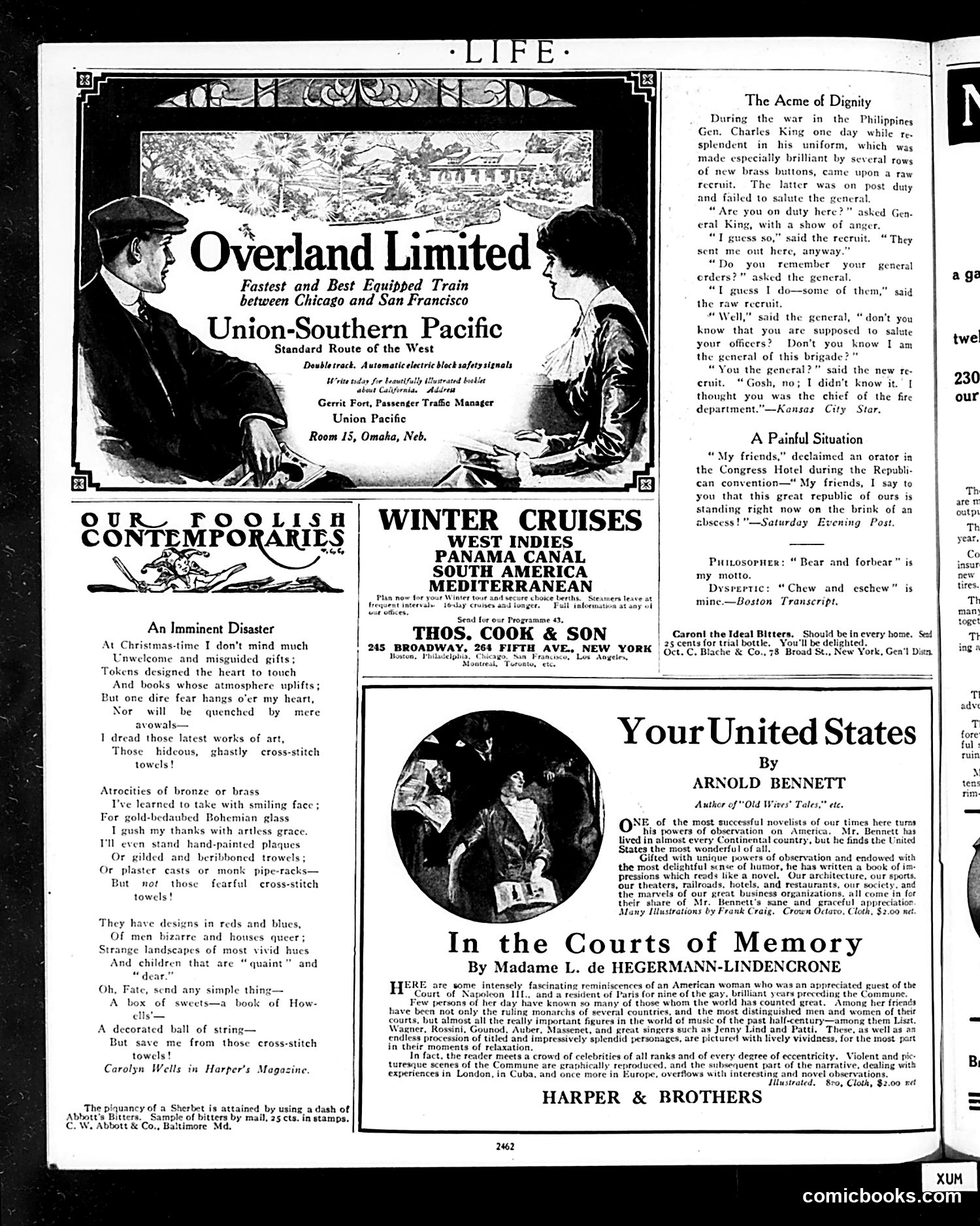
This page contains primarily **advertisements and literary content** rather than political cartoons requiring interpretation. The main satirical content is a humorous anecdote titled "The Acme of Dignity" about a Philippine War-era general (Gen. Charles King) whose elaborate uniform impresses no one—a raw recruit mistakes him for a fire department chief. The joke satirizes military pomposity and the disconnect between a officer's self-importance and actual authority. Below that, "An Imminent Disaster" is a poem humorously complaining about receiving ugly cross-stitch towels as Christmas gifts—mild domestic satire about unwanted presents. The page is otherwise dominated by advertisements for the Overland Limited train, winter cruises, and books (including Arnold Bennett's "Your United States"). These ads, along with the book descriptions, comprise the bulk of the page's content rather than sharp political commentary or caricature-based satire typical of Life's more famous work.
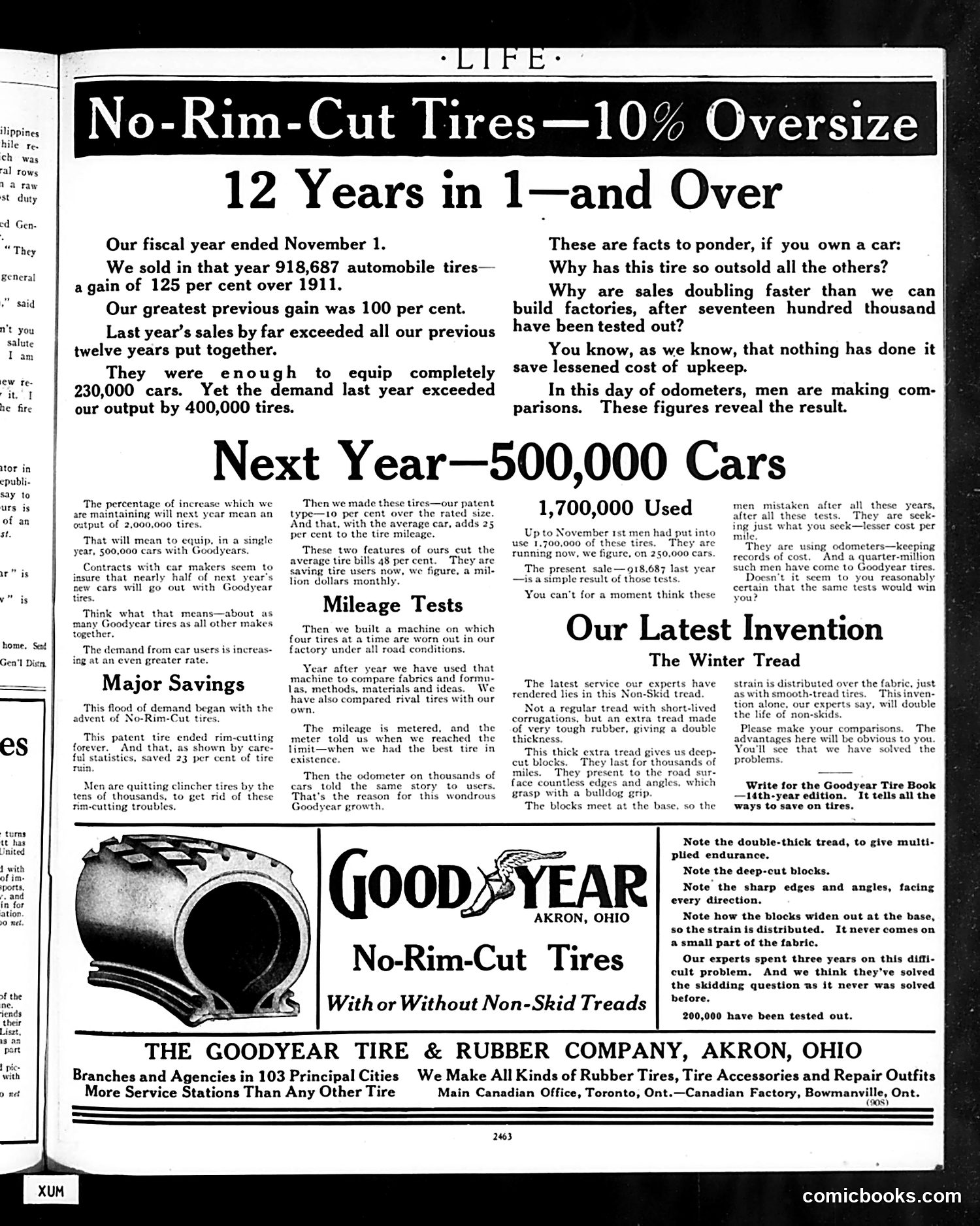
This is a **full-page advertisement**, not satire or political commentary. It promotes Goodyear's "No-Rim-Cut Tires" to automobile owners. The ad emphasizes sales growth: Goodyear sold 918,687 tires in their fiscal year—a 125% increase over 1911—yet demand exceeded supply by 400,000 units. The company projects selling enough tires next year to equip 500,000 cars. The pitch focuses on **practical consumer benefits**: the patented "No-Rim-Cut" design prevents rim damage (saving 23% of tire wear), oversized tires add 25% more mileage, and odometer tests prove Goodyear's superiority. The company claims 1.7 million tires already in use, establishing credibility through real-world data. A new "Winter Tread" invention with deep-cut blocks and distributed strain is highlighted as the latest improvement. The underlying message: buy Goodyear because testing proves it reduces upkeep costs—appealing to cost-conscious car owners.
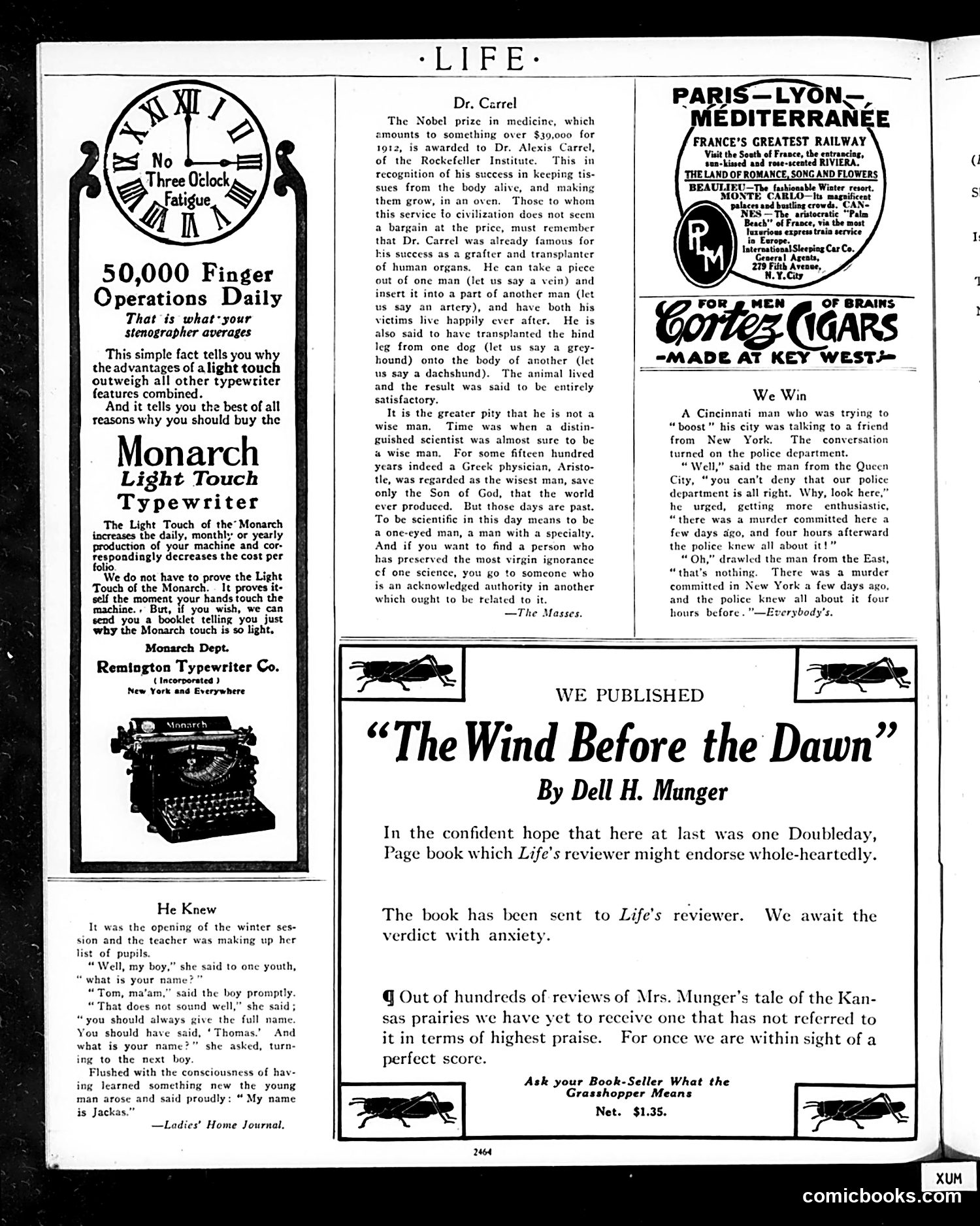
This page is primarily **advertising and editorial content** rather than political satire. The main items are: 1. **Monarch Typewriter ad** (left): Promotes the "Light Touch" typewriter, claiming it enables 50,000 daily finger operations for stenographers, increasing productivity while reducing fatigue. 2. **Dr. Alexis Carrel article** (center): Reports on the 1912 Nobel Prize in Medicine awarded to Carrel for keeping body tissues alive and enabling organ transplantation. The article's tone is somewhat critical—it praises his technical skill but laments that he is "not a wise man," arguing that modern science produces specialists with narrow expertise rather than broadly educated thinkers (contrasting with historical figures like Aristotle). 3. **Paris-Lyon-Méditerranée Railway ad** (top right): Tourism advertisement for the French Riviera. 4. **Cortez Cigars ad** (right): Product advertisement. 5. **"We Win" anecdote** (bottom right): A humorous short piece comparing police efficiency between Cincinnati and New York. The page reflects early 20th-century concerns: medical advancement, workplace efficiency, and civic pride.
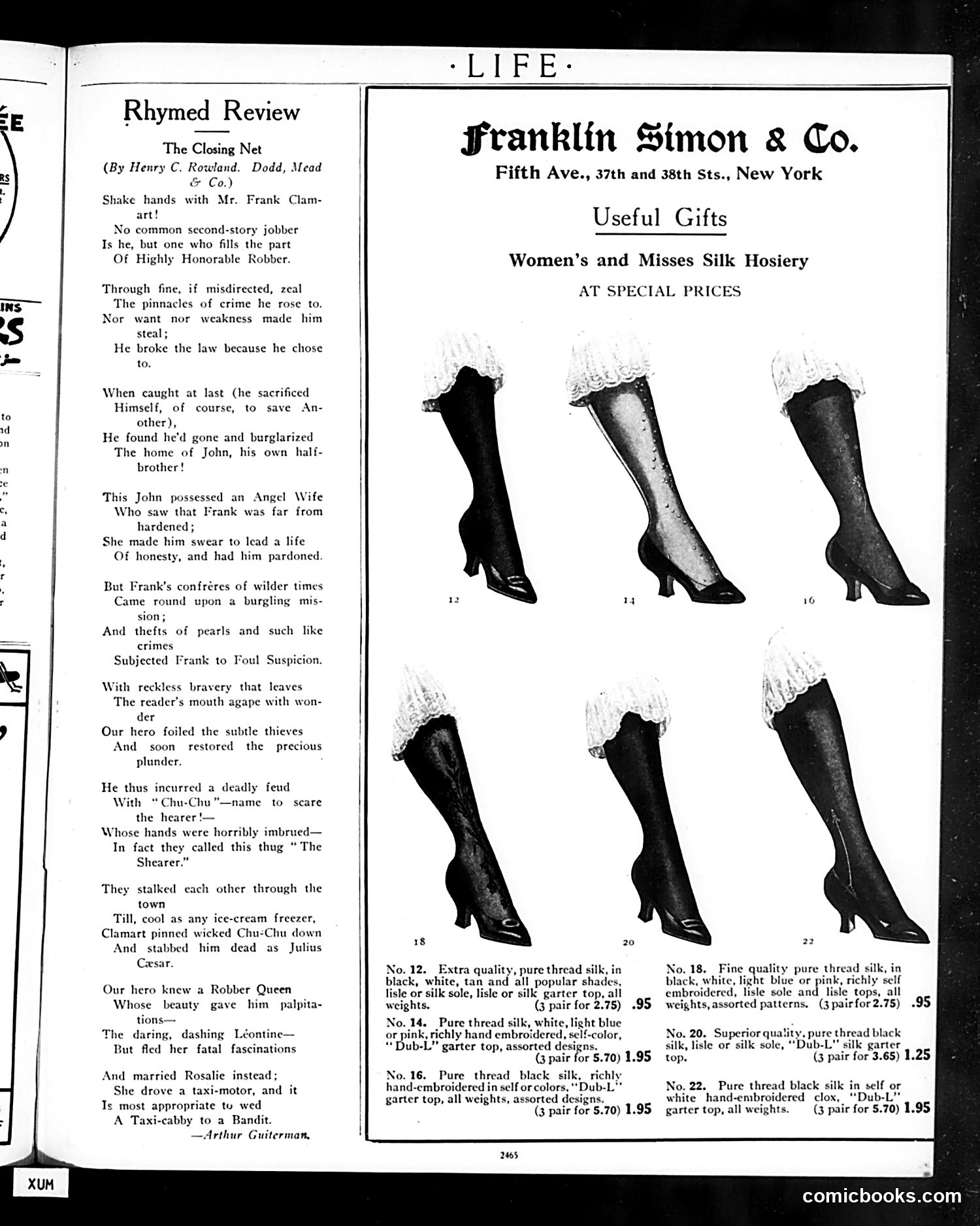
This page is **primarily an advertisement** for Franklin Simon & Co. hosiery, occupying roughly two-thirds of the space with product images and pricing. The left side contains a **book review in verse** by Arthur Guiterman, critiquing Henry C. Rowland's novel *The Closing Net*. Guiterman uses satirical poetry to mock the plot's melodramatic coincidences: a "Highly Honorable Robber" named Frank Clamart accidentally burglarizes his own half-brother's home, is reformed by an "Angel Wife," foils thieves, feuds with a villain called "Chu-Chu" (killed with Shakespearean reference to Julius Caesar), avoids a "Robber Queen" seductress, and marries a taxi-driver instead. The satire targets overwrought crime fiction conventions—improbable plot twists, noble criminals, exotic villain names, and convenience-store morality. Guiterman's final couplet ("A Taxi-cabby to a Bandit") undercuts the sentimental ending with dry humor about the absurd pairing. The hosiery ad is incidental to the literary critique.
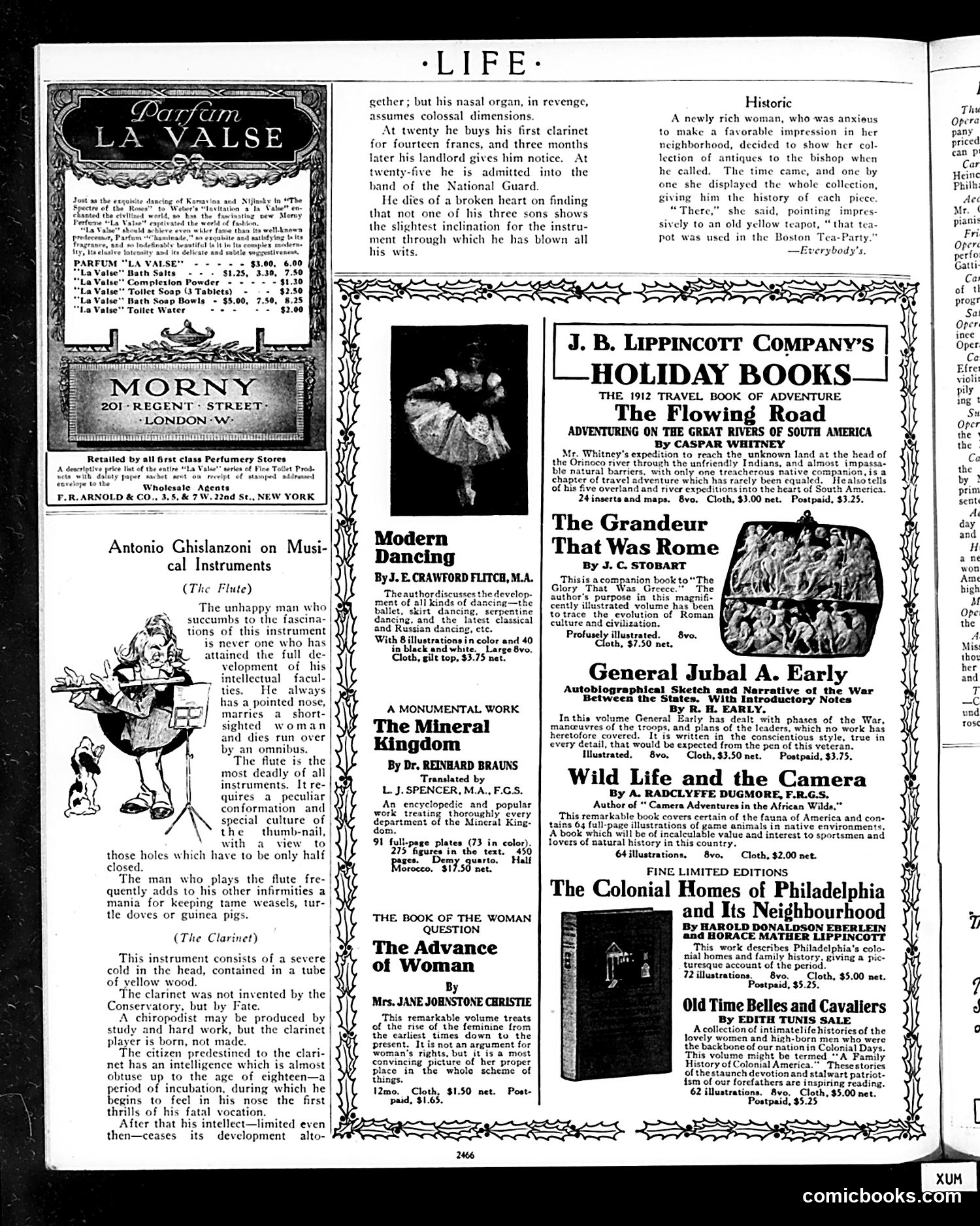
This page from *Life* magazine combines advertisements and book reviews with a satirical essay on musical instruments by Antonio Ghislanzoni. **The main satire** mocks flute and clarinet players as inherently defective individuals. Ghislanzoni claims flute players possess underdeveloped intellects, marry "short-sighted women," and die tragically—a absurdist exaggeration. The clarinet section is equally caustic, suggesting the instrument literally contains "a severe cold in the head" and that clarinet players are born intellectually "obtuse" and never develop beyond that state. **The visual humor** comes from the grotesque illustration of a figure playing the flute—caricatured with an absurdly pointed nose and distorted features, embodying Ghislanzoni's mockery. **The joke's context**: This appears to be *Life's* characteristic tongue-in-cheek humor targeting both musicians and pretentious artistic circles. The essay uses deliberate logical absurdity—blaming instruments themselves for their players' supposed failures—as satirical commentary, likely poking fun at both musical snobbery and the eccentric characters drawn to classical music.
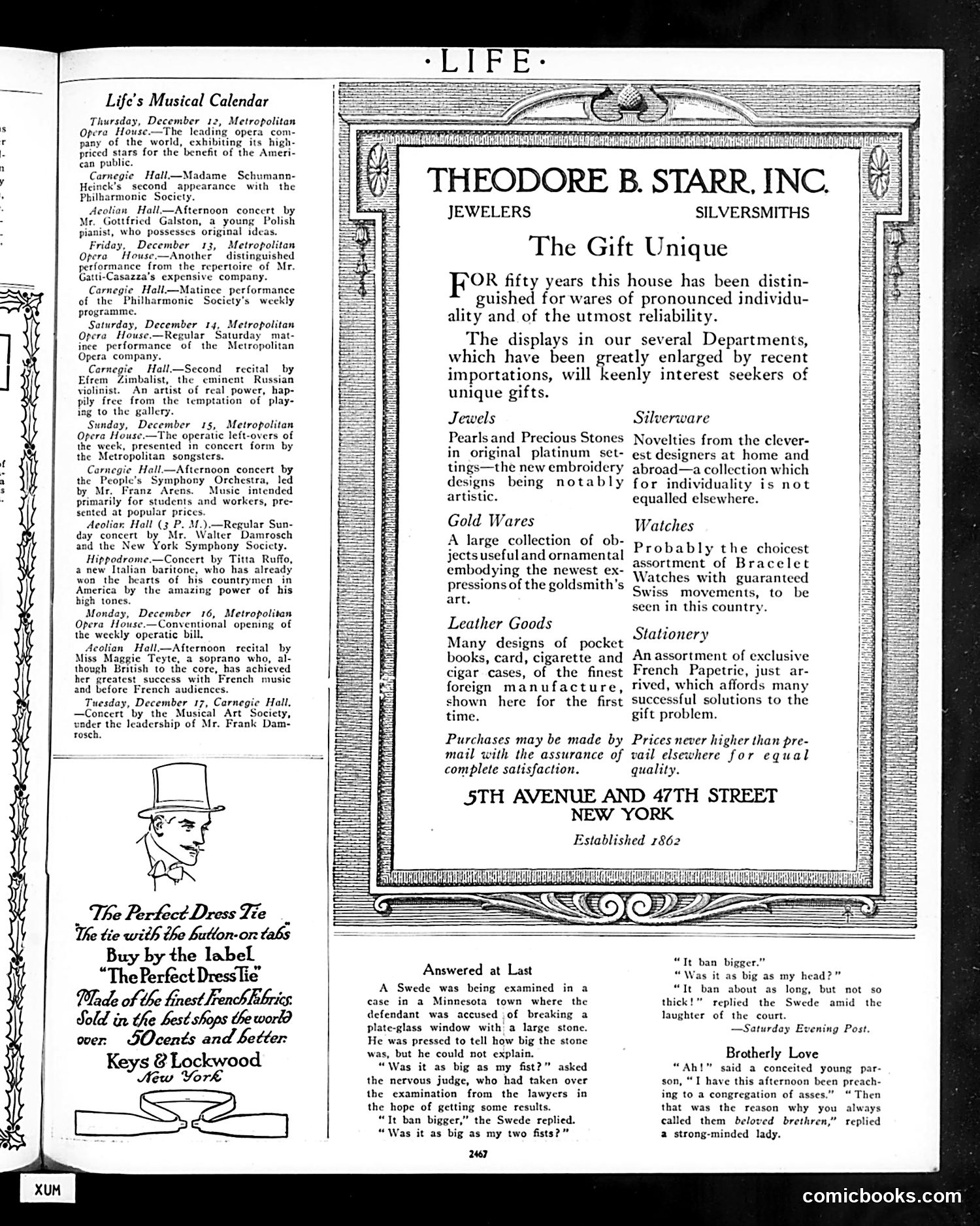
This page is primarily **advertising and entertainment listings**, not political satire. It contains: **Left side:** A musical calendar listing New York concert venues (Metropolitan Opera, Carnegie Hall, Aeolian Hall) with upcoming performances by famous classical musicians and opera companies. This reflects the era's highbrow cultural calendar. **Right side:** A full-page advertisement for Theodore B. Starr, Inc., a luxury jewelry and silverware retailer established in 1862, located on Fifth Avenue. The ad emphasizes exclusivity and quality ("individuality is not equalled elsewhere"). **Bottom left:** An advertisement for "The Perfect Dress Tie" by Keys & Lockwood, featuring a simple illustration of a well-dressed man in a top hat. **Bottom right:** A brief humorous anecdote ("Answered at Last") about a Swede being questioned in court about a window-breaking case—a mild joke playing on ethnic stereotypes common to the era. The page reflects early 20th-century upper-class American life, emphasizing refined culture and luxury consumption.
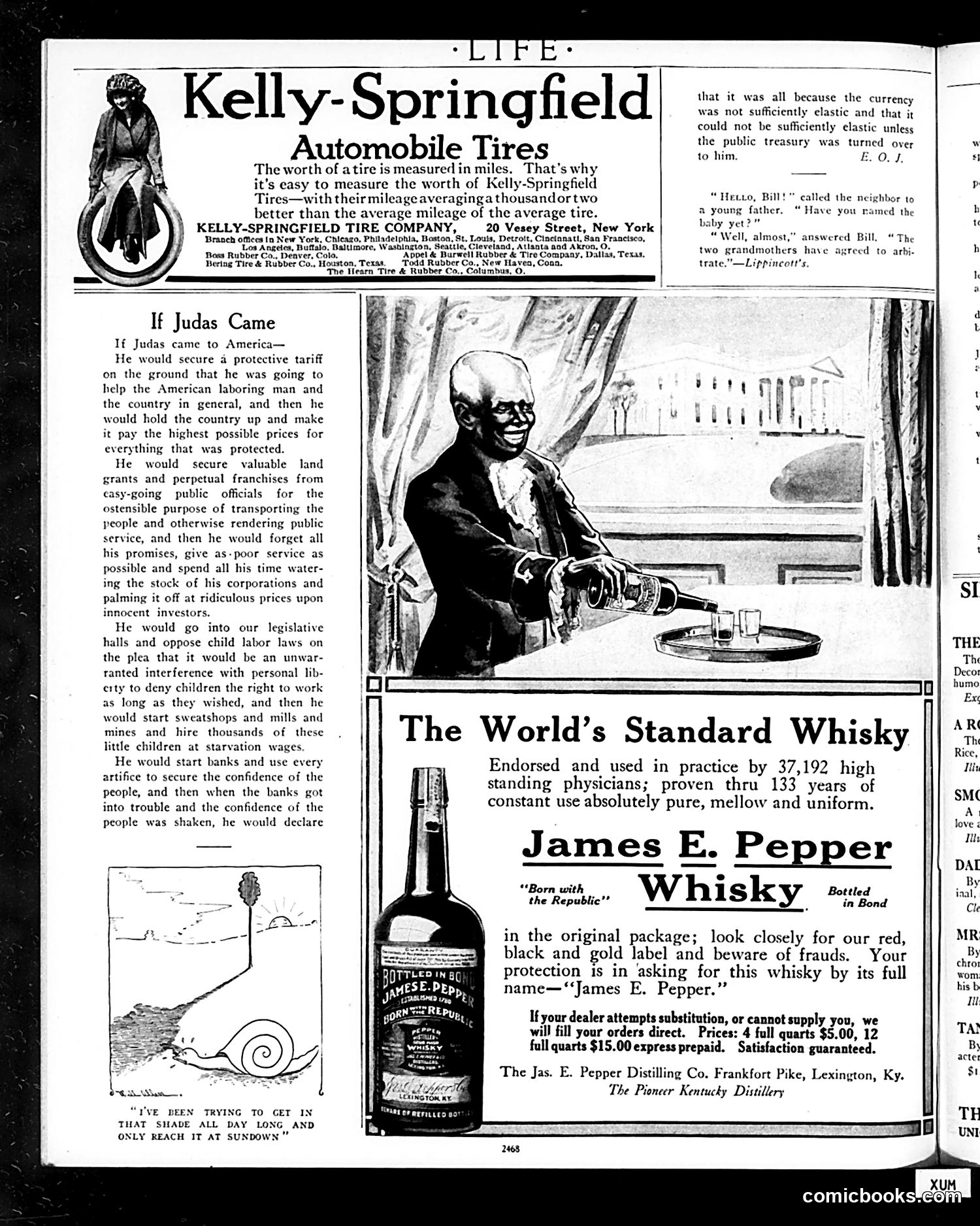
The main satirical article, "If Judas Came," uses the biblical figure of Judas as a metaphorical vehicle to critique early 20th-century American capitalism and corporate malfeasance. The piece depicts a hypothetical scenario where Judas—history's archetypal traitor—immigrates to America and exploits the nation's systems. The satire catalogs specific contemporary abuses: securing protective tariffs under false pretenses, obtaining land grants and franchises then abandoning public service commitments, opposing child labor laws while operating exploitative sweatshops, and manipulating banks to defraud investors. The author equates unregulated capitalist behavior with Judas's betrayal, suggesting that American industrialists and financiers commit moral treachery comparable to the apostle's infamy. This reflects Progressive Era concerns about monopolies, labor exploitation, and financial fraud—issues that dominated early 1900s political discourse. The surrounding advertisements (tire company, whisky) are period-typical magazine filler, unrelated to the satire's message.
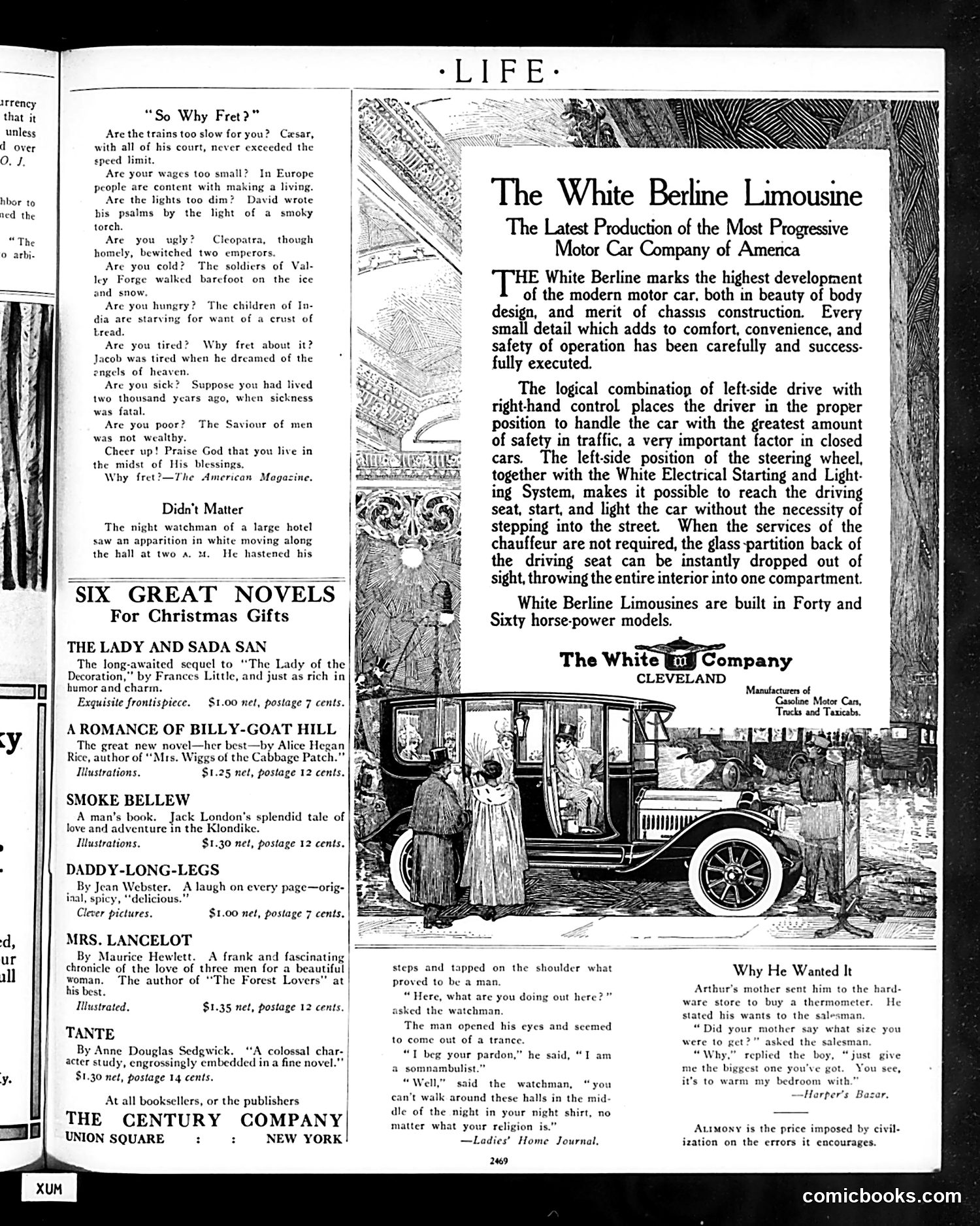
This page mixes editorial content with advertising. The main satirical piece, "So Why Fret?" (attributed to *The American Magazine*), uses historical and religious comparisons to mock modern complaints about comfort and circumstances. It suggests people today should stop complaining because historical figures—Caesar, David, Cleopatra, soldiers at Valley Forge, and Jesus—endured far worse. The satire appears to target what the editor views as excessive entitlement among contemporary Americans. Below this, a brief joke titled "Didn't Matter" plays on religious identity: a night watchman confronts a sleepwalker in pajamas; when told the man is a somnambulist (sleepwalker), the watchman insists he can't walk the halls in nightclothes "no matter what your religion is"—the humor arising from the watchman's apparent confusion between "somnambulist" and a religious sect. The page is otherwise dominated by advertisements for novels and a White automobile limousine.
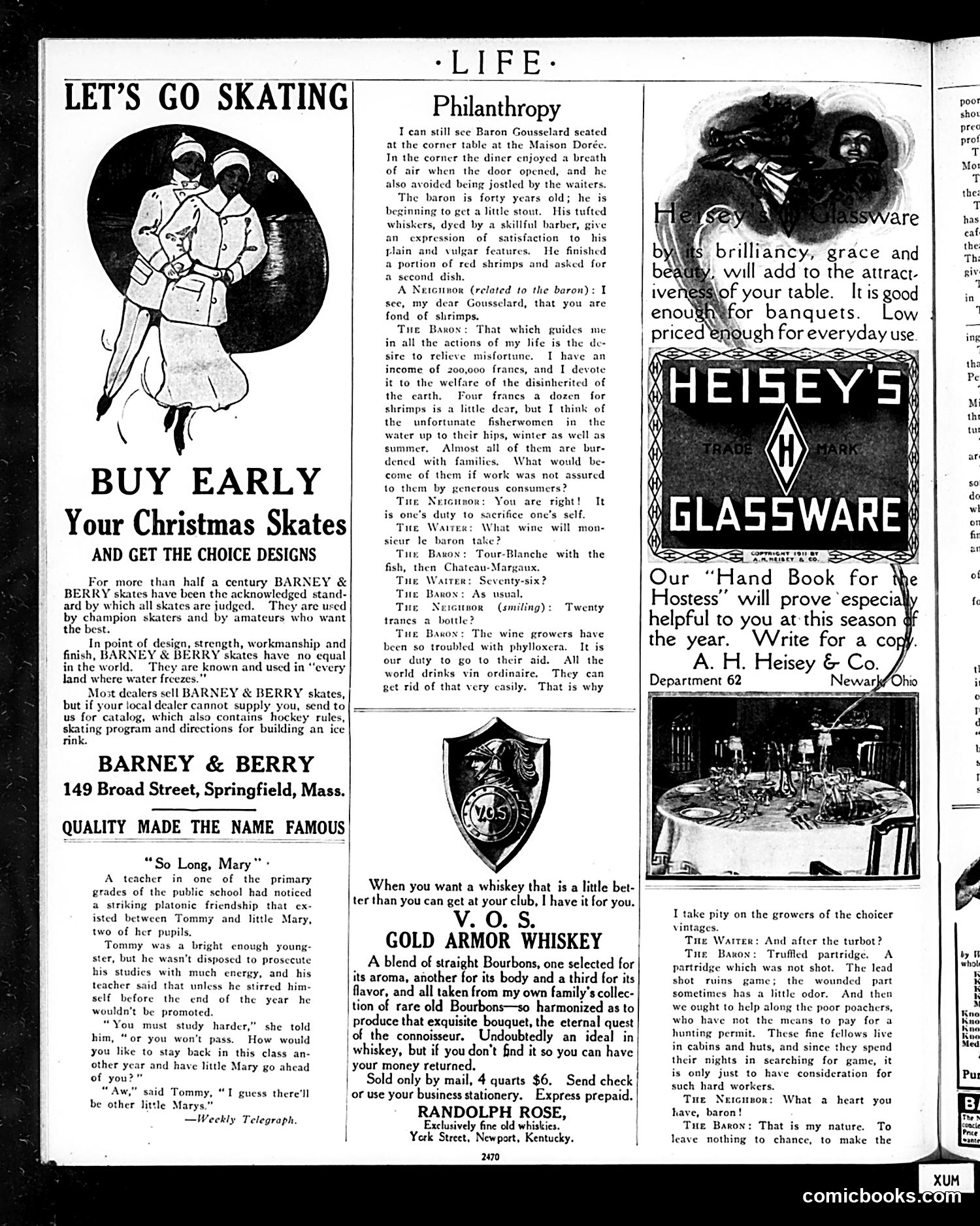
This is primarily an **advertising page** with one brief satirical piece embedded. The main content consists of Christmas skating advertisements (Barney & Berry skates) and whiskey promotions (Gold Armor Whiskey). The satire appears in the **"Philanthropy" section**—a mock dialogue between Baron Gousselard and a neighbor at a Parisian restaurant. The joke exposes hypocritical charitable reasoning: the Baron justifies indulgent spending (expensive shrimp, fine wine) as *helping* poor fisherwomen and wine-growers, when he's actually just enjoying luxury. His self-serving logic—spending money on expensive goods "relieves misfortune"—parodies the privileged classes' self-congratulatory rationalization of their consumption. The brief "So Long, Mary" filler joke depicts a boy prioritizing a girlfriend over academic advancement, implying romantic distraction trumps ambition. The page is typical early-20th-century *Life* content: advertising mixed with mild social satire targeting upper-class pretension.
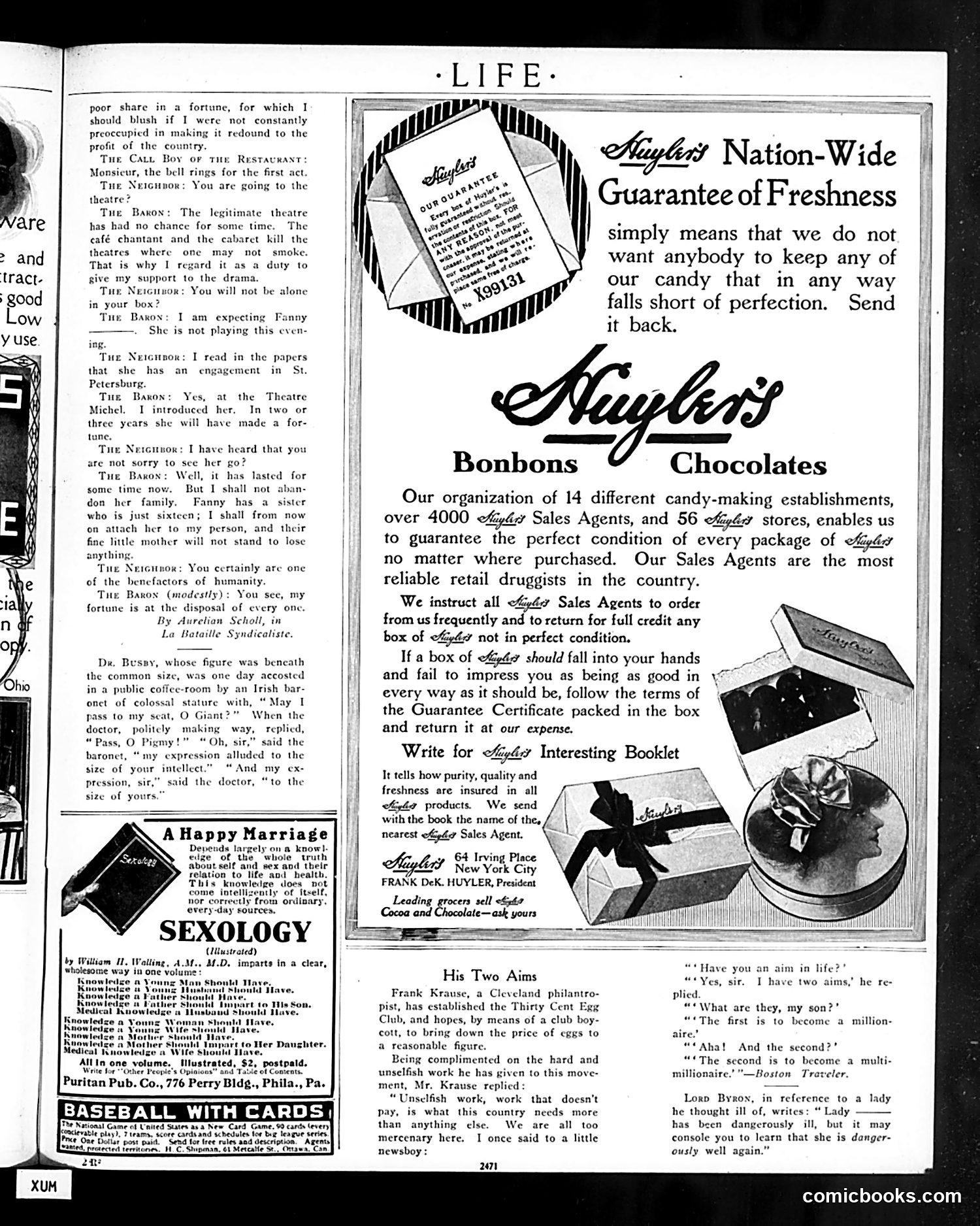
This page is primarily **advertising** for Saylor's Bonbons and Chocolates, with minor satirical content. The main advertisement features Saylor's "Nation-Wide Guarantee of Freshness"—a marketing promise that the company will accept returns of any imperfect candy. The ad emphasizes their extensive distribution network (14 factories, 4,000 sales agents, 56 stores) to assure quality. Below the ad are several unrelated short humor pieces typical of Life magazine's satirical format: - A dialogue between a Baron and neighbors about theater patronage and romantic conquests (satirizing aristocratic pretension) - A brief anecdote about Dr. Busay and an Irish baronet exchanging insults about intellect versus size - A piece titled "His Two Aims" about a Cleveland philanthropist establishing a "Thirty Cent Egg Club" to lower egg prices The page reflects early 20th-century American humor: social satire of European affectations, class commentary, and domestic life observations. The scattered format—mixing ads with jokes—was typical of Life's editorial style.
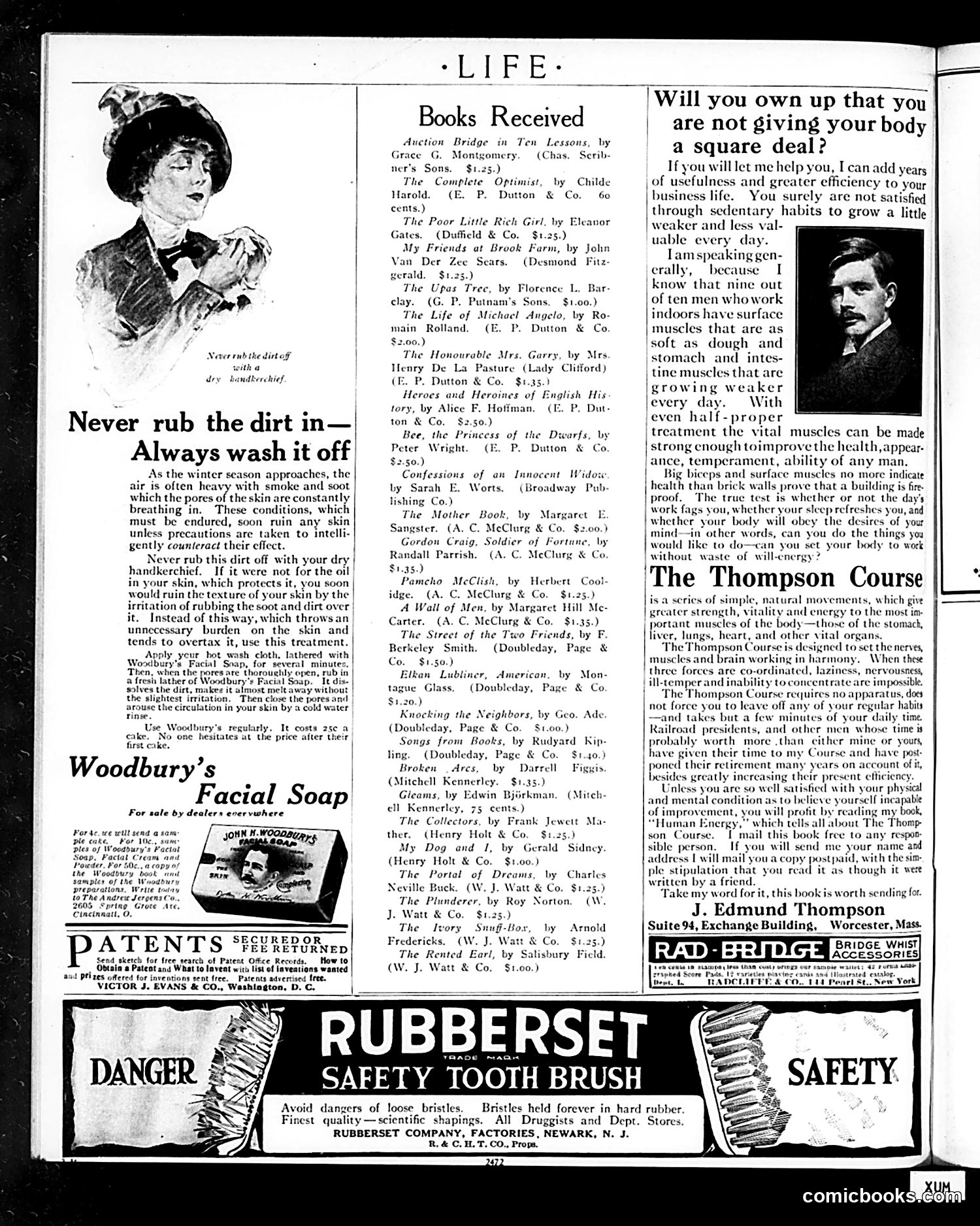
This page is primarily **advertising and book reviews**, not satire or political commentary. The main content features a **Woodbury's Facial Soap advertisement** with skincare advice (don't rub dirt off with dry handkerchiefs; wash with hot water and soap instead). This reflects early 20th-century hygiene concerns about urban pollution and soot from industrial air. The right side includes **The Thompson Course** advertisement—a physical fitness program promising to strengthen internal muscles and improve health through exercise. The pitch emphasizes that sedentary office workers (railroad presidents, etc.) need activity to maintain vigor. Below is a **"Books Received"** section listing recently published novels and non-fiction, typical of Life magazine's literary coverage. The **Rubberset Safety Toothbrush** ad at bottom warns against loose bristles—a product safety concern of the era. No recognizable political figures or satire appear on this page. It's a straightforward example of early-1900s magazine advertising and book promotion.
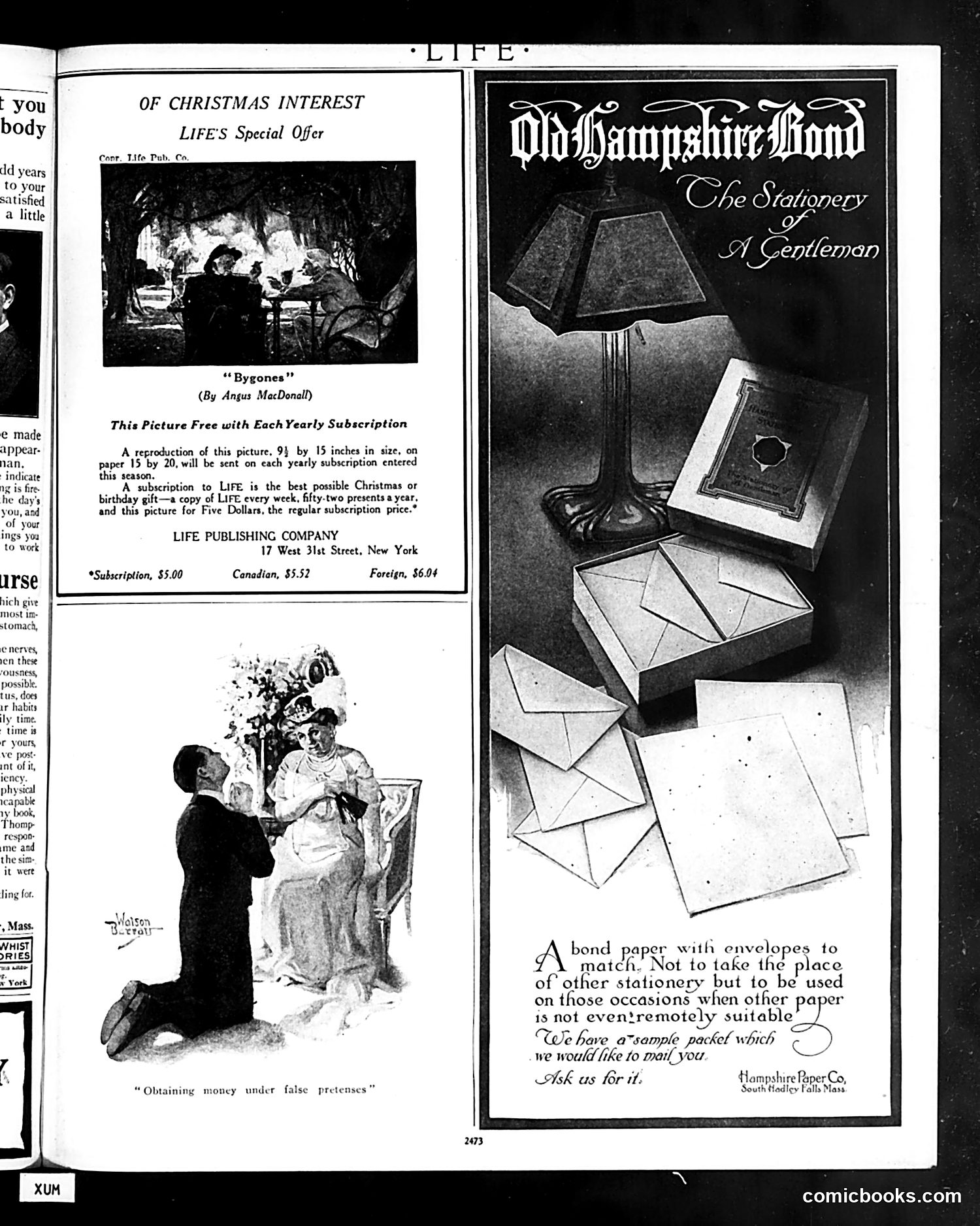
This page contains Christmas advertising rather than political satire. **Left side:** Life magazine promotes a yearly subscription offer ($5.00) that includes a free art reproduction titled "Bygones" by Angus MacDonall—a sentimental illustration showing what appears to be a nostalgic domestic scene. The subscription pitch markets LIFE as an ideal Christmas gift. **Bottom left:** A small cartoon titled "Obtaining money under false pretences" shows a man presenting flowers to a woman, likely satirizing courtship deception or romantic fraud—a common theme in period humor. **Right side:** An advertisement for Hampshire Bond stationery featuring elegant envelopes and writing paper, marketed for formal occasions when "other paper is not even remotely suitable." This appeals to genteel sensibilities about appropriate correspondence materials. The page reflects early 20th-century consumer culture and genteel social anxieties about proper etiquette and gift-giving.
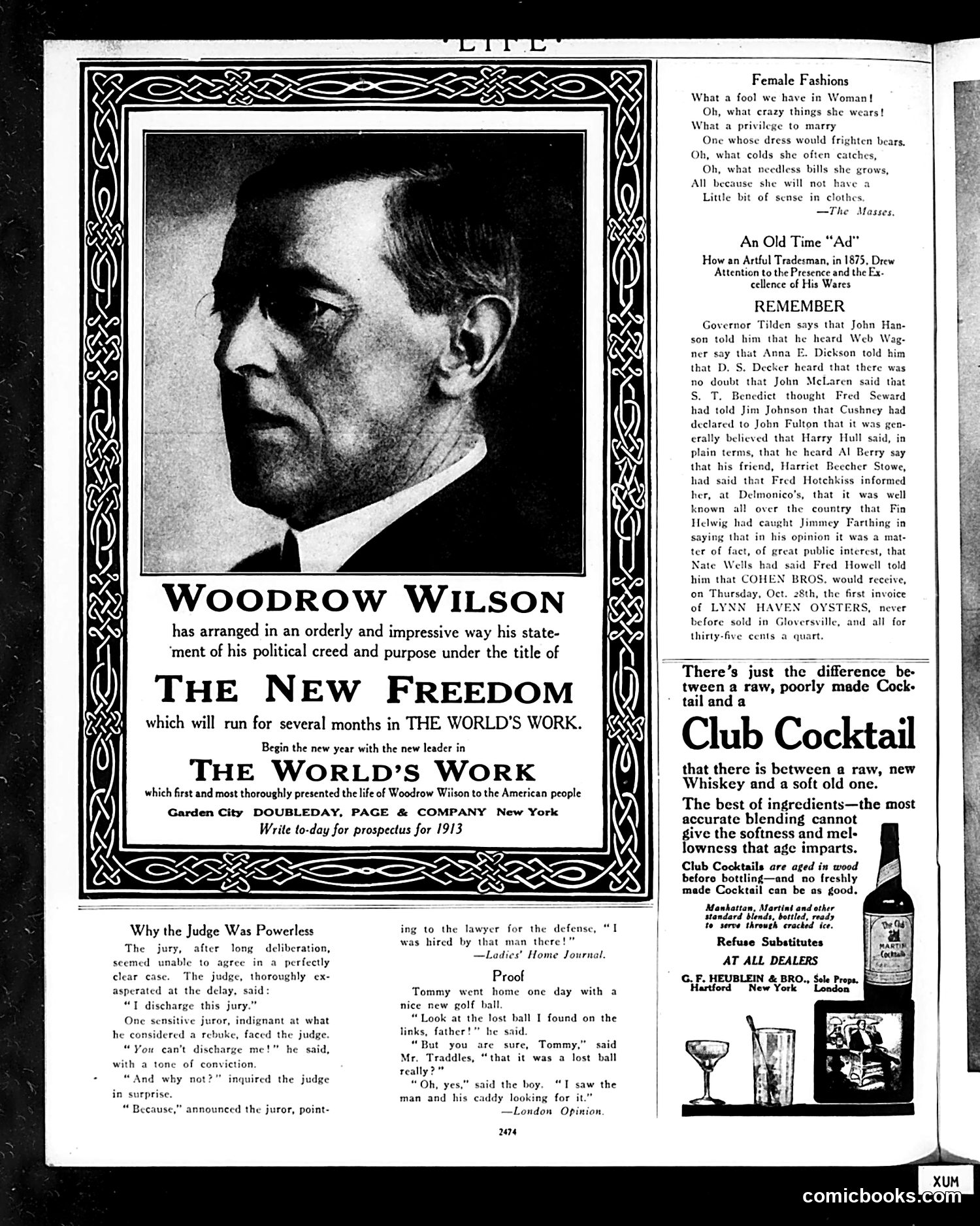
This page combines advertising with light humor content typical of early 1910s Life magazine. **Main Advertisement:** A full-page promotion for Woodrow Wilson's political manifesto *The New Freedom*, appearing serially in *The World's Work* magazine. The portrait and text present Wilson as a new political leader for 1913, emphasizing his organized statement of political principles. **Humorous Content:** Three brief jokes appear: 1. "Why the Judge Was Powerless"—a courtroom anecdote about juror insubordination 2. "Proof"—a boy's logic about finding a golf ball 3. **Social Commentary:** A poem from *The Masses* criticizing women's fashion choices as foolish and expensive **Period Advertisement:** An 1875-style advertisement demonstrating absurdly long chains of hearsay ("Governor Tilden says that John Hanson told him...") to promote Lynn Haven oysters—satirizing exaggerated vintage advertising claims. **Product Ads:** Club Cocktail and Heublein liquor advertisements emphasizing age and quality. The page reflects Progressive Era concerns: political leadership, courtroom justice, gender criticism, and consumer products.
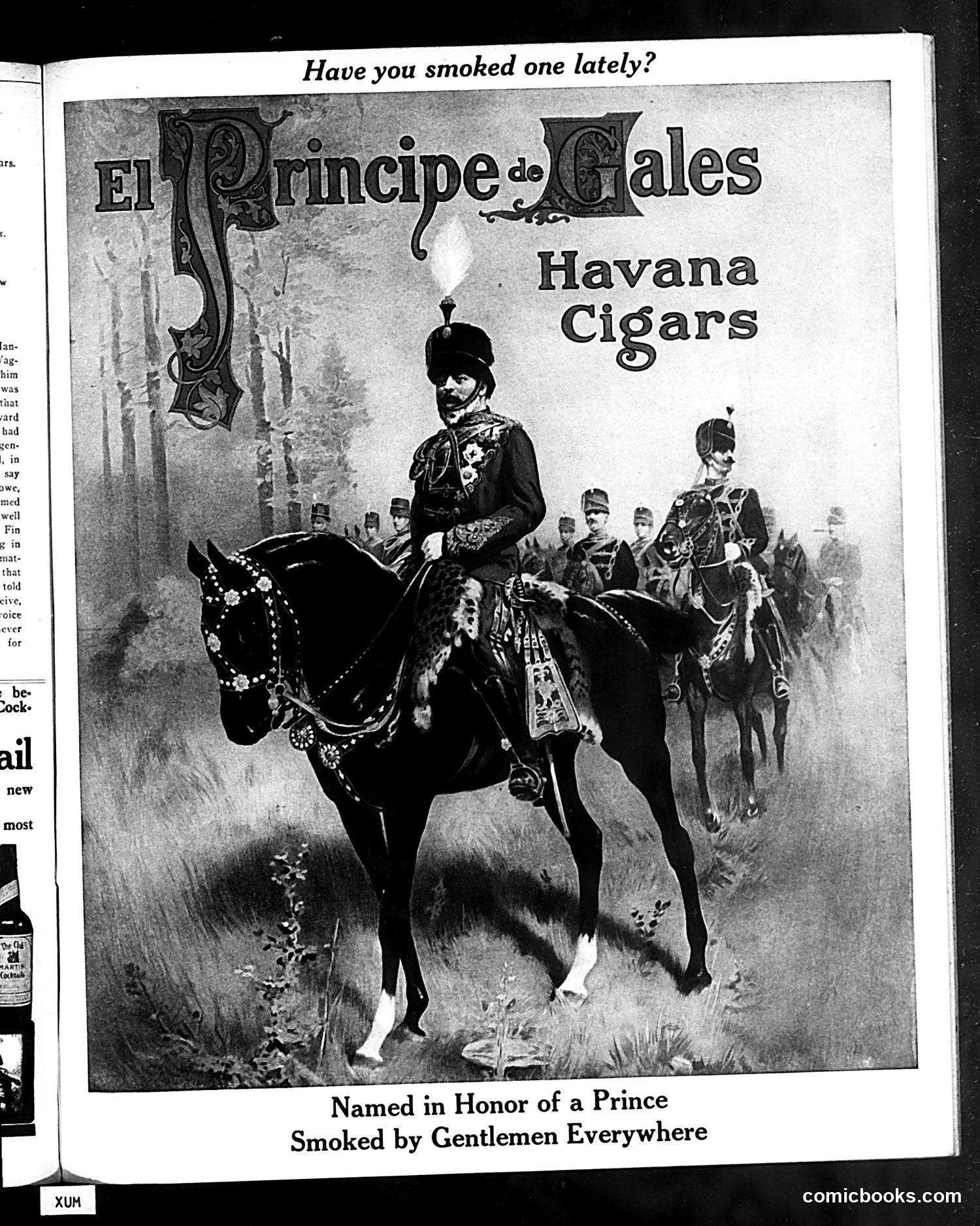
This is an advertisement for "El Príncipe de Gales" (The Prince of Wales) Havana cigars. The image depicts a military or royal figure in ornate uniform mounted on a decorated horse, leading a procession of similarly dressed officers. The ad's appeal relies on associating the cigar brand with aristocratic prestige and masculine sophistication. By naming the product after a prince and claiming it's "smoked by gentlemen everywhere," the advertisement suggests that purchasing these cigars confers social status and refinement on the buyer. The elaborate military imagery and formal procession reinforce themes of power, authority, and upper-class exclusivity—marketing tactics common in early 20th-century luxury goods advertising. The rhetorical question "Have you smoked one lately?" uses social pressure to encourage consumption.
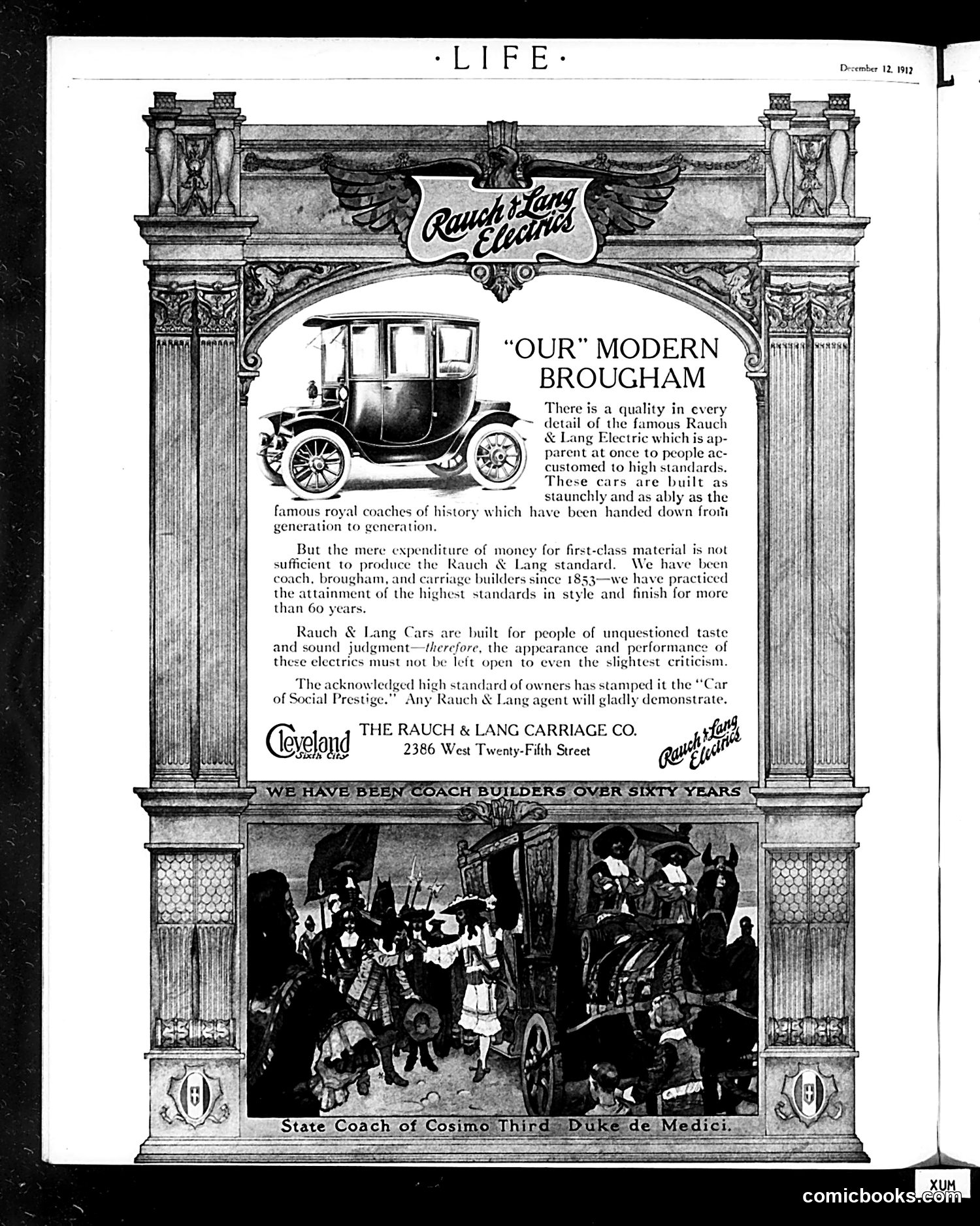
This is primarily a **car advertisement**, not satire or political cartoon. It's a 1912 Life magazine ad for the Rauch & Lang Electric automobile, positioned as a luxury vehicle for the wealthy. The ad's appeal is **class-based**: it emphasizes that Rauch & Lang cars are built for "people of unquestioned taste and sound judgment" and have earned the reputation as the "Car of Social Prestige." The ornate architectural framing (classical columns, decorative elements) reinforces exclusivity and refinement. The bottom illustration depicts a "State Coach of Cosmo Third Duke de Medici"—a historical royal carriage—to draw a parallel: just as royal coaches were built with superior craftsmanship across generations, so too are these electric automobiles. The company claims 60+ years of carriage-building expertise. **For modern readers**: this represents how early automobiles marketed themselves to the wealthy by claiming they represented the continuation of aristocratic tradition and taste—positioning car ownership as a marker of social standing rather than mere transportation.