
Life, 1912-12-12 · page 28 of 48
Life — December 12, 1912 — page 28: what you’re looking at
What you’re looking at
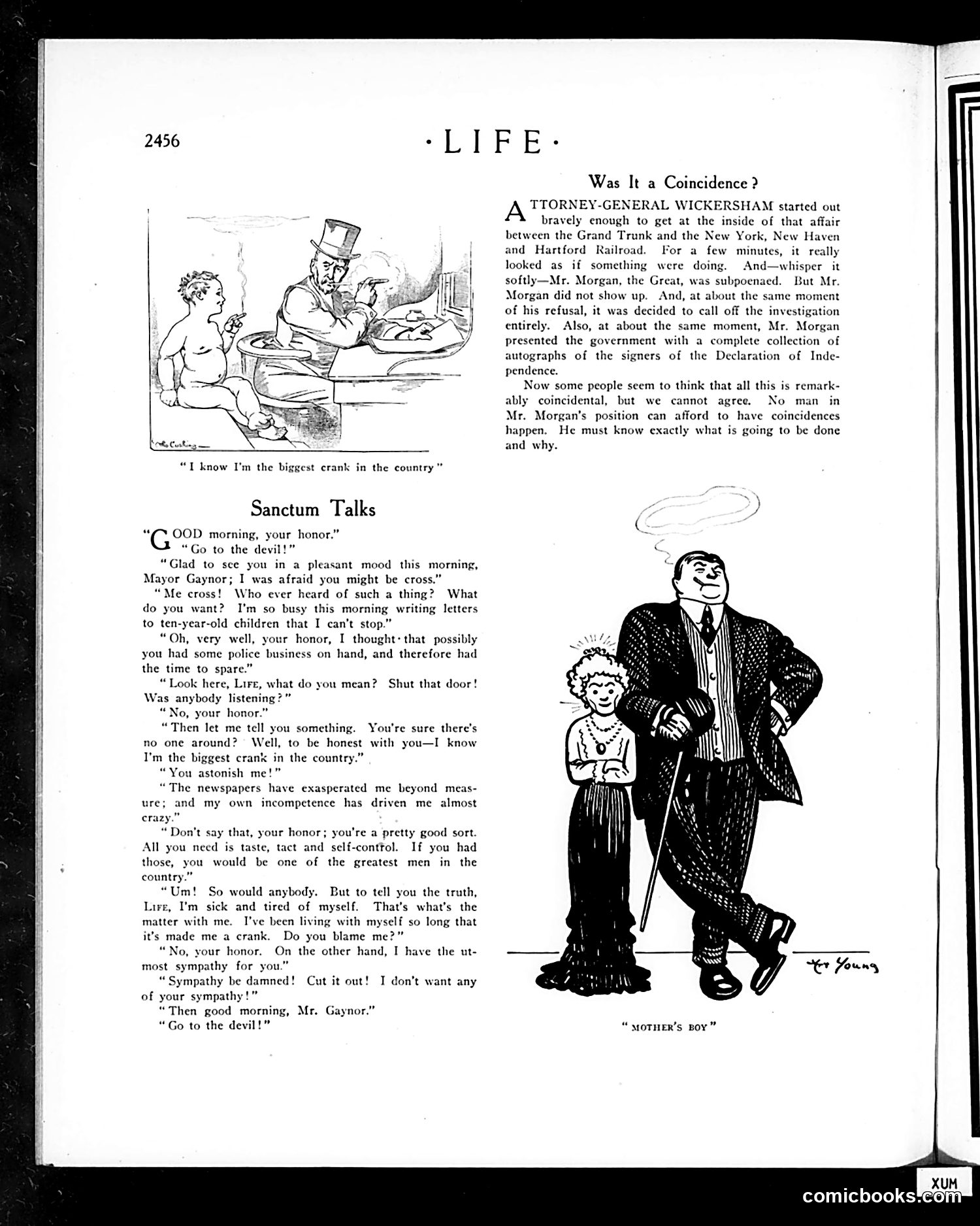
**Top Section ("Was It a Coincidence?")**: This satirizes Attorney-General Wickersham's investigation into railroad dealings involving J.P. Morgan, the powerful banker. Morgan was subpoenaed but didn't appear; the investigation was mysteriously dropped shortly after. The article sarcastically notes Morgan then donated Declaration of Independence autographs to the government—suggesting he essentially bought his way out of trouble. The satire's point: a man of Morgan's wealth and power doesn't experience mere "coincidences"; he controls outcomes through influence. **"Sanctum Talks" Section**: Features Mayor Gaynor of New York in a conversation with "Life" magazine's editor. Gaynor confesses to being mentally exhausted and self-critical, acknowledging his own "incompetence" and crankiness. The cartoon mocks his volatile personality while he complains about press exaggeration. The smaller cartoon, "Mother's Boy," appears to be a separate satirical sketch about privilege or maternal indulgence. The page critiques both unchecked wealth (Morgan) and unstable municipal leadership (Gaynor).
📄 Transcribed text from this page (OCR, searchable)
Machine-transcribed from the original scan — historical spelling and the odd misread are preserved.
*LIPE« Was It a Coincidence ? TTORNEY-GENERAL WICKERSHAM started out bravely enough to get at the inside of that affair between the Grand Trunk and the New York, New Haven and Hartford Railroad. For a few minutes, it really looked as if something were doing. And—whisper it softly—Mr. Morgan, the Great, was subpoenaed. But Mr. Morgan did not show up. And, at about the same moment of his refusal, it was decided to call off the inves entirely. Also, at about the same moment, Mr. Morgan presented the government with a complete collection of autographs of the signers of the Declaration of Inde- pendence. Now some people seem to think that all this is remark- ably coincidental, but we cannot agree. No man in Mr. Morgan's position can afford to have coincidences happen. He must know exactly what is going to be done and why. “I know I'm the biggest crank in the country” Sanctum Talks : >) ss OOD morning, your honor.” = “Go to the devil!” “Glad to sce you in a pleasant mood this morning, Mayor Gaynor; I was afraid you might be cross.” “Me cross! Who ever heard of such a thing? What do you want? I’m so busy this morning writing letters to ten-year-old children that I can’t stop.” “Oh, very well, your honor, I thought: that pos: ibly you had some police business on hand, and therefore had the time to spare.” “Look here, Lire, what do you mean? Shut that door! Was anybody listening No, your honor. | “Then let me tell you something. You're sure there's j no one around? Well, to be honest with you—I know j I'm the biggest crank in the country.” “You astonish me!” “The newspapers have exasperated me beyond meas- d my own incompetence has driven me almost “Don't say that, your honor; you're a pretty good sort. All you need is taste, tact and self-conttol. If you had those, you would be one of the greatest men in the country. “Um! So would anybody. But to tell you the truth, Lire, I'm sick and tired of myself. That’s what's the matter with me. I’ve been living with myself so long that it’s made me a crank. Do you blame me?” “No, your honor. On the other hand, I have the ut- most sympathy for you.” “Sympathy be damned! Cut it out! I don’t want any of your sympathy!” “Then good morning, Mr. Gaynor.” “Go to the devil!” “ MOTHER’S BOY” TE 2 |