
Life, 1912-12-12 · page 10 of 48
Life — December 12, 1912 — page 10: what you’re looking at
What you’re looking at
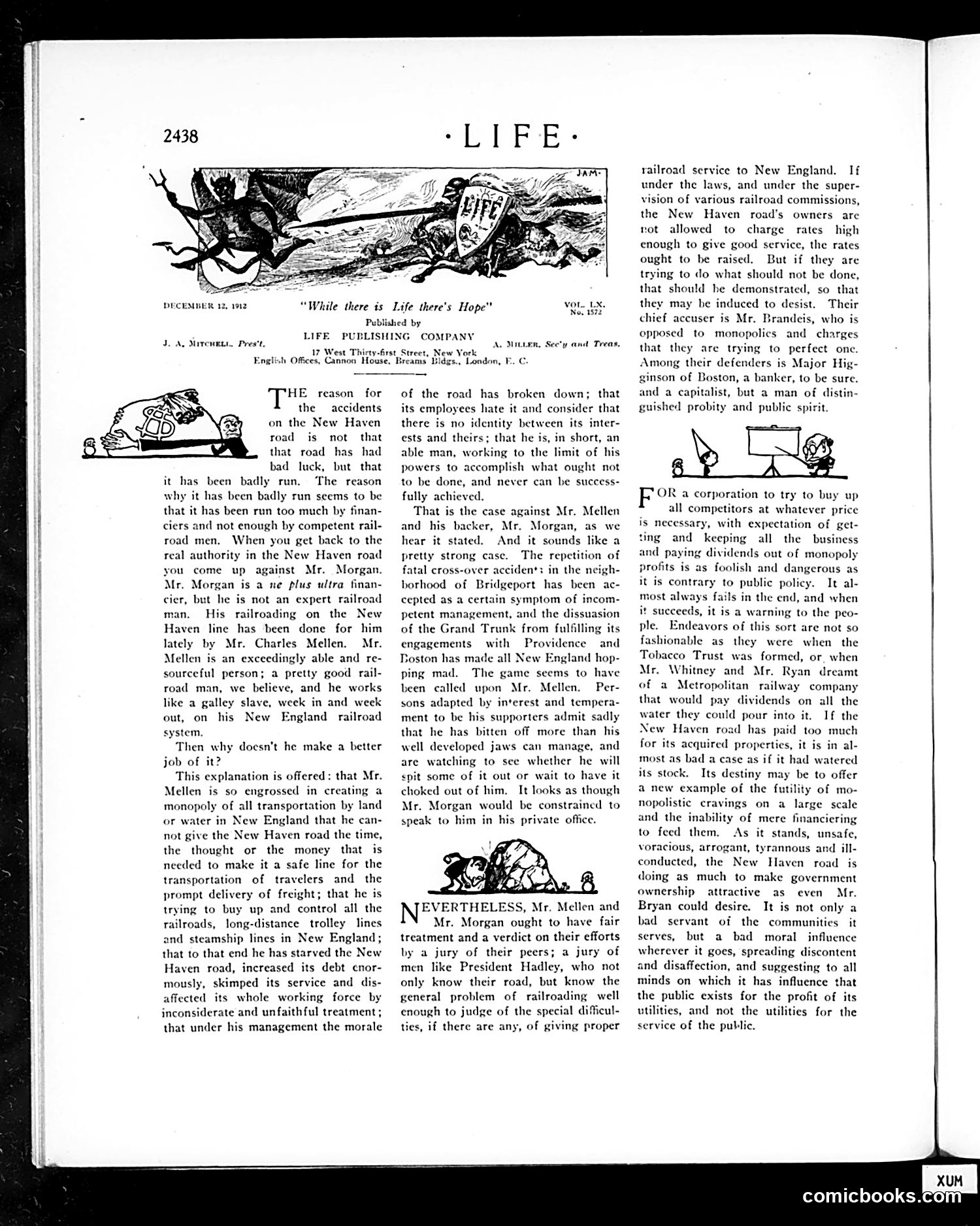
This editorial cartoon critiques the management of the New Haven Railroad. The text identifies the central conflict: railroad magnate **Mr. Mellen** (appears to be the primary target) and **Mr. Morgan** are accused of mismanaging the line through incompetent leadership and financial prioritization over service quality. The cartoon depicts a skeletal or dying figure labeled "LIFE," suggesting the railroad is failing under their stewardship. The article argues that Mellen prioritizes creating monopolies and controlling competitors rather than improving actual railroad operations, employee welfare, or public service. The satire criticizes how wealthy industrialists pursue profit and market dominance at the expense of functional, ethical business practices—a common Progressive Era critique of monopolistic corporate behavior.
📄 Transcribed text from this page (OCR, searchable)
Machine-transcribed from the original scan — historical spelling and the odd misread are preserved.
DECEMNER 12, 1912 “While there is Life there's Hope" VOL LX. Nov 15 Published by dirrewrts. Pres‘t, 17 West T Engi HE reason for the accidents on the New Haven road is not that that road has had bad luck, but that it has been badly run. The reason why it has been badly run seems to be that it has been run too much by finan- ciers and not enough by competent rail- road men, When you get back to the real authority in the New Haven road you come up against Mr. Morgan. Mr. Morgan is a ne plus ultra finan- cier, but he is not an expert railroad man. His railroading on the New Haven line has been done for him lately by Mr. Charles Mellen. Mr. Mellen is an exceedingly able and re- sourceful person; a pretty good rail- road man, we believe, and he works like a galley slave, week in and week out, on his New England railroad system. Then why doesn’t he make a better job of it? This explanation is offered: that Mr. Mellen is so engrossed in creating a monopoly of all transportation by land or water in New England that he can- not give the New Haven road the time, the thought or the money that is needed to make it a safe line for the transportation of travelers and the prompt delivery of freight; that he is trying to buy up and control all the railroads, long-distance trolley lines and steamship lines in New England; that to that end he has starved the New Haven road, increased its debt cnor- mously, skimped its service and dis- affected its whole working force by inconsiderate and unfaithful treatment ; that under his management the morale rty-frst Street, Offices, Cannon House, Breams’ FE PUBLISHING COMPANY LER, See'y anit Treas, New York ., London, F of the road has broken down; that its employees hate it and consider that there is no identity between its inter- ests and theirs; that he is, in short, an able man, working to the limit of his powers to accomplish what ought not to be done, and never can be success- fully achieved. That is the case against Mr. Mellen and his backer, Mr, Morgan, as we hear it stated. And it sounds like a pretty strong case. The repetition of fatal cross-over accident; in the neigh- borhood of Bridgeport has been ac- cepted as a certain symptom of incom- petent management, and the dissuasion of the Grand Trunk from fulfilling its engagements with Providence and Boston has made all New England hop- ping mad. The game seems to have been called upon Mr. Mellen. Per- sons adapted by interest and tempera- ment to be his supporters admit sadly that he has bitten off more than his well developed jaws can manage, and are watching to see whether he will spit some of it out or wait to have it choked out of him. It looks as though Mr. Morgan would be constrained to speak to him in his private office. EVERTHELESS, Mr. Mellen and Mr. Morgan ought to have fair treatment and a verdict on their efforts by a jury of their peers; a jury of men like President Hadley, who not only know their road, but know the general problem of railroading well enough to judge of the special difficul- ties, if there are any, of giving proper railroad service to New England. If under the laws, and under the super- vision of various railroad commissions, the New Haven road’s owners are rot allowed to charge rates high enough to give good service, the rates ought to be raised. But if they are trying to do what should not be done, that should be demonstrated, so that they may he induced to desist. Their chief accuser is Mr. Brandeis, who is opposed to monopolics and charges that they are trying to perfect onc. Among their defenders is Major Hig- inson of Boston, a banker, to be sure. and a capitalist, but a man of distin- guished probity and public spirit. Fok a corporation to try to buy up all competitors at whatever price is necessary, with expectation of get- ting and keeping all the busin and paying dividends out of monopoly profits is as foolish and dangerous as it is contrary to public policy. It al- most always fails in the end, and when succeeds, it is a warning to the peo- ple. Endeavors of this sort are not so fashionable as they were when the Tobacco Trust was formed, or, when Mr. Whitney and Mr. Ryan dreamt of a Metropolitan railway company that would pay dividends on all the water they could pour into it. If the New Haven road has id too much for its acquired properties, it is in al- most as bad a case as if it had watered ils stock. Its destiny may be to offer a new example of the futility of mo- nopolistic cravings on a large scale and the inability of mere financicring to feed them, As it stands, unsafe, voracious, arrogant, tyrannous and ill- conducted, the New Haven road is doing as much to make government ownership attractive as even Mr. Bryan could desire. It is not only a bad servant of the communities it serves, but a bad moral influence wherever it goes, spreading discontent and disaffection, and suggesting to all minds on which it has influence that the public exists for the profit of its utilities, and not the utilities for the service of the public. comicbooks.