
Life, 1912-12-12 · page 30 of 48
Life — December 12, 1912 — page 30: what you’re looking at
What you’re looking at
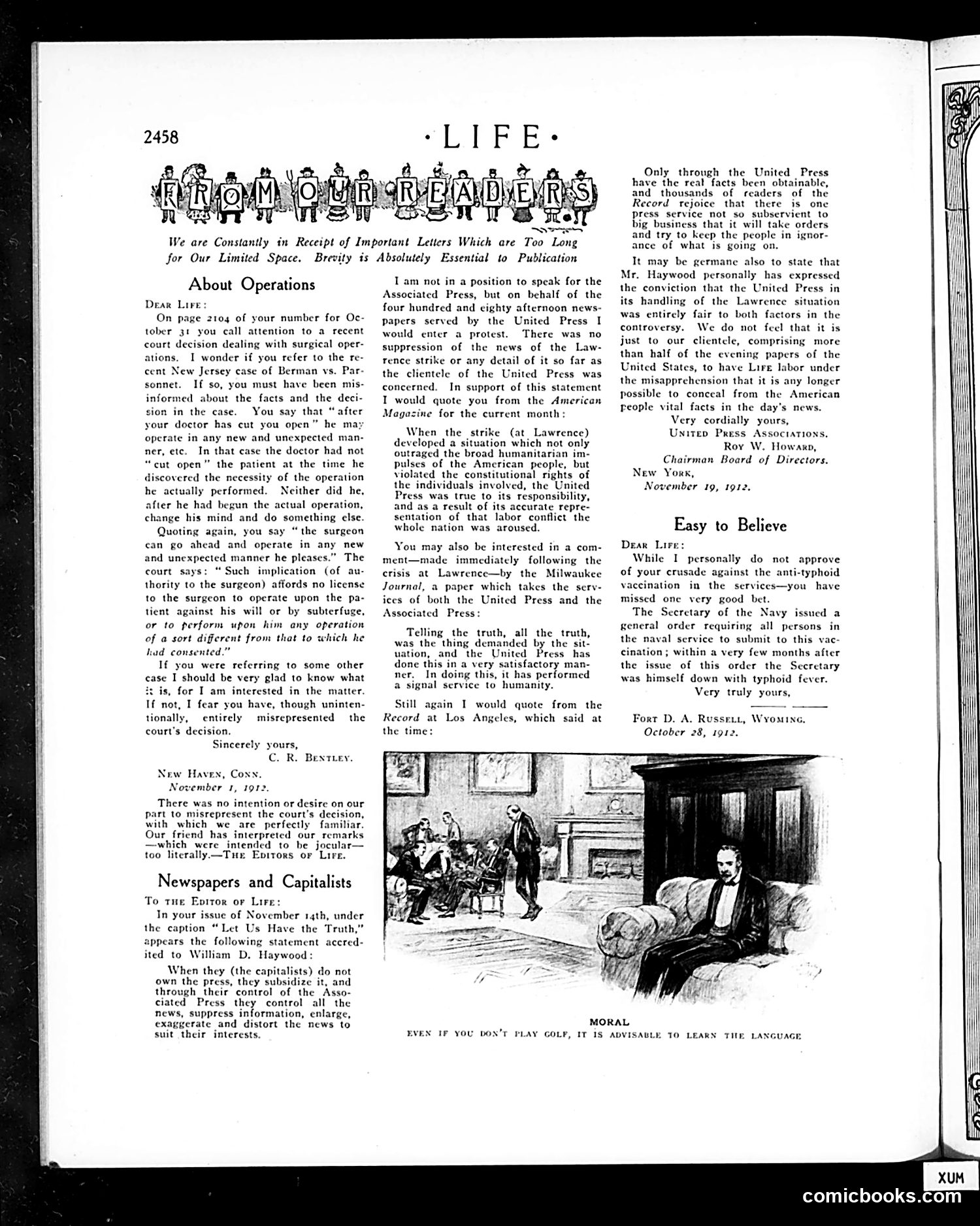
This page consists primarily of **reader letters and editorial responses**, not political cartoons. The main content addresses press freedom and corporate influence: **"Newspapers and Capitalists"** section quotes William D. Haywood (labor activist) accusing capitalists of controlling the Associated Press to suppress news unfavorable to their interests. The United Press responds defensively, citing praise from the *American Magazine* and other publications for their coverage of the **Lawrence textile strike** (1912)—a major labor conflict where workers sought better conditions. The satire is subtle: while Haywood claims capitalist press censorship, the United Press defends its independence by quoting favorable reviews of its own coverage, somewhat ironically proving the complexity of the issue rather than settling it. **The cartoon below** (captioned "MORAL") shows golfers; its connection to the letters above is unclear from the visible text. The page reflects genuine 1912 anxieties about whether large news organizations could report impartially on labor disputes and capitalist interests.
📄 Transcribed text from this page (OCR, searchable)
Machine-transcribed from the original scan — historical spelling and the odd misread are preserved.
We are Constantly in Receipt of Important Letters Which are Too Long for Our Limited Space. About Operations Dear Live: On page 2104 of your number for Oc- tober 31 you call attention to a recent court decision dealing with surgical oper- ations. I wonder if you refer to the re- cent New Jersey case of Berman vs. Par- sonnet. If so, you must have been mis- informed about the facts and the deci sion in the case. You say that “after your doctor has cut you open” he may operate in any new and unexpected man- ner, etc. In that case the doctor had not cut open” the patient at the time he discovered the necessity of the operation he actually performed. ther did he, after he had begun the actual operation, change his mind and do something else. Quoting again, you say “the surgeon can go ahead and operate in any new and unexpected manner he pleases.” The court says: “Such implication (of au- thority to the surgeon) affords no license to the surgeon to operate upon the pa- tient against his will or by subterfuge, or to perform upon him any operation of a sort different from that to which he had consented.” If you were referring to some other case I should be very glad to know what i: is, for I am interested in the matter. If not, I fear you have, though uninten- tionally, entirely misrepresented the court's decision. Sincerely yours, C. R. Bestuey. New Havex, Coxy. November 1, 1912 There was no intention or desire on our part to misrepresent the court's decision, with which we are perfectly familiar. Our friend has interpreted our remarks —which were intended to be jocular— too literally—Tue Epitors or Lire. Newspapers and Capitalists To tue Eptror or Lire: In your issue of November 14th, under the caption “Let Us Have the Truth,” appears the following statement acered- ited to William D, Haywood: When they (the capitalists) do not own the press, they subsidize it, and through their control of the Asso- ciated Press they control all the news, suppress information, enlarge, exaggerate and distort the news to suit their interests. Brevity is Absolutely Essential to Publication I am not in a position to speak for the Associated Press, but on behalf of the four hundred and eighty afternoon news- Papers served by the United Press I would enter a protest. There was no suppression of the news of the Law- rence strike or any detail of it so far as the clientele of the United Press was concerned. In support of this statement I would quote you from the American Magazine for the current month: When the strike (at Lawrence) developed a situation which not only outraged the broad humanitarian im- pulses of the American people, but violated the constitutional rights of the individuals involved, the United Press was true to its responsibility, sa result of its accurate repre- ion of that labor conflict the whole nation was aroused. You may also be interested in a com- ment—made immediately following the crisis at Lawrence—by the Milwauk Journal, a paper which takes the serv- ices of both the United Press and the Associated Press: Telling the truth, all the truth, was the thing demanded by the sit: uation, and the United Press has done this in a very satisfactory man- ner, In doing this, it has performed a signal service to humanity. Still again I would quote from the Record at Los Angeles, which said at the time: IF YoU box’t FLAY GOLF, IT 1S ADVISAULE 10 LEARN TIE Only through the United Press have the real facts been obtainable, and thousands of readers of the Record rejoice that there is one Press service not so subservient to big business that it will take orders and try to keep the people in ignor- ance of what is going on. It may be germane also to state that Mr. Haywood personally has expressed the conviction that the United Press in its handling of the Lawrence situation was entirely {i to both factors in the controversy. We do not feel that it is just to our clientele, comprising more than half of the evening papers of the United States, to have Lire labor under the misapprehension that it is any longer possible to conceal from the American reople vital facts in the day's ne Very cordially your Unitep Press Associations, Roy W. Howanro, Chairman Board of Directors. New York, November 19, 1912. Easy to Believe Dear Lire: While I personally do not approve of your crusade against the anti-typhoid vaccination in the services—you have missed one very good bet. The Seerctary of the Navy issued a general order requiring all persons in the naval service to submit to this vac- cination ; within a very few months after the issue of this order the Secretary was himself down with typhoid fever. Very truly yours, Fort D. A. Russent, Wyomine. October 28, 1912. LANGUAGE comicbooks.com