
Life, 1912-12-12 · page 26 of 48
Life — December 12, 1912 — page 26: what you’re looking at
What you’re looking at
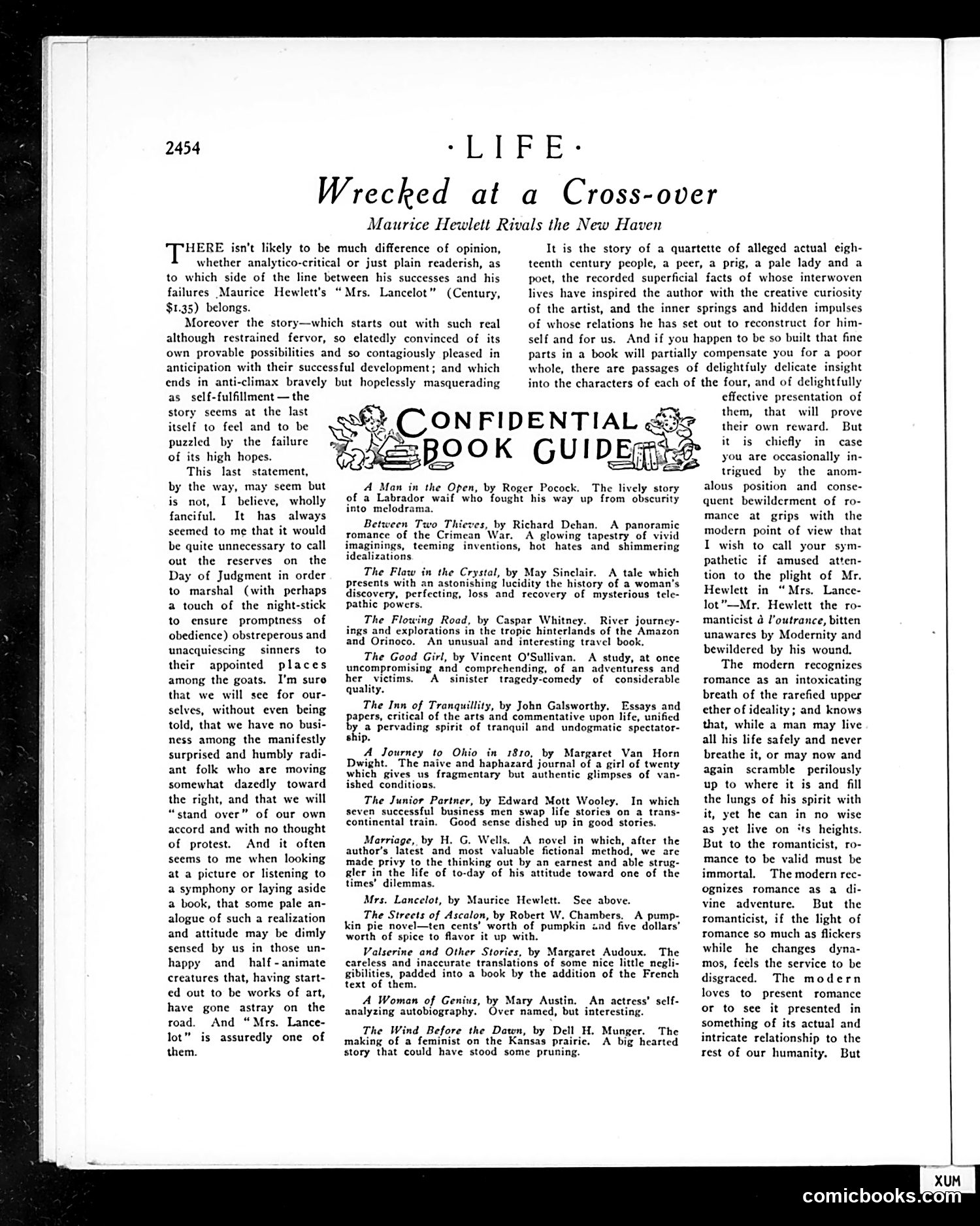
This page is a literary review, not a political cartoon. The headline metaphorically describes Maurice Hewlett's novel *Mrs. Lancelot* as a promising story that fails at its conclusion—"wrecked at a cross-over" suggests a journey that derails at a critical junction. The reviewer criticizes the book for starting with genuine promise and emotional conviction but ending in "anti-climax" that merely masquerades as intentional artistry. The author compares the failed novel to a work of art that "gone astray on the road"—suggesting Hewlett possessed artistic talent but lost his way narratively. The page also includes a "Confidential Book Guide" listing contemporary 1910s-era novels with brief descriptions, providing context for readers about available literature.
📄 Transcribed text from this page (OCR, searchable)
Machine-transcribed from the original scan — historical spelling and the odd misread are preserved.
‘LIFE? Wrecked at a Cross-over Maurice Hewlett Rivals the New Haven i[CHERE isn’t likely to be much difference of opinion, whether analytico-critical or just plain readerish, as to which side of the line between his successes and his failures Maurice Hewlett’s “Mrs. Lancelot” (Century, $1.35) belongs. Moreover the story—which starts out with such real although restrained fervor, so elatedly convinced of its own provable possibilities and so contagiously pleased in anticipation with their successful development; and which ends in anti-climax bravely but hopelessly masquerading It is the story of a quartette of alleged actual eigh- teenth century people, a peer, a prig, a pale lady and a poet, the recorded superficial facts of whose interwoven lives have inspired the author with the creative curiosity of the artist, and the inner springs and hidden impulses of whose relations he has set out to reconstruct for him- self and for us. And if you happen to be so built that fine parts in a book will partially compensate you for a poor whole, there are passages of delightfuly delicate insight into the characters of each of the four, and of delightfully as self-fulfillment — the story seems at the last itself to feel and to be puzzled by the failure of its high hopes. This last statement, by the way, may seem but is not, I believe, wholly fanciful. It has always seemed to me that it would be quite unnecessary to call out the reserves on the Day of Judgment in order to marshal (with perhaps a touch of the night-stick to ensure promptness of obedience) obstreperous and unacquiescing sinners to their appointed places among the goats. I’m sure that we will see for our- selves, without even being told, that we have no busi- ness among the manifestly surprised and humbly radi- ant folk who are moving somewhat dazedly toward the right, and that we will “stand over” of our own accord and with no thought of protest. And it often seems to me when looking at a picture or listening to a symphony or laying aside a book, that some pale an- alogue of such a realization and attitude may be dimly sensed by us in those un- happy and half - animate creatures that, having start- ed out to be works of art, have gone astray on the road. And “Mrs. Lance- lot” is assuredly one of them. SLC eS BOOK GUI A Man in the Open, by Roger Pocock. The lively story of a Labrador waif who fought his way up from obscurity into melodrama, Between Two Thieves, by Richard Dehan. A panoramic romance of the Crimean War. A glowing tapestry of vivid imaginings, teeming inventions, hot hates and shimmering idealizations The Flaw in the Crystal, by May Sinclair. A tale which Presents with an astonishing lucidity the history of a woman's discovery, perfecting, loss and recovery of mysterious tele- pathic powers. The Flowing Road, by Caspar Whitney. River journcy- ings and explorations in the tropic hinterlands of the Amazon and Orinoco. An unusual and interesting travel book. The Good Girl, by Vincent O'Sullivan. A study, at once uncompromising and comprehending, of an adventuress and her victims. A sinister tragedy-comedy of considerable quality. The Inn of Tranquillity, by John Galsworthy. Essays and apers, critical of the arts and commentative upon life, unified a pervading spirit of tranquil and undogmatic spectator- ship. A Journey to Ohio in 1810, by Margaret. Van Horn Dwight. The naive and haphazard journal of a girl of twenty which gives us fragmentary but authentic glimpses of van- ished conditions. The Junior Partner, by Edward Mott Wooley. seven successful business men swap life stories on a trans- continental train. Good sense dished up in good stories. Marriage, by H. G. Wells. A novel in which, after the author's latest and most valuable fictional method, we are made privy to the thinking out by an earnest and able strug- gler in the life of to-day of his attitude toward one of the times’ dilemmas. In which Mrs. Lancelot, by Maurice Hewlett. See above. The Streets of Ascalon, by Robert W. Chambers. A pump- ‘in pie novel—ten cents’ worth of pumpkin iad five dollars’ worth of spice to flavor it up with. Valserine and Other Stories, by Margaret Audoux. The careless and inaccurate translations of some nice little _negli- gibilities, padded into a book by the addition of the French text of them. An actress’ self- A Woman of Genius, by Mary Austin. Over named, but interesting. analyzing autobiography. The Wind Before the Dawn, by Dell H. Munger. making of a feminist on the Kansas prairie. story that could have stood some pruning. The A big hearted ON FIDENTIAL 3g effective presentation of them, that will prove their own reward. But it is chiefly in case you are occasionally in- trigued by the anom- alous position and conse- quent bewilderment of ro- mance at grips with the modern point of view that I wish to call your sym- pathetic if amused atten- tion to the plight of Mr. Hewlett in “Mrs. Lance- lot"—Mr. Hewlett the ro- manticist 4 l’outrance, bitten unawares by Modernity and bewildered by his wound. The modern recognizes romance as an intoxicating breath of the rarefied upper ether of ideality; and knows that, while a man may live all his life safely and never breathe it, or may now and again scramble perilously up to where it is and fill the lungs of his spirit with it, yet he can in no wise as yet live on ‘ts heights. But to the romanticist, ro- mance to be valid must be immortal. The modern rec- ognizes romance as a di- vine adventure. But the romanticist, if the light of romance so much as flickers while he changes dyna- mos, feels the service to be disgraced. The modern loves to present romance or to see it presented in something of its actual and intricate relationship to the rest of our humanity. But comicbooks.com