
A complete issue · 44 pages · 1912
Life — November 14, 1912
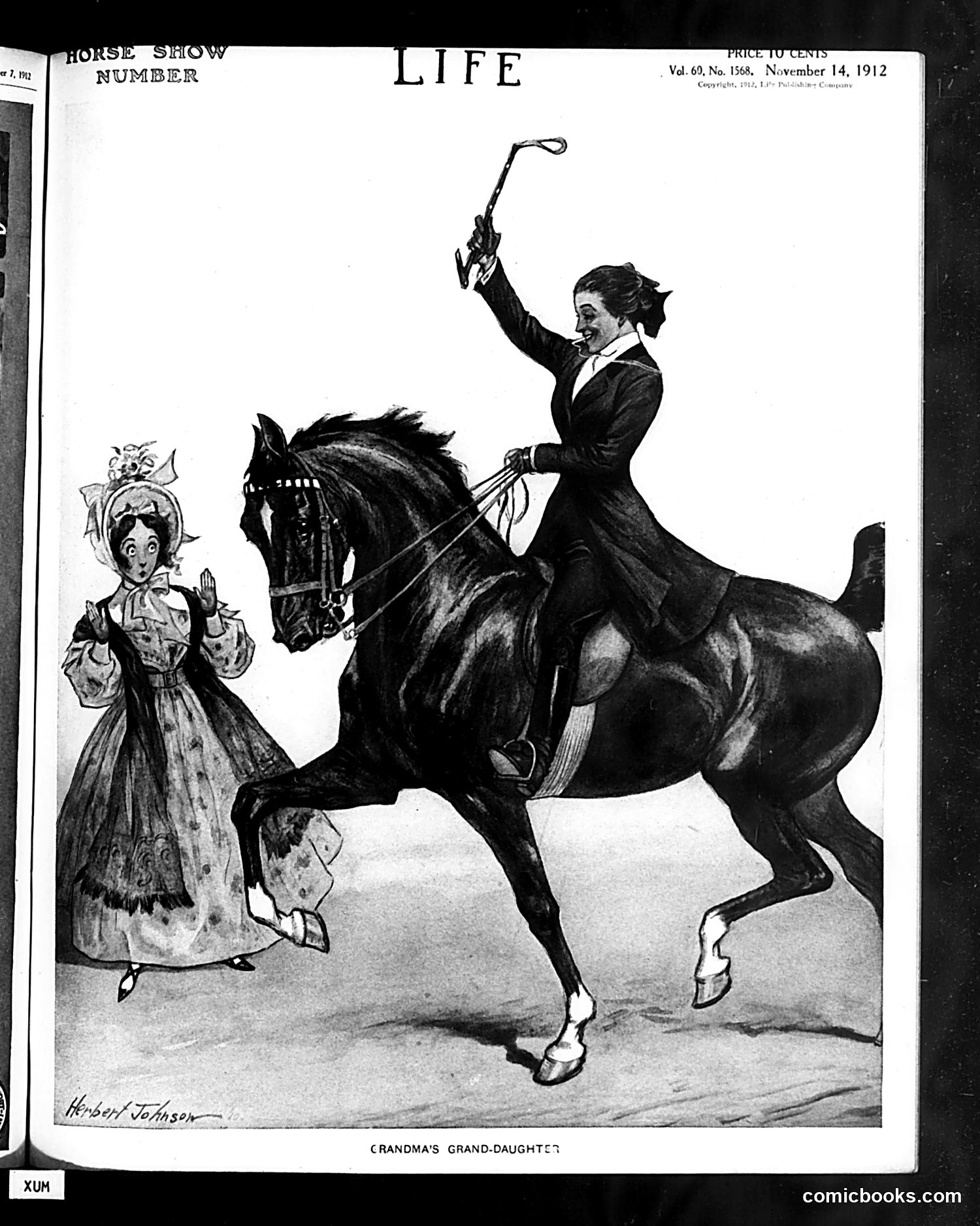
This November 1912 *Life* cartoon by Herbert Johnson satirizes women's increasing independence and rejection of traditional gender roles. The image contrasts two generations: on the left, a prim Victorian grandmother in restrictive formal dress, hands raised in shock; on the right, her granddaughter riding horseback in masculine attire, wielding a riding crop with confident athleticism. The joke targets anxieties about "New Woman" behavior—the granddaughter's active horsemanship, practical clothing, and assertive posture represent the modern woman's rejection of constrictive Victorian femininity. The grandmother's horrified reaction embodies conservative disapproval of these social changes occurring around 1912, when women increasingly pursued sports, education, and independence.
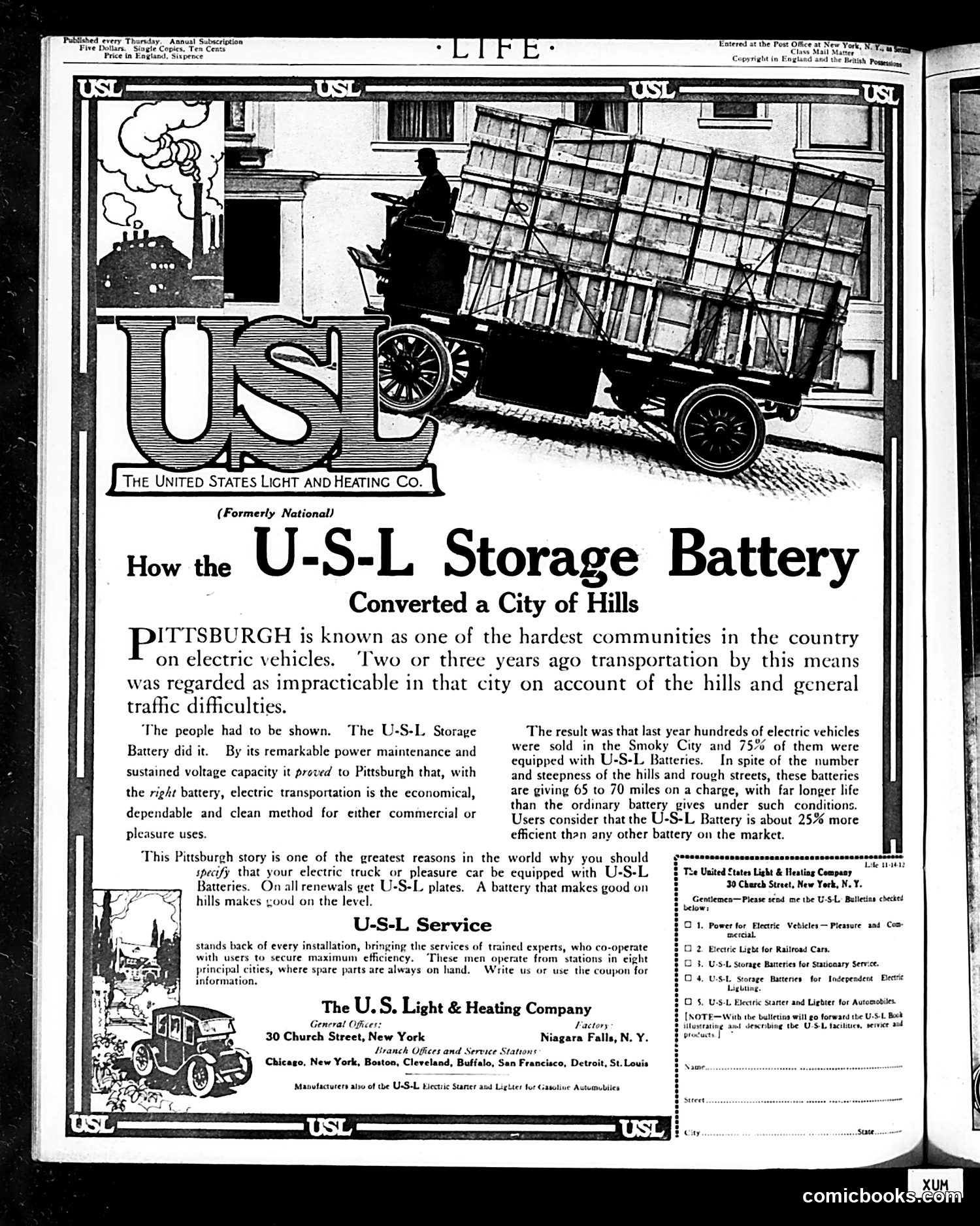
This is primarily **advertising rather than satire or political cartooning**. The U.S. Light & Heating Company (USL) promotes their Storage Battery for electric vehicles, specifically targeting Pittsburgh—a city with steep hills that made early electric cars impractical. The ad's central claim: USL batteries enabled electric vehicle adoption even in Pittsburgh's challenging terrain, achieving 65-70 miles per charge with longer lifespan than competitors. The illustration shows an electric truck loaded with cargo ascending a hill, demonstrating the battery's capability. The implicit message is technological innovation solving real urban problems. This reflects the early 1900s electric vehicle market before gasoline engines dominated. The ad includes a coupon and lists USL offices in major American cities.
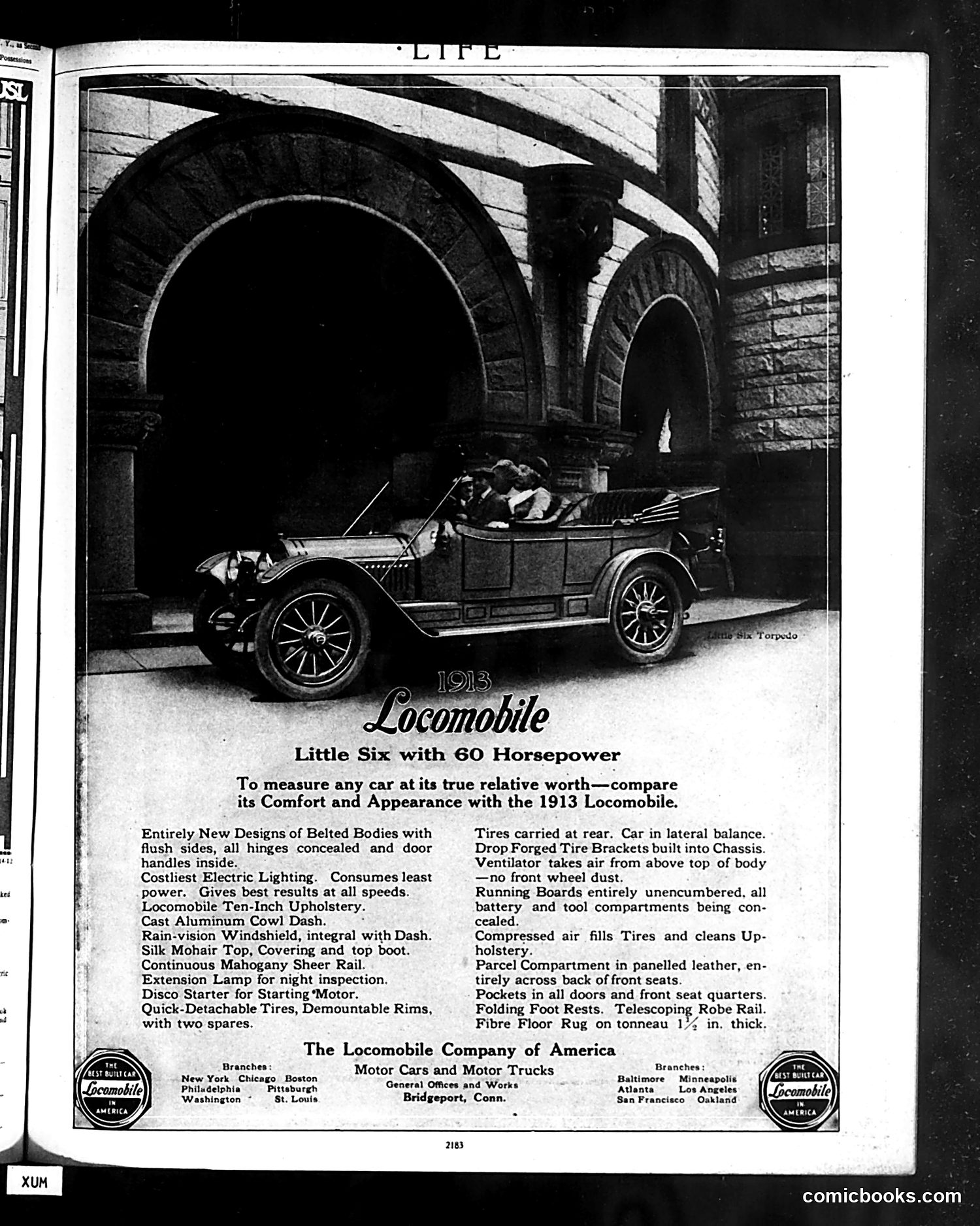
This page is **not a political cartoon or satirical content** — it's a **1913 automobile advertisement** for the Locomotile Company of America, featuring their "Little Six" model with 60 horsepower. The image shows the car parked beneath grand stone archways, likely meant to evoke classical architecture and suggest luxury and prestige. The ad emphasizes engineering features: electric lighting, comfortable upholstery, innovative tire systems, and practical details like enclosed compartments. This represents early automotive marketing, positioning the Locomotile as a high-end vehicle for affluent buyers. There is no satire or political commentary present — it's a straightforward product advertisement typical of 1913 Life magazine, which carried substantial advertising alongside humorous content.
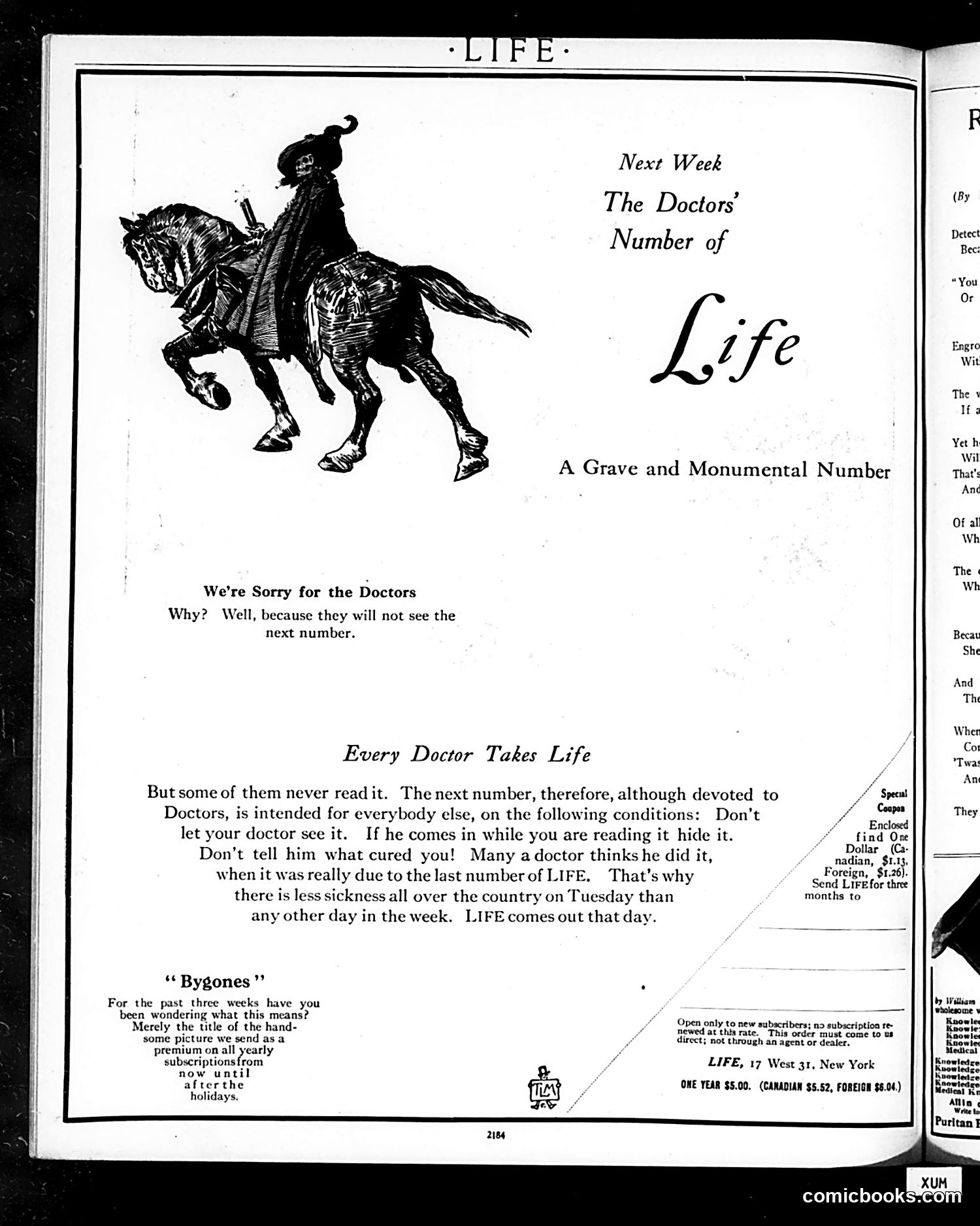
This page is primarily an **advertisement for Life magazine itself**, promoting next week's issue titled "The Doctors' Number." The central illustration shows a figure on horseback in period costume (possibly representing a doctor or authority figure), though the specific historical reference is unclear from the image alone. The satire plays on the ironic claim that doctors won't read the upcoming issue because they'll be too busy treating patients—implying the magazine content will somehow cause widespread illness on publication day. The joke suggests doctors attribute patient recoveries to their own treatment rather than to reading Life magazine. A secondary "Bygones" section references a recurring premium illustration sent to yearly subscribers. The page functions as self-promotional humor rather than political commentary.
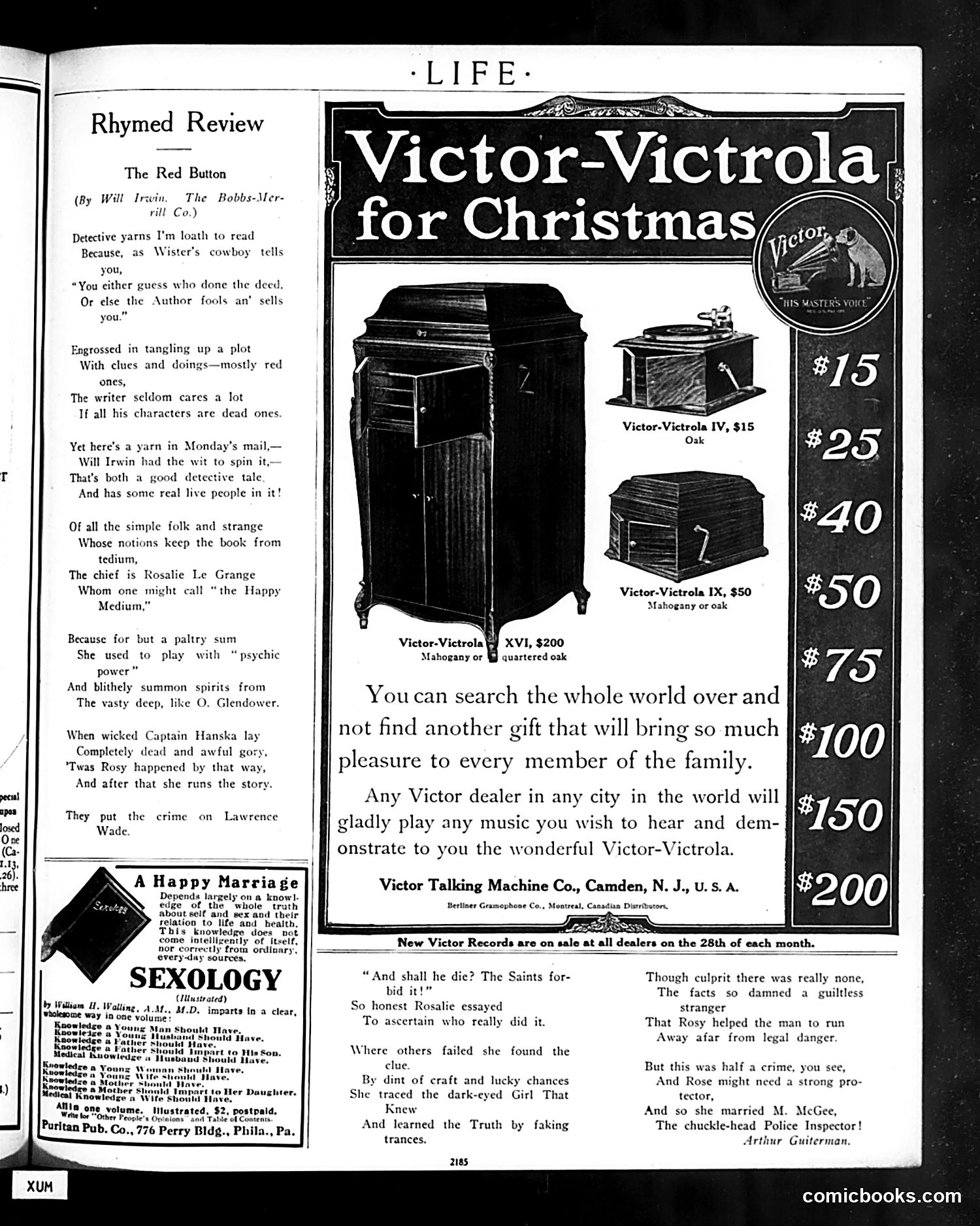
This page is primarily **advertising**, not satire or political commentary. The right half features a large Victor-Victrola advertisement promoting phonographs at various price points ($15–$200) as Christmas gifts. The left side contains a "Rhymed Review" of a detective story called "The Red Button" by Will Irwin, praising it as an entertaining mystery with good plotting. Below that is a small advertisement for "Sexology," a book promising practical knowledge about marriage and relationships. The poem and advertisements reflect early 20th-century consumer culture and gender attitudes, but contain no political cartoon elements or social satire requiring historical context to decode.
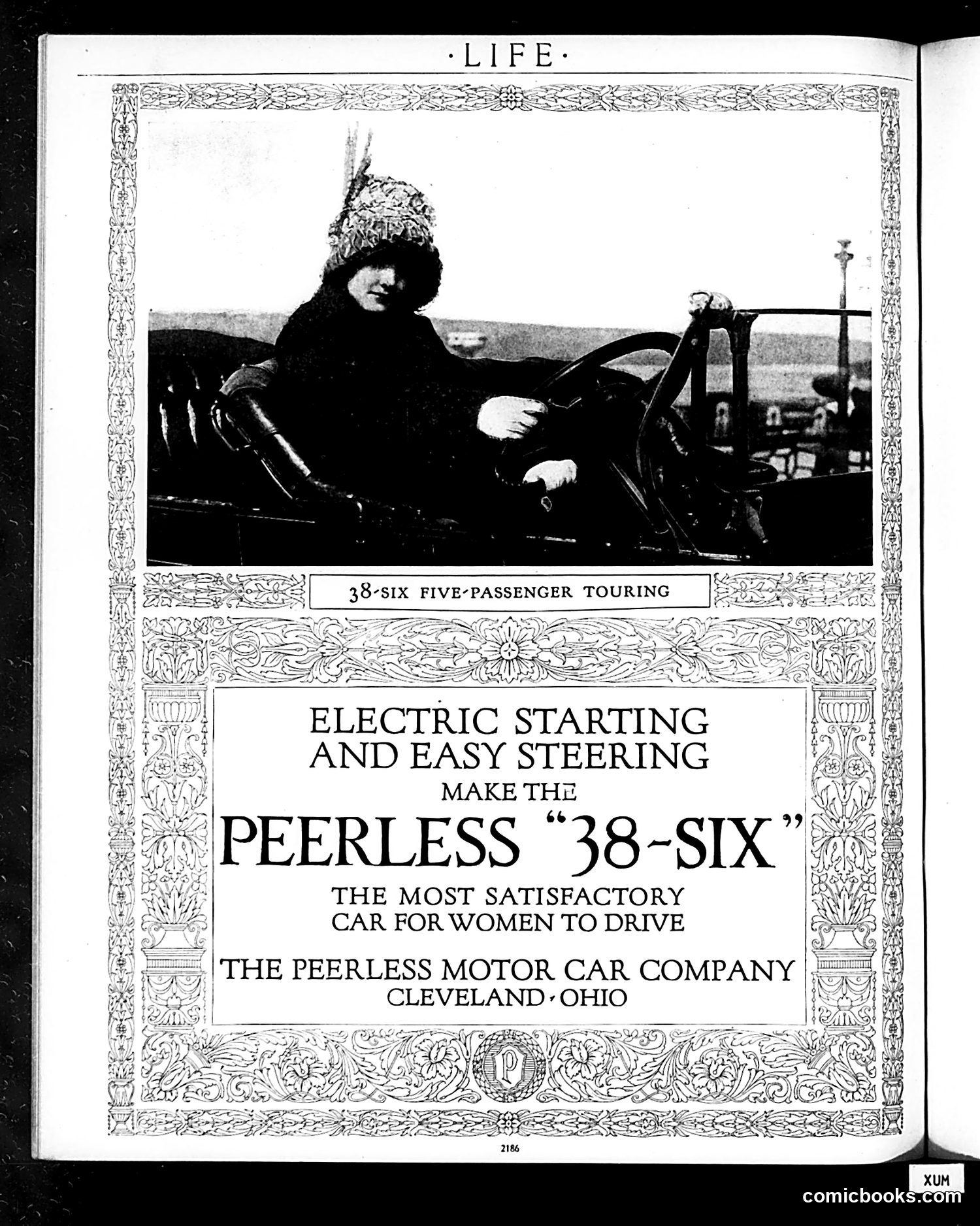
This page is primarily **advertising, not satire**. It's a Peerless Motor Car Company advertisement from *Life* magazine promoting their "38-Six" automobile model. The ad targets women drivers specifically, highlighting "Electric Starting and Easy Steering" as features that make the car particularly suitable for female operators. The photograph shows a woman in winter clothing seated at the steering wheel. The marketing approach reflects early 20th-century gender assumptions—automobiles were still relatively new, and manufacturers marketed specific models to women by emphasizing ease of use and convenience. The "38-Six" is positioned as "the most satisfactory car for women to drive," suggesting the company believed women needed simpler, less demanding vehicles than men. This represents genuine historical marketing that reveals period attitudes toward women and technology.
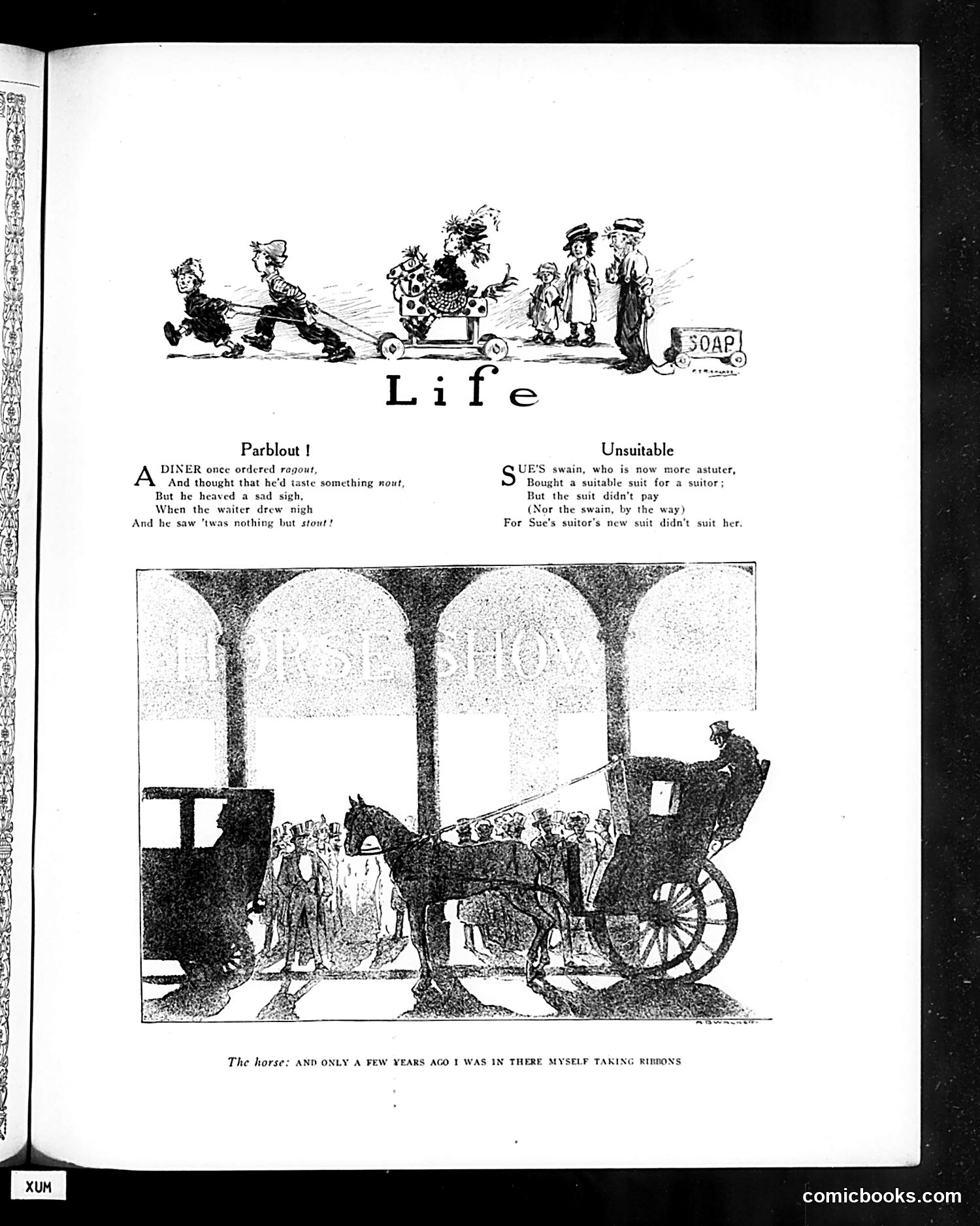
This page from *Life* magazine contains two satirical pieces: **"Parblout I"** (top left): A brief humorous anecdote about a diner who ordered "ragout" (a stew) but misheard it as "rout" (a defeat). The joke plays on the homophone confusion—when the waiter serves the dish, the diner comically sees only "stout" (a strong drink) instead. **"Unsuitable"** (top right): A quip about Sue, who bought a suit for a suitor, but it didn't fit him properly. The humor derives from the pun on "suit"—both the clothing and whether something is appropriate. **The main illustration** below depicts a grand archway with horses, carriages, and crowds. The caption references "the horse" and "ribbons," suggesting this illustrates a historical or contemporary scene, though the specific reference remains unclear without additional context.
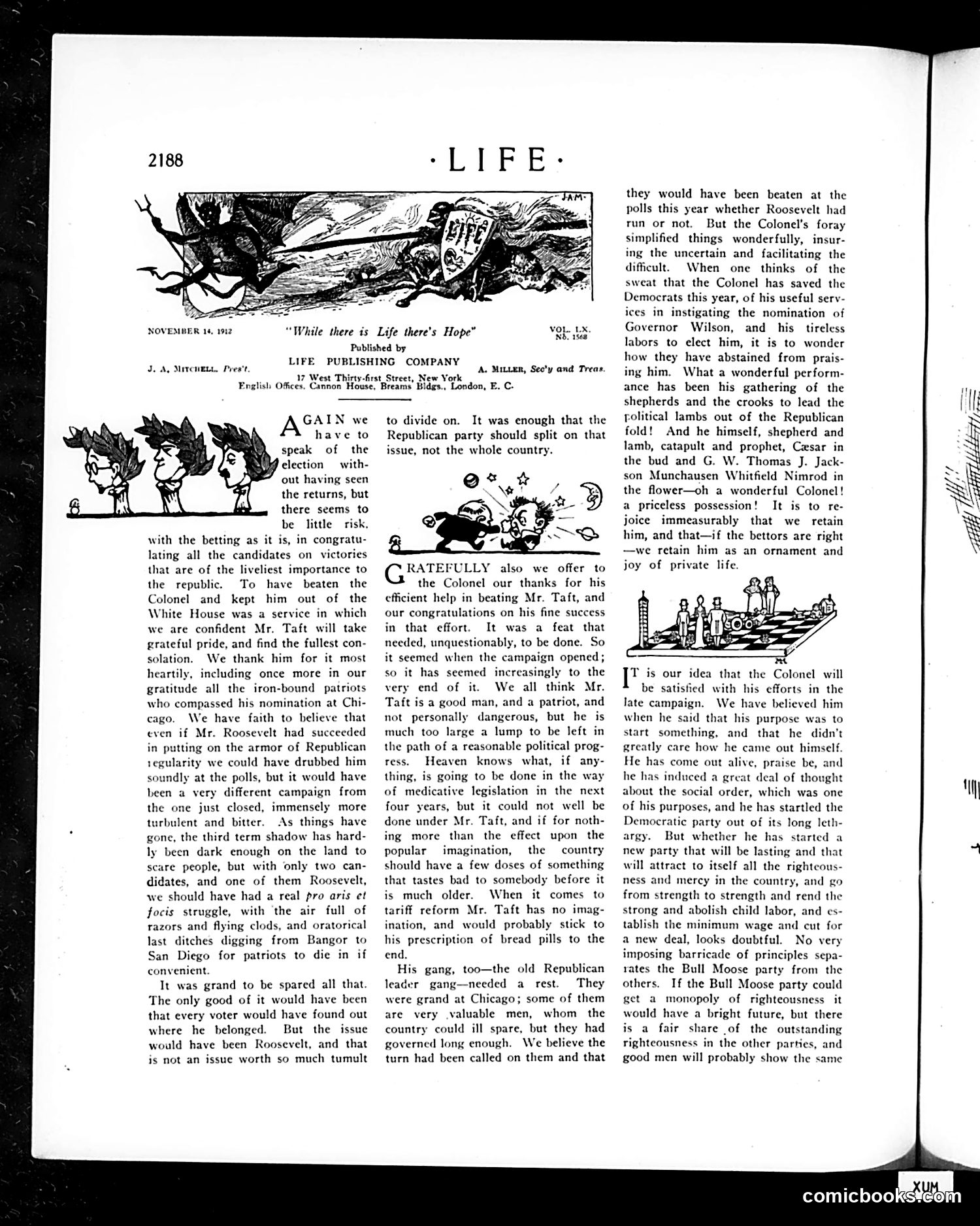
This page discusses the 1912 presidential election aftermath. The text praises Colonel Theodore Roosevelt for staying out of the Republican Party split, crediting him with helping defeat William Howard Taft and keeping Republicans unified enough to prevent a Democratic victory. The cartoons (top and middle) appear to show election-related figures in satirical situations, though specific identities are unclear from the image quality. The article thanks Roosevelt for his "efficient help in beating Mr. Taft" and suggests the Colonel's withdrawal from politics was dignified. It expresses hope that the Republican Party can reunify and warns against the "Bull Moose party" becoming permanent, arguing the country needs strong Republican opposition to the Democrats. The overall tone celebrates Roosevelt's restraint while lamenting the party's recent turmoil.
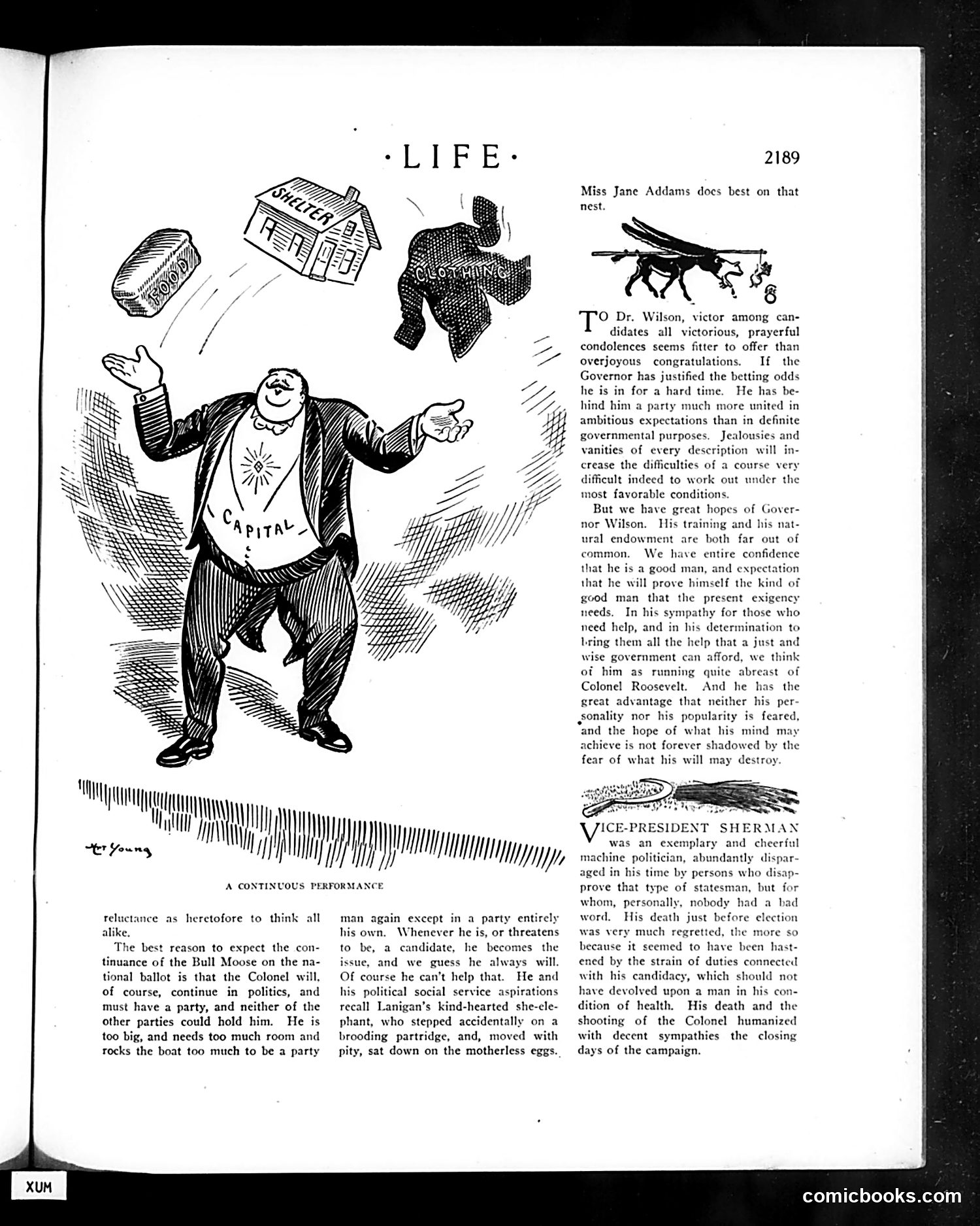
**The Cartoon:** The main illustration depicts a rotund figure labeled "CAPITAL" juggling objects while wearing a coat. The title "A CONTINUOUS PERFORMANCE" suggests satire about capitalism's perpetual, precarious balancing act. The figure appears to be a capitalist juggling various economic elements—possibly representing the instability of markets or business operations. **The Text:** The page discusses Dr. Wilson (likely Governor Wilson, later President Woodrow Wilson) as a political candidate, praising his character and potential. It also discusses Vice-President Sherman, noting his recent death before the election. **Context:** This appears from the 1912 election period, when Wilson was emerging as a presidential candidate. The juggling cartoon likely satirizes the economic anxieties and instability of the era, with capitalism portrayed as a precarious balancing act requiring careful management.
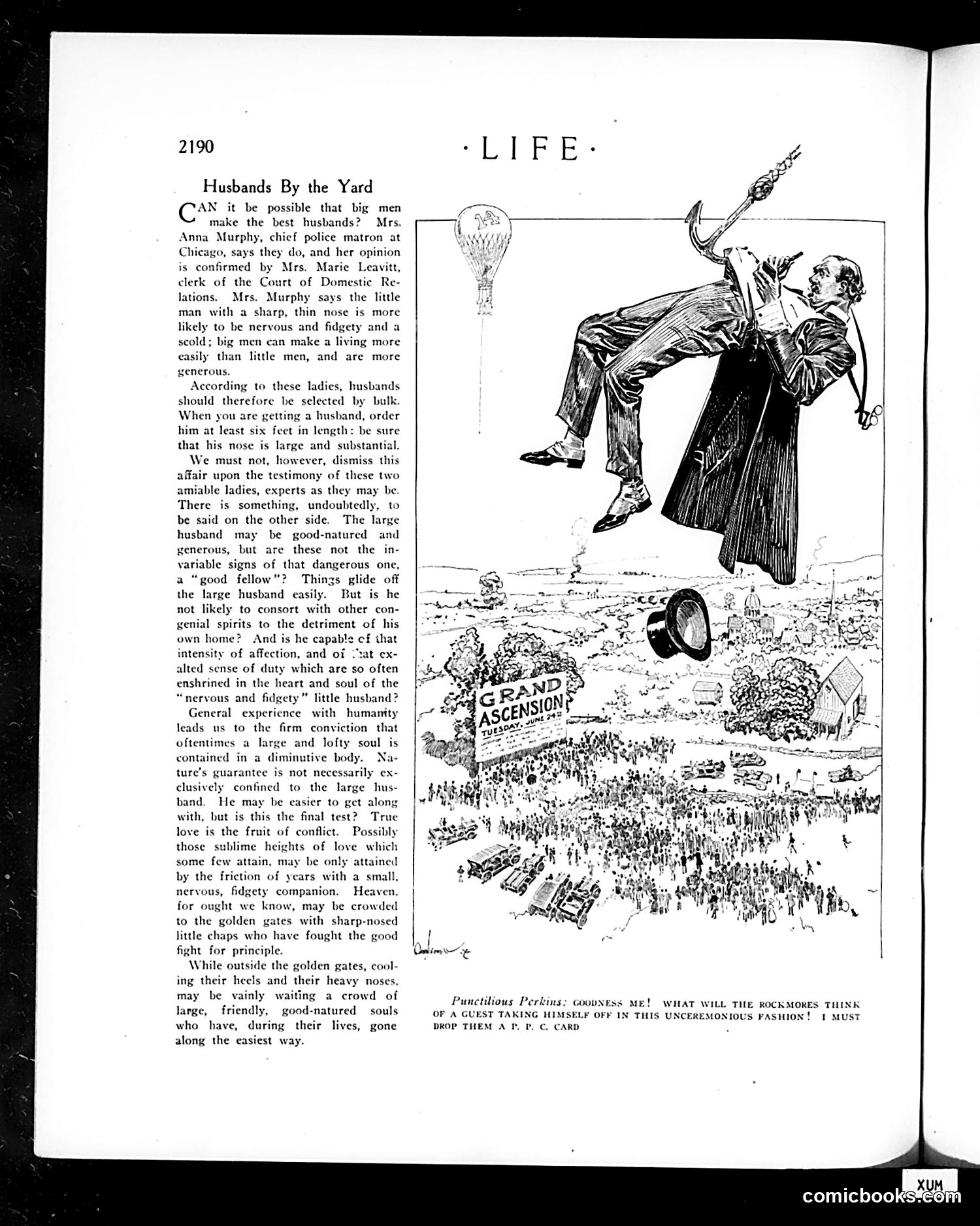
This satirical article argues that large men make better husbands than small men, citing a Chicago police matron and court clerk as sources. The piece humorously advises women to select husbands by bulk—ensuring they're at least six feet tall with large noses—claiming bigger men are more generous and good-natured. The accompanying cartoon shows a man in formal dress floating away from a "Grand Ascension" event (likely a balloon ascension spectacle), dropping his hat in embarrassment. The caption suggests he's being mocked for attending such an event as a guest, worried about social judgment. The satire mocks both prescriptive dating advice for women and social anxiety about public appearance and respectability—typical early 20th-century Life magazine humor.
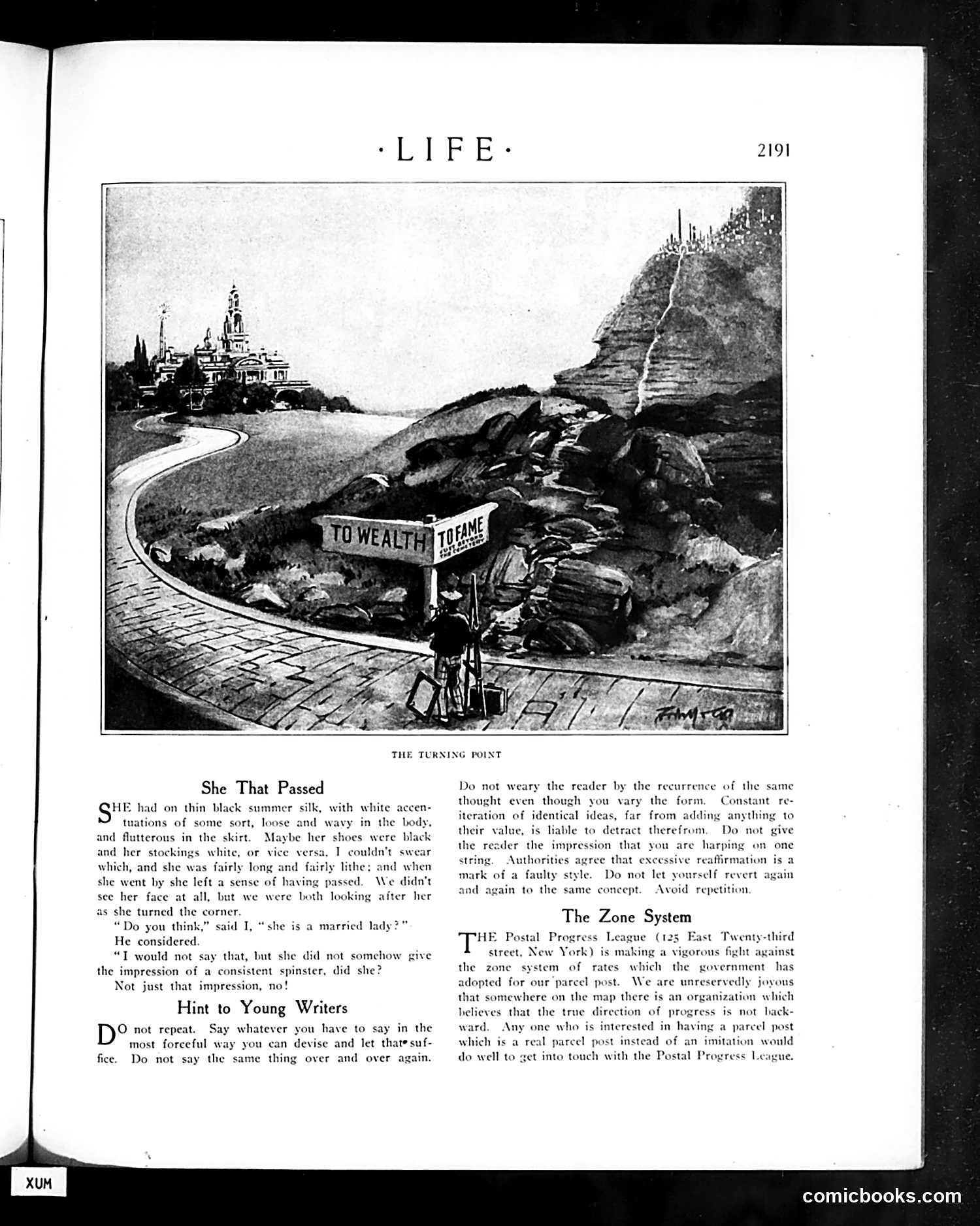
This cartoon satirizes the pursuit of wealth. The image shows a figure at a signpost marked "TO WEALTH" standing at a literal fork in the road—one path leads toward an ornate cathedral/castle (representing spiritual or cultural values), while the other descends into rocky, treacherous terrain (representing the harsh realities of wealth-seeking). The satire's point: choosing the path "to wealth" means abandoning higher pursuits and moral considerations for material gain. The contrasting landscapes emphasize the spiritual cost of unchecked materialism. The accompanying text titled "She That Passed" appears thematically related, discussing judgment and impression—reinforcing the cartoon's moral commentary on choices and their consequences during what was likely a period of American industrial expansion and wealth-focused culture.
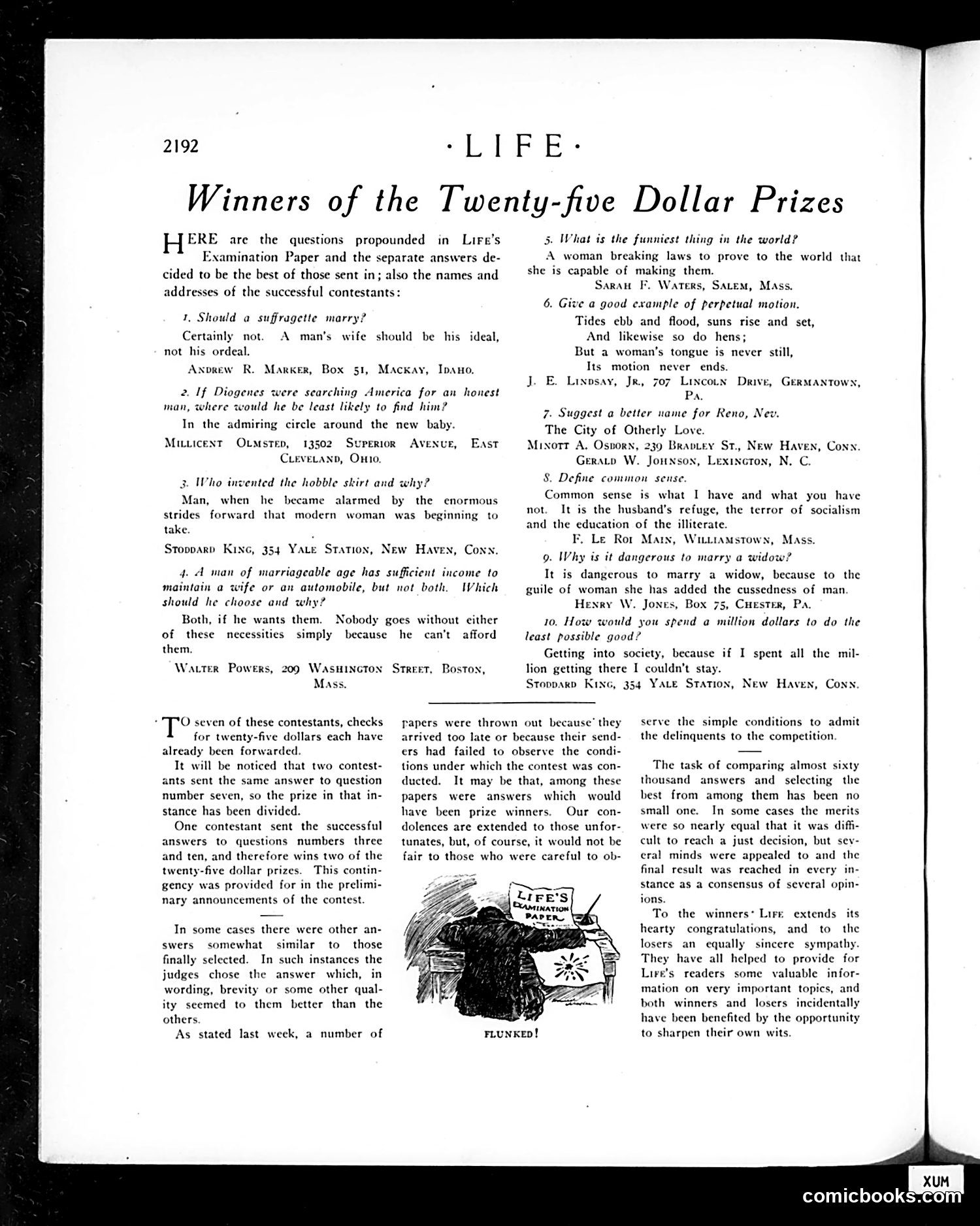
This page presents answers to Life magazine's "Examination Paper" contest, offering $25 prizes for witty responses to questions about marriage, gender roles, and social conduct. The small cartoon shows a figure labeled "FLUNKED!"—appearing to be someone who failed the contest. The image likely satirizes a contestant whose answer was rejected. The contest questions and winning answers reflect early 20th-century social attitudes: debates about women's roles (suffragettes, hobble skirts), marriage dynamics, and gender relations. Winners' responses favor traditional views—a wife shouldn't marry a widower, wives shouldn't work—suggesting the magazine's readership held conservative social values. The cartoon mocks unsuccessful contestants who failed to provide "acceptable" answers matching these conventional expectations.
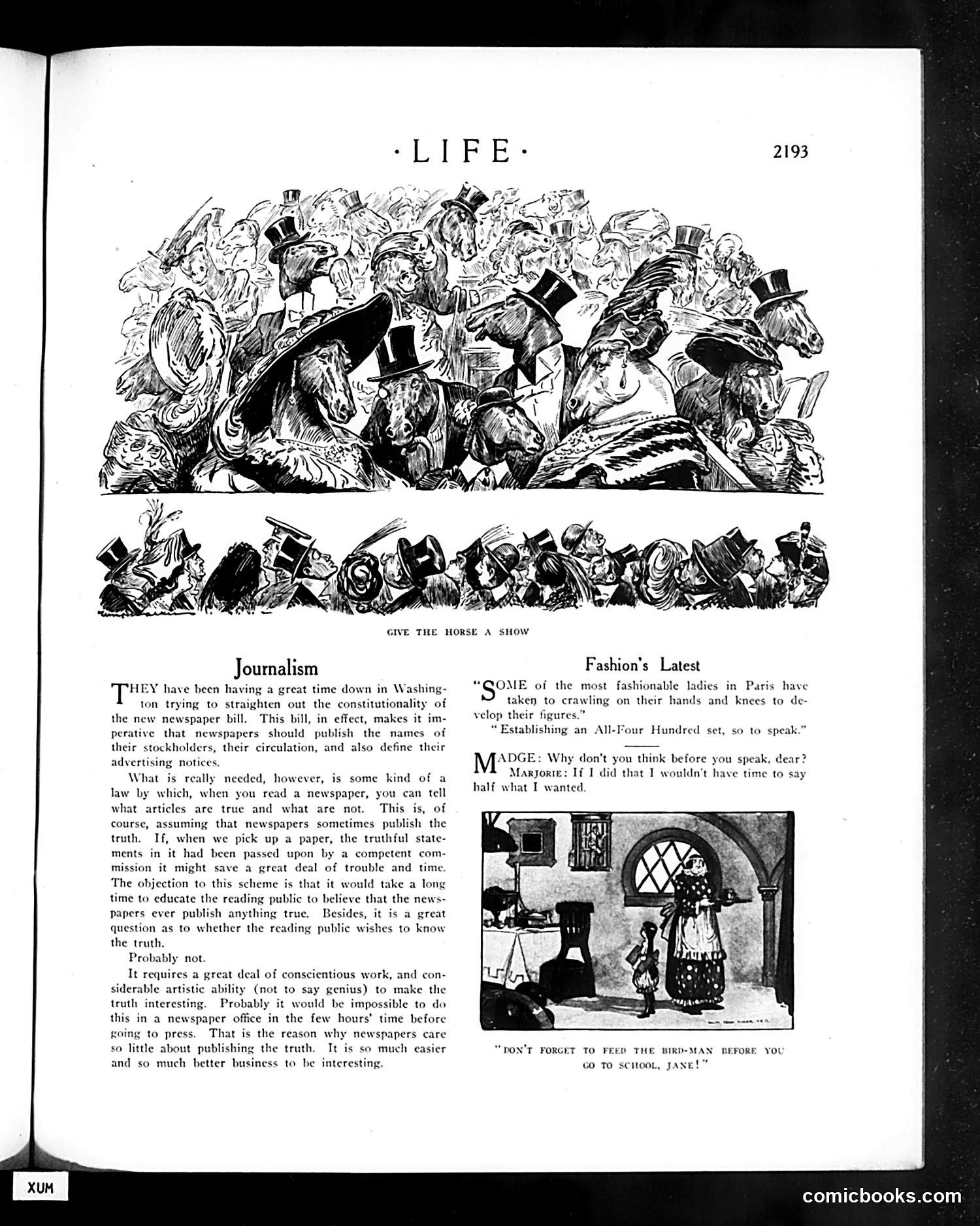
This page contains two distinct pieces: **The Top Illustration**: A densely packed satirical drawing showing numerous figures in top hats at what appears to be a crowded social gathering or parade. The caption "Give the Horse a Show" suggests mockery of ostentatious displays or performative spectacle among the wealthy elite. **"Journalism" Article**: Critiques newspapers' editorial standards, arguing they prioritize entertainment over truth-telling. It suggests newspapers deliberately avoid publishing truthful but unsexy content because "it is so much easier and so much better business to be interesting." **"Fashion's Latest"**: A brief satirical dialogue mocking Parisian fashion trends (women crawling to develop their figures), followed by a domestic cartoon about remembering to feed the bird-man before school. The overall page satirizes superficiality in American culture—media sensationalism and fashion vanity.
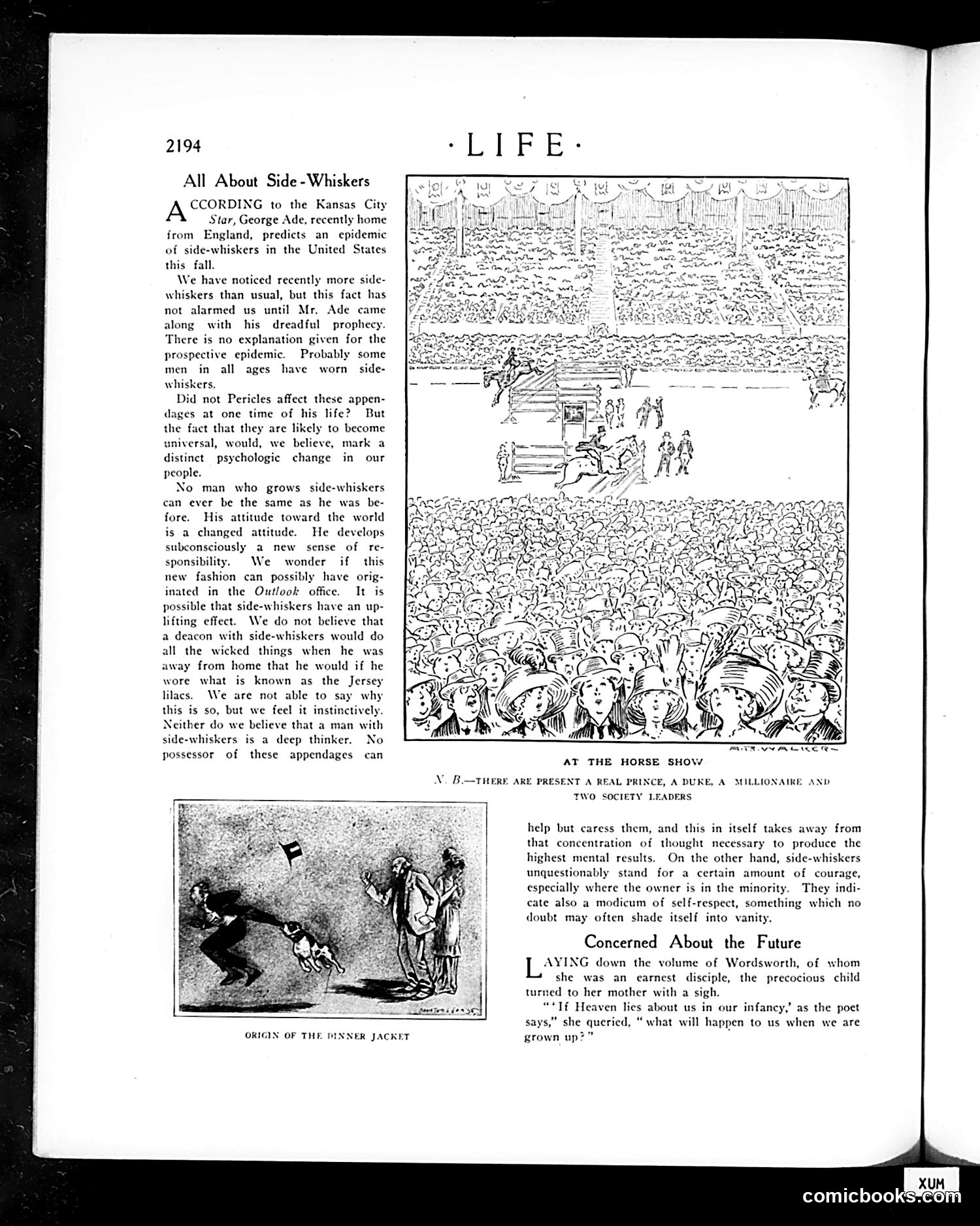
This page contains two distinct pieces: **"All About Side-Whiskers"** (left column with illustration "At the Horse Show"): A humorous essay arguing that growing side-whiskers fundamentally changes a man's psychology and attitude. The accompanying cartoon depicts fashionable society people at a horse show, suggesting side-whiskers were a status symbol among the wealthy elite. The satire mocks how adopting this facial hair fashion supposedly transforms one's personality and sense of responsibility. **"Origin of the Dinner Jacket"** (bottom left): A small illustration showing the historical origin of formal evening wear, presented as lighthearted social commentary. **"Concerned About the Future"** (right column): A brief anecdote about a child asking her mother what will happen as she grows up—touching on parental anxiety about children's futures, a timeless concern. The overall tone is genteel social satire typical of early 20th-century Life magazine.
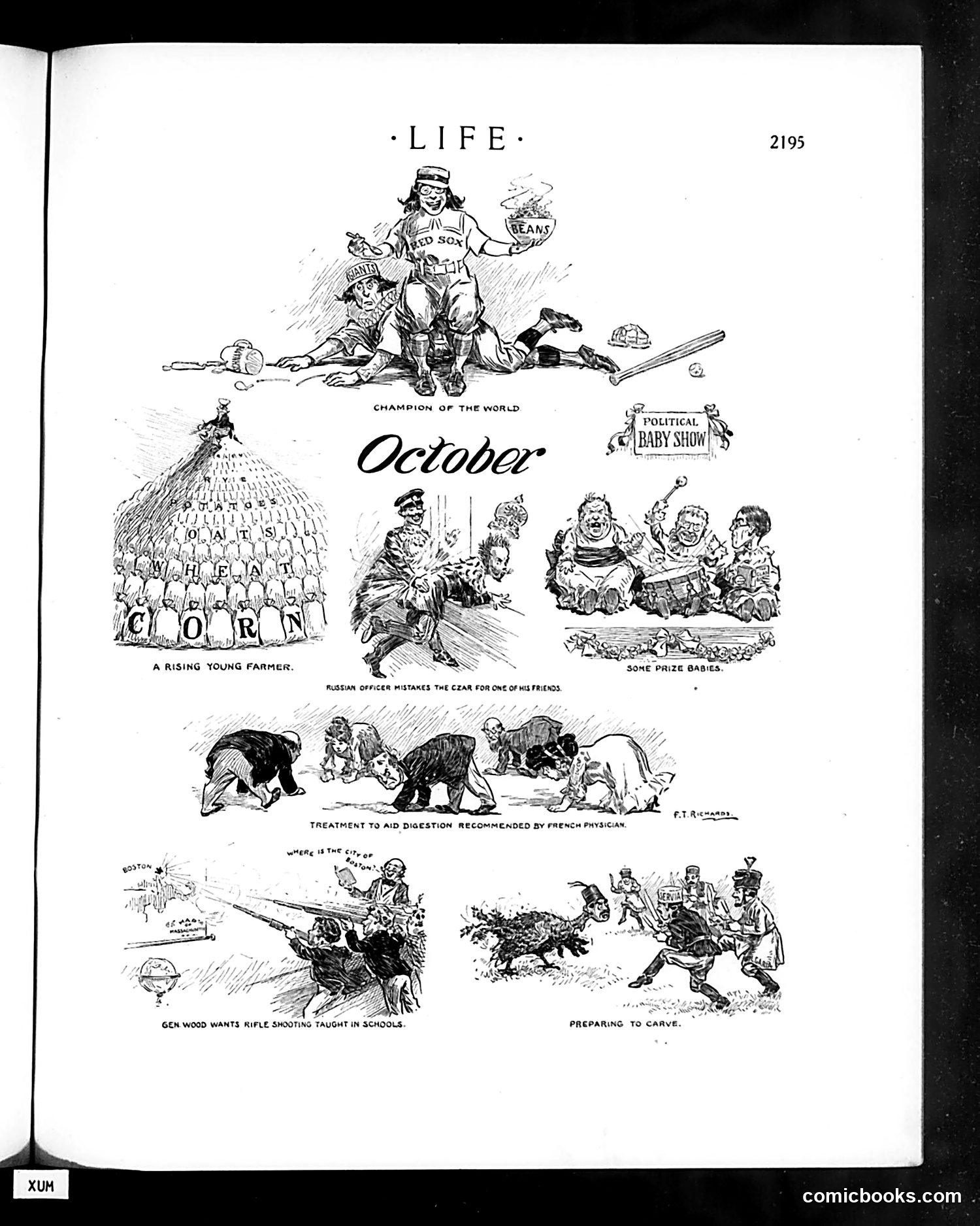
This page collects satirical cartoons mocking contemporary political figures and events. The top image depicts a "Champion of the World" — likely referencing the Red Sox baseball team — positioned over defeated rivals, commenting on sports dominance. "A Rising Young Farmer" shows corn growth, while "Political Baby Show" depicts prize babies (likely metaphorical politicians). The "Treatment to Aid Digestion" cartoon shows bears with human figures, apparently satirizing a French physician's medical recommendation. "Gen Wood Wants Rifle Shooting Taught in Schools" criticizes General Leonard Wood's advocacy for military preparedness education. The final cartoon, "Preparing to Carve," shows a figure with a knife approaching what appears to be a turkey or fowl, likely a political metaphor about dividing resources or power. The overall page uses visual metaphors — animals, sports, children, food — to mock political proposals and personalities of the era.
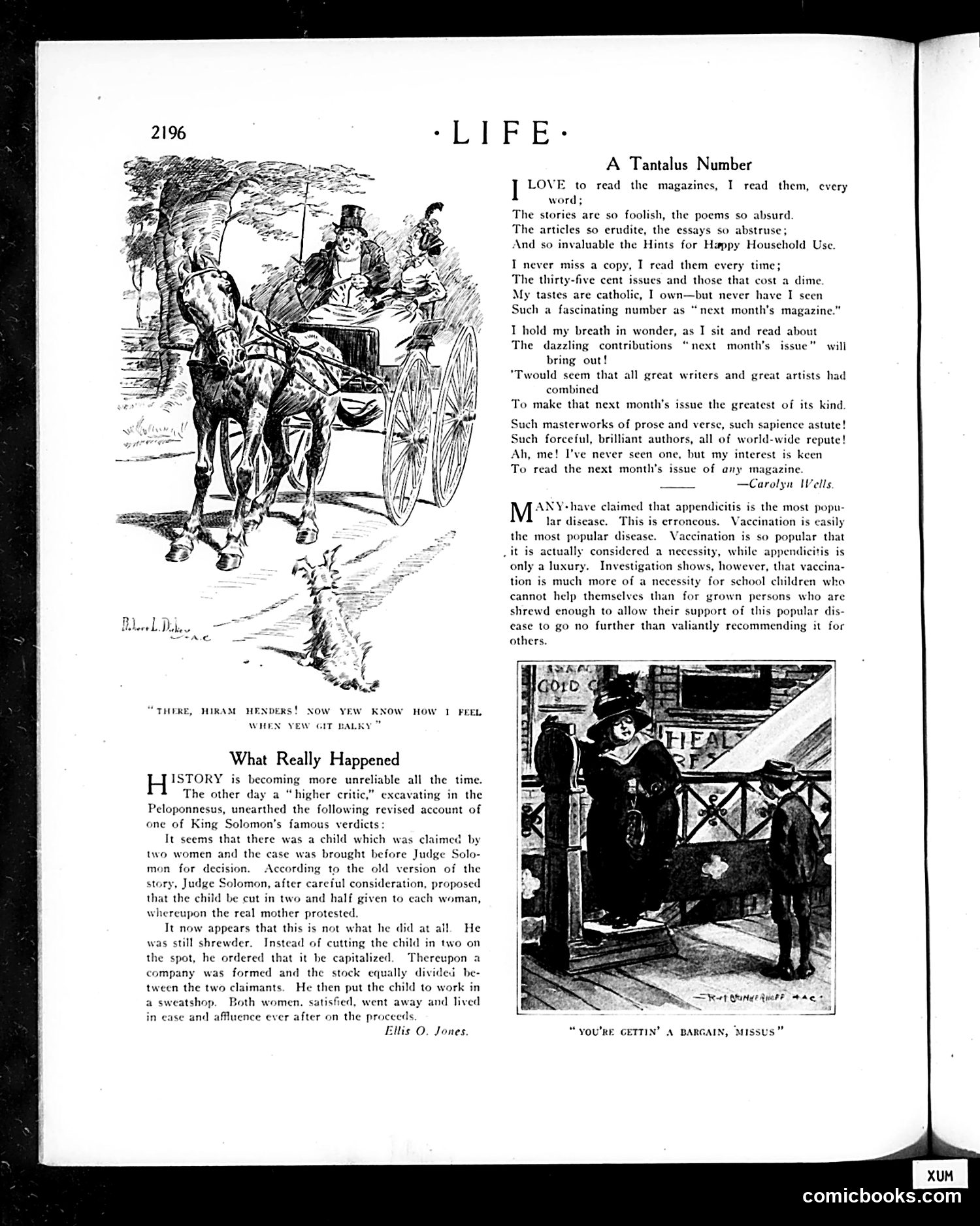
The top cartoon satirizes rural life and stubbornness. A man with a horse-drawn cart addresses another man (Hiram Henders), suggesting the speaker now understands how frustrating it is when someone (Hiram) acts "balky" (stubborn/uncooperative)—using the horse as a visual metaphor. The main article, "What Really Happened," is a mock-serious critique of how history gets rewritten. It humorously "revises" the biblical story of King Solomon's famous judgment about two women and a child. Instead of the wisdom tale where Solomon proposes cutting the child in half to reveal the true mother, this "modern" version claims Solomon actually *capitalized* the child—formed a company, divided stock between the women, and put the child to work in a sweatshop. This satirizes early 1900s industrial capitalism and child labor exploitation, suggesting that modern profit-seeking has corrupted even ancient moral wisdom. The satire targets contemporary greed and the commodification of human life.
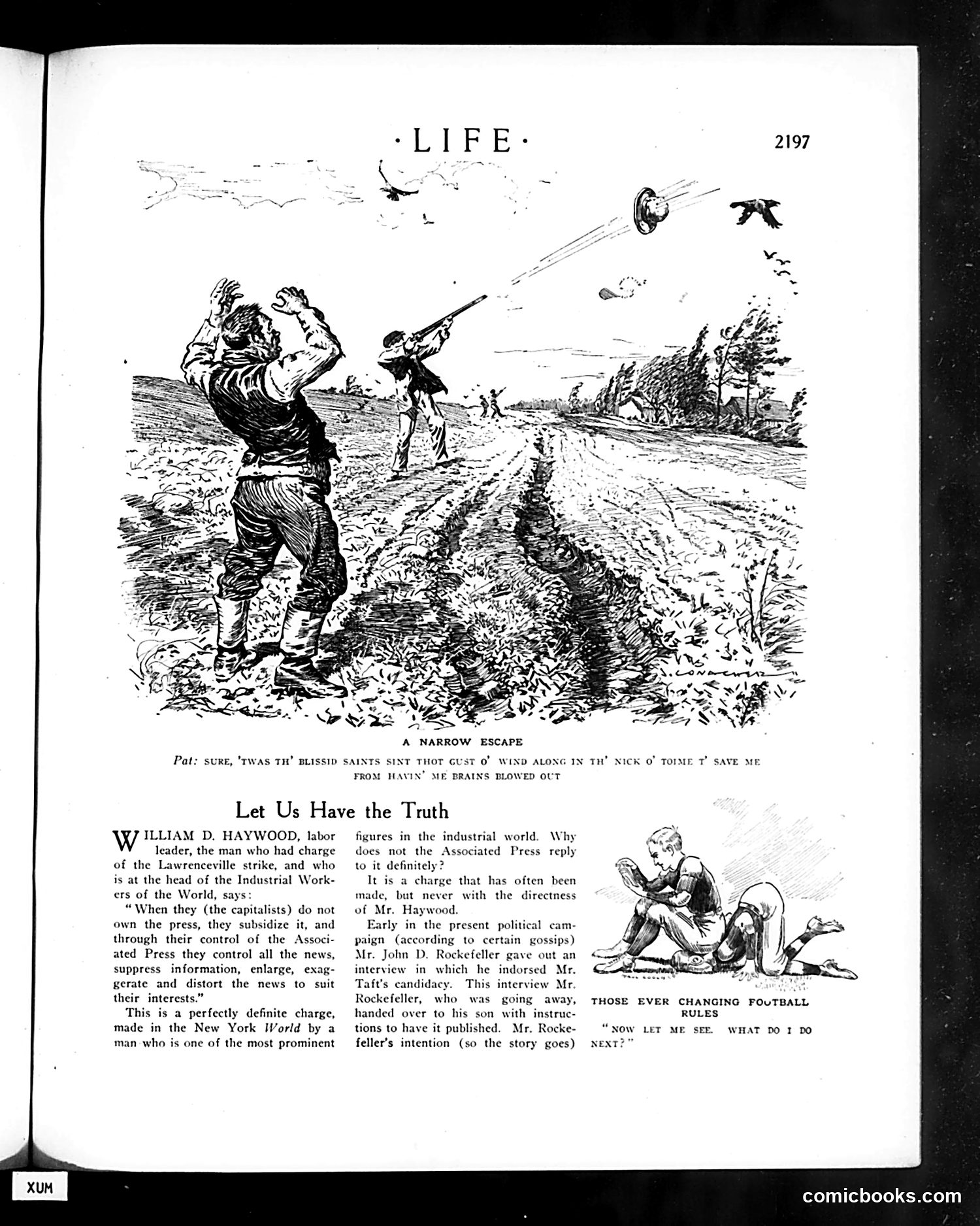
The top cartoon depicts a laborer narrowly escaping death from flying debris—a visual reference to industrial accidents common among workers. The caption uses working-class dialect to underscore the danger. The main article features William D. Haywood, leader of the Industrial Workers of the World (IWW), accusing capitalists of controlling the Associated Press to suppress labor news and distort reporting in their favor. Life challenges the AP to respond directly to this "perfectly definite charge." The article then shifts to John D. Rockefeller allegedly endorsing Taft's presidential candidacy—suggesting wealthy industrialists manipulate political messaging through controlled media channels, which validates Haywood's broader claim about press manipulation. The satirical point: major news organizations and wealthy elites collude to control public information, leaving workers and ordinary citizens deceived. This represents progressive-era skepticism about corporate influence over media.
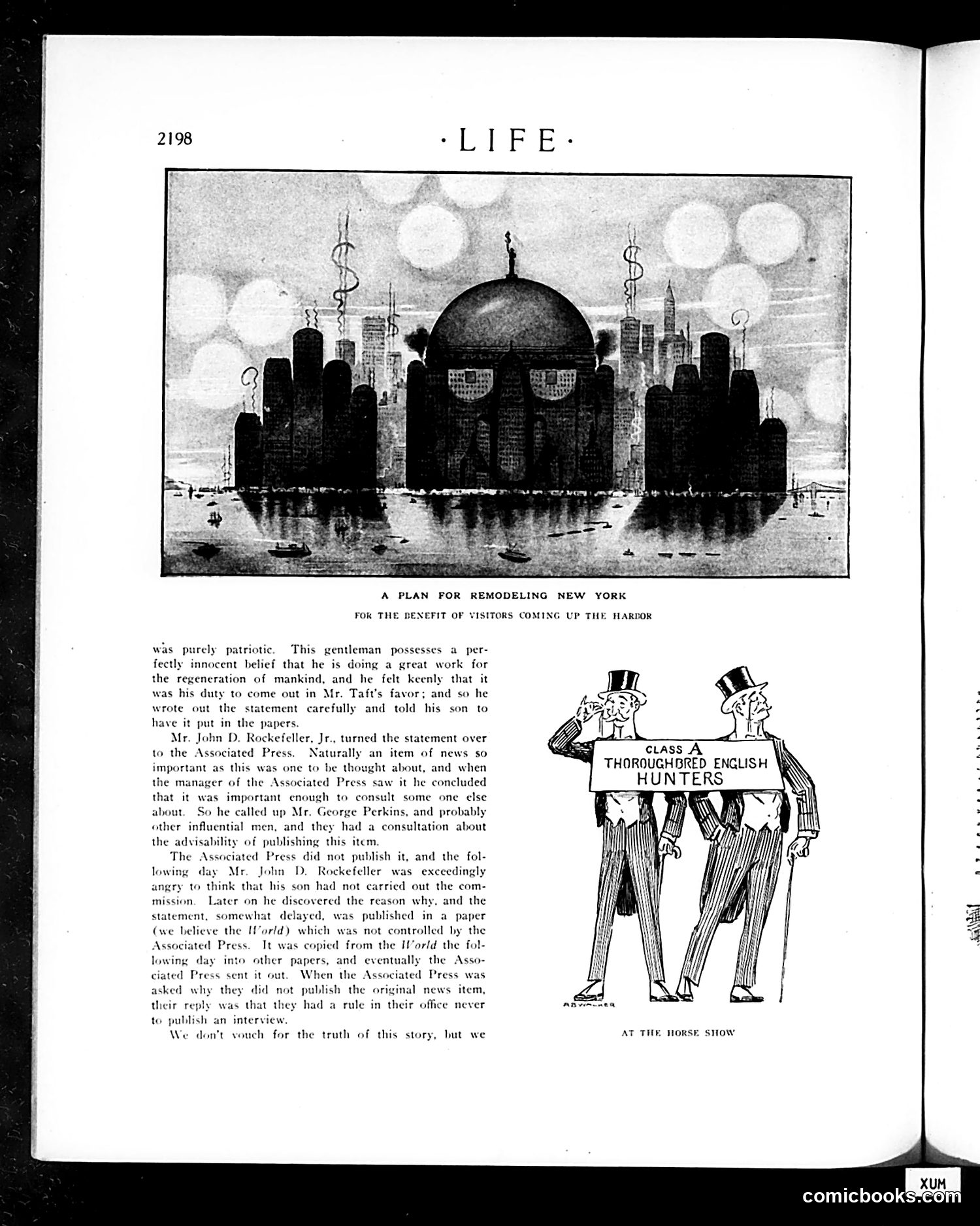
**Top Image:** "A Plan for Remodeling New York" depicts a grandiose, dome-topped structure dominating the Manhattan skyline—likely satirizing someone's ambitious urban vision. The caption suggests this is mocking an overly grand scheme presented to impress harbor visitors. **Bottom Cartoon:** Two figures labeled "Class A Thoroughbred English Hunters" at a horse show represent wealthy elites, likely satirizing American high society's pretensions to European refinement. **Main Text:** This passage critiques John D. Rockefeller Jr. and the Associated Press's editorial gatekeeping. Rockefeller wrote a pro-Taft statement (suggesting President William Howard Taft era, early 1900s), but the AP refused to publish it, citing a rule against publishing interviews. Life sarcastically questions this censorship, implying powerful institutions suppress news selectively. The story exposes how media establishments, despite claims of objectivity, make editorial decisions influenced by consulting other "influential men"—suggesting collusion among elites to control public information.
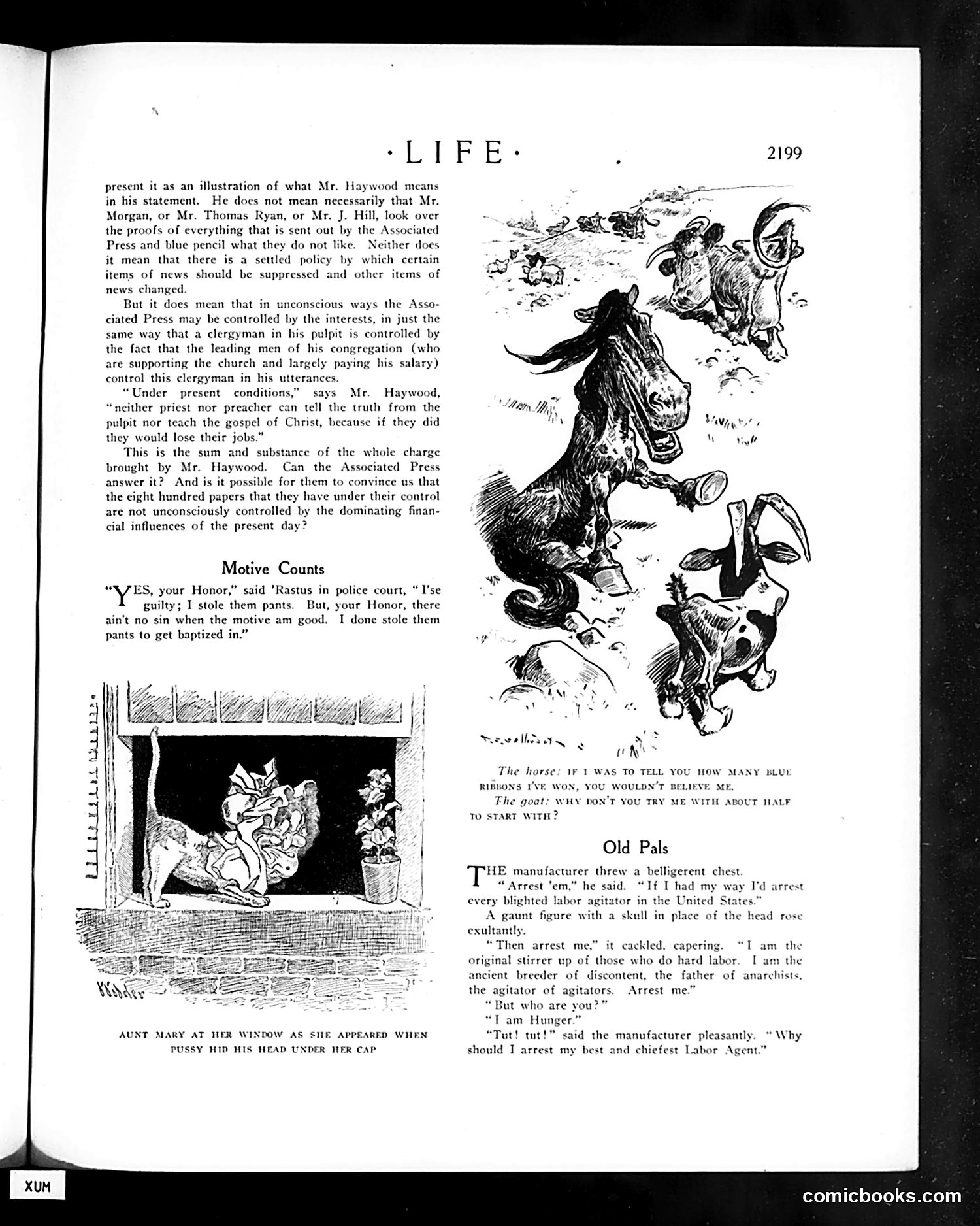
This page critiques media control and labor relations through multiple cartoons: **Top section:** Text discusses allegations by Mr. Haywood (likely IWW leader Bill Haywood) that the Associated Press is unconsciously controlled by wealthy financial interests—Morgan, Ryan, Hill—similar to how a clergyman's message is shaped by his congregation's money. The analogy suggests institutional corruption through financial influence rather than explicit censorship. **"Motive Counts":** A racist caricature of a Black defendant ('Rastus) argues he stole pants for baptism, satirizing how motivations can justify wrongdoing. **Animal cartoons:** A horse and goat boast humorously about achievements; Aunt Mary's cat scenario appears as visual humor. **"Old Pals":** The main satirical piece depicts a manufacturer demanding arrest of labor agitators. A skeletal figure representing "Hunger" appears, claiming to be the "original stirrer" of workers and "father of anarchists." The manufacturer then realizes Hunger itself is his best labor agent—suggesting that worker unrest stems from poverty and desperation, which capitalists inadvertently create and rely upon.
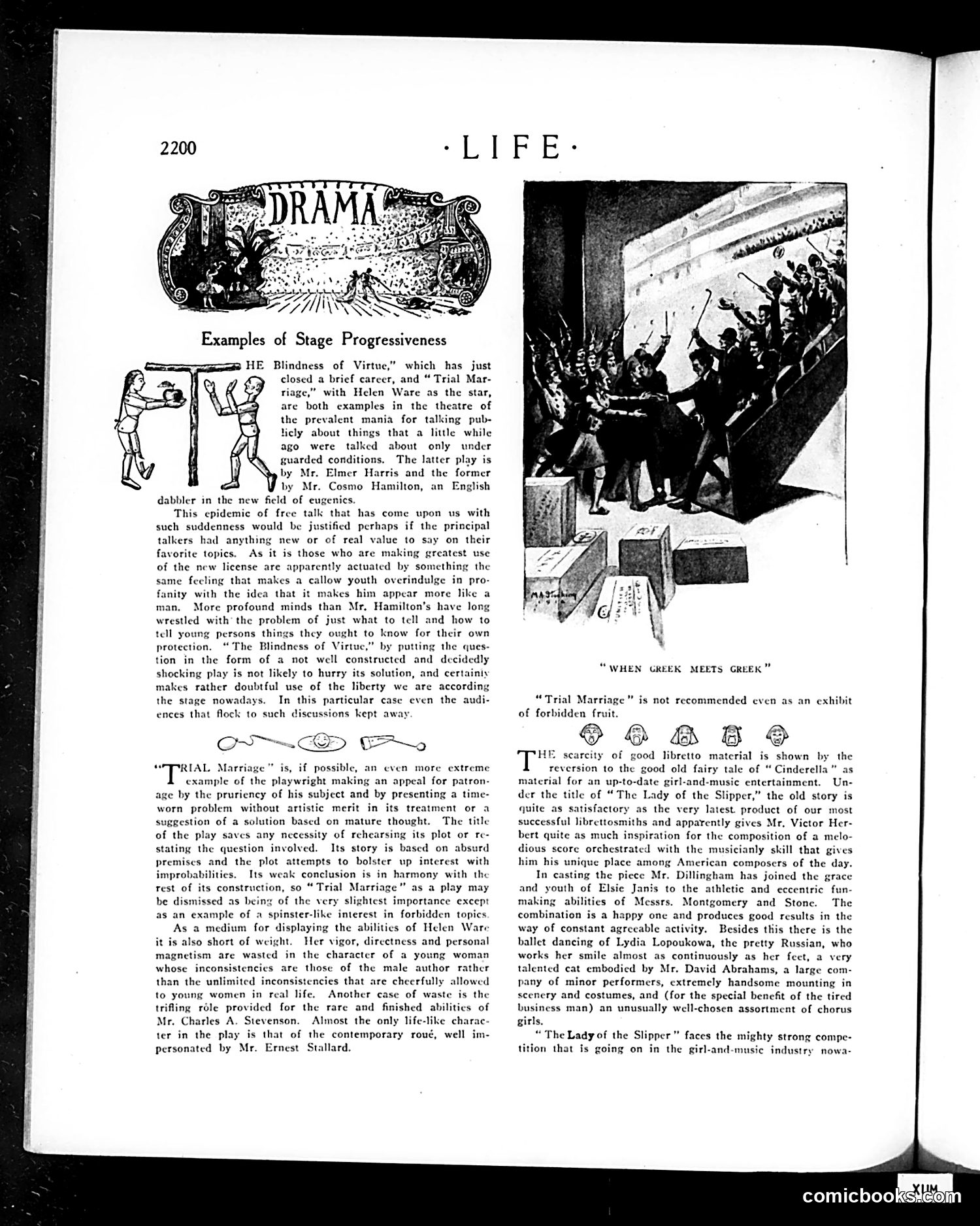
This is a theater criticism page satirizing early 1900s Broadway's obsession with "daring" plays about taboo subjects. The text mocks two plays—"The Blindness of Virtue" and "Trial Marriage"—for exploiting sexual and social topics (eugenics, premarital relations) without artistic merit, comparing their shock-value appeal to adolescent profanity use. The critic argues these plays present serious subjects superficially, with weak plots and unconvincing characters. Helen Ware's talents are "wasted" in poorly written roles. The page contrasts this trend with "The Lady of the Slipper," a Cinderella adaptation praised for combining legitimate artistry (composer Victor Herbert's score) with star power (Elsie Janis, Montgomery and Stone). The small illustrations of wrestlers or acrobats appear to reference physical theater, while "When Greek Meets Greek" is an idiom meaning conflict between equals.
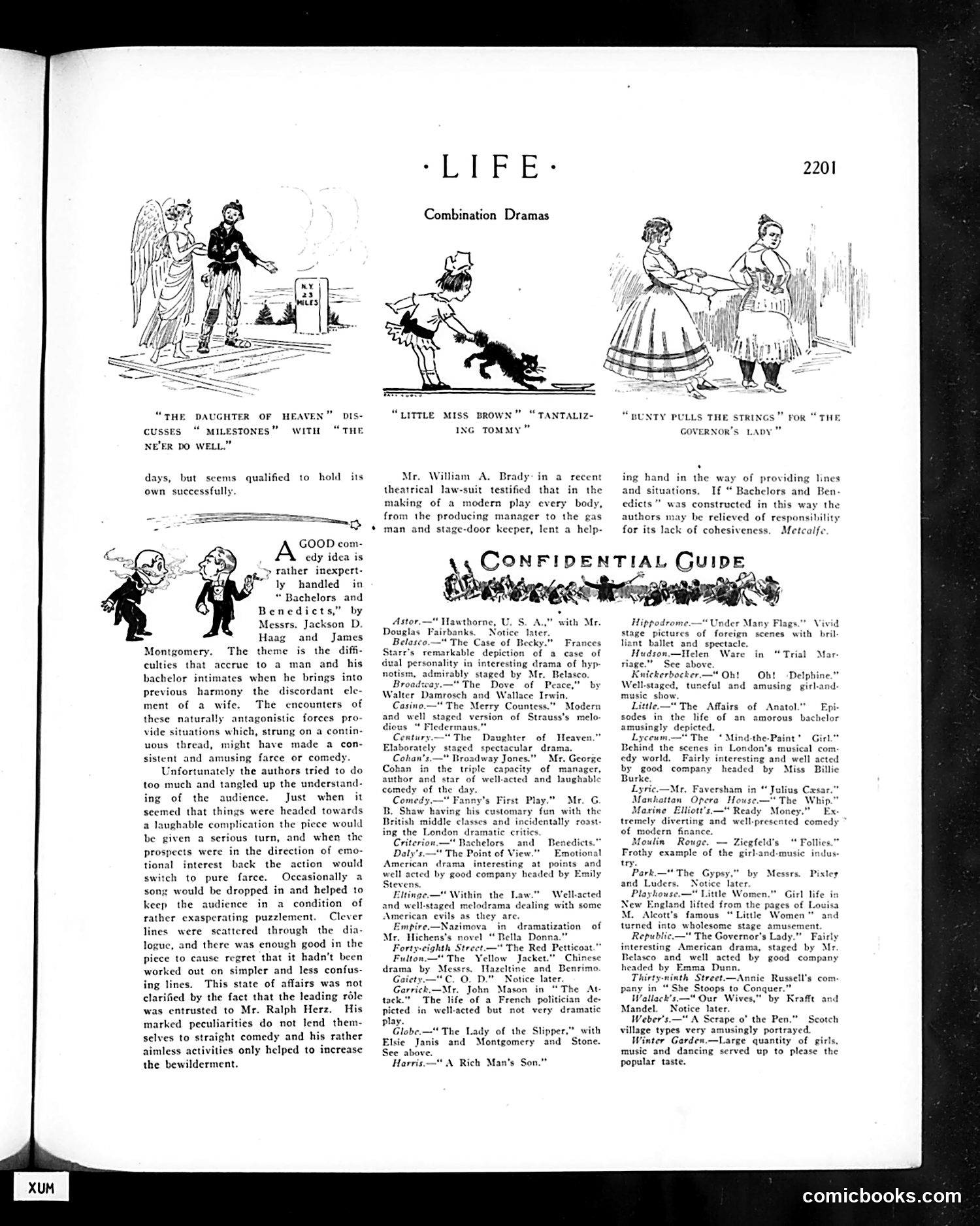
This page from *Life* magazine contains theater reviews and a "Confidential Guide" to Broadway shows. The top section features four small cartoons illustrating theatrical plots—apparently satirizing overly melodramatic or absurd stage scenarios: an angel discussing "milestones" with a soldier, a woman tantalizing "Tommy" with a dog, and girls pulling strings for a governor's lady. The main text critiques "Bachelors and Benedicts," a contemporary play about marital discord, faulting its confused structure—switching erratically between farce and serious drama—and blaming actor Ralph Herz's lack of comedic skill. The satirical point: Broadway productions of the era often lacked coherence and relied on stars' personalities rather than solid playwriting. The *Life* review mocks how theatrical producers and performers cobbled together entertainment that bewildered audiences rather than entertained them—a common complaint about early 1900s commercial theater's quality.
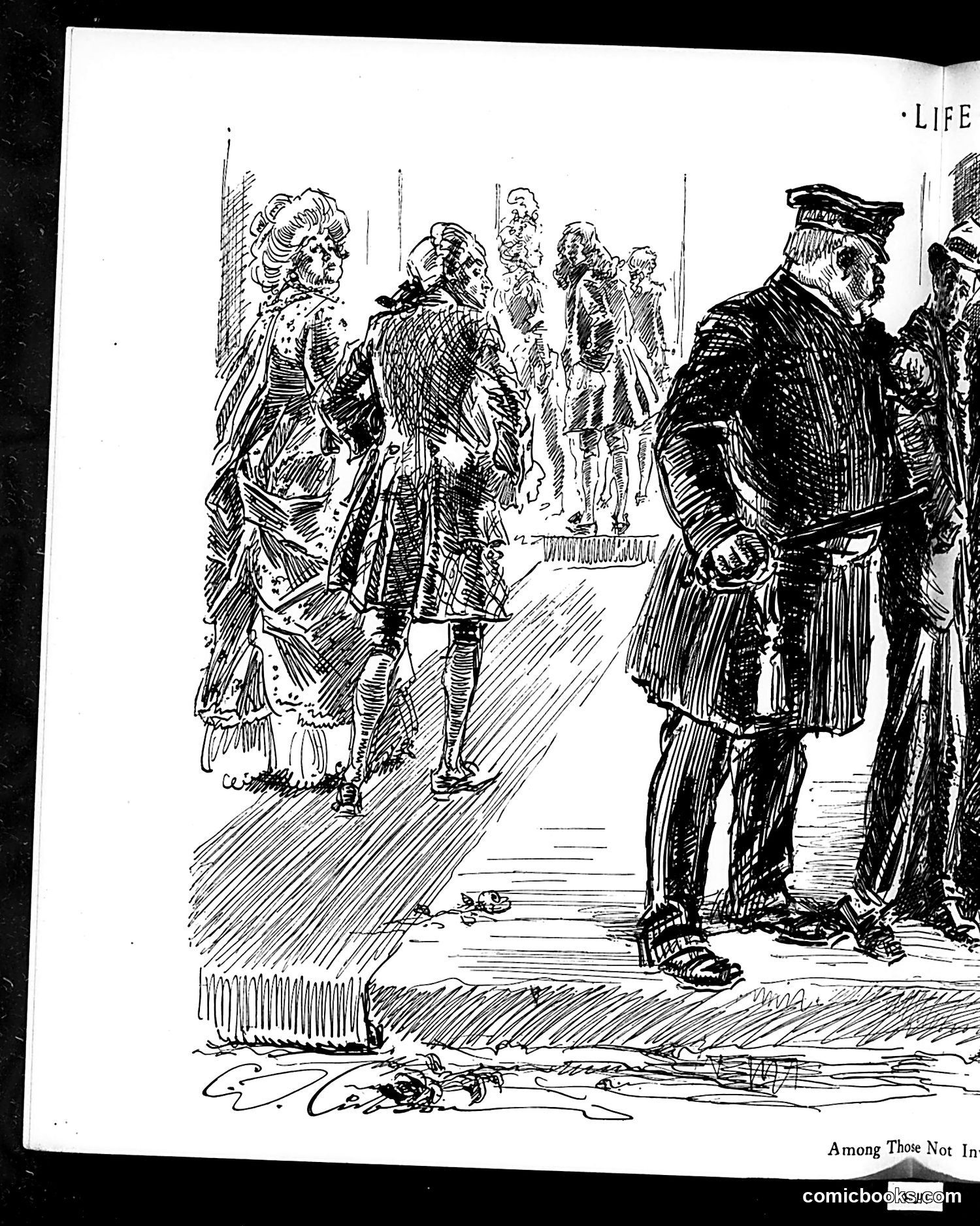
This appears to be a political cartoon from Life magazine satirizing official ceremonies or formal gatherings. The visible text reads "Among Those Not In," suggesting commentary on exclusion or absence from some event. The sketch depicts military or formally-dressed officials in what appears to be an official setting, with figures standing prominently in the foreground while others stand in the background. The style and uniforms suggest this likely references a specific historical event involving governmental or military proceedings, possibly related to appointments, assignments, or official recognition. However, without the complete caption, publication date, or additional context visible on the page, I cannot definitively identify which specific event, figures, or political situation this cartoon references. The incomplete OCR text limits precise interpretation of the satire's target.
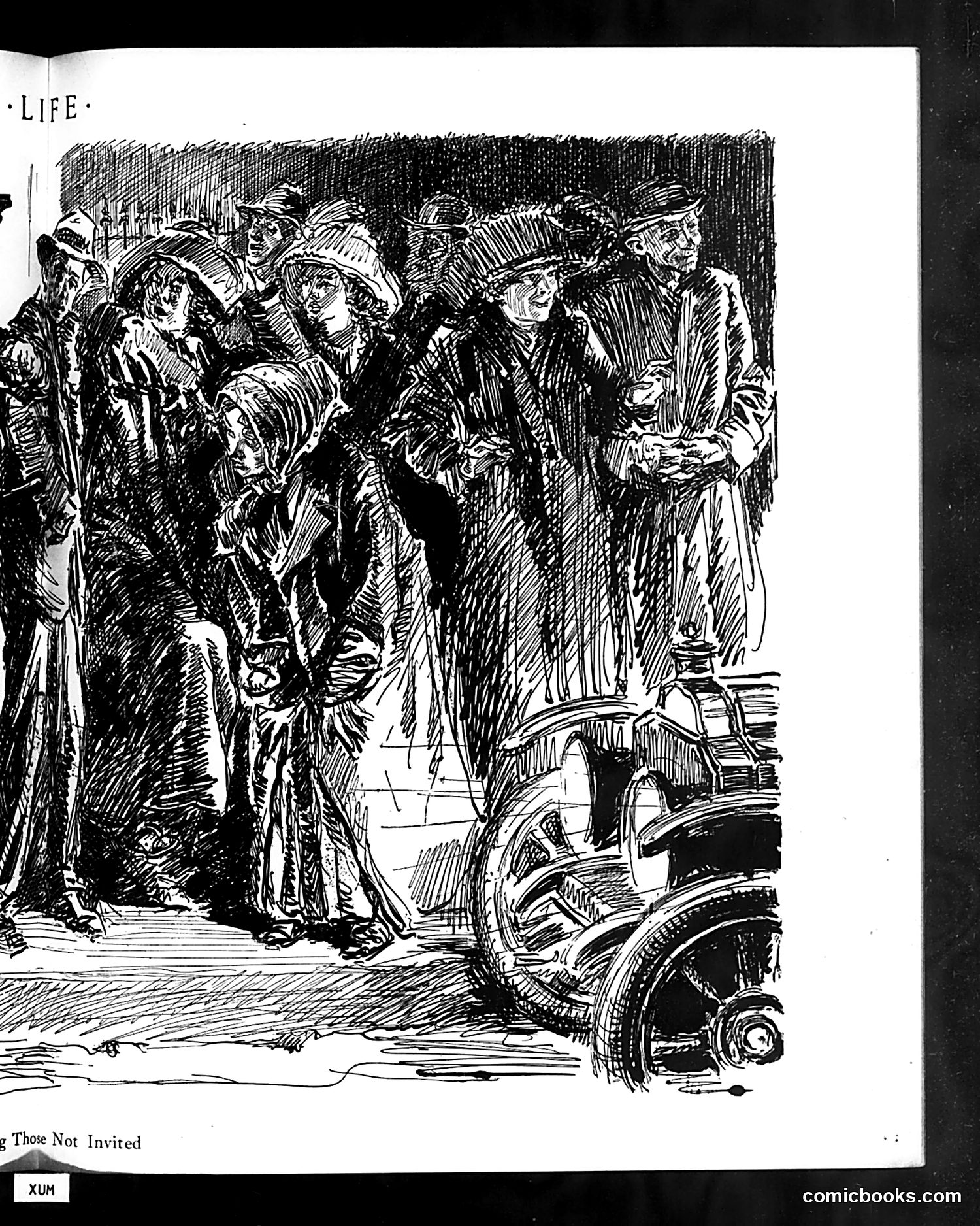
This cartoon depicts a crowd of well-dressed people (wearing coats and hats typical of early 20th century) gathered around what appears to be an automobile. The title "Excluding Those Not Invited" suggests social exclusion or class division—the cartoon satirizes a situation where certain people are deliberately kept out of an event or privilege. The gathering appears to represent the wealthy or socially elite, while the title implies commentary on who is denied access or invitation. This likely critiques social stratification or exclusive practices of the period, possibly referencing automobile ownership as a marker of wealth and status. The detailed cross-hatching emphasizes the density and self-satisfied nature of the assembled group. Without additional context, the specific event or controversy referenced remains unclear.
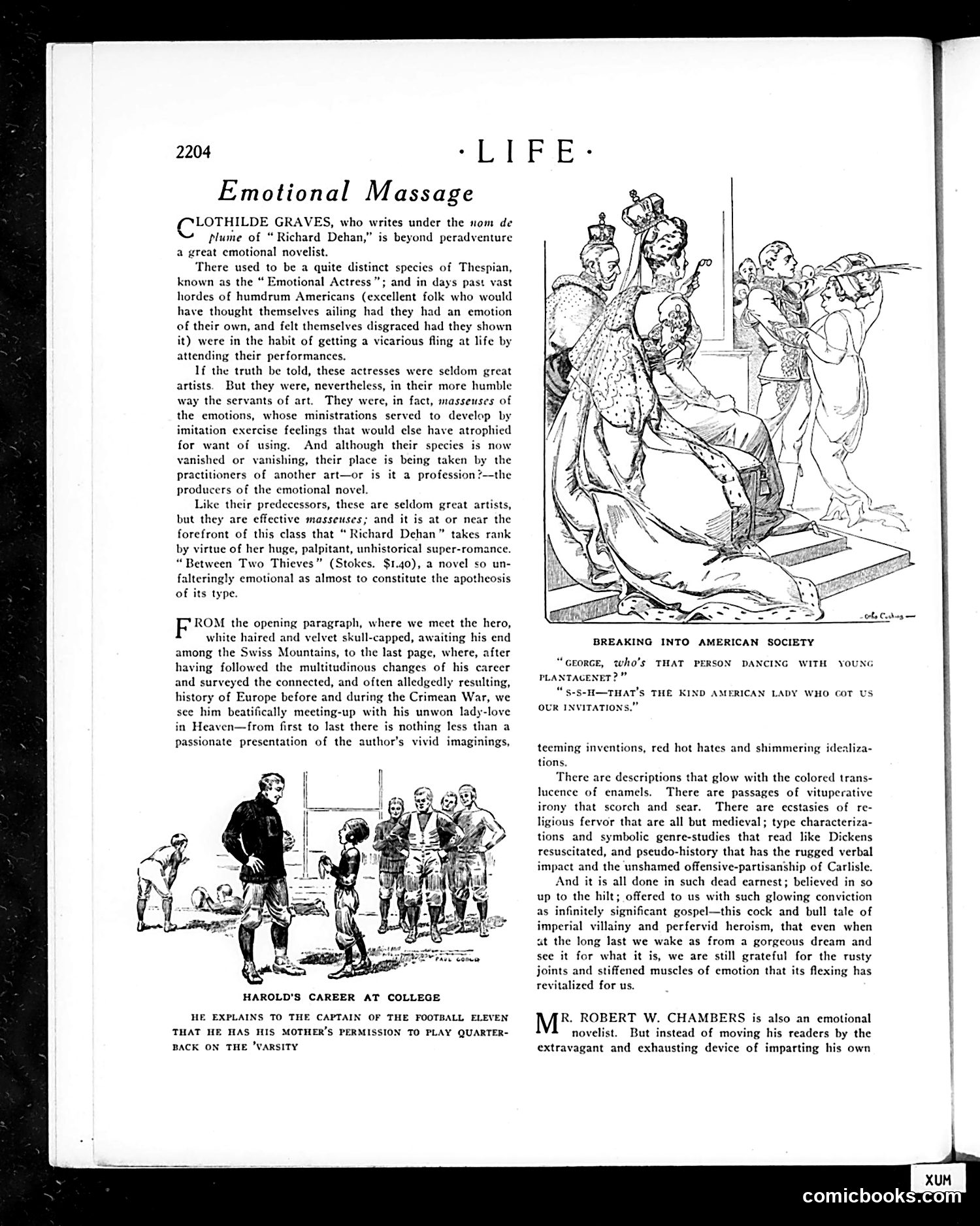
This *Life* magazine page satirizes "emotional" novelists—writers like Clothilde Graves (pen name "Richard Dehan") who manipulate readers' feelings through melodramatic plots rather than artistic merit. The article uses the metaphor of "emotional massage"—these writers are "masseuses of the emotions," exercising feelings that ordinary Americans supposedly lack in real life. The two cartoons mock American social anxieties: the upper cartoon shows confusion about a "person" of unclear social status crashing high society ("that's the kind American lady who got us our invitations"), while the lower cartoon depicts a mother giving her son permission to play college football—trivial domestic moments contrasted with the page's discussion of grand historical fiction. The satire suggests such novels are effective but artistically shallow—providing emotional stimulation to readers who live emotionally stunted lives, much like a physical massage for atrophied muscles.
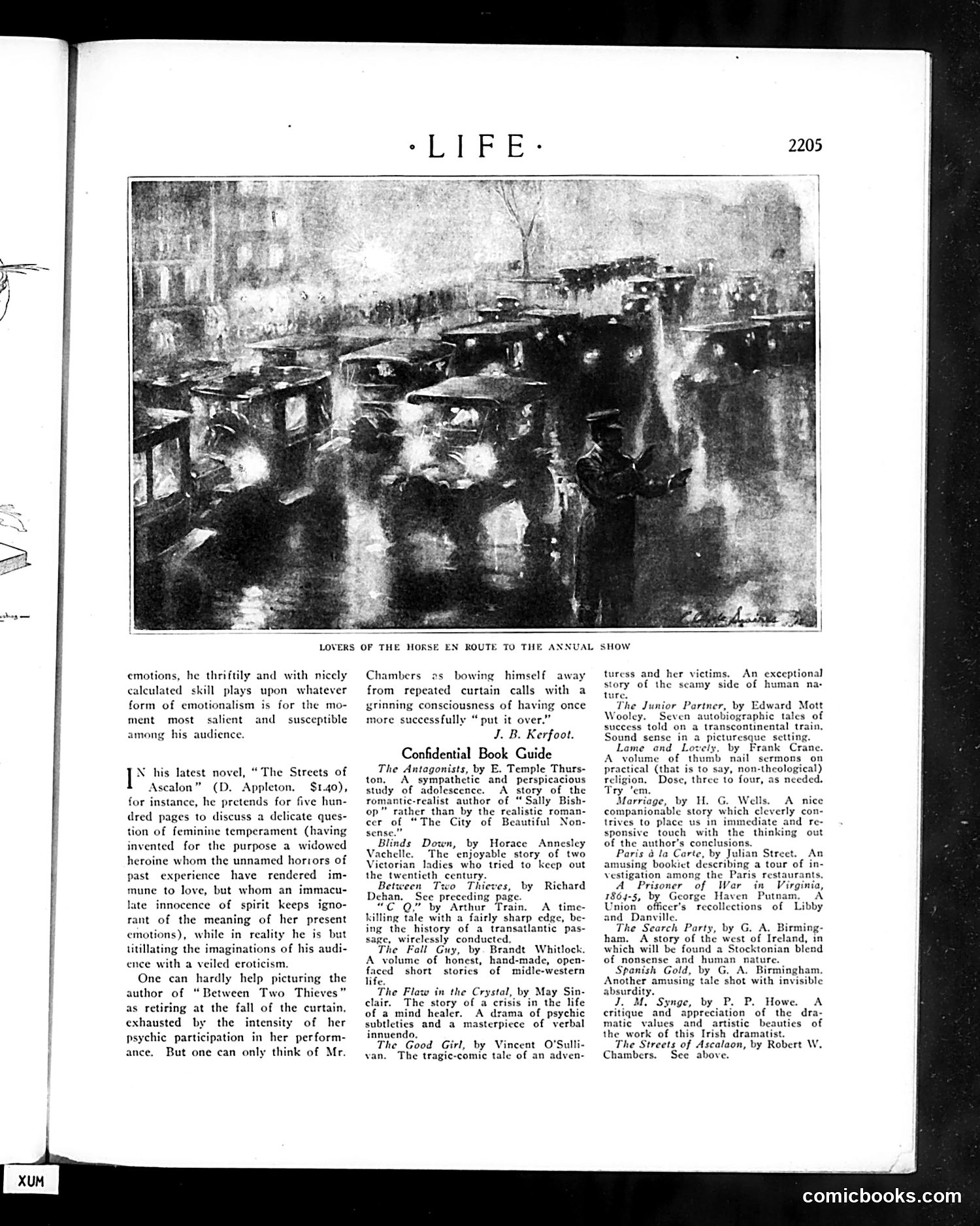
This cartoon depicts a crowded street scene of horse-drawn carriages and crowds, illustrating the caption about people traveling to an annual horse show—likely a major social event of the era. The page primarily contains a **book review section** by J. B. Kerfoot critiquing Robert W. Chambers' novel *The Streets of Ascalon*. Kerfoot argues that Chambers manipulates his audience's emotions, using a seemingly serious story about feminine temperament as a vehicle for "veiled eroticism"—essentially accusing the author of titillating readers while pretending to serious literature. He contrasts Chambers unfavorably with another author ("Between Two Thieves"), suggesting Chambers cynically "puts it over" on audiences rather than genuinely engaging with his material. The "Confidential Book Guide" lists contemporary novels with brief, often witty descriptions—a typical Life magazine feature recommending recent publications to readers.
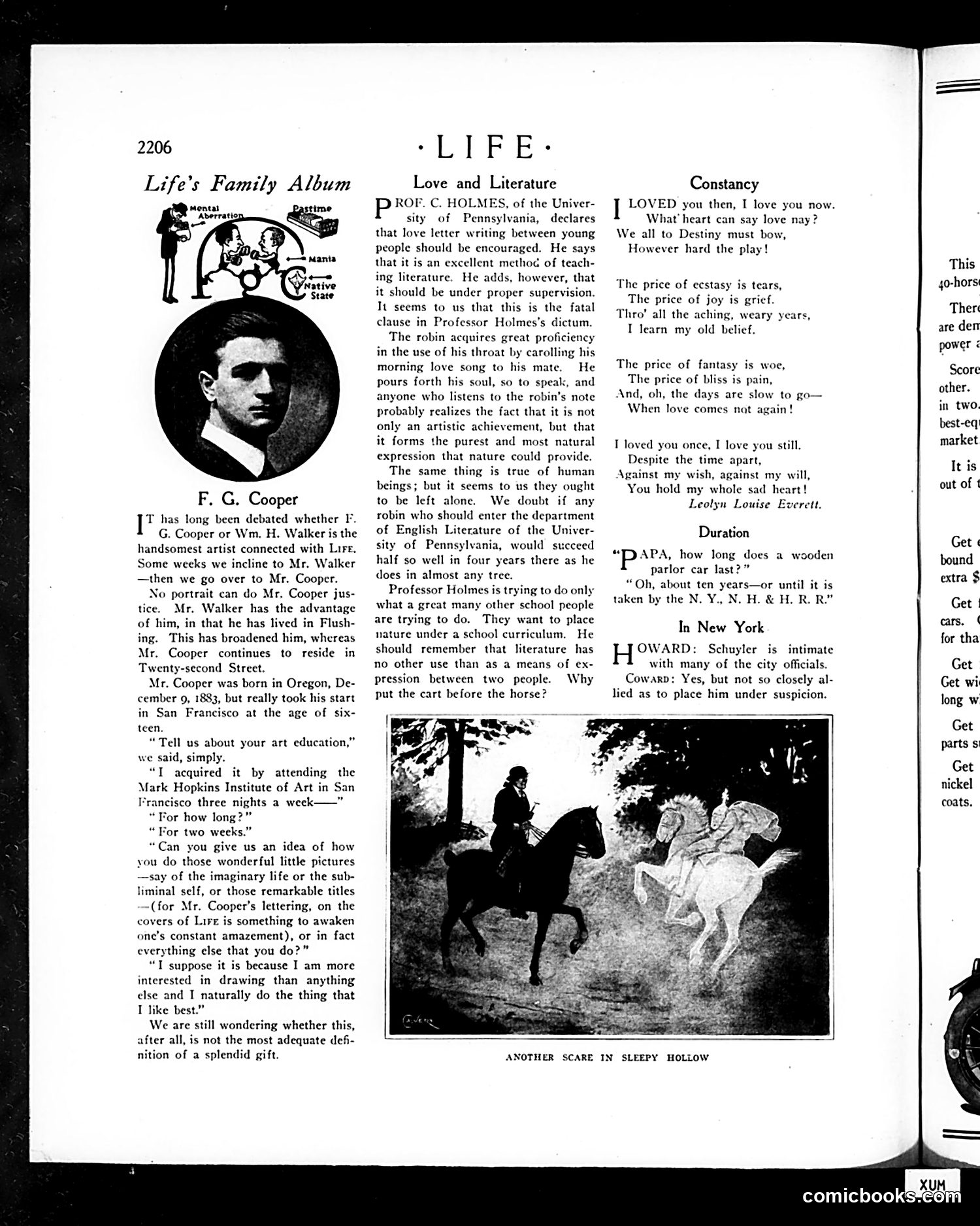
This page from *Life* magazine features a profile of artist **F. G. Cooper**, presented as light editorial humor. The text humorously debates whether Cooper or fellow artist Wm. H. Walker is more handsome, then playfully critiques Cooper's minimalist explanation of his artistic process—essentially that he draws because he enjoys drawing. The accompanying sections include: **"Love and Literature"**: Professor C. Holmes of University of Pennsylvania advocates supervised love-letter writing as educational. The editors sarcastically compare this to a robin singing naturally; their point is that forcing nature into academic structure defeats its purpose. **Poetry and Humor Sections**: These include romantic verse on constancy, a joke about railroad durability (the N.Y., N.H. & H.R.R. apparently claimed wooden cars), and a quip about New York politician Schuyler's connections. **Image**: Shows a horseman in what appears to be a Gothic scene, captioned "Another Scare in Sleepy Hollow"—likely referencing Irving's *Headless Horseman* tale. The overall tone is gentle satire typical of *Life*'s era.
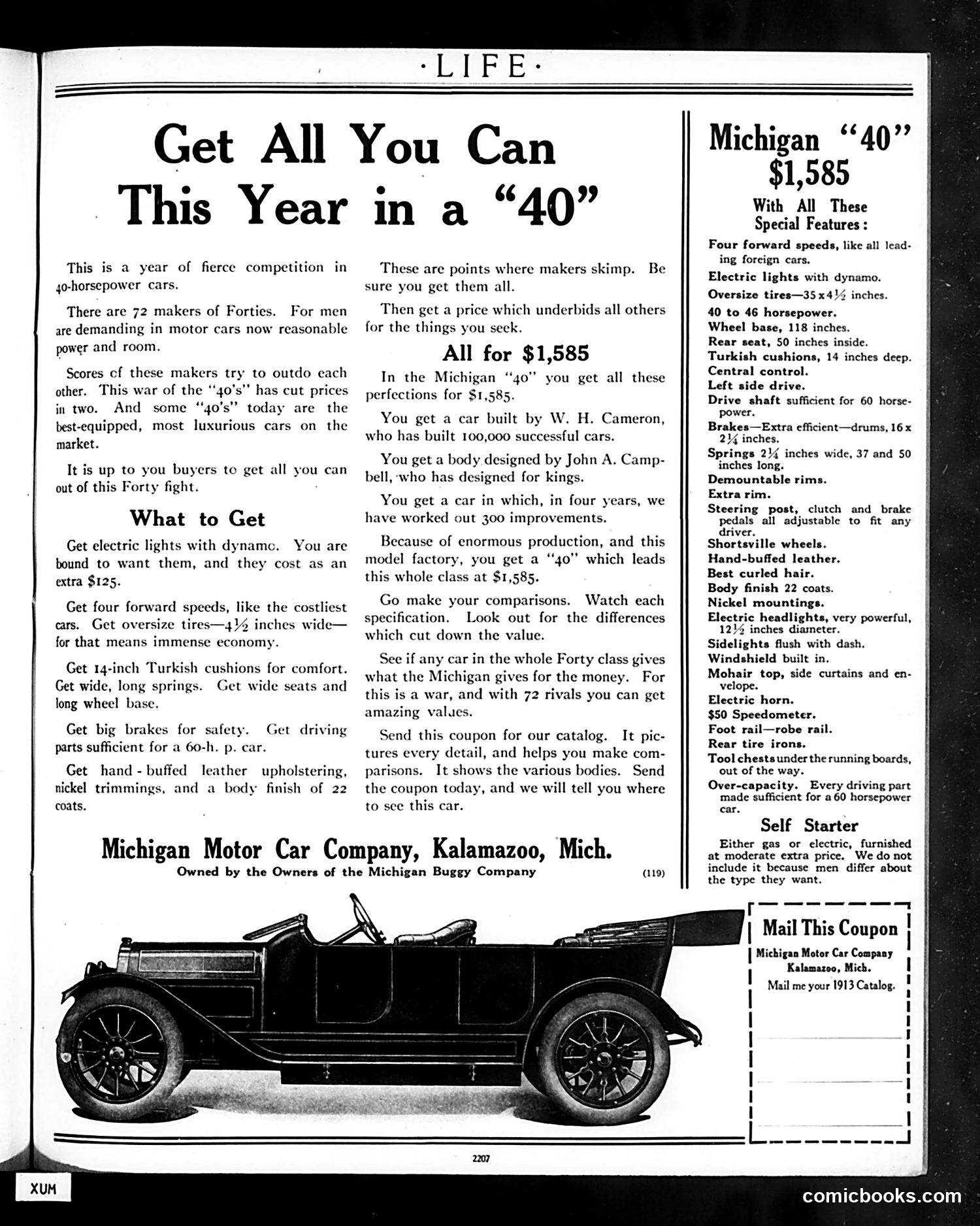
This is primarily a **automobile advertisement**, not a political cartoon. It promotes the Michigan Motor Car Company's "40" model priced at $1,585. The "satire" is implicit in the framing: the ad acknowledges fierce competition among 72 manufacturers of 40-horsepower cars, describing it as a "war" where prices have been "cut in two." The Michigan company positions itself as offering the best value—claiming superior features (electric lights, Turkish cushions, hand-buffed leather, 22-coat finish) at the lowest price. The humor lies in the **tongue-in-cheek appeal to consumer savvy**: buyers are urged to "get all you can" from this competitive "fight," with detailed instructions on what features to demand. Rather than hard-sell tactics, the ad trusts educated consumers to make informed comparisons. The single illustration shows the car's profile—a typical 1913 touring automobile. This reflects the **early automotive era's competitive frenzy** and emerging consumer culture, where manufacturers appealed to rational self-interest rather than brand loyalty.
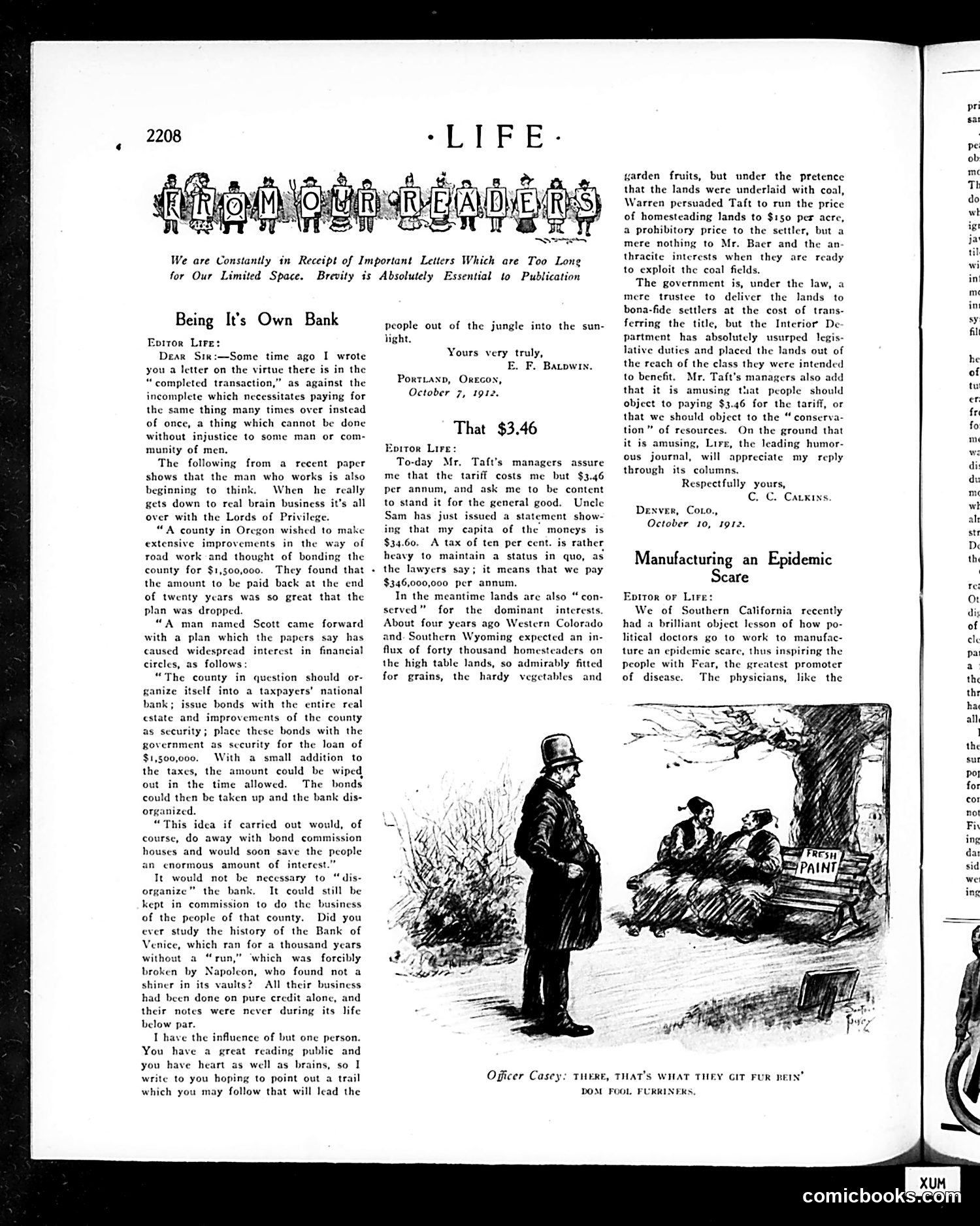
This page contains **no cartoon** but rather reader letters on economic policy during the 1912 election season. **Key Content:** The letters critique **President Taft's administration**. One writer proposes an Oregon county create its own bank using real estate as collateral—avoiding expensive bond intermediaries—citing the historical success of Venice's Bank. Another letter attacks **Taft's tariff policy**, claiming his managers say it costs citizens only $3.46 annually, but the actual per-capita burden is $34.60—a 10% tax on national wealth ($346 million). The writer also accuses **Taft and Interior Secretary Richard Ballinger** (implied by "Warren") of blocking Western homesteaders by raising land prices to $150/acre—affordable only to wealthy coal interests like industrialist George Baer, not ordinary settlers. **Context:** This reflects Progressive Era criticism of Taft for favoring big business over common people, contributing to the Republican Party split that helped elect Wilson in 1912.
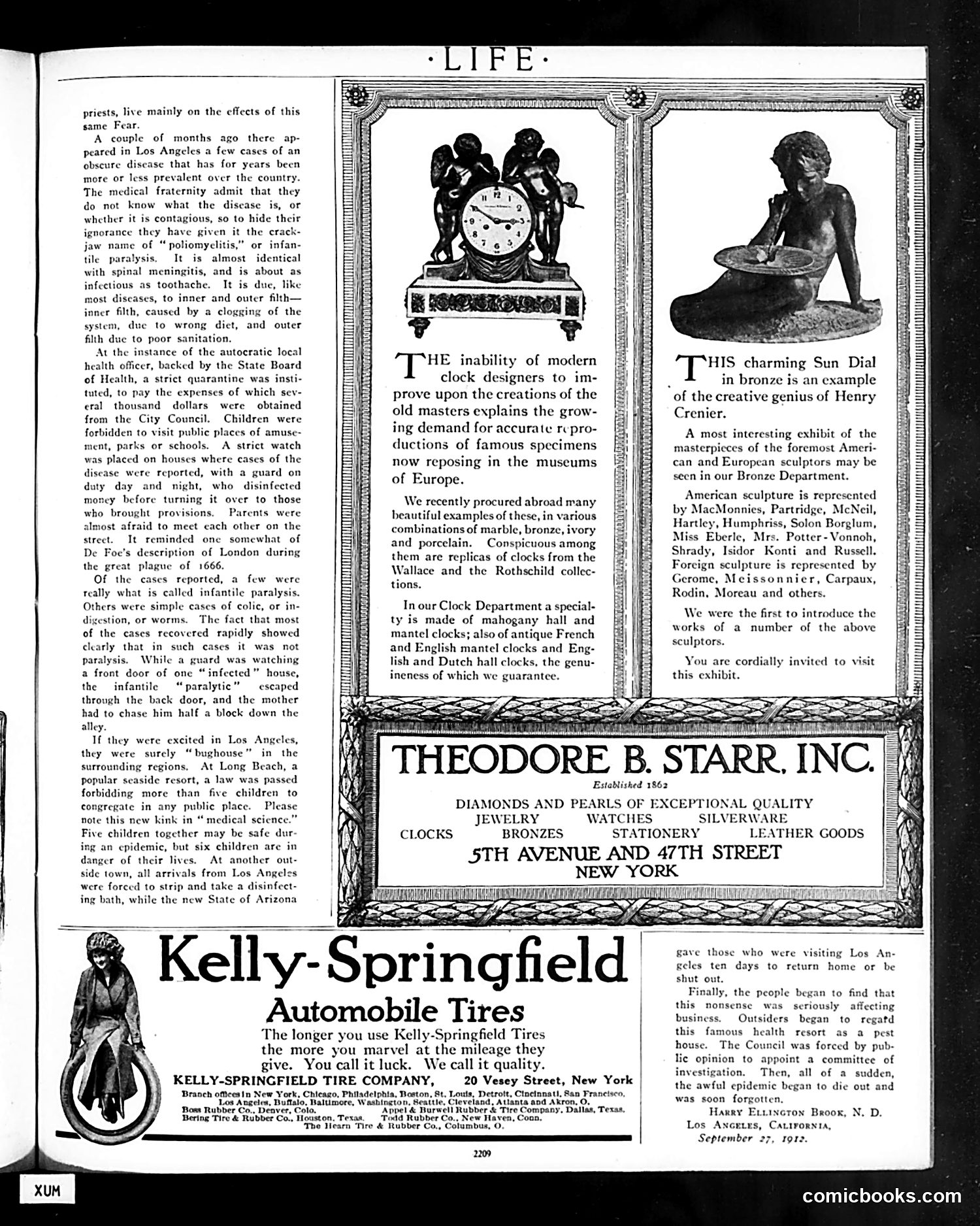
This page is primarily **advertising** for luxury goods (Theodore B. Starr jewelry, Kelly-Springfield tires), with a significant article criticizing the public health response to a poliomyelitis outbreak in Los Angeles. ## The Satirical Article The left column attacks what the author views as **medical hysteria and governmental overreach** during a 1912 polio epidemic. The satire mocks: - Officials' ignorance dressed up in medical jargon ("poliomyclitis") - Extreme quarantine measures (forbidding children from public places, disinfecting money, armed guards) - Absurd regulations (Long Beach limiting children to groups of five) - Forced bathing of Los Angeles arrivals in Arizona The author compares this panic to **London's 1666 plague**, suggesting the response is disproportionate. Most cases, he argues, were minor ailments (colic, worms) that recovered quickly—proof they weren't truly paralysis. He attributes disease to poor sanitation and diet, not contagion. **Context**: This reflects early 20th-century skepticism of germ theory and distrust of public health authorities' emergency powers—concerns that resonate today.
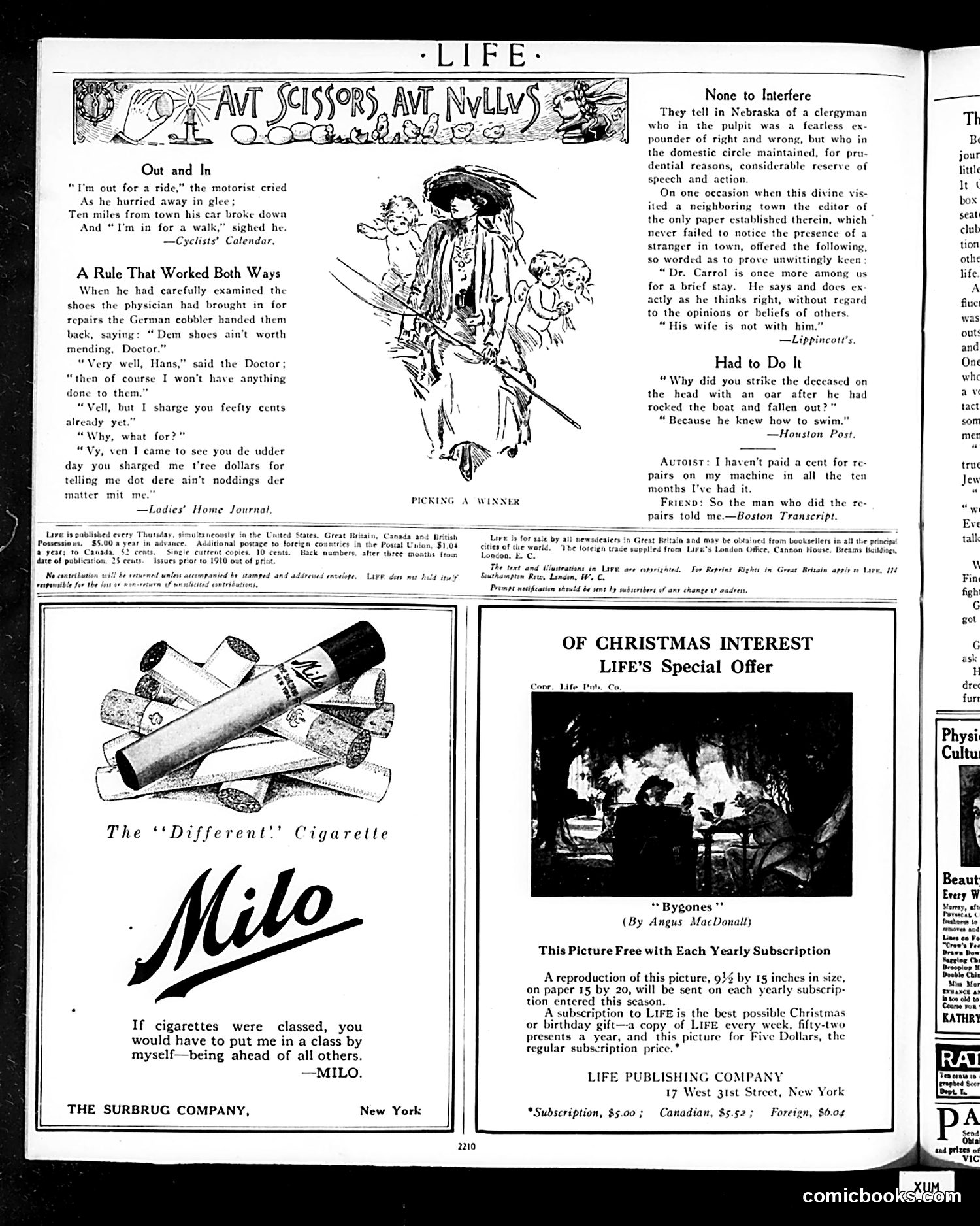
This page contains **short humorous anecdotes** rather than political cartoons, typical of Life's satirical humor format. **"Out and In"**: A motorist's comeuppance—he boasts about a joyride but breaks down, forced to walk home instead. **"A Rule That Worked Both Ways"**: A German-accented cobbler refuses to repair a doctor's shoes, claiming they're worthless, then demands payment anyway. The joke: he mirrors the doctor's own logic (the doctor charged him $3 just to say nothing was wrong), exposing hypocrisy through dialect humor common to the era. **"None to Interfere"**: A clergyman preaches morality publicly but stays silent at home—the editor's notice about his visit sardonically notes his wife *isn't* accompanying him, implying domestic discord he won't address. **"Had to Do It"**: Dark humor about striking a drowning man with an oar because "he knew how to swim"—absurdist logic. The page also advertises **Milo cigarettes** and a **Life subscription offer** including a free reproduction of a painting called "Bygones."
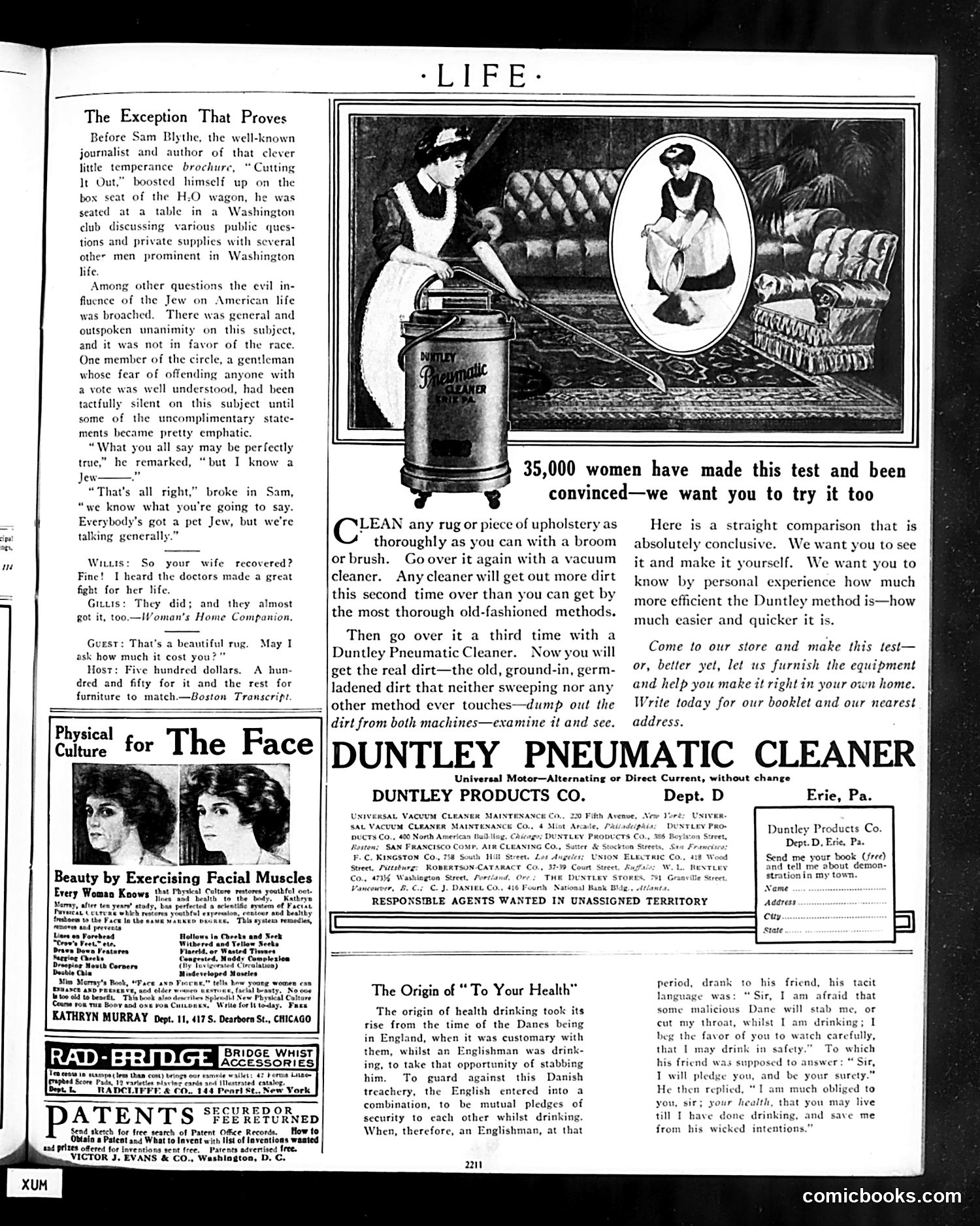
This page contains a satirical short story (left column) that exposes hypocrisy regarding antisemitic prejudice. The setup: a Washington club discussion where prominent men unanimously express "the evil influence of the Jew on American life." One cautious member finally speaks up, saying he knows a good Jewish person. Sam Blythe (a real journalist/temperance advocate) cuts him off with the punchline: everyone has their "pet Jew" exception, but "we're talking generally"—meaning the bigotry stands regardless. The satire works by revealing how people maintain racist views while exempting individuals they personally know, never applying that exception to challenge their broader prejudice. The page is otherwise dominated by period advertisements (Duntley vacuum cleaner, facial exercise courses, patent services), typical of Life magazine's mixed content model.
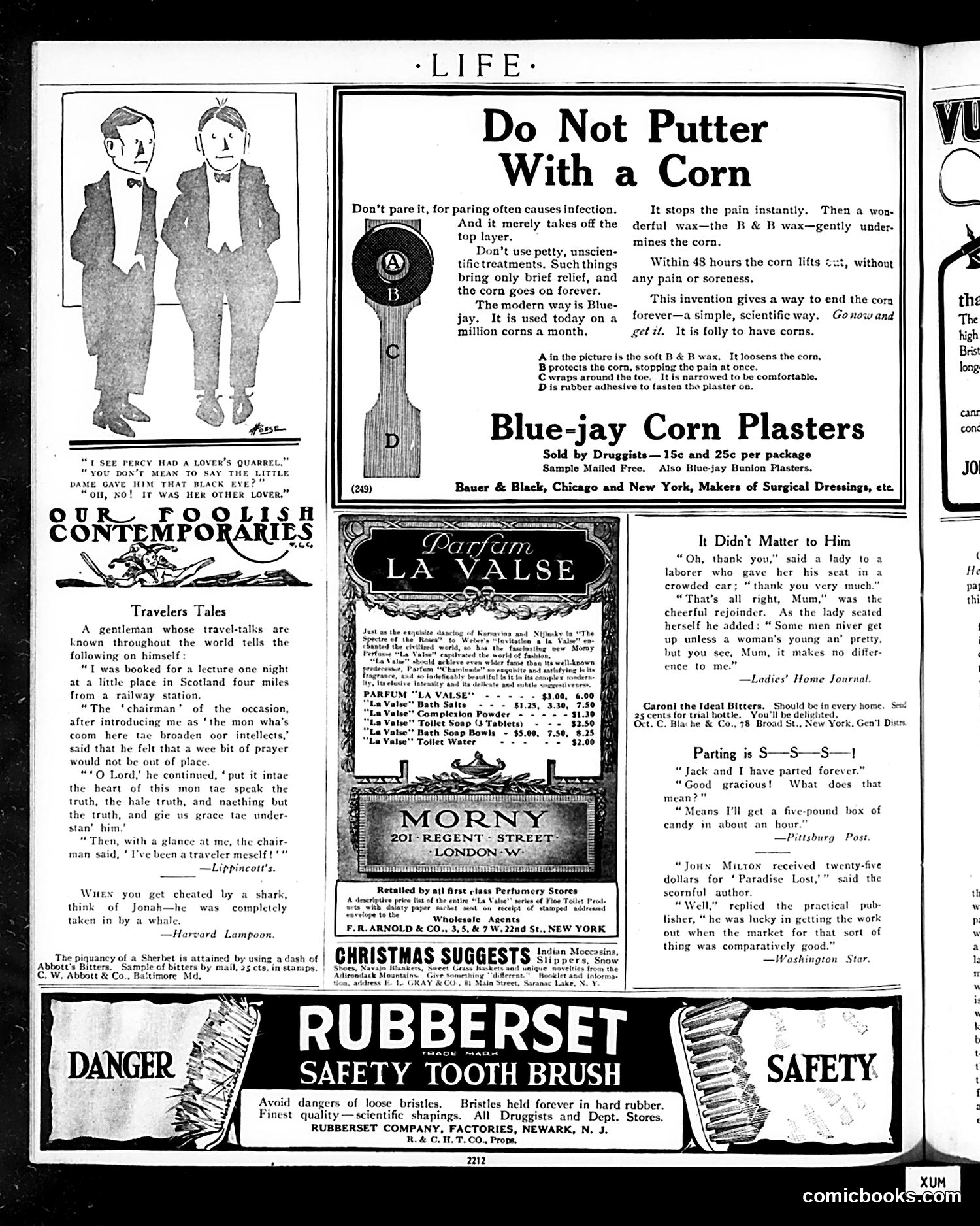
This page is primarily **advertisements and filler content** rather than political satire. The main cartoon—showing two well-dressed men with the caption "I see Percy had a lover's quarrel...the little dame gave him that black eye...No! It was her other lover"—is a simple joke about infidelity, not political commentary. The page's dominant content is **commercial advertising**: Blue-Jay Corn Plasters (the centerpiece), La Valse perfume, Morny cosmetics, and a Rubberset toothbrush. These reflect early 20th-century consumer products. The "Travelers Tales" and "Our Foolish Contemporaries" sections are light humor pieces—one about a Scottish minister's prayer, another playing on "Jonah and the whale"—typical filler for humor magazines of this era. **No significant political or social satire appears here.** This is a standard entertainment/advertising page from Life magazine's commercial period.
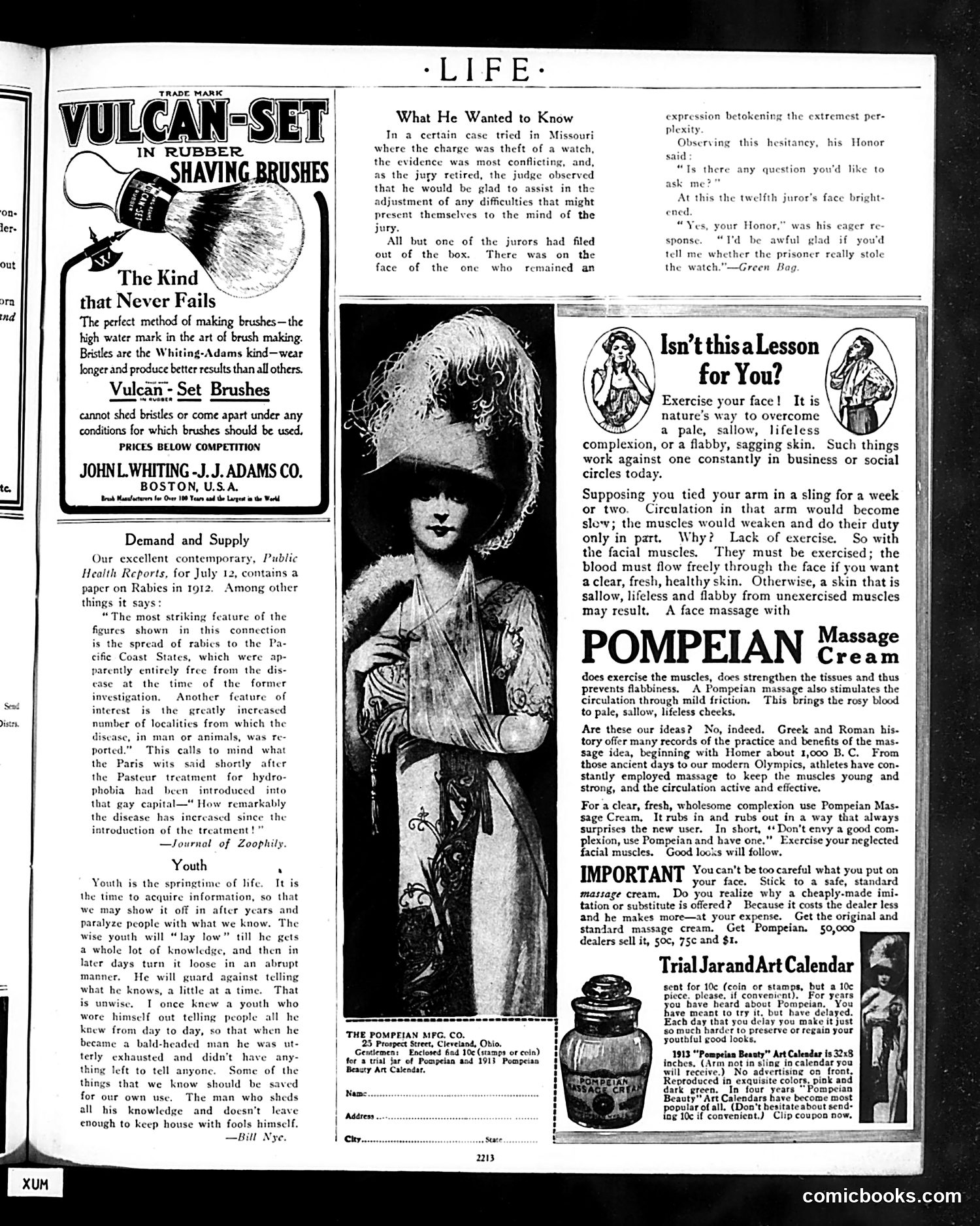
This page is primarily **advertising and humor columns**, not political satire. The main content includes: 1. **Vulcan-Set Shaving Brushes ad** (top left): Standard product advertisement emphasizing durability. 2. **"Demand and Supply" column**: A satirical piece noting the ironic spread of rabies cases *after* the Pasteur rabies treatment was introduced in Paris—implying the cure somehow increased the disease (absurdist humor about unintended consequences). 3. **"Youth" by Bill Nye**: Humorous essay about hoarding knowledge rather than sharing it gradually. 4. **"What He Wanted to Know"**: A courtroom anecdote where a confused juror asks the judge whether the defendant actually stole the watch—comedy based on the juror's fundamental misunderstanding of his role. 5. **Pompeian Massage Cream ad** (right): Beauty product advertisement with pseudo-scientific health claims about facial exercise and circulation. The page reflects early 1910s consumer culture and light humor rather than political commentary.
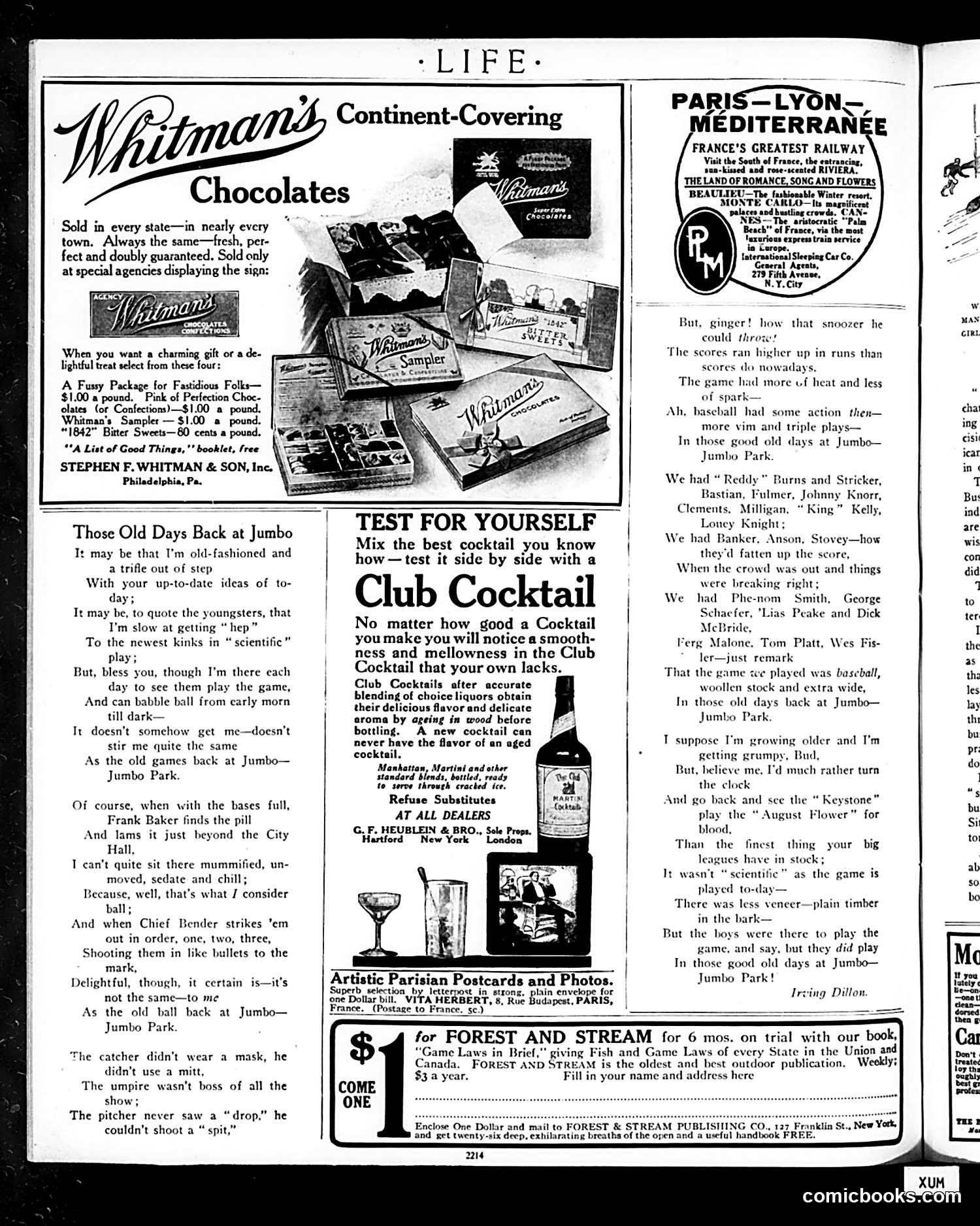
This page is primarily **advertising** with one substantial **nostalgic poem** by Irving Dillon. The poem laments the decline of baseball at Jumbo Park, contrasting modern "scientific" play with an earlier, more exciting era. The author—claiming to be old-fashioned—recalls legendary 19th-century players: "Reddy" Burns, Cap Anson, Stovey, and others whose names appear authentic to early baseball history. He argues that despite appreciating modern feats (Frank Baker's home run, Chief Bender's pitching), the old games had more "action," "vim and triple plays," and raw excitement than today's more calculated style. The satire gently mocks aging sports fans who romanticize the past while grudgingly admitting modern achievements are impressive but "not the same." It captures turn-of-the-century anxiety about how technology and systematization were supposedly diminishing athletic authenticity—a recurring cultural complaint across eras. The surrounding advertisements (Whitman's Chocolates, Club Cocktails, Paris-Lyon railway) are period marketing with no satirical content.
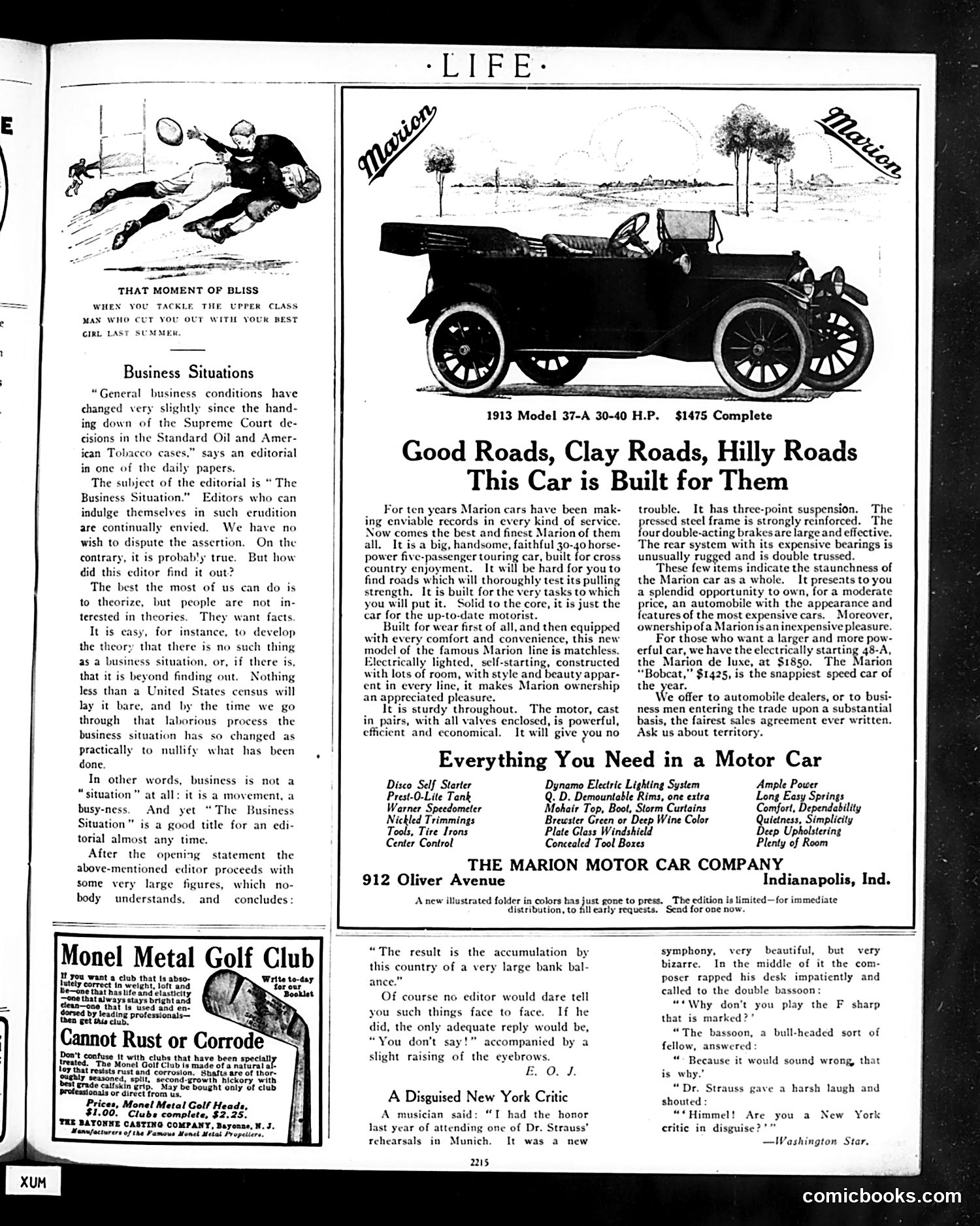
This page mixes editorial commentary with advertising. The cartoon at top-left depicts two men in physical combat—labeled "That Moment of Bliss When You Tackle the Upper Class Man Who Cut You Out With Your Best Girl Last Summer." This satirizes masculine rivalry and class resentment: a working or middle-class man fighting a wealthy rival over a romantic competitor, framed as socially satisfying despite the violence. The main editorial discusses "The Business Situation"—a vague term newspapers use to describe economic conditions. The writer mocks editors who claim authority analyzing business trends using large figures "nobody understands," arguing that business is constant movement, not a static "situation" to analyze. It's satire of journalistic pretension and economic commentary. The remainder is straightforward advertising for Marion automobiles (1913 Model 37-A) and Monel metal golf clubs, promoting the Marion as built for various road conditions and featuring modern conveniences like electric starters.
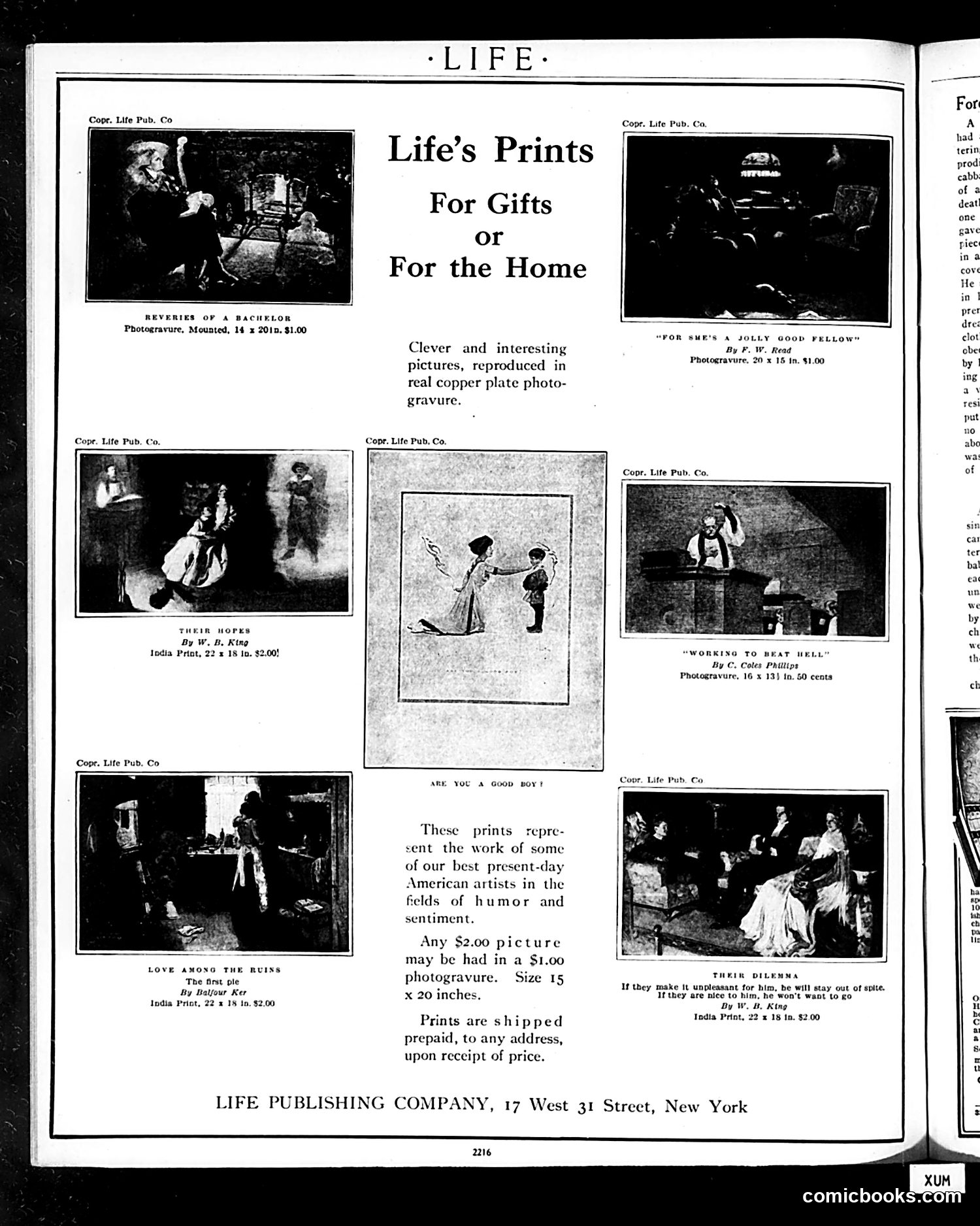
This is primarily an **advertisement**, not political satire. Life Publishing Company is selling art prints for home decoration and gifts, featuring works by contemporary American artists in humor and sentiment. The prints shown depict domestic and sentimental scenes—a bachelor's daydreams, a "jolly good fellow," hopeful couples, children misbehaving, and a couple's relationship dilemma. The titles ("Are You a Good Boy?", "Their Dilemma") suggest gentle, moralistic humor about everyday life. The page represents Life magazine's commercial venture selling reproductions via photogravure—a printing technique allowing affordable copies of original artworks. Prices range from 50 cents to $2.00, with a promotional offer of $2.00 images available as $1.00 photogravures (15 x 20 inches). This reflects early 20th-century consumer culture: mass-producing sentimental domestic imagery for middle-class home decoration.
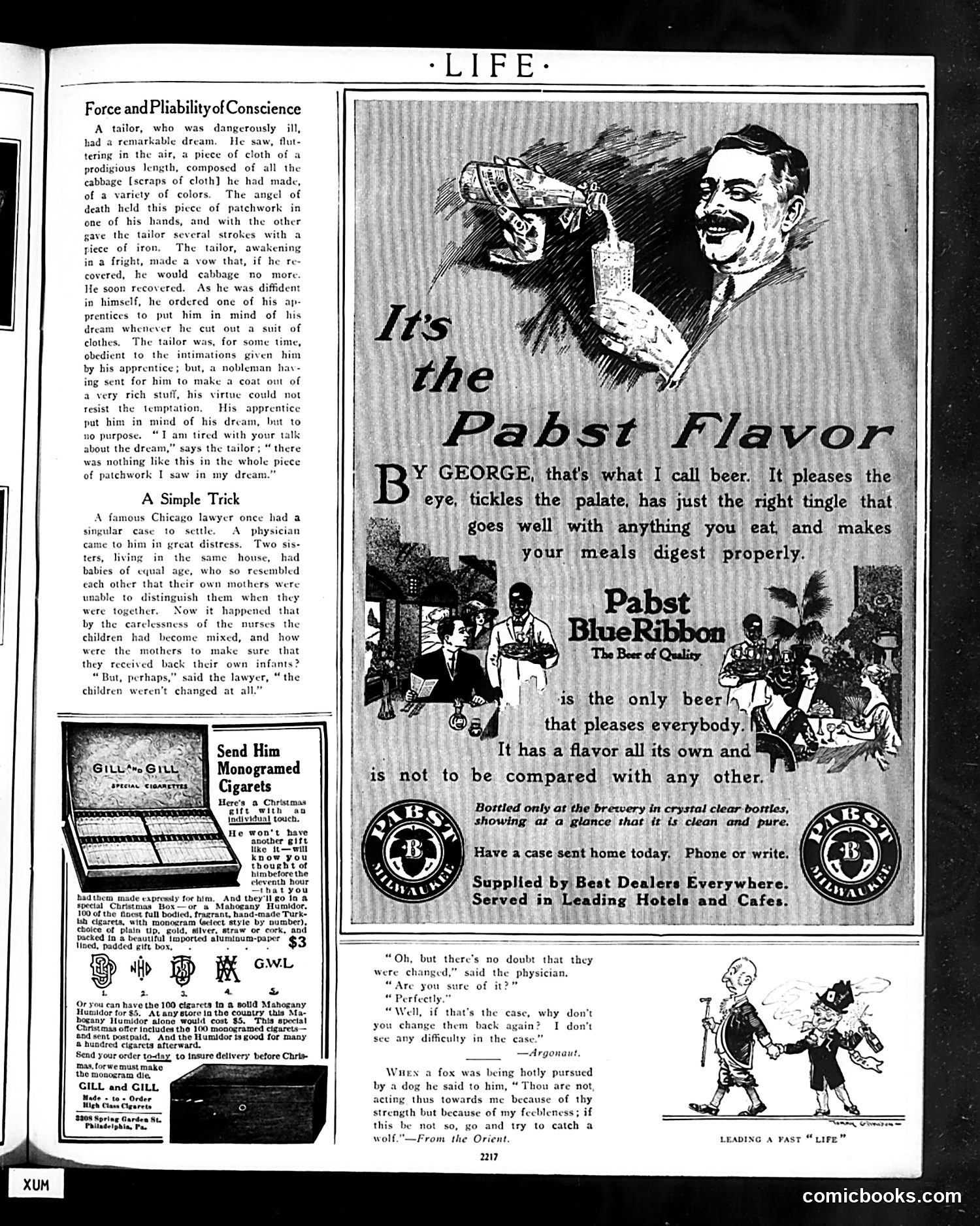
This page contains three distinct sections: **Left Column - Moral Tales:** Two brief stories illustrating ethical compromise. "Force and Pliability of Conscience" tells of a tailor who vows to stop stealing fabric scraps after a dream, but abandons his principles when offered lucrative work. "A Simple Trick" presents a lawyer's logical puzzle about twin babies. These appear designed to amuse readers with ironic commentary on human weakness and rationalization. **Center - Advertisement:** A Gill & Gill cigarette advertisement offering monogrammed cigars as a Christmas gift, packaged in mahogany humidors ($3-5). **Right - Advertisement & Cartoon:** A Pabst Blue Ribbon beer advertisement features a cheerful man promoting beer's flavor and digestive benefits—typical early-1900s advertising claims. Below is a small cartoon captioned "Leading a Fast 'Life'" showing a child and devil-figure, likely playing on the magazine's title. The page reflects early 20th-century advertising practices making health/digestion claims for alcohol and tobacco—now recognized as false and harmful.
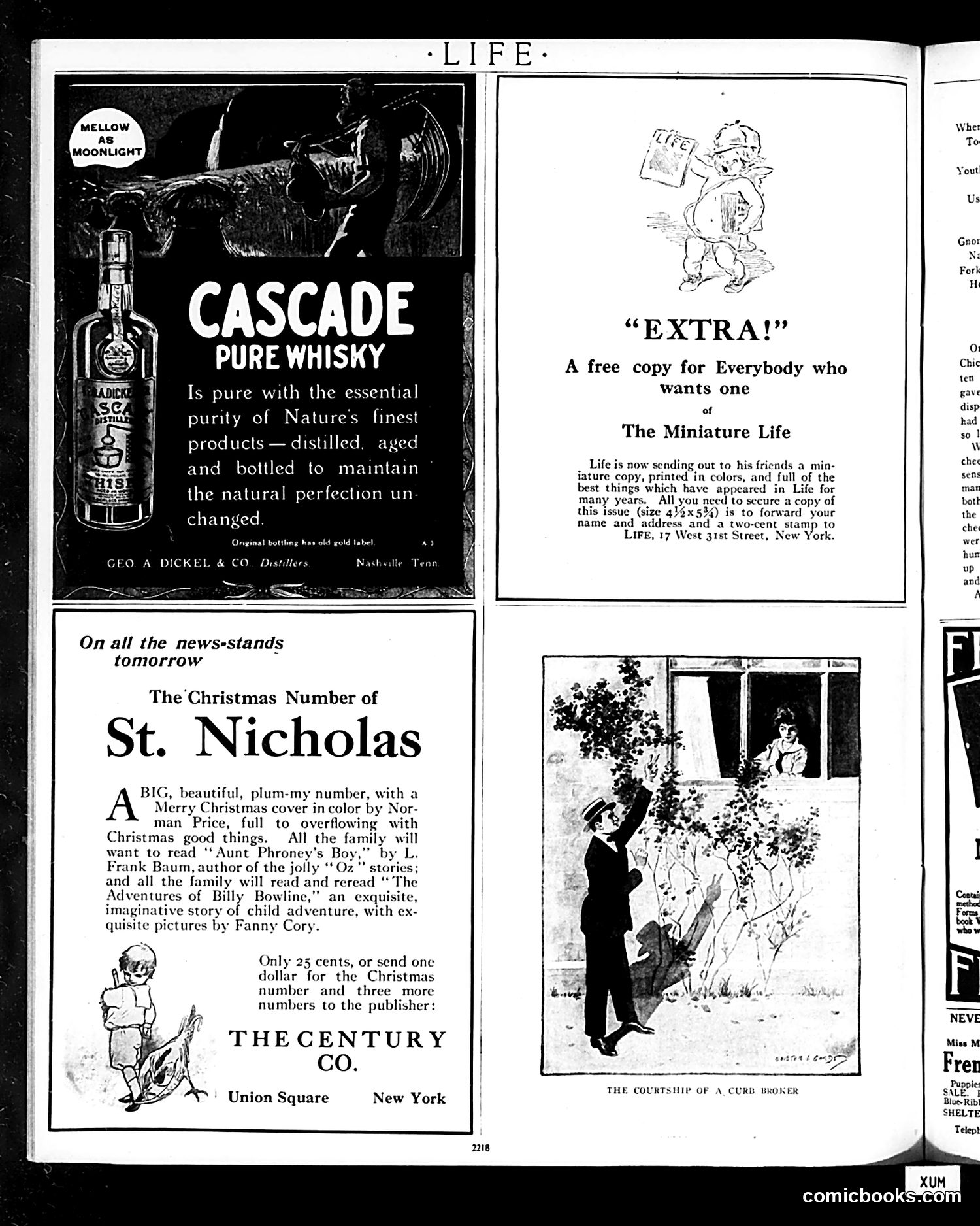
This page consists primarily of **advertisements and promotional content** rather than political satire or editorial cartoons. **Left side:** A Cascade Pure Whisky advertisement featuring a dramatic nighttime scene with a bottle, emphasizing the product's "natural perfection." Below it is a promotional notice for *St. Nicholas* magazine's Christmas issue, featuring stories by L. Frank Baum (author of *Oz*) and illustrated by Fanny Cory—aimed at family entertainment. **Right side:** A miniature reproduction offer for Life magazine itself, allowing readers to request a small colored copy by mail. Below this is an illustration titled "The Courtship of a Cure Broker," showing a man in formal dress courting a woman at a window—a romantic or comedic scene, though its specific satirical point is unclear from the image alone. The page demonstrates early 20th-century magazine monetization through advertisements and self-promotion rather than containing identifiable political commentary or caricature.
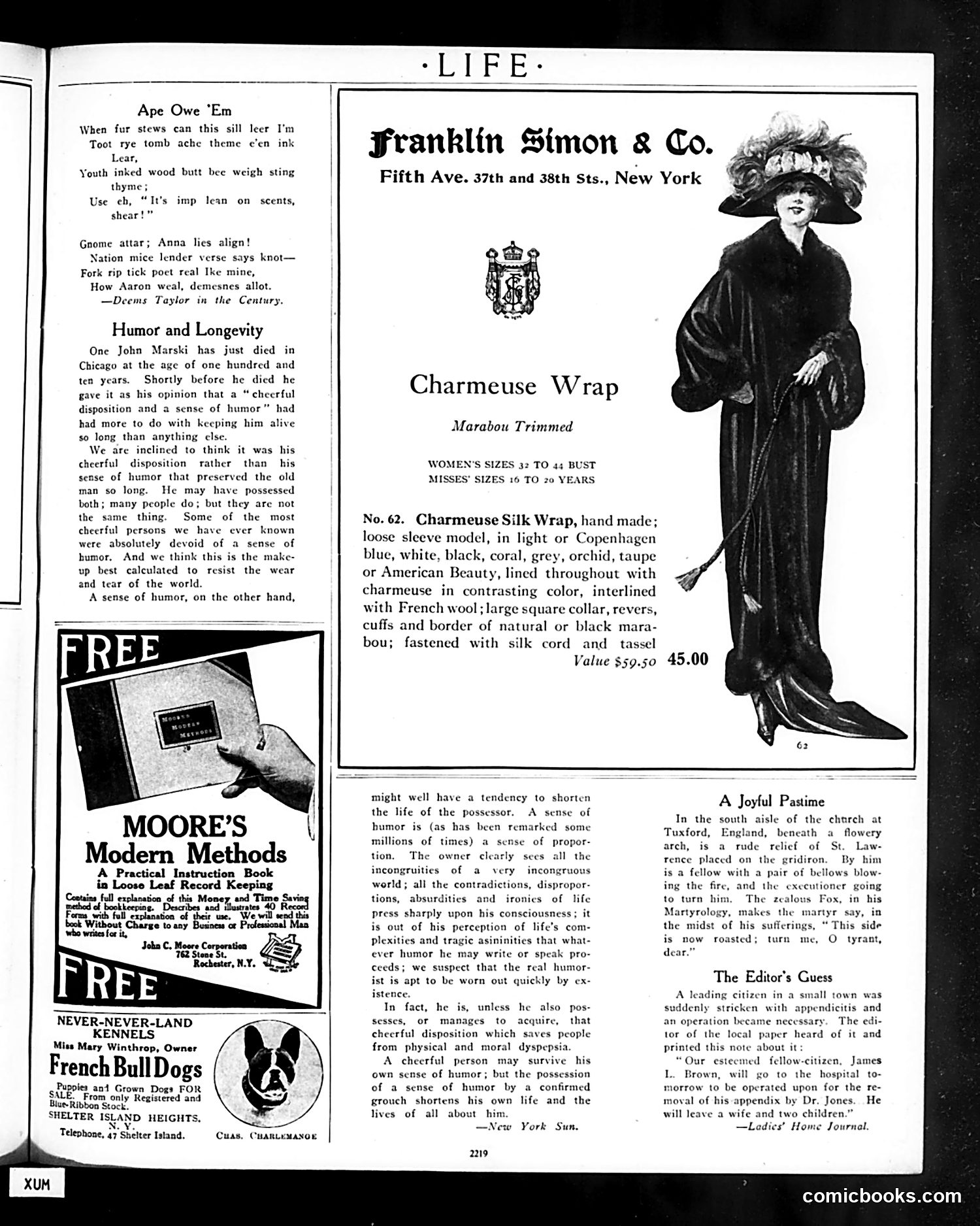
This page is primarily **advertising and editorial content** rather than political satire. The main feature is a **fashion advertisement** for Franklin Simon & Co., showcasing a "Charmeuse Wrap" (an elegant women's coat) trimmed with marabou feathers—typical luxury goods of the era. The left side contains two editorial pieces: 1. **"Age Owe 'Em"** — appears to be a phonetic poem (possibly Scottish dialect) by Deems Taylor, difficult to parse from the OCR. 2. **"Humor and Longevity"** — a brief essay arguing that while *cheerfulness* promotes long life (referencing a 110-year-old man), a sharp *sense of humor* actually wears people down by making them acutely aware of life's absurdities and contradictions. The author suggests humorists are worn out by their own perception of incongruity. The page also includes advertisements for **Moore's Modern Methods** (bookkeeping instruction), **French Bulldogs**, and a humorous anecdote about a newspaper editor's note about a town citizen's appendicitis surgery. No political cartoons are present.
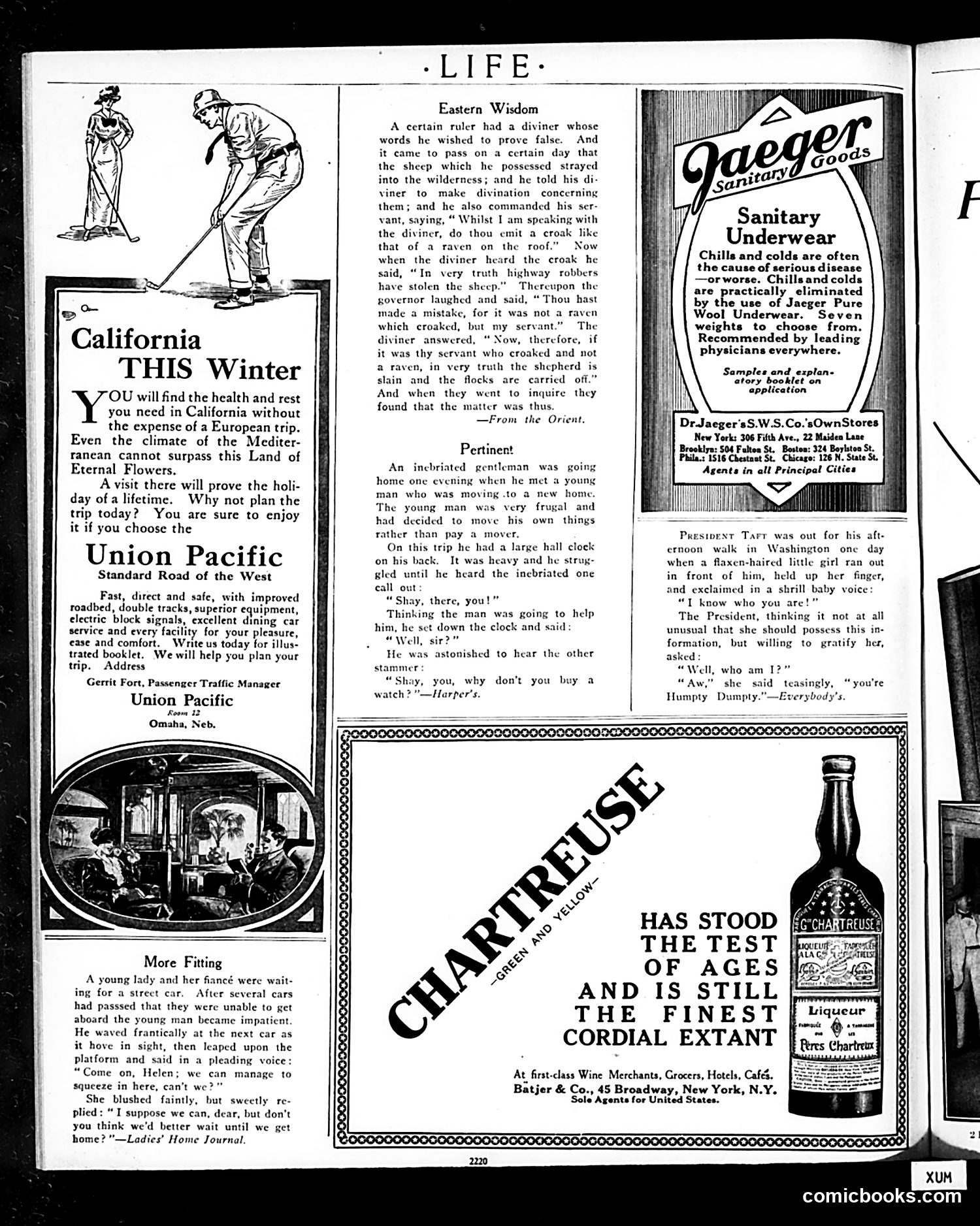
This page combines advertisements and humorous anecdotes typical of early 20th-century Life magazine. The cartoons are minimal—mostly sketch illustrations accompanying travel and product ads. **Main content includes:** - A **Union Pacific Railroad advertisement** featuring golf imagery, promoting California winter travel as an affordable alternative to European vacations - A **Jaeger wool underwear ad** emphasizing health benefits - Three **humorous short stories**: "Eastern Wisdom" (an absurdist tale about a diviner whose predictions prove paradoxically correct), "Pertinent" (a drunk man mockingly suggests a struggling mover buy a watch instead of carrying a clock), and "More Fitting" (a fiancée's suggestive double entendre about waiting until they're home to "squeeze in") - An **anecdote about President Taft** with a child who mistakes him for Humpty Dumpty - A **Chartreuse liqueur advertisement** The page emphasizes genteel humor and lifestyle content aimed at affluent readers. The cartoons serve mainly as decorative accompaniment to advertisements and satirical stories rather than standalone political commentary.
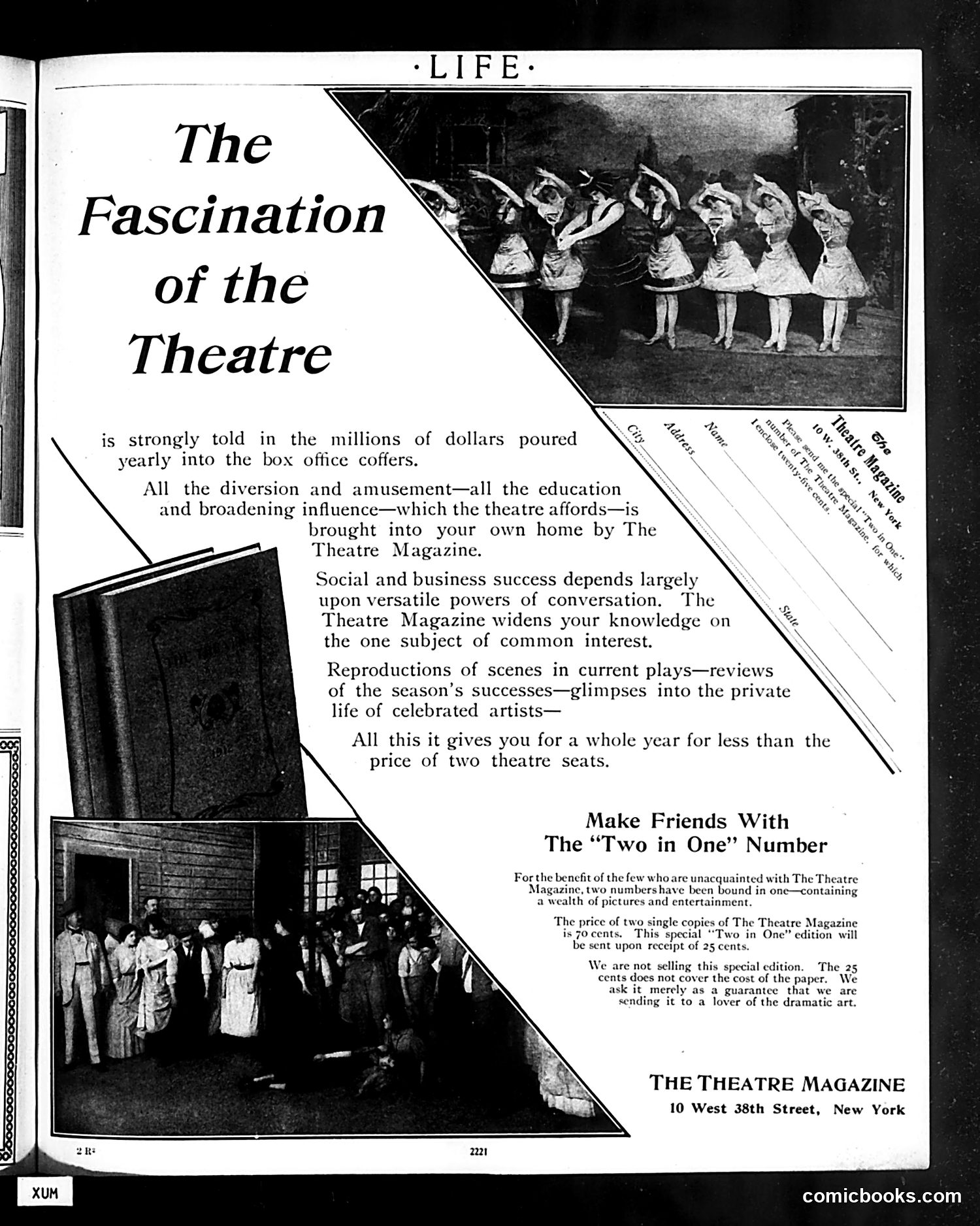
This is **advertising copy**, not satire or political commentary. The page promotes *The Theatre Magazine* to early 20th-century readers by arguing that theater knowledge enhances social standing and conversation skills. The images show: - **Top**: chorus girls in a theatrical performance - **Bottom**: what appears to be a formal social gathering or theatrical scene The pitch emphasizes that the magazine provides affordable access to theater culture—"all this" for less than two theater tickets yearly—positioning it as a status symbol. The "Two in One" offer at 25 cents (below cost, they claim) targets those unfamiliar with the publication. The core message: theater and knowledge of theater were markers of cultural refinement and social success. By reading this magazine, ordinary people could participate in that world and improve their conversational abilities—crucial for "social and business success" in that era. This reflects genuine period attitudes about self-improvement through culture consumption.
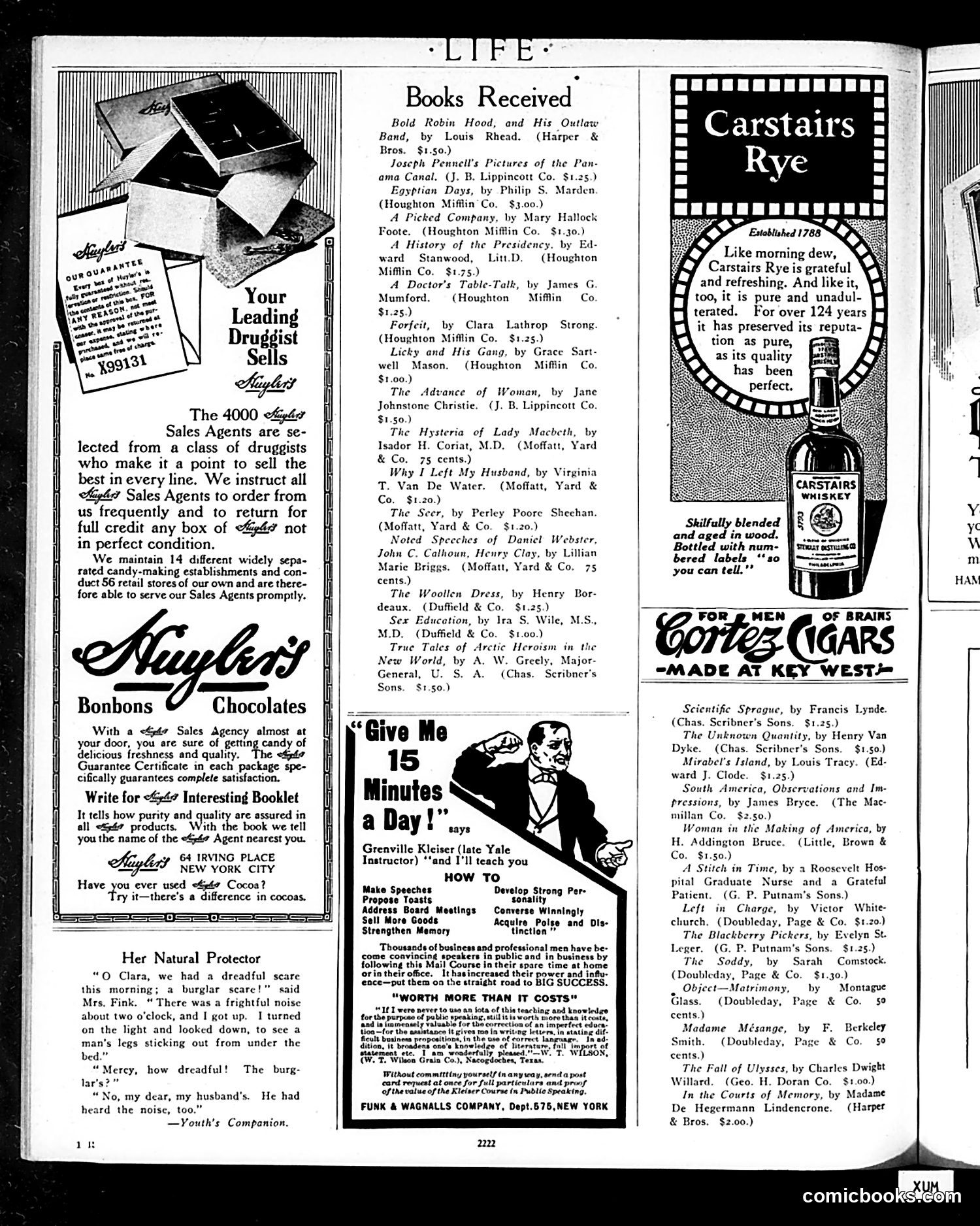
This page consists primarily of **advertisements and book listings**, not political satire. The notable humor appears in a brief anecdote titled "Her Natural Protector": A woman tells her friend about a frightening nighttime incident—she heard noise, turned on lights, and found a man's legs protruding from under her bed. The friend assumes it's a burglar. The punchline: it was actually her husband, who had also gotten up to investigate the noise. The joke plays on **domestic gender roles of the era**: it's presented as darkly humorous that the husband is portrayed as a protective figure ("natural protector"), yet the wife found him hiding under the bed—an undignified position that undermines the masculine ideal. The humor derives from this deflation of male authority in the household. The page otherwise advertises candy, cocoa, a public-speaking correspondence course, and lists recently published books on topics ranging from Robin Hood to Egyptian history to women's advancement.
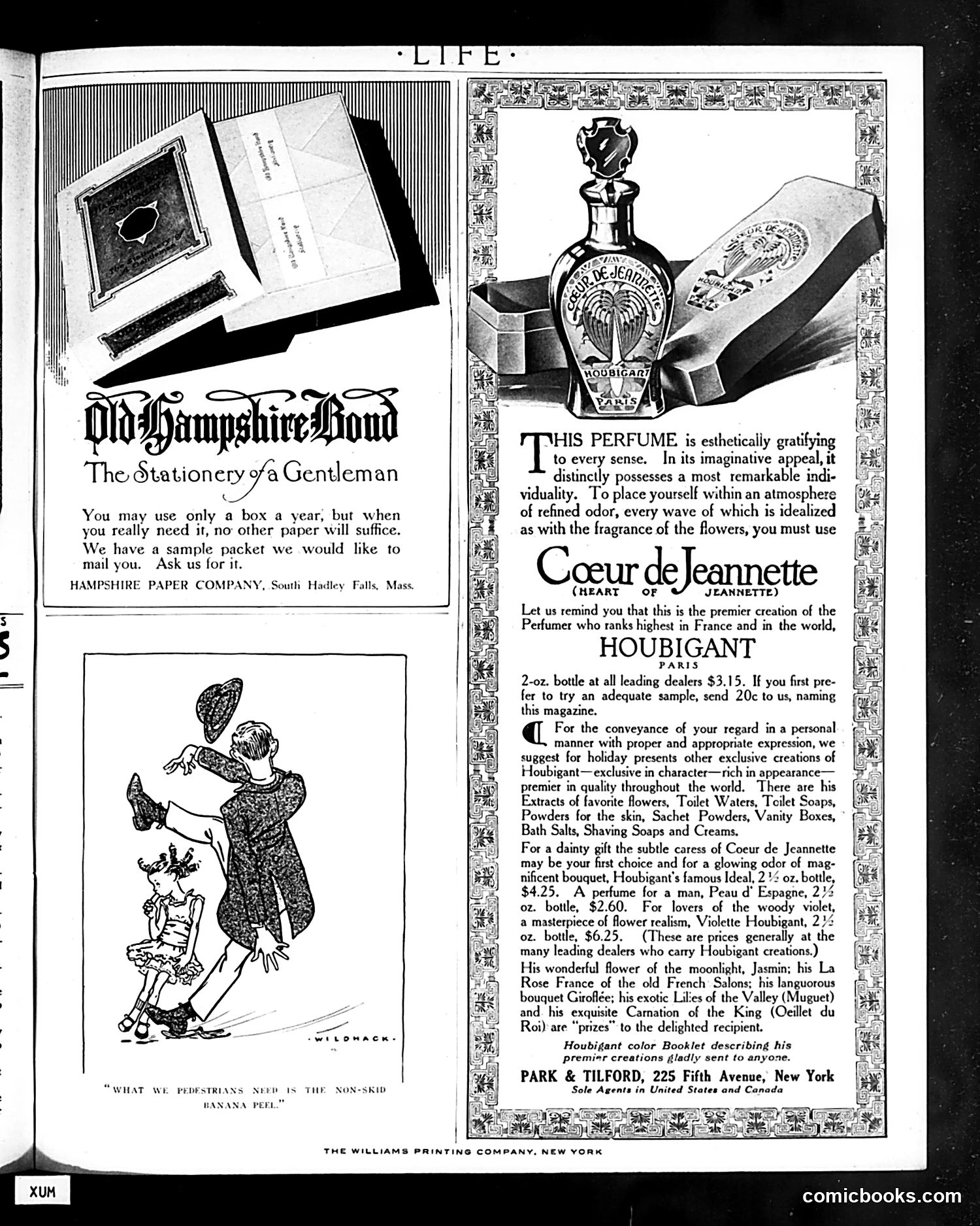
This page is primarily **advertising**, not political satire. It contains three ads with one cartoon element: The notable cartoon depicts a pedestrian juggling banana peels with the caption "What we pedestrians need is the non-skid banana peel." This is **safety satire**—a joke about urban hazards. The banana peel was a stock comedic trope in early 20th-century humor (slipping on banana peels was a staple of slapstick), so the cartoon ironically suggests making banana peels non-slip to prevent accidents. The humor lies in treating a comedy cliché as a serious safety problem requiring a product solution. The page otherwise features ads for Hampshire Paper Company stationery and Houbigant perfume (Coeur de Jeannette and other fragrances), with luxurious product descriptions and pricing typical of the era's upscale magazine advertising.
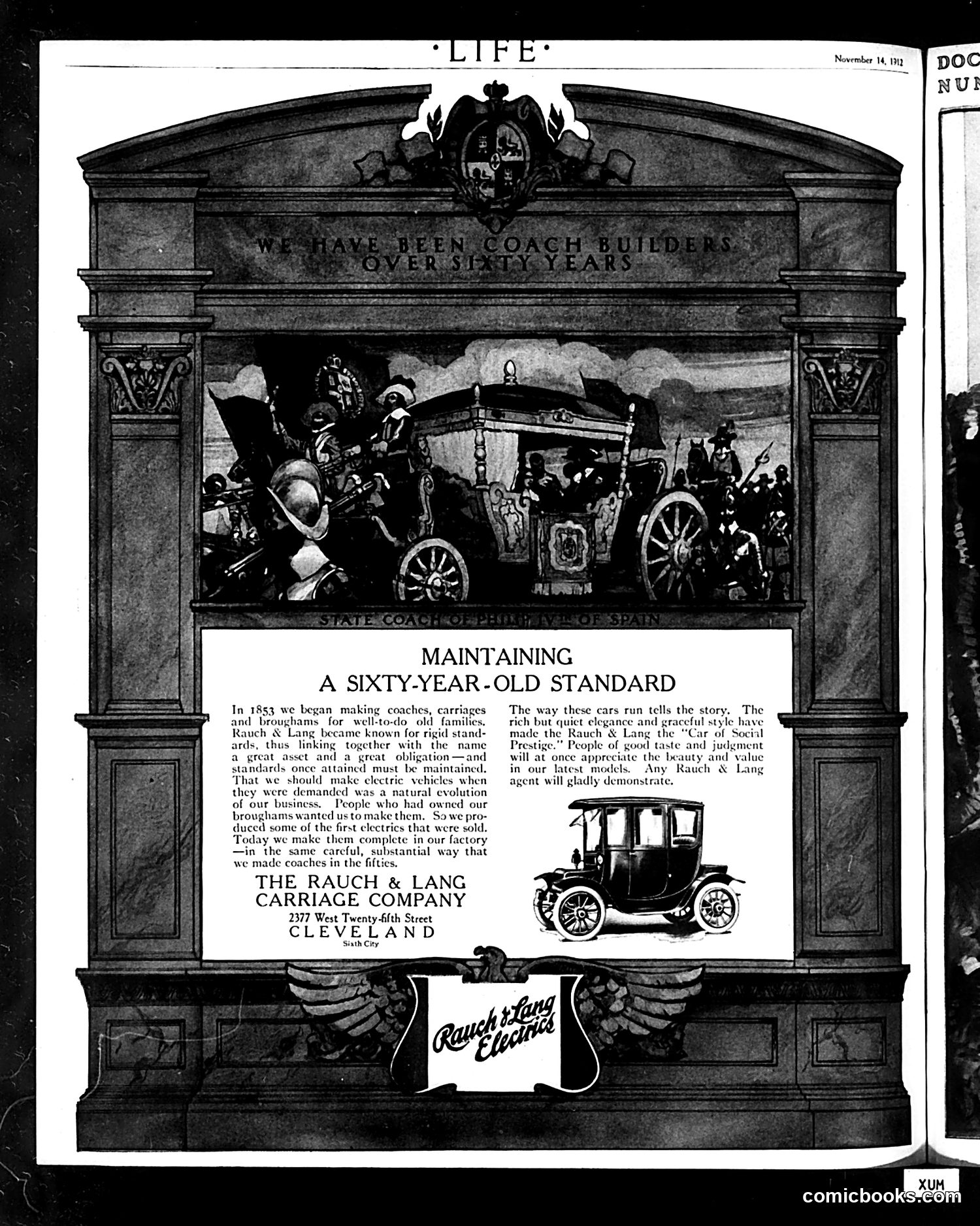
This is an **advertisement, not political satire**. The Rauch & Lang Carriage Company uses a grand classical frame (depicting a historical royal coach) to advertise their electric automobiles. The key message: since 1853, the company maintained quality standards through technological evolution—from horse-drawn carriages to early electric cars. The contrast between the ornate historical coach imagery and the modest modern electric vehicle emphasizes *continuity of craftsmanship* across 60 years. For modern context: this represents the **transition era** (early 1900s) when electric vehicles competed with gasoline cars. The ad targets wealthy, conservative consumers ("people of good taste") by assuring them that buying an electric Rauch & Lang means purchasing reliability backed by six decades of tradition—not risky new technology. The date is November 14, 1912, placing this during electric cars' final viable market period before gasoline engines dominated.