
Life, 1912-11-14 · page 20 of 44
Life — November 14, 1912 — page 20: what you’re looking at
What you’re looking at
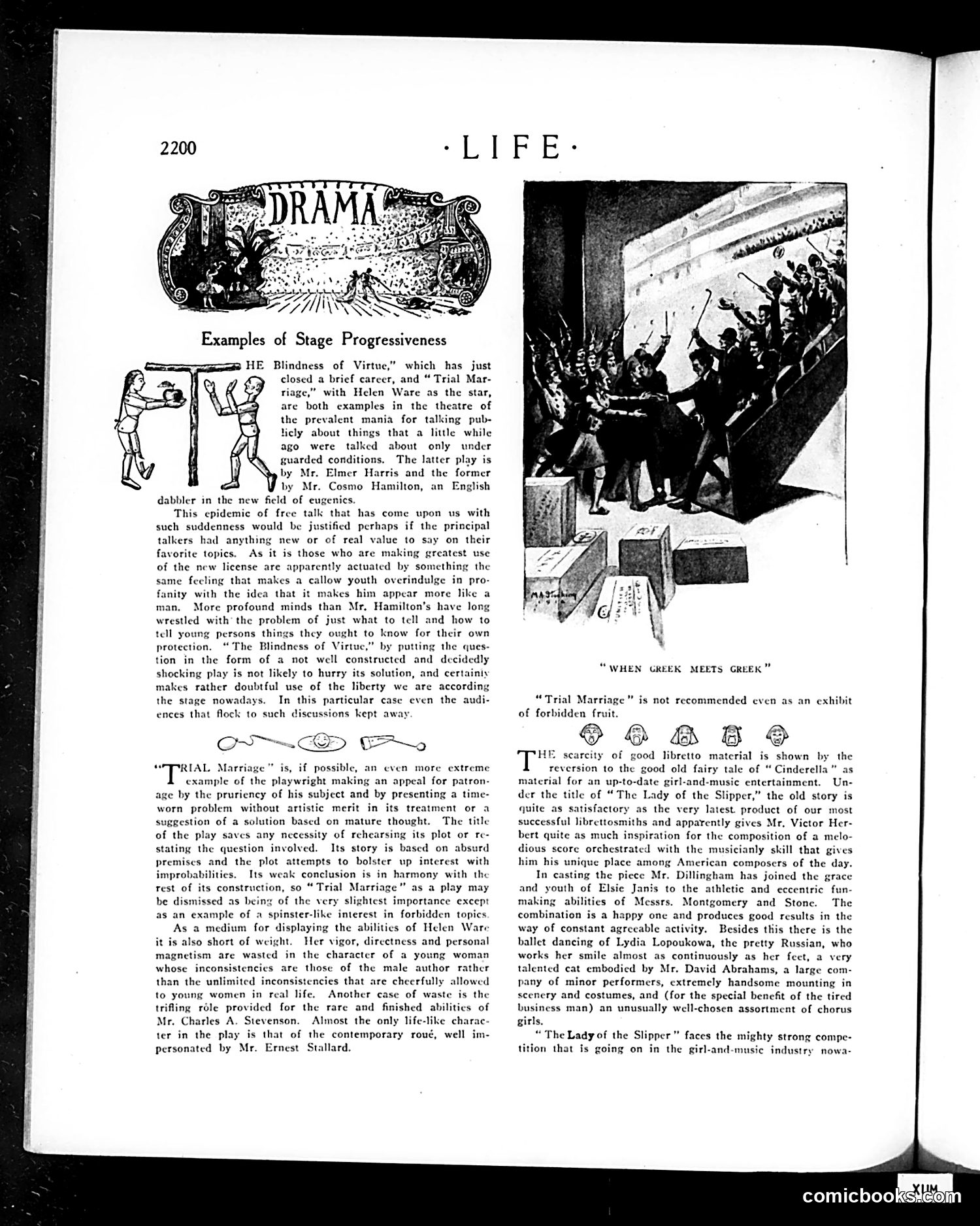
This is a theater criticism page satirizing early 1900s Broadway's obsession with "daring" plays about taboo subjects. The text mocks two plays—"The Blindness of Virtue" and "Trial Marriage"—for exploiting sexual and social topics (eugenics, premarital relations) without artistic merit, comparing their shock-value appeal to adolescent profanity use. The critic argues these plays present serious subjects superficially, with weak plots and unconvincing characters. Helen Ware's talents are "wasted" in poorly written roles. The page contrasts this trend with "The Lady of the Slipper," a Cinderella adaptation praised for combining legitimate artistry (composer Victor Herbert's score) with star power (Elsie Janis, Montgomery and Stone). The small illustrations of wrestlers or acrobats appear to reference physical theater, while "When Greek Meets Greek" is an idiom meaning conflict between equals.
📄 Transcribed text from this page (OCR, searchable)
Machine-transcribed from the original scan — historical spelling and the odd misread are preserved.
Examples of Stage Progressiveness HE Blindness of Virtue,” which has just closed a brief career, and “Trial Mar- riage,” with Helen Ware as the star, are both examples in the theatre of the prevalent mania for talking pub- Nicly about things that a little while ago were talked about only under guarded conditions. The latter play is by Mr. Elmer Harris and the former VYivy Mr. Cosmo Hamilton, an English dabbler in the new field of eugenics. This epidemic of free talk that has come upon us with such suddenness would be justified perhaps if the principal talkers had anything new or of real value to say on their favorite topics. As it is those who are making greatest use of the new license are apparently actuated by something the same fecling that makes a callow youth overindulge in pro fanity with the idea that it makes him appear more like a man, More profound minds than Mr, Hamilton's have long wrestled with’ the problem of just what to tell and how to tell young persons things they ought to know for their own protection. “The Blindness of Virtue,” by putting the ques- tion in the form of a not well constructed and decidedly shocking play is not likely to hurry its solution, and ce makes rather doubtful use of the liberty we are accordi the stage nowadays. In this particular case even the audi- ences that flock to such discussions kept away. OSSD T~ RIAL Marriage” is, if possible, an even more extreme example of the playwright making an appeal for patron- age by the pruriency of his subject and by presenting a time- worn problem without artistic merit in its treatment or a suggestion of a solution based on mature thought. The title of the play saves any necessity of rehearsing its plot or re- stating the question involved. Its story is based on absurd premises and the plot attempts to bolster up interest with improbabilities.. Its weak conclusion is in harmony with the rest of its construction, so “Trial Marriage” as a play may be dismissed as being of the very slightest importance except as an example of a spinster-like interest in forbidden topics As a medium for displaying the abilitics of Helen Ware it is also short of weight. Her vigor, directness and personal magnetism are wasted in the character of a young woman whose inconsistencies are those of the male author rathcr than the unlimited inconsistencies that are cheerfully allowed to young women in real life. Another case of waste is the trifling réle provided for the rare and finished abilities of Mr. Charles A. Stevenson. Almost the only life-like charac- ter in the play is that of the contemporary roué, well im- personated by Mr. Ernest Stallard. “WHEN GREEK MEETS GREEK” “Trial Marriage” is not recommended even as an exhibit of forbidden fruit. HE scarcity of good libretto material is shown by the reversion to the good old fairy tale of “ Cinderella material for an up-to-date girl-and-music entertainment. U: der the title of “The Lady of the Slipper,” the old story is quite as satisfactory as the very latest. product of our most successful librettosmiths and apparently gives Mr. Victor Her- bert quite much inspiration for the composition of a melo- dious score orchestrated with the musicianly skill that gives him his unique place among American composers of the day. In casting the piece Mr. Dillingham has joined the grace and youth of Elsie Janis to the athletic and eccentric fun- making abilities of Messrs. Montgomery and Stone. The combination is a happy one and produces good results in the way of constant agreeable activity. Besides this there is the ballet dancing of Lydia Lopoukowa, the pretty Russian, who works her smile almost as continuously as her fect, a very talented cat embodied by Mr. David Abrahams, a large con pany of minor performers, extremely handsome mounting in scenery and costumes, and (for the special benefit of the tired business man) an unusually well-chosen assortment of chorus girls, “ The Lady of the Slipper” faces the mighty strong compe- tition that is going on in the girl-and-music industry nowa- comicbookie 7