
Life, 1912-11-14 · page 26 of 44
Life — November 14, 1912 — page 26: what you’re looking at
What you’re looking at
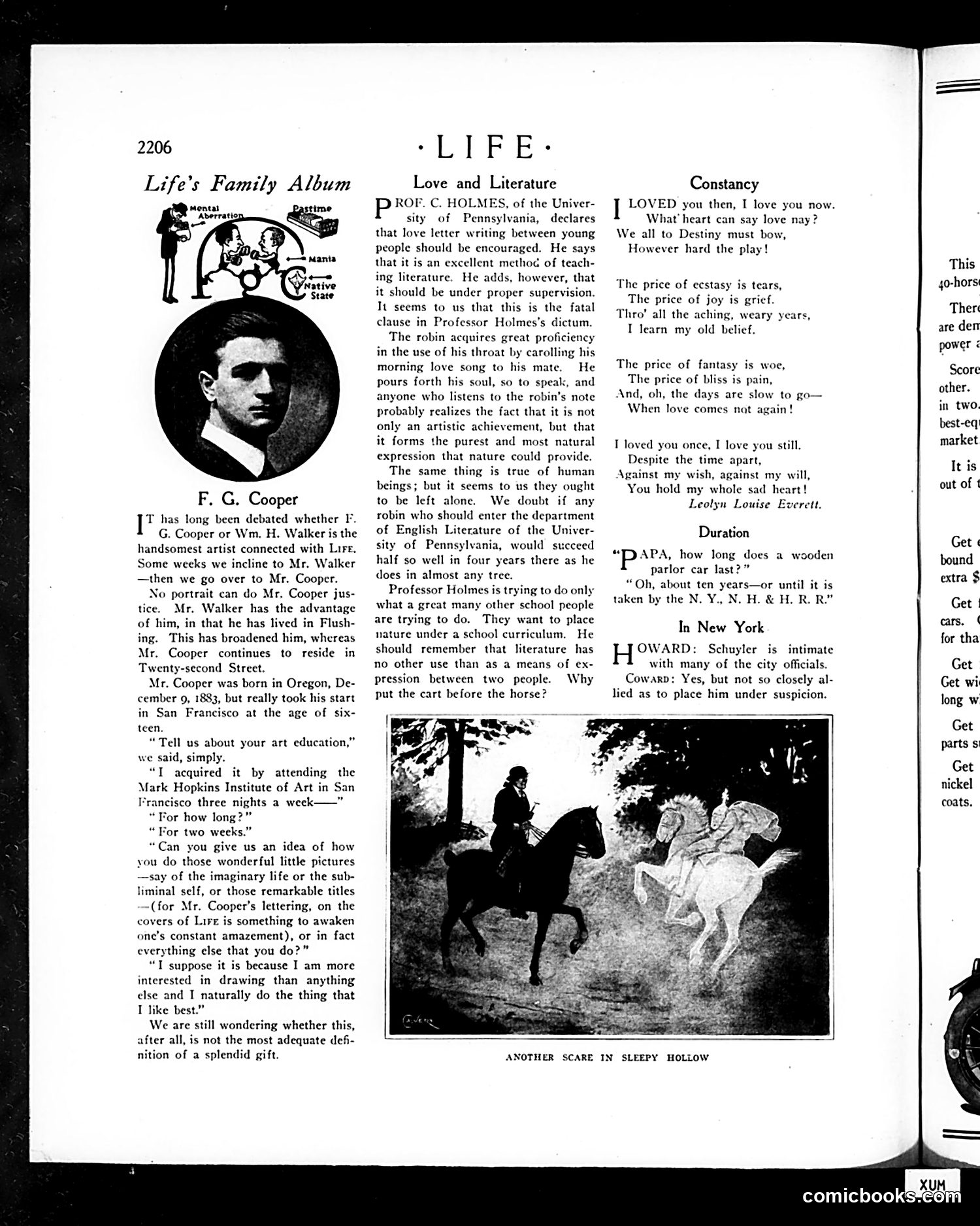
This page from *Life* magazine features a profile of artist **F. G. Cooper**, presented as light editorial humor. The text humorously debates whether Cooper or fellow artist Wm. H. Walker is more handsome, then playfully critiques Cooper's minimalist explanation of his artistic process—essentially that he draws because he enjoys drawing. The accompanying sections include: **"Love and Literature"**: Professor C. Holmes of University of Pennsylvania advocates supervised love-letter writing as educational. The editors sarcastically compare this to a robin singing naturally; their point is that forcing nature into academic structure defeats its purpose. **Poetry and Humor Sections**: These include romantic verse on constancy, a joke about railroad durability (the N.Y., N.H. & H.R.R. apparently claimed wooden cars), and a quip about New York politician Schuyler's connections. **Image**: Shows a horseman in what appears to be a Gothic scene, captioned "Another Scare in Sleepy Hollow"—likely referencing Irving's *Headless Horseman* tale. The overall tone is gentle satire typical of *Life*'s era.
📄 Transcribed text from this page (OCR, searchable)
Machine-transcribed from the original scan — historical spelling and the odd misread are preserved.
2206 Life’s Family Albu F. G. Cooper T has long been debated whether F. G. Cooper or Wm. H. Walker is the handsomest artist connected with Lire. Some weeks we incline to Mr. Walker —then we go over to Mr. Cooper. ‘0 portrait can do Mr. Cooper jus- tice. Mr. Walker has the advantage of him, in that he has lived in Flush- ing. This has broadened him, whereas Mr. Cooper continues to reside in Twenty-second Street. Mr. Cooper was born in Oregon, De- cember 9, 1883, but really took his start in San Francisco at the age of six- teen, “Tell us about your art education,” we said, simply. “I acquired it by attending the Mark Hopkins Institute of Art in San Francisco three nights a week——” “For how long?” “For two weeks.” “Can you give us an idea of how you do those wonderful little pictures. —say of the imaginary life or the sub- liminal self, or those remarkable titles (for Mr. Cooper’s lettering, on the covers of Lire is something to awaken one’s constant amazement), or in fact everything else that you do?” “T suppose it is because I am more interested in drawing than anything else and I naturally do the thing that I like best.” We are still wondering whether this, after all, is not the most adequate defi- nition of a splendid gift. ‘LIFE: Love and Literature ROF. C. HOLMES, of the Univer- sity of Pennsylvania, declares that love letter writing between young people should be encouraged. He says that it is an excellent methoc of teach- ing literature. He adds, however, that it should be under proper supervision. It seems to us that this is the fatal clause in Professor Holmes’s dictum. The robin acquires great proficiency in the use of his throat by carolling his morning love song to his mate. He pours forth his soul, so to speak, and anyone who listens to the robin’s note probably realizes the fact that it is not only an artistic achievement, but that it forms the purest and most natural expression that nature could provide. The same thing is true of human beings; but it seems to us they ought to be left alone. We doubt if any robin who should enter the department of English Literature of the Univer- sity of Pennsylvania, would succeed half so well in four years there as he does in almost any tree. Professor Holmes is trying to do only what a great many other school people are trying to do. They want to place nature under a school curriculum. He should remember that literature has no other use than as a means of ex- pression between two people. Why put the cart before the horse? Constancy LOVED you then, I love you now. What heart can say love nay? We all to Destiny must bow, However hard the play! The price of ecstasy is tears, The price of joy is gr Thro’ all the aching, weary years, I learn my old belief. The price of fantasy is woe, The price of bliss is pain, And, oh, the days are slow to go— When love comes nat again! T loved you once, I love you still. Despite the time apart, Against my wish, against my will, You hold my whole sad heart! Leolyn Louise Everett. Duration “DAPA, how long does a wooden parlor car last?” “Oh, about ten years—or until it is taken by the N. Y., N. H. & H.R. R.” In New York OWARD: Schuyler is intimate with many of the city officials. Cowarp: Yes, but not so closely al- lied as to place him under suspicion. ANOTHER SCARE IN SLEEPY HOLLOW \ This 4o-horsi Ther are den power Score other. in two, best-eq' market It is out of 1 Get « bound extra $ Get | cars. | for tha Get Get wi long w Get parts si Get nickel coats. comicbookdeeam