
Life, 1912-11-14 · page 28 of 44
Life — November 14, 1912 — page 28: what you’re looking at
What you’re looking at
This page contains **no cartoon** but rather reader letters on economic policy during the 1912 election season. **Key Content:** The letters critique **President Taft's administration**. One writer proposes an Oregon county create its own bank using real estate as collateral—avoiding expensive bond intermediaries—citing the historical success of Venice's Bank. Another letter attacks **Taft's tariff policy**, claiming his managers say it costs citizens only $3.46 annually, but the actual per-capita burden is $34.60—a 10% tax on national wealth ($346 million). The writer also accuses **Taft and Interior Secretary Richard Ballinger** (implied by "Warren") of blocking Western homesteaders by raising land prices to $150/acre—affordable only to wealthy coal interests like industrialist George Baer, not ordinary settlers. **Context:** This reflects Progressive Era criticism of Taft for favoring big business over common people, contributing to the Republican Party split that helped elect Wilson in 1912.
📄 Transcribed text from this page (OCR, searchable)
Machine-transcribed from the original scan — historical spelling and the odd misread are preserved.
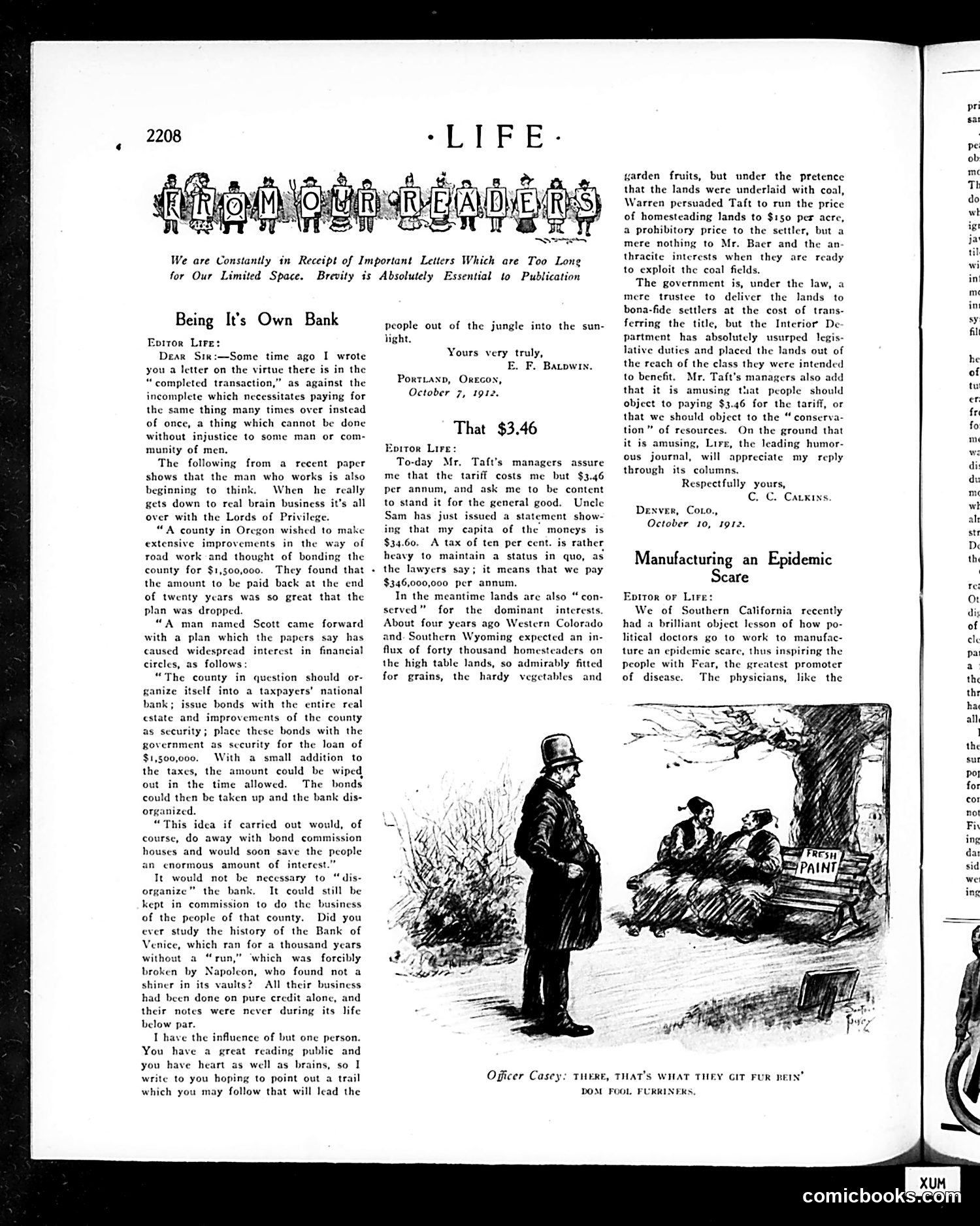
We are Constantly in Receipt of Important Letters Which are Too Long for Our Limited Space. Brevity is Absolutely Essential to Publication Being It’s Own Bank Evrtor Lire: Dear Six:—Some time ago I wrote you a letter on the virtue there is in the “completed transaction,” as against the incomplete which necessitates paying for the same thing many times over instead of once, a thing which cannot be done without injustice to some man or com- munity of men. The following from a recent paper shows that the man who works is also beginning to think, When he really gets down to real brain business it’s all over with the Lords of Privilege. “A county in Oregon wished to make extensive improvements in the way of road work and thought of bonding the county for $1,300,000. They found that the amount to be paid back at the end of twenty years was so great that the plan was dropped. A man named Scott came forward with a plan which the papers say has caused widespread interest in financial circles, as follow: “The county in question should or- ganize itself into a taxpayers’ national bank; issue bonds with the entire real estate and improvements of the county as security; place these bonds with the government as security for the loan of $1,500,000. With a small addi to the taxes, the amount could be wiped out in the time allowed. The bonds could then be taken up and the bank dis- organized. “This idea if carried out would, of course, do away with bond commission houses and would soon save the pcople an enormous amount of interest.” It would not be necessary to “ dis- organize” the bank. It could still be kept in commission to do the business of the people of that county. Did you ever study the history of the Bank of Venice, which ran for a thousand ye without * ‘which was for broken by Napoleon, who found not a shiner in its vaults? All their business had been done on pure credit alone, and their notes were never during its life below par. I have the influence of but one person. You have a great reading public and you have heart as well as brains, so I write to you hoping to point out a trail which you may follow that will lead the people out of the jungle into the sun- light. Yours very truly, E. F. Barpwiy. Portiaxp, Orecos October 7, 1912. That $3.46 Epitor Lire: To-day Mr, Taft’s managers assure me that the tariff costs me but $3.46 per annum, and ask me to be content to stand it for the general good. Uncle Sam has just issued a statement show- ing that my capita of the moneys is $34.60. A tax of ten per cent. is rather heavy to maintain a status in quo, as the lawyers say; it means that we pay $346,000,000 per annum. In the meantime lands are also “ con- served” for the dominant interests. About four years ago Western Colorado and. Southern Wyoming expected an in- flux of forty thousand homesteaders on the high table lands, so admirably fitted for grains, the hardy vegetables and garden fruits, but under the pretence that the lands were underlaid with coal, Warren persuaded Taft to run the price of homesteading lands to $150 per acre, a prohibitory price to the settler, but a mere nothing to Mr. Baer and the an- thracite interests when they are ready to exploit the coal fields. The government is, under the law, a mere trustee to deliver the lands to bona-fide settlers at the cost of trans- ferring the title, but the Interior De partment has absolutely usurped legis- lative duties and placed the lands out of the reach of the class they were intended to benefit. Mr. Taft's managers also add that it is amusing that people should object to paying $3.46 for the tariff, or that we should object to the “ conserva- tion” of resources. On the ground that it is amusing, Lire, the leading humor- ous journal, will appreciate my reply through its columns. Respectfully yours, C. C. Carxins Denver, Cou October 10, 1912. Manufacturing an Epidemic Scare Eptror oF Lire We of Southern California recently had a brilliant object lesson of how po- litical doctors go to work to manufac- ture an epidemic scare, thus inspiring the people with Fear, the greatest promoter of disease. The physicians, like the Officer Casey: THERE, THAT'S WHAT THEY GIT FUR REIN’ DOM FOOL FURRINERS, in cor not Fix ing das sid we ing comicbookMeem