
Life, 1912-11-14 · page 8 of 44
Life — November 14, 1912 — page 8: what you’re looking at
What you’re looking at
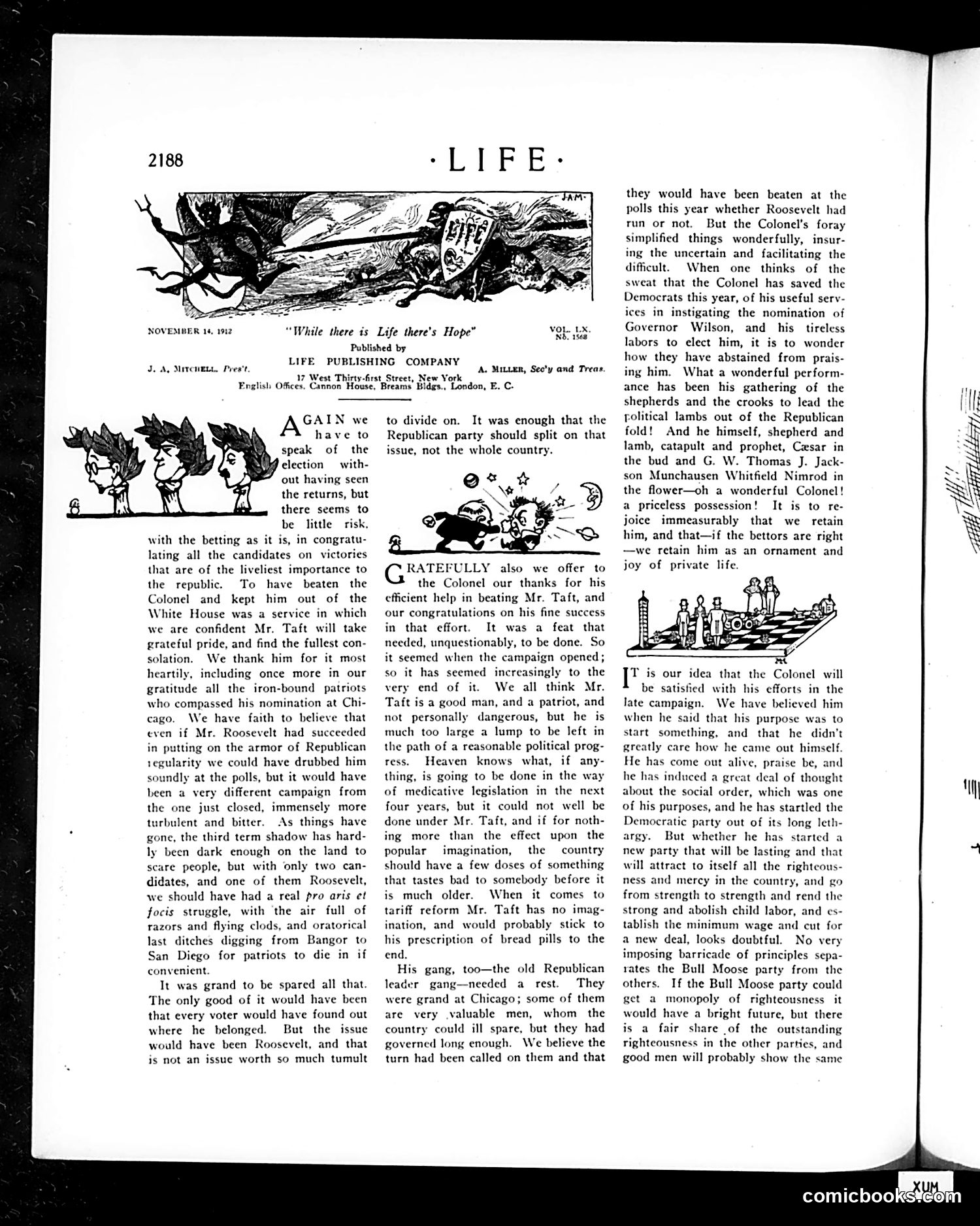
This page discusses the 1912 presidential election aftermath. The text praises Colonel Theodore Roosevelt for staying out of the Republican Party split, crediting him with helping defeat William Howard Taft and keeping Republicans unified enough to prevent a Democratic victory. The cartoons (top and middle) appear to show election-related figures in satirical situations, though specific identities are unclear from the image quality. The article thanks Roosevelt for his "efficient help in beating Mr. Taft" and suggests the Colonel's withdrawal from politics was dignified. It expresses hope that the Republican Party can reunify and warns against the "Bull Moose party" becoming permanent, arguing the country needs strong Republican opposition to the Democrats. The overall tone celebrates Roosevelt's restraint while lamenting the party's recent turmoil.
📄 Transcribed text from this page (OCR, searchable)
Machine-transcribed from the original scan — historical spelling and the odd misread are preserved.
NOVEMBER 14, 1912 “While there is Life there's Hope” Published by LIFE JA, MITCHELL, Pres't PUBLISHING COMPANY A. Mitten, Seo'y and Treas. 17 West Thirty-first Street, New York English Offices, Cannon House, Breams’ Bidgs., London, E. C- GAIN we have to speak of the J election with- out having seen the returns, but there seems to be little risk, with the betting as it is, in congratu- lating all the candidates on victori that are of the liveliest importance to the republic. To have beaten the Colonel and kept him out of the White House was a service in which we are confident Mr. Taft will take grateful pride, and find the fullest con- solation. We thank him for it most heartily, including once more in our gratitude all the iron-bound patriots who compassed his nomination at Chi- cago. We have faith to believe that even if Mr. Roosevelt had succeeded in putting on the armor of Republican regularity we could have drubbed him soundly at the polls, but it would have been a very different campaign from the one just closed, immensely more turbulent and bitter. As things have gone, the third term shadow has hard- ly been dark enough on the land to scare people, but with only two can- didates, and one of them Roosevelt, we should have had a real pro aris et focis struggle, with ‘the air full of razors and flying clods, and oratorical last ditches digging from Bangor to San Diego for patriots to die in if convenient. It was grand to be spared all that. The only good of it would have been that every voter would have found out where he belonged. But the issue would have been Roosevelt, and that is not an issue worth so much tumult to divide on. It was enough that the Republican party should split on that issue, not the whole country. RATEFULLY also we offer to the Colonel our thanks for his efficient help in beating Mr. Taft, and our congratulations on his fine success in that effort. It was a feat that needed, unquestionably, to be done. So it seemed when the campaign opened; so it has seemed increasingly to the very end of it. We all think Mr. Taft is a good man, and a patriot, and not personally dangerous, but he is much too large a lump to be left in the path of a reasonable political prog- ress. Heaven knows what, if an: thing, is going to be done in the way of medicative legislation in the next four years, but it could not well be done under Mr. Taft, and if for noth- ing more than the effect upon the popular imagination, the country should have a few doses of something that tastes bad to somebody before it is much older. When it comes to tariff reform Mr. Taft has no imag- ination, and would probably stick to his prescription of bread pills to the end. His gang, too—the old Republican leader gang—needed a rest. They were grand at Chicago; some of them are very .valuable men, whom the country could ill spare, but they had governed long enough. We believe the turn had been called on them and that they would have been beaten at the polls this year whether Roosevelt had run or not. But the Colonel’s foray simplified things wonderfully, insur- ing the uncertain and facilitating the difficult. When one thinks of the sweat that the Colonel has saved the Democrats this year, of his useful serv- ices in instigating the nomination of Governor Wilson, and his tireless labors to elect him, it is to wonder how they have abstained from prais- ing him. What a wonderful perform- ance has been his gathering of the shepherds and the crooks to lead the political lambs out of the Republican fold! And he himself, shepherd and lamb, catapult and prophet, Cxsar in the bud and G. W. Thomas J. Jack- son Munchausen Whitfield Nimrod in the flower—oh a wonderful Colonel! a priceless possession! It is to re- joice immeasurably that we retain him, and that—if the bettors are right —we retain him as an ornament and joy of private life. a is our idea that the Colonel will be satisfied with his efforts in the late campaign. We have believed him when he said that his purpose was to start something, and that he didn’t greatly care how he came out himself. He has come out alive, praise be, and he has induced a great deal of thought about the social order, which was one of his purposes, and he has startled the Democratic party out of its long leth- argy. But whether he has started a new party that will be lasting and that will attract to itself all the rightcous- ness and mercy in the country, and go from strength to strength and rend the strong and abolish child labor, and es- tablish the minimum wage and cut for a new deal, looks doubtful. No very imposing barricade of principles sepa- rates the Bull Moose party from the others. If the Bull Moose party could get a monopoly of righteousness it would have a bright future, but there is a fair share of the outstanding righteousness in the other parties, and good men will probably show the same comicboohedh