
Life, 1912-11-14 · page 16 of 44
Life — November 14, 1912 — page 16: what you’re looking at
What you’re looking at
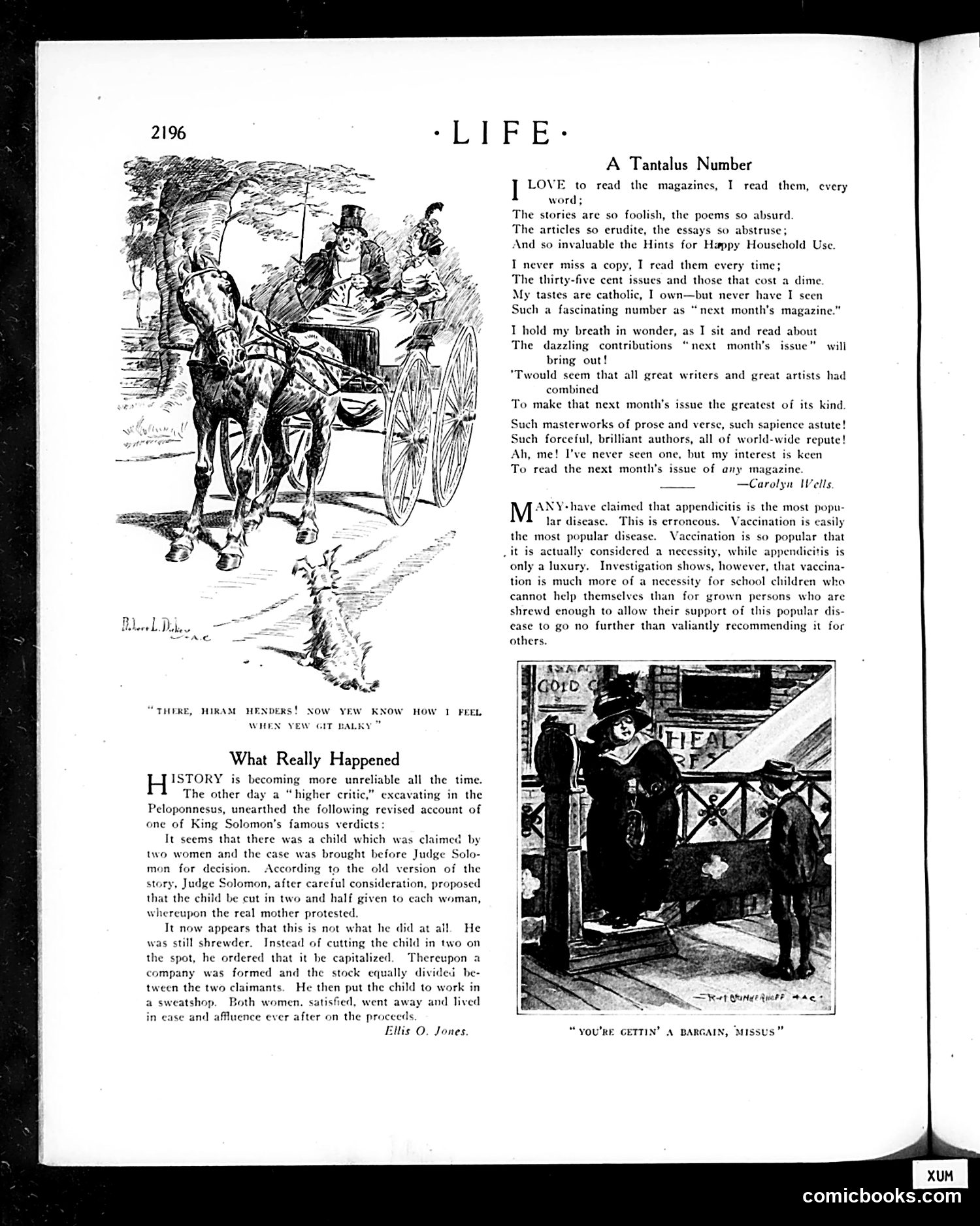
The top cartoon satirizes rural life and stubbornness. A man with a horse-drawn cart addresses another man (Hiram Henders), suggesting the speaker now understands how frustrating it is when someone (Hiram) acts "balky" (stubborn/uncooperative)—using the horse as a visual metaphor. The main article, "What Really Happened," is a mock-serious critique of how history gets rewritten. It humorously "revises" the biblical story of King Solomon's famous judgment about two women and a child. Instead of the wisdom tale where Solomon proposes cutting the child in half to reveal the true mother, this "modern" version claims Solomon actually *capitalized* the child—formed a company, divided stock between the women, and put the child to work in a sweatshop. This satirizes early 1900s industrial capitalism and child labor exploitation, suggesting that modern profit-seeking has corrupted even ancient moral wisdom. The satire targets contemporary greed and the commodification of human life.
📄 Transcribed text from this page (OCR, searchable)
Machine-transcribed from the original scan — historical spelling and the odd misread are preserved.
-LIFE- “THERE, HIRAM HENDERS! NOW YEW KNOW HOW 1 FEEL WHEN VEW GIT BALKY What Really Happened ISTORY is becoming more unreliable all the time. The other day a “higher critic,” excavating in the Peloponnesus, unearthed the following revised account of one of King Solomon's famous verdict It seems that there was a child which was claimed by two women and the case was brought before Judge Solo- mon for decision. According to the old version of the story, Judge Solomon, after careful consideration, proposed that the child be cut in two and half given to cach woman, whereupon the real mother protested. It now appears that this is not what he did at all. He was still shrewder. Instead of cutting the child in two on the spot, he ordered that it be capitalized. Thereupon a company was formed and the stock equally divided be- He then put the child to work in a sweatshop. Both women. satisfied, went away and lived in case and affluence ever after on the proceeds. Ellis O. Jones. tween the two claimants. A Tantalus Number LOVE to read the magazines, I read them, every word; The stories are so foolish, the poems so absurd The articles so erudite, the essays so abstrus And so invaluable the Hints for Happy Household Use. I never miss a copy, I read them every time; The thirty-five cent issues and those that cost a dime. My tastes are catholic, I own—but never have I seen Such a fascinating number as “next month’s magazine.” T hold my breath in wonder, as I sit and read about The dazzling contributions “next month's issue” will bring out! 'Twould seem that all great writers and great artists had combined To make that next month's issue the greatest of its kind. Such masterworks of prose and verse, such sapience astute! Such forceful, brilliant authors, all of world-wide repute! Ah, me! I’ve never seen one, but my interest is keen To read the next month’s issue of any magazine. —Carolyn Wells. ANY-have claimed that appendicitis is the most popu- lar disease. This is erroncous. Vaccination is easily the most popular disease. Vaccination is so popular that _it is actually considered a necessity, while appendicitis is only a luxury, Investigation shows, however, that vaccina- tion is much more of a necessity for school children who cannot help themselves than for grown persons who are shrewd enough to allow their support of this popular dis- case to go no further than valiantly recommending it for others. comicbooks.com