
Life, 1912-11-14 · page 24 of 44
Life — November 14, 1912 — page 24: what you’re looking at
What you’re looking at
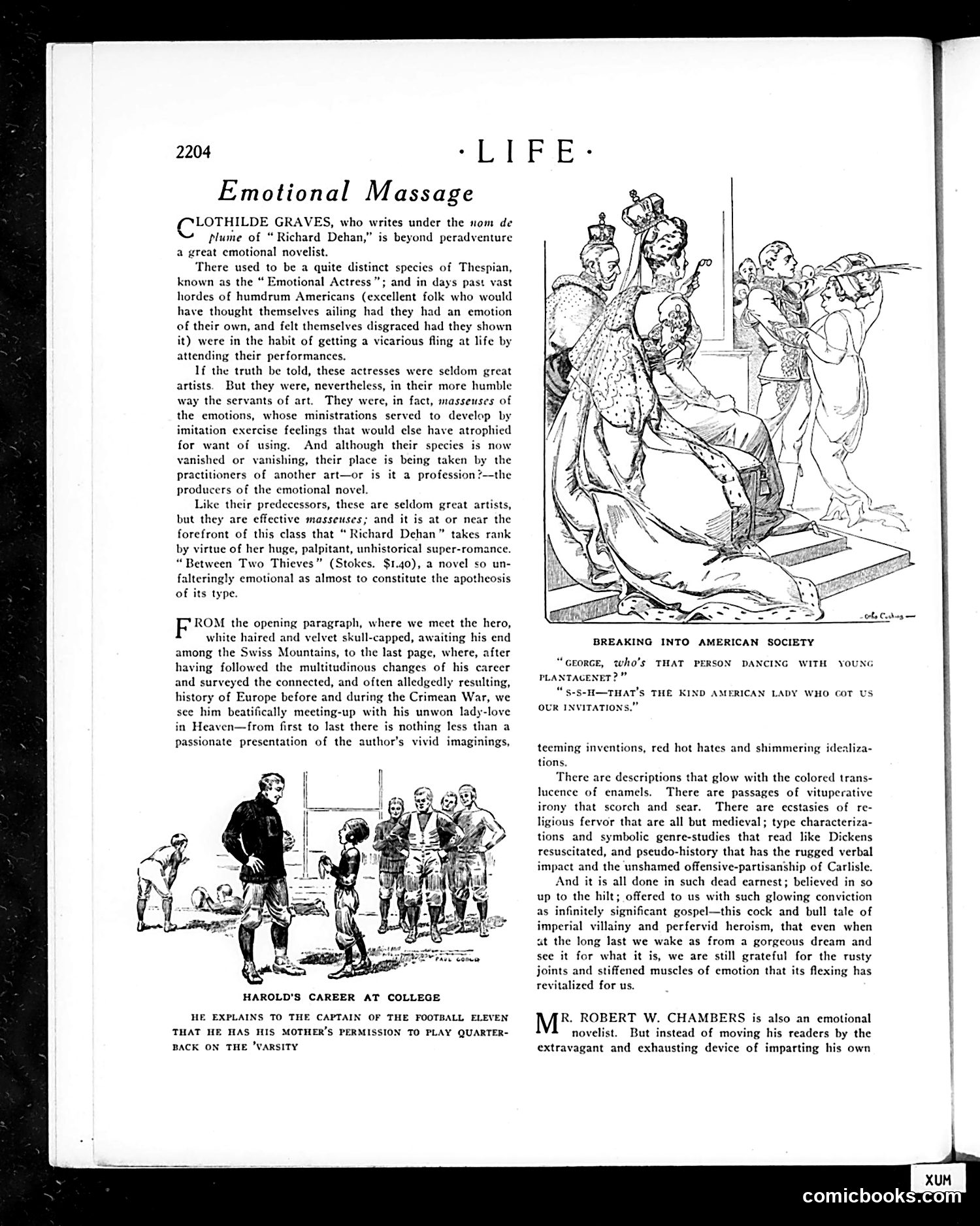
This *Life* magazine page satirizes "emotional" novelists—writers like Clothilde Graves (pen name "Richard Dehan") who manipulate readers' feelings through melodramatic plots rather than artistic merit. The article uses the metaphor of "emotional massage"—these writers are "masseuses of the emotions," exercising feelings that ordinary Americans supposedly lack in real life. The two cartoons mock American social anxieties: the upper cartoon shows confusion about a "person" of unclear social status crashing high society ("that's the kind American lady who got us our invitations"), while the lower cartoon depicts a mother giving her son permission to play college football—trivial domestic moments contrasted with the page's discussion of grand historical fiction. The satire suggests such novels are effective but artistically shallow—providing emotional stimulation to readers who live emotionally stunted lives, much like a physical massage for atrophied muscles.
📄 Transcribed text from this page (OCR, searchable)
Machine-transcribed from the original scan — historical spelling and the odd misread are preserved.
2204 Emotional Massage LOTHILDE GRAVES, who writes under the nom de plume of “Richard Dehan,” is beyond peradventure a great emotional novelist. There used to be a quite distinct species of Thespian, known as the “ Emotional Actress”; and in days past vast hordes of humdrum Americans (excellent folk who would have thought themselves ailing had they had an emotion of their own, and felt themselves disgraced had they shown it) were in the habit of getting a vicarious fling at life by attending their performances. lf the truth be told, these actresses were seldom great artists. But they were, nevertheless, in their more humble way the servants of art. They were, in fact, masseuses of the emotions, whose ministrations served to develop by imitation exercise feelings that would else have atrophied for want of using. And although their species is now vanished or vanishing, their place is being taken by the Practitioners of another art—or is it a profession?—the producers of the emotional novel. Like their predecessors, these are seldom great artists, but they are effective masseuses; and it is at or near the forefront of this class that “ Richard Dehan” takes rank by virtue of her huge, palpitant, unhistorical super-romance. “Between Two Thieves” (Stokes. $1.40), a novel so un- falteringly emotional as almost to constitute the apotheosis of its type. ROM the opening paragraph, where we meet the hero, white haired and velvet skull-capped, awaiting his end among the Swiss Mountains, to the last page, where, after having followed the multitudinous changes of his career and surveyed the connected, and often alledgedly resulting, history of Europe before and during the Crimean War, we see him beatifically meeting-up with his unwon lady-love in Heaven—from first to last there is nothing less than a passionate presentation of the author’s vivid imaginings, HAROLD'S CAREER AT COLLEGE HE EXPLAINS TO THE CAPTAIN OF THE FOOTBALL ELEVEN THAT HE HAS HIS MOTHER'S PERMISSION TO PLAY QUARTER- BACK ON THE VARSITY *“LIFE: BREAKING INTO AMERICAN SOCIETY “GEORGE, who's THAT PERSON DANCING WITH YOUNG PLANTAGENET?” “S-S-H—THAT' OUR INVITATIONS. THE KIND AMERICAN LADY WHO CoT US teeming inventions, red hot hates and shimmering idealiza- tions. There are descriptions that glow with the colored trans- lucence of enamels. There are passages of vituperative irony that scorch and sear. There are ecstasies of re- ligious fervor that are all but medieval; type characteriza- tions and symbolic genre-studies that read like Dickens resuscitated, and pseudo-history that has the rugged verbal impact and the unshamed offensive-partisanship of Carlisle. And it is all done in such dead earnest; believed in so up to the hilt; offered to us with such glowing conviction as infinitely significant gospel—this cock and bull tale of imperial villainy and perfervid heroism, that even when ut the long last we wake as from a gorgeous dream and see it for what it is, we are still grateful for the rusty joints and stiffened muscles of emotion that its flexing has revitalized for us. R. ROBERT W. CHAMBERS is also an emotional novelist. But instead of moving his readers by the extravagant and exhausting device of imparting his own comicbooks.com