
Life, 1912-11-14 · page 18 of 44
Life — November 14, 1912 — page 18: what you’re looking at
What you’re looking at
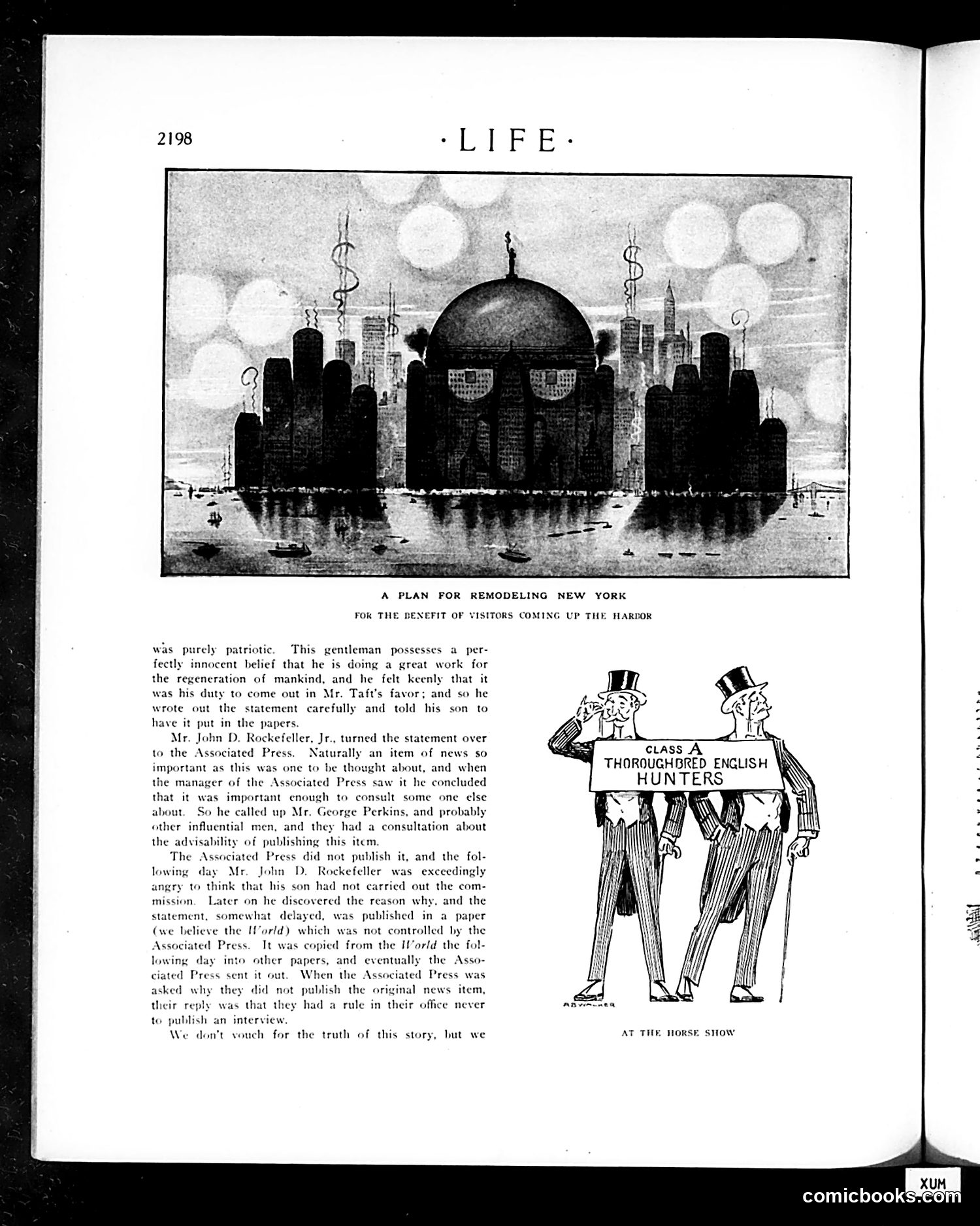
**Top Image:** "A Plan for Remodeling New York" depicts a grandiose, dome-topped structure dominating the Manhattan skyline—likely satirizing someone's ambitious urban vision. The caption suggests this is mocking an overly grand scheme presented to impress harbor visitors. **Bottom Cartoon:** Two figures labeled "Class A Thoroughbred English Hunters" at a horse show represent wealthy elites, likely satirizing American high society's pretensions to European refinement. **Main Text:** This passage critiques John D. Rockefeller Jr. and the Associated Press's editorial gatekeeping. Rockefeller wrote a pro-Taft statement (suggesting President William Howard Taft era, early 1900s), but the AP refused to publish it, citing a rule against publishing interviews. Life sarcastically questions this censorship, implying powerful institutions suppress news selectively. The story exposes how media establishments, despite claims of objectivity, make editorial decisions influenced by consulting other "influential men"—suggesting collusion among elites to control public information.
📄 Transcribed text from this page (OCR, searchable)
Machine-transcribed from the original scan — historical spelling and the odd misread are preserved.
A PLAN FOR REMODELING NEW YORK FOR THE BENEFIT OF VISITORS COMING UP THE HARDOR was purely patriotic. This gentleman possesses a per- fectly innocent belief that he is doing a great work for the regeneration of mankind, and he felt keenly that it was his duty to come out in Mr. Taft's favor; and so he wrote out the statement carefully and told his son to have it put in the papers : Mr. John D. Rockefeller, Jr., turned the statement over 4 to the Associated Press. Naturally an item of news so s crass A \ y important as this was one to be thought about, and when THOROUGHBRED ENGLISH : the manager of the Associated Press saw it he concluded HUNT that it was important cnough to consult some one else FR : about. So he called up Mr. George Perkins, and probably : other influential men, and they had a consultation about : the advisability of publishing this item : The Associated Press did not publish it, and the fol- : lowing day Mr. John D. Rockefeller was exceedingly a angry to think that his son had not carried out the com- mission. Later on he discovered the reason why, and the = statement, somewhat delayed, was published in a paper B (we believe the World) which was not controlled by the % Associated Press. It was copied from the H’orld the fol- lowing day into other papers, and eventually the Asso- ciated Press sent it out. When the Associated Press was asked why they did not publish the original news item, their reply was that they had a rule in their office never to publish an interview. We don't vouch for the truth of this story, but we AT THE HORSE SHOW