
Life, 1912-11-14 · page 25 of 44
Life — November 14, 1912 — page 25: what you’re looking at
What you’re looking at
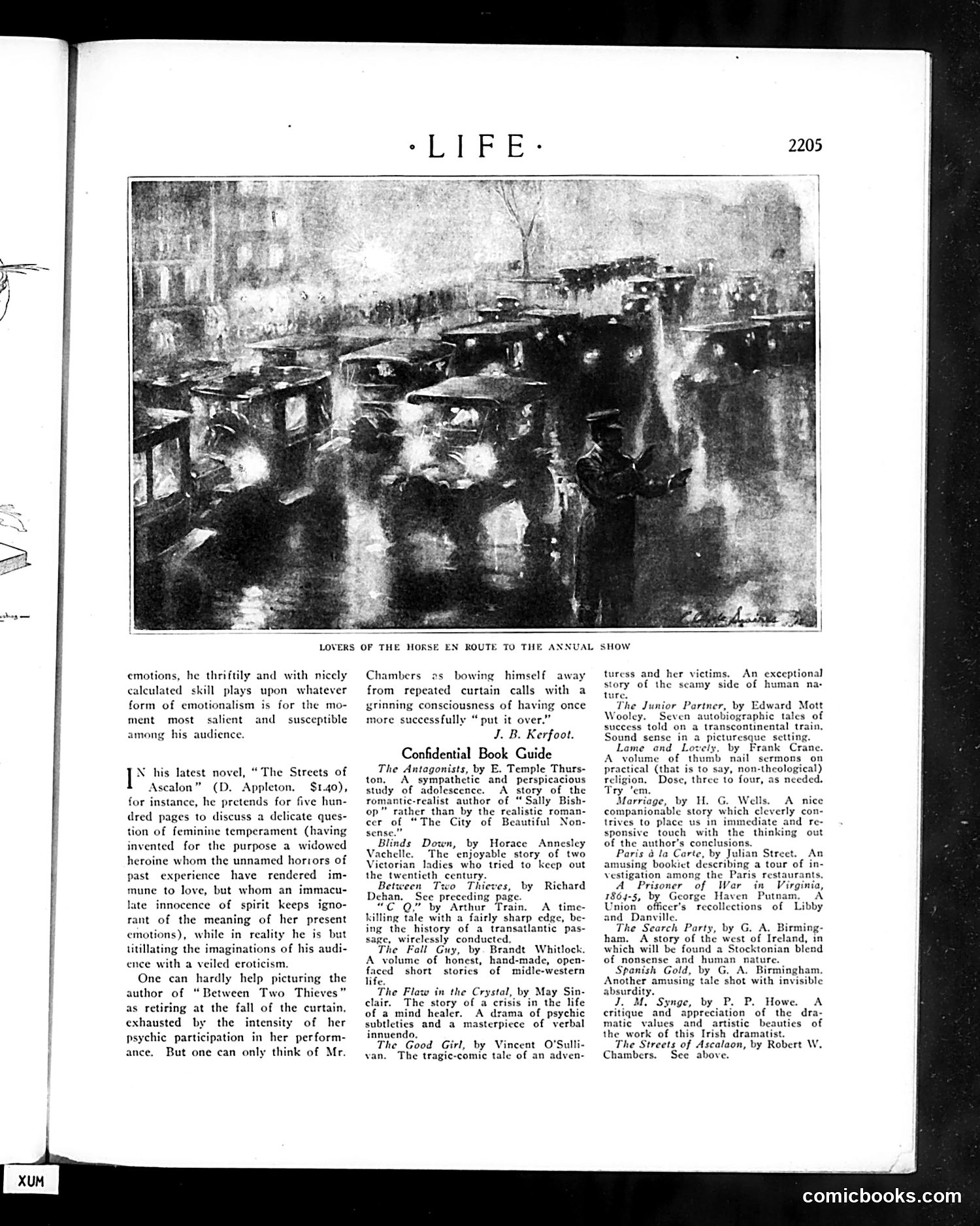
This cartoon depicts a crowded street scene of horse-drawn carriages and crowds, illustrating the caption about people traveling to an annual horse show—likely a major social event of the era. The page primarily contains a **book review section** by J. B. Kerfoot critiquing Robert W. Chambers' novel *The Streets of Ascalon*. Kerfoot argues that Chambers manipulates his audience's emotions, using a seemingly serious story about feminine temperament as a vehicle for "veiled eroticism"—essentially accusing the author of titillating readers while pretending to serious literature. He contrasts Chambers unfavorably with another author ("Between Two Thieves"), suggesting Chambers cynically "puts it over" on audiences rather than genuinely engaging with his material. The "Confidential Book Guide" lists contemporary novels with brief, often witty descriptions—a typical Life magazine feature recommending recent publications to readers.
📄 Transcribed text from this page (OCR, searchable)
Machine-transcribed from the original scan — historical spelling and the odd misread are preserved.
LOVERS OF THE HORSE EN ROUTE TO THE emotions, he thriftily and with nicely calculated skill. plays upon whatever form of emotionalism is for the mo- ment most salient and susceptible among his audience. N his latest novel, “The Streets of Ascalon” (D. Appleton. $1.40), for instance, he pretends for five hun- dred pages to discuss a delicate ques- tion of feminine temperament (having invented for the purpose a widowed heroine whom the unnamed horrors of past experience have rendered im- mune to love, but whom an immacu- late innocence of spirit keeps igno- rant of the meaning of her present emotions), while in reality he is but litillating the imaginations of his audi- ence with a veiled eroticism. One can hardly help picturing the author of “Between Two Thieves” as retiring at the fall of the curtain, exhausted by the intensity of her psychic participation in her perform- ance, But one can only think of Mr. Chambers as bowing himself away from repeated curtain calls with a grinning consciousness of having once more successfully “ put it over.” J. B. Kerfoot. Confidential Book Guide The Antagonists, by E. Temple Thurs- ton. A sympathetic and perspicacious study of adolescence. A story of. the romantic-realist author of “Sally Bish- op” rather than by the realistic roman- cer of “The City of Beautiful Non- sense. Blinds Down, by Horace Annesley helle. The ‘enjoyable story of two Victorian ladies who tried to keep out the twenticth century. Between Two Thieves, chan, Sce preceding page. Q.” by Arthur Train. A time- Killing tale with a fairly sharp edge, be- ing the history of a transatlantic ‘pas- sage, wirelessly conducted. The Fall Guy, by. Brandt Whitlock. A volume of honest, hand-made, open- faced short stories’ of midle-western ife. The Flaw in the Crystal, by May Sin- clair. The story of a crisis in the life of a mind healer. A drama of psychic subtleties and a masterpiece of verbal innuendo. The Good Girl, by Vincent O’Sulli- van. The tragic-comic tale of an adven- by Richard NUAL SHOW turess and her victims. An exceptional ry of the scamy side of human na- ture, The Junior Partner, by Edward Mott Wooley. Seven autobiographic tales of success told on a transcontinental train, Sound sense in a picturesque setting. Lame ond Lovely, by Frank Crane. A Volume of thumb nail sermons on practical (that is to say, non-theological) religion. Dose, three 10 four, as needed. Try ’em. Marriage, by H. G. Wells. A nice companionable story which cleverly con- trives to place us in immediate and re- sponsive touch with the thinking out of the author's conclusions. Paris & la Carte, by Julian Street. An amusing bookict describing a tour of in- vestigation among the Paris restaurants. A Prisoner of Wer in Virginia, 1864-5, by George Haven Putnam. |X Union’ officer’s recollections of Libby and Danville. The Search Party, by G. A. Birming- ham. A story of the west of Ireland, in which will be found a Stocktonian blend of nonsense and human nature. Spanish Gold, by G. A. Birmingham, Another amusing tale shot with invisible absurdity. M. Synge, by P, P. Howe. A tion of the dra- and apprec’ alues and artistic beauties of The Streets of Ascalaon, by Robert W. Chambers. See above. comicbooks.com