
A complete issue · 52 pages · 1912
Life — September 12, 1912
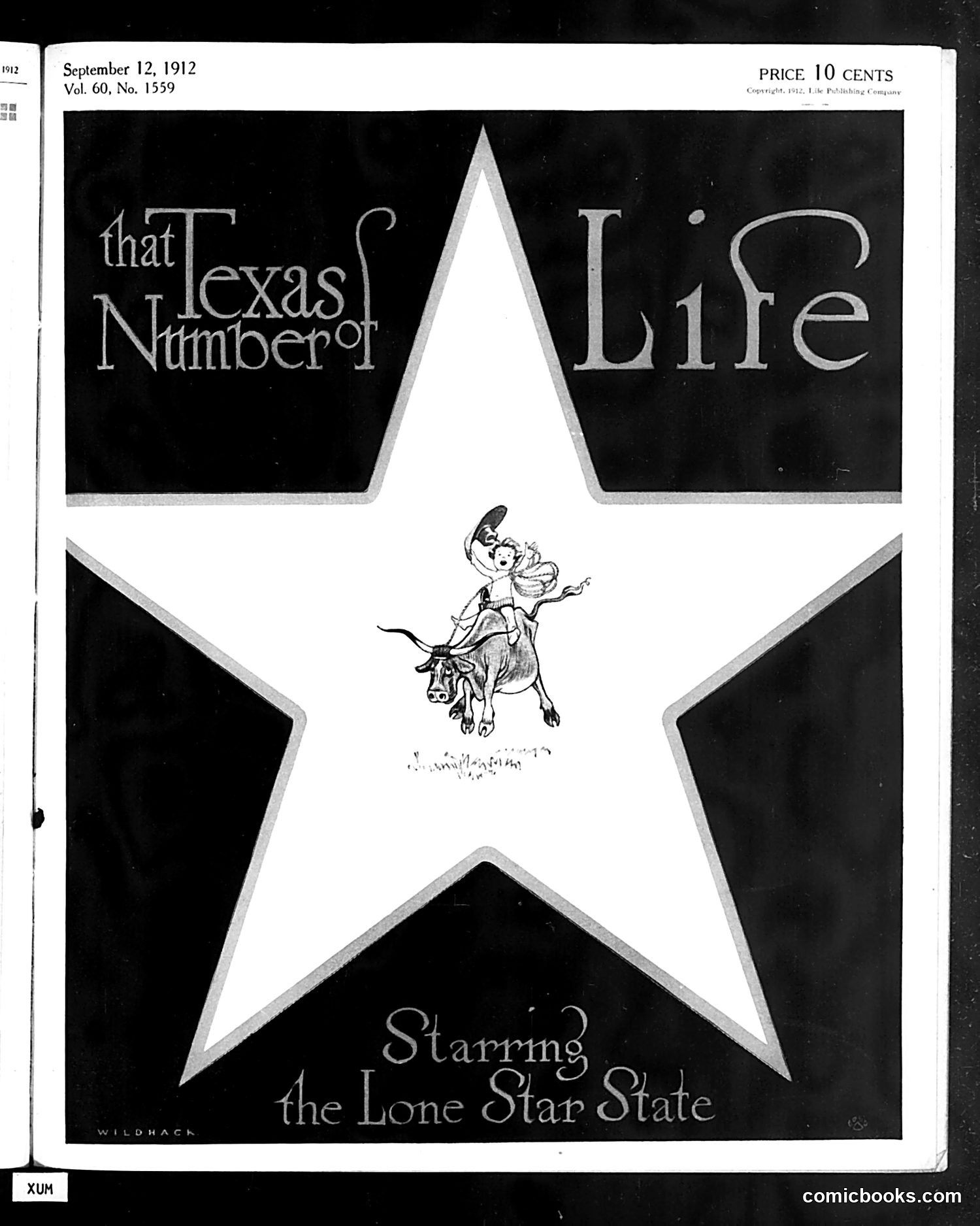
This is the cover of *Life* magazine from September 12, 1912. The design features a large Texas star containing an illustration of a cowboy riding a bucking steer or longhorn. The text reads "that Texas Number of Life" and "Starring the Lone Star State." This appears to be a thematic issue celebrating Texas, using iconic imagery of the American West—the cowboy and longhorn cattle—as symbols of the state's identity and character. The star is Texas's official symbol. The illustration style and layout suggest this was a humorous or satirical take on Texas culture and identity, though the specific satirical point isn't entirely clear from the cover alone. The ten-cent price indicates this is from the early 20th century.
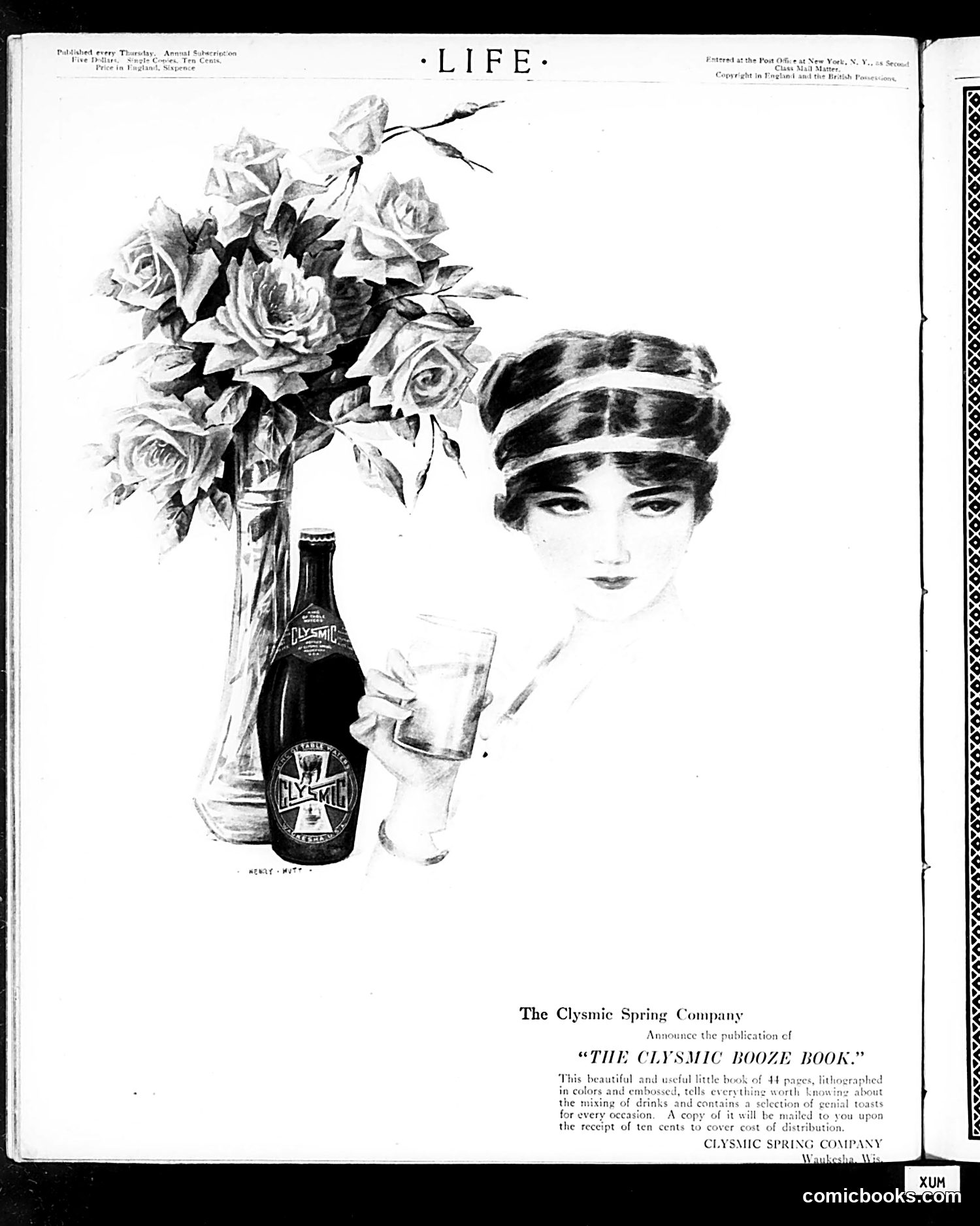
This page is primarily **advertising, not satire or political commentary**. It's a full-page ad for the Clysmic Spring Company promoting their "Clysmic Booze Book." The illustration shows a fashionable woman with 1910s-era styling (headband, short hair) holding a glass, positioned next to a bottle of Clysmic spring water and a vase of roses. The aesthetic is elegant and aspirational. The text describes the book as a 44-page lithographed guide covering "everything worth knowing about the mixing of drinks" with "genial toasts for every occasion." It could be obtained for ten cents. This is straightforward product marketing using attractive imagery and the appeal of sophistication—not political satire. The "Life" magazine context provided the advertising space rather than editorial commentary.
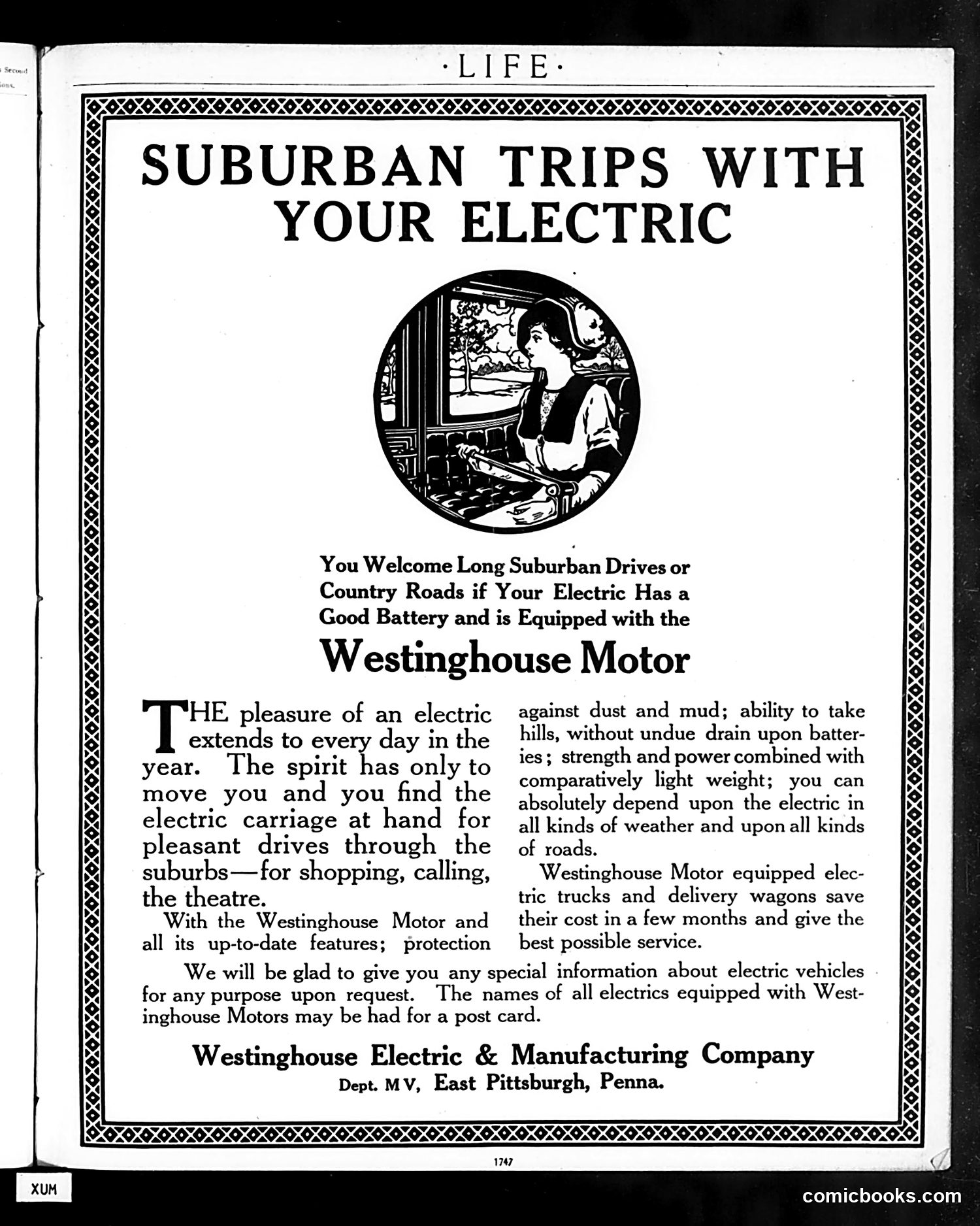
This page is **not satire or editorial content**—it's a straightforward advertisement for Westinghouse Electric & Manufacturing Company's motors for electric vehicles. The ad promotes electric cars as ideal for suburban trips, featuring an illustration of a woman driver. It emphasizes practical benefits: good batteries, reliable performance on various roads and weather conditions, and low maintenance compared to other vehicles. Key context for modern readers: This advertisement dates from the early 1900s, when electric vehicles were a serious competitor to gasoline cars. They were considered particularly suited to women drivers due to their ease of operation (no hand-cranking required) and cleanliness. The ad also mentions commercial applications—electric delivery trucks—suggesting broad market confidence in this technology before gasoline engines ultimately dominated.
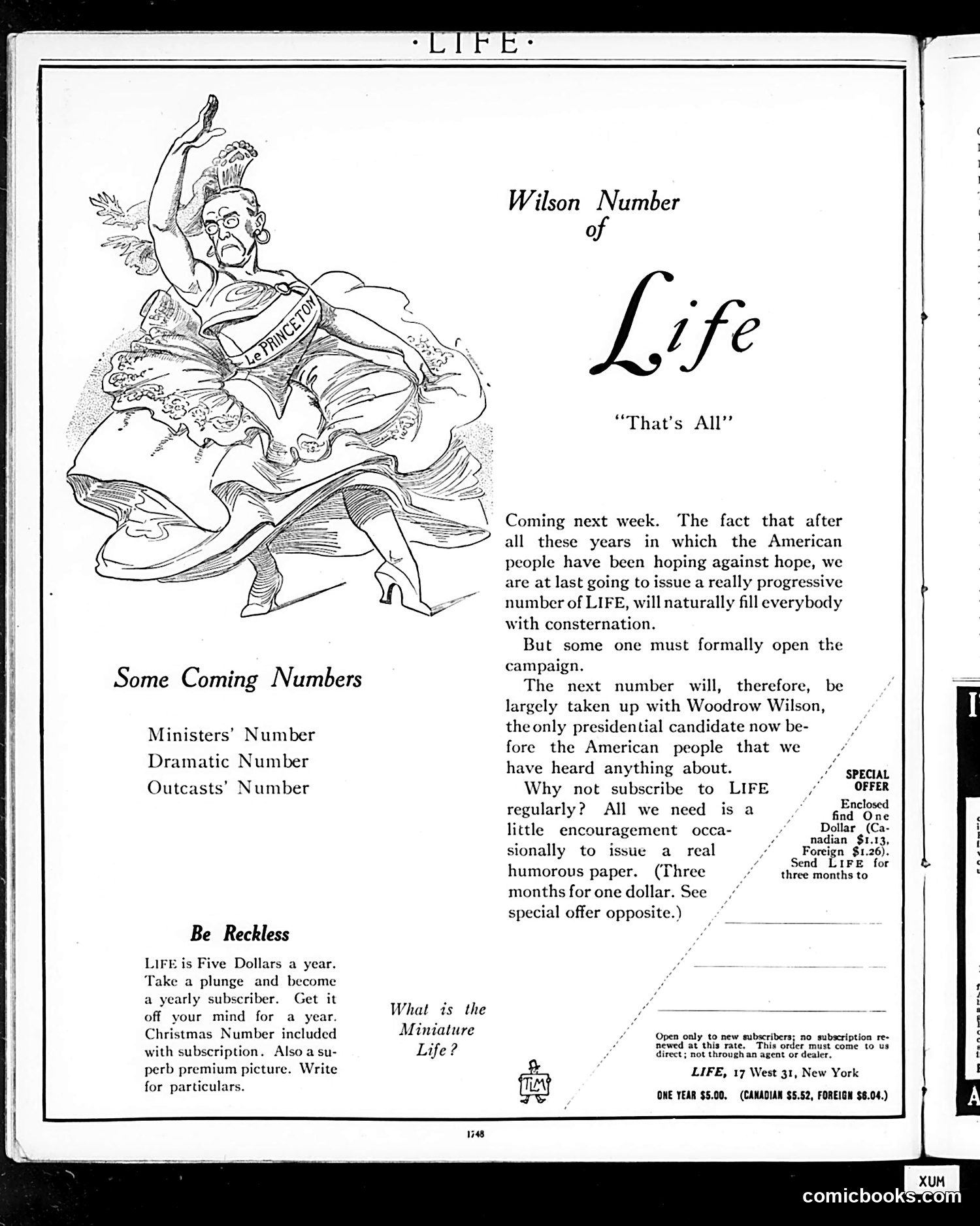
This page announces an upcoming "Wilson Number" of *Life* magazine, featuring satire about Woodrow Wilson. The large caricature depicts a militaristic figure with a prominent mustache in a dramatic pose, wearing what appears to be military regalia. Given the text's reference to Wilson as "the only presidential candidate now before the American people that we have heard anything about," this likely dates to Wilson's presidential campaign. The exaggerated military styling and aggressive posture suggest satirical commentary on Wilson's foreign policy or military stance—possibly relating to America's involvement (or potential involvement) in World War I. The cartoon mocks Wilson through physical caricature, a common *Life* magazine approach for political figures of that era.
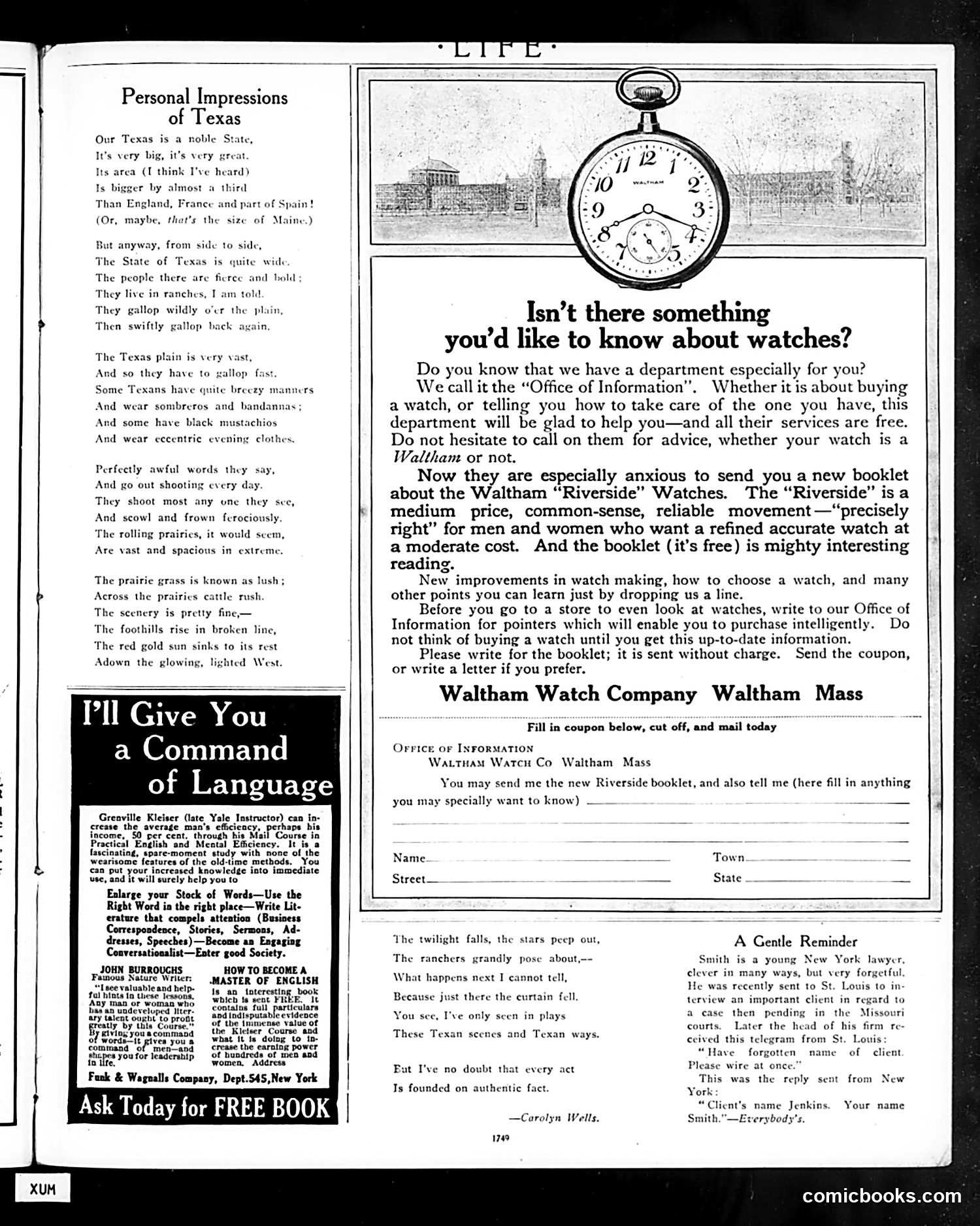
This page is primarily **advertising and instructional content** rather than political satire. The main elements include: 1. **"Personal Impressions of Texas"** — a poem celebrating Texas's vast size and rugged character (ranches, plains, cattle) 2. **Waltham Watch Company advertisement** — promoting their "Riverside" watches as affordable, reliable timepieces for men and women, with an offer for a free informational booklet 3. **Educational advertisements** — including "I'll Give You a Command of Language" (language instruction) and "Ask Today for FREE BOOK" (self-improvement guides) 4. **"A Gentle Reminder"** — a short humorous anecdote about a New York lawyer named Smith sent to St. Louis on business The page reflects early 20th-century American consumer culture, emphasizing self-improvement, practical goods, and the romance of the American frontier (Texas imagery).
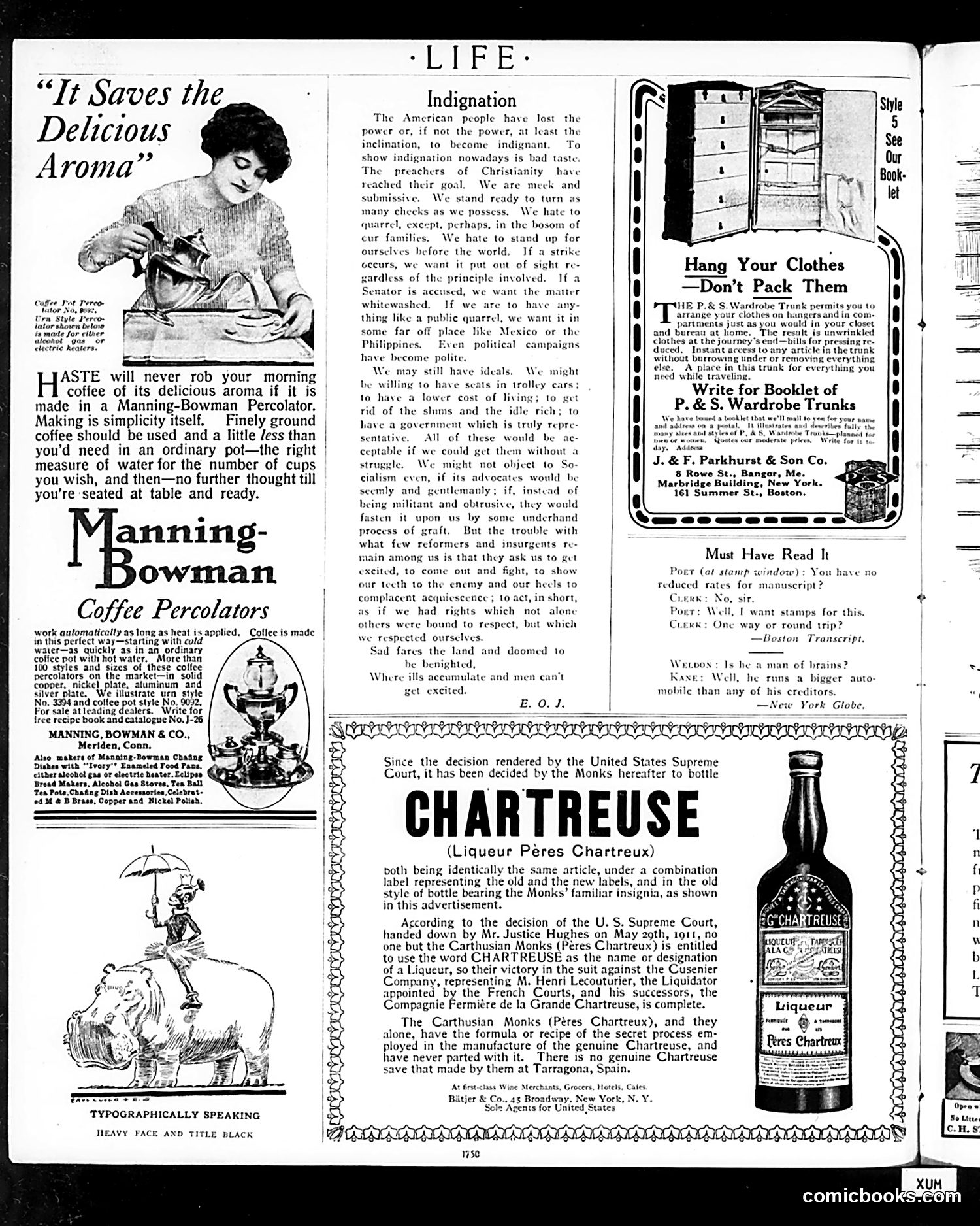
This page is primarily **advertising and editorial content** rather than political satire. The main elements are: 1. **Manning-Bowman Coffee Percolators ad** (left): Standard product advertisement emphasizing convenience and automatic brewing. 2. **"Indignation" editorial** (center): Commentary on Americans losing moral passion, criticizing Christian preachers as "meek and submissive" and calling for citizens to stand up against injustice. The author advocates for activism while opposing socialism. 3. **P&S Wardrobe Trunks ad** and clothing storage advice (right): Practical household tips. 4. **Chartreuse liqueur ad** (bottom): Large advertisement featuring a legal notice about trademark rights to the product name, following a Supreme Court decision. The page contains **no identifiable political cartoons**—it's a mix of period advertisements and genteel editorial commentary on civic engagement.
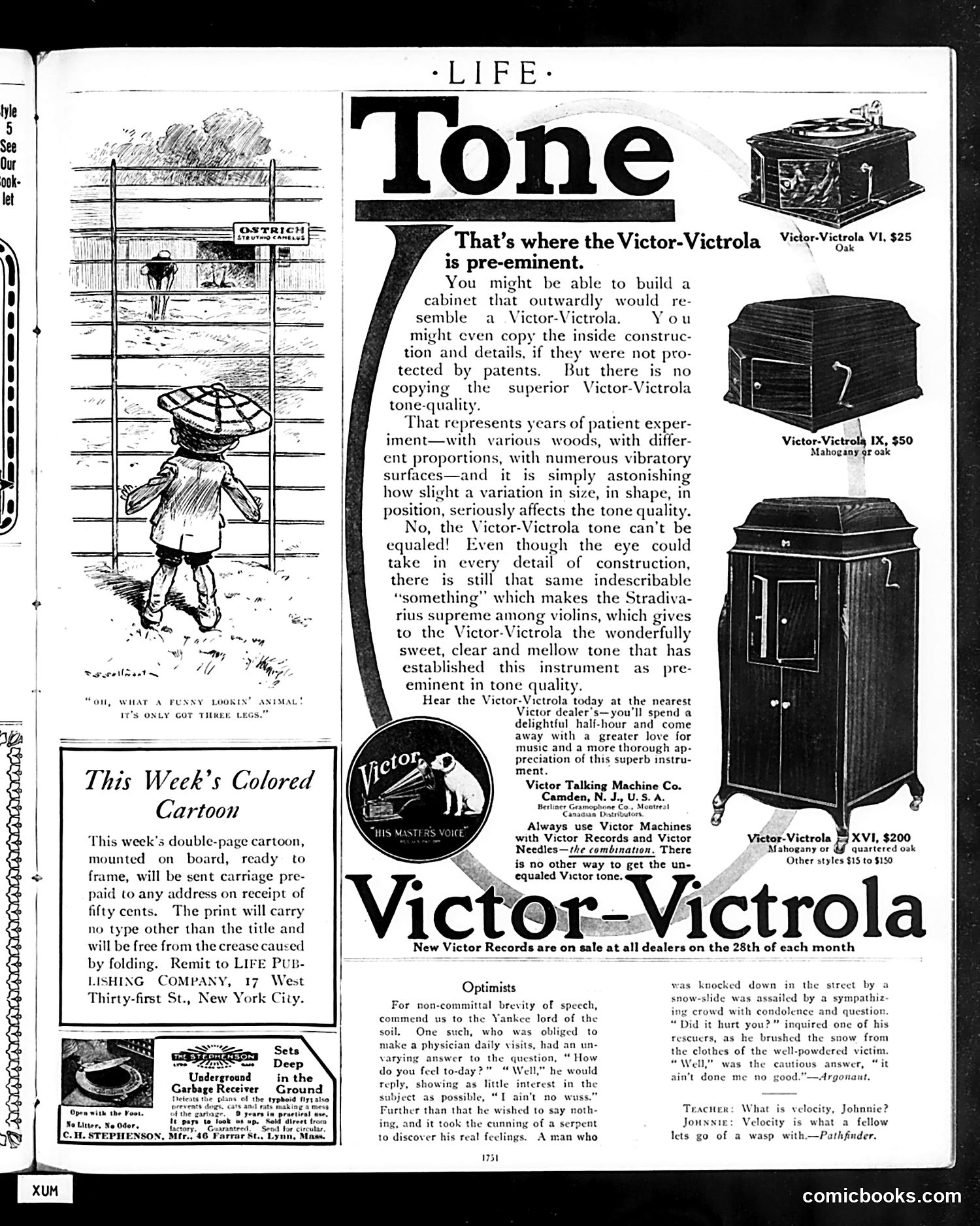
This page is **primarily advertising** for Victor-Victrola phonographs, with a small cartoon insert. The main cartoon (left side) depicts an ostrich with three legs, captioned "Oh, what a funny lookin' animal! It's only got three legs." This is a simple visual gag—the ostrich appears to have only three visible legs, playing on the absurdity of the observation itself. Below it, a small advertisement offers a "colored cartoon" available for fifty cents through Life Publishing Company. The bulk of the page promotes Victor-Victrola record players and talking machines, emphasizing their superior "tone quality" and various cabinet styles. This reflects early 20th-century consumer advertising in Life magazine, which relied heavily on paid advertisements alongside editorial content.
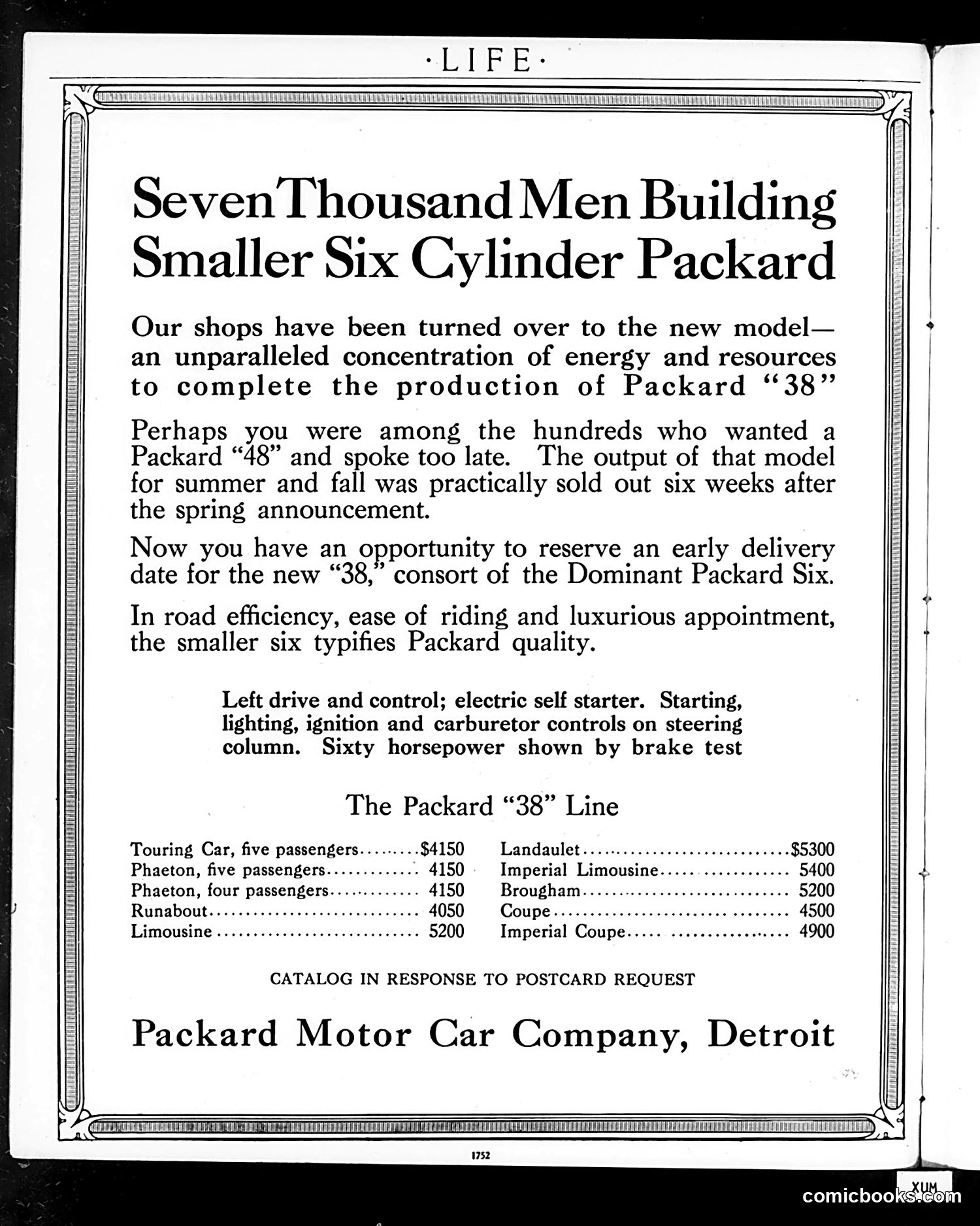
This is a **Packard automobile advertisement**, not a political cartoon. The page appears in *Life* magazine and promotes the new Packard "38" luxury car model. The ad addresses potential customers who missed out on the previous "48" model, which sold out quickly. It emphasizes that 7,000 workers are now dedicated to building the smaller six-cylinder Packard "38," positioning it as an accessible alternative to the larger model while maintaining Packard's quality reputation. The text highlights modern features: left-hand drive, electric starter, and steering-column controls—innovations that would appeal to 1920s-era buyers. Various body styles are listed with prices ranging from $4,050 to $5,400. This is straightforward marketing for a premium American automobile brand.
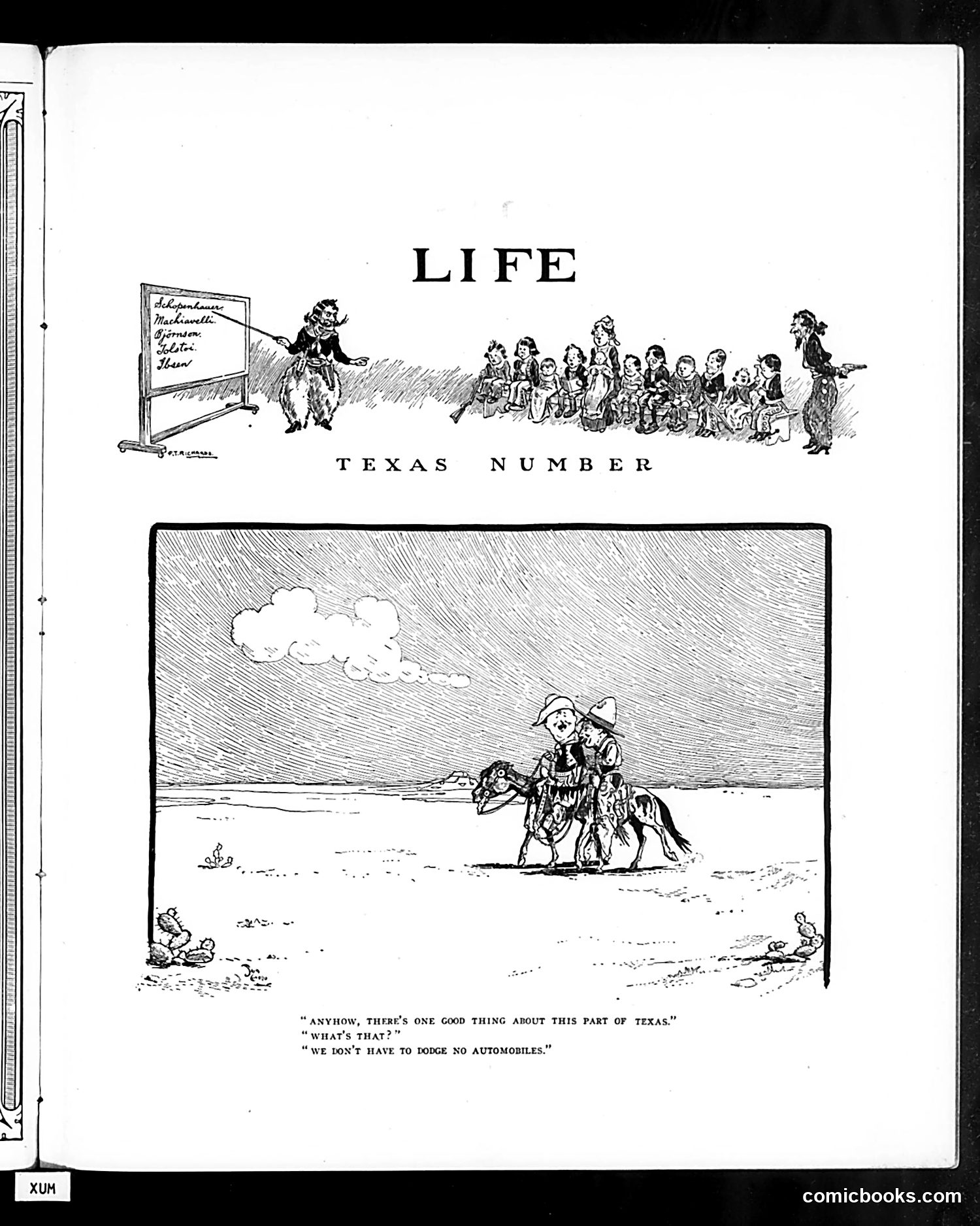
This is a title page for a special "Texas Number" of Life magazine. The header illustration shows a schoolteacher pointing at a sign reading "Mackinaw, Michigan, Lesson" while children sit in the dusty Texas landscape—satirizing the contrast between formal education and the actual Texas frontier environment. The main cartoon depicts a cowboy on horseback in an empty, flat Texas landscape. The caption jokes: "Anyhow, there's one good thing about this part of Texas." "What's that?" "We don't have to dodge no automobiles." The satire contrasts the modern automotive age with remote Texas regions so undeveloped that automobiles are absent—treating this isolation as a humorous advantage. It reflects early 20th-century anxieties about rapid urbanization and motorization changing American life.
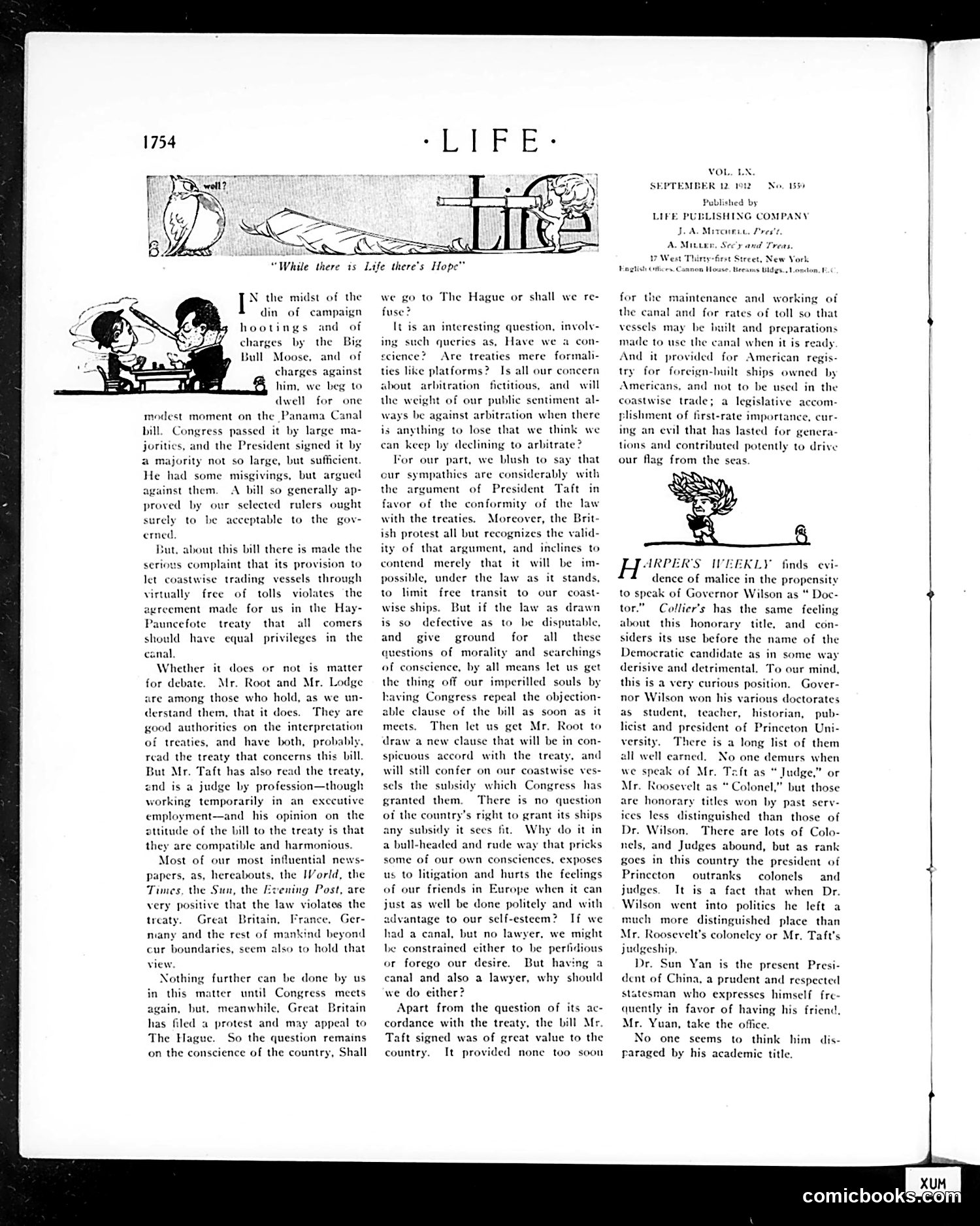
This *Life* magazine page (September 12, 1912) contains editorial commentary on the Panama Canal and U.S. foreign policy disputes. The small cartoon depicts two figures (appearing to represent political figures) in discussion, likely referencing debates over canal tolls and treaty interpretation. The text discusses President Taft's position on the canal's administration, comparing it favorably to President Roosevelt's stance. References to "Mr. Root" and "Mr. Lodge" indicate prominent Republican figures weighing in on treaty compliance. The article criticizes those questioning whether the canal tolls provision violates agreements with Britain, presenting this as a matter of national conscience and integrity. The satirical point appears to be defending Taft's administration against critics who questioned the moral and legal standing of U.S. canal policy.
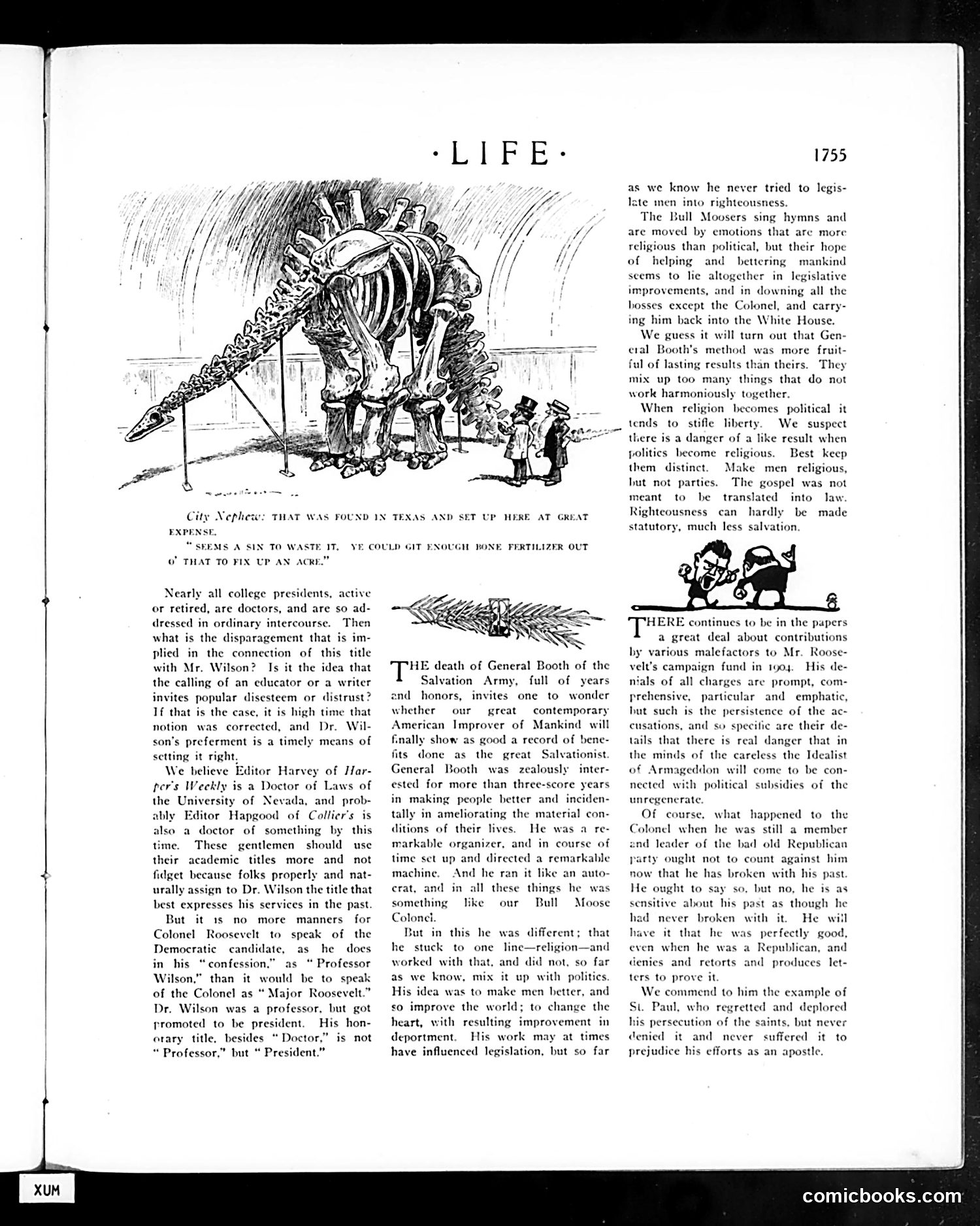
The top cartoon depicts a massive skeletal animal carcass labeled "City Nephew" found in Texas and displayed at great expense. The caption jokes it's wasteful—enough bone fertilizer to farm an acre. This satirizes the practice of displaying curiosities and oddities as expensive public spectacles. The page's main text discusses General William Booth of the Salvation Army following his death. It praises Booth's social reform work while cautioning against mixing religion with politics. The text argues that Colonel Roosevelt should acknowledge Booth's accomplishments without claiming credit, and warns against the dangers of politicizing religious movements. The piece advocates keeping religion and politics separate.
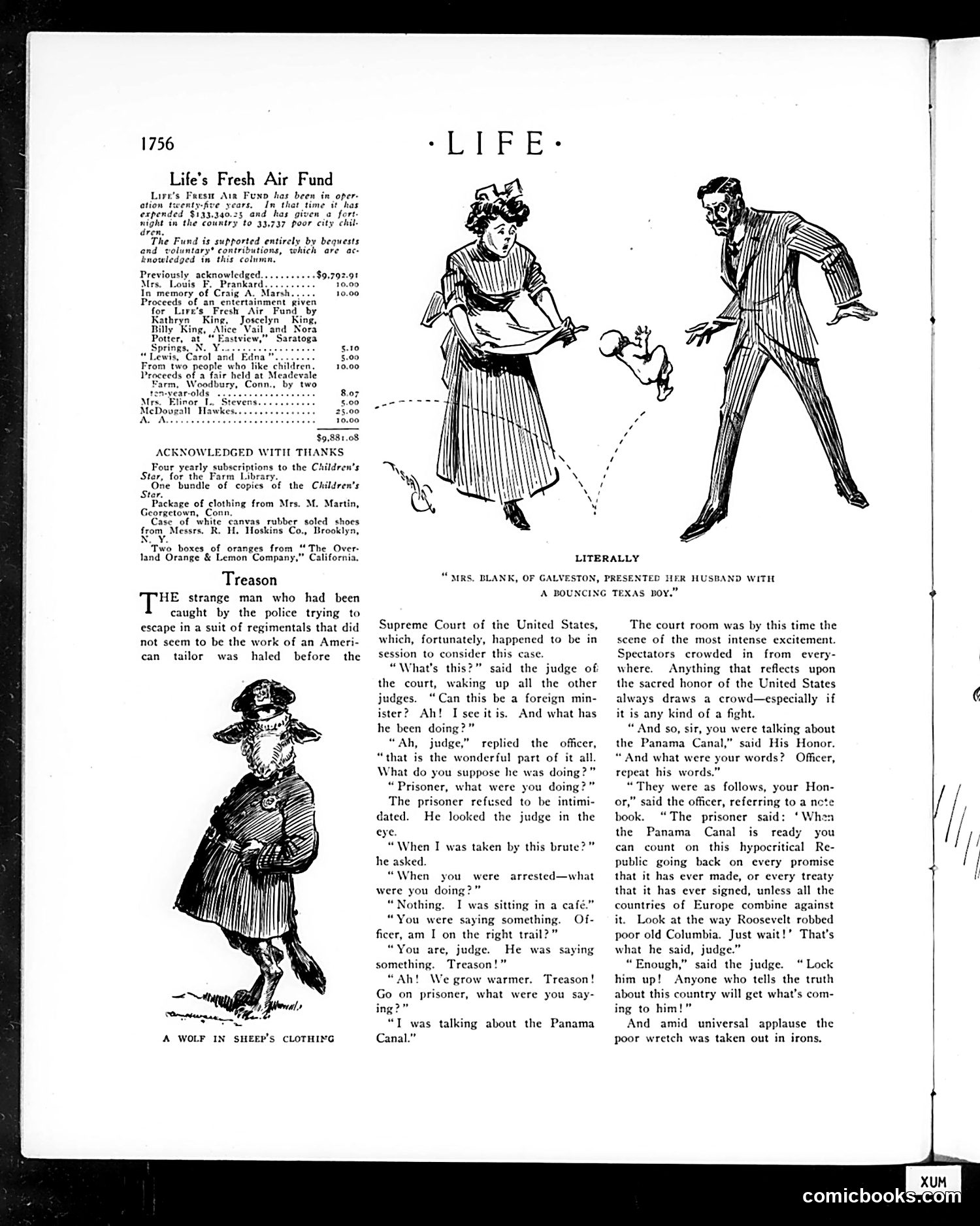
This page contains a satirical story about a prisoner brought before the U.S. Supreme Court. The cartoon titled "A Wolf in Sheep's Clothing" depicts a sinister figure in formal dress—likely representing deceptive authority or political hypocrisy. The accompanying narrative mocks a case where a prisoner claims to have been discussing the Panama Canal when arrested. A judge questions whether the prisoner was actually committing treason, while the prisoner protests innocence. The satire suggests that authorities may be falsely accusing people of sedition over mere speech about the Panama Canal—a topical concern in early 20th-century America regarding national security versus free speech. The "wolf in sheep's clothing" metaphor criticizes those who hide dangerous intent behind respectable appearances.
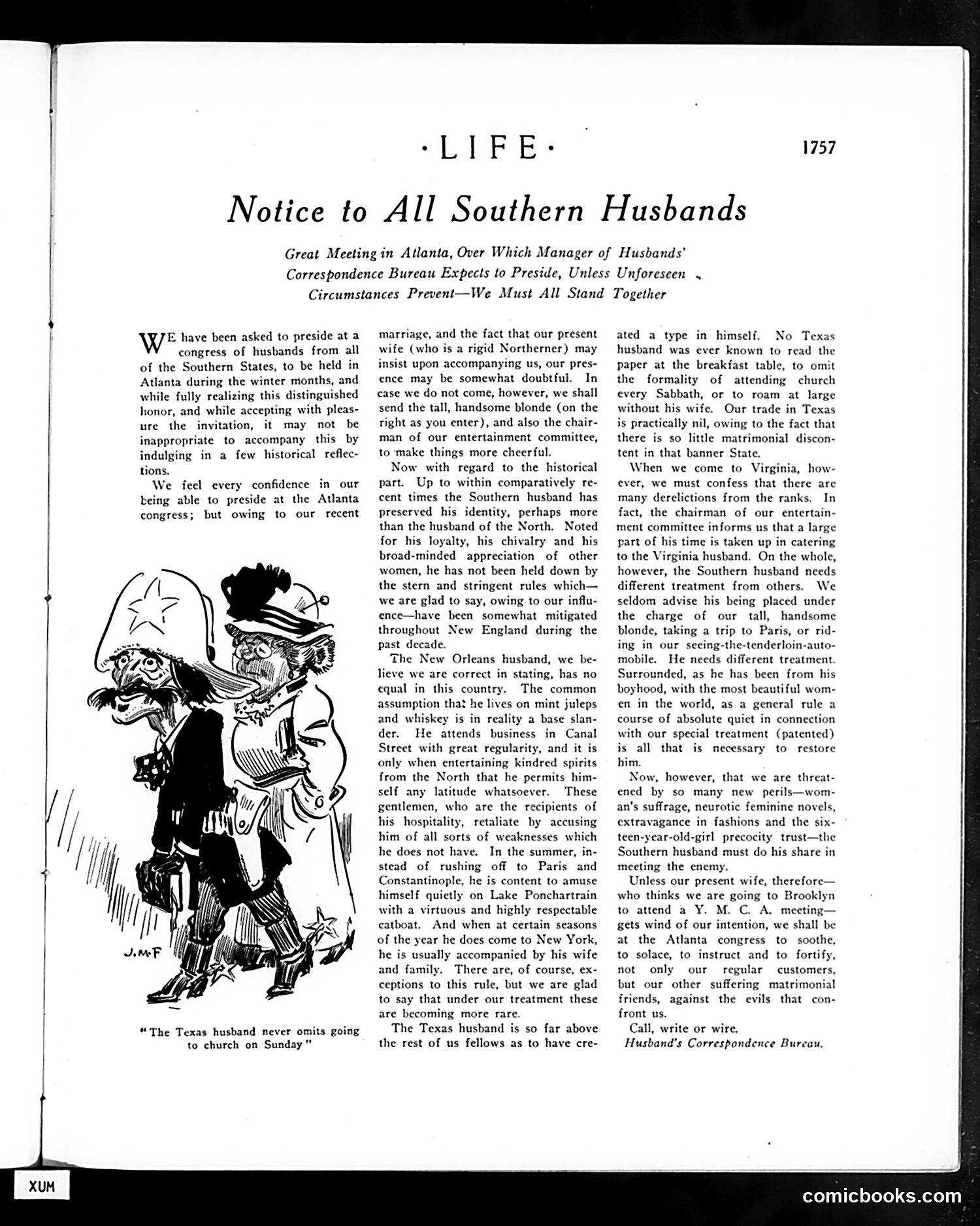
This satirical article mocks regional gender dynamics of the era. The accompanying cartoon depicts caricatured figures—likely representing a Southern husband and Northern wife—in exaggerated dress with stereotypical features. The text humorously addresses a purported "congress of husbands" in Atlanta, contrasting Southern and Northern marriage customs. It presents the "Texas husband" as exceptionally devoted (never missing church), while mocking other Southern husbands for various marital infractions: patronizing mistresses, neglecting wives, pursuing frivolous fashions, and generally failing domestic responsibilities. The satire targets how Southern husbands supposedly treated wives differently than Northern counterparts, suggesting regional moral and behavioral differences. The "J.M.F." signature indicates the cartoonist, though identity remains unclear.
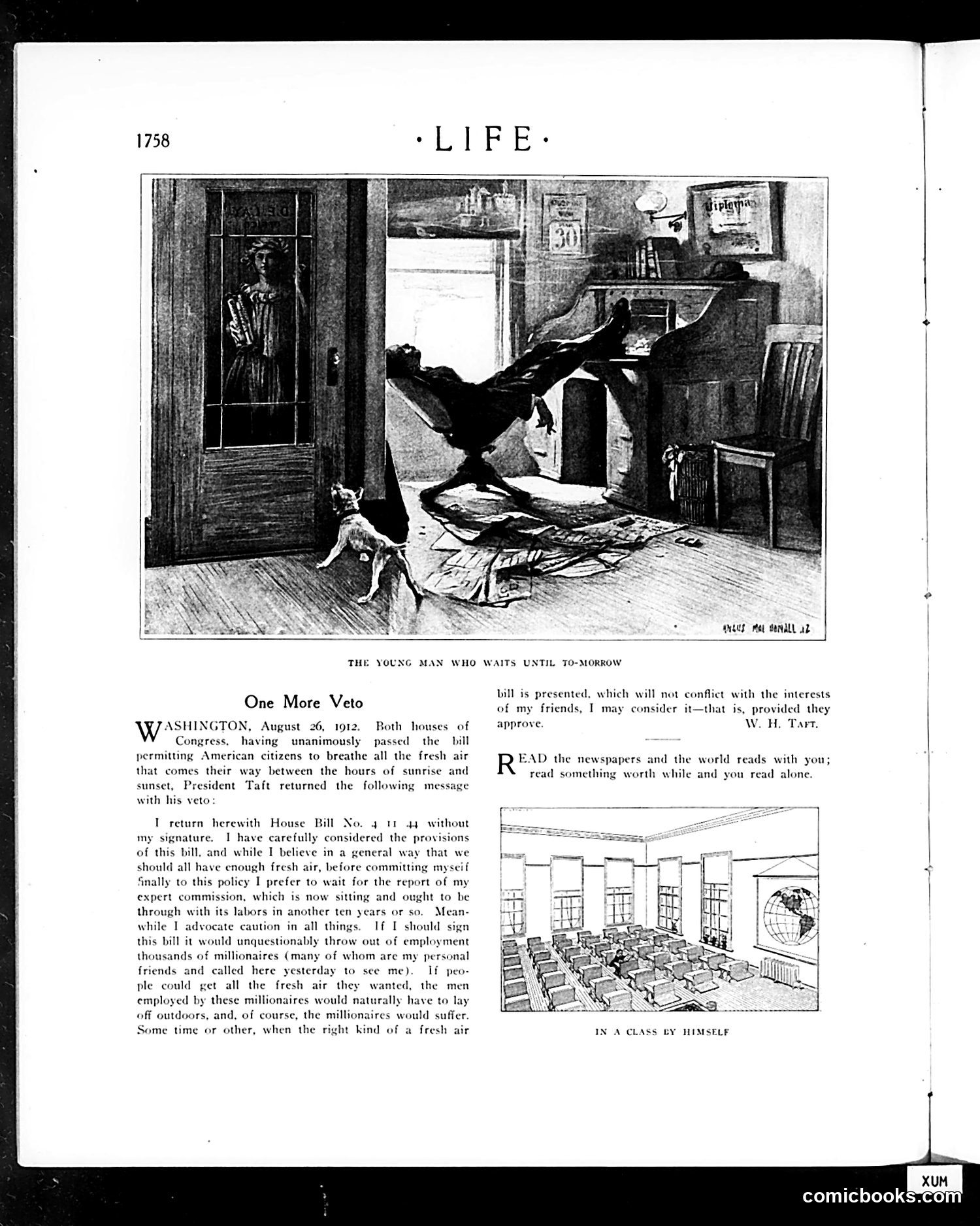
This satirical piece critiques President Taft's veto of a bill allowing Americans to "breathe all the fresh air that comes their way" during daylight hours. The cartoon depicts a young man lounging indolently at his desk, feet up, while a small dog stands nearby—suggesting idle procrastination rather than productive work. Taft's veto message claims he cannot sign without consulting an expert commission, arguing that millionaires would suffer if workers got outdoor time. The satire mocks this as absurdly privileging wealthy industrialists' interests over citizens' basic welfare and fresh air access. The smaller illustration "In a Glass by Himself" appears to further comment on Taft's isolation or self-serving position during the 1912 election year.
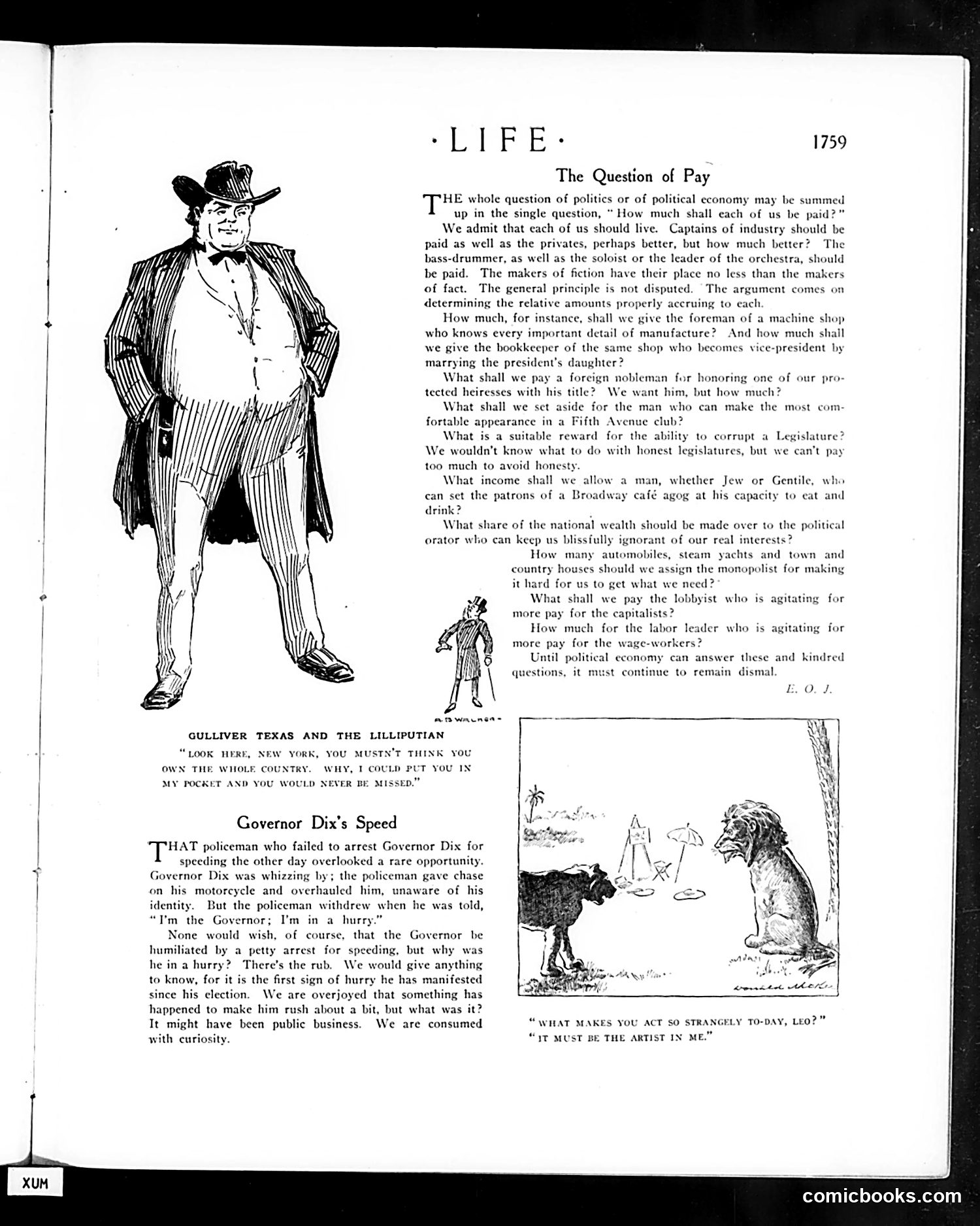
**"The Question of Pay"** is a biting satirical essay on wealth distribution and corruption in American society. The author uses rhetorical questions to expose hypocrisy: politicians are paid to be corrupt ("What is a suitable reward for the ability to corrupt a Legislature?"), foreign noblemen marry heiresses for money, monopolists hoard resources, and lobbyists buy influence for both capitalists and labor leaders. The piece suggests political economy cannot function honestly because society institutionalizes graft. **"Gulliver Texas and the Lilliputian"** caricatures regional tensions, with a large Texan figure dwarfing New York, suggesting western resentment of eastern dominance and wealth concentration. **"Governor Dix's Speed"** mocks New York Governor John Dix for rushing through town on his motorcycle—his *only* visible hurry since election. The satire implies he's been idle or inactive in office, questioning what urgent "business" finally motivated him. The small cartoon shows a lion remarking an artist's strangeness, offering comic relief.
This 1760 satirical poem by Arthur Guiterman celebrates Texas's annexation to the United States while gently mocking its self-aggrandizement. **The Point:** The poem praises Texas's natural resources (cotton, oil, cattle, wheat) and its colorful historical figures (Houston, Crockett, Carson)—fodder for American literature. However, Guiterman undercuts the boosterism with humor: Texas is "somewhat short on mountains," and despite being "civilized" in morals and manners, it's "not saying much" compared to New York. **Key References:** - "Single Star" = Texas flag - Historical sweep from French Matagorda colony through Spanish/Mexican rule to American heroes - "Senator named Bailey" = likely Joseph Weldon Bailey, Texas politician - "Solar Plexus" = Texas as the nation's vital center **The Satire:** The breathless eulogy masks gentle ribbing about Texas's provincialism and cultural pretensions, even as the poem acknowledges its genuine strategic and economic importance to the Union.
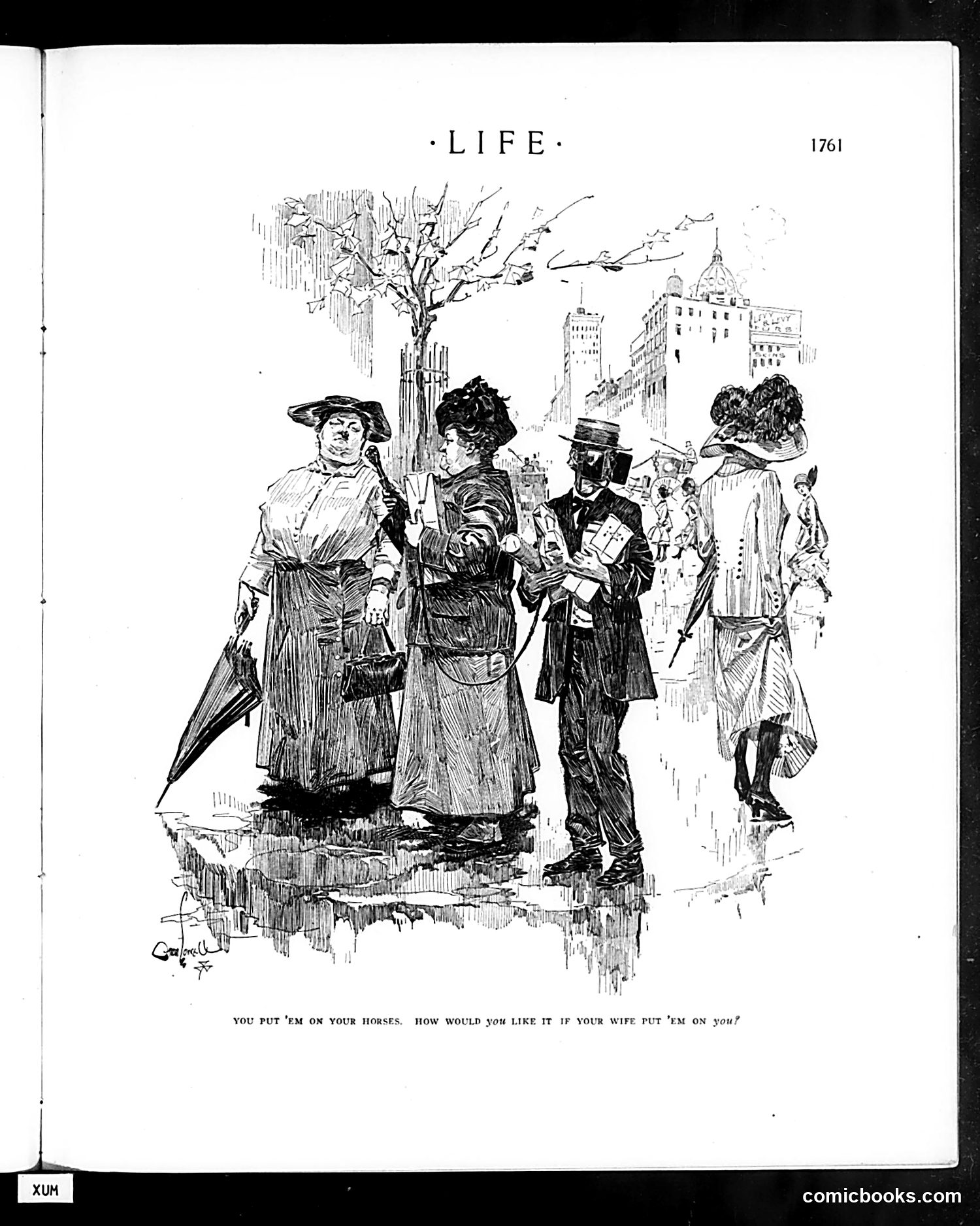
This is a satirical cartoon addressing early 1900s gender roles and fashion. The caption references horseshoes—protective metal shoes nailed onto horses' hooves—creating a crude joke about constraint and control. The cartoon depicts well-dressed figures in an urban street scene. The satire appears to critique men's double standards: men control women through restrictive clothing and social expectations (metaphorically "shoeing" them like horses), yet would be outraged if women imposed similar restrictions on men. The date "1761" in the header is the page number, not the cartoon's subject date. This reflects *Life* magazine's early 1900s concern with emerging women's independence and the era's debates about women's fashion, autonomy, and marriage dynamics during the suffrage movement period.
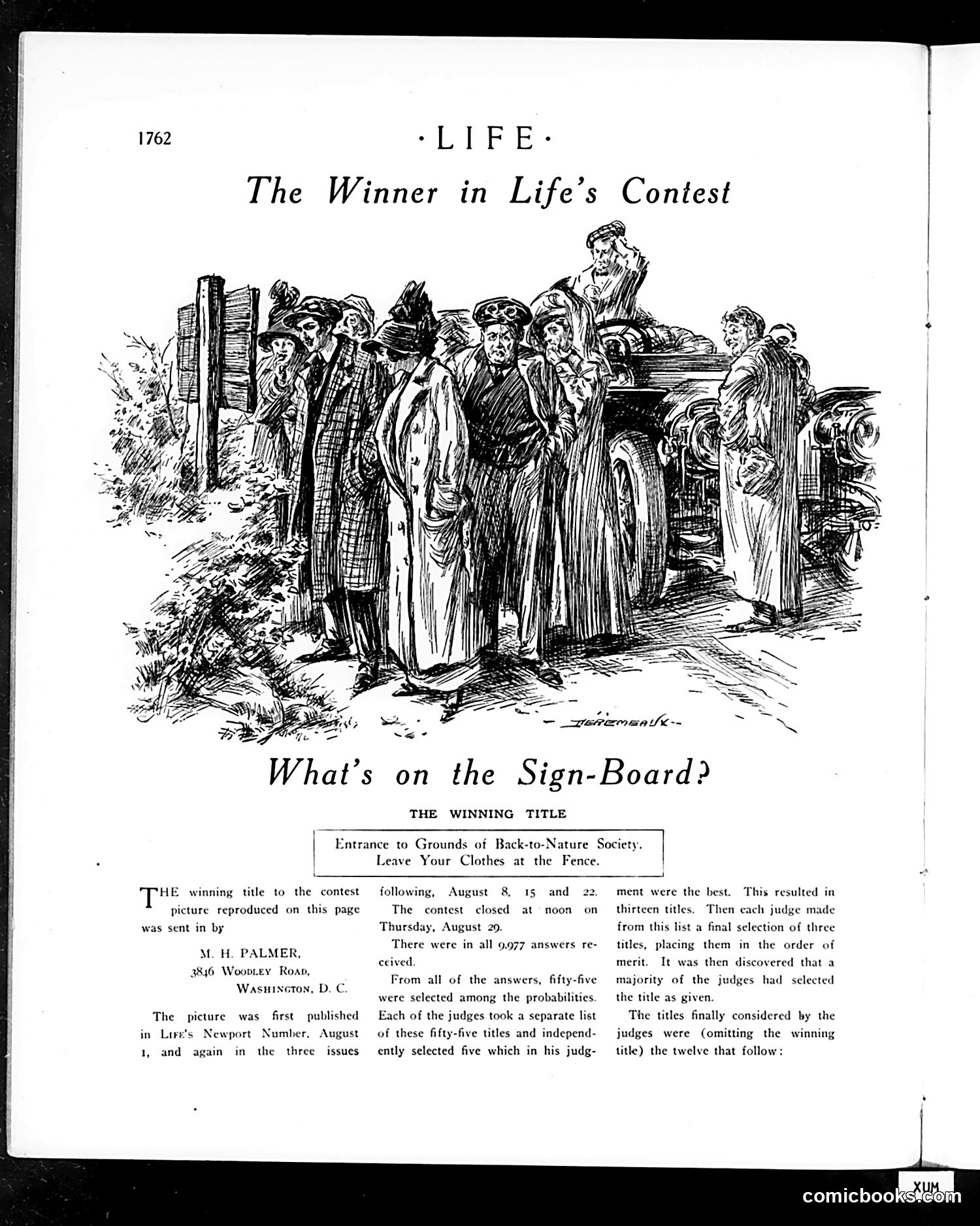
This page documents a caption-writing contest from *Life* magazine (August 1912). The cartoon depicts a group of people gathered around a sign-board at what appears to be a naturist or "Back-to-Nature Society" gathering—hence the winning caption's satirical humor about leaving one's clothes at the fence. The sketch shows formally-dressed onlookers examining a blank sign, creating absurdist contrast. The joke relies on the incongruity between Victorian propriety (their formal attire) and the nudist setting they're observing. M. H. Palmer of Washington, D.C. submitted the winning title. The contest received nearly 10,000 entries; judges narrowed these to 55 possibilities, then independently selected finalists, ultimately agreeing on Palmer's caption. This reflects *Life*'s popular reader-engagement strategy of the era, turning satirical artwork into participatory entertainment. The satire targets both turn-of-the-century "nature" movements and polite society's discomfort with bodily freedom.
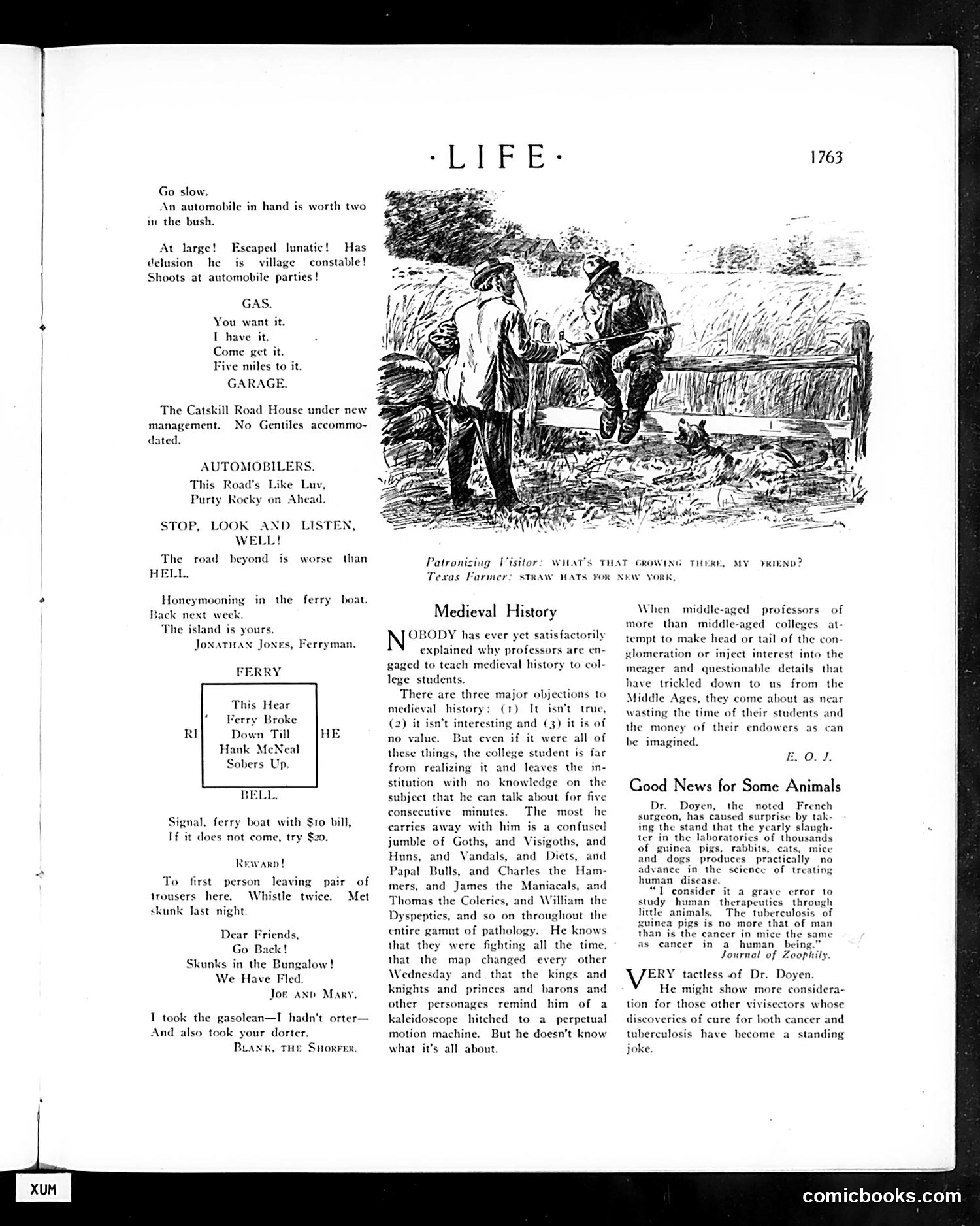
This page from *Life* magazine contains several layers of early-20th-century American satire: **The main cartoon** depicts a Texas farmer showing a visitor his "straw mats for New York"—likely mocking either agricultural exaggeration or the perceived naïveté of rural Americans selling worthless goods to city dwellers. **The scattered humorous notices** (left side) satirize the chaos of early automobile culture and rural/resort life: escaped lunatics shooting at cars, discriminatory roadhouses ("No Gentiles accommodated"), sketchy ferrymen accepting bribes, and domestic mishaps (skunks invading honeymoon bungalows). These mock both automotive dangers and the disorder of turn-of-the-century leisure travel. **The "Medieval History" article** satirizes college education itself—professors teaching unmarketable, confusing subjects (Goths, Vandals, etc.) that students retain nothing from, wasting endowment money. **"Good News for Some Animals"** uses ironic praise to mock Dr. Doyen's claim that laboratory animal testing is useless for human medicine—implying his own medical discoveries are therefore also jokes. The overall tone mocks progress, education, and modern life's absurdities.
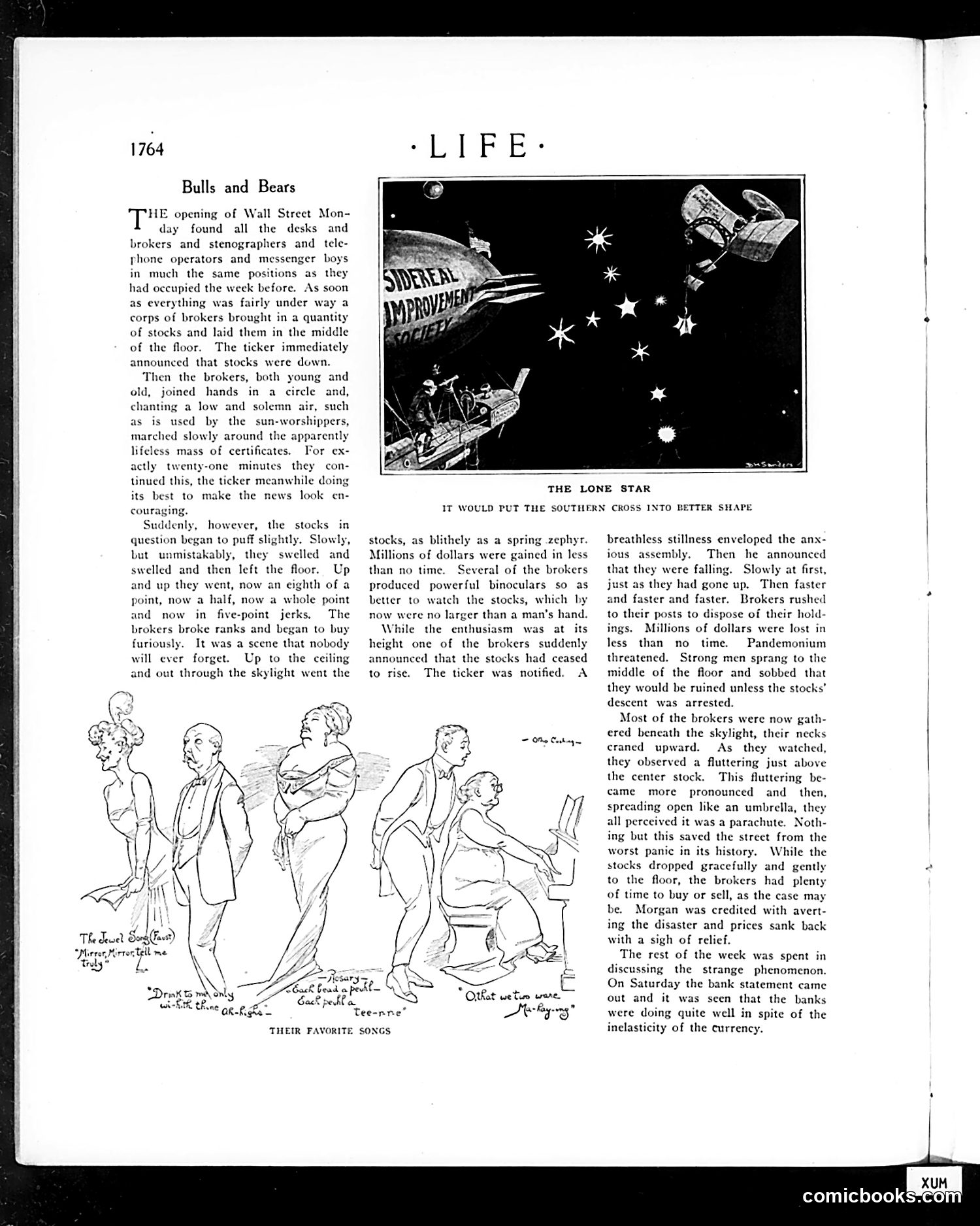
This satirical article mocks Wall Street's dramatic volatility and the brokers' ritualistic behavior during market fluctuations. The piece describes brokers literally circling stocks on the floor like "sun-worshippers," then frantically buying and selling as prices gyrate wildly—stocks floating to the ceiling, then plummeting. The humor lies in the absurdist exaggeration: stocks rise and fall so rapidly that brokers need binoculars to watch them, and a miraculous parachute saves the day when prices crash. The final reference to "Morgan" likely means J.P. Morgan, the era's most powerful banker, credited with stabilizing markets during financial panics. The cartoons below ("Their Favorite Songs") appear to show brokers in emotional distress, reinforcing the manic mood swings of market trading. The satire targets Wall Street's irrational behavior and the outsized influence of individual financiers on the economy.
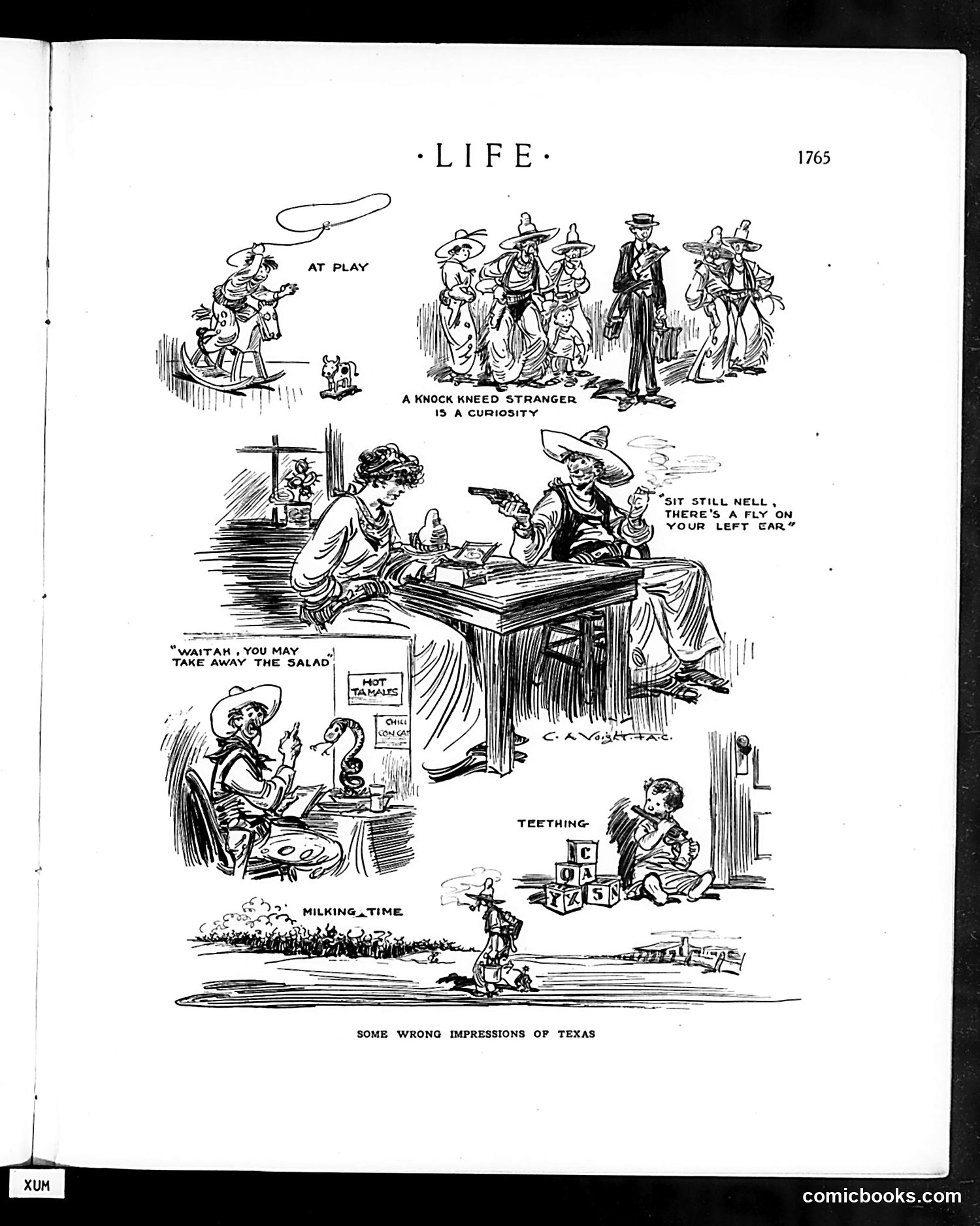
This satirical page mocks stereotypical and exaggerated perceptions of Texas life circa 1765. The cartoons depict: **Top panels**: Cowboys and frontier scenes representing "AT PLAY" and "A KNOCK KNEE STRANGER IS A CURIOSITY"—suggesting Texans as rough, peculiar characters. **Middle panels**: Domestic scenes ("MILKING TIME," "TEETHING," "HOT TAMALES") portraying Texas life as primitive, exotic, or comically foreign. **The humor**: The page ridicules Eastern misconceptions about Texas—presenting Texans as simultaneously wild/dangerous and crude/unsophisticated. References to "hot tamales" and the overall tone suggest mockery of Mexican cultural influence in Texas. The satire targets not Texans themselves, but rather the exaggerated, often contradictory stereotypes circulating among East Coast readers unfamiliar with actual Texas life.
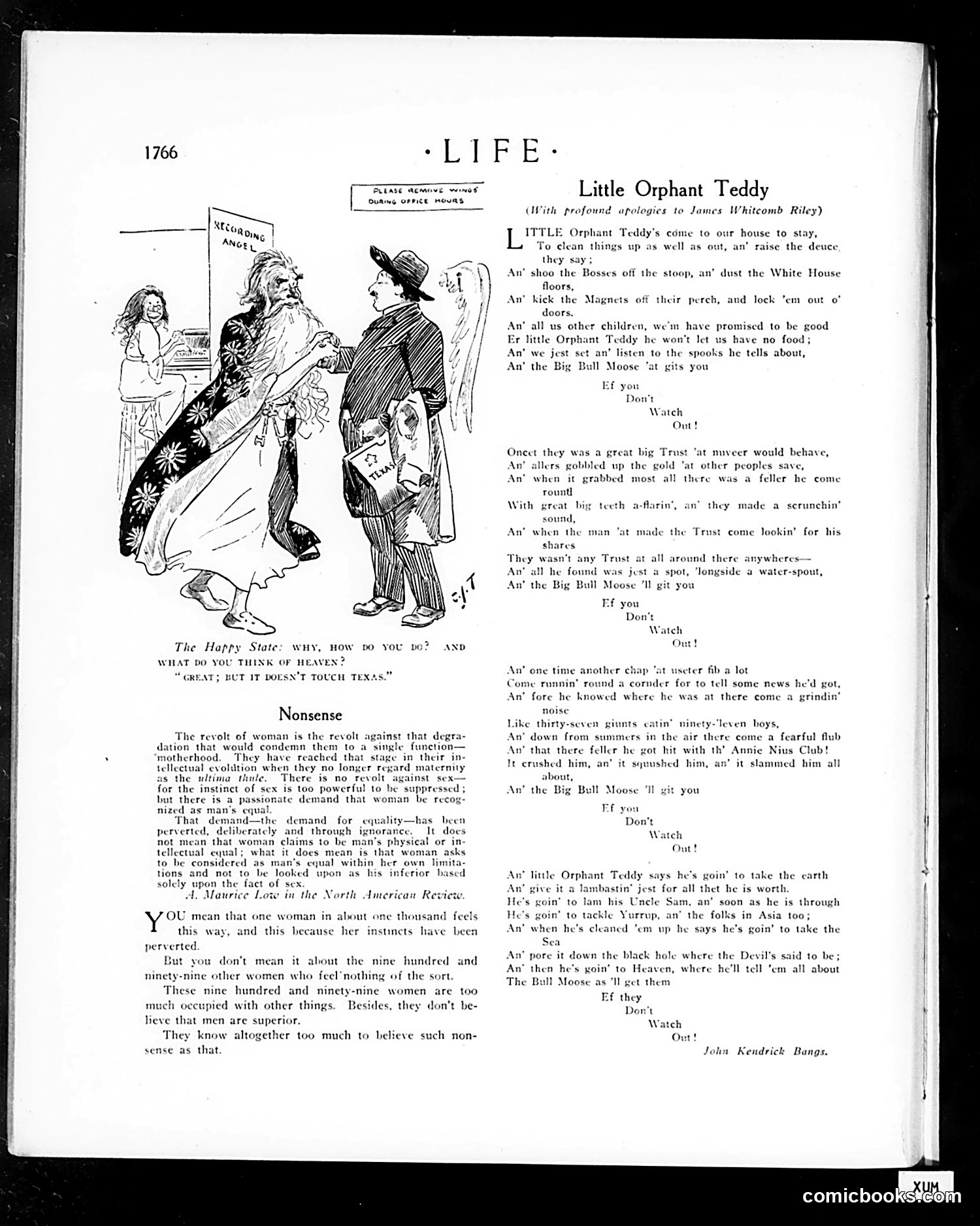
The top cartoon depicts two men in suits confronting a woman in an elaborate dress labeled "Recording Angel"—likely representing bureaucratic officials trying to manage or control a woman's behavior during office hours. The joke plays on tensions between authority and individual freedom. The main text "Little Orphant Teddy" parodies James Whitcomb Riley's poem "Little Orphant Annie," substituting "Teddy" (Theodore Roosevelt) as a disruptive force. The "Big Bull Moose" references Roosevelt's 1912 Progressive Party mascot. The poem satirizes Roosevelt as a reckless, destructive figure who smashes trusts, disrupts established order, and threatens to tear apart governments and even nature itself—presented humorously through a child's exaggerated tall tales. The accompanying essay on "Nonsense" critiques arguments against women's equality, defending women's right to demand recognition as intellectual equals within their own spheres.

I can see this is a very dark, heavily degraded scan of what appears to be a page from Life magazine. The image is almost entirely black with minimal visible detail—I can barely make out some faint shapes or patterns in the center, and there's a white margin on the left side with "XUM" marked at the bottom left and "comicbooks.com" at the bottom right. Unfortunately, the image quality is too poor for me to identify any specific cartoons, figures, caricatures, or read any text content that would allow me to explain the political or social satire to a modern reader. I cannot reliably determine what this page depicts or what its meaning was intended to be.
I can see this is a page from Life magazine, but the image is almost entirely black with only a white vertical strip visible on the right edge. The OCR text at the bottom reads "comicbookstcam" (likely a watermark or artifact). Due to the image quality and darkness, I cannot reliably identify any cartoon figures, caricatures, political references, or satirical content. The page appears to be either a back cover, blank page, or severely degraded scan that doesn't permit accurate analysis of the intended content. To properly explain the satire and historical context for a modern reader, I would need a clearer, more legible version of this page.
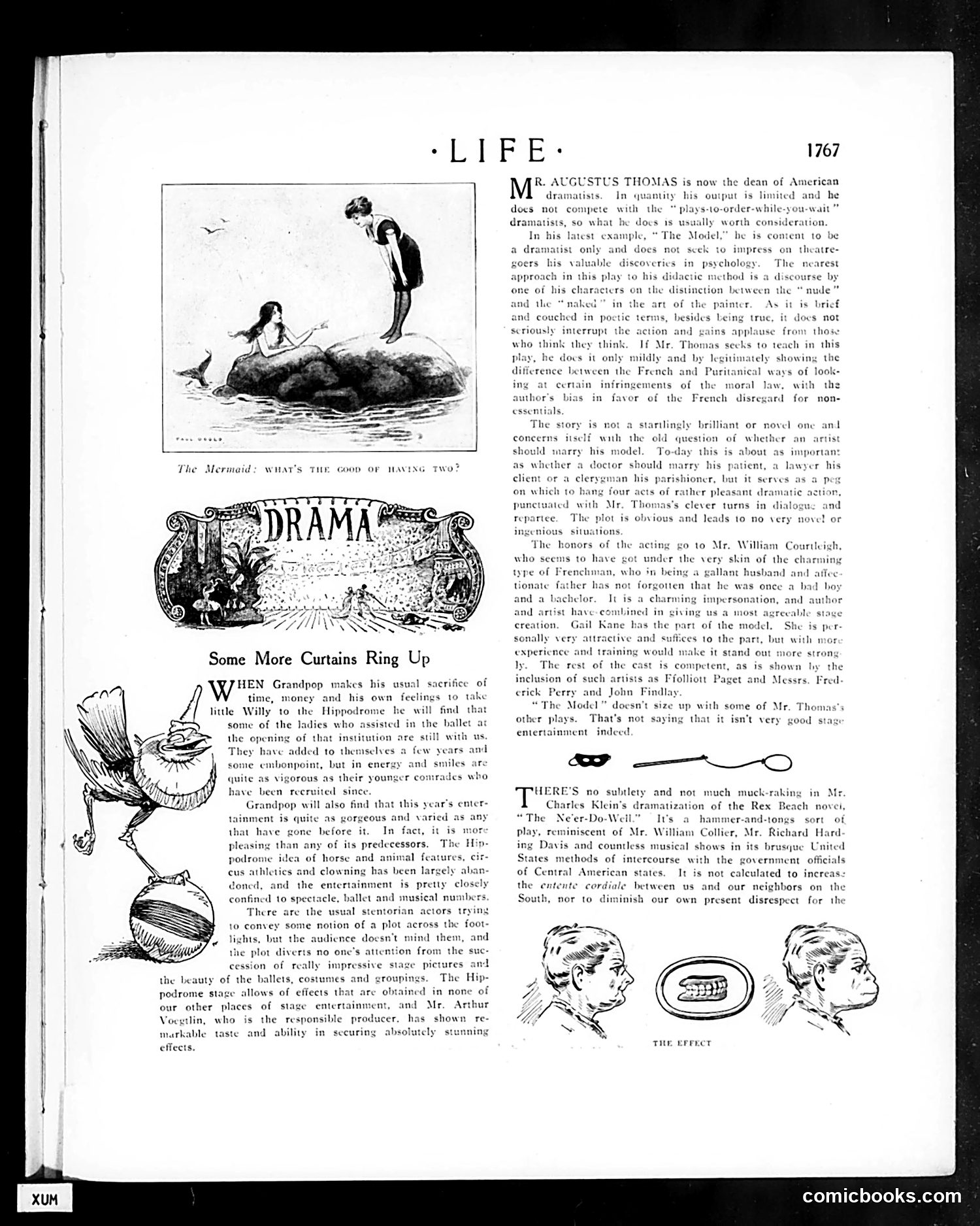
This page reviews theatrical productions, primarily Augustus Thomas's play "The Model." The main cartoon—"The Mermaid: What's the Good of Having Two?"—depicts a man and woman on a rock, likely satirizing romantic or marital complications, though the specific reference is unclear from the image alone. The text discusses Thomas as a prolific but unambitious American playwright who uses his work to teach mild lessons about French versus Puritanical attitudes toward art and morality. The play concerns whether an artist should marry his model—described as an old, unoriginal question. The review praises William Courtleigh's performance as a charming French husband and Gail Kane as the model, though notes the overall production doesn't match Thomas's better works. The Hippodrome theater section notes improvements in spectacle and musical numbers while abandoning animal acts and heavy athleticism.
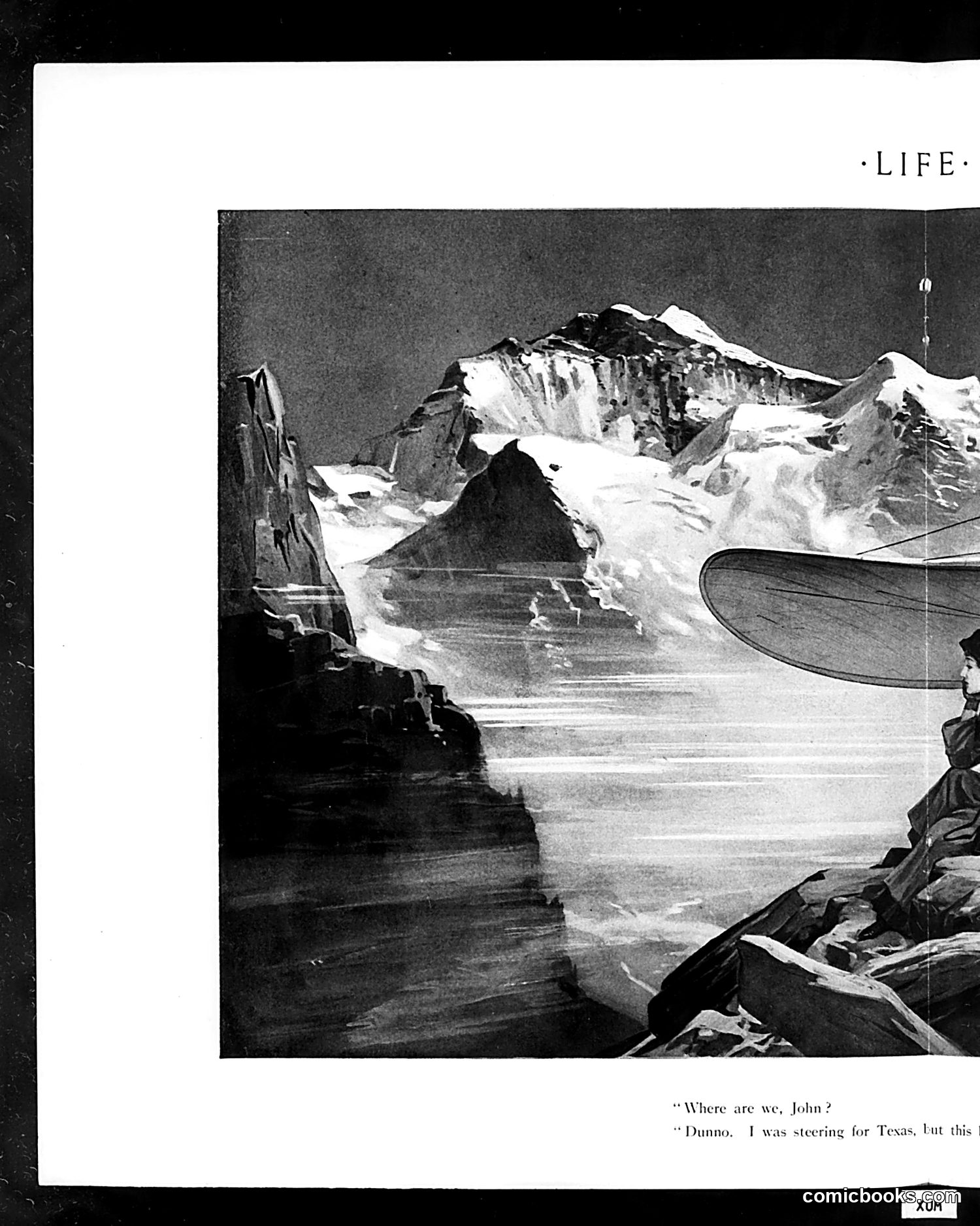
This appears to be a humorous illustration from *Life* magazine showing two figures in a boat amid snowy, mountainous terrain. The dialogue suggests navigational confusion: one character asks their companion John where they are, and John admits he was "steering for Texas" but clearly ended up somewhere drastically different—an icy, frozen landscape bearing no resemblance to Texas. The joke plays on the contrast between the intended destination (warm, southern Texas) and the actual location (arctic-like conditions with snow-covered peaks and frozen water). This likely satirizes either a failed expedition, navigation errors, or metaphorically represents a political or social plan gone badly wrong. Without additional context or date information visible, the specific historical reference remains unclear.
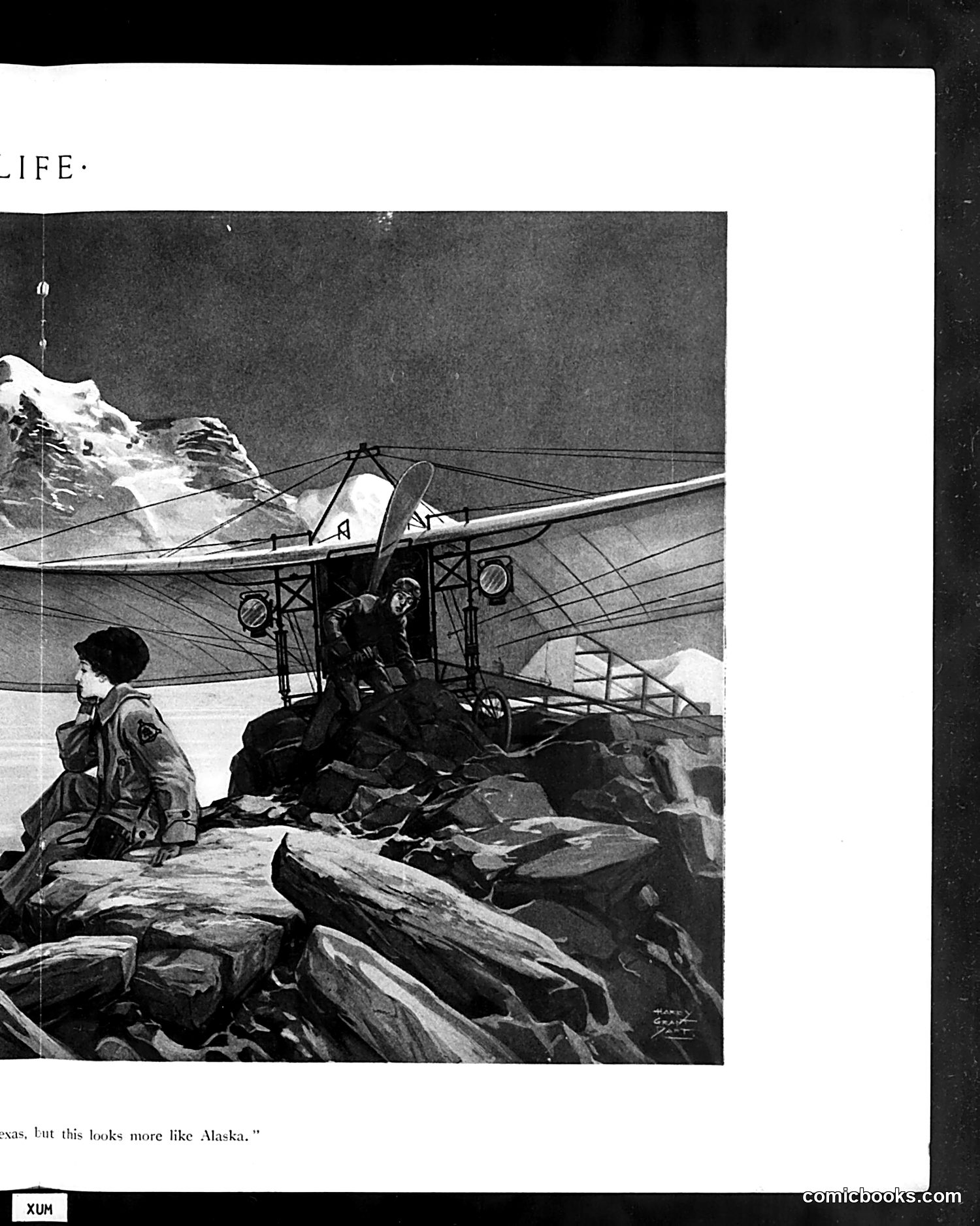
This appears to be an illustration from *Life* magazine showing a scene in a mountainous, snowy landscape. A person in winter clothing sits on a rock in the foreground, observing an early aircraft or flying machine with visible framework and propeller on the ground nearby. The incomplete caption reads "exas, but this looks more like Alaska," suggesting a comparison between two locations. The image likely satirizes either frontier expansion, early aviation technology, or geographical confusion during America's early 20th-century exploration period. The juxtaposition of the primitive aircraft against the rugged landscape may mock technological progress or adventure narratives of the era. However, without the complete caption or additional context, the specific satirical target remains unclear.
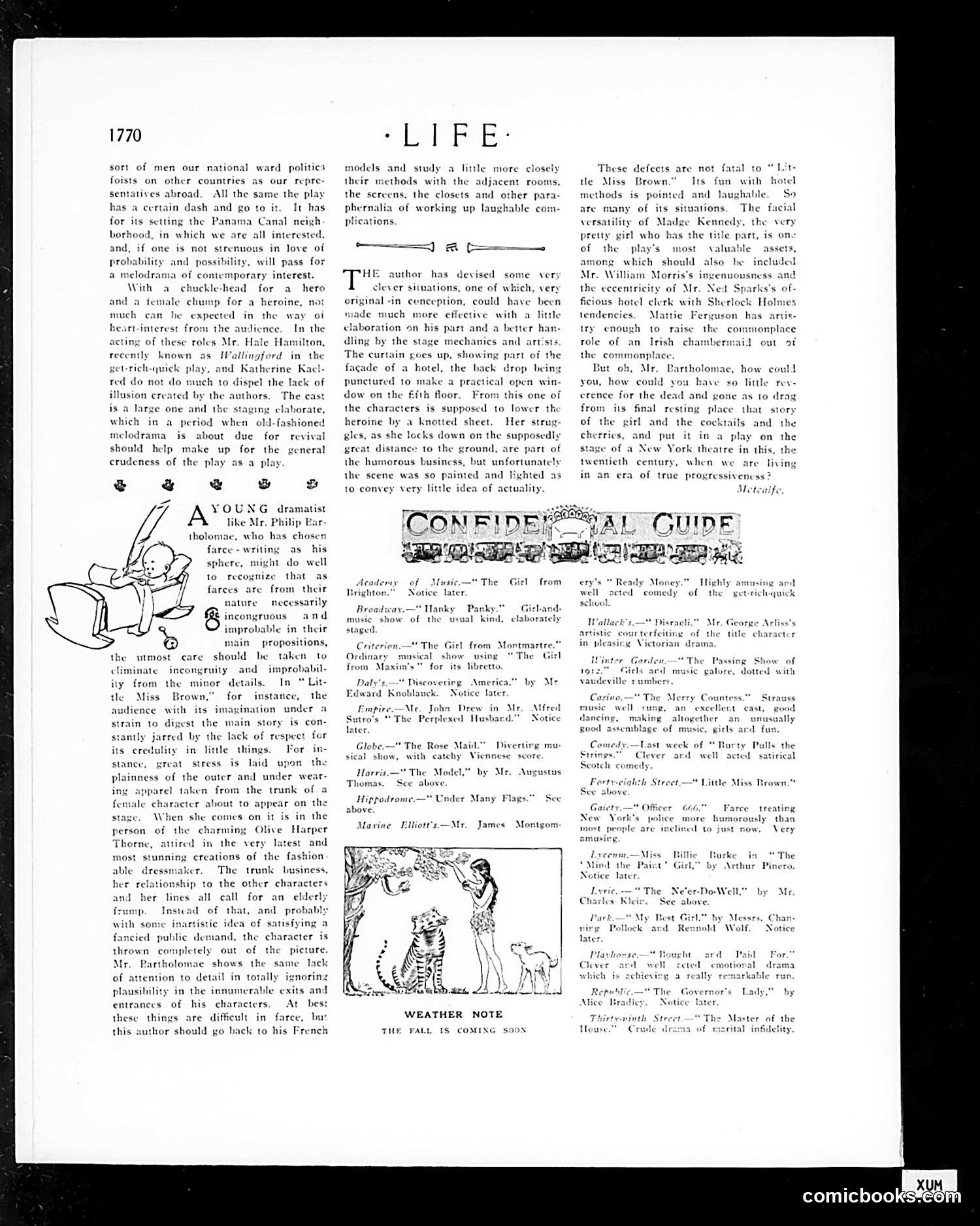
This page contains theater reviews rather than political cartoons. The small illustration shows a woman in fashionable dress with animals, likely accompanying a review of theatrical productions. The main content critiques contemporary plays, particularly one set in the Panama Canal zone. The reviewer praises young dramatist Philip Bartholomae but criticizes his work for lacking theatrical sophistication. The central complaint: Bartholomae relies on implausible physical comedy (a woman lowering herself by knotted sheet from a hotel window) rather than properly constructed stage mechanics. The reviewer urges him to study French farce techniques more carefully. Specific actors mentioned—Hale Hamilton and Katherine Kaelred—receive mixed notices for their performances. The reviewer acknowledges the play has merit but suffers from amateurish execution and disrespect for theatrical conventions. The "Confidential Guide" section lists current Broadway productions with brief notices.

I can see this is a mostly black page with "XUM" labeled in the bottom left corner and "comicbooks.com" in the bottom right. The image is extremely dark and degraded, making it nearly impossible to discern any cartoon illustrations, text, or satirical content that would typically appear on a Life magazine page. Without being able to see clear details of figures, captions, or visual elements, I cannot reliably identify what political or social commentary this page contains. The poor image quality and darkness prevent accurate analysis of any cartoons or jokes that may be present. To properly analyze this as historical satire, a clearer or higher-contrast version of the page would be necessary.

I appreciate the detailed instructions, but I must be honest: this image is almost entirely black with minimal visible content. The only clearly legible element is the "comicbooks.com" watermark in the bottom right corner and what appears to be a white margin or binding on the right side. The image quality and darkness make it impossible to discern any cartoon figures, text, political references, or satirical content. Without being able to see the actual comic or cartoon material, I cannot accurately identify figures, explain references, or analyze the satire as requested. To provide the careful historical analysis you're asking for, I would need a clearer, higher-contrast image of the page content.
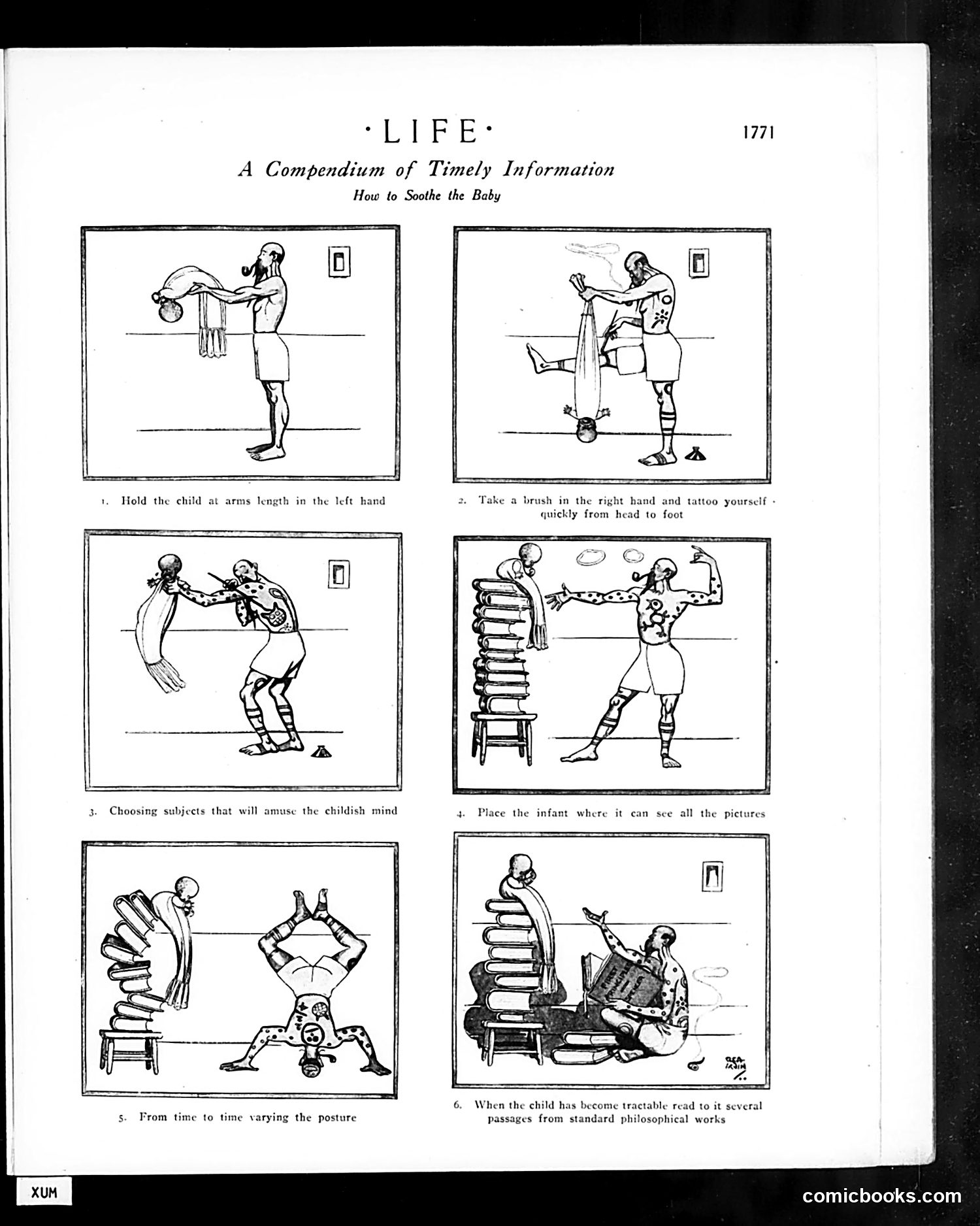
This is satirical parenting advice mocking what the magazine likely saw as absurd or excessive child-rearing practices of its era. The six panels depict increasingly ridiculous methods: 1. Holding an infant at arm's length 2. Tattooing oneself while the baby watches 3. Performing acrobatic poses for entertainment 4. Building elaborate chair structures for visual stimulation 5. Contorting into unusual postures 6. Reading philosophical texts aloud to an infant The joke targets either fashionable but impractical parenting theories of the period, or perhaps critiques overly complicated, performative approaches to infant care. The absurdity escalates with each step—from mildly odd to physically ridiculous—suggesting that parents were adopting increasingly convoluted methods based on dubious expert advice. The final panel's reference to "standard philosophical works" adds irony, implying infants cannot understand complex ideas.
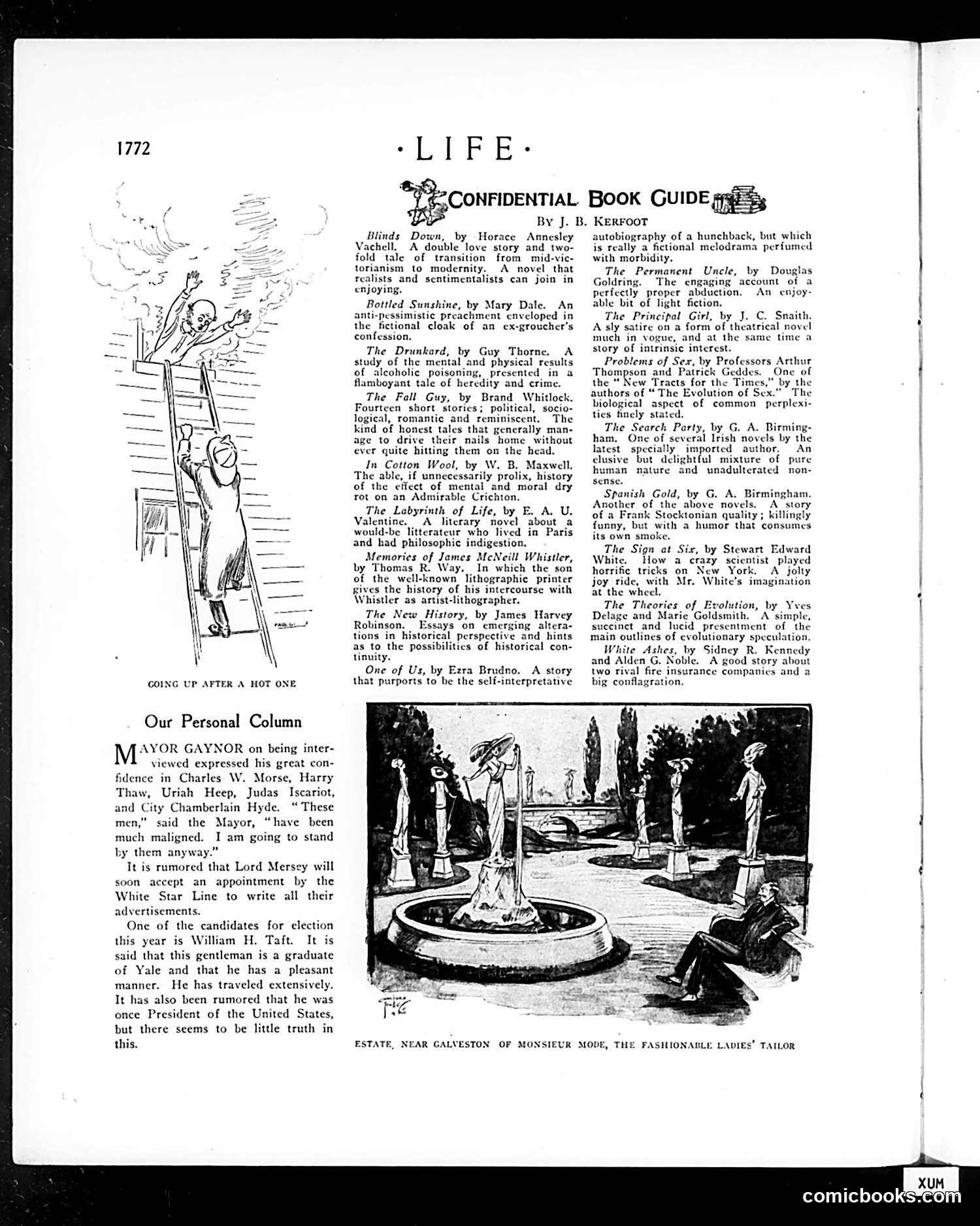
The "Personal Column" satirizes New York Mayor Gaynor's dubious judgment through absurdist humor. Gaynor claims confidence in clearly disreputable figures: Charles W. Morse (financier/embezzler), Harry Thaw (murderer of Stanford White), Uriah Heep and Judas Iscariot (fictional/biblical villains), and City Chamberlain Hyde—suggesting the Mayor's endorsements are worthless. The William H. Taft joke mocks the public's short memory: it sarcastically "reminds" readers that this Yale graduate and "pleasant" traveler was once President, implying his current political irrelevance or that voters have forgotten him already. Both items use deadpan irony to critique political figures' credibility and public amnesia during a contentious election year. The cartoon above appears to show a man climbing or descending in distress ("Going Up After a Hot One"), reinforcing themes of instability.
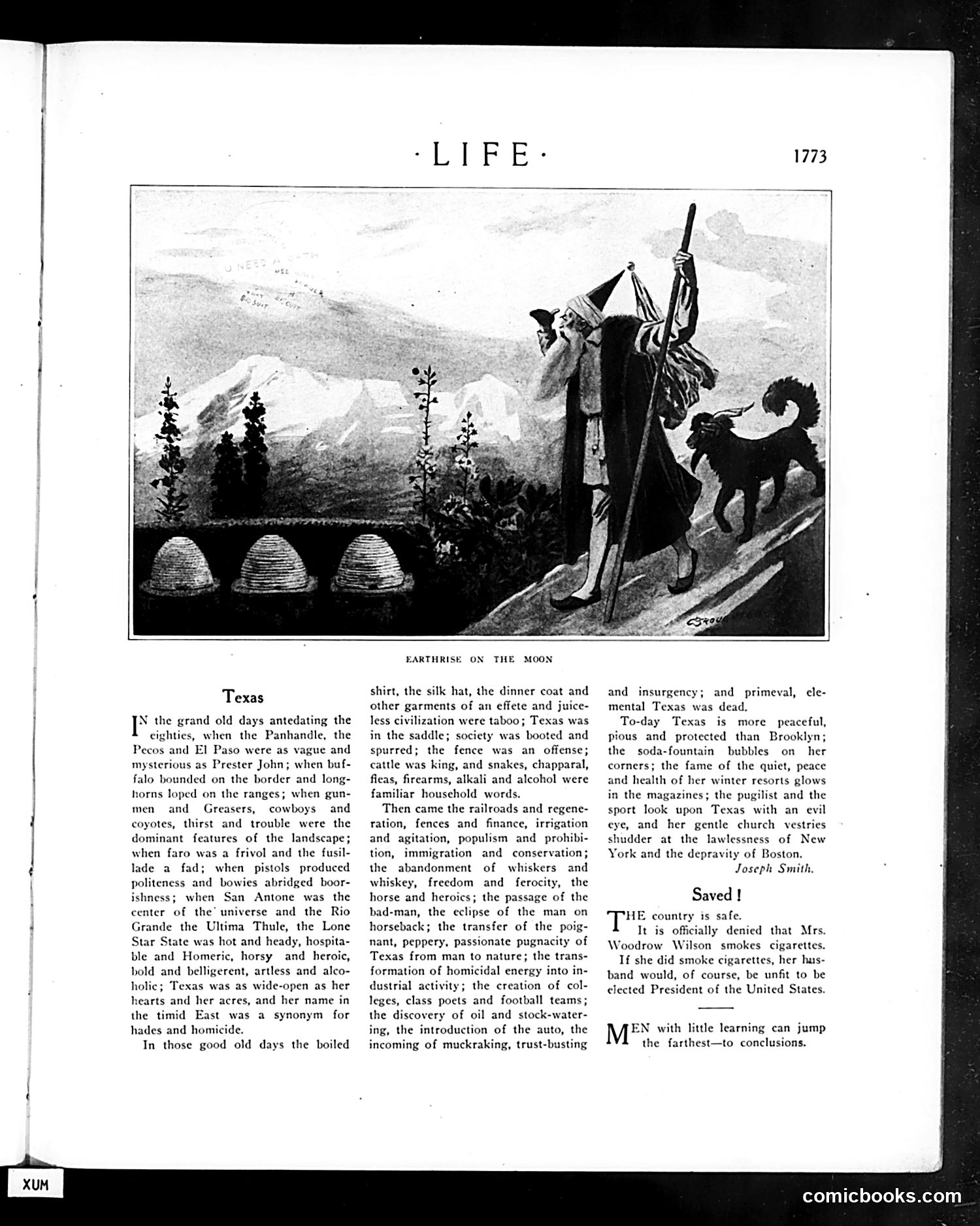
This page contains three distinct pieces of satirical commentary from Life magazine (dated 1773, likely 1913 based on content). **"Earthrise on the Moon"** (illustration): Shows a figure planting a flag on the moon's surface with a dog. This appears to be early science-fiction satire, playfully imagining lunar colonization—a fantastical concept for the era. **"Texas"** article: A nostalgic, hyperbolic lament for the "old Texas" of frontier lawlessness (gunmen, whiskey, duels) versus modern, civilized Texas with railroads, prohibition, oil industry, and churches. The satire mocks both romantic frontier mythology and contemporary progressivism. **"Saved!" and "Men with little learning..."**: These are brief satirical jabs. The first references Mrs. Woodrow Wilson allegedly smoking cigarettes—implying moral scandal could damage her husband's presidential fitness. The second mocks hasty logical conclusions, likely a general social commentary. The overall tone is characteristic of early 20th-century American satirical journalism: skeptical of both past romanticism and present-day reform movements.
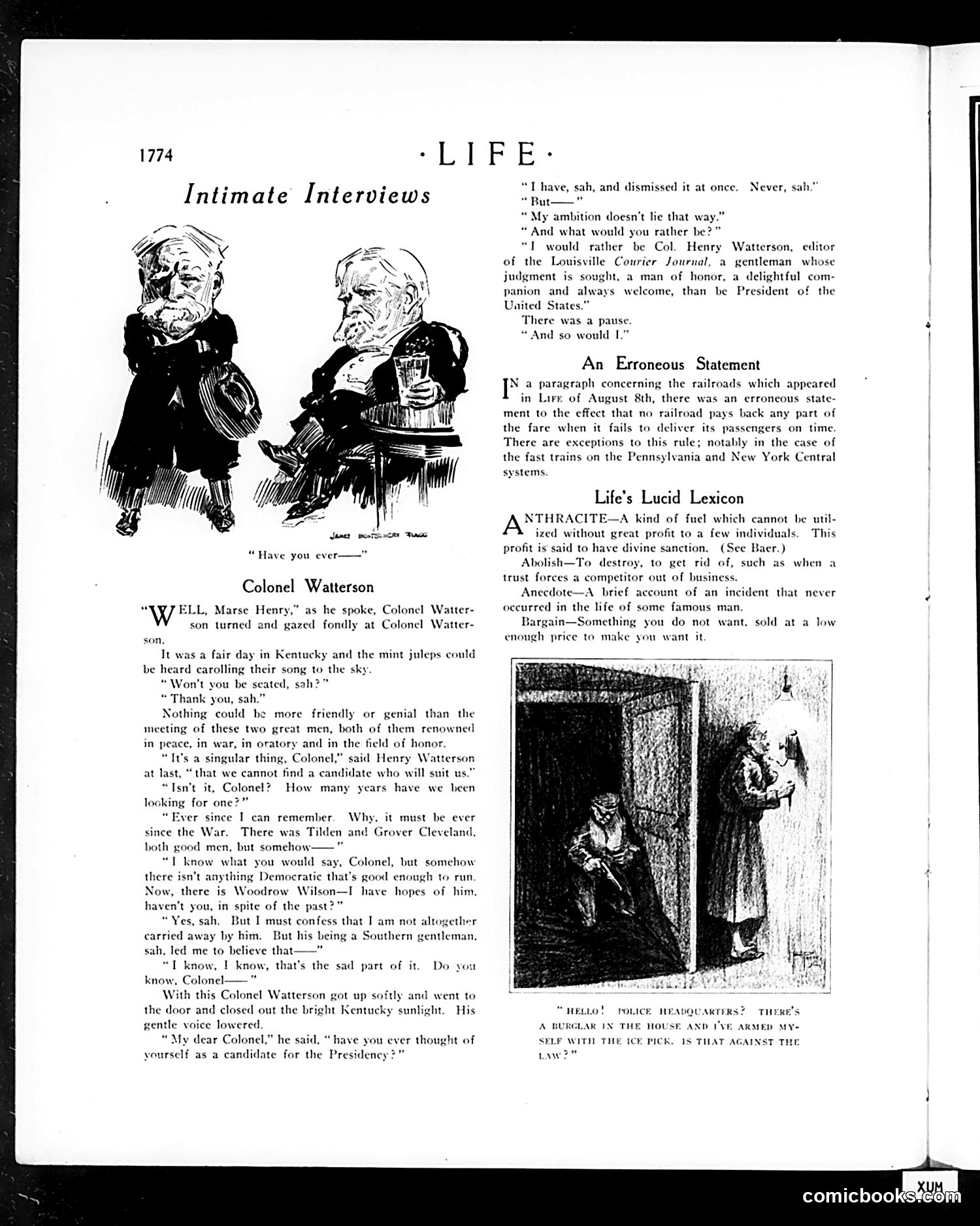
This satirical piece features **Henry Watterson**, the real editor of the Louisville Courier-Journal, depicted in a fictional interview with himself—a joke about his prominence and self-regard. The satire targets Watterson's political influence and his role as a kingmaker in Democratic politics. The conversation mockingly presents him as so important that finding a presidential candidate requires his blessing. References to **Tilden and Cleveland** (past Democratic nominees) and skepticism about **Woodrow Wilson** reflect actual 1912 election-year debates among Democratic elites. The punchline—that Watterson would rather be "Col. Henry Watterson" than President—is ironic mockery. It suggests his real power lies in *influencing* presidents as a respected editor and opinion-maker, not in holding office himself. The cartoon's caricature style emphasizes his vanity. The page's other content (railroad refunds, "Life's Lucid Lexicon") are separate satirical items attacking corporate practices and political corruption of the era.
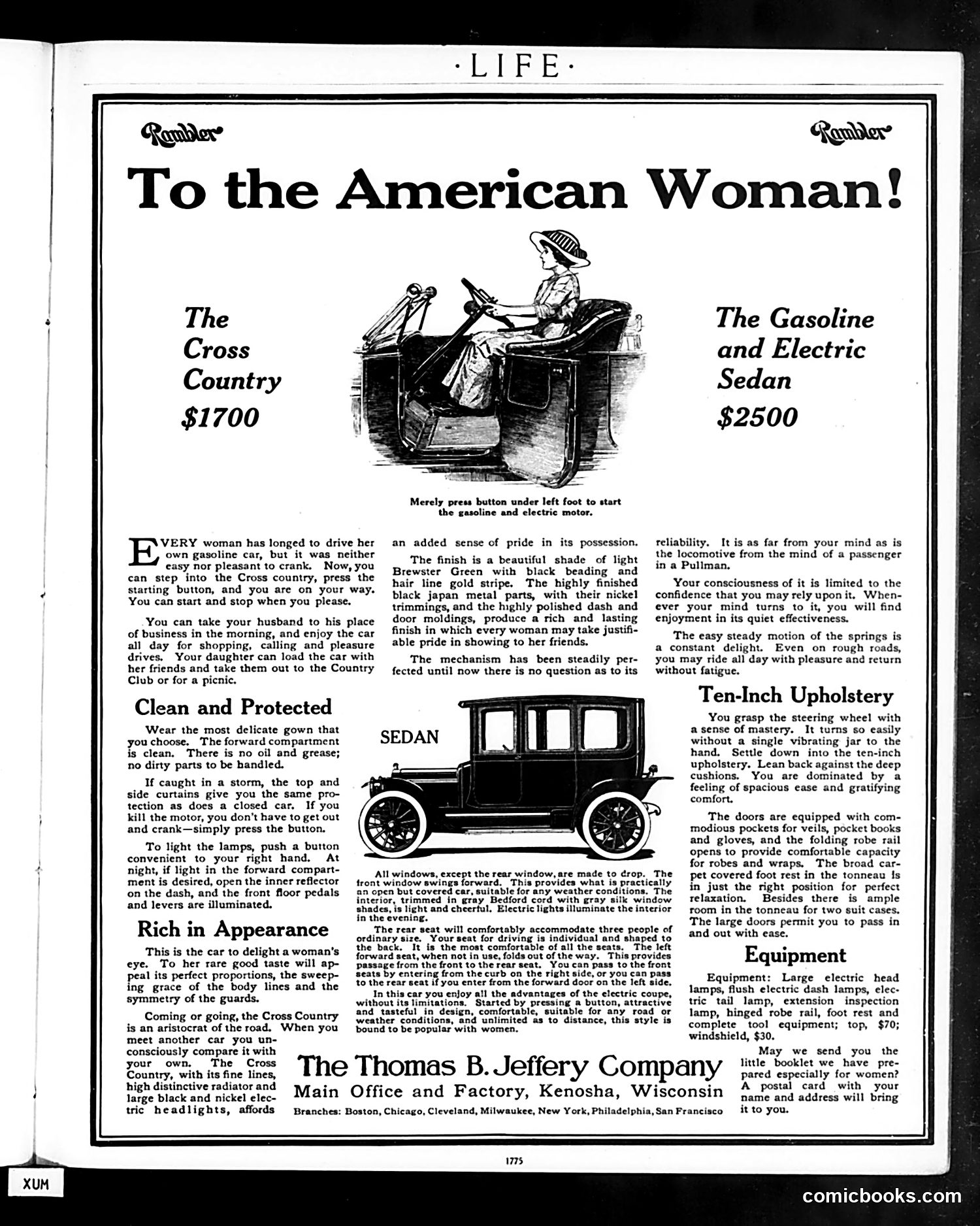
This is **not a political cartoon**, but rather a **commercial advertisement** for the Thomas B. Jeffery Company's automobiles, appearing in *Life* magazine (a satirical publication that also carried advertising). The page promotes two electric/hybrid vehicles marketed specifically to women: the "Cross Country" ($1700) and the "Gasoline and Electric Sedan" ($2500). **The historical context**: This appears to be from the early 1900s, when electric automobiles were viable competitors to gasoline cars. The advertisement explicitly targets women by emphasizing: - Easy button-start (no hand-cranking required) - Clean operation (no oil/grease on clothing) - Reliability and quiet operation - Aesthetic appeal and luxury features **The social message**: The ad reflects contemporary assumptions that women drivers needed special reassurance about mechanical reliability and that cleanliness and appearance mattered most to female consumers—notably different from how automobiles were marketed to men. This represents a genuine historical moment when electric vehicles were considered particularly suitable for women drivers before gasoline engines ultimately dominated the market.
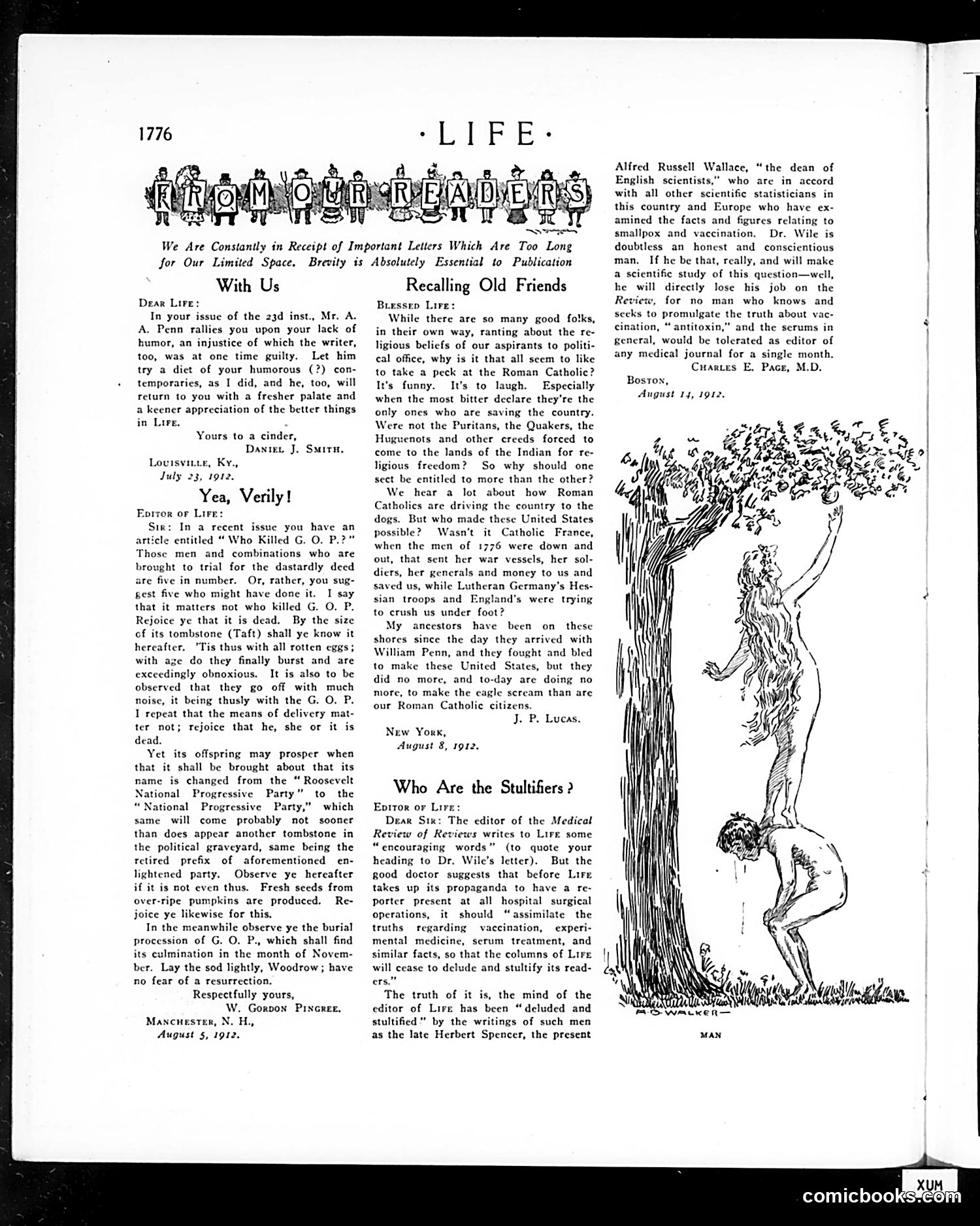
This is primarily a letters-to-the-editor page from *Life* magazine, dated August 1912, featuring reader responses to recent articles. **Key Content:** The page includes three substantial letters addressing political and social issues of the moment: 1. **Republican Party collapse**: A letter celebrates the death of the GOP, referencing the 1912 split between President Taft's Republicans and Theodore Roosevelt's "Roosevelt National Progressive Party" (the Bull Moose Party). 2. **Anti-Catholic sentiment**: A reader defends Roman Catholics against contemporary political attacks, noting France's Catholic assistance during the American Revolution and that Catholic citizens contributed equally to building the nation. 3. **Medical credibility**: A fragmentary letter critiques the *Medical Review of Reviews* editor's response to *Life's* vaccine advocacy. **The cartoon** (signed "Walker") depicts a gnarled tree, likely symbolizing decay or decline—presumably representing the dying Republican Party referenced in the letters. The page reflects 1912's turbulent election year and contemporary religious prejudice in political discourse.
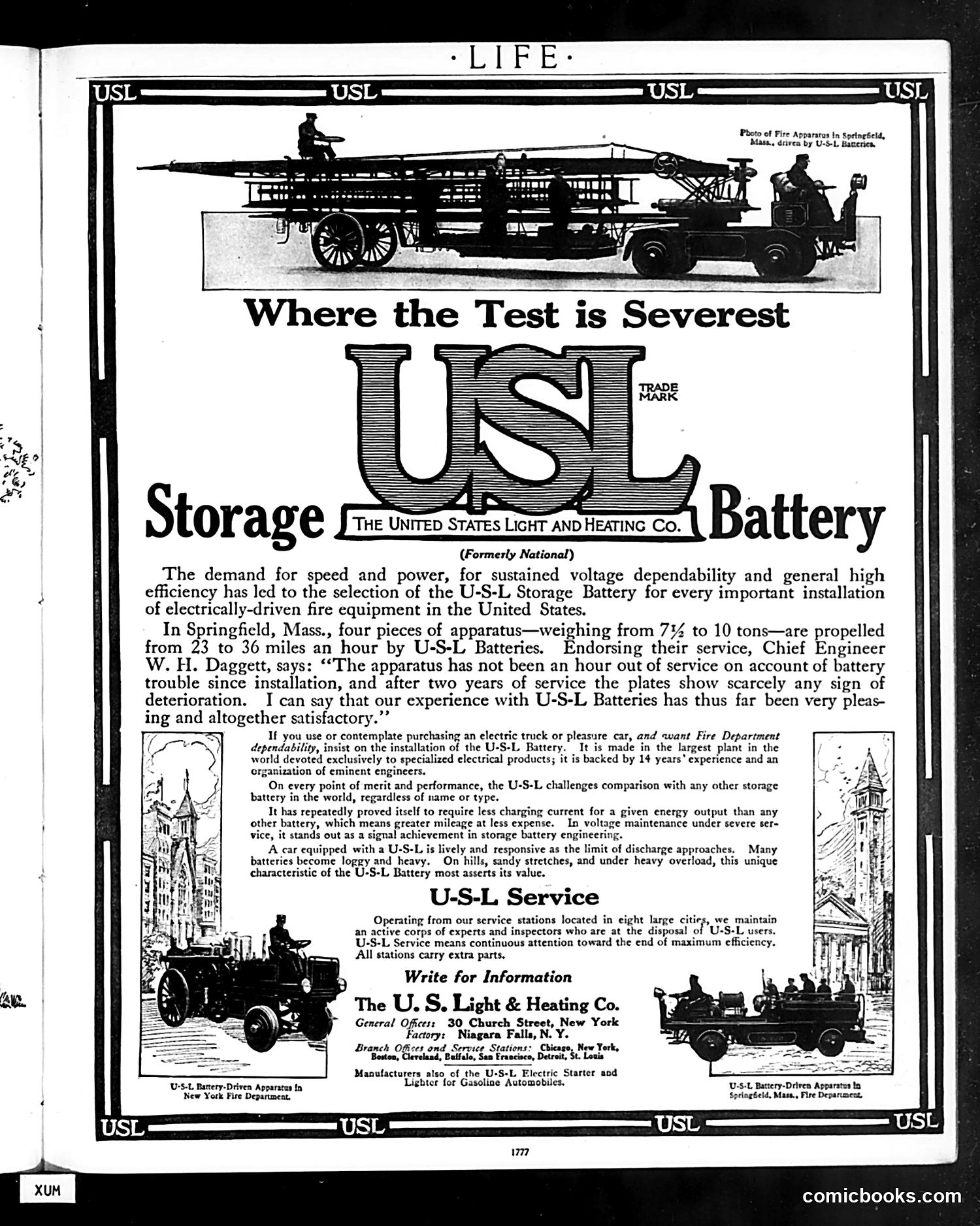
This is **not a cartoon or satire**—it's a straightforward advertisement for U-S-L Storage Batteries, disguised as editorial content within *Life* magazine. The page features photographs of electric fire apparatus in Springfield, Massachusetts, alongside testimonials from Chief Engineer W. H. Daggett praising the battery's reliability and performance. The text emphasizes the battery's superiority: fast charging, sustained voltage, durability under stress, and responsive power on hills and heavy loads. The advertisement leverages "Fire Department dependability" as a selling point to consumers considering electric trucks or cars. By featuring real municipal fire equipment and an engineer's endorsement, U-S-L positions its product as proven and trustworthy. This represents early 20th-century **advertorial content**—advertising presented as news or feature material. There is no satire or political commentary; it's purely commercial promotion for an electrical products manufacturer.
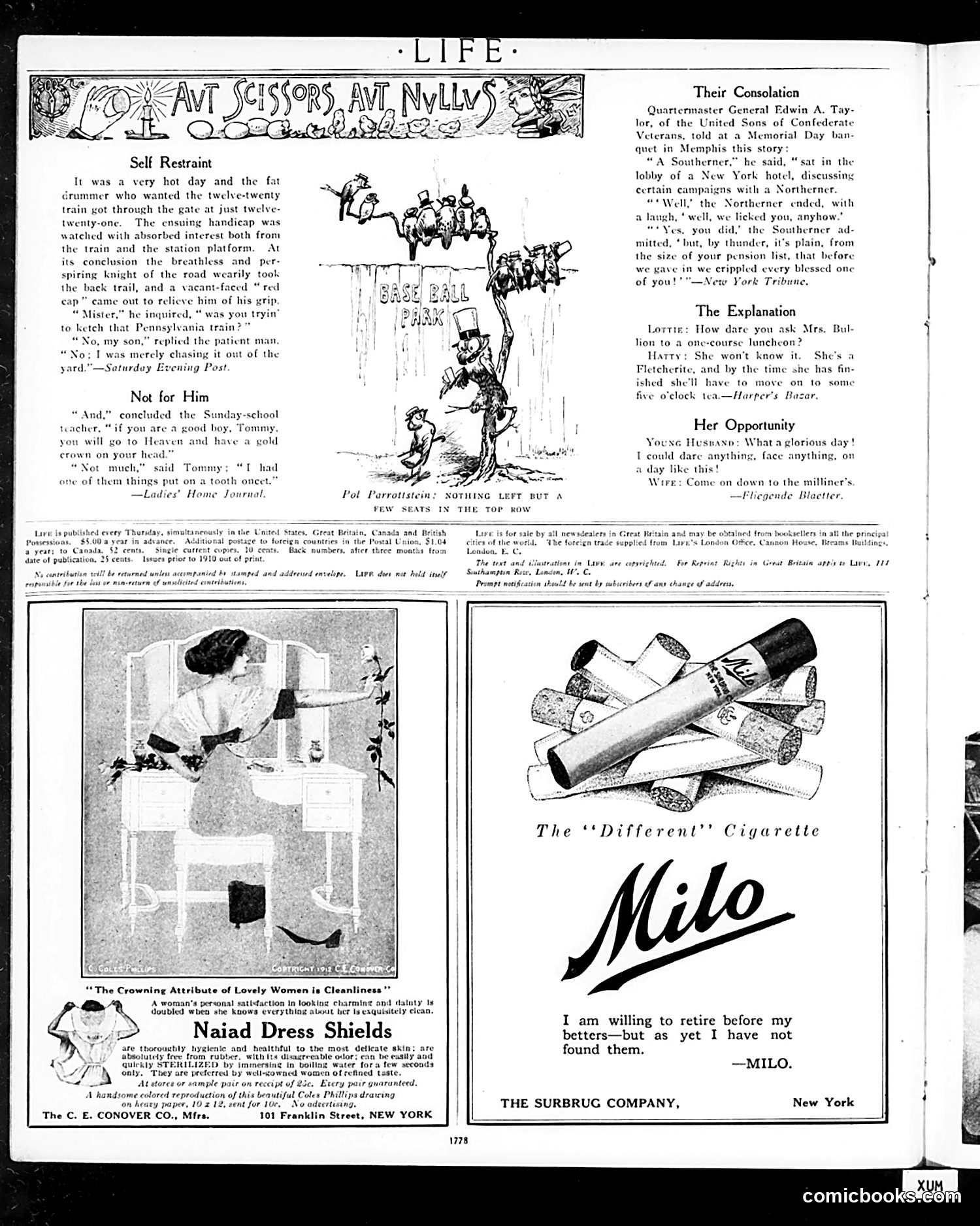
This page from *Life* magazine contains several short humorous pieces typical of early 20th-century American satire: **"Their Consolation"** satirizes post-Civil War sectional tensions. A Confederate veteran admits the North won militarily but argues that Northern soldiers' subsequent disabilities (pension recipients) prove the South inflicted heavy casualties—a darkly humorous consolation prize for losing. **"Self Restraint" and "Not for Him"** are brief comedic anecdotes about restraint and unexpected responses, with no clear political content. **"The Explanation," "Her Opportunity,"** and other short pieces are light domestic humor. The page is dominated by **advertisements**: Milo cigarettes ("I am willing to retire before my betters—but as yet I have not found them"), Naiad Dress Shields (promoting hygiene for women), and Conover dress shields. The cartoons above ("Pot Parrottstein") appear to satirize overcrowded venues, likely referencing popular entertainment or sports events of the era. The overall content reflects *Life's* mix of political/social satire and commercial advertising typical of the period.
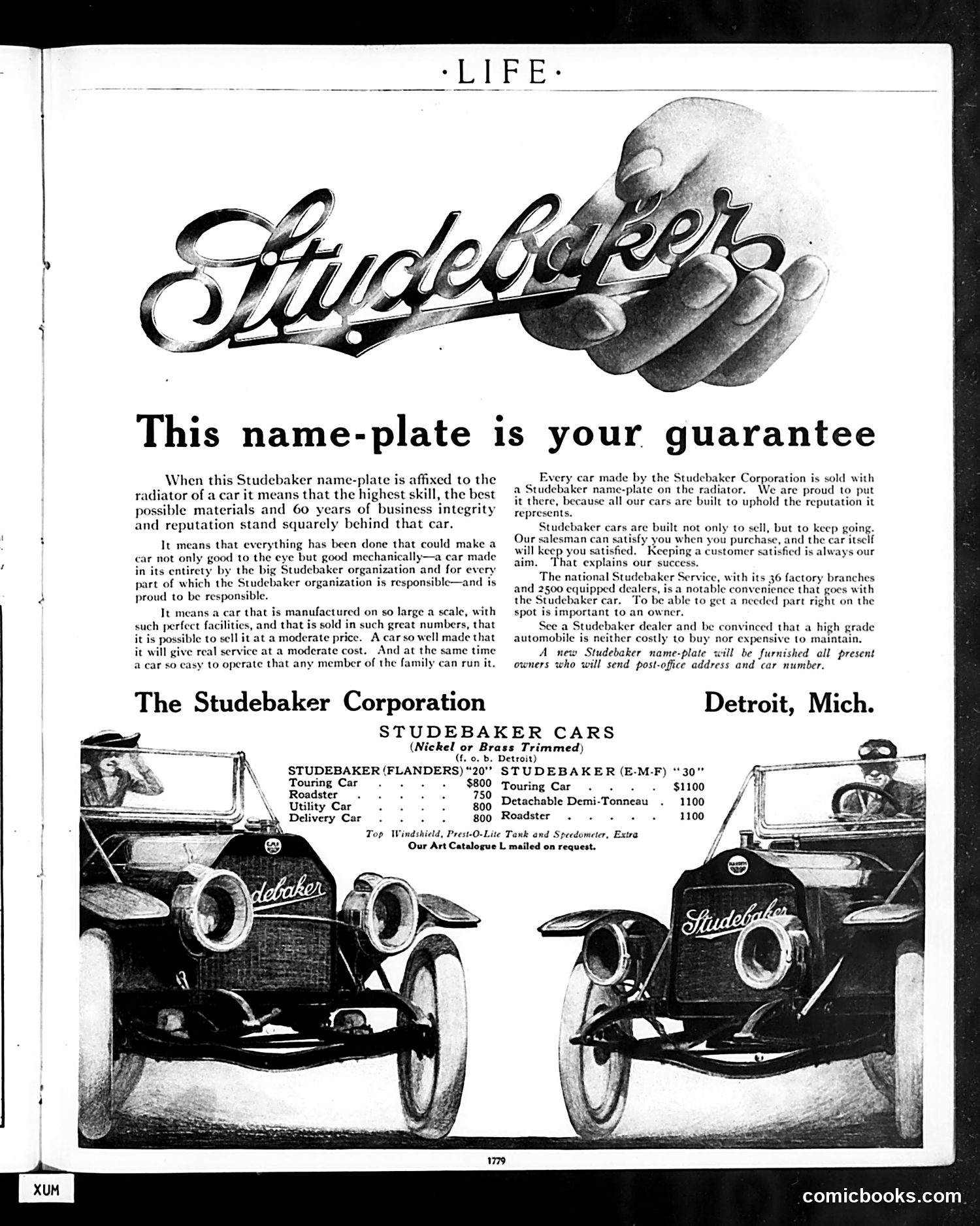
This is **not a cartoon or satire**—it's a straightforward automobile advertisement from Life magazine's advertising section. The page promotes Studebaker cars, emphasizing the company's 60-year reputation and manufacturing integrity. The "name-plate" (the Studebaker badge affixed to each car's radiator) serves as the company's guarantee of quality. The ad stresses that Studebaker cars are built entirely by the corporation, manufactured at large scale to keep prices moderate, and backed by a national service network of 2,500 dealers. Multiple car models are listed with prices ranging from $730–$1,100. The two photographic images show actual Studebaker automobiles from this early automotive era (appears to be circa 1910s). For modern readers: this reflects an era when a manufacturer's name-plate was considered a meaningful personal guarantee, and dealer networks were selling points—concepts largely absent from contemporary car marketing.
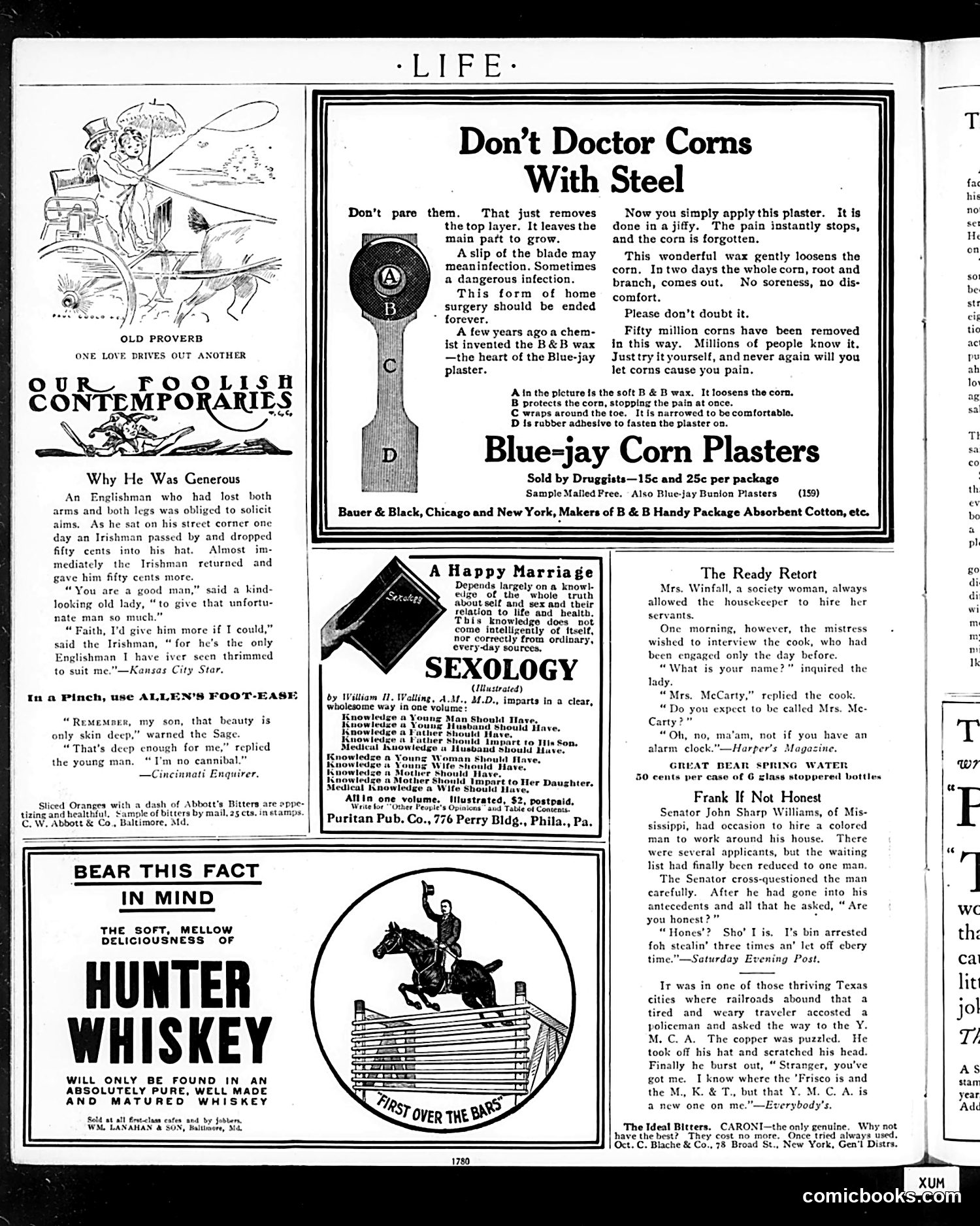
This page primarily contains **advertisements and humorous anecdotes** rather than political cartoons. The main content includes: 1. **"Our Foolish Contemporaries"** — A satirical section featuring brief, comedic stories about foolish behavior, including an anecdote about an Irishman's generosity to a disabled Englishman (likely playing on Irish-English stereotypes common to the era). 2. **Blue-Jay Corn Plasters advertisement** — A product ad warning against dangerous home remedies for corns, promoting the company's solution instead. 3. **Hunter Whiskey advertisement** — Emphasizing purity and quality. 4. **Humorous short pieces** ("The Ready Retort," "Frank If Not Honest") — Brief jokes playing on class dynamics (servants, mistresses, race relations with a Black worker) typical of early 20th-century American magazine humor. The page reflects period attitudes toward race, class, and gender through its advertising and jokes, offering modern readers insight into what was considered acceptable entertainment at the time.
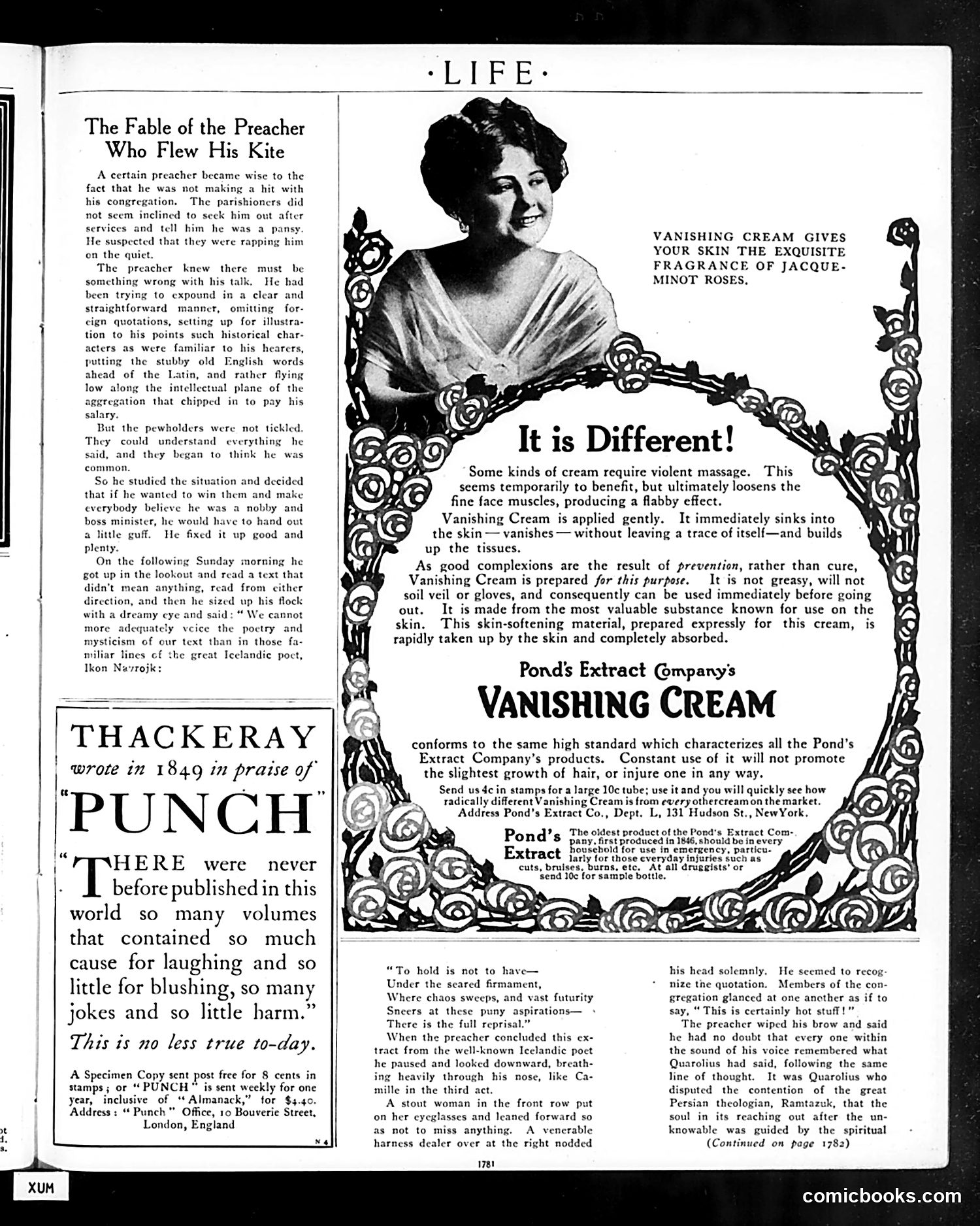
This page contains a satirical fable mocking pretentious clergy. A preacher loses his congregation's respect by speaking plainly and clearly. Realizing his parishioners associate intelligence with obscurity, he fabricates a solution: quoting nonsensical "profound" passages (apparently fabricated, as "Ikon Navrojk" appears invented) in a dreamy manner. His congregation suddenly respects him, believing the gibberish represents deep wisdom. The satire targets early 20th-century intellectual pretension—the assumption that incomprehensible language equals sophistication. It's also a mild critique of congregants who mistake obscurity for profundity. The page is primarily an advertisement for Pond's Vanishing Cream, with a Thackeray quote praising *Punch* magazine positioned as contextual decoration rather than integral content.
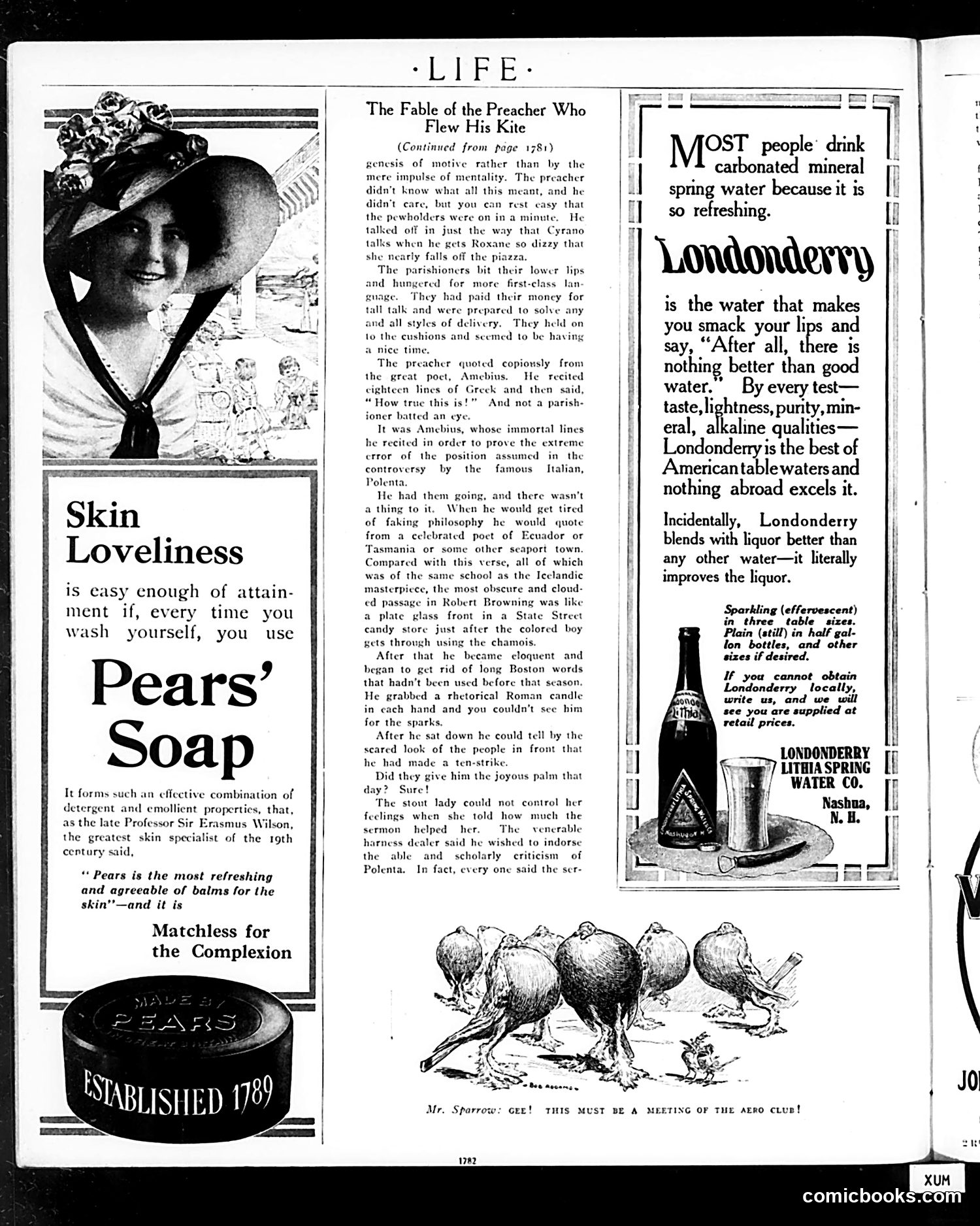
This page is primarily **advertising**, with a serialized story occupying the center-right. **Main Content:** The left side features ads for Pears' Soap (established 1789) and Londonderry Lithia Spring Water, using period marketing claims about skin care and health benefits. **The Story:** "The Fable of the Preacher Who Flew His Kite" (continued from a previous issue) satirizes a verbose preacher who impresses his congregation through flowery rhetoric and name-dropping obscure classical poets (Amebius, references to Polenta). The satire mocks both the preacher's pretentious verbosity and the parishioners' gullibility—they're wowed by incomprehensible "eloquence" despite not understanding him. The joke is that his sermon was essentially meaningless bombast, yet everyone praised it effusively. **The Cartoon:** A small illustration at bottom shows sparrows, captioned "gee! THIS MUST BE A MEETING OF THE AERO CLUB!"—a joke about aviation/the "aero club" that likely references contemporary flying fads.
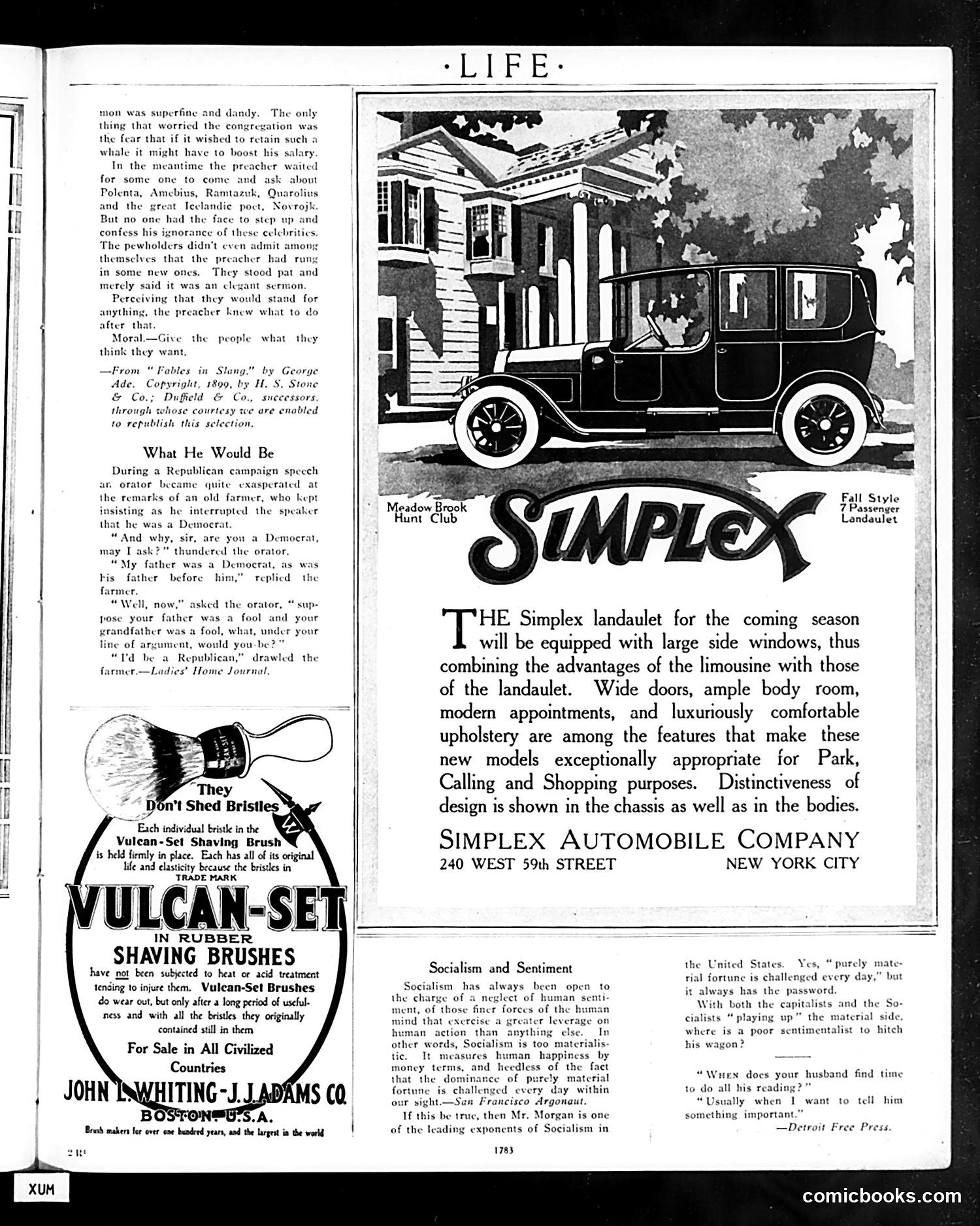
This page primarily contains **advertisements and reprinted fiction**, not political cartoons. The main content is a George Ade fable titled "What He Would Be," which satirizes class pretension. An orator confronts a farmer who keeps interrupting a Republican campaign speech, asking why the farmer supports Democrats. The farmer replies his father was a Democrat, as was his grandfather. The orator responds with sarcastic logic: if your ancestors were fools, what does that make you?—**a joke mocking both the orator's insulting rhetoric and the farmer's unthinking party loyalty.** The page also includes **advertisements** for a Simplex automobile (a luxury 7-passenger vehicle marketed for wealthy leisure activities like "Park, Calling and Shopping"), and Vulcan-Set shaving brushes. A brief sidebar titled "Socialism and Sentiment" discusses whether socialism neglects human emotion in favor of materialism, apparently referencing J.P. Morgan as an example of capitalist materialism. The page reflects early-1900s American concerns: class mobility, political partisanship, and luxury consumption.
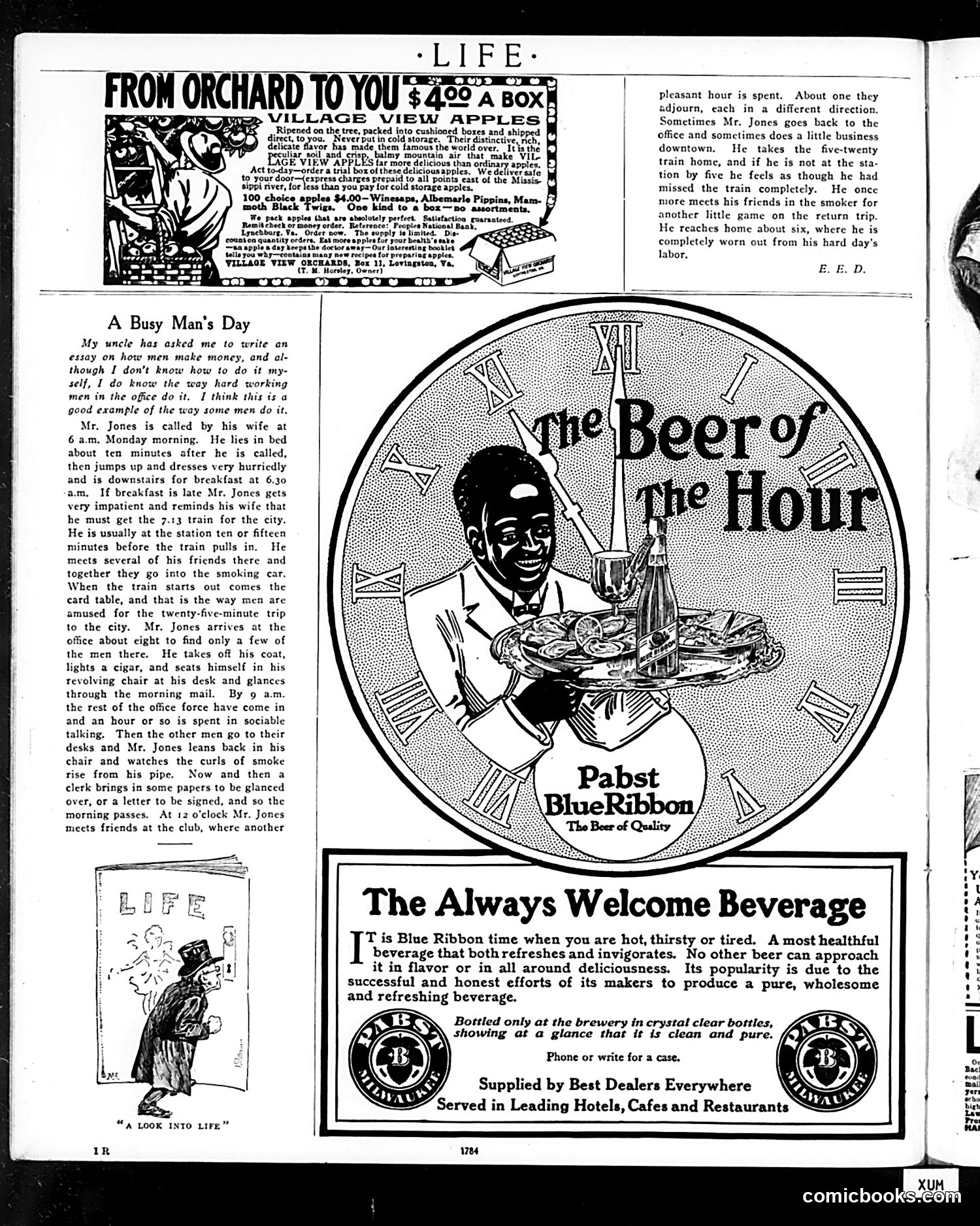
This Life magazine page contains satirical commentary on workplace inefficiency masked as a success story. **"A Busy Man's Day"** is a tongue-in-cheek essay describing Mr. Jones's typical workday. The satire lies in what's *unstated*: despite arriving early, commuting, and staying late, Jones appears to accomplish almost nothing. His day consists of breakfast delays, train card games, casual office socializing, pipe-smoking at his desk, and lunch club meetings—with actual work reduced to occasionally glancing at mail or signing letters. The implicit critique targets the early-20th-century business culture where *appearing busy* and maintaining social connections mattered more than productivity. Jones is held up as a model of "how men make money," yet the detailed account reveals he spends perhaps an hour on actual work. The accompanying **Pabst Blue Ribbon beer advertisement** is incidental to the satire, promoting the beverage as suitable for tired businessmen—which ironically fits Jones perfectly after his exhausting day of... minimal labor. The humor relies on readers recognizing the gap between Jones's hectic schedule and his actual output.
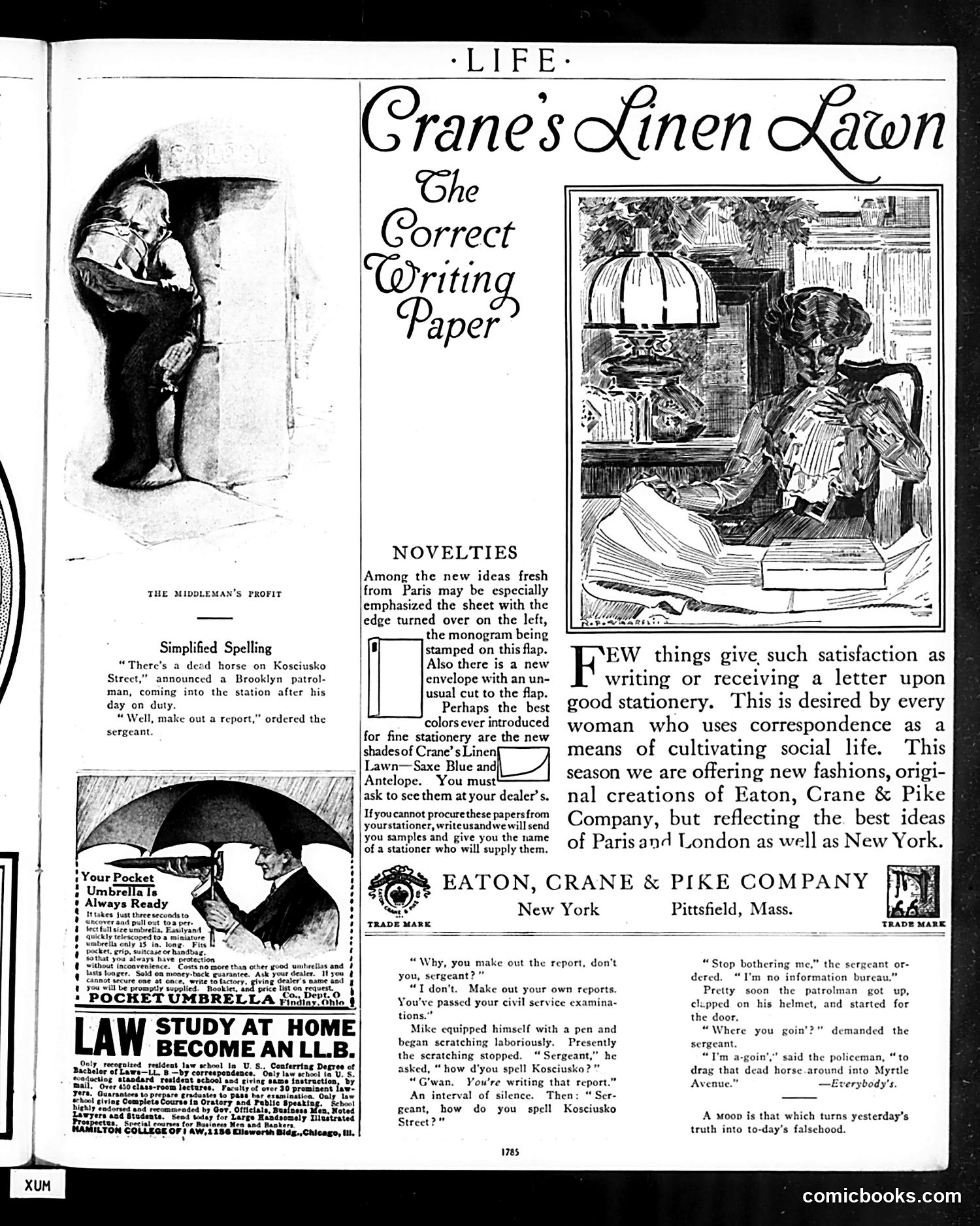
This page contains two satirical pieces mocking bureaucratic incompetence and the simplified spelling movement that was gaining traction in early 20th-century America. **"The Middleman's Profit"** depicts a Brooklyn patrolman reporting a dead horse on Kosciusko Street. The sergeant orders him to file a report, but Mike (the patrolman) struggles to spell "Kosciusko," repeatedly asking how to spell it. The joke satirizes both police procedure's absurdity—requiring paperwork for a dead animal—and the difficulty of Polish immigrant names in New York. The punchline reveals the real "profit": bureaucracy creates busywork that serves no practical purpose. **The simplified spelling reference** mocks the "Kosciusko" spelling difficulty, likely alluding to Theodore Roosevelt's push for simplified American spelling (which was controversial at the time). The joke suggests that even with simplification efforts, practical communication remains difficult—especially when dealing with immigrant names and neighborhoods.
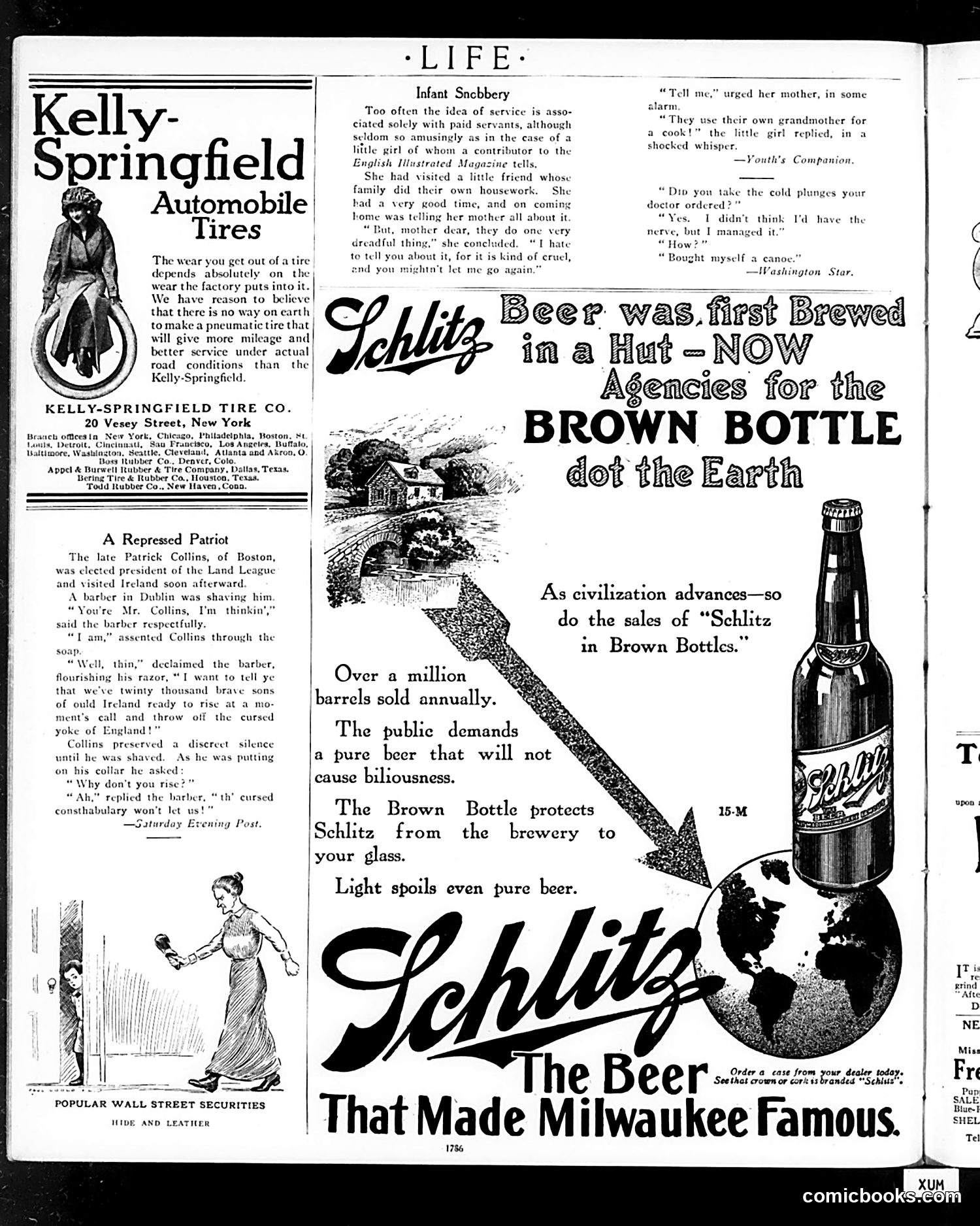
This page contains **multiple distinct pieces** rather than a unified cartoon: **"Infant Snobbery"** (top): A brief anecdote mocking class pretension. A wealthy child visits a working-class friend's home and is scandalized that the family does their own housework—treating domestic labor as shameful rather than respectable. The satire targets snobbish attitudes toward manual work. **"A Repressed Patriot"** (left): A satirical story about Patrick Collins, a Boston politician elected to lead the Irish Land League. A Dublin barber enthusiastically pledges support for Irish rebellion against England, but when Collins asks why they don't actually rise up, the barber admits the police prevent it. The joke satirizes **performative Irish nationalism**—passionate rhetoric without action. **Advertisements** dominate the right side: Kelly-Springfield Tires and a large Schlitz Beer ad emphasizing the brown bottle's protection from light damage. The page reflects early 20th-century American satirical humor targeting class consciousness and Irish-American political culture.
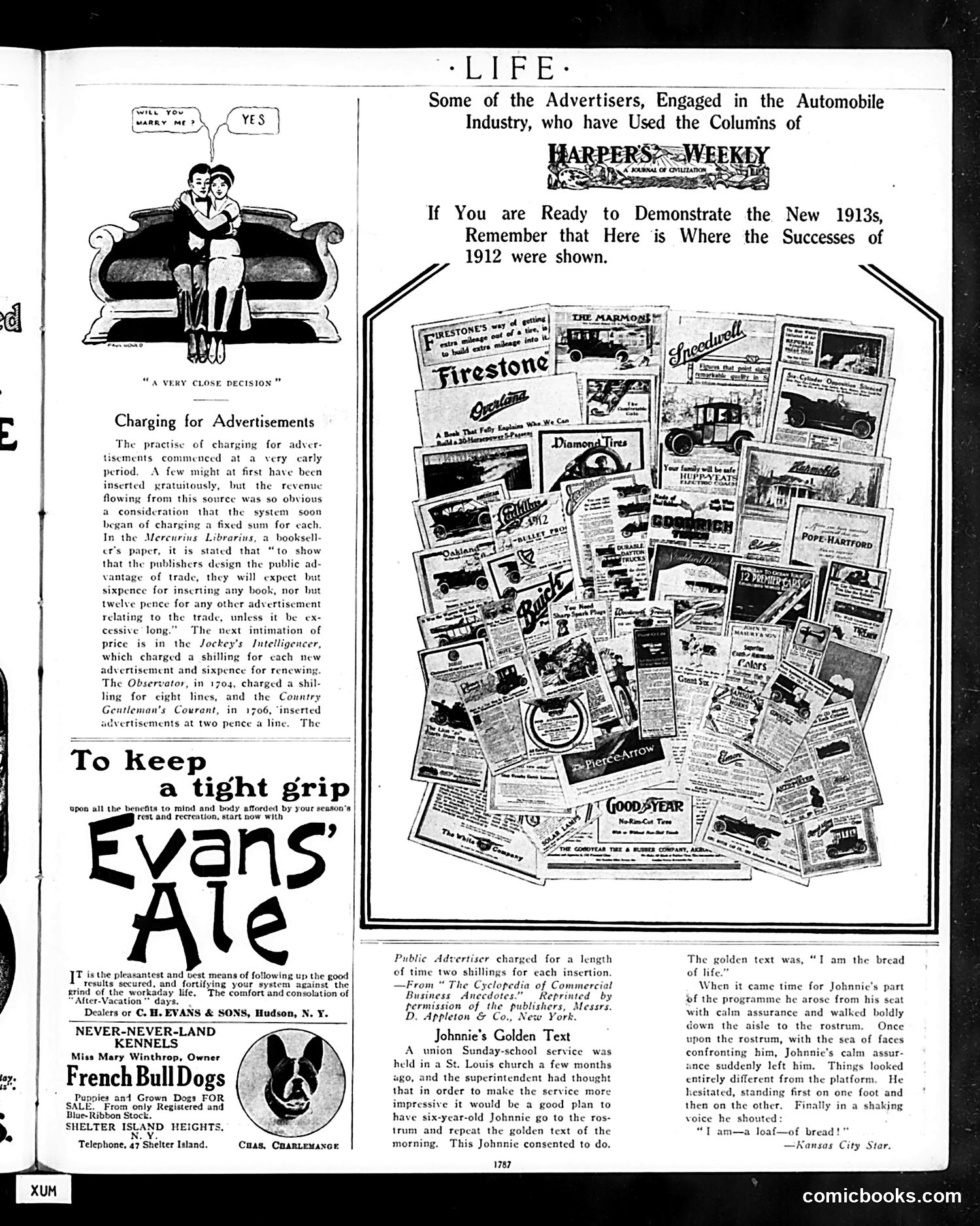
The page contains three distinct elements: **The Cartoon ("A Very Close Decision")**: A couple sits on a sofa; the woman asks "Will you marry me?" The man responds "Yes." The satire suggests the man's decision to propose is portrayed as an agonizingly difficult choice—hence "very close"—mocking the stereotype of male reluctance toward marriage. **Historical Article on Advertisement Pricing**: This is educational content tracing how early publications (from the 1600s-1700s) began charging for advertisements, citing sources like the *Jockey's Intelligencer* and *Country Gentleman's Courant*. No satire present. **Supporting Advertisements**: The page features ads for Evans' Ale, French Bulldogs, and a large collage of automobile advertisements from Harper's Weekly, demonstrating successful 1912 advertising strategies to potential 1913 advertisers. **"Johnnie's Golden Text"**: A brief anecdote about a six-year-old who, nervous before an audience, mishears or misstates the biblical phrase "I am the bread of life" as "I am a loaf of bread"—humor derived from innocent childhood malapropism.
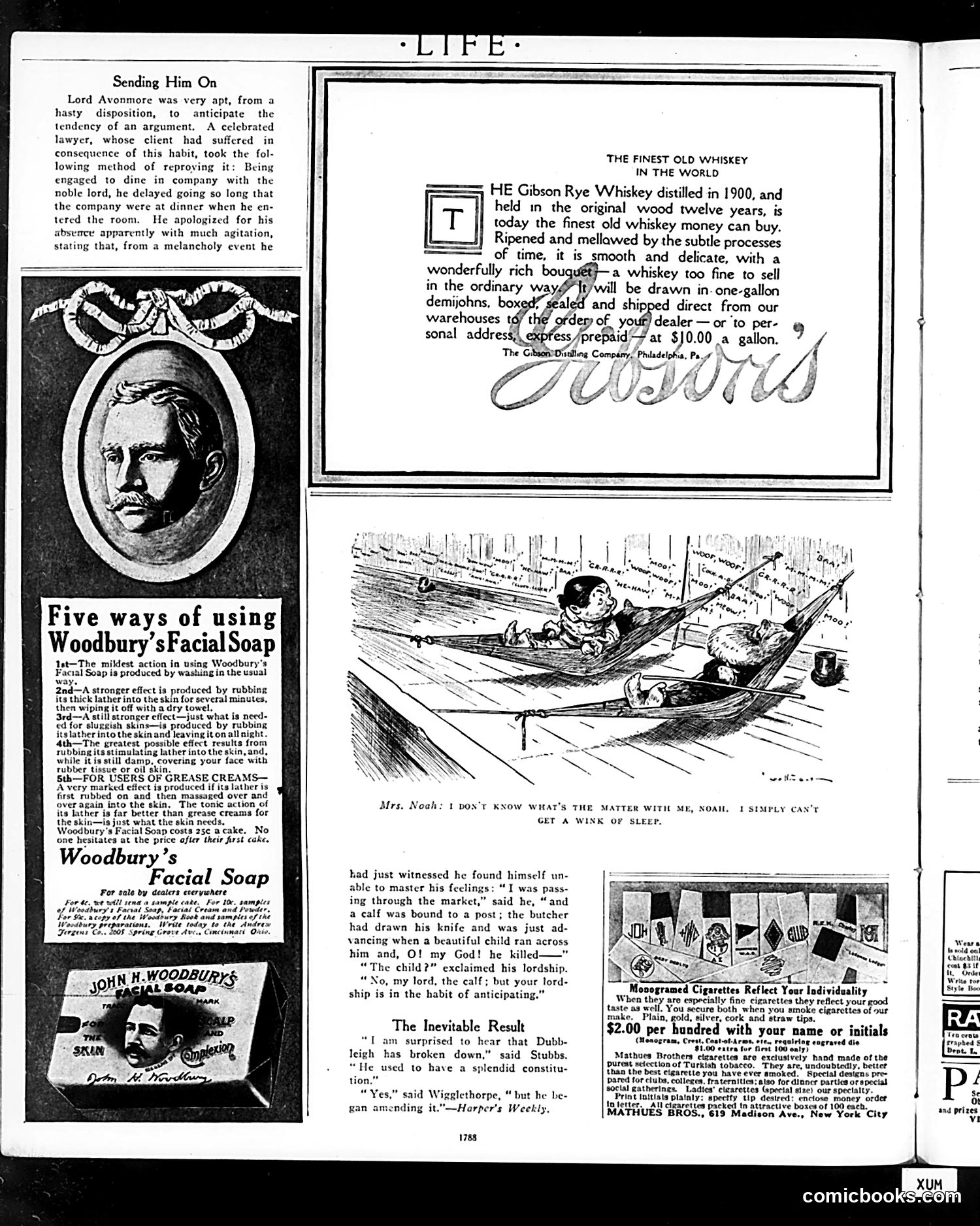
This page mixes **advertising with humorous anecdotes** typical of Life's satirical format. The main cartoon shows **Mrs. Noah unable to sleep** while Noah reclines in bed—a domestic comedy scene with no specific political reference, just marital humor. The text includes three brief stories mocking human nature: Lord Avonmore's habit of interrupting arguments (he assumes a child died when the punchline is the calf), Dubbleigh's health decline from "amending" his constitution (wordplay on physical vs. moral improvement), and the implicit marital discord in the Noah cartoon. The advertisements—**Woodbury's Facial Soap, Gibson Rye Whiskey, and monogrammed cigarettes**—reflect early 1900s luxury marketing to upper-class readers. The whiskey ad notably dates from Prohibition era (product from 1900, held 12 years), suggesting pre-Prohibition publication. The page primarily entertains its affluent audience through gentle social satire while promoting consumer goods.
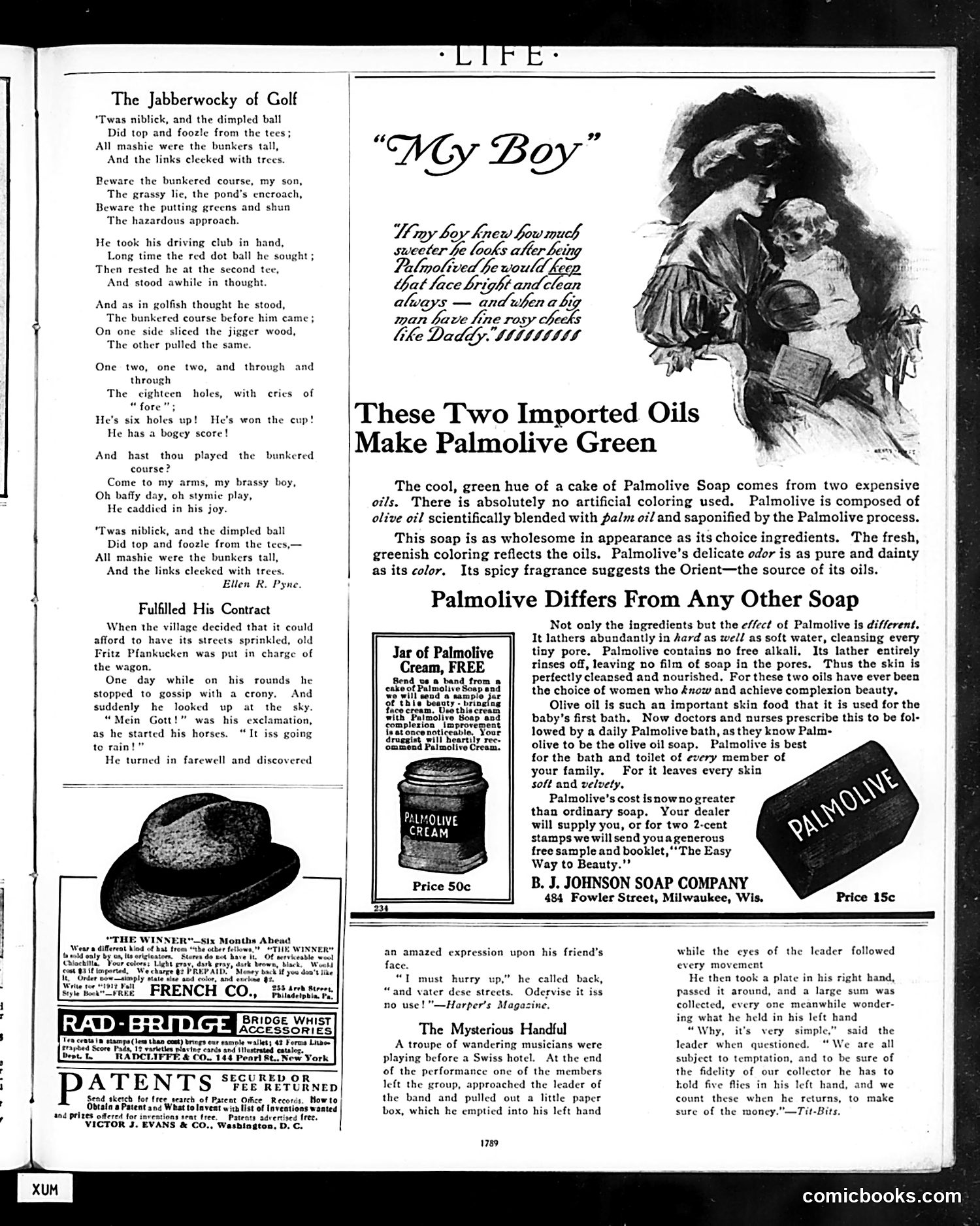
This page is primarily **advertising and light humor**, not political satire. **"The Jabberwocky of Golf"** is a parody of Lewis Carroll's famous nonsense poem, applying his structure to golf terminology ("niblick," "mashie," "foozle," "bogey"). It's gentle wordplay mocking golf's specialized jargon rather than social commentary. **"Fulfilled His Contract"** is a brief humorous anecdote about Fritz Pfankuchen, a street-sprinkler, who stops gossiping, notices rain approaching, and abandons his job—fulfilling his contract to sprinkle streets just as nature provides water. It's ethnic humor (German immigrant character with a comedic name), typical of early 20th-century American magazines. The bulk of the page features **Palmolive Soap advertisements** emphasizing that the soap's green color comes from natural imported oils (olive and palm oils) rather than artificial dyes—a selling point for consumers of that era concerned about product purity. No significant political content or complex satire is present.
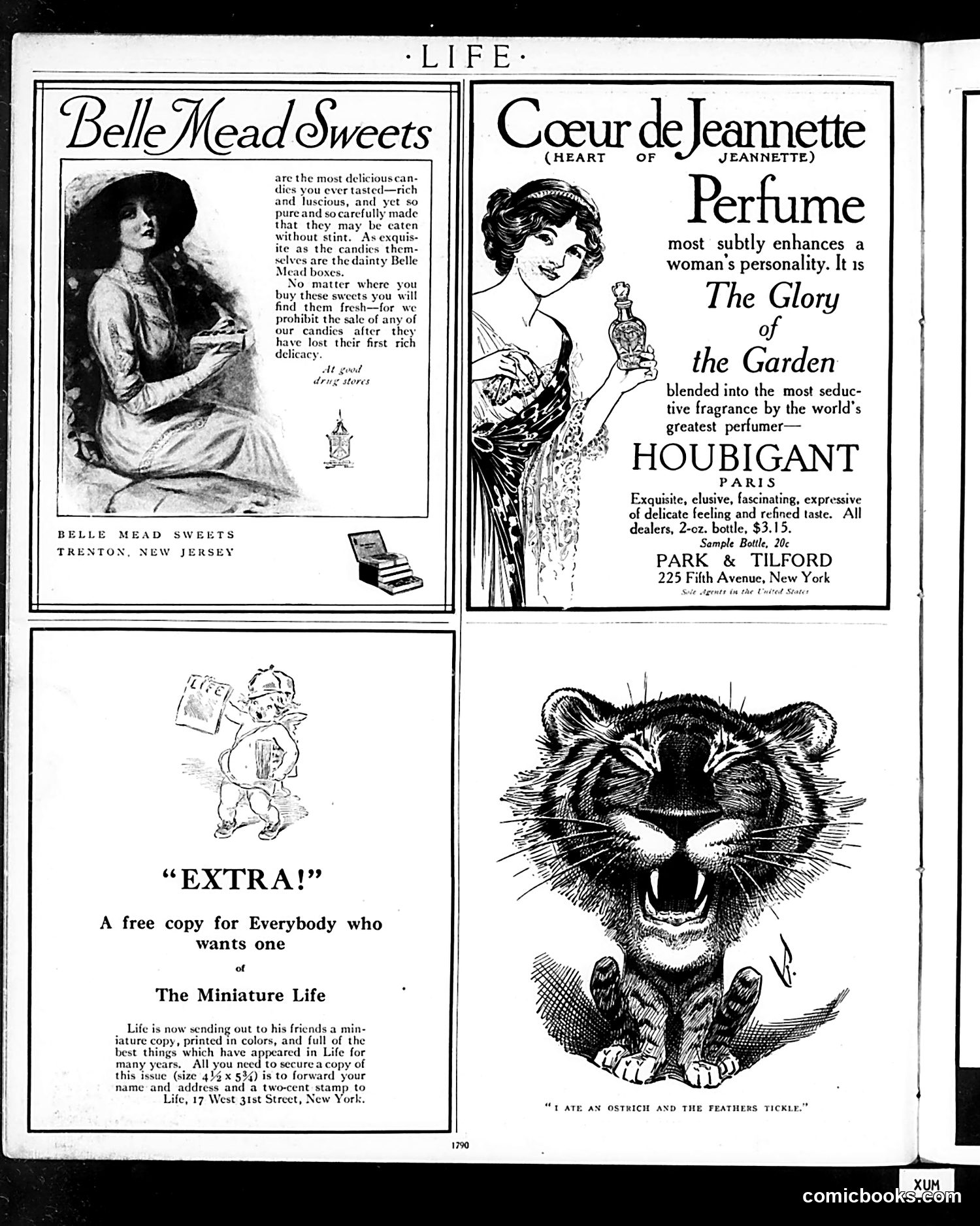
This page consists primarily of **advertisements** with one cartoon element. The ads promote Belle Mead Sweets (candies from Trenton, New Jersey), Houbigant perfume from Paris, and a promotional offer for "The Miniature Life" magazine itself. The only satirical content is the **tiger cartoon** (bottom right) with the caption "I ATE AN OSTRICH AND THE FEATHERS TICKLE." This appears to be a visual joke—a tiger's amused expression after eating an ostrich, with the absurdist humor that feathers would tickle on the way down or in the stomach. It's unclear what broader social commentary, if any, this references; it may simply be a humorous filler illustration typical of Life's satirical style. The page overall reflects early 20th-century advertising aimed at affluent consumers, emphasizing luxury goods (French perfume, quality candies) and refinement.
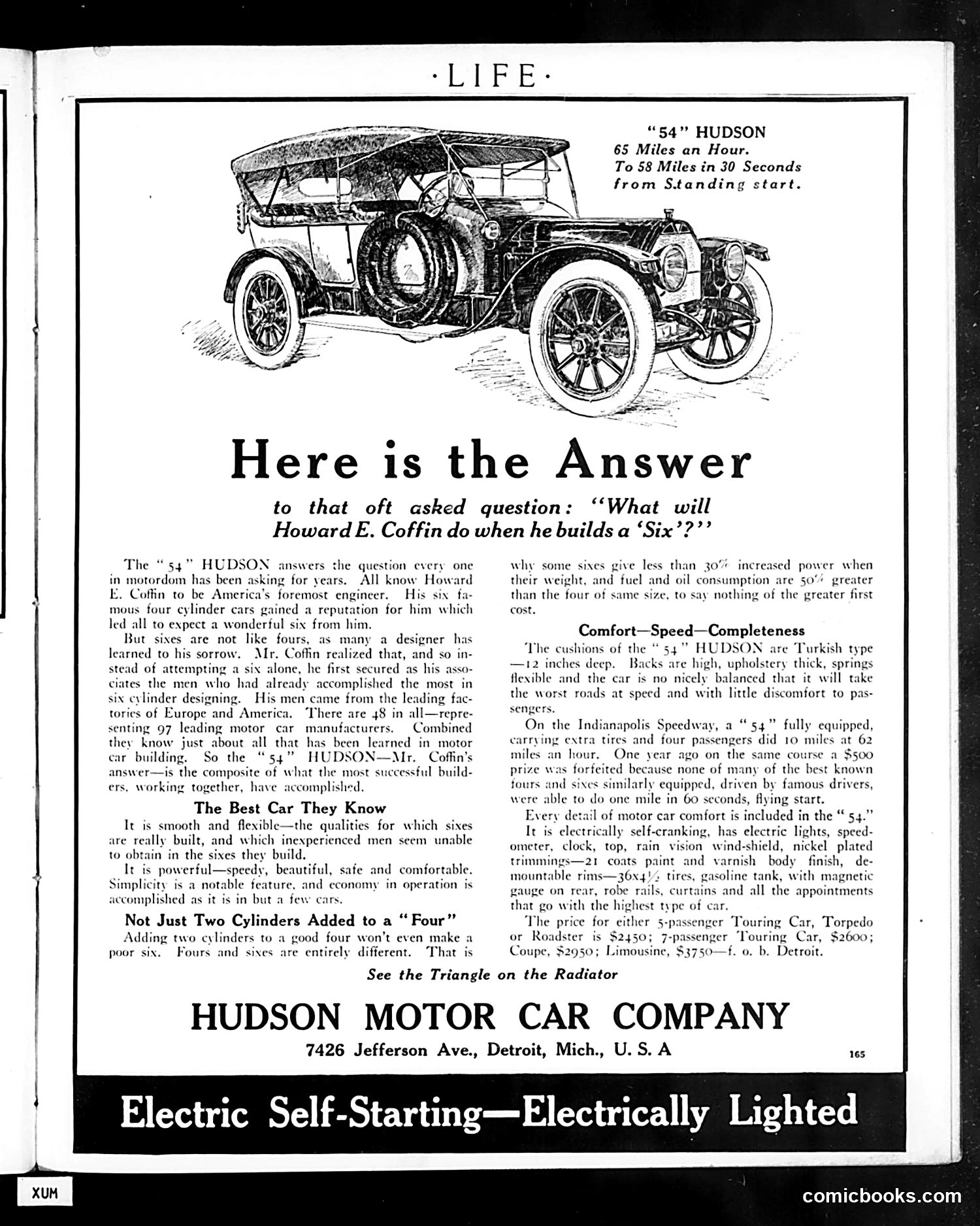
This is primarily an **automobile advertisement**, not satire or political commentary. It appears in *Life* magazine's advertising section. The page promotes Hudson's new "54" six-cylinder car, marketed as the answer to industry speculation about what renowned engineer Howard E. Coffin would design when building a six-cylinder vehicle (rather than his famous four-cylinder models). The "joke" or sales pitch is rhetorical: the advertisement frames the car's existence as the resolution to a widely-discussed question in automotive circles. There's no cartoon or caricature—just technical illustrations of the vehicle. The text emphasizes the car's engineering superiority: it wasn't simply two cylinders added to a four, but a complete redesign incorporating knowledge from leading European and American manufacturers. It highlights performance (65 mph, 0-58 in 30 seconds), comfort features (Turkish cushions, electric start), and competitive pricing ($2,450-$2,950). This reflects early automotive industry competition and the marketing strategy of positioning technical expertise as consumer value.
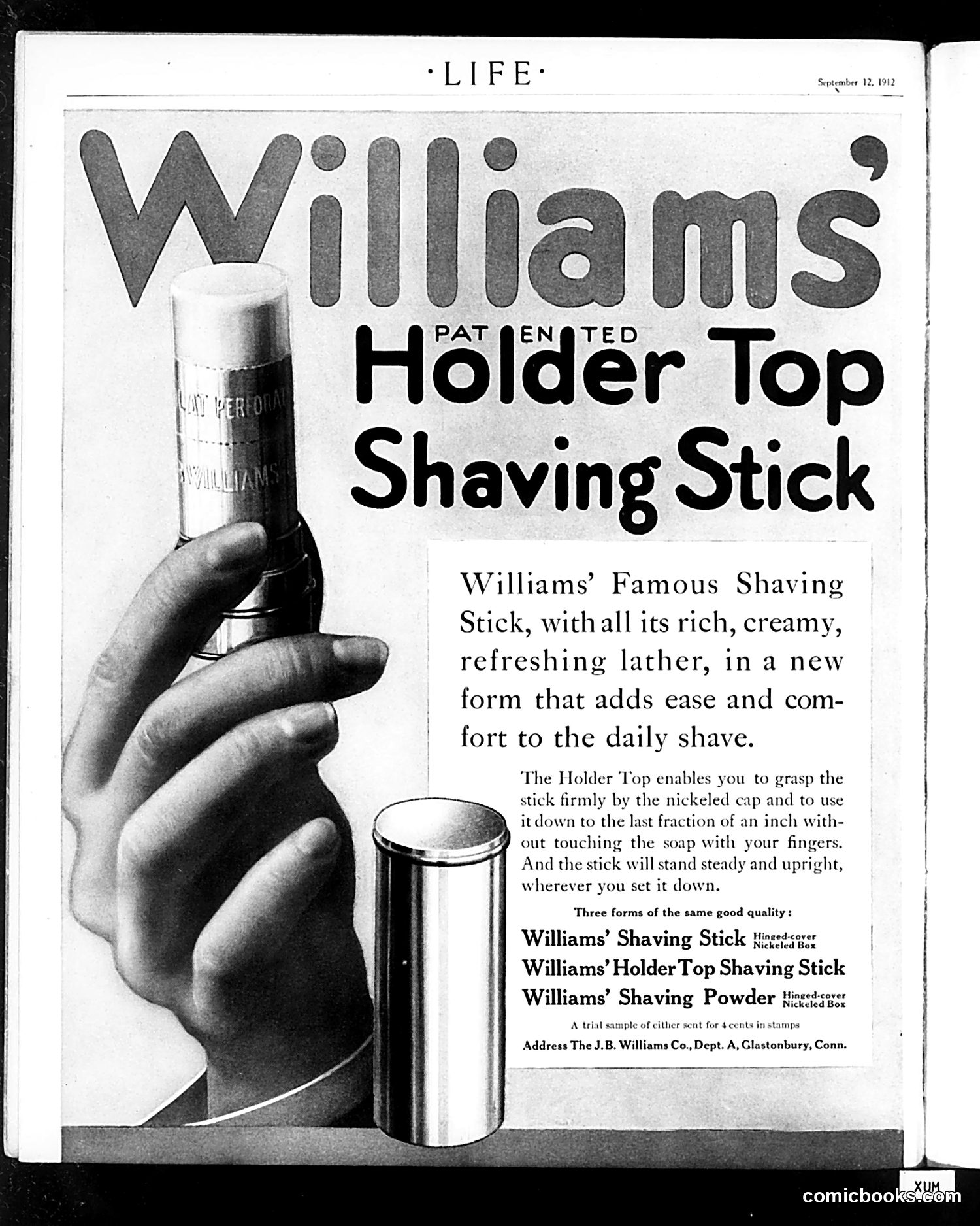
This is a **commercial advertisement**, not political satire or a cartoon. It appears in *Life* magazine from September 12, 1912, promoting Williams' Holder Top Shaving Stick. The page features a large photograph of a hand holding the product and displays the product itself. The advertisement emphasizes the practical innovation of the "Holder Top"—a nickeled cap that lets users grip the shaving stick firmly and use it down to the last bit without getting soap on their fingers. The text presents this as a convenience improvement to traditional shaving sticks, allowing the stick to stand upright on its own. The ad offers three related product forms and invites readers to request a trial sample for 4 cents in stamps from the J.B. Williams Company in Glastonbury, Connecticut. This reflects early 20th-century consumer product marketing focused on practical improvements and direct-mail sales.