
Life, 1912-09-12 · page 20 of 52
Life — September 12, 1912 — page 20: what you’re looking at
What you’re looking at
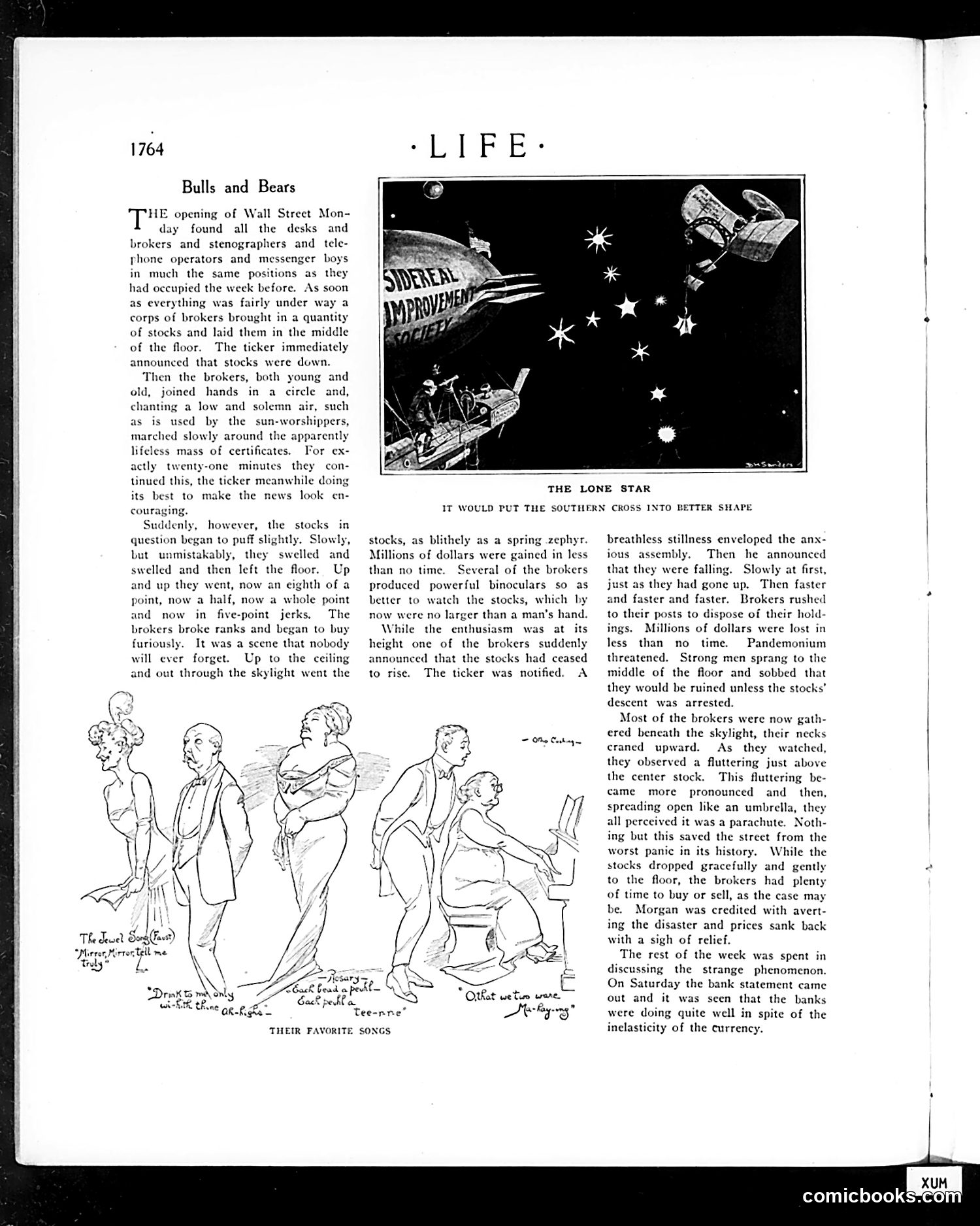
This satirical article mocks Wall Street's dramatic volatility and the brokers' ritualistic behavior during market fluctuations. The piece describes brokers literally circling stocks on the floor like "sun-worshippers," then frantically buying and selling as prices gyrate wildly—stocks floating to the ceiling, then plummeting. The humor lies in the absurdist exaggeration: stocks rise and fall so rapidly that brokers need binoculars to watch them, and a miraculous parachute saves the day when prices crash. The final reference to "Morgan" likely means J.P. Morgan, the era's most powerful banker, credited with stabilizing markets during financial panics. The cartoons below ("Their Favorite Songs") appear to show brokers in emotional distress, reinforcing the manic mood swings of market trading. The satire targets Wall Street's irrational behavior and the outsized influence of individual financiers on the economy.
📄 Transcribed text from this page (OCR, searchable)
Machine-transcribed from the original scan — historical spelling and the odd misread are preserved.
The Jewel Song( faut) Mirtentell me 1764 Bulls and Bears TE = opening of Wall Street Mon- day found all the desks and brokers and stenographers and tele- phone operators and messenger boys in much the same positions as they had occupied the week before. As soon as everything was fairly under way a corps of brokers brought in a quantity of stocks and laid them in the middle of the floor. The ticker immediately announced that stocks were down. Then the brokers, both young and old, joined hands in a circle and, chanting a low and solemn air, such as is used by the sun-worshippers, marched slowly around the apparently For ex- actly twenty-one minutes they con- tinued this, the ticker meanwhile doing its | to make the news look en- couraging. Suddenly, however, the stocks in question began to puff slightly. Slowly, Lut unmistakably, they swelled and swelled and then left the floor. Up and up they went, now an eighth of a point, now a half, now a whole point and now in five-point jerks, The brokers broke ranks and by n to buy lifeless mass of certificates. furiously. It was a scene that nobody will ever forget. Up to the ceiling and out through the skylight went the \\ . & ead a pect. \ Deke es ar ai) MN Chere of 6 a Ttee-nne’ THE LONE STAR IT WOULD PUT THE SOUTHERN CROSS INTO BETTER SHAPE stocks, as blithely as a spring zephyr. Millions of dollars were gained in less than no time. Several of the brokers produced powerful binoculars so as Letter to watch the stocks, which by now were no larger than a man’s hand. While the enthusiasm was at its height one of the brokers suddenly announced that the stocks had ceased to rise. The ticker was notified. A HO Cratay THEIR FAVORITE SONGS breathless stillness enveloped the anx- ious assembly. Then he announced that they were falling. Slowly at first, just as they had gone up. Then faster and faster and faster. Brokers rushed to their posts to dispose of their hold- ings. Millions of dollars were lost in less than no time. Pandemonium threatened. Strong men sprang to the middle of the floor and sobbed that they would be ruined unless the stocks’ descent was arrested. Most of the brokers were now gath- ered beneath the skylight, their necks craned upward. As they watched, they observed a fluttering just above the center stock. This fluttering be- came more pronounced and_ then, spreading open like an umbrella, they all perceived it was a parachute. Noth- ing but this saved the street from the worst panic in its history. While the stocks dropped gracefully and gently to the floor, the brokers had plenty of time to buy or sell, as the case may be. Morgan was credited with avert- ing the disaster and prices sank back with a sigh of relief. The rest of the week was spent in discussing the strange phenomenon. On Saturday the bank statement came out and it was seen that the banks were doing quite well in spite of the inelasticity of the currency. |