
Life, 1912-09-12 · page 10 of 52
Life — September 12, 1912 — page 10: what you’re looking at
What you’re looking at
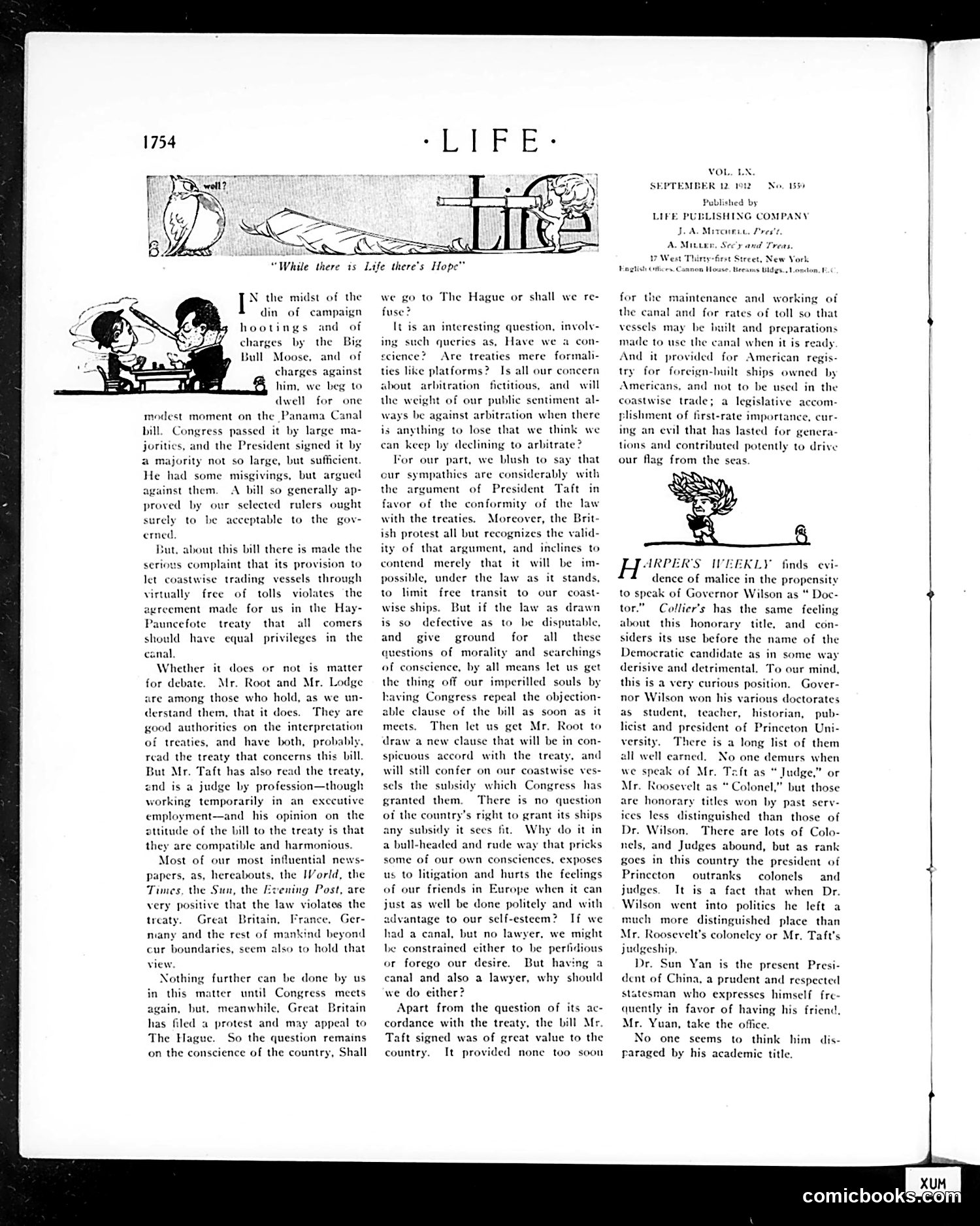
This *Life* magazine page (September 12, 1912) contains editorial commentary on the Panama Canal and U.S. foreign policy disputes. The small cartoon depicts two figures (appearing to represent political figures) in discussion, likely referencing debates over canal tolls and treaty interpretation. The text discusses President Taft's position on the canal's administration, comparing it favorably to President Roosevelt's stance. References to "Mr. Root" and "Mr. Lodge" indicate prominent Republican figures weighing in on treaty compliance. The article criticizes those questioning whether the canal tolls provision violates agreements with Britain, presenting this as a matter of national conscience and integrity. The satirical point appears to be defending Taft's administration against critics who questioned the moral and legal standing of U.S. canal policy.
📄 Transcribed text from this page (OCR, searchable)
Machine-transcribed from the original scan — historical spelling and the odd misread are preserved.
“While there ts Life there's Hope’ N the midst of the campaign and of the Big and of din of hootings charges by Bull Moose, charges against him, we beg to dwell for one modest moment on the Panama Canal bill. Congress passed it by large ma- jorities, and the President signed it by a majority not so large, but sufficient He had some misgivings, but argued against them. A bill so generally ap- proved by our selected rulers ought the able to surely to be accep’ gov- ered. But. about this bill there is made the se s complaint that its provision to let coastwise trading vessels through virtually free of tolls violates the agreement made for us in the Ha Pauncefote treaty that all comers should have equal privileges in’ the canal, Whether it or not is for debate. Mr. Root and Mr. Lodge are among those who hold, as we un- derstand them, that it does. They are good authorities on the interpretation of treaties, and have both, probably. read the treaty that concerns this Dill. But Mr. Taft has also read the treaty, end is a judge by profession—though working temporarily in an exccutive employment—and his opinion on the attitude of the bill to the treaty is that they are compatible and harmonious. Most of our most influential news- papers, as, hereabouts, the World, the Times, the Sun, the Evening Post, are very positive that the law violates the treaty. Sritain, Frat Ger- many and the rest of mankind beyond cur boundaries, seem also to hold that does matter nce, view. Nothing further can be done by us in this matter until Congress meets again, but. meanwhile, Great Britain has filed a protest and may appeal to The Hague. So the question remains ‘on the conscience of the country, we go to The Hague or shall we re- fuse? It is an interesting question, involv- ing such queries as, Have we a con- Are treaties mere formali- Is all our concern about arbitration fictitious, and will the weight of our public sentiment al- ways be against arbitration when there is anything to lose that we think we can keep by declining to arbitrate? For our part, we blush to say that our sympathies are considerably with the ument of President Taft in favor of the conformity of the law with the treat} Moreover, the Brit- ish protest all but recognizes the valid- ity of that argument, and inclines to contend merely that it: will be im- possible, under the law as it stands, to limit free transit to our coast- wise ships. But if the law as drawn is so defective as to be disputable, and give ground for all questions of morality and searchings ience? ties like platforms? these of conscience, by all means let us get the thing off our imperiled souls by ving Congress repeal the objection- ble clause of the bill as soon as it meets, Then let us get Mr, Root to draw a new clause that will be in con- spicuous accord with the treaty, and will still confer on our coastwise ves- the subsid granted them. of the country’s right to grant its ships any subsidy it sees fit. Why do it in a bull-headed and rude way that pricks some of our own consciences, exposes us to litigation and hurts the feelings of our friends in Europe when it can just as well be done politely and with advantage to our self-esteem? If we y which Congress has There is no question se had a canal, but no lawyer, we might be constrained either to be perfidious or forego our desire. But having a canal and also a lawyer, why should we do cither? Apart from the question of its ac- cordance with the treaty, the bill Mr. Taft signed was of great value to the country. It provided none too soon VOL. LX. SEPTEMBER 12. 19122 Published by LIFE PUBLISHING COMPANY J. A. Mircnnne. Press A. Mitten, Sec'y and Treas 1 West Thi Haglish Gfices. Caano +t Street, New Vork House, Beams Uldgs.. 1c on. for the maintenance and working of the canal and for rates of toll so that vessels m y be built and preparations made to use the canal when it is ready And it provided for American regis- try for foreign-built ships owned by Americans, and not to be used in the coastwise trade; a legislative accom- lishment of first-rate importance, cur- ing an evil that has lasted for genera- tions and contributed potently to drive our flag from the seas. IRPER'S WEEKLY finds dence of malice in the propensity to speak of Governor Wilson as “ Doc- tor.” Collier's has the same feeling about this honorary title, and con- siders its use before the name of the Democratic candidate as in some way derisive and detrimental. To our mind, this is a very curious position. Gover- nor Wilson won his various doctorates as student, teacher, historian, pub- licist and president of Princeton Uni- versity. There is a long list of them all well earned. No one demurs when we speak of Mr. Taft as “ Judge,” or Mr. Roosevelt as “ Colonel,” but those are honorary titles won by past serv- ices less distinguished than those of Dr. Wilson. There are lots of Colo- nels, and Judges abound, but as rank goes in this country the president of Princeton outranks colonels and judges. It is a fact that when Dr. Wilson went into politics he left a much more distinguished place than Mr. Roosevelt’s coloneley or Mr. Taft's judgeship. Dr. Sun Yan is the present Presi- dent of China, a prudent and respected statesman who expresses himself fre- quently in favor of having his friend. Mr. Yuan, take the office. No one seems to think him paraged by his academic title. evi- dis- comicbooks'