
Life, 1912-09-12 · page 15 of 52
Life — September 12, 1912 — page 15: what you’re looking at
What you’re looking at
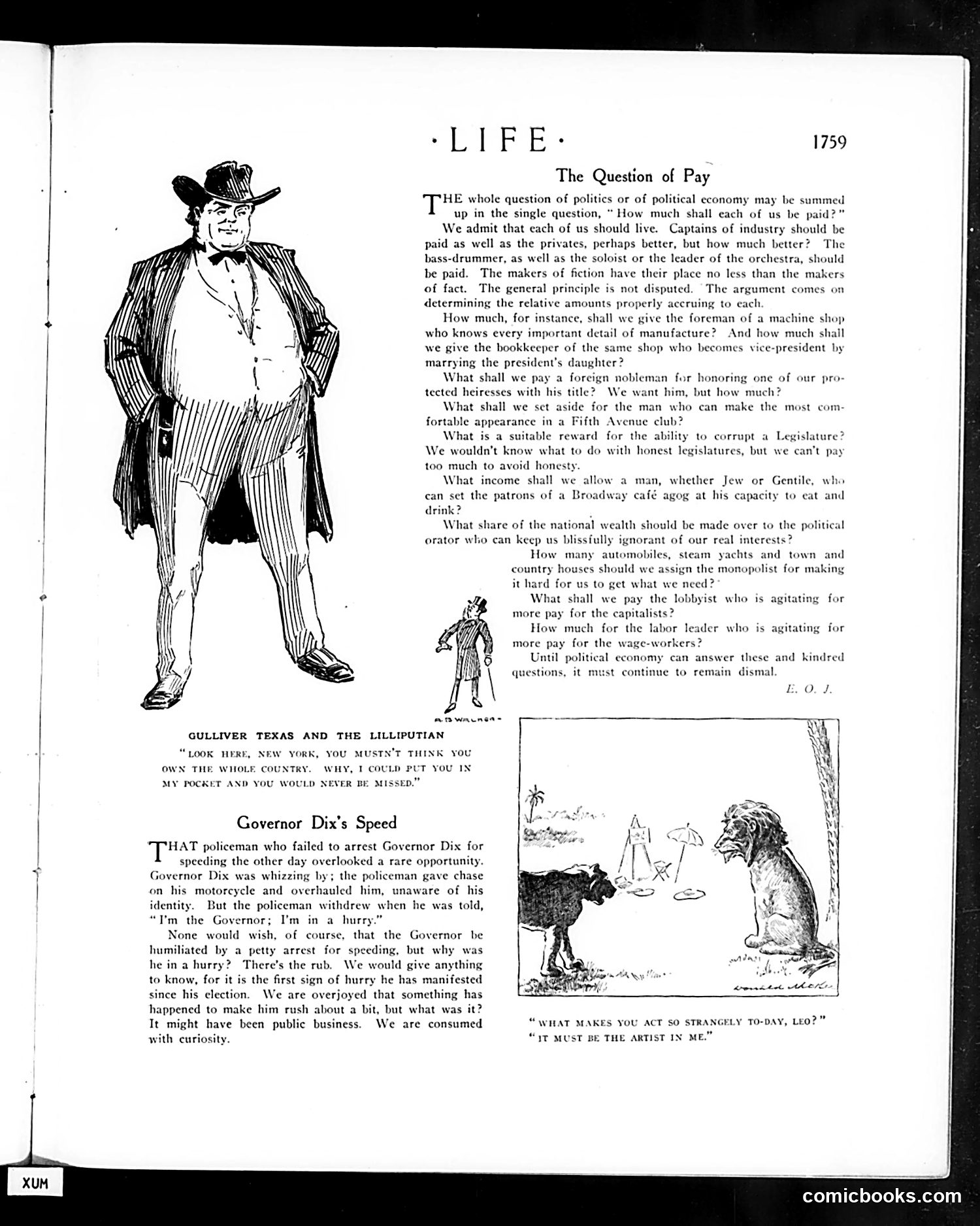
**"The Question of Pay"** is a biting satirical essay on wealth distribution and corruption in American society. The author uses rhetorical questions to expose hypocrisy: politicians are paid to be corrupt ("What is a suitable reward for the ability to corrupt a Legislature?"), foreign noblemen marry heiresses for money, monopolists hoard resources, and lobbyists buy influence for both capitalists and labor leaders. The piece suggests political economy cannot function honestly because society institutionalizes graft. **"Gulliver Texas and the Lilliputian"** caricatures regional tensions, with a large Texan figure dwarfing New York, suggesting western resentment of eastern dominance and wealth concentration. **"Governor Dix's Speed"** mocks New York Governor John Dix for rushing through town on his motorcycle—his *only* visible hurry since election. The satire implies he's been idle or inactive in office, questioning what urgent "business" finally motivated him. The small cartoon shows a lion remarking an artist's strangeness, offering comic relief.
📄 Transcribed text from this page (OCR, searchable)
Machine-transcribed from the original scan — historical spelling and the odd misread are preserved.
——> -LIFE- 1759 The Question of Pay THE whole question of politics or of political economy may be summed up in the single question, “ How much shall each of us be paid?” We admit that cach of us should live. Captains of industry should be paid as well as the privates, perhaps better, but how much better? The bass-drummer, as well as the soloist or the leader of the orchestra, should be paid. The makers of fiction have their place no less than the makers of fact. The general principle is not disputed. The argument comes on determining the relative amounts properly accruing to each, How much, for instance, shall we give the foreman of a machine shop who knows every important detail of manufacture? And how much shall we give the bookkeeper of the same shop who becomes vice-president by marrying the president's daughter? What shall we pay a foreign nobleman for honoring one of our pro. tected heiresses with his title? We want him, but how much? What shall we sct aside for the man who can make the most com- fortable appearance in a Fifth Avenue club? What is a suitable reward for the ability to corrupt a Legislature? We wouldn't know what to do with honest legislatures, but we can’t pay too much to avoid honesty. What income shall we allow a man, whether Jew or Gentile, who can set the patrons of a Broadway ca wog at his capacity to eat and drink? . What share of the national wealth should be made over to the political é orator who can keep us blissfully ignorant of our real interests? How many automobiles, steam yachts and town and country houses should we assign the monopolist for making it hard for us to get what we need? What shall we pay the lobbyist who is agitating for more pay for the capitalists? How much for the labor le: more pay for the wage-workers? Until political economy can answer these and kindred st continue to remain dismal ler who is agitating for questions, itm AB wacnes = GULLIVER TEXAS AND THE LILLIPUTIAN “LOOK HERE, NEW YORK, YOU MUSTN'T THINK YOU OWN THE WHOLE COUNTRY. WHY, 1 COULD PUT YoU IN MY POCKET AND YOU WOULD NEVER BE MISSED.” Governor Dix’s Speed PRAT policeman who failed to arrest Governor Dix for speeding the other day overlooked a rare opportunity. Governor Dix was whizzing by; the policeman gave chase on his motorcycle and overhauled him, unaware of his identity. But the policeman withdrew when he was told, “I'm the Governor; I'm in a hurry.” None would wish, of course, that the Governor be humiliated by a petty arrest for speeding, but why was he in a hurr: There's the rub. We would give anything to know, for it is the first sign of hurry he has manifested since his election. We are overjoyed that something has happened to make him rush about a bit, but what was it? It might have been public business. We are consumed “WHAT MAKES YOU ACT SO STRA with curiosity. “JT MUST BE THE ARTIST IN ME.’ SELY TO-DAY, LEO?” comicbooks.com