
Life, 1912-09-12 · page 32 of 52
Life — September 12, 1912 — page 32: what you’re looking at
What you’re looking at
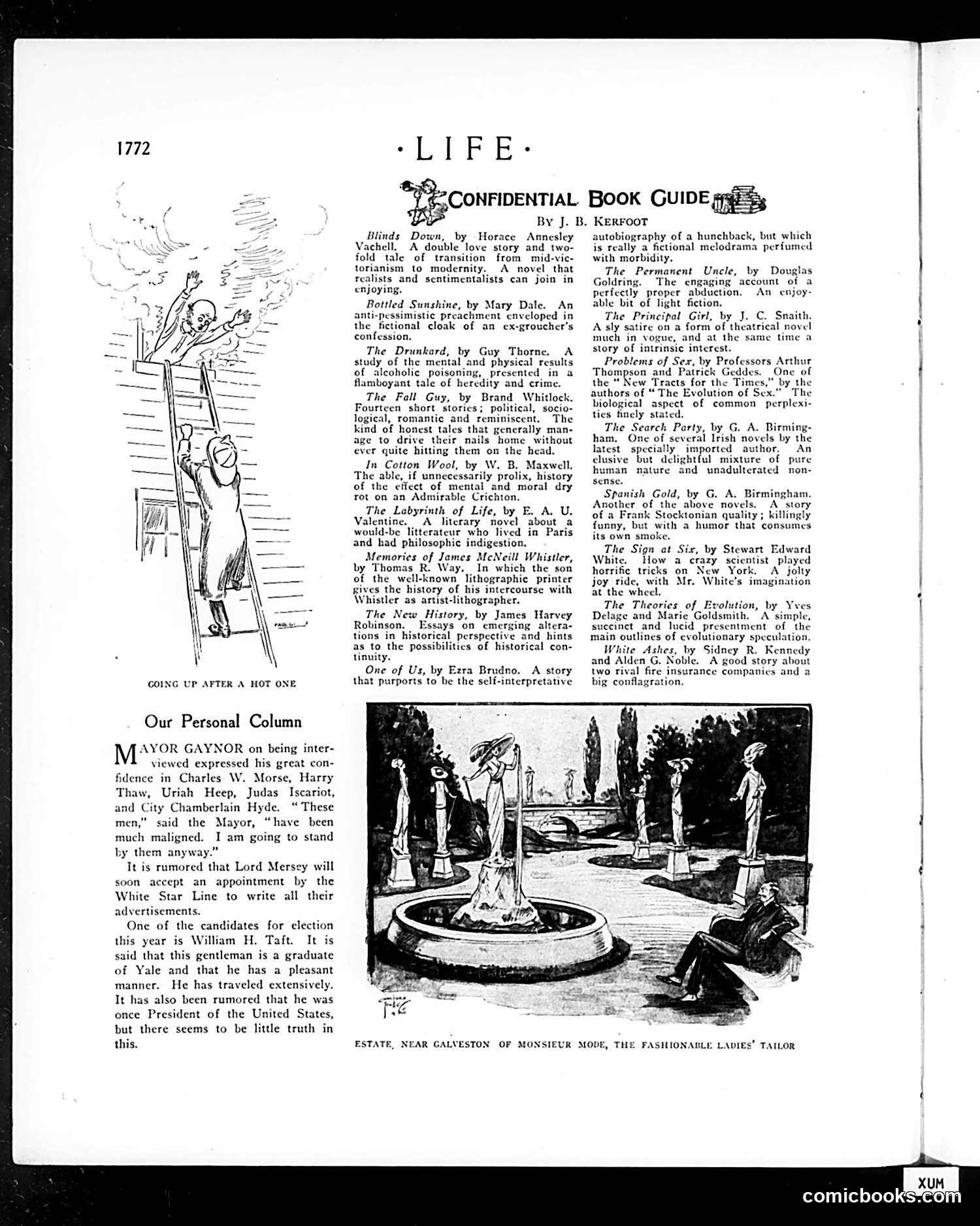
The "Personal Column" satirizes New York Mayor Gaynor's dubious judgment through absurdist humor. Gaynor claims confidence in clearly disreputable figures: Charles W. Morse (financier/embezzler), Harry Thaw (murderer of Stanford White), Uriah Heep and Judas Iscariot (fictional/biblical villains), and City Chamberlain Hyde—suggesting the Mayor's endorsements are worthless. The William H. Taft joke mocks the public's short memory: it sarcastically "reminds" readers that this Yale graduate and "pleasant" traveler was once President, implying his current political irrelevance or that voters have forgotten him already. Both items use deadpan irony to critique political figures' credibility and public amnesia during a contentious election year. The cartoon above appears to show a man climbing or descending in distress ("Going Up After a Hot One"), reinforcing themes of instability.
📄 Transcribed text from this page (OCR, searchable)
Machine-transcribed from the original scan — historical spelling and the odd misread are preserved.
Our Personal Column AYOR GAYNOR on being inter- viewed expressed his great con- fidence in Charles W. Morse, Harry Thaw, Uriah Heep, Judas Iscariot, and City Chamberlain Hyde. “ These men,” said the Mayor, “have been much maligned. I am going to stand by them anyway.” It is rumored that Lord Mersey will soon accept an appointment by the White Star Line to write all their advertisements. One of the candidates for election this year is William H. Taft. It is said that this gentleman is a graduate of Yale and that he has a pleasant manner. He has traveled extensively. It has also been rumored that he was once President of the United States, but there seems to be little truth in this. LIFE CONFIDENTIAL BOOK GUIDE gts, By J. Blinds Down, by Horace Annesley Vachell. A double love story and two- fold tale of transition from mid-vic- torianism to modernity. A novel that realists and sentimentalists can join in enjoying. Bottled Sunshine, by Mary Dale. An anti-pessimistic preachment enveloped in the fictional cloak of an ex-groucher’s confession, The Drunkard, by Guy Thorne. study of the mental and physical results of alcoholic poisoning, presented in a flamboyant tale of heredity and crime. The Fall Guy, by Brand Whitlock. Fourteen short stories; political, socio- logical, romantic and reminiscent. The kind of honest tales that generally ma age to drive their nails home without ever quite hitting them on the head. In Cotton Wool, by W. B. Maxwell. The able, if unnecessarily prolix, history of the effect of mental and moral dry rot on an Admirable Crichton. The Labyrinth of Life, by E. A. U. Valentine." A literary novel about a would-be litterateur who lived in Paris and had philosophic indigestion. Memories of James McNeill Whistler, by Thomas R. Way. In which the son of the well-known lithographic printer gives the history of his intercourse with Whistler as artist-lithographer. The New History, by James Harvey Robinson, Essays on emerging altera- tions in historical perspective and hints as to the possibilitics of historical con- tinuity. One of Us, by Ezra Brudno. A story that purports to be the self-interpretative B. KERFOOT autobiography of a hunchback, but which is really a fictional melodrama perfumed with morbidity. The Permanent Uncle, by Douglas Goldring. The engaging account of a perfectly proper abduction, An enjoy- able bit of light fiction. The Principal Girl, by J. C. Snaith. A sly satire on a form of theatrical novel much in vogue, and at the same time a story of intrinsic interest. Problems of Sex, by Professors Arthur Thompson and Patrick Geddes. One of the “ New Tracts for the Times,” by the authors of “ The Evolution of Sex.” The biological aspect of common perplexi- ties finely stated. The Search Party, by G. A. Birming- ham. One of several Irish novels by the latest specially imported author, An clusive but delightful mixture of pure human nature and unadulterated non- sense. Spanish Gold, by G. A. Birmingham. Another of the’ above no A story of a Frank Stocktonian quality; Killingly funny, but with a humor that consumes its own smoke. The Sign at Six, by Stewart Edw White. How a crazy scientist pla horrific tricks on New York. A jolty joy ride, with Mr. White’s imagination at the wheel. The Theories of Delage and M A simple, succinct and lucid presentment of the main outlines of evolutionary speculation. White Ashes, by Sidney R. Kennedy and Alden G. Noble. A good story about two rival fire insurance companics and a big conflag , by Yves ESTATE, NEAR GALVESTON OF MONSIEUR MODE, THE FASHIONABLE LADIES’ TAILOR | comicbooleely (0)