
Life, 1912-09-12 · page 25 of 52
Life — September 12, 1912 — page 25: what you’re looking at
What you’re looking at
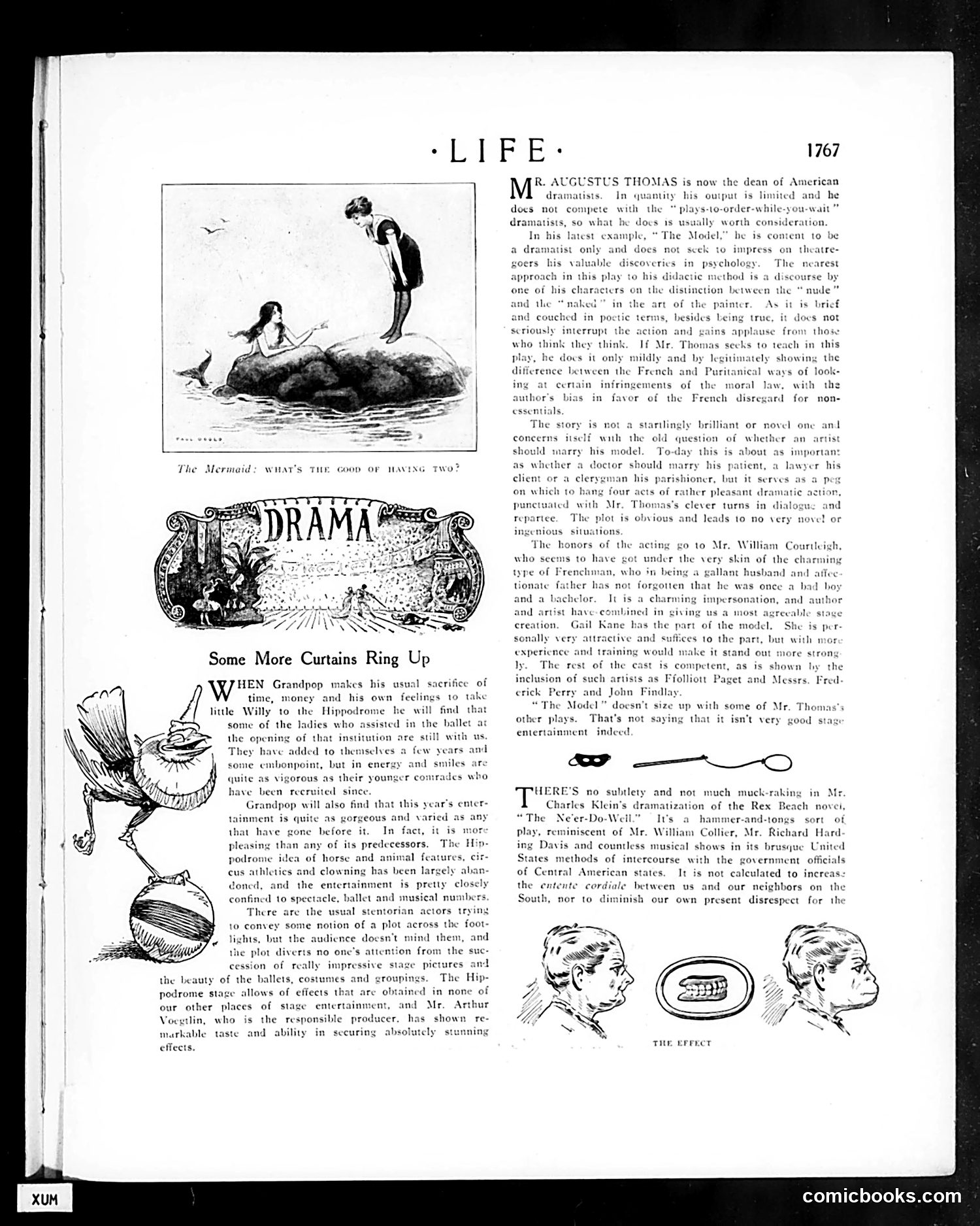
This page reviews theatrical productions, primarily Augustus Thomas's play "The Model." The main cartoon—"The Mermaid: What's the Good of Having Two?"—depicts a man and woman on a rock, likely satirizing romantic or marital complications, though the specific reference is unclear from the image alone. The text discusses Thomas as a prolific but unambitious American playwright who uses his work to teach mild lessons about French versus Puritanical attitudes toward art and morality. The play concerns whether an artist should marry his model—described as an old, unoriginal question. The review praises William Courtleigh's performance as a charming French husband and Gail Kane as the model, though notes the overall production doesn't match Thomas's better works. The Hippodrome theater section notes improvements in spectacle and musical numbers while abandoning animal acts and heavy athleticism.
📄 Transcribed text from this page (OCR, searchable)
Machine-transcribed from the original scan — historical spelling and the odd misread are preserved.
LEP Es the beauty of the ballets, costumes and groupings. The podrome stage allows of effects t our other places of Voegtlin, markable effects. Mermaid litle Willy to the war's THE DOF HAVING TWo? Some More Curtains Ring Up HEN Grandpop makes his asual sacrifice of time, money and his own fee take Hippodrome he will some of the ladies who assisted in the ballet the opening of th They have added to themselves jonpoint, but in ener quite as vigorous as their younger co} have been recruited since Grandpop will stitution are still with us, 2 few years and some ¢ and smiles les who Iso find that this year's enter- tainment is quite In fact, it cessors. The imal features, before it. ny of its pr podrome idea of horse and that have gone pleasing than cus athletics and clowning has been largely aban- doned, ar confined to spectacle, ballet and musical numbers. There are the usual stentorian actors trying to convey some notion of a plot across the foot- lights, but th ih the plot diverts no one’s attention from the suc- the entertainment is pretty closely audience doesn't mind m, and cession of really pictures and Hip- are obtained in none of stage entertainment, and Mr. Arthur is the responsible producer, has shown re- and ability in. securing impressive std who taste absolutely stunning 1767 dean of American output is limited and he plays-to-order-while-you-wait ” M* AUGUSTUS THOMAS is now dramatists, In quantity bh with the dramatists, so what he docs 1s In his latest example, “ The does not compete usually worth consideration Model,” he ist only and does not seek tc is content to be a drama impress on theatre- goers his valuable discoveries in psychology. The approach in this play to his nearest lidactic method is a discourse by one of his characters on the distinction between the " As it besides being true, nude” brief does not from those and the “naked” in art of the painter and couched in poctic tern scriously interrupt the action and ¢ who think they think. If Mr. ns applause Thomas seeks to teach in this play, he does it only mildly and by legitimately showing the difference between the French and Puritanical ways of look- ing at certain infringements of the moral author's French favor of the disregard essentials The story is not a startlingly brilliant or novel on with the old question of concerns itself whether an ar J marry his model. To-day this is about as important ould mar patient, a lawyer his an his on which to hang four act ether a doctor tor a cler: arishioner, but it serves as ap. of rather pleasant dramatic az punctuated with Mr. Thomas's clever turns in dialogu repartee, The plot is obvious leads 10 no very nov ingenious The honors of the who seems situations. acting go to Mr, William Courtleigh. under the in of the charming type of Frenchman, who in being a gallant husband and Uonate a bad have very her has not forgotten that he was once and a bachelor. It is a charming impersonation, and author nd artist have-combined in givin creation. $a most agreeable Gail Kane has the part of the model. r sonally very attra is per- tive and suffices to the part, but with mor ce and train experic 1 make it stand out ly. The rest of the cast is ¢ petent inclusion of such artists as Ffolliott Ps crick Perry and John Findlay The Model” docsn’t size up with some of Mr. Thomas's other plays. That's not s 1 entertainment indeed —_ as is shown by the t and Messrs. Fred isn’t very good stag: —_s"_D) HERE'S no subtlety and not much muck-raking in Mr, Charles Klein’s dramatization of the Rex Beach novei, “The Ne’er-Do-Weil.” It's a hammer-and-tongs sort of play, reminiscent of Mr. William Collier, Mr. Richard Hard g Davis and countless musical shows in its brusque United States methods of intercourse with the government officials of Cemtral Am the entente ican states. It is not calculated to increas: cordiale between us and our neighbors on the South, nor to diminish our own present disrespect for the THE EFFECT comicbooks.com