
Life, 1912-09-12 · page 34 of 52
Life — September 12, 1912 — page 34: what you’re looking at
What you’re looking at
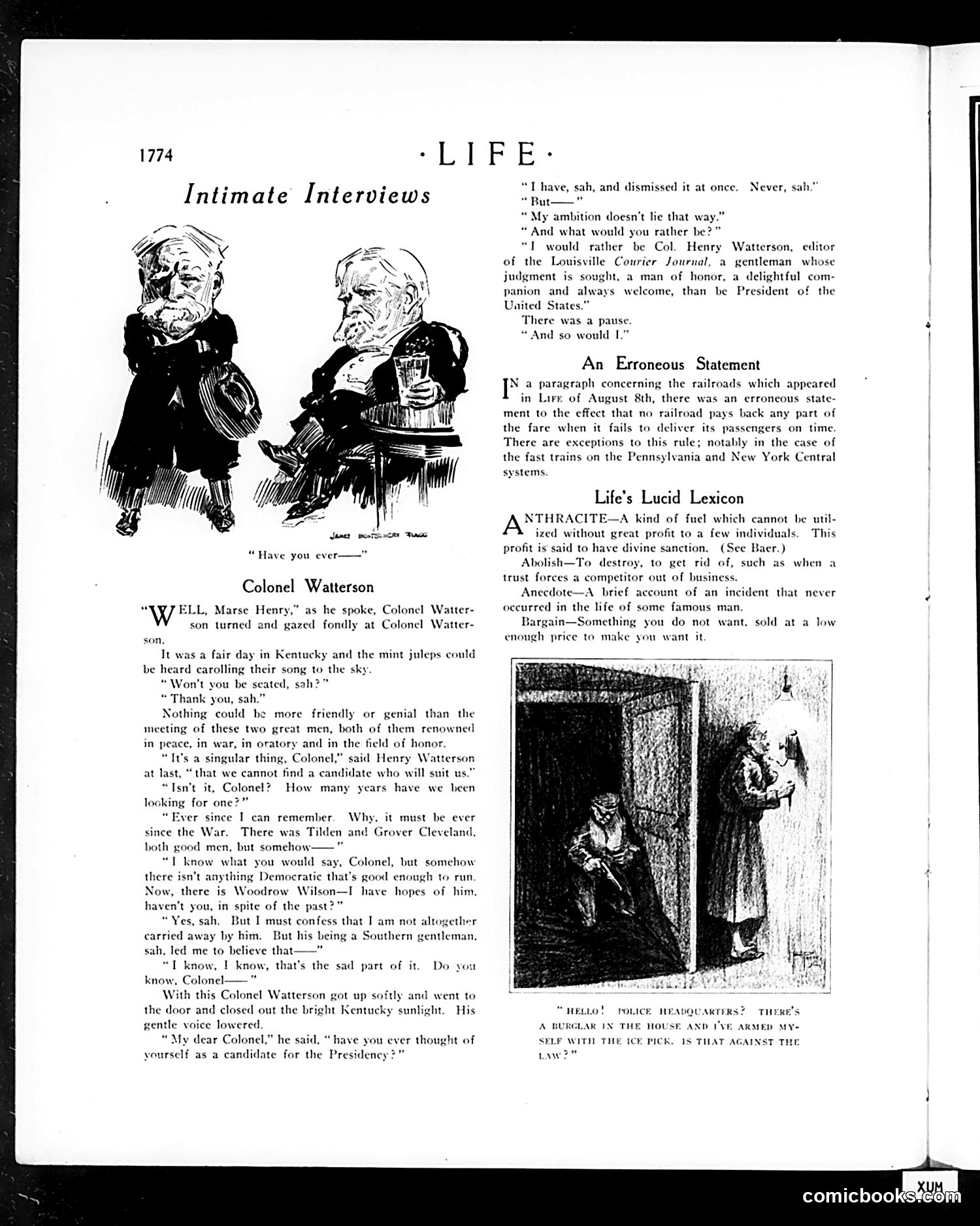
This satirical piece features **Henry Watterson**, the real editor of the Louisville Courier-Journal, depicted in a fictional interview with himself—a joke about his prominence and self-regard. The satire targets Watterson's political influence and his role as a kingmaker in Democratic politics. The conversation mockingly presents him as so important that finding a presidential candidate requires his blessing. References to **Tilden and Cleveland** (past Democratic nominees) and skepticism about **Woodrow Wilson** reflect actual 1912 election-year debates among Democratic elites. The punchline—that Watterson would rather be "Col. Henry Watterson" than President—is ironic mockery. It suggests his real power lies in *influencing* presidents as a respected editor and opinion-maker, not in holding office himself. The cartoon's caricature style emphasizes his vanity. The page's other content (railroad refunds, "Life's Lucid Lexicon") are separate satirical items attacking corporate practices and political corruption of the era.
📄 Transcribed text from this page (OCR, searchable)
Machine-transcribed from the original scan — historical spelling and the odd misread are preserved.
1774 -LIFE-: Intimate Interviews “Have you ever—" Colonel Watterson “WF LL, Marse Henry,” as he spoke, Colonel Watter- son turned and gazed fondly at Colonel Watter- son. It was a fair day in Kentucky and the mint juleps could be heard carolling their song to the sky. “Won't you be seated, sah?” “Thank you, sah. Nothing could be more friendly or genial than the meeting of these two great men, both of them renowned in peace, in war, in oratory and in the field of honor. “It's a singular thing, Colonel,” said Henry Watterson at last, “that we cannot find a candidate who will suit us “Isn't it, Colonel? How many years ha looking for one?” “Ever since I can remember. Why, it must be ever since the War. There was Tilden and Grover Cleveland, both good men, but somehow—"” “T know what you would » Colonel, but somehow there isn’t anything Democratic that’s good enough to run Now, there is Woodrow Wilson—I have hopes of him. haven't you, in spite of the past?” “Yes, sah. But I must confess that I am not altogether carried away by him. But his being a Southern gentleman, sah, led me to believe that——” “T know, | know, that’s the sad part of it. Do you we been know, Colonel— ” With this Colonel Watterson got up softly and went to the door and closed out the bright Kentucky sunlight. His. ntle voice lowered. “My dear Colonel,” he said, “ have you ever thought of yourself as a candidate for the Presidency?” “T have, sah, and dismissed it at once. Never, sah.” “But—” “My ambition doesn’t lie that way “And what would you rather be “T would rather be Col. Henry Watterson, editor of the Louisville Courter Journal, a gentleman whose judgment is sought, a man of honor, a delightful com- panion and always welcome, than be President of the ited State: There was a pause. “And so would 1. An Erroneous Statement N a paragraph concerning the railroads which appeared in Lire of August 8th, there was an erroneous state- ment to the effect that no railroad pays back any part of the fare when it fails to deliver its passengers on time There are exceptions to this rule; notably in the case of the fast trains on the Pennsylvania and New York Central systems. Life’s Lucid Lexicon f kind of fuel which cannot be util- ized without great profit to a few individuals. This profit is said to have divine sanction. (See Baer.) Abolish—To destroy, to get rid of, such as when a trust forces a competitor out of business. Anecdote—A brief account of an incident that never occurred in the life of some famous man. in—Something you do not want, sold at a low enough price to make you want it Cres POLICE HE. QUARTERS? THERE'S AK IN THE HOUSE AND I'VE ARMED MY~ SELF WITH THE ICE PICK. IS THAT AGAINST THE comicbookee ci 2