
A complete issue · 44 pages · 1912
Life — June 20, 1912
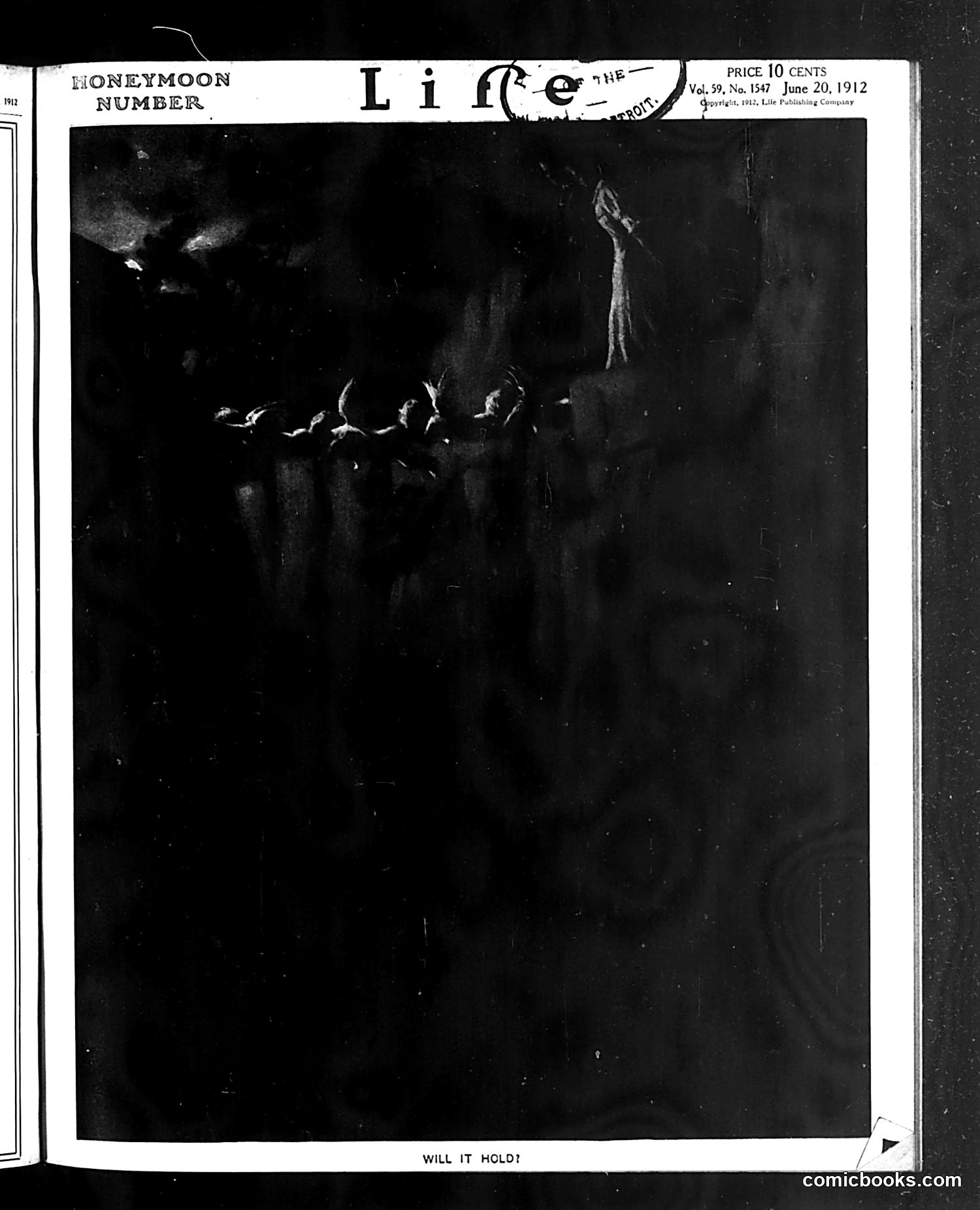
This is the cover of Life's "Honeymoon Number" issue. The dark, dramatic illustration shows a couple suspended or hanging above a group of figures below who appear to be reaching upward. The caption reads "WILL IT HOLD?" The image likely satirizes marriage itself—specifically the tension between romantic idealism (the honeymoon phase) and practical survival. The reaching figures below may represent life's responsibilities, creditors, or social pressures threatening the newlyweds' precarious position. The ambiguous "rope" or support structure suggests marital commitment is tested by external forces. Without clearer details, the specific couple depicted remains unclear, but the humor centers on the fragility of newlywed bliss when confronted with reality's demands.
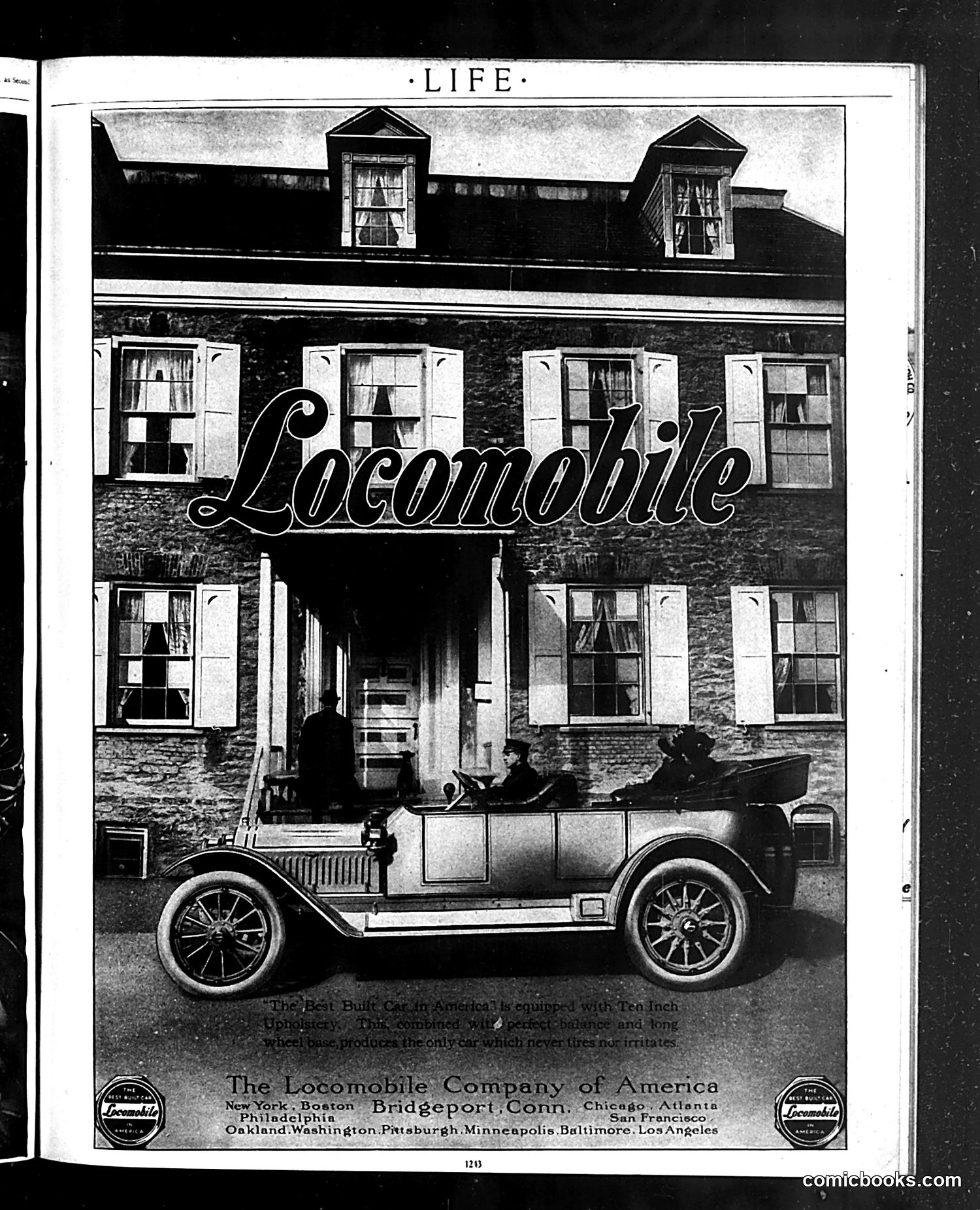
This page is **primarily an advertisement**, not editorial satire or political commentary. It's a full-page ad for the Locomotive automobile, published by The Locomotive Company of America, with offices listed in major cities (New York, Boston, Chicago, Atlanta, and others). The advertisement features a side-profile photograph of an early motorcar parked in front of a brick townhouse. The text claims it's "The Best Built Car in America," emphasizing its ten-inch wheel base and balanced design that "produces the only car which never tires or irritates." There is no political cartoon or satirical commentary on this page—it's straightforward product marketing from the early automobile era, likely early 1900s based on the vehicle's design and the magazine's format.
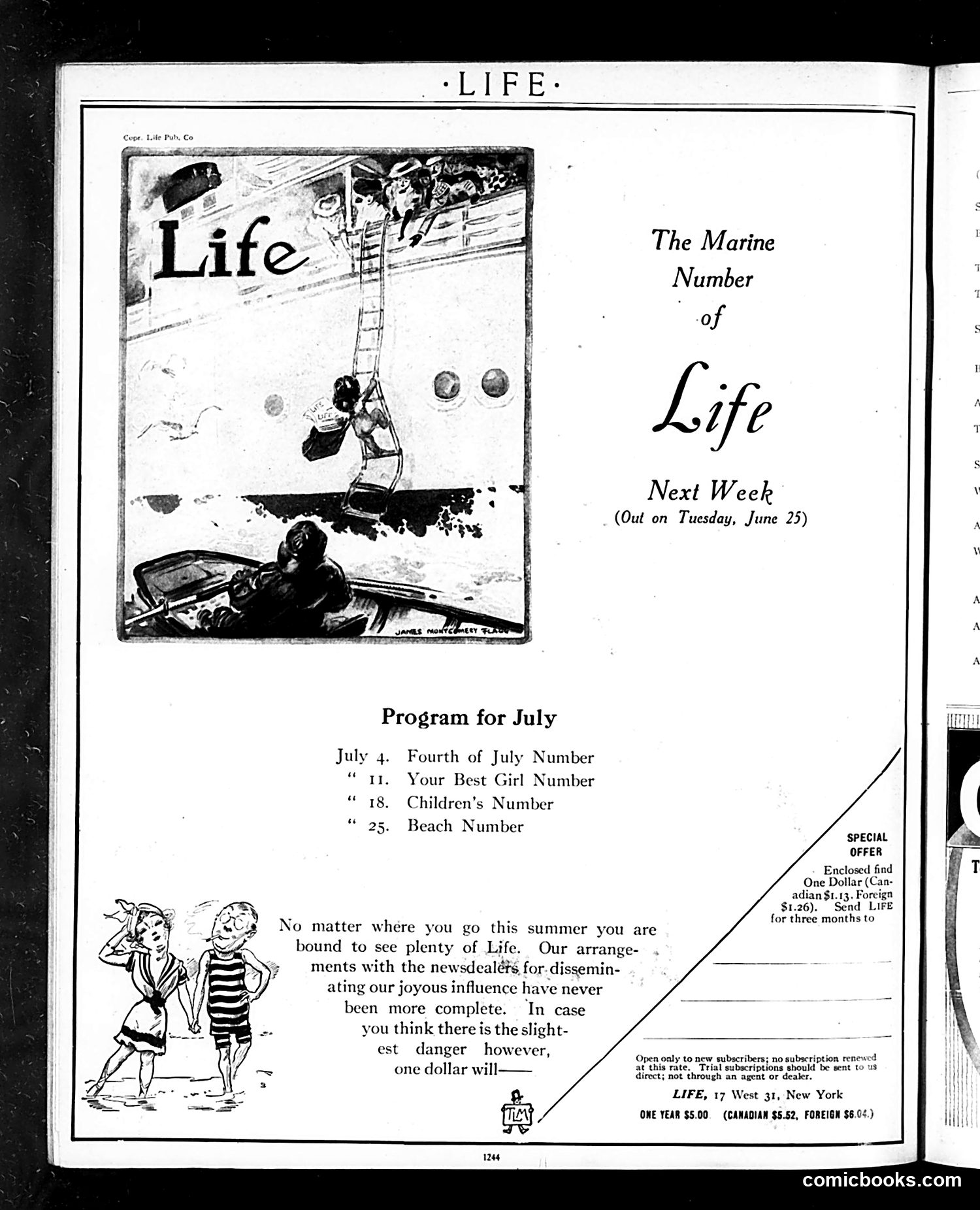
This is primarily an **advertisement for Life magazine's upcoming issues**, not political satire. The page announces the Marine Number coming next week (June 25) and lists July's editorial program: Fourth of July, "Your Best Girl," Children's, and Beach numbers. The illustration shows a sailor climbing a ship's ladder while another figure swims below—likely promoting the Marine/nautical theme. The two children in striped and solid swimsuits at bottom are generic summer imagery. The "Special Offer" promotes a subscription deal ($1 for three months). The text emphasizes Life's broad summer reach through newsdealer distribution. This is essentially a **promotional house ad**—typical magazine content from this era announcing upcoming themed issues to attract subscribers.
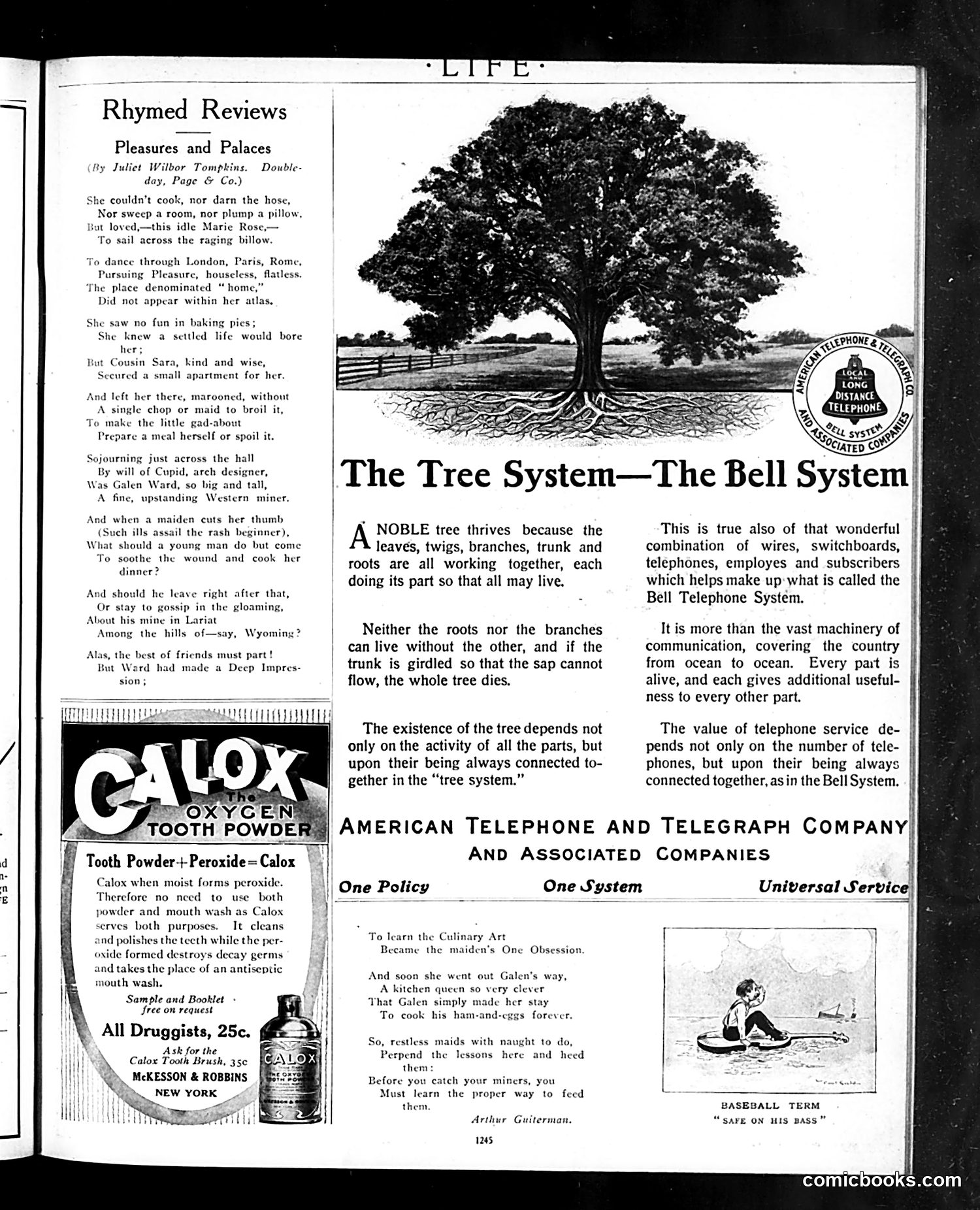
This page contains no political cartoons. Instead, it features: **Left column**: A conventional poem titled "Pleasures and Palaces" about a woman named Marie Rose who rejected domestic life to travel Europe. Below is a **Calox Tooth Powder advertisement** comparing the product's cleansing properties to antiseptic peroxide. **Right column**: An extended **advertisement for Bell Telephone System** that uses an extended metaphor comparing a tree's interconnected root-branch system to telephone infrastructure. The ad emphasizes how each component depends on others for the system's overall functionality. **Bottom right**: A small cartoon captioned "Baseball Term: 'Safe on His Bass'" showing what appears to be a figure in water—likely a pun on baseball terminology. This is primarily an advertising page with minimal satirical content.
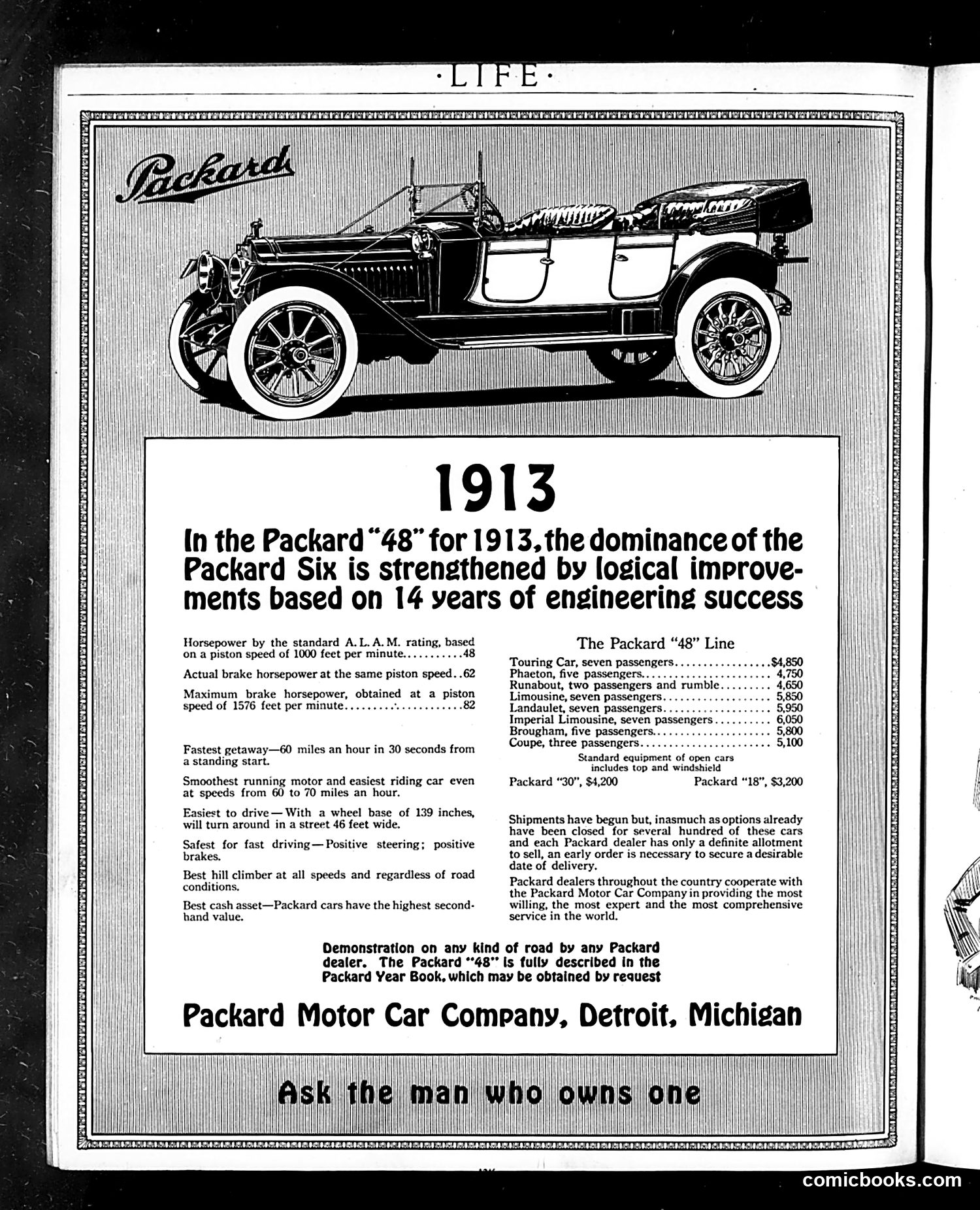
This page is **not a cartoon or satire**—it's a straightforward **automobile advertisement** for the Packard Motor Car Company of Detroit, Michigan, published in *Life* magazine in 1913. The image shows a side-view illustration of the Packard "48" model, a luxury touring car. The advertisement emphasizes engineering achievements: powerful engine specifications, brake horsepower ratings, speed capabilities (60 mph in 30 seconds), and handling features. The text lists various body styles and prices (ranging from $3,200 to $6,050), targeting wealthy buyers. The closing slogan—"Ask the man who owns one"—was Packard's famous advertising tagline, implying satisfied owners would endorse the vehicle. This represents early 20th-century automobile marketing in upscale publications.
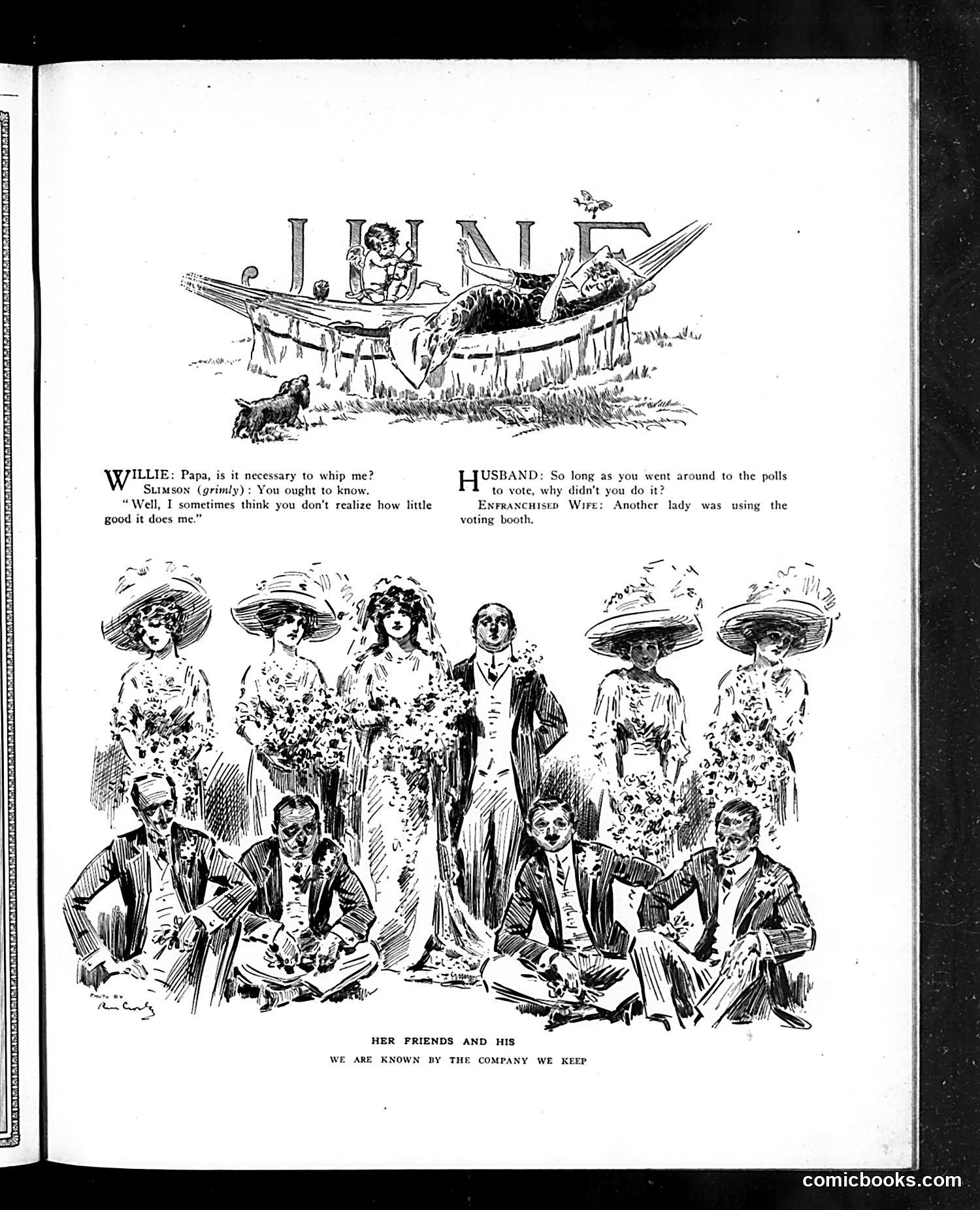
This page satirizes early 20th-century women's suffrage activism. The top illustration shows a domestic scene where a child asks his father if he needs whipping, prompting the father to explain he went to vote instead of using the voting booth—implying women's suffrage activism caused disruption and distraction from civic duty. The lower illustration depicts a wedding party with the caption "HER FRIENDS AND HIS / WE ARE KNOWN BY THE COMPANY WE KEEP." This appears to mock the social mixing created by suffrage movements, suggesting that women's political activism brought together people of different classes or social standings in ways that challenged traditional social hierarchies. The satire reflects anti-suffrage sentiment common in the era.
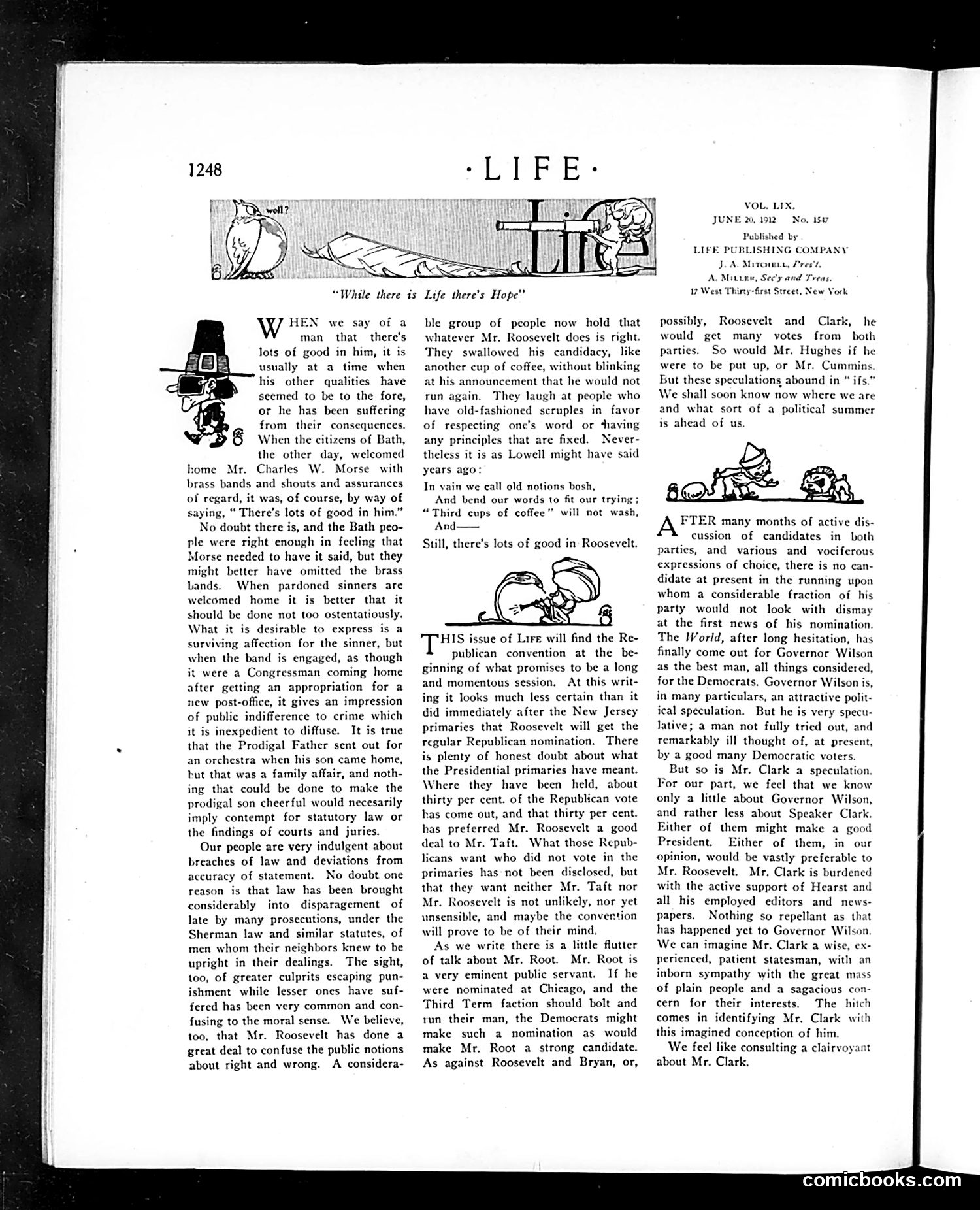
This June 1912 *Life* editorial page discusses the Republican National Convention and presidential candidates. The text examines Roosevelt's political standing and mentions several figures: Roosevelt himself, Clark (likely House Speaker Champ Clark, a Democratic candidate), Taft (the incumbent president), and Root (likely Elihu Root, a prominent Republican). The editorial expresses skepticism about Roosevelt's chances and discusses potential Democratic nominees. It defends Speaker Clark against what the writer calls unfair "clairvoyant" speculation about him. The small cartoon illustrations (showing figures in period dress) are decorative rather than the main satirical focus—the real satire lies in the editorial's sardonic tone about candidate viability and party politics during this fractious election year.
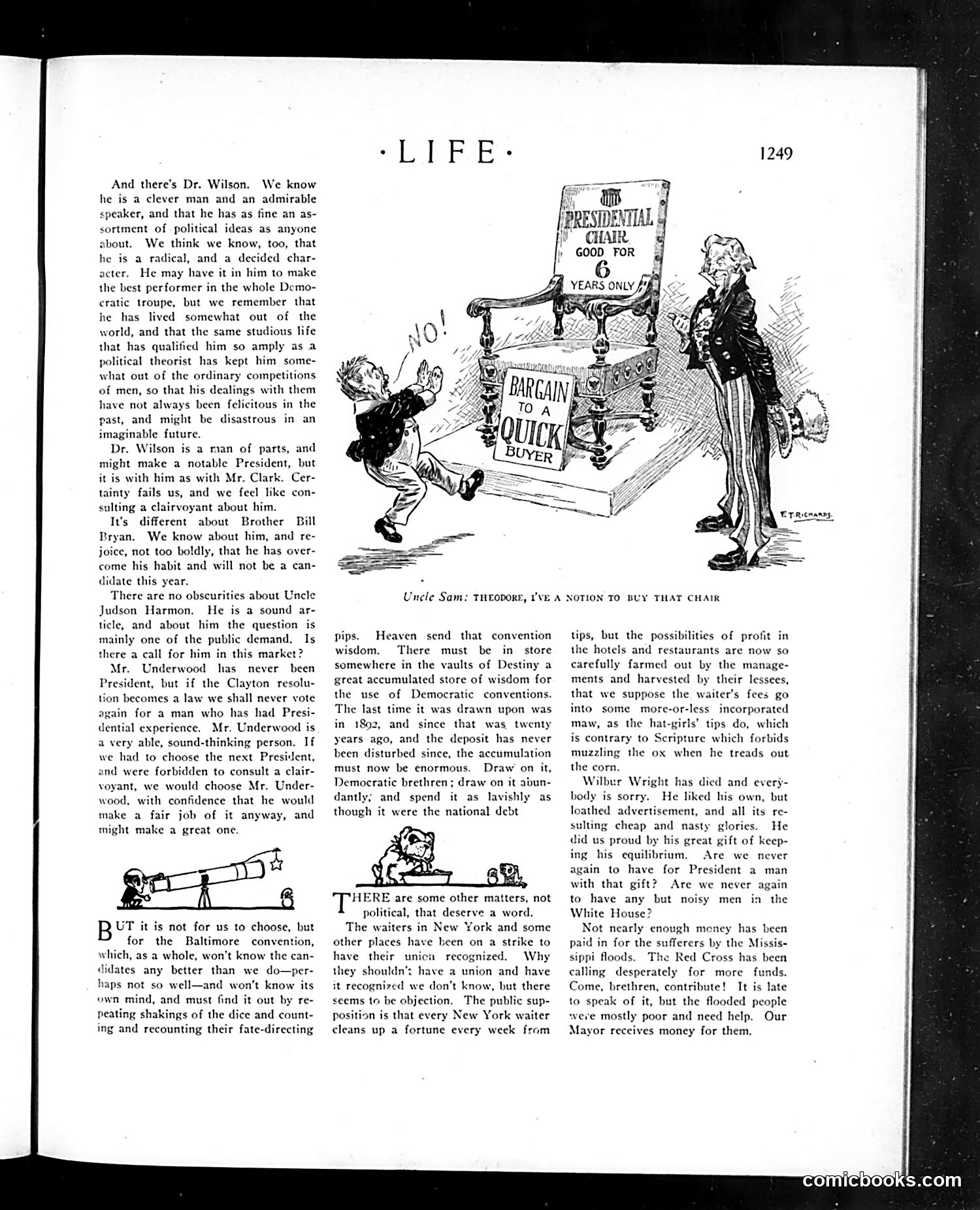
The central cartoon satirizes the 1912 presidential election. It depicts Uncle Sam attempting to purchase a "Presidential Chair" marked "Good for 6 Years Only" as a "Bargain to a Quick Buyer." A man leaps away shouting "No!"—likely representing either Theodore Roosevelt or William Howard Taft, both reluctant candidates that cycle. The surrounding text discusses Democratic candidates, praising Dr. Wilson as intellectually serious while dismissing Bryan's political viability and criticizing Underwood's unsuitability for the presidency. The joke targets the commodification of the presidency itself—treating high office as disposable merchandise with an expiration date. This reflects anxieties about American politics becoming increasingly transactional and cheapened during the Progressive Era's contentious multi-candidate races.
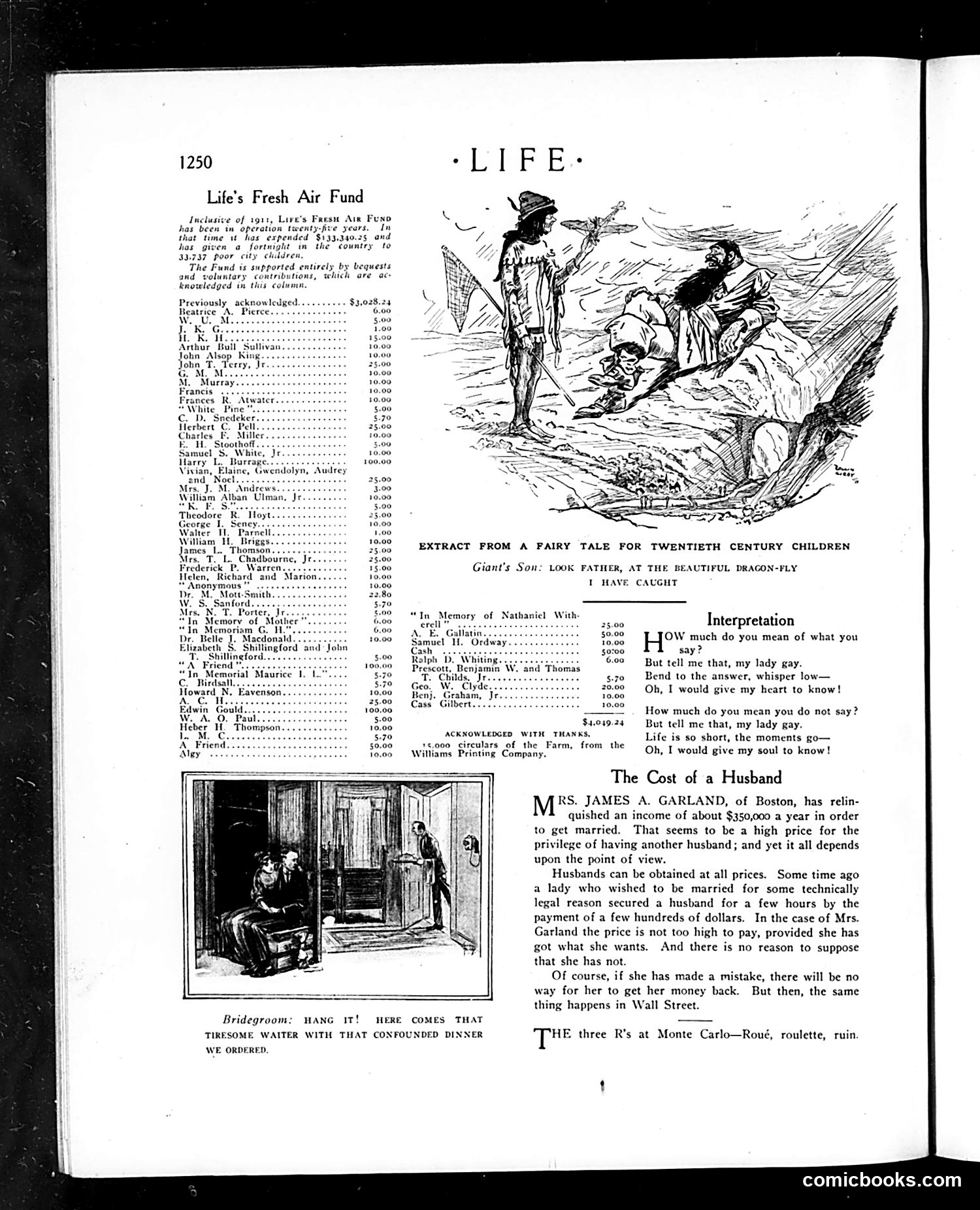
This page from *Life* magazine contains three distinct elements: 1. **"Life's Fresh Air Fund"** - A fundraising list for a charitable organization that has operated for twenty-five years, sending poor city children to the countryside for health and rest. The lengthy donor list suggests this was an important philanthropic cause. 2. **"Extract from a Fairy Tale for Twentieth Century Children"** - An illustration showing what appears to be adults presenting a caught dragon-fly to children, with accompanying poem "Giant's Son." This is likely satirizing how modern fairy tales reflect contemporary interests rather than traditional narratives. 3. **"The Cost of a Husband"** - An article about Mrs. James A. Garland of Boston who relinquished $350,000 yearly income to get married, satirizing marriage economics and the financial calculations involved in matrimonial decisions, particularly for wealthy women. The "Bridegroom" illustration depicts a domestic scene with accompanying humorous caption about dining confusion.
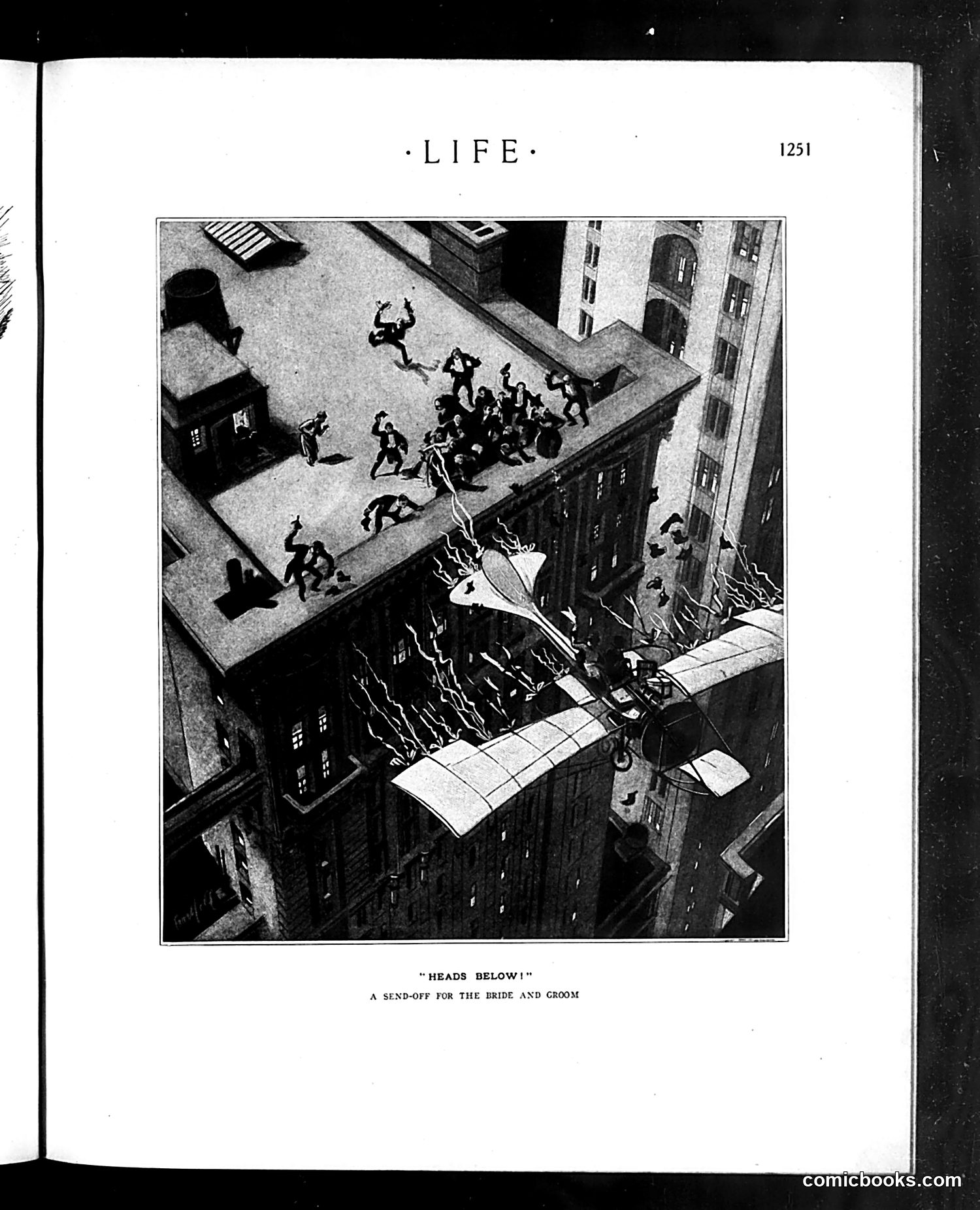
This is a humorous illustration titled "Heads Below!" subtitled "A Send-Off for the Bride and Groom." The bird's-eye photograph shows a multi-story building with people on a rooftop platform throwing confetti or rice down onto a street below, where crowds of pedestrians are visible. The satire appears to be about a chaotic wedding send-off. Rather than a traditional quiet celebration, the bride and groom's departure involves raining debris from a high building onto unsuspecting pedestrians below—creating mayhem in the street. The joke critiques overly enthusiastic or inconsiderate wedding celebrations that inconvenience the general public. The aerial perspective emphasizes the comic scale of the disruption and the contrast between the celebrants above and ordinary people below dealing with the consequences.
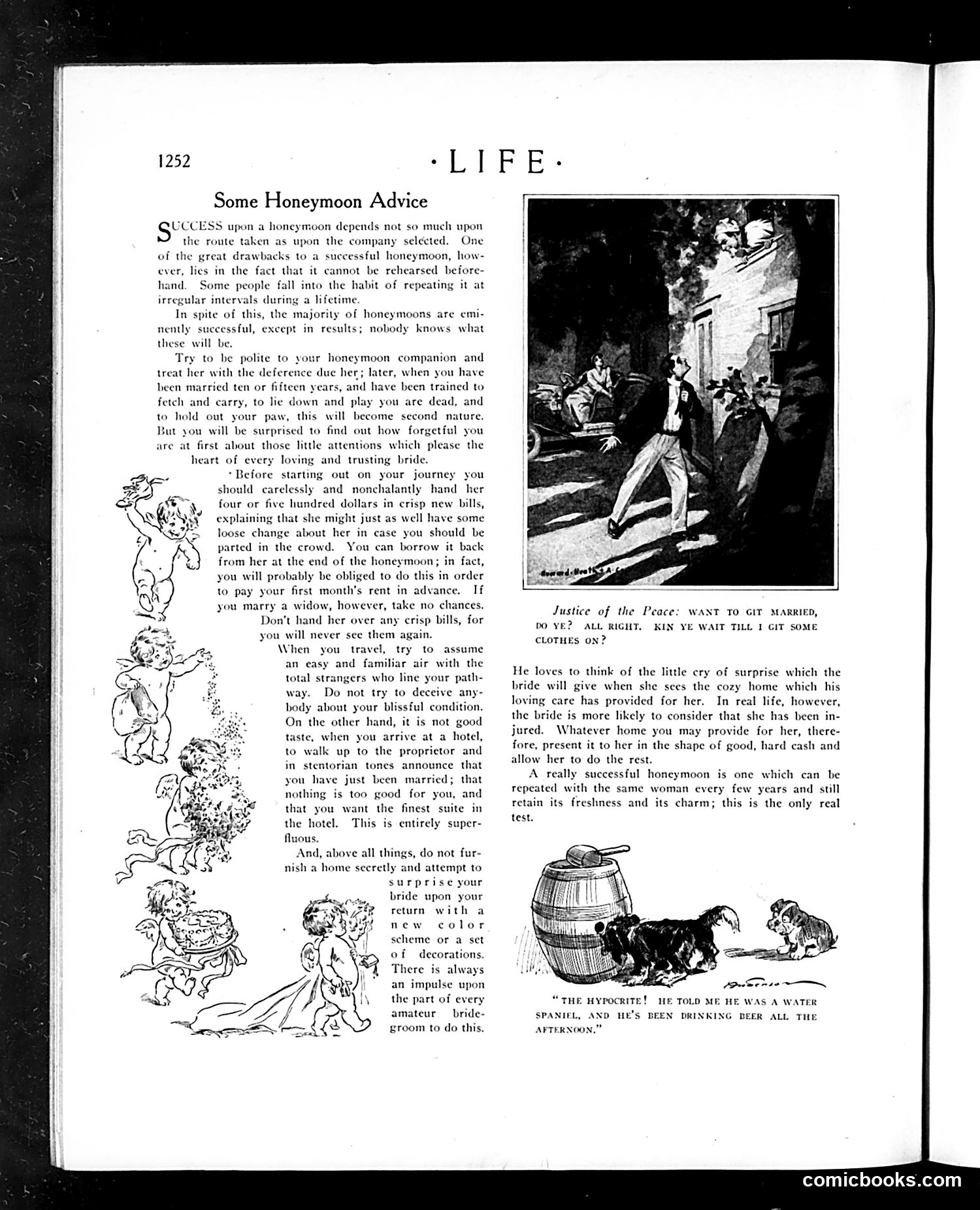
This page offers tongue-in-cheek advice to newlyweds about honeymoon travel. The left margin features decorative cupid illustrations. The main text humorously warns grooms to: - Give their bride spending money ("four or five hundred dollars in crisp new bills") - Avoid surprising her with home renovations upon return - Maintain politeness toward strangers while traveling - Not boast excessively about their hotel accommodations A captioned illustration shows a "Justice of the Peace" officiating a wedding, with dialogue about obtaining clothes before departure. Another illustration depicts a man with dogs and a barrel, captioned with a jest about a spaniel drinking beer all afternoon—the "hypocrite" reference being satirical wordplay. The overall tone is light domestic satire aimed at male readers, reflecting early 20th-century gender expectations and marriage norms.
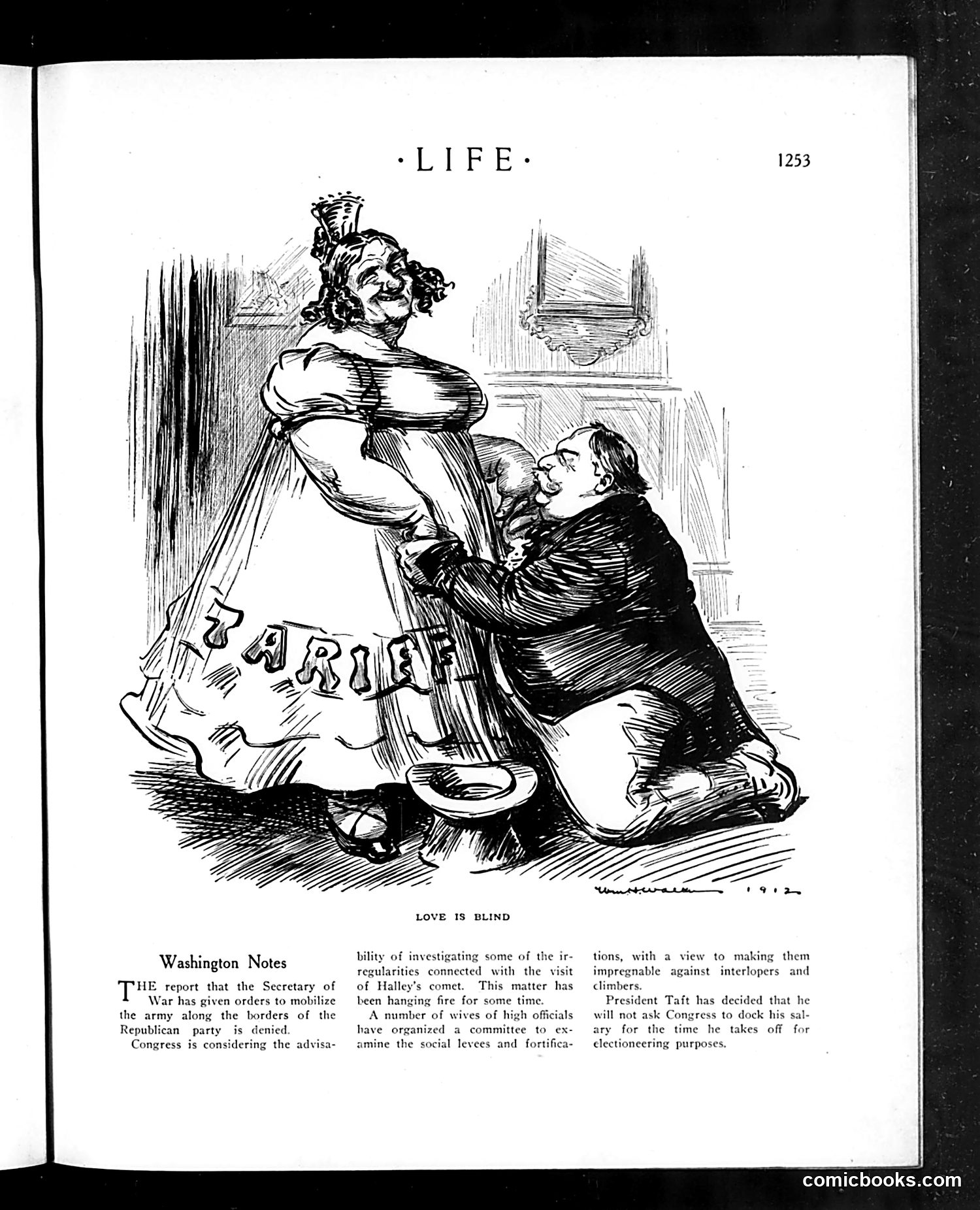
This cartoon satirizes romantic pursuit and social climbing. A portly man in formal dress kneels before a woman labeled "BARBIE" (likely referencing a specific public figure of the era, though unclear which). The woman stands confidently, wearing a crown and elaborate dress, while the man gazes upward adoringly despite her apparent physical advantages over him. The caption "LOVE IS BLIND" serves as the joke's punchline—suggesting the man cannot see (or chooses to ignore) obvious disparities, perhaps in wealth, status, or appearance, blinded by romantic interest or social ambition. The accompanying "Washington Notes" discuss military mobilization and President Taft's electoral decisions, typical of Life's satirical political commentary from this period.
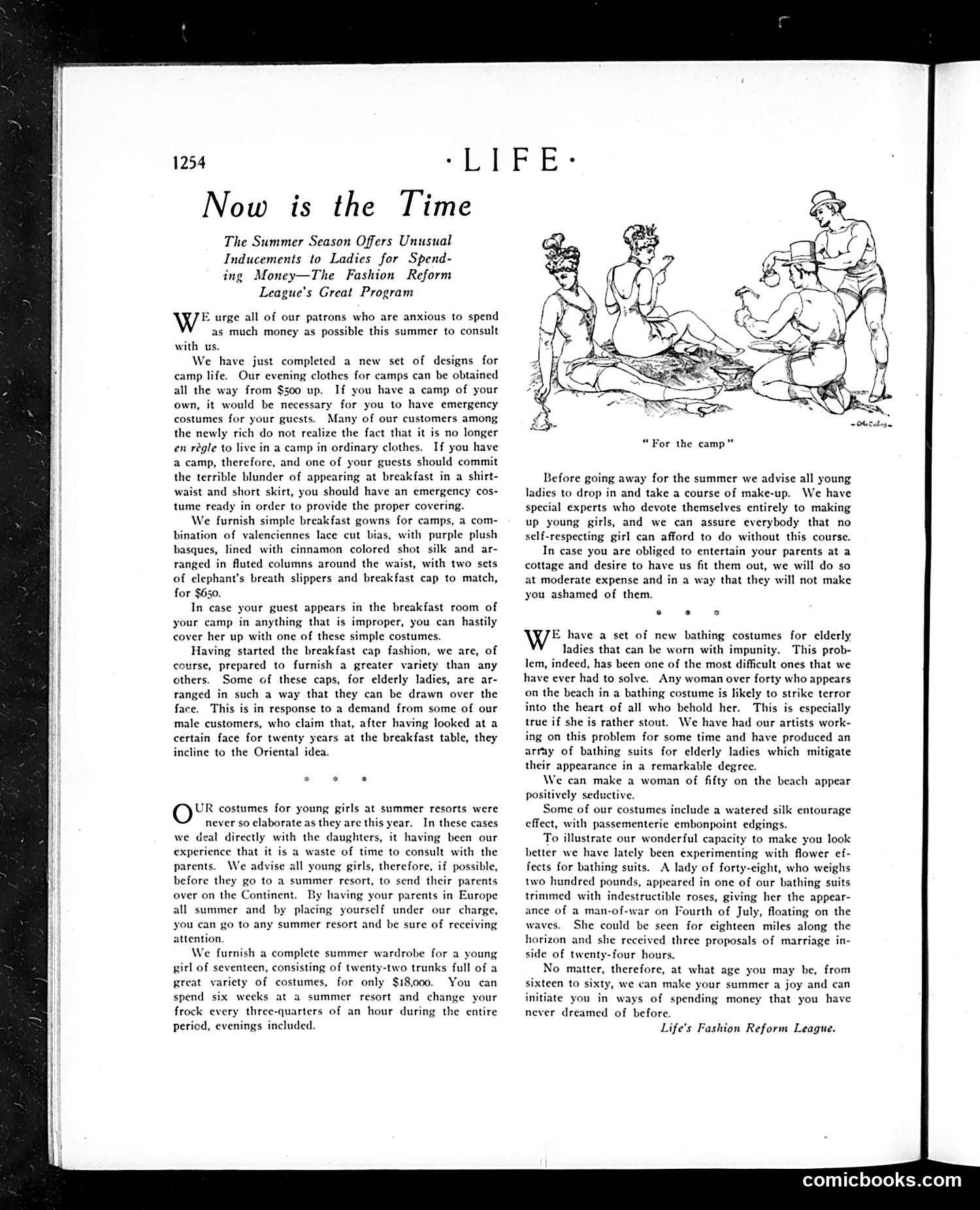
This page from *Life* magazine promotes the "Fashion Reform League's" summer wardrobe program for women. The illustration depicts people at a beach camp setting, apparently demonstrating practical clothing. The text's satire targets women's fashion excess and impracticality. It mocks how women were expected to wear restrictive, elaborate clothes even at informal summer camps—"appearing at breakfast in a shirt-waist and short skirt" required an emergency costume change. The League advocates for sensible camp clothing and addresses the anxiety older women felt about appearing in bathing costumes, offering solutions to make them "positively seductive" despite age or body type. The satire critiques both women's fashion industry standards and the social pressure women faced regarding appearance, while the League positions itself as offering practical, dignified alternatives for summer leisure.
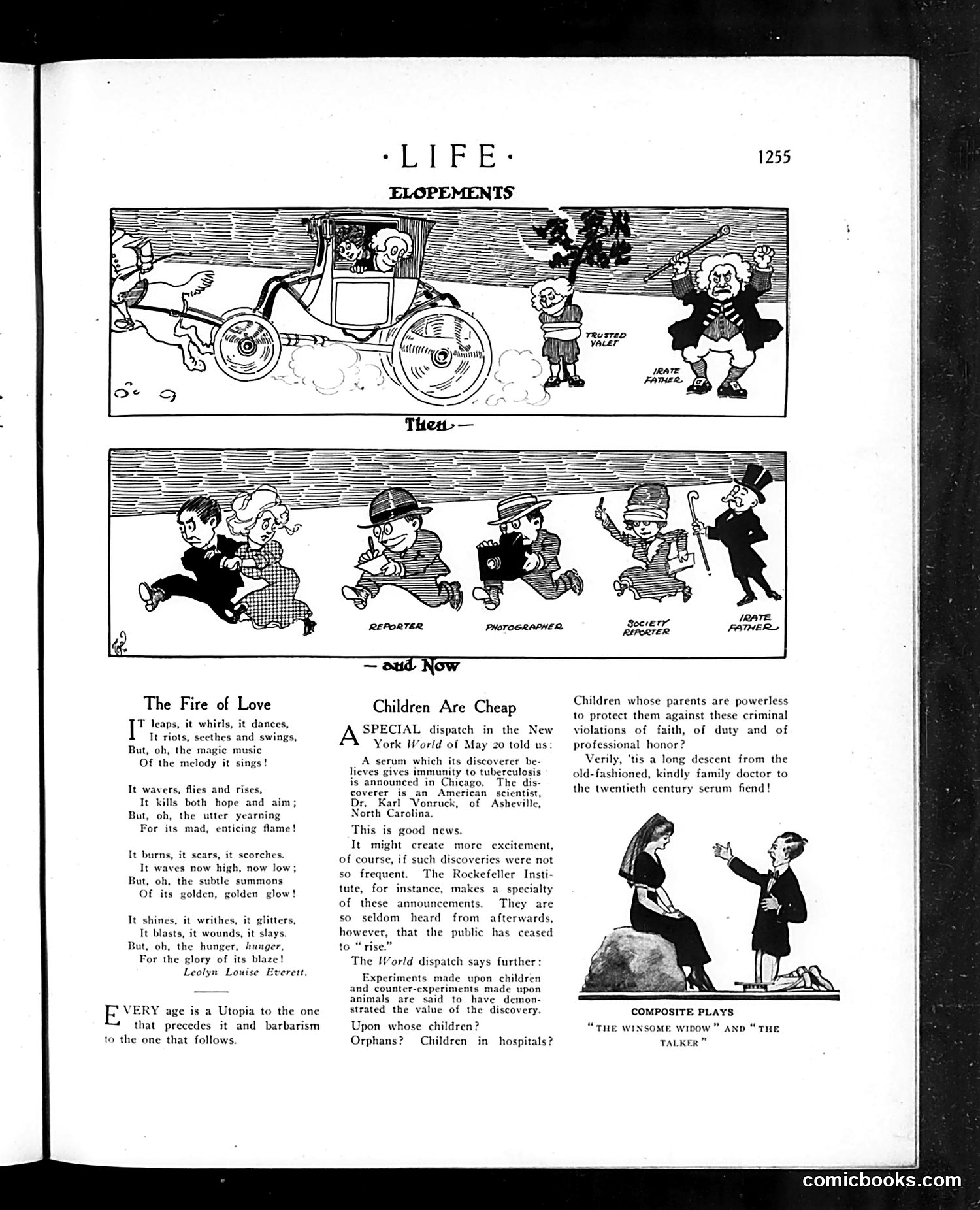
This page contains two editorial cartoons and commentary satirizing early 20th-century social issues. **"Elopements"** depicts romantic entanglements through crude caricatures of types involved in scandalous relationships—appearing to mock sensationalist media coverage of affairs and runaway couples. **"Children Are Cheap"** is the page's sharp political critique. It attacks medical researchers who test experimental serums (particularly tuberculosis treatments) on vulnerable children—orphans and hospitalized poor children whose parents cannot protect them. The text sarcastically notes that such "discoveries" are frequent yet rarely produce results. Life's editors argue this represents a moral descent from traditional family doctors to exploitative "serum fiends." The satire targets both unethical medical experimentation and society's willingness to sacrifice powerless children in the name of scientific progress. This reflects genuine Progressive Era concerns about medical ethics and vulnerable populations. The poems and brief mentions of composite plays appear supplementary to these core critiques.
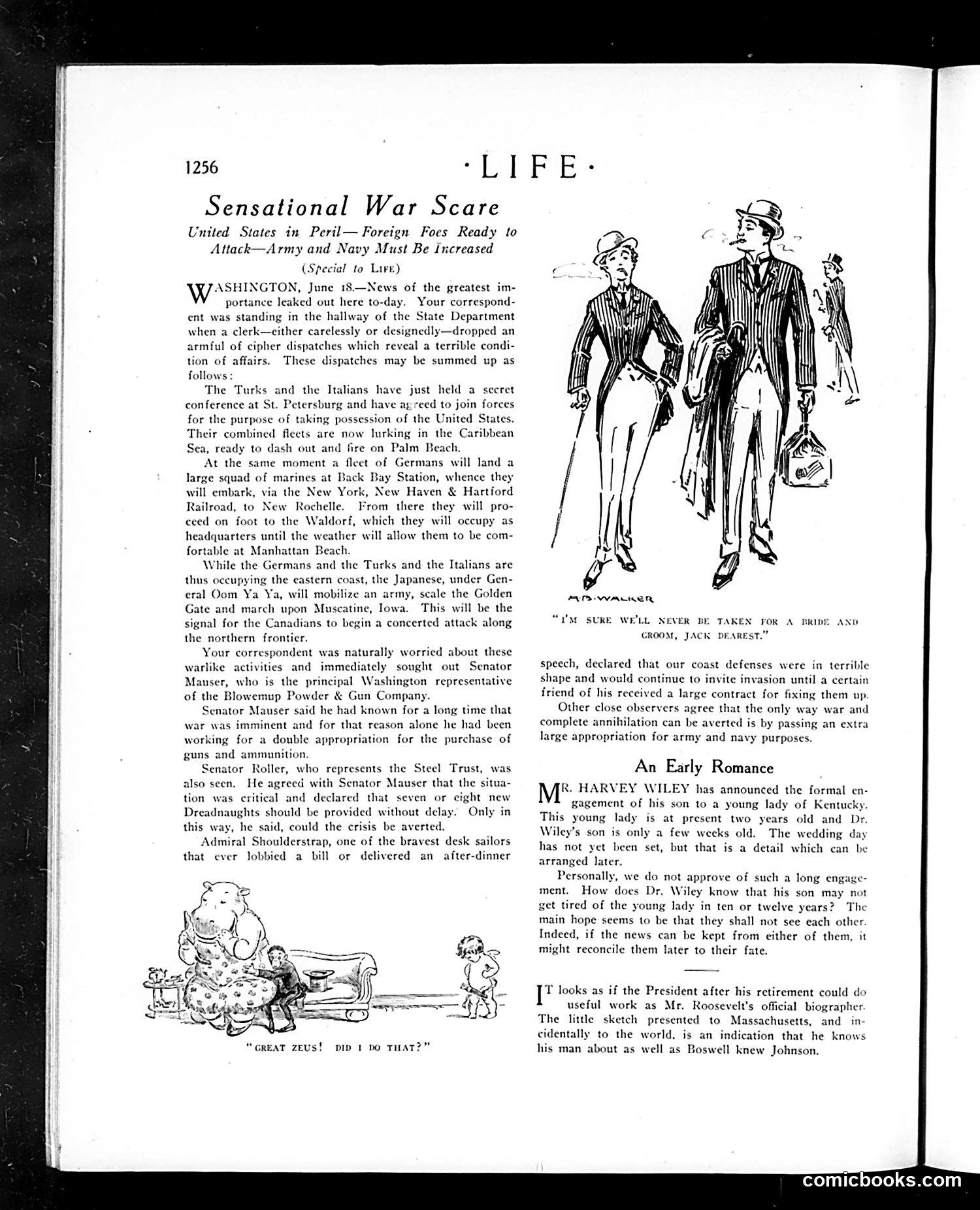
This page satirizes American war hysteria and military-industrial profiteering circa 1917 (inferred from the date line "June 18"). **The Main Article** mocks fabricated invasion scenarios: the text presents absurdly exaggerated "leaked" reports of coordinated attacks by Turks, Italians, Germans, and Japanese—targeting places like Palm Beach, the Waldorf Hotel, and Iowa. The satire exposes how politicians like "Senator Mauser" (representing munitions manufacturers) and "Senator Roller" (Steel Trust) exploit war scares to secure defense contracts and appropriations, regardless of actual threats. **The Illustration** (by P.V. Walker) shows two well-dressed figures walking together with the caption "I'm sure we'll never be taken for a bride and groom, Jack dearest"—likely satirizing the artificiality or absurdity of something in the news cycle. **The Bottom Section** briefly mocks an engagement announcement of infants, treating it satirically as ridiculous long-term planning. The page's core message: defense spending is driven by manufactured panic and private profit, not genuine national security needs.
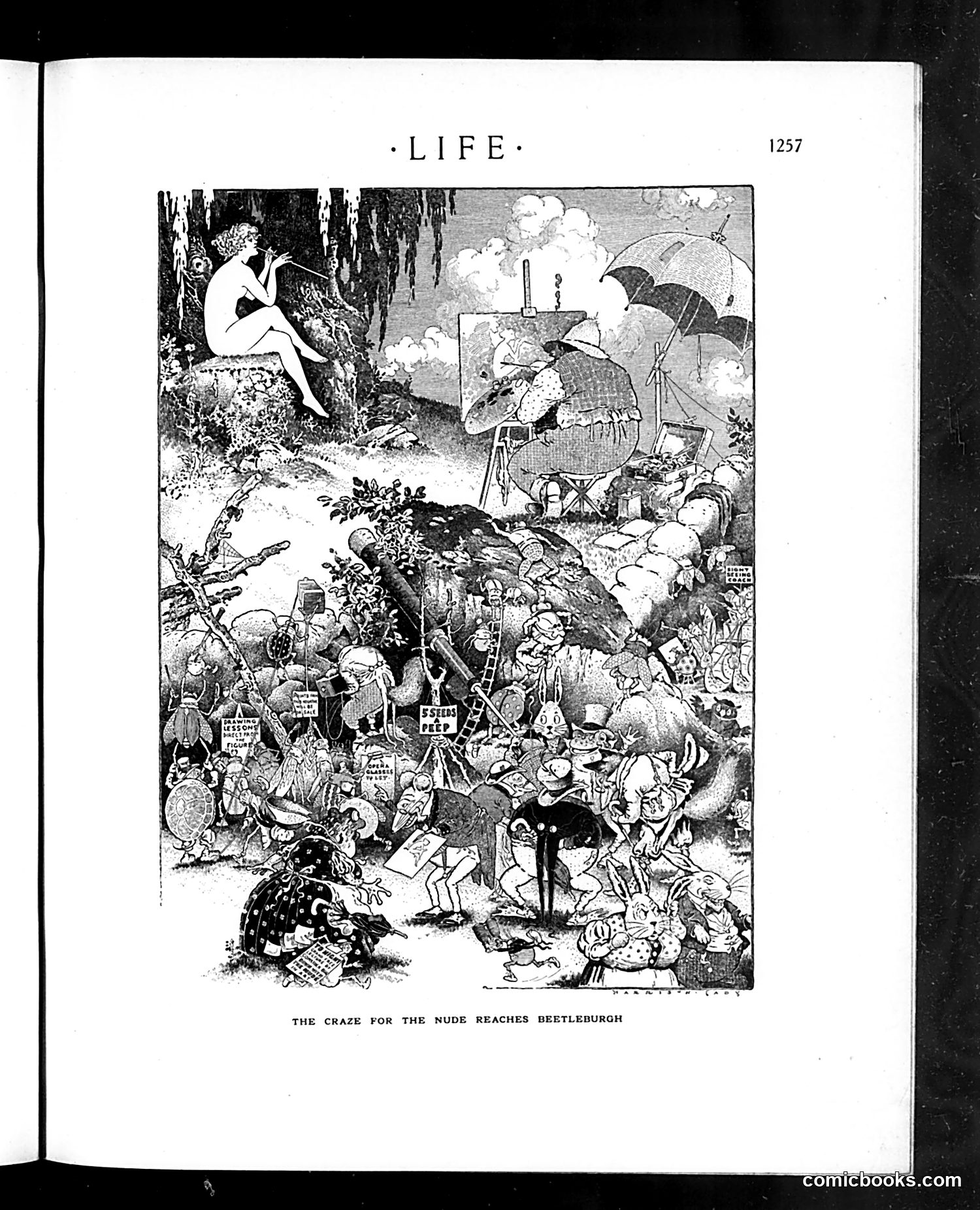
This satirical cartoon depicts a chaotic scene titled "The Craze for the Nude Reaches Beetleburgh," mocking the early 20th-century artistic and cultural trend toward nude figure drawing and painting. The composition shows a crowded, anarchic artist's colony or bohemian gathering. A nude female figure sits in a tree (upper left), while artists with easels and umbrellas attempt to sketch or paint her. The scene includes numerous insect-like creatures—fitting the "Beetleburgh" name—along with various onlookers and activity. The satire targets the pretentiousness of the nude-art movement, suggesting it has become absurdly fashionable and chaotic rather than serious artistic practice. The inclusion of insects, the circus-like atmosphere, and the title's pun (Beetles/Beetleburgh) reduce what advocates considered progressive art to ridiculous comedy.
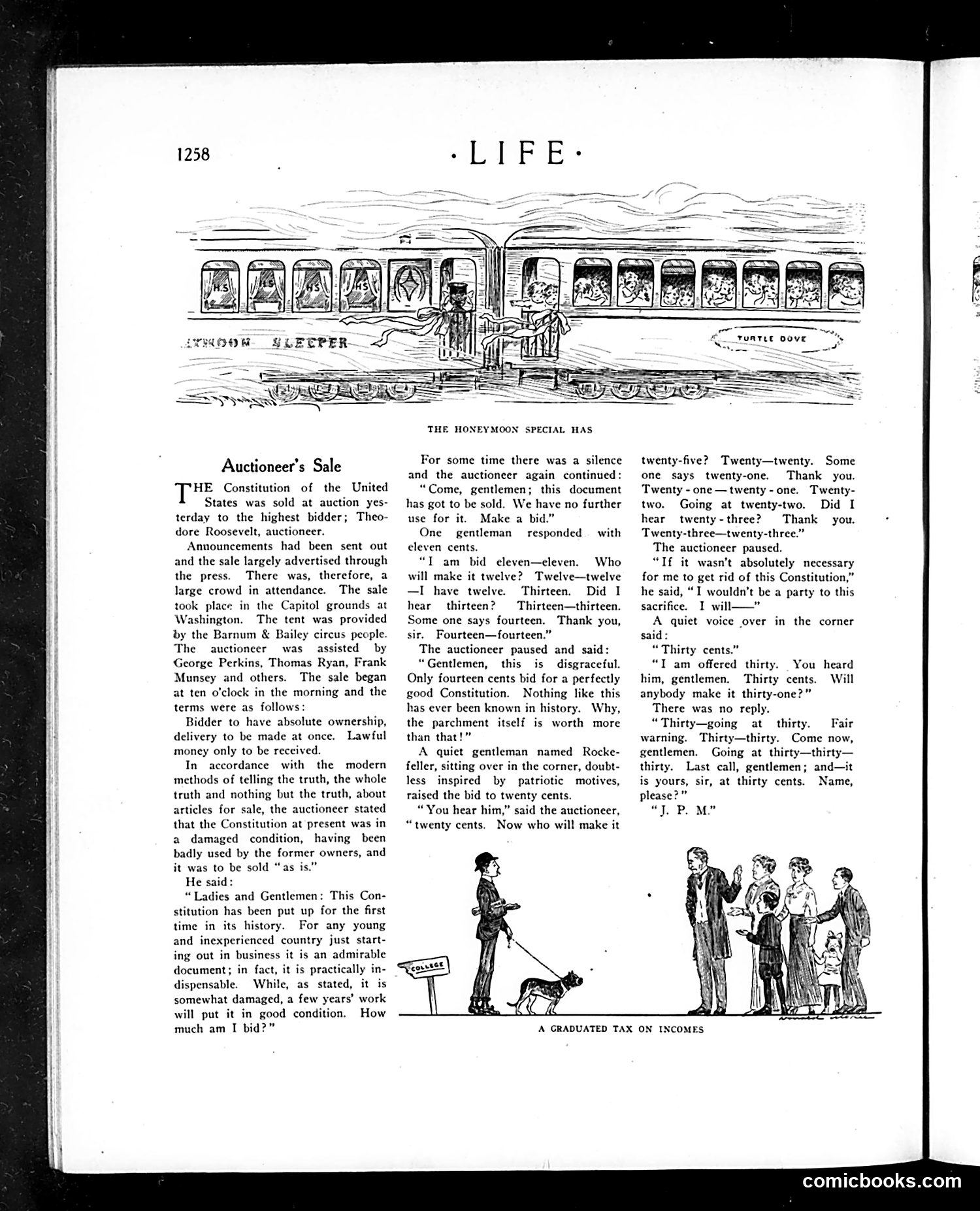
This satirical piece imagines the U.S. Constitution being auctioned off, with **Theodore Roosevelt as auctioneer**. The humor targets Roosevelt's perceived erosion of constitutional limits on executive power during his presidency. The absurdly low bids—reaching only thirty cents, won by "J.P.M." (likely J.P. Morgan, representing wealthy industrialists)—mock the idea that the Constitution has been effectively abandoned or sold to the highest bidder. References to **George Perkins, Thomas Ryan, and Frank Munsey** (Roosevelt associates and financiers) suggest complicity in this "sale." The accompanying cartoon, "A Graduated Tax on Incomes," references recent income tax debates—a progressive policy opposed by the wealthy figures named above. The satire criticizes Roosevelt's "trust-busting" and regulatory expansion as constitutional overreach, sardonically suggesting the nation's founding document is now worthless currency in an era of unchecked corporate and executive power.
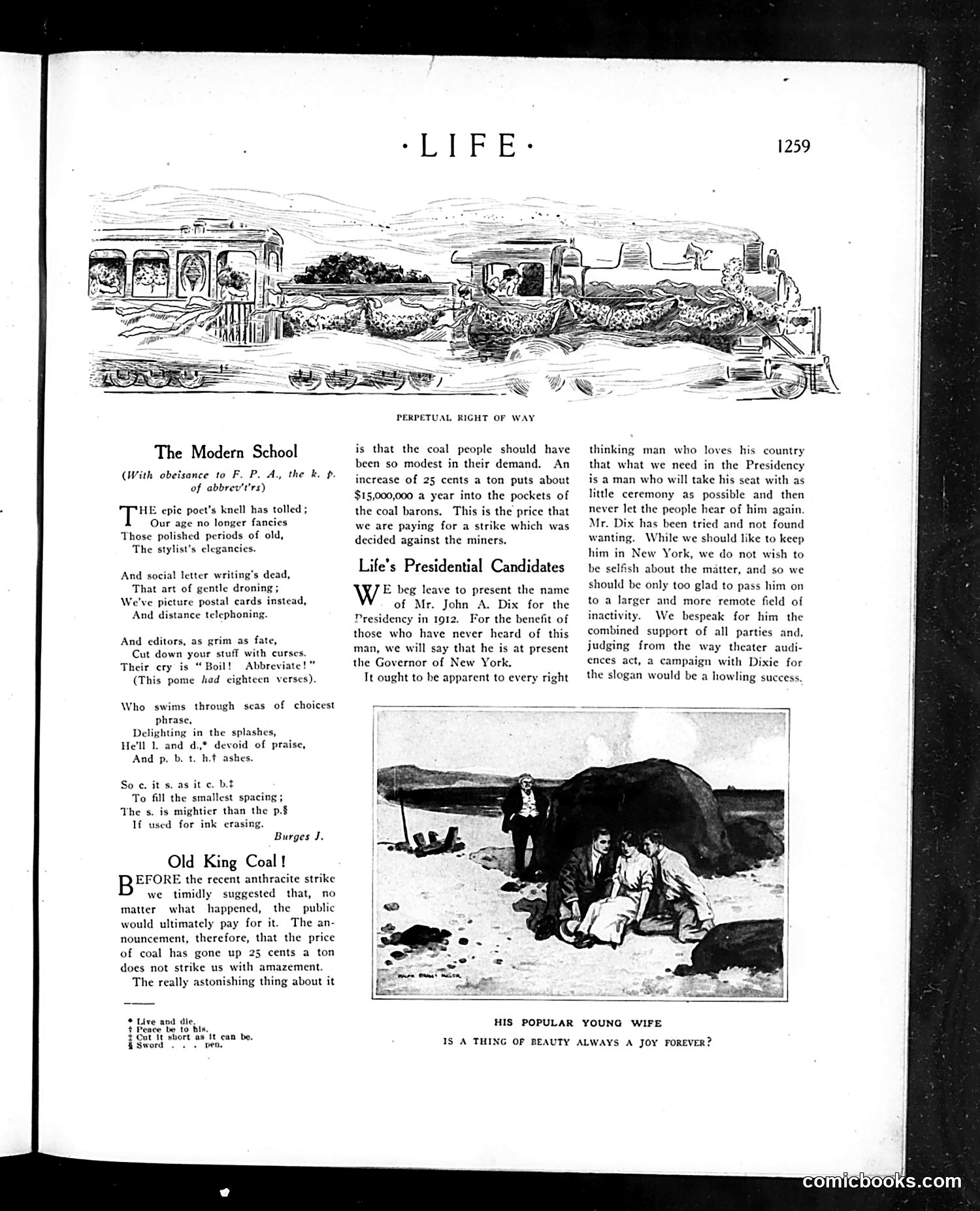
This page contains three satirical pieces: **"The Modern School"** mocks the decline of elegant writing. It laments that editors now demand brevity and abbreviations over "polished periods" and "stylist's elegancies," replacing formal letters with picture postcards and telephone calls. The poem itself uses intentional abbreviations (like "1, and d." for "live and die") to demonstrate this degradation of language. **"Old King Coal"** criticizes coal barons following the recent anthracite strike. Life sardonically notes that a 25-cent-per-ton price increase (worth $15 million annually) is surprisingly *modest* given the miners lost their strike. The piece mocks the coal industry's restraint in exploiting their victory. **"Life's Presidential Candidates"** proposes John A. Dix, Governor of New York, for the 1912 presidency—specifically because he's invisible and inactive. The satire suggests the ideal president is one the public never hears from, making Dix perfect due to his established obscurity. The page reflects Progressive Era concerns: linguistic decline, labor disputes, and political disengagement.
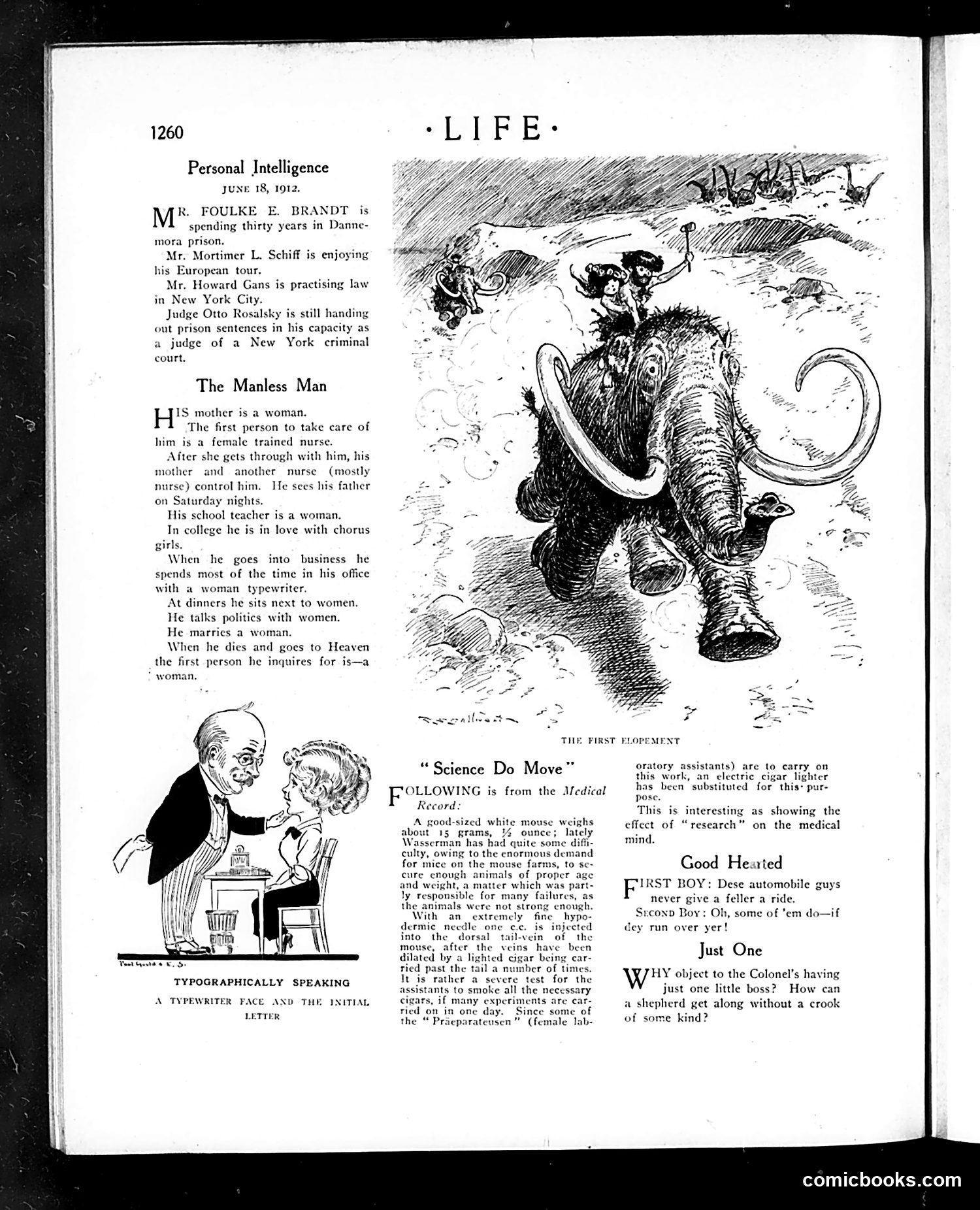
This page contains several satirical pieces typical of Life's humor: **"The Manless Man"** is a tongue-in-cheek essay listing all the women who control a man's life—from his mother and nurses through school, college, business, and marriage. The satire targets early 1900s gender dynamics, suggesting men are entirely dependent on and subordinate to women at every life stage. It's gentle social commentary on masculine powerlessness. **"Science Do Move"** mocks medical research by describing an absurd procedure: researchers use lit cigars to dilate mouse veins before injections. The joke is that this impractical method has now been "modernized" with an electric cigar lighter for female lab assistants. It satirizes how research sometimes prioritizes convenience over sense. **"Good Hearted"** and **"Just One"** are brief joke snippets about automobiles and a colonel's "boss" (likely a donkey), employing wordplay typical of period humor. The illustrations support these satirical pieces with period-appropriate cartoon styling.
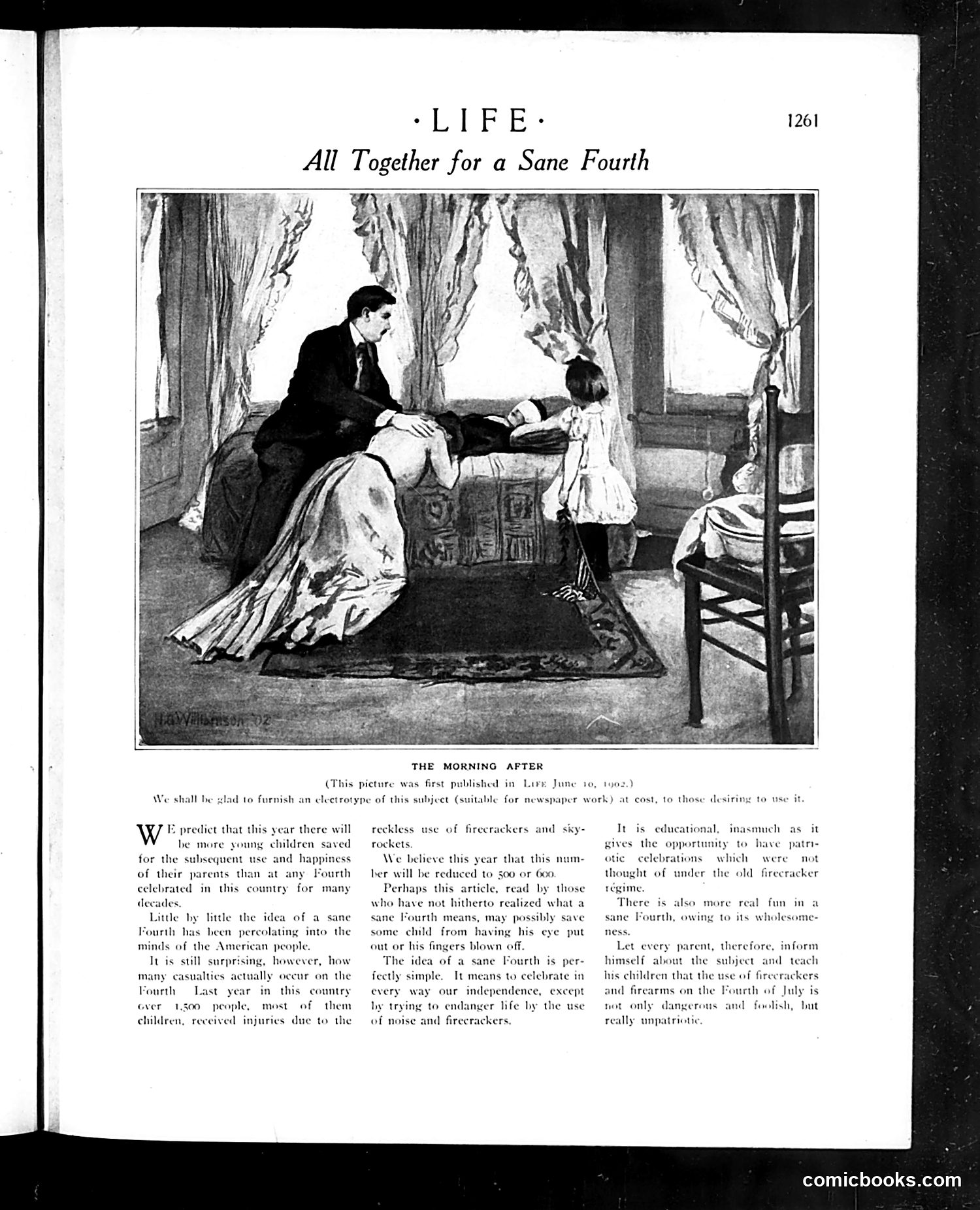
This is a public safety editorial from Life magazine advocating for a "sane Fourth of July" by reducing fireworks injuries among children. The accompanying illustration shows a domestic scene: a man tending to an injured child the morning after Independence Day celebrations, depicting the consequences of reckless firecracker use. The text reports that over 500 children were injured annually from fireworks in the early 1900s, and urges parents to discourage firecracker and sky-rocket use. The argument frames this as both practical safety and patriotic duty—claiming true patriotism means celebrating independence *without* endangering lives through "noise and firecrackers." The "sane Fourth" movement represented Progressive Era safety advocacy, positioning responsible parenting and public health awareness as modern, educated approaches versus the "old firecracker régime." The piece predicts injury reduction to 300-600 if parents would simply educate themselves and their children. This reflects genuine historical concern: fireworks injuries were a serious public health problem in early-twentieth-century America.
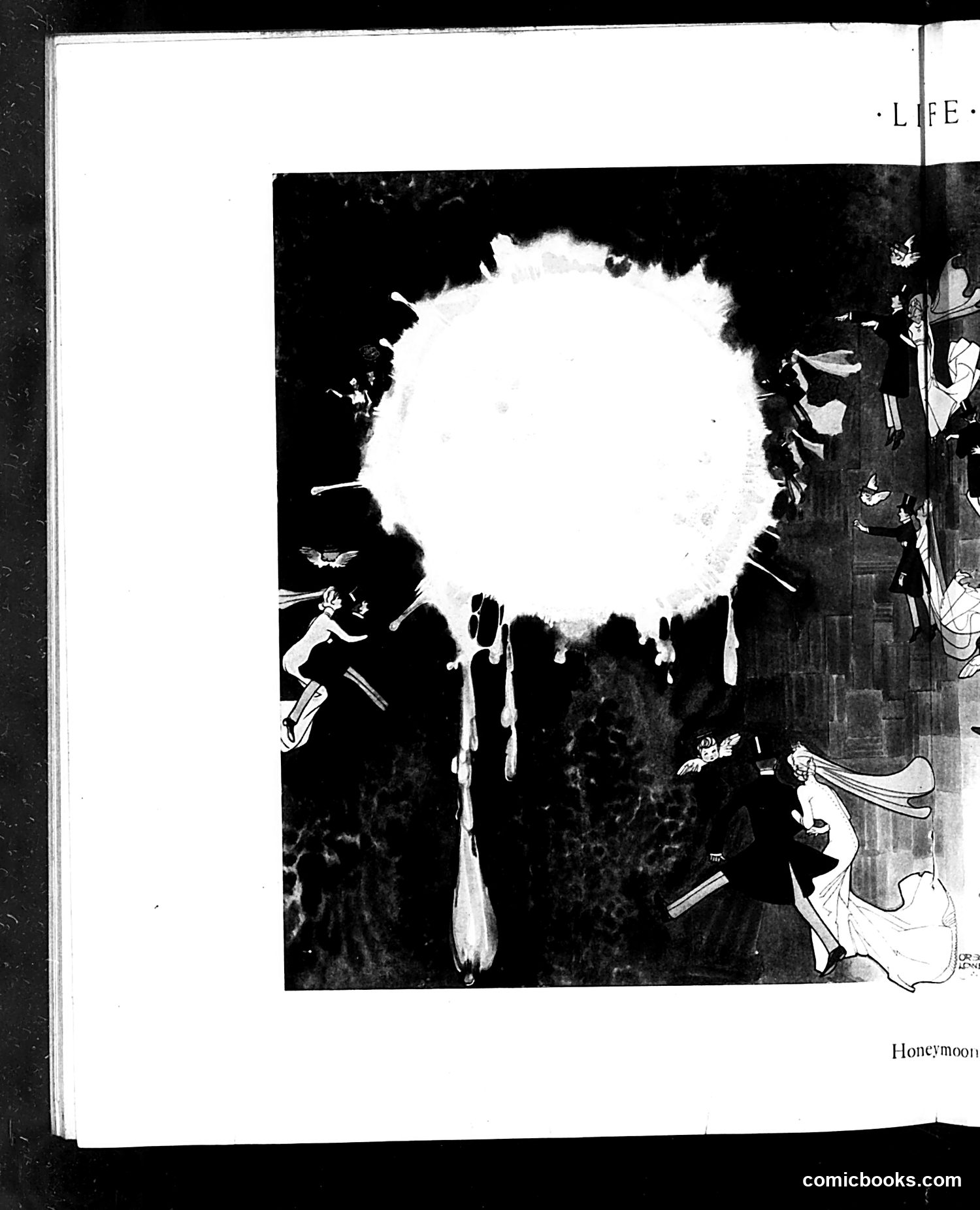
This appears to be a satirical cartoon from *Life* magazine titled "Honeymoon." The image shows a large, bright central figure (possibly representing a newlywed or romantic ideal) surrounded by darker silhouettes of figures in formal dress playing musical instruments—suggesting a celebratory band or orchestra. The satire likely comments on the contrast between the idealized, glowing vision of a honeymoon and the surrounding chaos or noise of reality. The musicians could represent well-wishers, family obligations, or commercial interests intruding upon what should be a private romantic moment. The stark black-and-white contrast emphasizes this tension between romantic fantasy and mundane intrusion. Without additional context about the specific publication date, the exact targets of satire remain unclear.
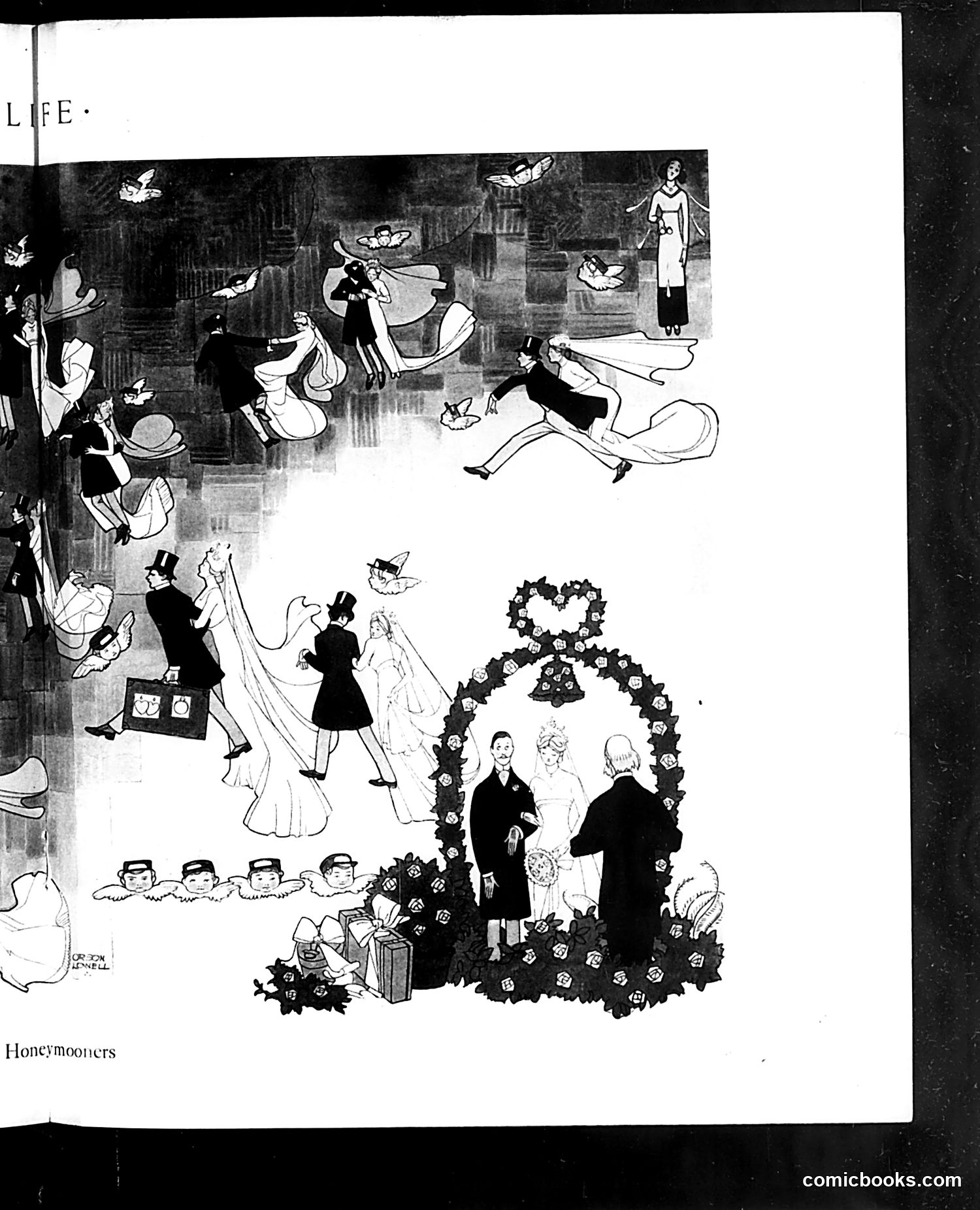
This is a satirical illustration titled "Honeymooners" from Life magazine. The cartoon depicts a wedding scene with a floral arch at the bottom showing a bride, groom, and clergy, surrounded by gift boxes. Above them, the scene becomes increasingly chaotic: angels and cupids fly overhead, guests appear to be floating or flying away, and a man in formal wear is shown mid-leap or fleeing across the upper portion. The satire appears to mock the contrast between the idealized, peaceful wedding ceremony below and the frantic, almost panicked reality of married life depicted above. The fleeing figure and general chaos suggest the joke is about the dramatic shift from romantic courtship to the hectic reality of married life—a common theme in early-to-mid 20th century American humor about matrimony.
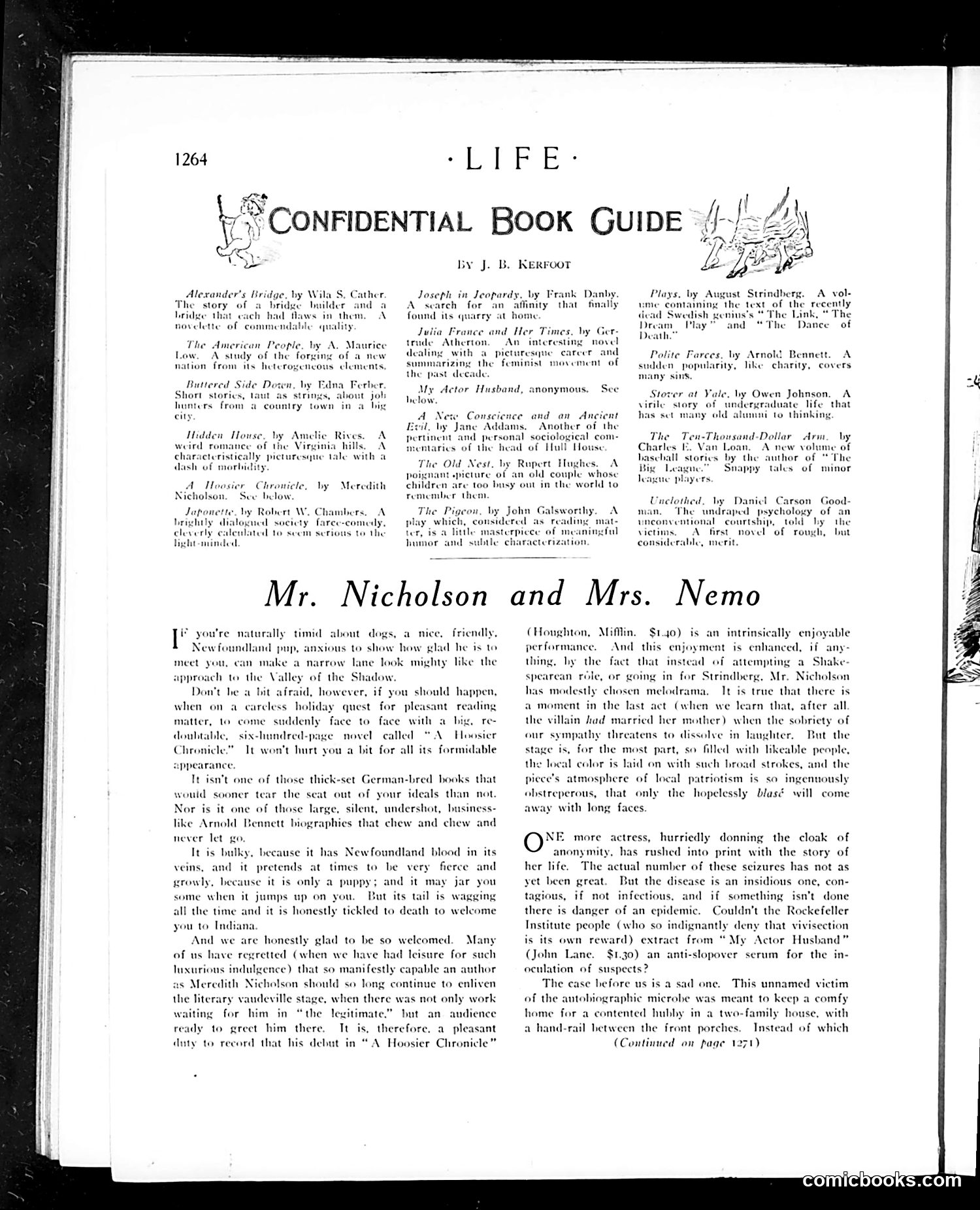
This page is a **book review column**, not a cartoon. The title uses a playful metaphor: "Mr. Nicholson" refers to author Meredith Nicholson, whose novel *A Hoosier Chronicle* is being reviewed; "Mrs. Nemo" (Latin for "Mrs. Nobody") represents the typical reader—described as timid about dogs but willing to encounter Nicholson's "big, redoubtable" six-hundred-page novel. The reviewer compares the book to a friendly Newfoundland puppy: bulky and sometimes fierce-seeming, but ultimately good-natured and eager to please. The satire gently mocks overly intellectual, heavy-handed books (like German novels or Arnold Bennett biographies) while praising Nicholson's approachable style. The piece celebrates Nicholson's shift from writing lightweight vaudeville material to serious literary fiction, presenting this debut novel as a welcome contribution to American literature.
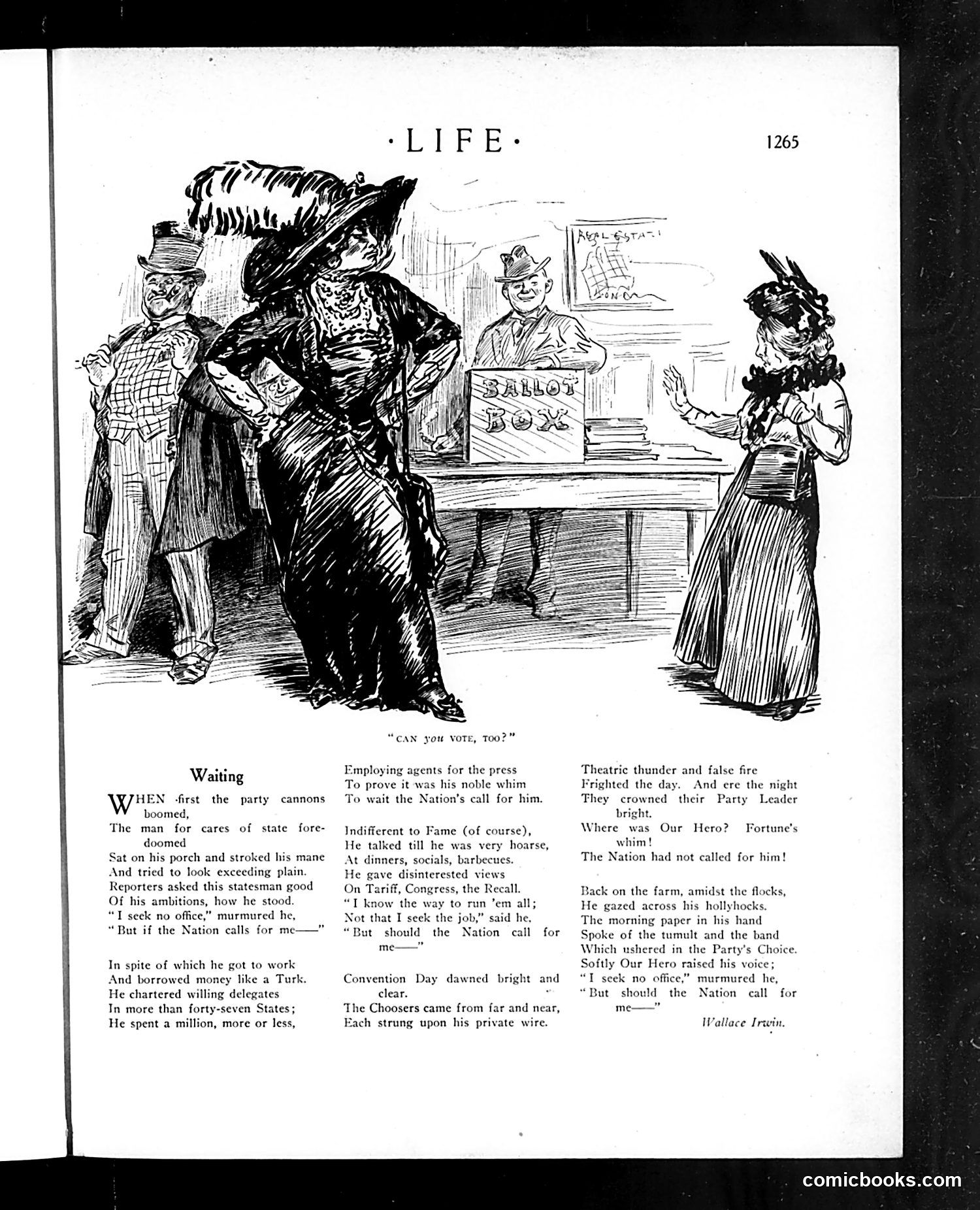
This poem by Wallace Irwin satirizes a common political pretense: the candidate who claims not to seek office while actively campaigning for it. The cartoon depicts a man at a voting booth being asked "Can you vote, too?"—likely mocking women's suffrage debates of the era. The accompanying poem describes a politician who publicly maintains he "seeks no office" and merely waits for "the Nation's call," yet simultaneously spends a million dollars, hires press agents, charters delegates across 47 states, and campaigns relentlessly at dinners and barbecues. The irony peaks at the convention: despite all his efforts, the party nominates someone else. Undeterred, he returns to his farm uttering the same refrain. Irwin skewers the hypocrisy of candidates performing false modesty while engaging in aggressive self-promotion—a timeless political behavior. The humor targets both the candidate's transparent duplicity and voters' willingness to accept such obvious pretense.
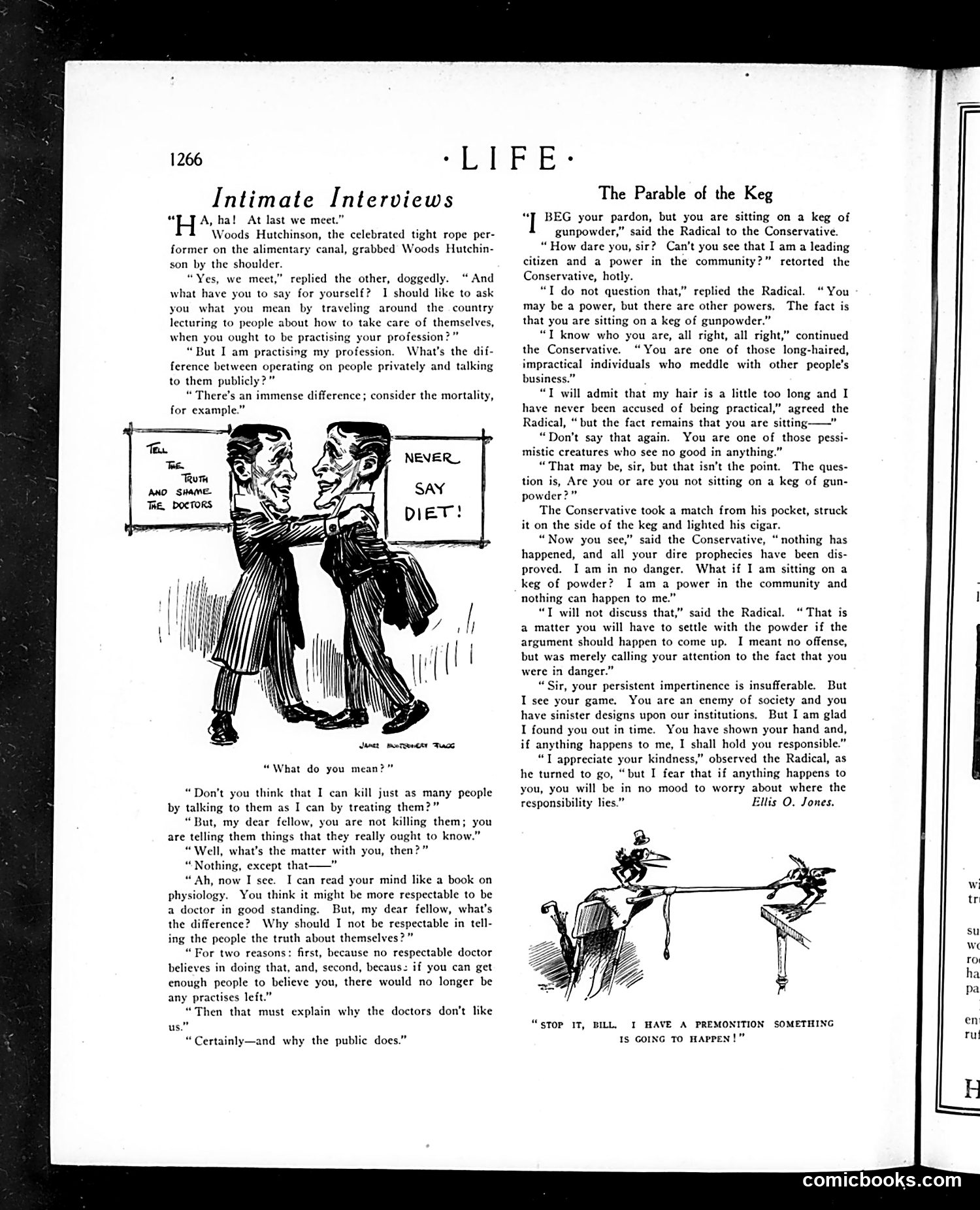
**"Intimate Interviews"** mocks the medical establishment's hostility toward public health education. Woods Hutchinson, a real doctor and health advocate, is criticized by a traditional physician for lecturing people on self-care rather than treating them privately. The satire exposes doctors' financial self-interest: they oppose public education because informed, healthy citizens means fewer paying patients. The punchline—"the public does" like him while doctors don't—suggests the public benefits from truth-telling while the medical profession profits from ignorance. **"The Parable of the Keg"** is political allegory. A Conservative (representing the establishment) sits literally atop a "keg of gunpowder" (social unrest/revolution) while a long-haired Radical warns him of danger. The Conservative dismisses warnings, confident his wealth and status protect him. When he strikes a match on the powder to light a cigar, he proves nothing can harm him—until it can. The satire warns that complacent, powerful elites ignore revolutionary danger at their peril, while radicals correctly perceive imminent upheaval.
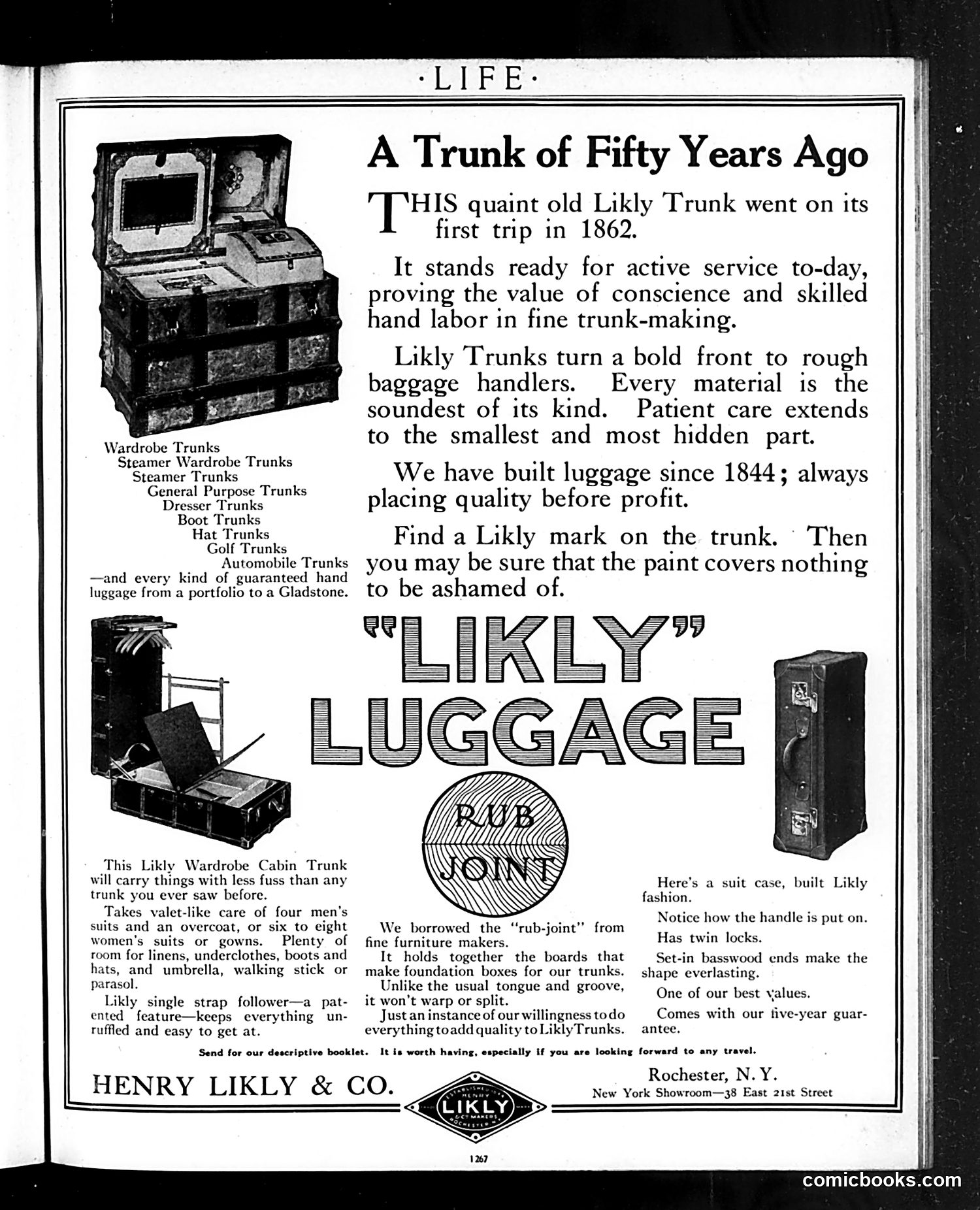
This is primarily **advertising, not satire or political commentary**. It's a full-page advertisement for Henry Likly & Co., a trunk and luggage manufacturer based in Rochester, New York. The page showcases the company's products—wardrobe trunks, steamer trunks, suit cases—with emphasis on craftsmanship and durability. The central narrative hook is a 50-year-old trunk from 1862 still in working condition, used to demonstrate the company's quality and longevity ("always placing quality before profit"). The only quasi-humorous element is the mild self-congratulation about competing against "rough baggage handlers" and the folksy tone ("Find a Likly mark on the trunk. Then you may be sure that the paint covers nothing to be ashamed of"). This reflects early-20th-century *Life* magazine's business model: *Life* was fundamentally a humor and satire publication that supported itself through advertising. This trunk advertisement simply occupies editorial space, with no political or social satire intended.
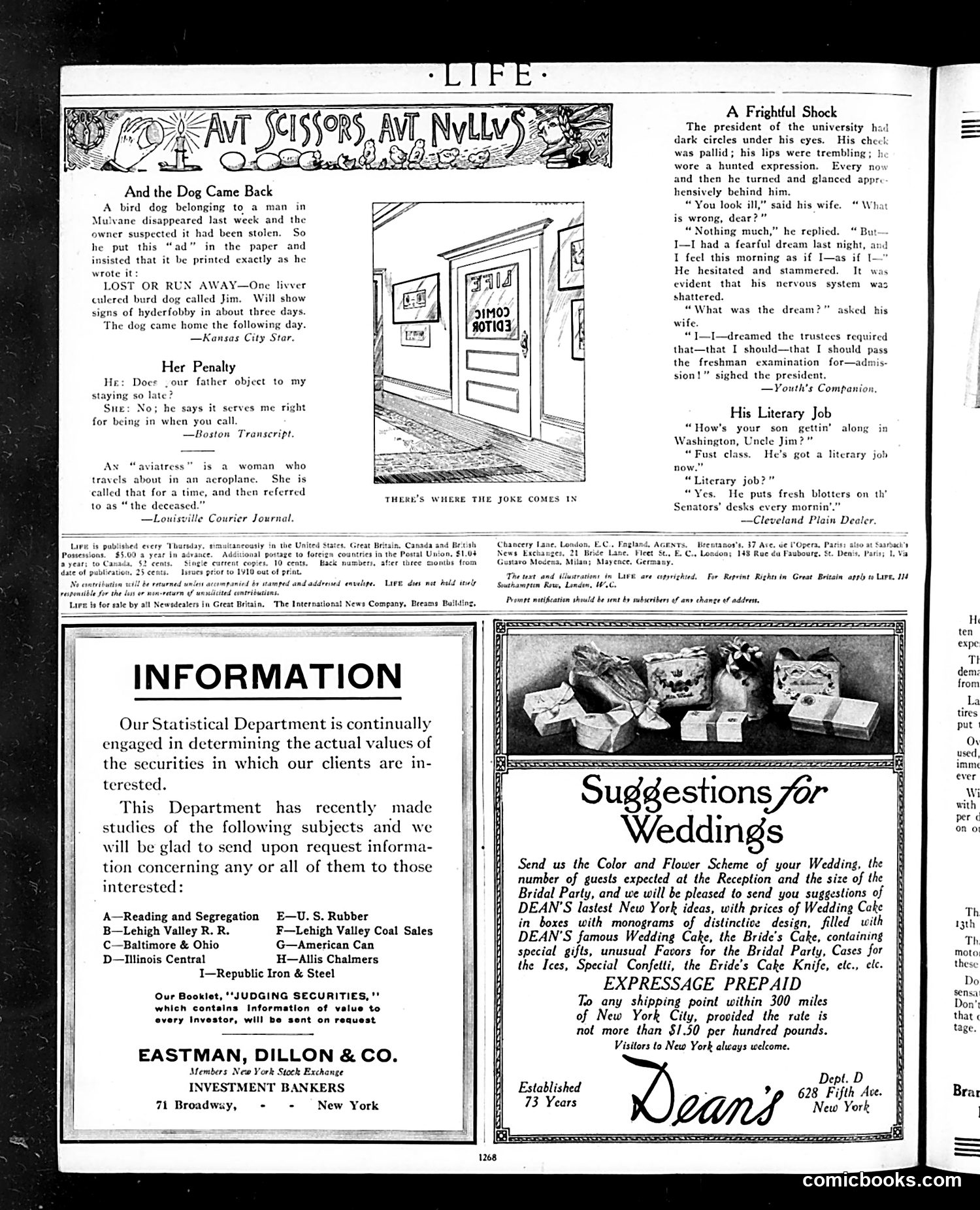
This page contains several brief humorous anecdotes typical of *Life* magazine's satirical format, plus advertising. **The cartoons/jokes:** 1. **"And the Dog Came Back"** — A man places a deliberately misspelled classified ad ("livver calered burd") for his lost dog, apparently believing the ad must match his own poor spelling/grammar. The joke: the dog returns anyway, making his linguistic "authenticity" pointless. 2. **"Her Penalty"** — A dating joke: the girl's father doesn't object to the boyfriend staying late because it punishes *her* for being home to receive him. 3. **"An 'Aviatress'"** — Wordplay: women pilots are called "aviatress" temporarily, then darkly referred to as "the deceased" (implying aviation was dangerous). 4. **"A Frightful Shock"** — A university president is traumatized by dreaming he must pass freshman examinations himself—satirizing academic pretension and standards. 5. **"His Literary Job"** — A senator's son has a "literary job" putting fresh blotters on senators' desks—mocking both political nepotism and senators' intelligence. The page is mostly advertisements for investment banking and wedding services.
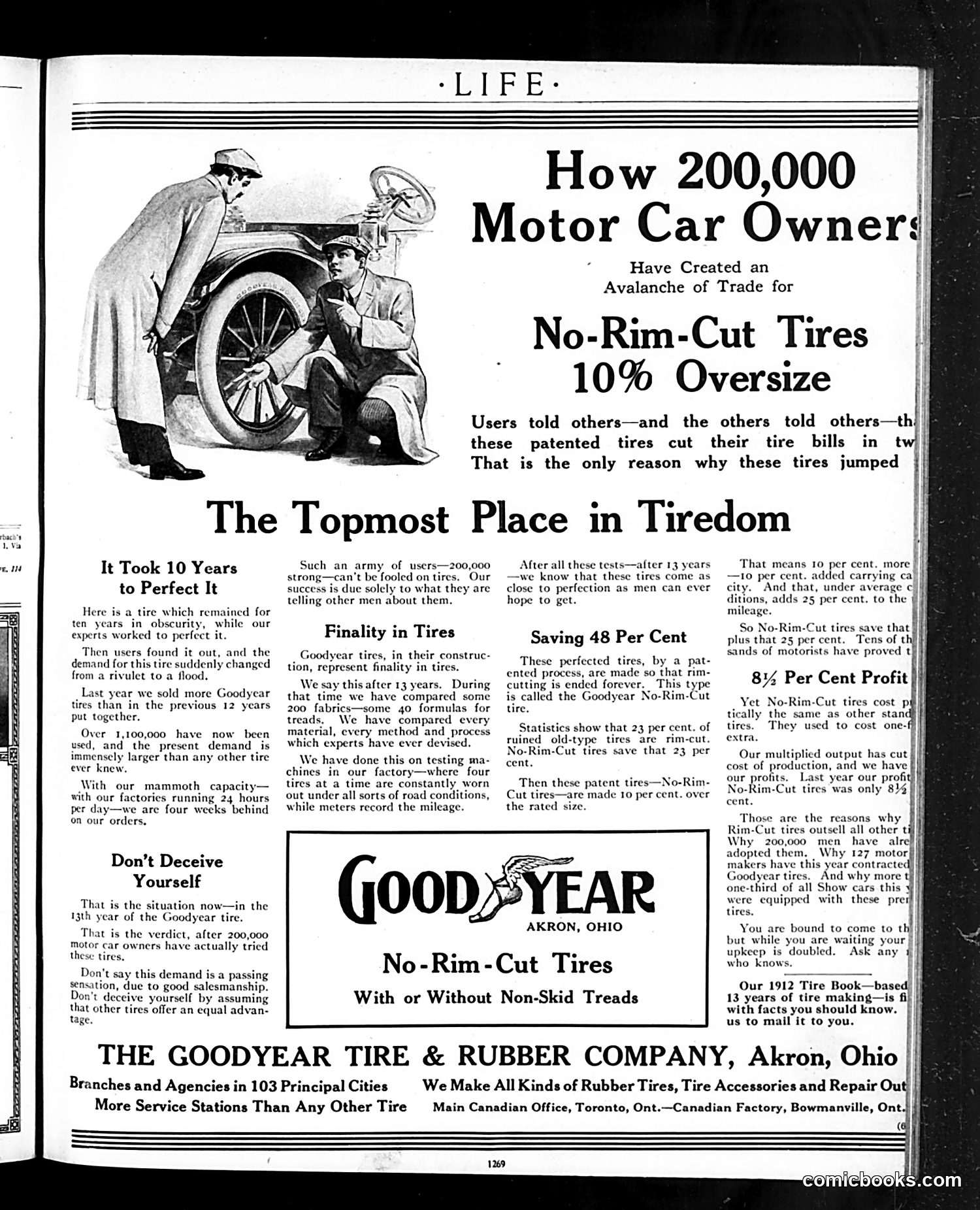
This is primarily a **Goodyear tire advertisement**, not satirical content. The page shows two men examining a car tire—likely a mechanic and customer—illustrating the product's appeal to everyday motorists. The "satire" is actually marketing rhetoric: Goodyear claims their "No-Rim-Cut Tires" (10% oversized) represent "finality in tires" after 13 years of perfecting. The company argues 200,000 users prove superiority through word-of-mouth, not salesmanship. Key sales claims: these tires prevent rim-cutting (allegedly affecting 23% of standard tires), last 25% longer, cost the same as competitors, yet generate only 8½% profit—implying Goodyear prioritizes quality over greed. For modern readers: this reflects early 1910s automotive culture when tire quality was genuinely variable and a significant purchasing concern. The advertisement's emphasis on testing, user testimonials, and cost-benefit analysis was persuasive marketing for that era, targeting the rapidly growing middle-class car-owner market.
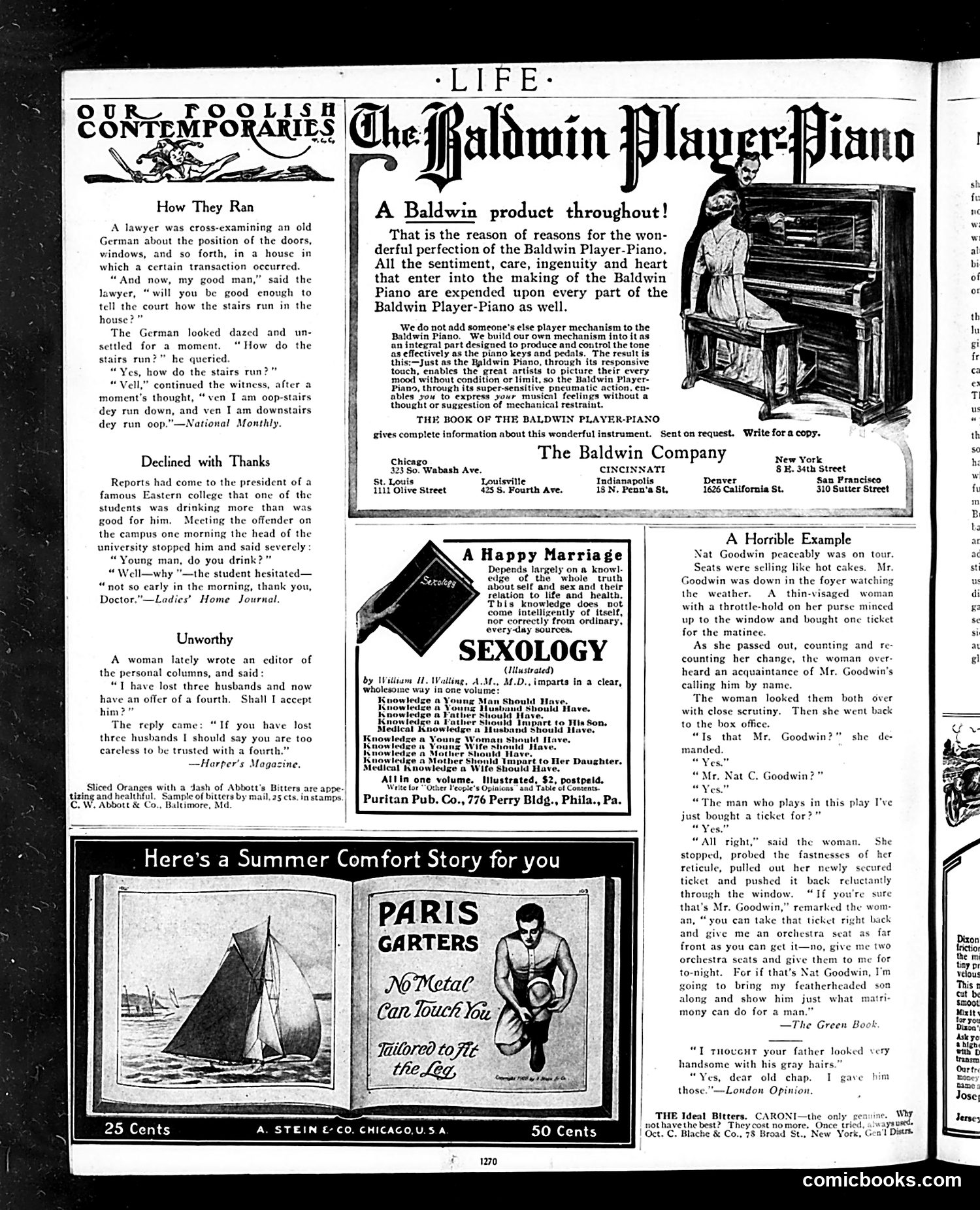
This page is primarily **advertisements and humor columns**, not political satire. The main content includes: **Advertisements:** Baldwin Player-Piano (emphasizing superior craftsmanship), a Sexology book promising marital advice, and Paris Garters for men. **Humor Columns:** Four brief jokes under "Our Foolish Contemporaries": - A German witness's confusion about how stairs "run" - A college president asking a student about drinking - A woman who's lost three husbands seeking a fourth - A final anecdote about actor Nat Goodwin and a cheap ticket-buyer **"A Horrible Example"** (right column) is a brief comedic story about a woman who buys one matinee ticket, then demands Goodwin exchange it for better orchestra seats—illustrating entitlement or cheap behavior. These are light satirical observations about human nature and social awkwardness, typical of Life's humor format. No specific political figures or events are referenced.
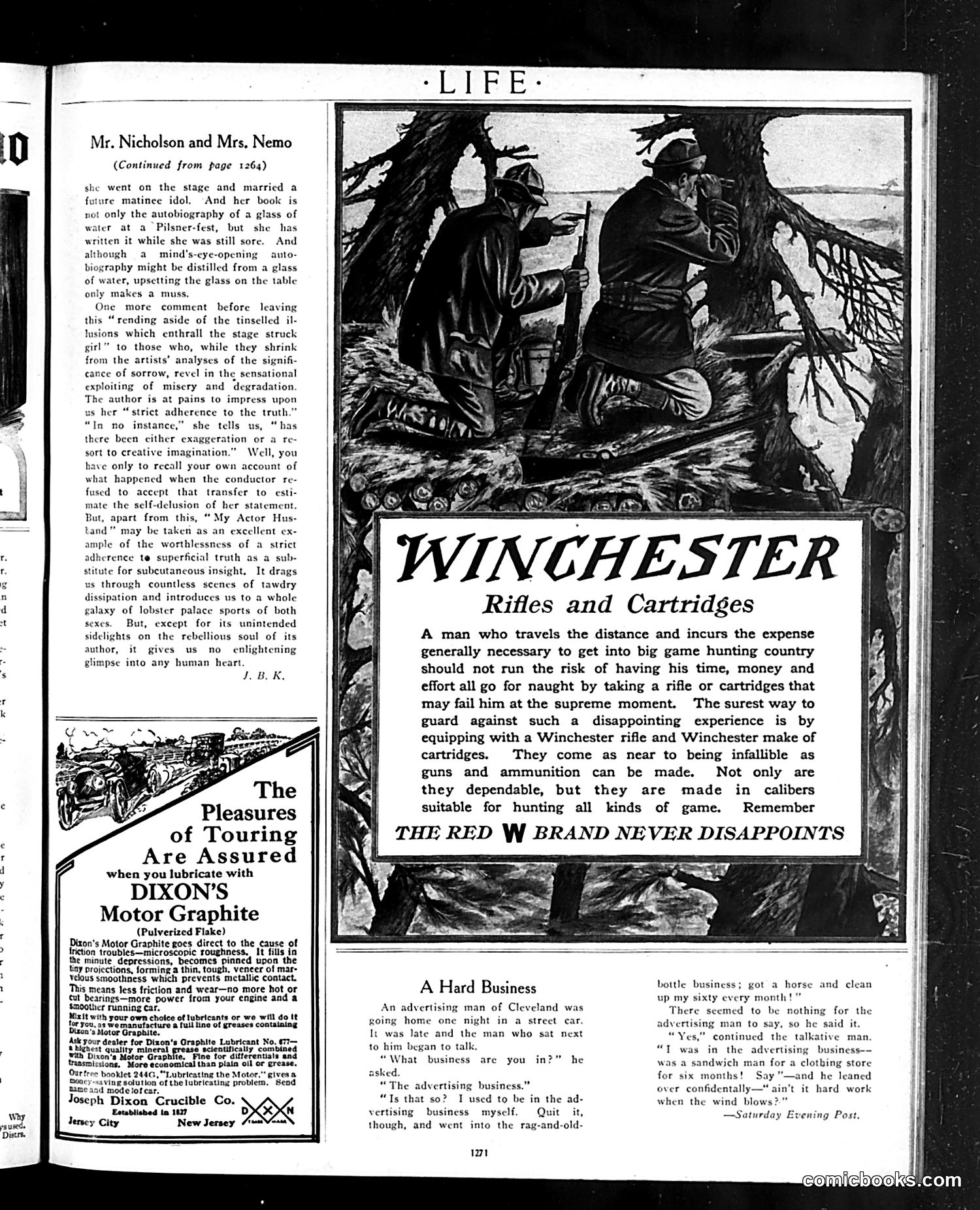
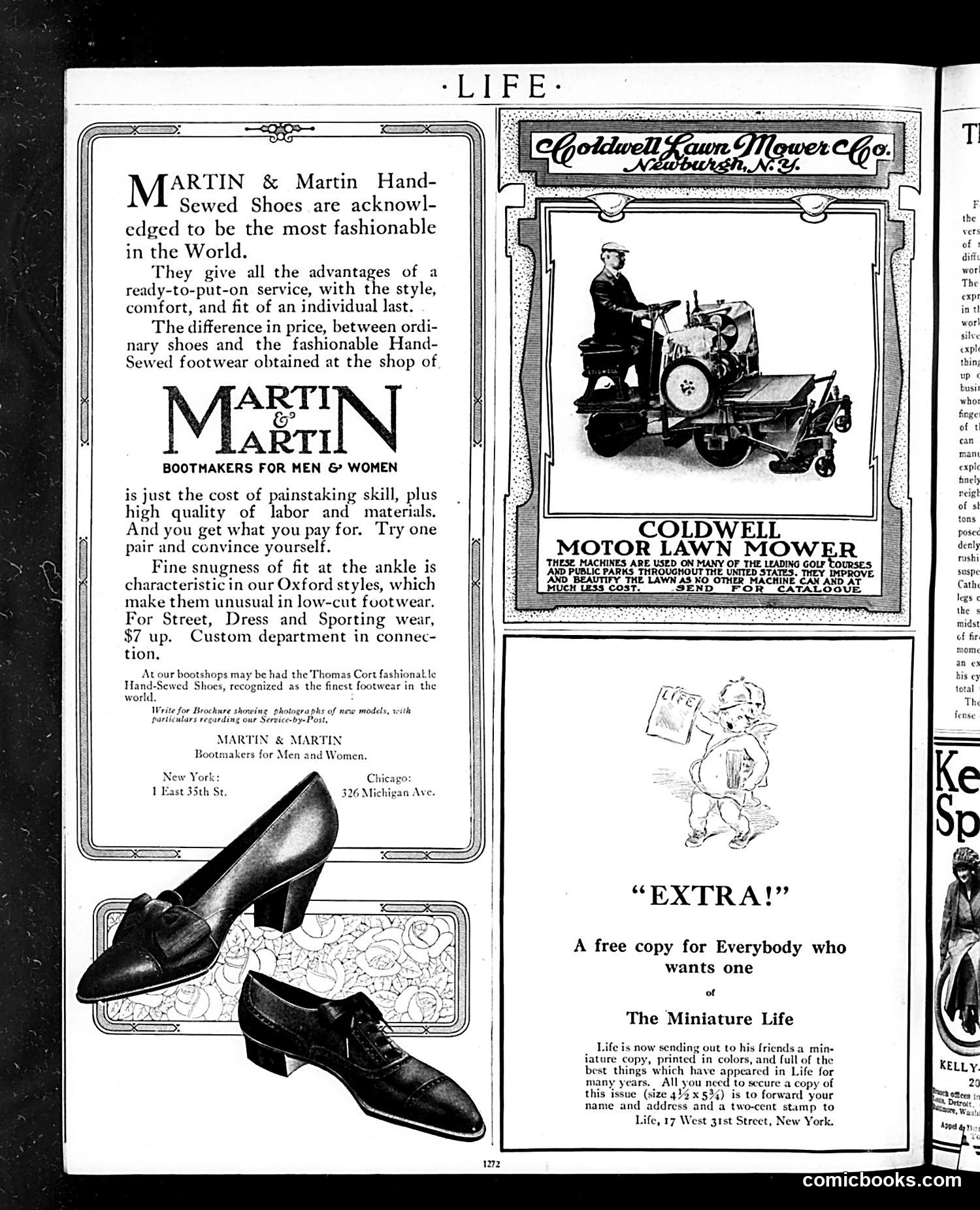
This is primarily a **commercial advertising page** rather than political satire. It contains three distinct ads: 1. **Martin & Martin Shoes** (left): Premium hand-sewn footwear marketed as the world's most fashionable, priced at $7 and up. The ad emphasizes craftsmanship and custom fit as justifying the higher cost. 2. **Coldwell Motor Lawn Mower** (upper right): Features an illustration of a motorized lawn mower in operation, marketed to golf courses and public estates as superior to competing machines. 3. **Miniature Life Magazine** (lower right): An advertisement offering a free miniature colored version of Life magazine to readers who send their name, address, and two cents to the publication's offices at 17 West 31st Street, New York. The page reflects **early 20th-century consumer culture**, emphasizing quality products, mechanization, and modern convenience. There is **no apparent satire or political commentary**—this is straightforward commercial promotion typical of Life's advertising content from this period.
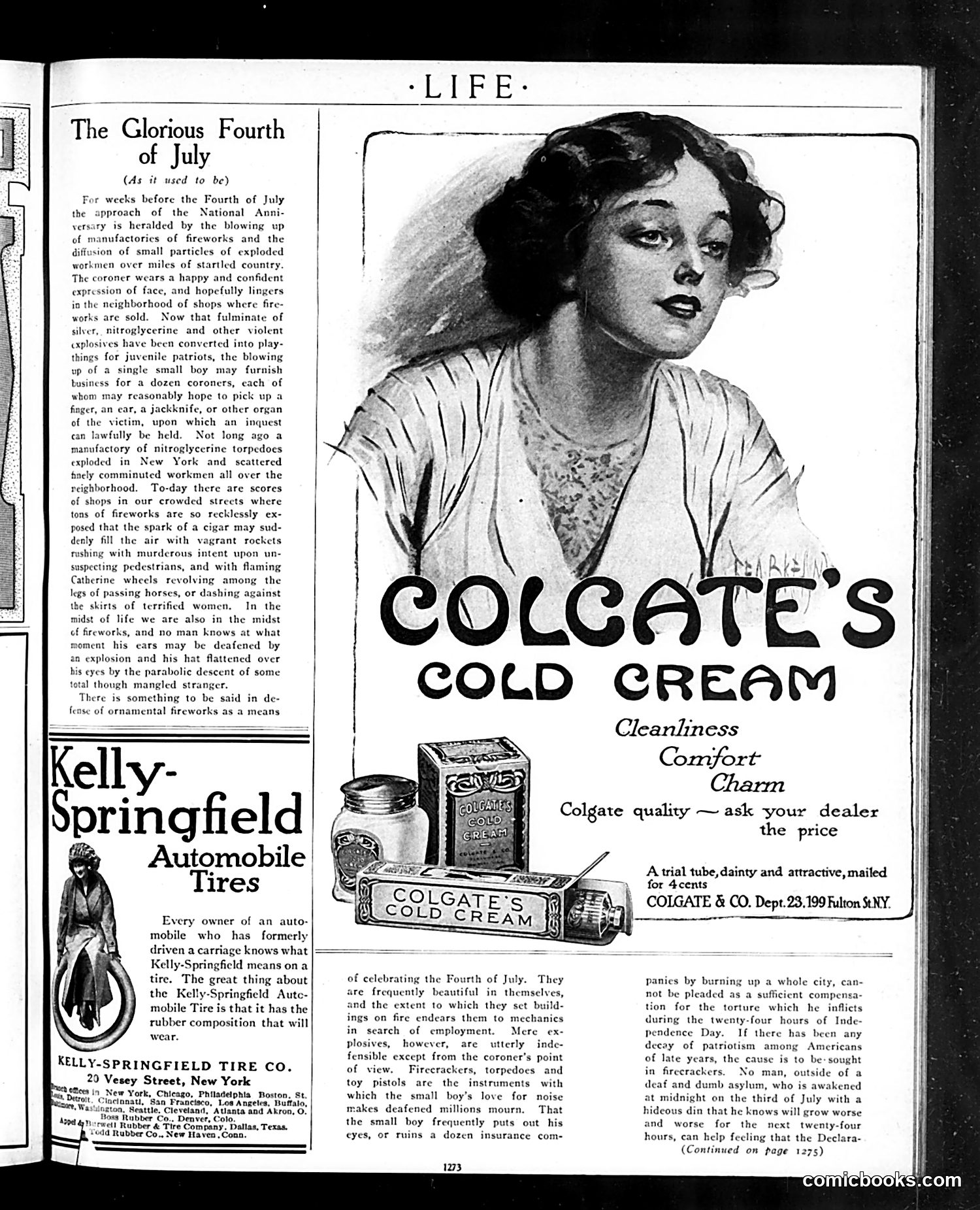
This is a satirical article—not a cartoon—criticizing the dangerous practices surrounding Independence Day celebrations. Life magazine mocks the reckless use of fireworks in crowded American cities, treating the holiday's carnage with darkly comic exaggeration. The piece highlights genuine hazards: fireworks factories exploding, workers killed, firecrackers maiming children (costing them eyes, fingers, ears), and Catherine wheels endangering horses and women. Life sardonically celebrates the coroner's busy schedule and notes that explosives originally meant for military use are sold openly near pedestrians. The satire's target is adult complacency—the article argues that while fireworks display *is* beautiful, this cannot justify the predictable mutilation and death inflicted on citizens, particularly children. The final point is caustic: even deaf-and-dumb asylum residents cannot escape the three-day "hideous din" preceding July Fourth. This reflects genuine Progressive Era concerns about industrial safety and child welfare, deployed here through exaggerated mock-celebration of preventable tragedy.
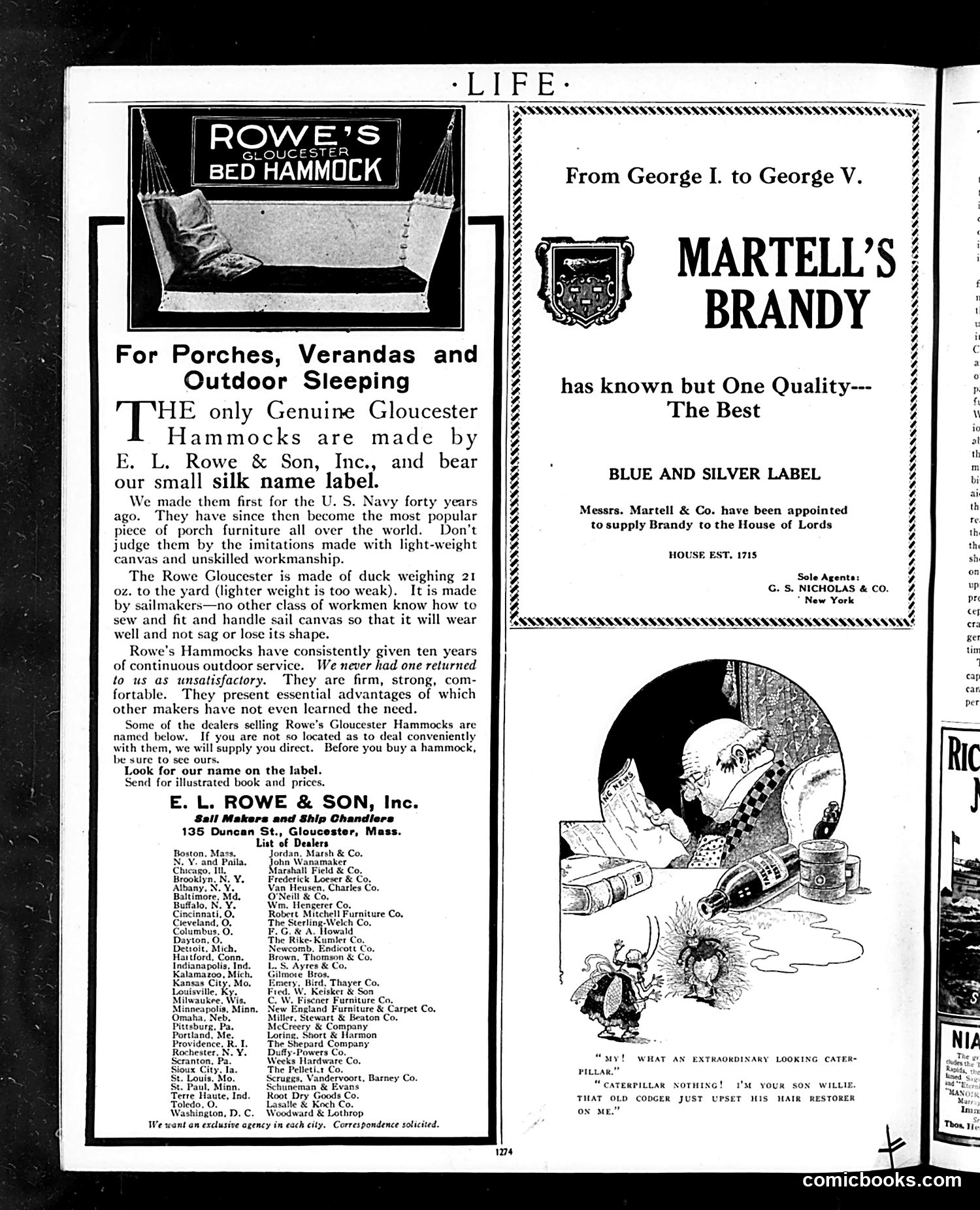
This page consists primarily of **product advertisements** rather than political satire or editorial cartoons. **Left side:** E. L. Rowe & Son advertises Gloucester hammocks, emphasizing their quality construction for outdoor use. The ad claims ten years of durability and lists authorized dealers nationwide. **Right side:** Martell's Brandy advertisement notes the product has "known but One Quality—The Best" and mentions appointment as supplier to the House of Lords, establishing prestige through royal association. **Small cartoon (bottom right):** A brief humorous exchange between two figures—a child identifies what appears to be a caterpillar as "extraordinary looking," while another character (Willie) claims it's actually his son's hair restorer that "upset his hair." This is mild domestic humor playing on vanity and grooming products. The page demonstrates early 20th-century advertising conventions using product endorsements, merchant lists, and light comedy to promote consumer goods.
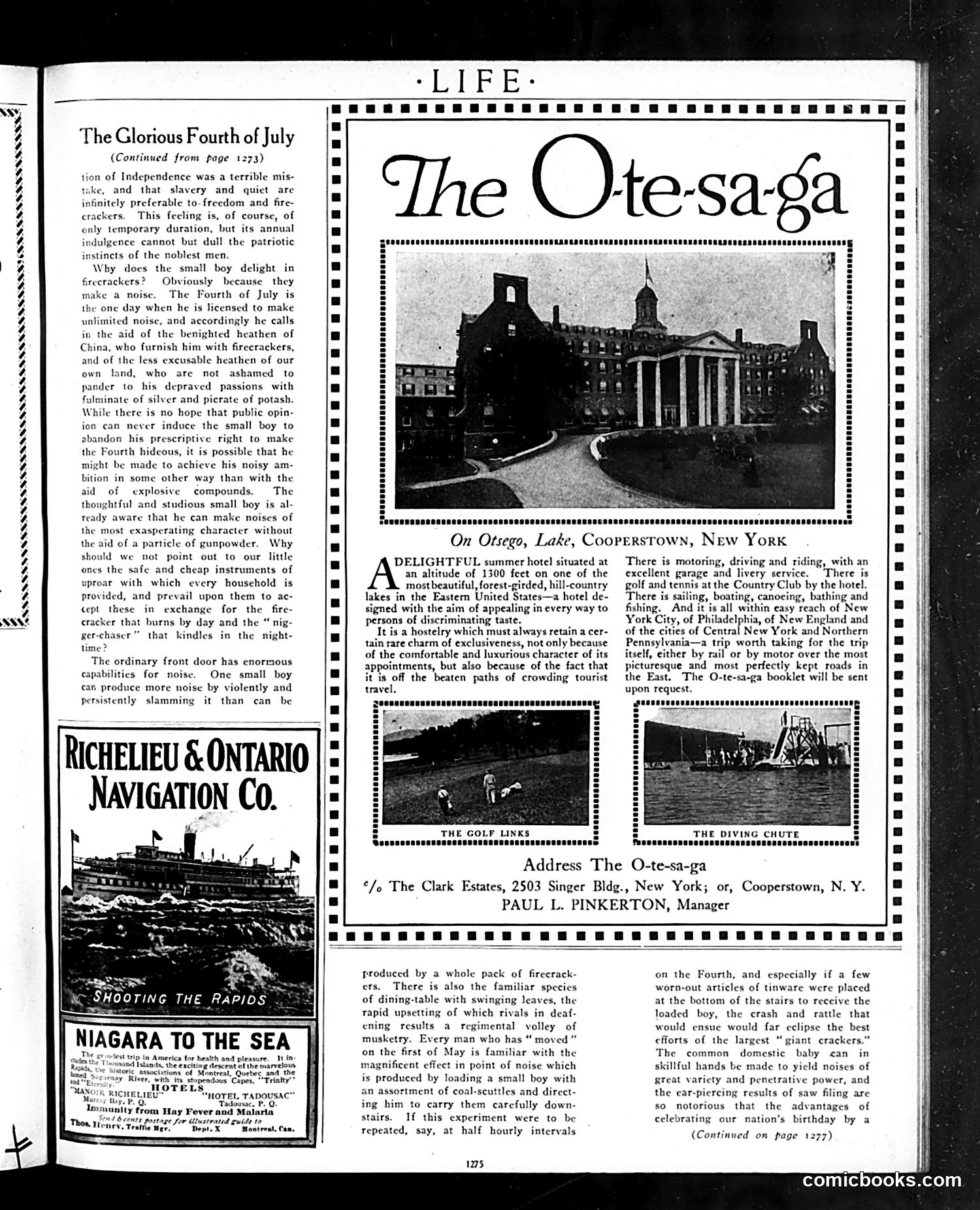
This page contains **no political cartoon**. It consists primarily of two advertisements: 1. **"The Glorious Fourth of July"** (left): A satirical essay criticizing children's use of firecrackers on Independence Day. The author argues that while patriotic noise-making is traditional, it damages public peace. He suggests parents redirect children's energy toward making noise through household items—slamming doors, rattling dishes—instead of explosives. The piece mocks firecracker use while offering practical (if tongue-in-cheek) alternatives. 2. **"The O-te-sa-ga"** (right): A full-page hotel advertisement for a luxury summer resort in Cooperstown, New York, featuring photographs of the building, golf links, and diving facilities. It emphasizes exclusivity, comfort, and recreational activities. The page is primarily **commercial advertising** with satirical editorial content. No identifiable caricatures or political figures appear.
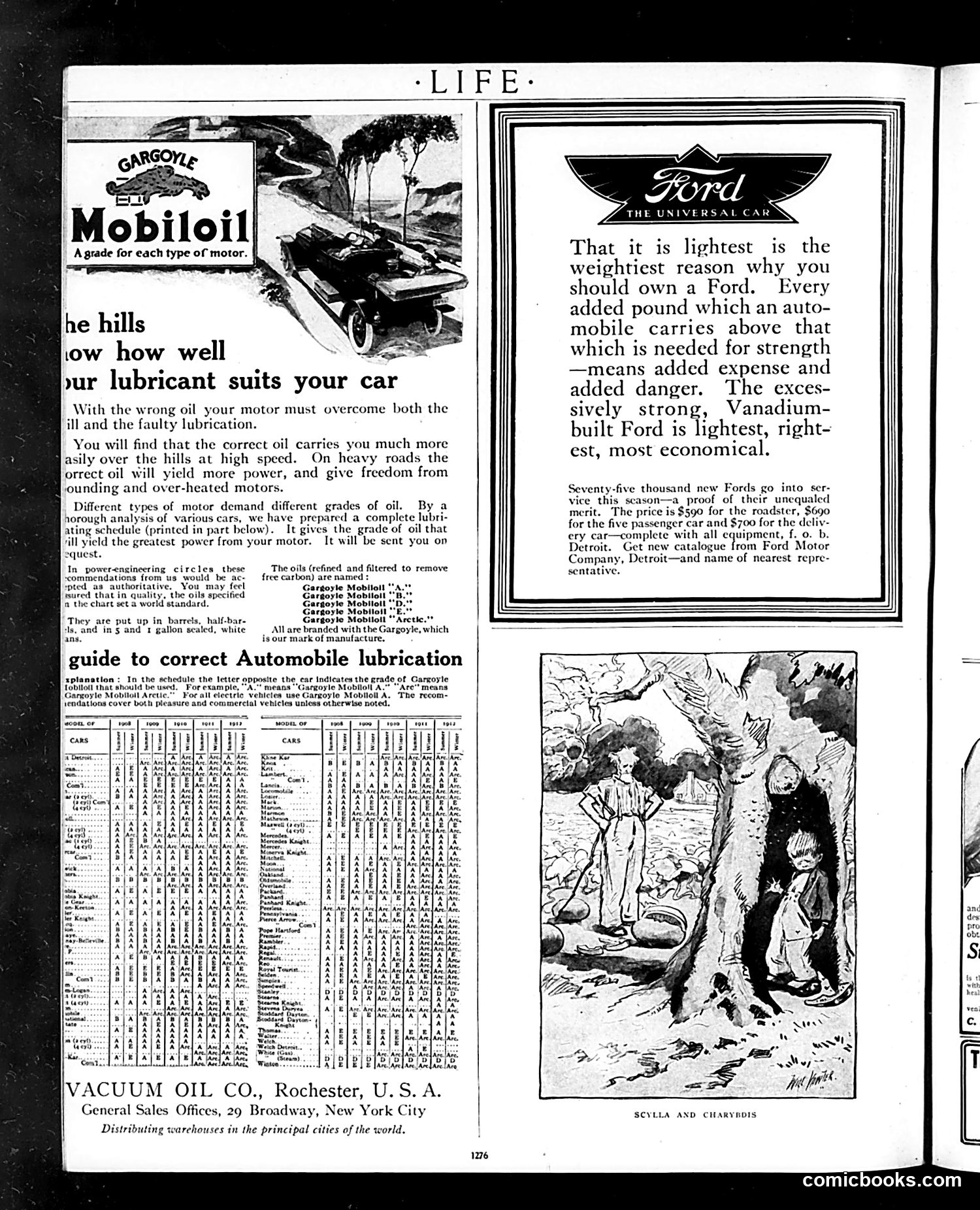
This page is primarily **advertising**, not satire or political commentary. The left side promotes **Mobiloil lubricants** by Vacuum Oil Co., featuring a practical guide matching car models to correct oil grades. The copy emphasizes that proper lubrication improves performance and power on hills and heavy roads. The right side advertises the **Ford Model T**, emphasizing its lightweight construction as an economic advantage—less weight means lower fuel costs and reduced danger. Ford lists contemporary prices ($590-$700) and promises availability through dealers nationwide. The illustration labeled "Scylla and Charybdis" (classical mythology references) appears decorative rather than satirical—likely evoking danger or navigation challenges, possibly suggesting that choosing correct lubricants helps drivers navigate automotive challenges. The page reflects early automotive manufacturing competition and the emerging consumer market for both vehicles and maintenance products. No political figures or specific satire are evident.
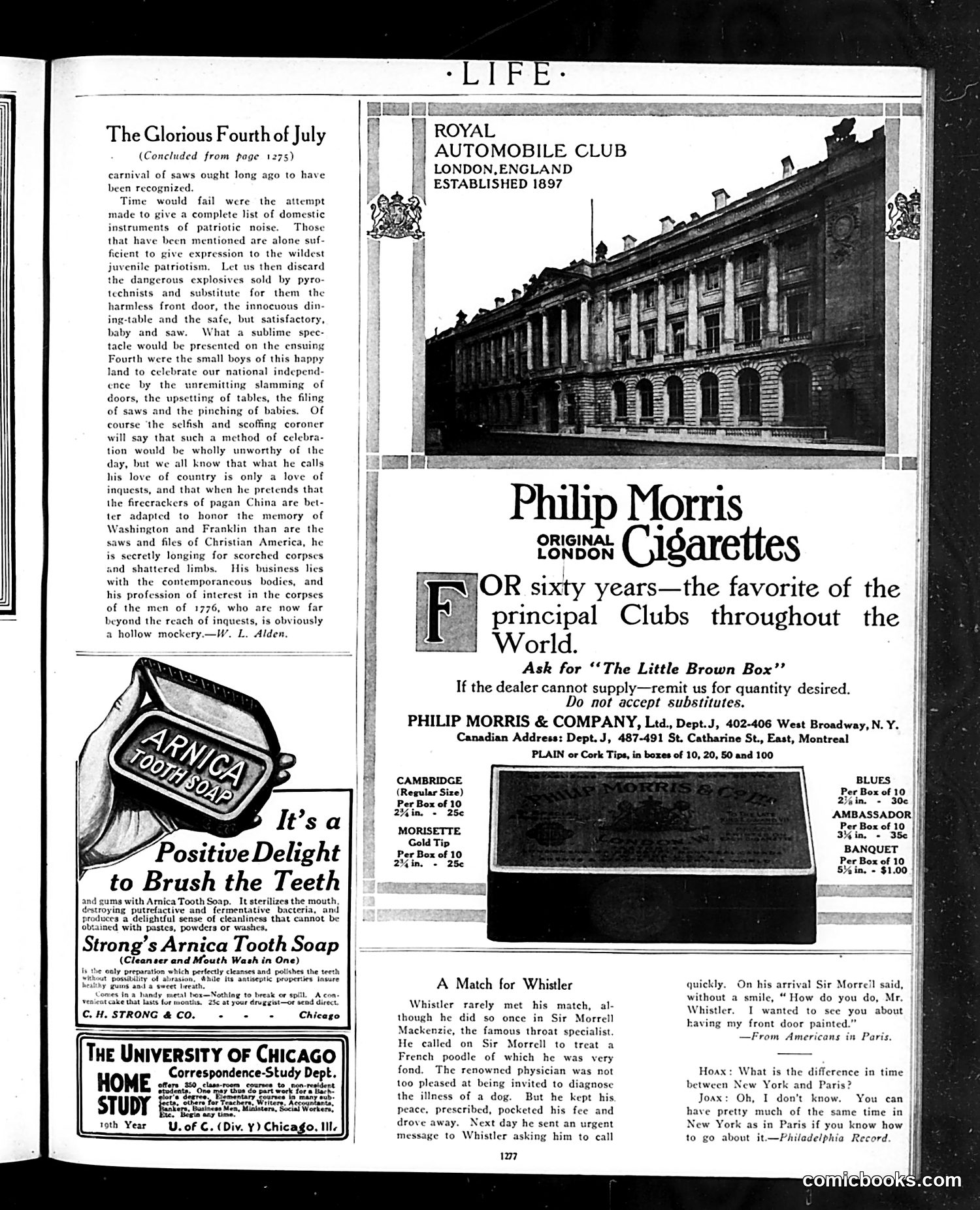
This page is primarily **advertising**, not political satire. The main content consists of commercial advertisements for Philip Morris cigarettes, Strong's Arnica Tooth Soap, and correspondence courses. The upper left contains an essay titled "The Glorious Fourth of July" (continued from a previous page), which satirizes overly patriotic Fourth of July celebrations. The author, W. L. Alden, humorously suggests replacing dangerous firecrackers with harmless household items—slamming doors, upsetting tables, and pinching babies—to celebrate American independence. He mocks coroners who object to this "method of celebration" as hypocritical, implying they profit from firecracker injuries. The bottom section includes a brief anecdote about painter James McNeill Whistler outwitting a physician (Sir Morrell Mackenzie), and a Paris/New York time-zone joke. The page reflects early 20th-century consumer culture and gentle domestic satire rather than serious political commentary.
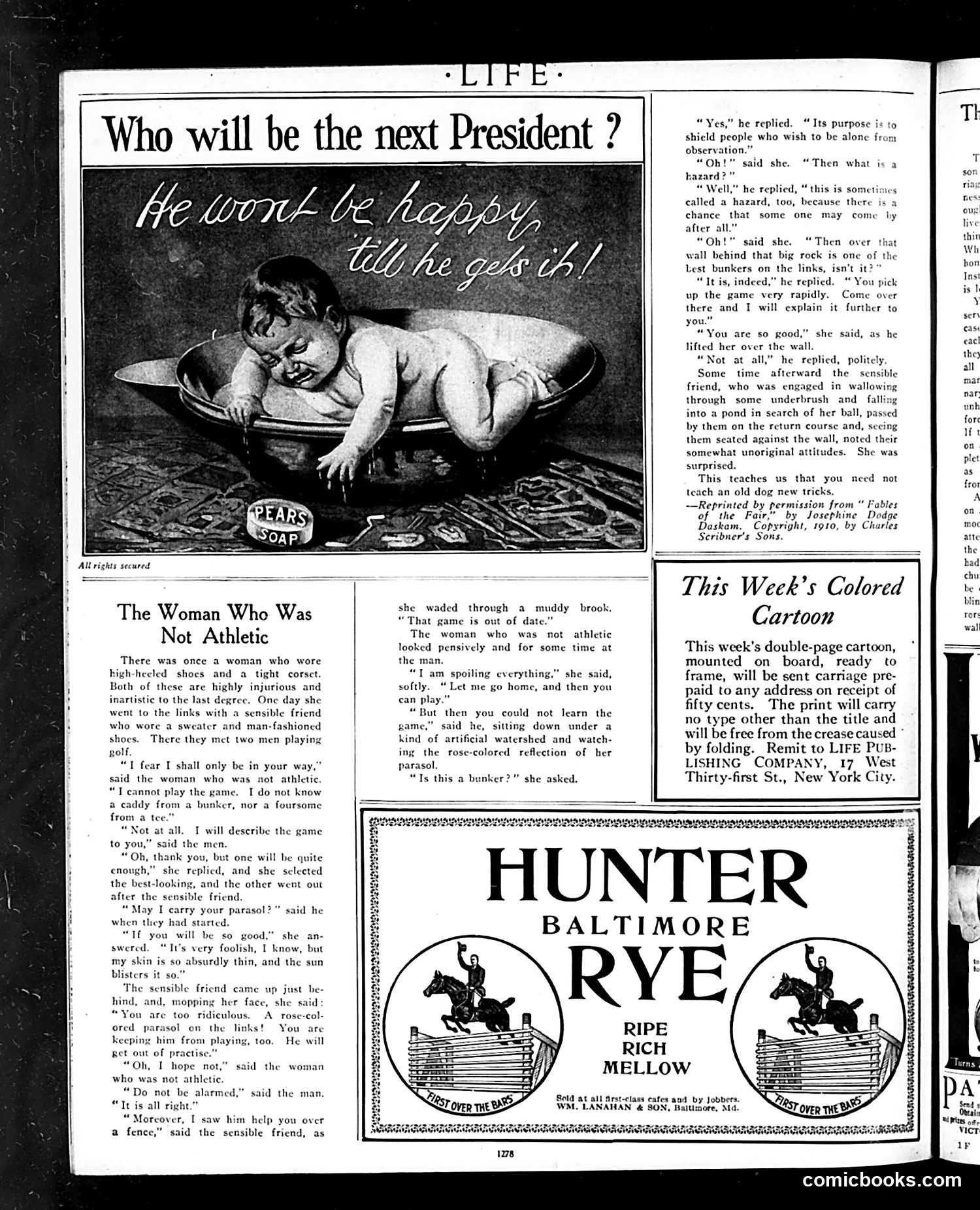
This Life magazine page contains two elements: **"The Woman Who Was Not Athletic"** (main story): A satirical fable mocking rigid gender roles of the early 1900s. It contrasts two women: one in fashionable but impractical clothing (corset, heels, parasol) who attracts male attention through helplessness, and a "sensible friend" in practical sportswear who actually plays golf. The joke is that the fashionable woman deliberately maintains incompetence to secure romantic attention—and succeeds. The moral stated at the end ("you need not teach an old dog new tricks") suggests this performative helplessness is an age-old female strategy, not genuine inability. **The header question** "Who will be the next President?" with a Pears Soap advertisement showing a baby appears unrelated—typical of Life's satirical juxtaposition style, possibly mocking political uncertainty through absurdist humor. The page also advertises Hunter Baltimore Rye whiskey and offers a colored cartoon for purchase.
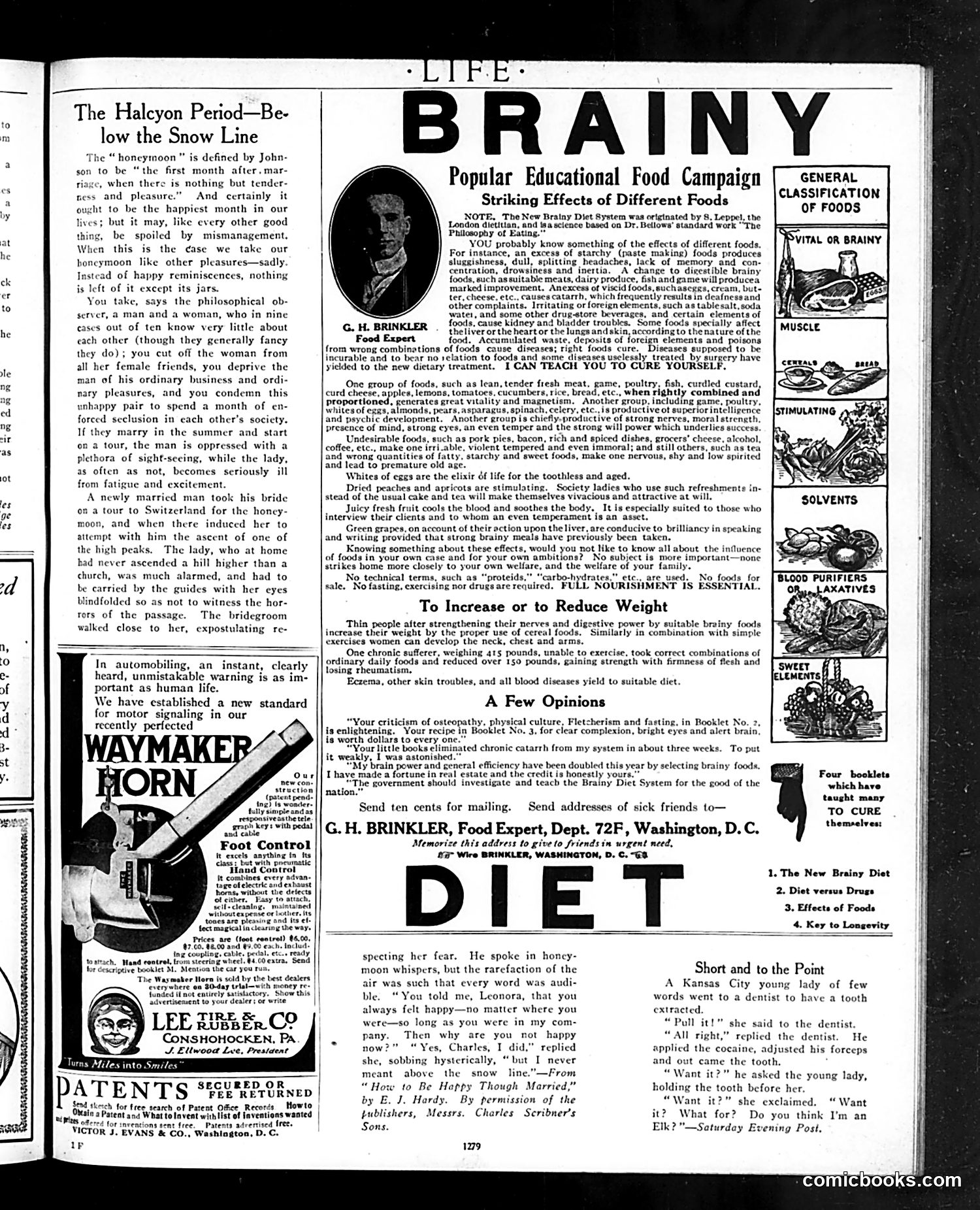
This page is primarily **educational advertising** promoting "The New Brainy Diet System" by C.H. Brinkler, a food expert. Rather than satire, it presents pseudo-scientific nutritional claims popular in early 20th-century dietary reform movements. The central claim: different foods produce different mental and physical effects. "Brainy foods" (lean meats, fish, eggs) allegedly generate intelligence and moral strength, while "undesirable foods" (pork, bacon, alcohol, coffee) cause irritability and immorality. The accompanying illustrations classify foods by supposed effects: muscle-building, stimulating, solvents, blood purifiers, and "sweet elements." The surrounding article "The Halcyon Period" discusses honeymoon expectations—standard period humor about newlywed couples discovering incompatibility. **Historical context**: This reflects early-1900s food faddism and dietary determinism—the belief that nutrition could cure disease and shape character. The "scientific" classification system would appear absurd to modern readers familiar with actual nutritional science.
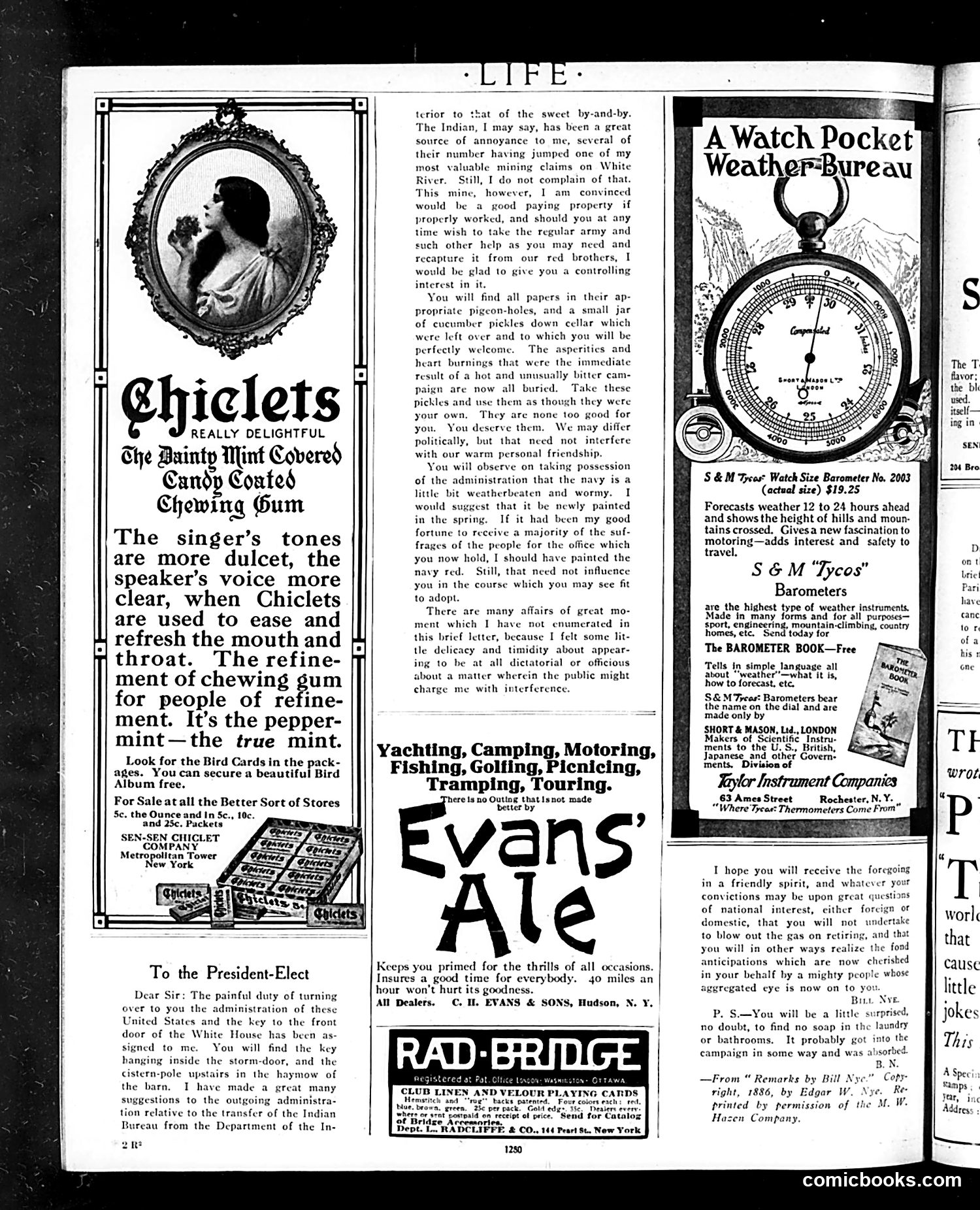
This page is primarily **advertising and humor**, not political cartooning. The main content is a satirical letter "To the President-Elect" — appearing to address the incoming administration (likely 1909, given the reference to transferring Indian Bureau matters). The letter humorously presents a pretend "handover" from the outgoing president, mixing trivial domestic details (cucumber pickles in the cellar, a key in the haymow) with actual policy concerns (the navy's condition, Indian affairs). The satire mocks both bureaucratic formality and the outgoing administration's attempt at gracious transition by treating serious matters with absurd casualness. The page otherwise features period advertisements for Chiclets gum, Evans' Ale, Rad-Bridge playing cards, and a S&M Tycos barometer — typical of *Life* magazine's revenue model. No specific political figures are identified in visible text.
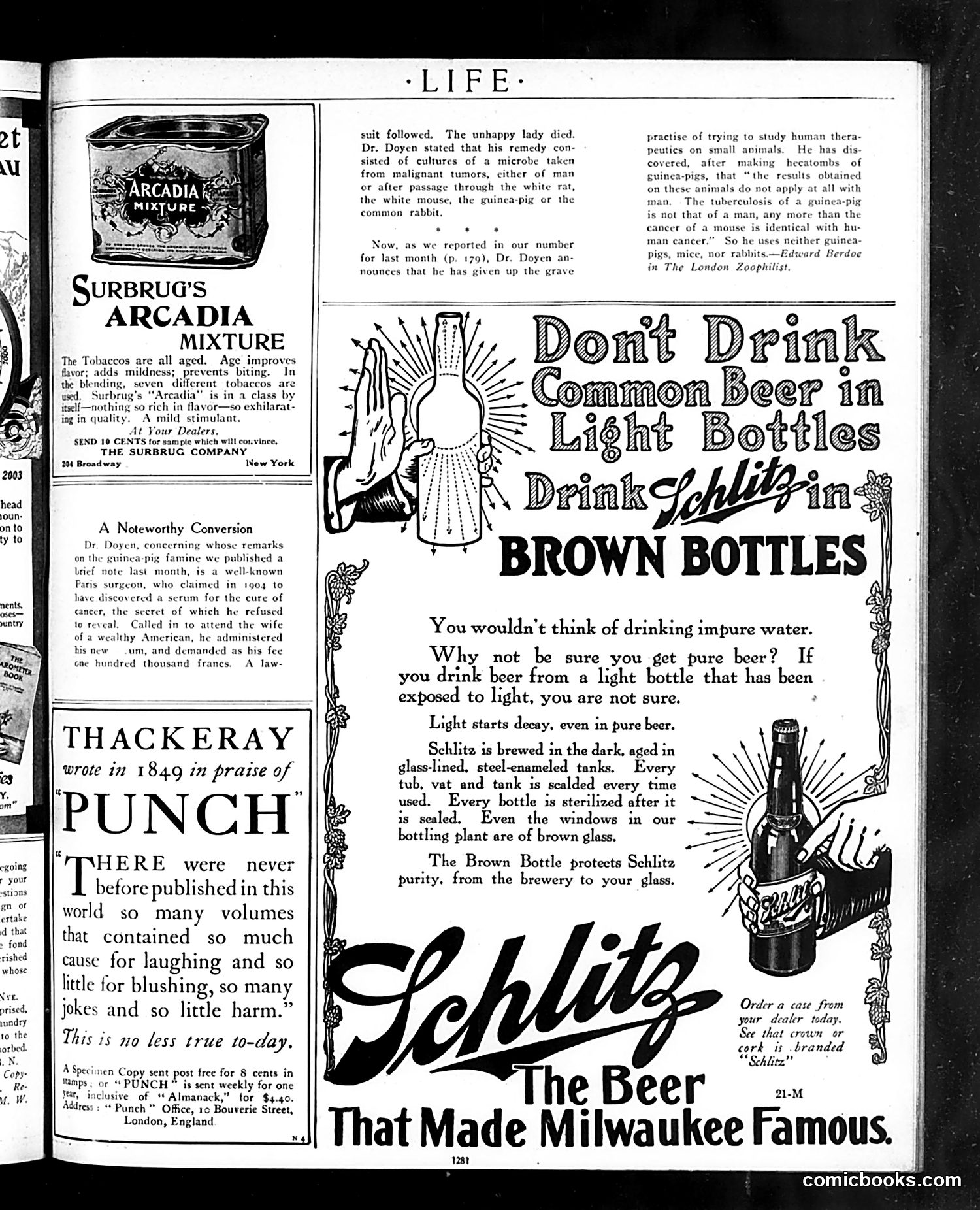
This page is primarily **advertising**, not satirical content. The dominant feature is a large Schlitz beer advertisement arguing that beer should be consumed from brown bottles rather than light ones, claiming light exposure causes decay even in pure beer. The page also includes smaller ads for Surburg's Arcadia tobacco mixture and references to Thackeray's 1849 praise of *Punch* magazine. The upper portion contains editorial text about Dr. Doyen, a Paris surgeon who claimed to have discovered a cancer serum in 1904 but refused to reveal its secret. The text notes his "conversion"—he abandoned testing on animals (guinea pigs, mice, rabbits) after realizing results didn't apply to humans, citing Edward Berdoe's *London Zoophilist*. There is **no political cartoon or satire** on this page—it's a straightforward mix of news items and period advertising emphasizing product purity and scientific claims typical of early 1900s marketing.
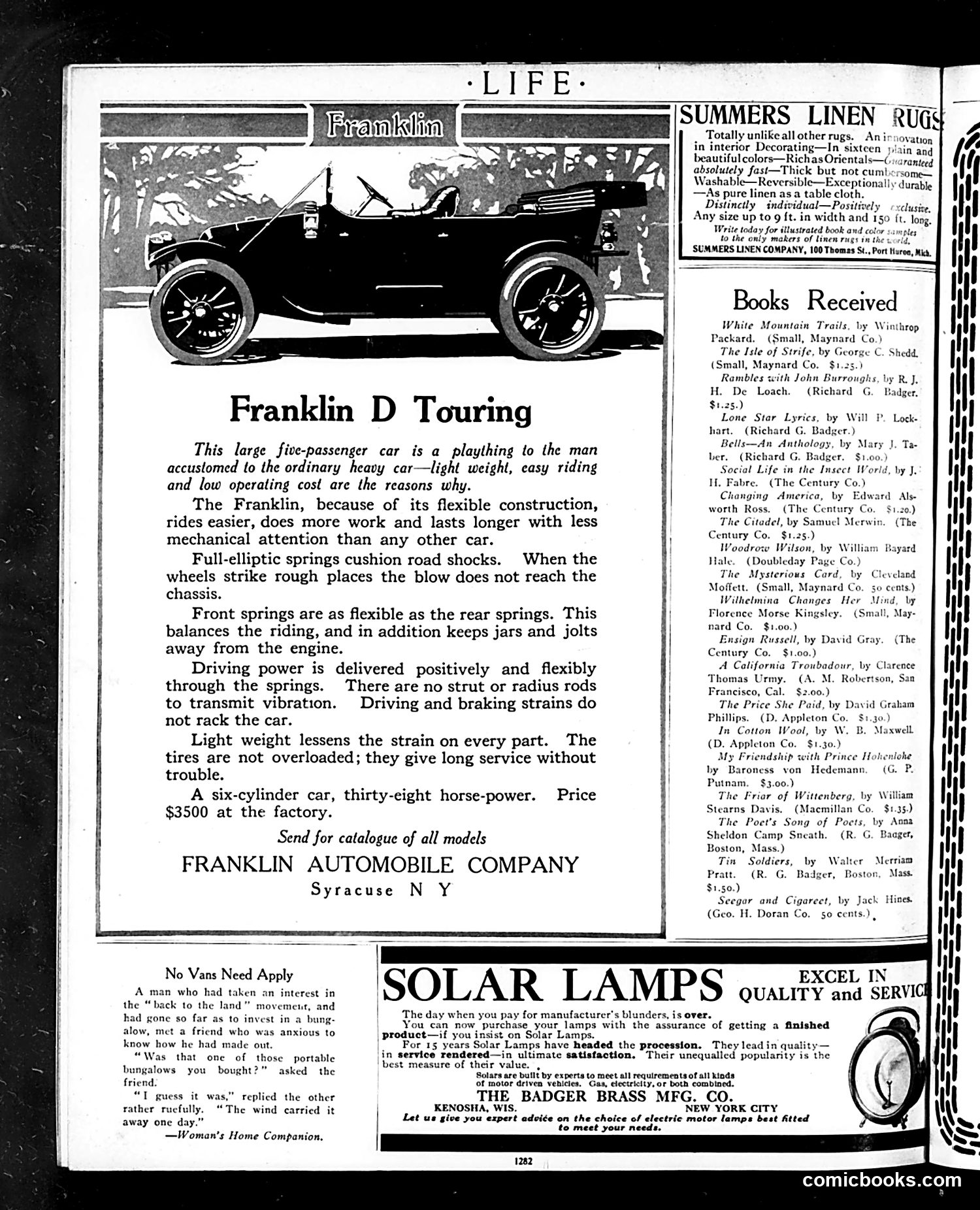
This page is primarily **advertising and book reviews**, not political satire. The main advertisement features the **Franklin D Touring automobile**, a five-passenger car marketed to middle-class buyers. The pitch emphasizes practical virtues: light weight, easy riding, low operating costs, and flexible construction requiring minimal mechanical attention. At $3500, it positions itself as accessible luxury for "the man accustomed to the ordinary heavy car." The right column lists **newly received books**—a standard Life magazine feature—including titles on nature, literature, and contemporary topics, with publishers and prices. A small humorous anecdote titled "No Vans Need Apply" describes a man's portable bungalow literally blown away by wind—a gentle joke about the back-to-the-land movement's impracticality. Lower sections advertise **Summers Linen Rugs** and **Solar Lamps**, emphasizing quality and durability. This represents typical early 20th-century Life content: consumer advertising mixed with literary notices and mild domestic humor—not political commentary or social satire.
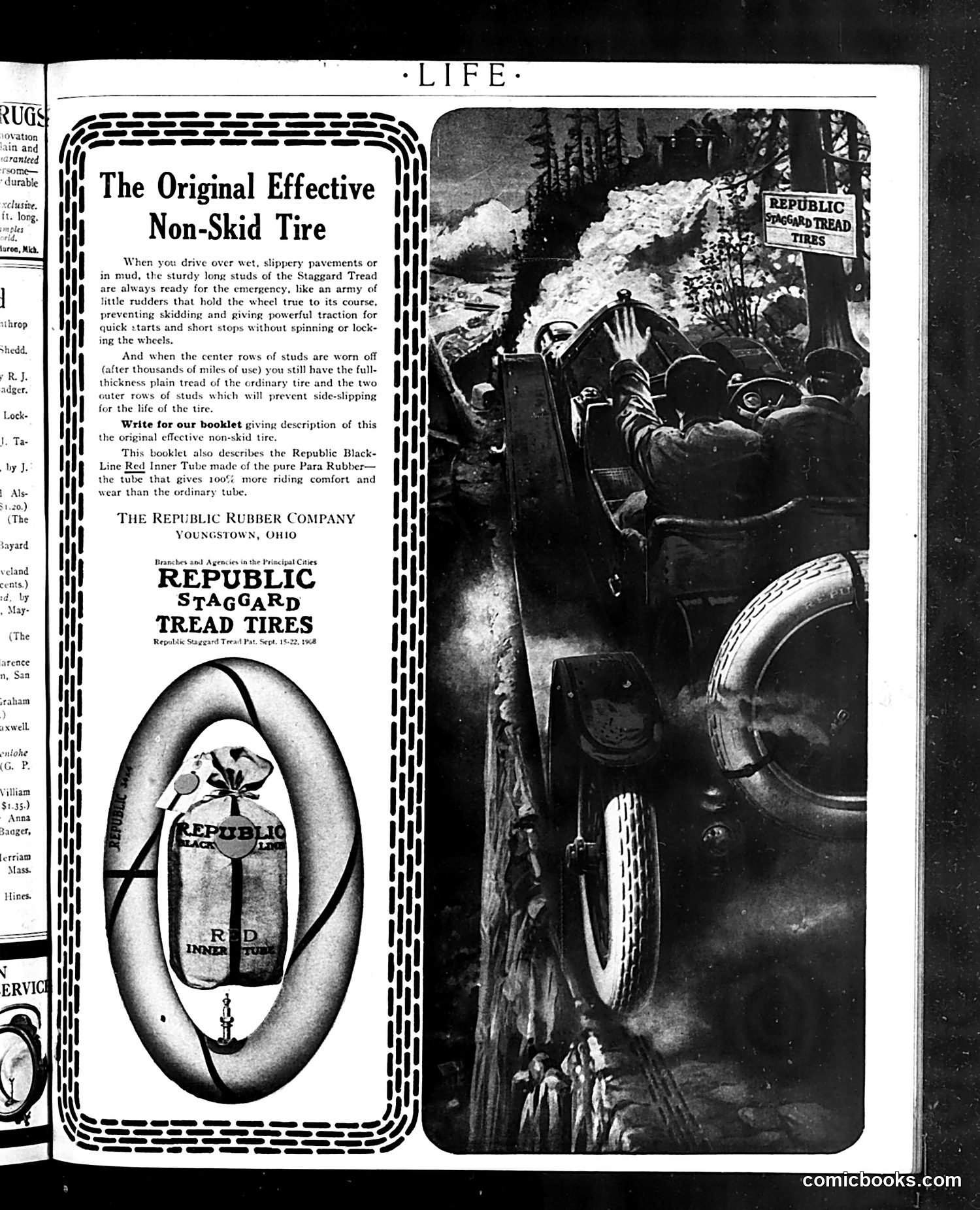
This page is primarily a **tire advertisement**, not satire or a political cartoon. The Republic Rubber Company advertises their "Staggard Tread" non-skid tire, featuring technical claims about safety on wet roads. The ad emphasizes the tire's studs (tread) acting as "little rudders" to prevent skidding and maintain traction. The left side shows a cross-section diagram of the tire and inner tube. The right side displays a photograph of an early automobile (circa 1910s-1920s) driving on a forest road, demonstrating the product in use. The patent date visible (Sept. 16-22, 1908) indicates this is from Life magazine's early period. This is straightforward commercial advertising rather than satirical content—typical of how such magazines funded themselves. The appeal is to automobile owners concerned with safety on poor road conditions, a genuine concern as motorized vehicles were still relatively new.
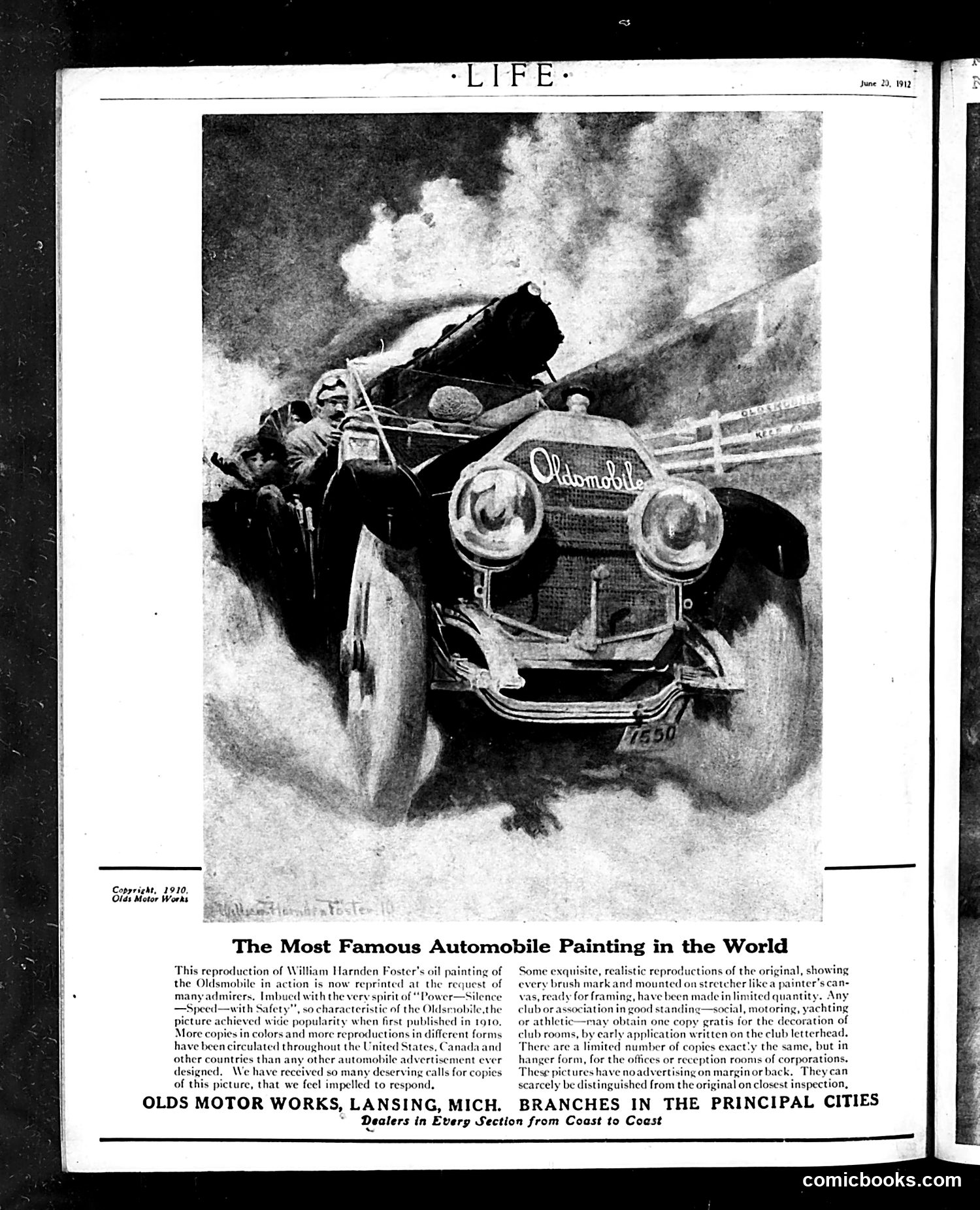
This is primarily an **advertisement**, not political satire. The page reproduces William Harnden Foster's famous 1910 oil painting of an Oldsmobile automobile in dramatic action—speeding through dust clouds with a driver at the wheel. The "satire" here is subtle and commercial: Olds Motor Works is presenting this artwork as high culture worthy of framing, claiming it's "The Most Famous Automobile Painting in the World." They're offering free reproductions to social clubs and corporate offices, strategically positioning the car as aspirational and prestigious rather than merely practical. The joke is the marketing strategy itself—treating car advertising as fine art. By 1912, when this ran, automobiles were still relatively novel luxuries. Olds is leveraging the painting's genuine artistic merit to elevate the brand's status and encourage displays in "good standing" clubs, turning advertising into decoration.