
Life, 1912-06-20 · page 8 of 44
Life — June 20, 1912 — page 8: what you’re looking at
What you’re looking at
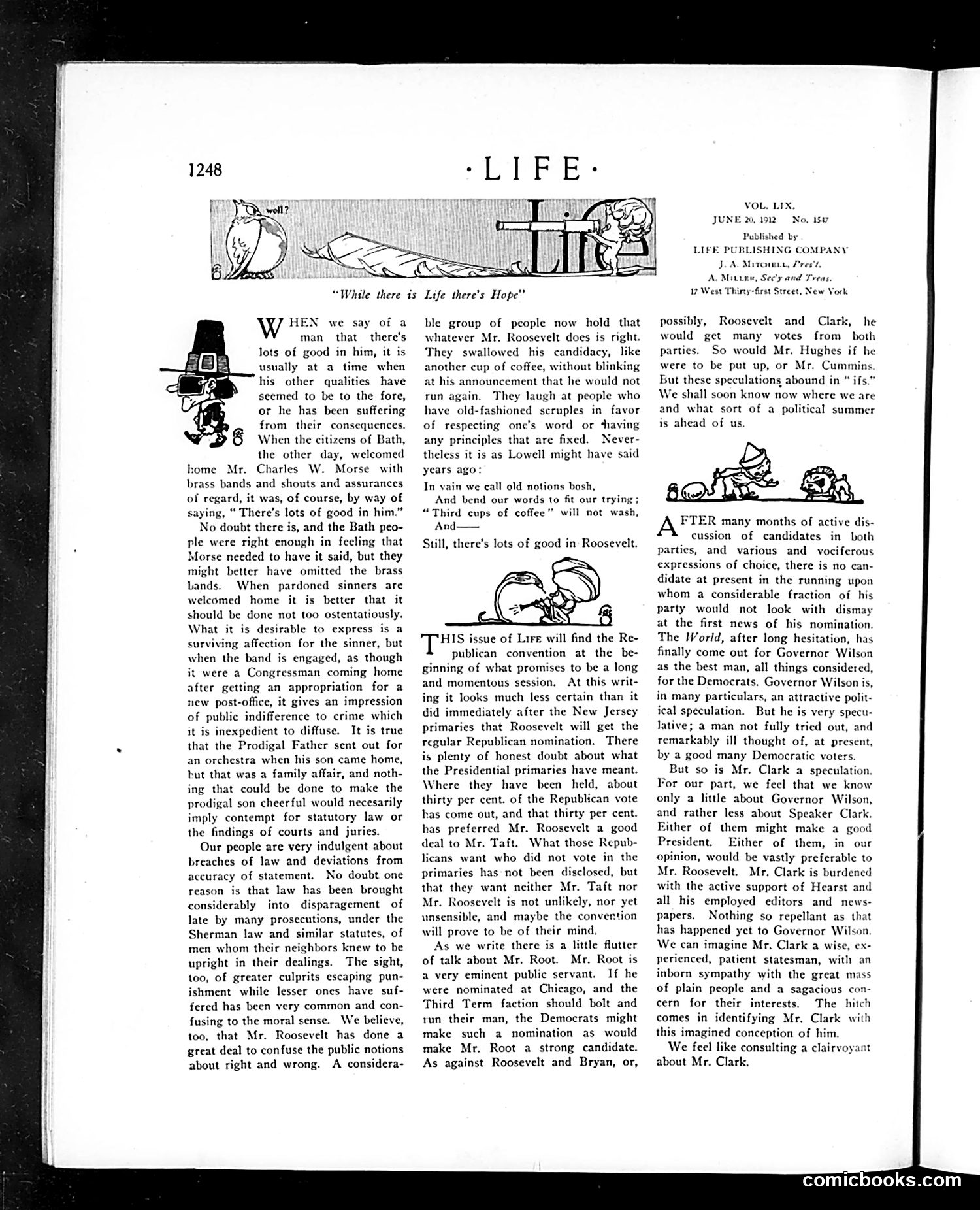
This June 1912 *Life* editorial page discusses the Republican National Convention and presidential candidates. The text examines Roosevelt's political standing and mentions several figures: Roosevelt himself, Clark (likely House Speaker Champ Clark, a Democratic candidate), Taft (the incumbent president), and Root (likely Elihu Root, a prominent Republican). The editorial expresses skepticism about Roosevelt's chances and discusses potential Democratic nominees. It defends Speaker Clark against what the writer calls unfair "clairvoyant" speculation about him. The small cartoon illustrations (showing figures in period dress) are decorative rather than the main satirical focus—the real satire lies in the editorial's sardonic tone about candidate viability and party politics during this fractious election year.
📄 Transcribed text from this page (OCR, searchable)
Machine-transcribed from the original scan — historical spelling and the odd misread are preserved.
“While there is Life there's Hope” HEN we say of a man that there’s lots of good in him, it is usually at a time when his other qualities have seemed to be to the fore, or he has been suffering from their consequences. When the citizens of Bath, the other day, welcomed kome Mr. Charles W. Morse with brass bands and shouts and assurances of regard, it was, of course, by way of saying, “ There's lots of good in him.” No doubt there is, and the Bath peo- ple were right enough in feeling that Morse needed to have it said, but they might better have omitted the brass bands. When pardoned sinners are welcomed home it is better that it should be done not too ostentatiously. What it is desirable to express is a surviving affection for the sinner, but when the band is engaged, as though it were a Congressman coming home after getting an appropriation for a new post-office, it gives an impression of public indifference to crime which it is inexpedient to diffuse, It is true that the Prodigal Father sent out for an orchestra when his son came home, but that was a family affair, and noth- ing that could be done to make the prodigal son cheerful would necesarily imply contempt for statutory law or the findings of courts and juries. Our people are very indulgent about breaches of law and deviations from accuracy of statement. No doubt one reason is that law has been brought considerably into disparagement of late by many prosecutions, under the Sherman law and similar statutes, of men whom their neighbors knew to be upright in their dealings. The sight, too, of greater culprits escaping pun- ishment while lesser ones have suf- fered has been very common and con- fusing to the moral sense. We believe, too, that Mr. Roosevelt has done a great deal to confuse the public notions about right and wrong. A considera- ble group of people now hold that whatever Mr. Roosevelt does is right. They swallowed his candidacy, like another cup of coffee, without blinking at his announcement that he would not run again. They laugh at people who have old-fashioned scruples in favor of respecting one’s word or ‘having any principles that are fixed. Never- theless it is as Lowell might have said years ago: In vain we call old notions bosh, And bend our words to fit our trying ; “Third cups of coffee” will not wash, And. Still, there’s lots of good in Roosevelt. HIS issue of Lire will find the Re- publican convention at the be- ginning of what promises to be a long and momentous session. At this writ- ing it looks much less certain than it did immediately after the New Jersey primaries that Roosevelt will get the regular Republican nomination, There is plenty of honest doubt about what the Presidential primaries have meant. Where they have been held, about thirty per cent. of the Republican vote has come out, and that thirty per cent. has preferred Mr. Roosevelt a good deal to Mr. Taft. What those Repub- licans want who did not vote in the primaries has not been disclosed, but that they want neither Mr. Taft nor Mr. Roosevelt is not unlikely, nor yet unsensible, and maybe the convertion will prove to be of their mind, As we write there is a little flutter of talk about Mr. Root. Mr. Root is a very eminent public servant. If he were nominated at Chicago, and the Third Term faction should bolt and run their man, the Democrats might make such a nomination as would make Mr. Root a strong candidate. As against Roosevelt and Bryan, or, Published by LIFE PUBLISHING COMPANY JA. Miron, Pres't, A. Mitten, See’y and Treas 17 West Thiny-first Street, New Vork possibly, Roosevelt and Clark, he would get many votes from both parties. So would Mr. Hughes if he were to be put up, or Mr. Cummins. But these speculations abound in “ ifs.” We shall soon know now where we are and what sort of a political summer is ahead of us. many months of active dis- cussion of candidates in both parties, and various and vociferous expressions of choice, there is no can- didate at present in the running upon whom a considerable fraction of his party would not look with dismay at the first news of his nomination. The IWorld, after long hesitation, has finally come out for Governor Wilson as the best man, all things considered, for the Democrats. Governor Wilson is, in many particulars, an attractive polit- ical speculation. But he is very specu- lative; a man not fully tried out, and remarkably ill thought of, at present, by a good many Democratic voters. But so is Mr. Clark a speculation. For our part, we feel that we know only a little about Governor Wilson, and rather less about Speaker Clark. Either of them might make a good President. Either of them, in our opinion, would be vastly preferable to Mr. Roosevelt. Mr. Clark is burdened ith the active support of Hearst and all his employed editors and news- papers. Nothing so repellant as that has happened yet to Governor W We can imagine Mr. Clark a wis perienced, patient statesman, with an inborn sympathy with the great mass of plain people and a sagacious con- cern for their interests. The hitch comes in identifying Mr. Clark with this imagined conception of him. We feel like consulting a clairvoyant about Mr. Clark. comicbooks.com