
Life, 1912-06-20 · page 24 of 44
Life — June 20, 1912 — page 24: what you’re looking at
What you’re looking at
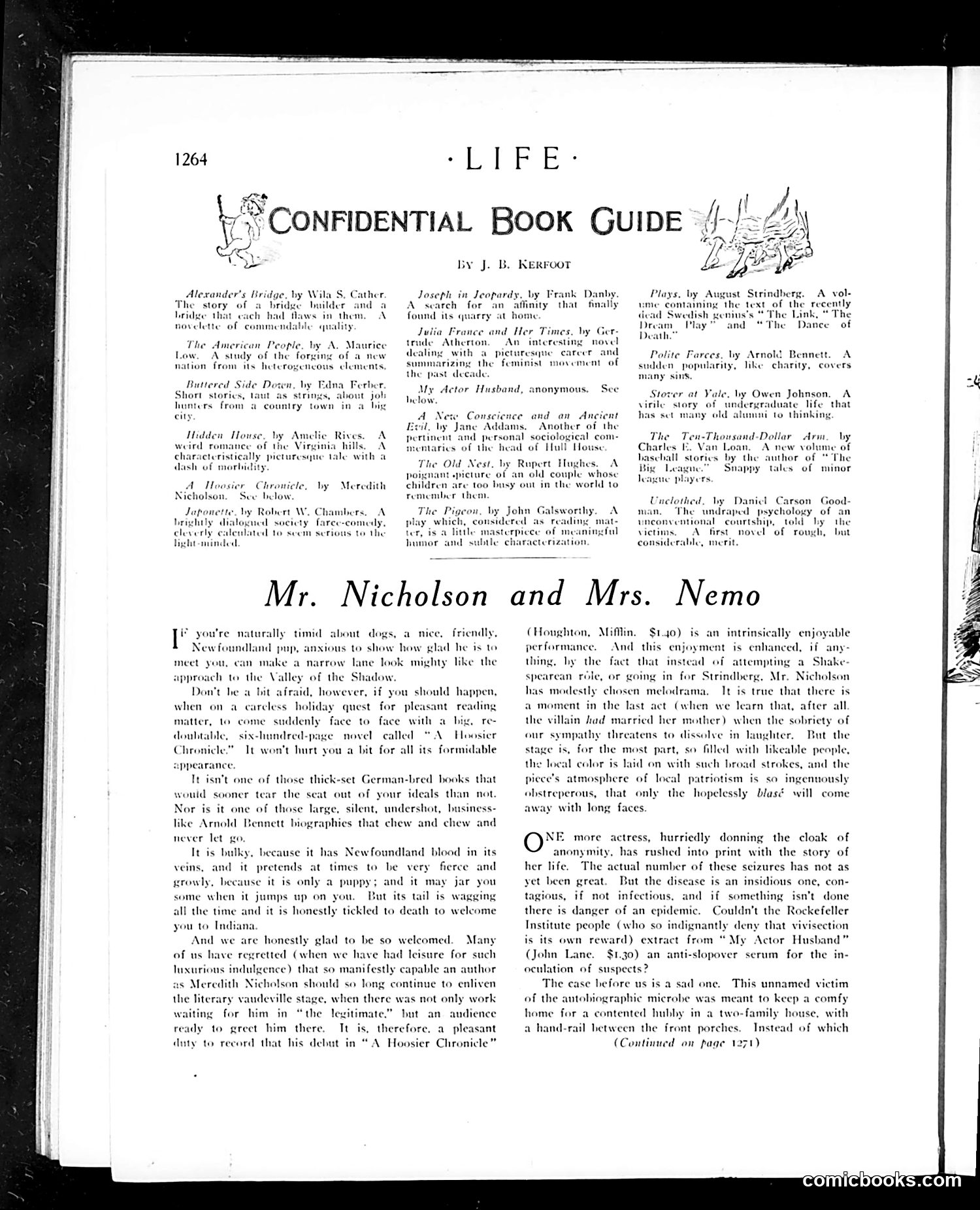
This page is a **book review column**, not a cartoon. The title uses a playful metaphor: "Mr. Nicholson" refers to author Meredith Nicholson, whose novel *A Hoosier Chronicle* is being reviewed; "Mrs. Nemo" (Latin for "Mrs. Nobody") represents the typical reader—described as timid about dogs but willing to encounter Nicholson's "big, redoubtable" six-hundred-page novel. The reviewer compares the book to a friendly Newfoundland puppy: bulky and sometimes fierce-seeming, but ultimately good-natured and eager to please. The satire gently mocks overly intellectual, heavy-handed books (like German novels or Arnold Bennett biographies) while praising Nicholson's approachable style. The piece celebrates Nicholson's shift from writing lightweight vaudeville material to serious literary fiction, presenting this debut novel as a welcome contribution to American literature.
📄 Transcribed text from this page (OCR, searchable)
Machine-transcribed from the original scan — historical spelling and the odd misread are preserved.
by J. B. KERFOoT Alexander's Bridge, by Wila S, Cather. veh had flaws in them, A mmendable quality The American People. by A. Maurice tttde Atherton Low, A study of the forging of a new n from its heterogeneous clements, — SuMMArizing the the past decade Buttered Side Down, by Edna Ferber. My Short stories, laut as strings, about job ae hunters from a country town in a big city A New helow Hidden House. by Amelic. Rives. A weird romance of the Virginia hills, A fentarics of the characteristically picturesque tale with a dash of morbidity A Hoosier Chronicle, by Nicholson. See below fe by Robert W. Cha alogucd society farce-¢ cleverly calculated 10 seem serious to the light-minde Meredith remember then play which, con: humor and subtle Mr. Nicholson and Mrs. Nemo [gore naturally timid about dogs, a nie friendly, Newfoundland pup, anxious to show how glad he is to meet you, can make a narrow lane look mighty like the » the Valley of the Shadow. bit afraid, however, if you should happen, ureless holiday quest for pleasant reading approach Don't 1 when on a matter, to come suddenly face to face with a big, re- doubtable, — six-hundres we novel called "A Hoosier Chronicle.” It won't hurt you a bit for all its formidable appearance. It isn’t one of those thick-set German-bred hooks that would sooner tear the seat out of your ideals than not. Nor is it one of those large, silent, undersh business- like Arnold Bennett biographies that chew and chew and never let go. It is bulky, because it has Newfoundland blood in its veins, and it pretends at times to be very fierce and growly, because it is only a puppy; and it may jar you some when it jumps up on you. But its tail is wagging all the time and it is honestly tickled to death to welcome you to Indiana And we are honestly glad to be so welcomed. Many of us have regretted (when we have had leisure for such luxtirions indulgence) that so manifestly capable an author as Meredith Nicholson should so long continue to enliven the literary vaudeville stage, when there was not only work waiting for him in’ “the legitimate.” but an audience ready to grect him there. It is, therefore. a pleasant duty to record that his debut in “ A Hoosier Chronich Joseph in Jeopard story of a bridge builder and a A’ search for an found its quarry at home Julia France and Her Times. by Ger- with a picturesque carcer and p feminist movement of ctor Husband, anonymous. See onscience Evil, by Jane Addams. pertinent and personal sociological com- The Ten-Thousand-Dollar Arm. Uy head of Hull House The Old Nest. by Rupert: Hughes. poignant picture of an old couple whose children are too busy out in the world to The Pigeon, by John Jered as reading mat- ter, isa little masterpicee of meaningful by Frank Danby ity that finally ame ud Swedish xenins's “The Link, Dream, May and “The Dance de _ interesting novel Death te Farces, by Arnold Bennett. A sudden popularity, like charity, covers many sins, Stover at Yale, by Owen Johnson. A virile story of undergraduate life that dan Ancient — has set many old alumai to thinking Another of the Charles E. Van Loan, A new volume of Il stories by the author of “The "Snappy tales of minor Unelothed. by Daniel Carson Good Isworthy. A oman. The undraped psychology of an unconventional courtship, told” by the Victims. A first novel of rough, but clerization considerable, merit. ton, Mifflin. $140) is an intrinsically enjoy performance. And this enjoyment is enhanced, if any- thing. by the fact that instead of attempting Shake- spearean role, or going in for Strindberg, Mr. Nicholson as modestly chosen melodrama. It is true that there is a moment in the last act (when we learn that, after all the villain had married her mother) when the sobriety of our sympathy threatens to dissolve in laughter, But the is, for the most part, so filled with likeable people, 1 color is laid on with such broad strokes, and the mosphere of loc: intism is so ingenuously obstreperous, that only the hopelessly blasé will come way with long faces. NE more actress, hurriedly donning the cloak of anonymity, has rushed into print with the story of her life. The actual number of these seizures has not as yet been great. But the disease is an insidious one, con- tagious, if not infectious, and if something isn’t done there is danger of an epidemic. Couldn't the Rockefeller Institute people (who so indignantly deny that vivisection is its own reward) extract from “My Actor Husband” (John Lane. $1.30) an anti-slopover serum for the in- oculation of suspects? sad one. This unnamed victim of the antobiographic microbe was meant to keep a comfy home for a contented hubby in a two-family house, with Instead of which The case before us is a hand-rail between the front porches, (Continued on page 1271)