
A complete issue · 44 pages · 1912
Life — February 8, 1912
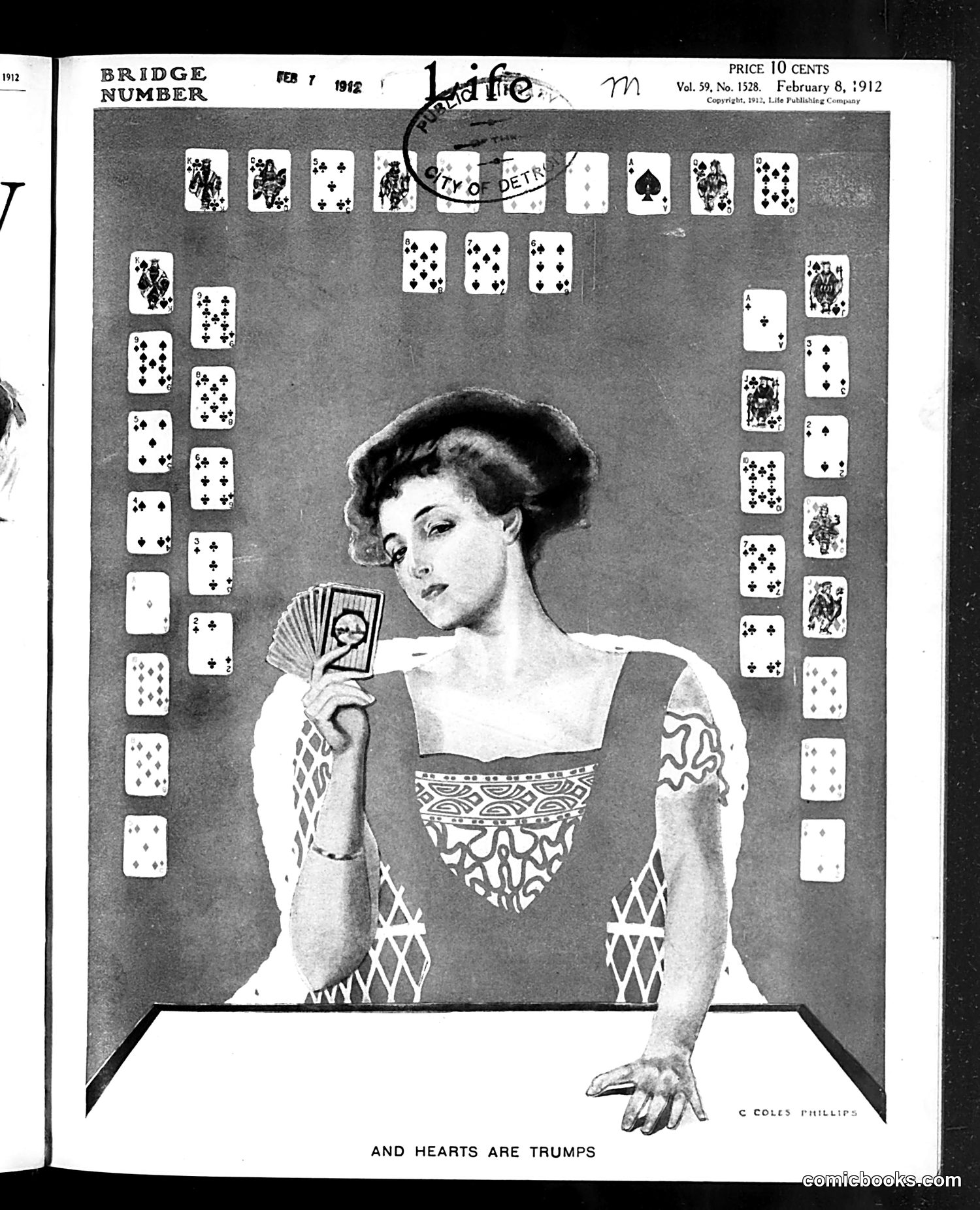
This is a "Bridge Number" issue of Life magazine featuring a card-game themed illustration. The image shows a woman holding playing cards arranged around her in a bridge layout—the card game was enormously popular among American middle and upper-class women in the early 1900s. The title "And Hearts Are Trumps" is a pun: it references both the card suit and romantic sentiment. The woman's fashionable Edwardian dress and composed demeanor suggest this is social commentary on how card games—particularly bridge—dominated women's leisure time and social gatherings during this era. The illustration by C. Coles Phillips appears to be satirizing or simply celebrating this cultural obsession with bridge among women of the period.
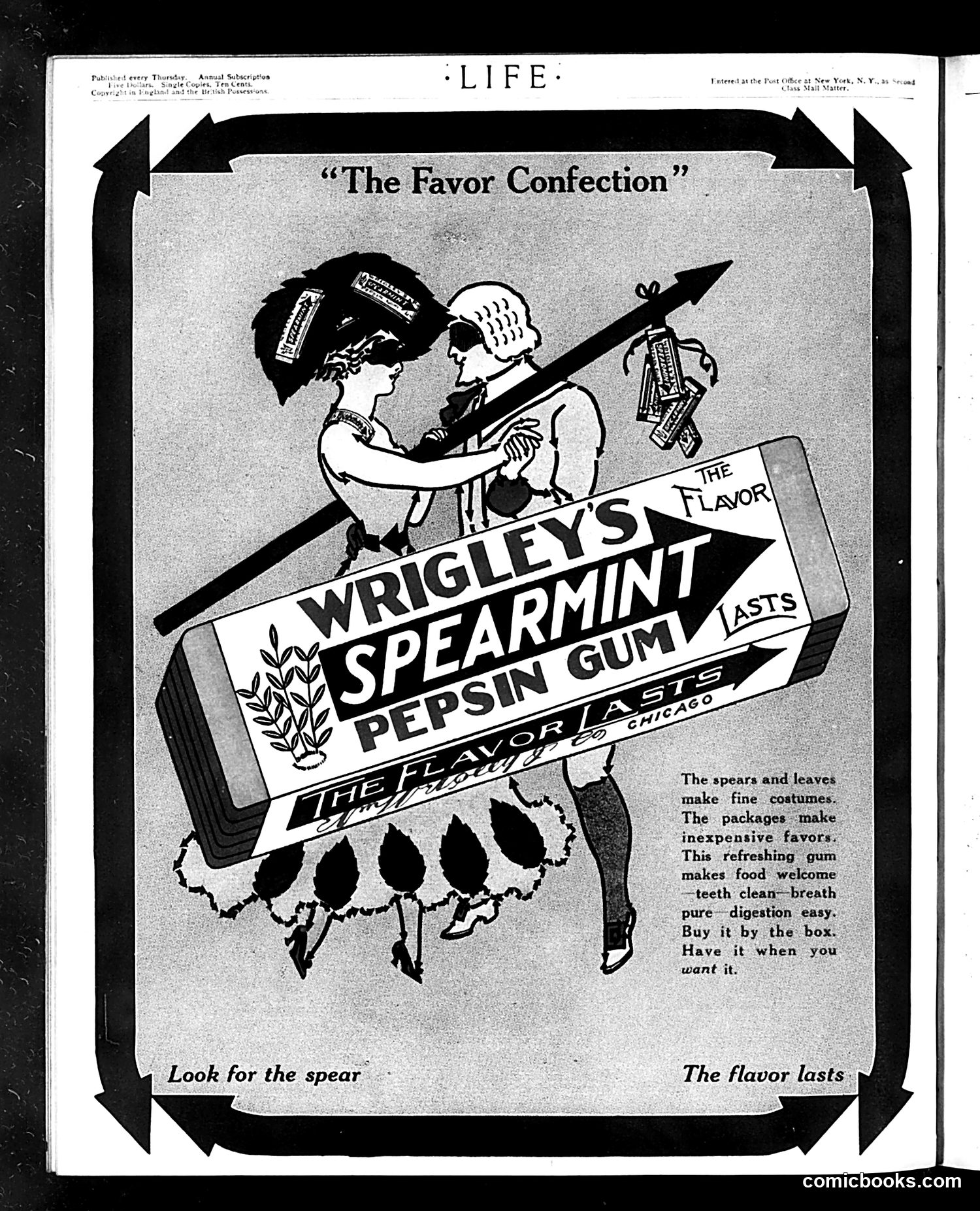
This is a **commercial advertisement**, not political satire. It depicts two elaborately costumed figures—appearing to be from a masquerade or costume ball—riding atop a giant Wrigley's Spearmint Gum package as if it were a lance or spear. The title "The Favor Confection" plays on the gum as party favors. The ad's humor relies on visual puns: the gum package itself becomes a "spear," and the elaborate costume pieces shown are made from gum packaging materials. The accompanying text emphasizes practical benefits—inexpensive party favors that aid digestion and freshen breath—positioning gum as both fun and functional for social gatherings. This reflects early-20th-century advertising techniques using playful imagery and puns to market everyday products.
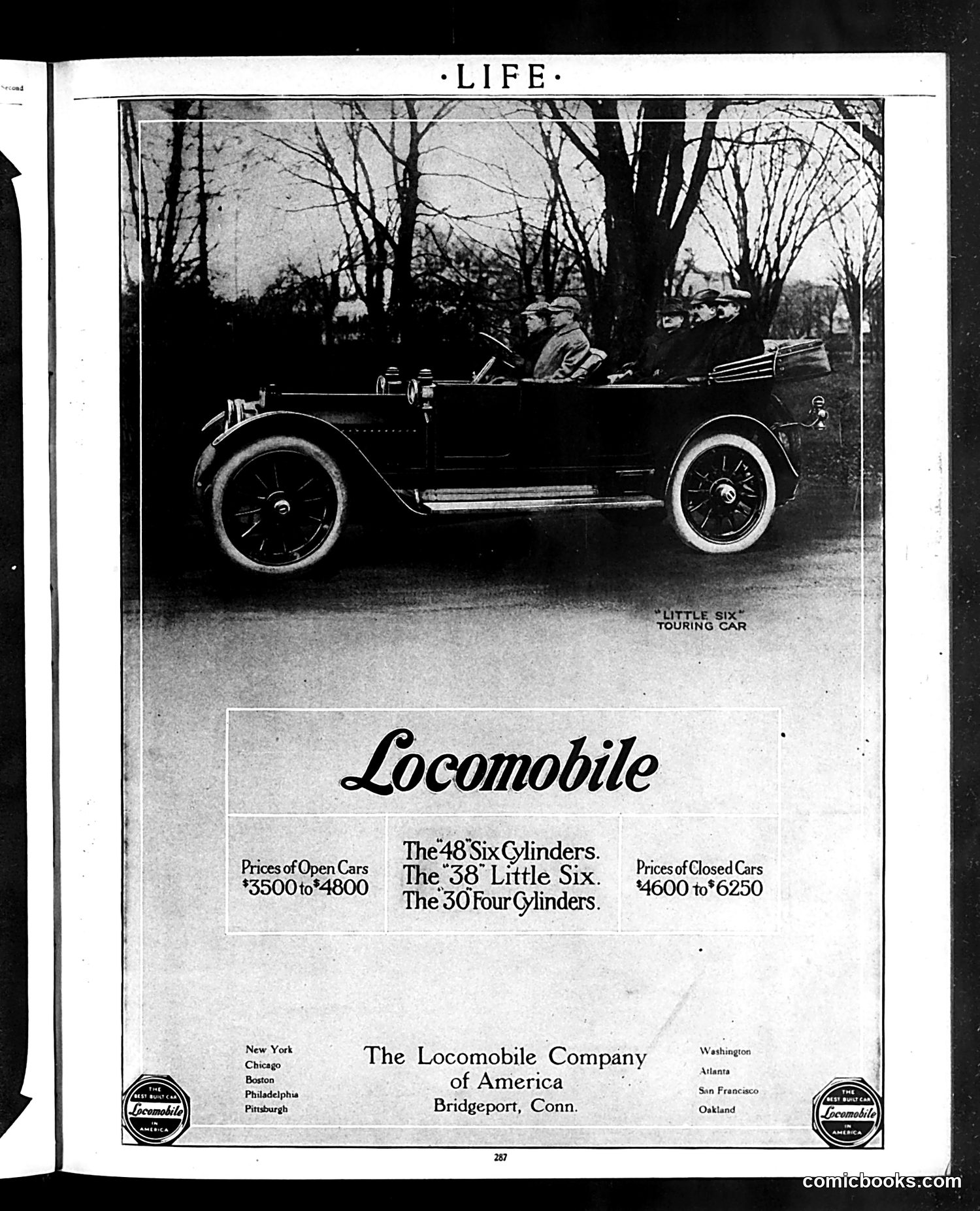
This page is **primarily an advertisement**, not satirical content. It features a Locomotile automobile—specifically what appears to be their "Little Six" model—photographed in profile on a tree-lined road with two occupants. The ad emphasizes three engine options: the 48 Six Cylinders, the 38 Little Six, and the 30 Four Cylinders, with pricing for both open and closed car models ($3,500–$6,250 range). The Locomotile Company of America, headquartered in Bridgeport, Connecticut, is listed with sales offices in major cities (New York, Chicago, Boston, Philadelphia, Pittsburgh, Washington, Atlanta, San Francisco, Oakland). This represents early automotive advertising from Life magazine's era as a general-interest publication, before it transitioned to photojournalism.
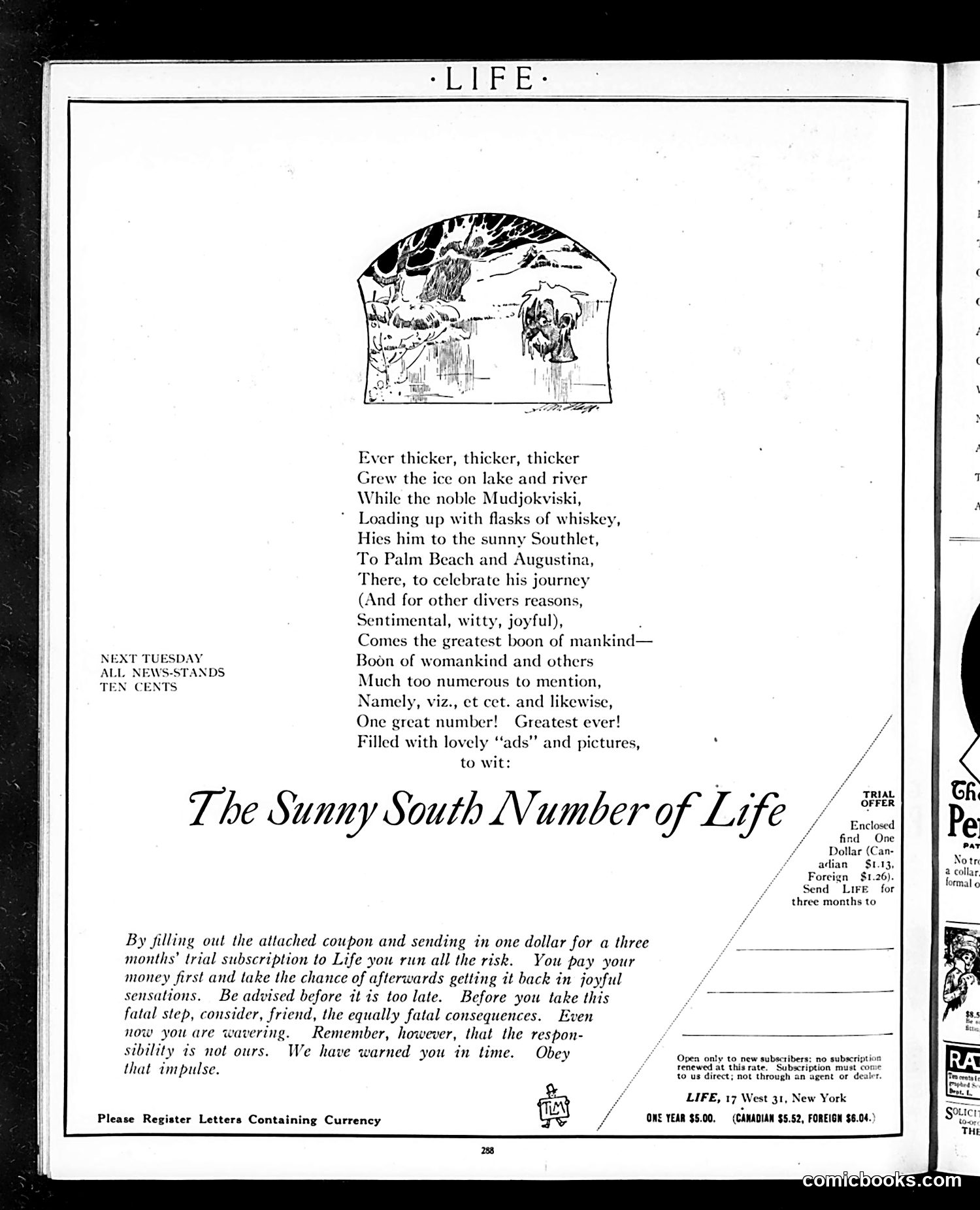
This page is primarily a subscription advertisement for "The Sunny South Number of Life," promoting a special issue focused on Florida destinations like Palm Beach and Augustina. The small illustration at top depicts winter conditions—"ice on lake and river"—contrasted with the warm South. The poem humorously describes a character named Mudioksvski loading whiskey to escape harsh northern winters. The main satire appears to target subscription sales tactics: the text ironically warns readers about the "fatal step" and "fatal consequences" of subscribing while simultaneously encouraging them to do so anyway. This self-aware humor about aggressive sales pitches was typical of Life's satirical style. The advertisement emphasizes the special issue contains numerous advertisements and pictures, making this essentially a promotional vehicle rather than editorial content.
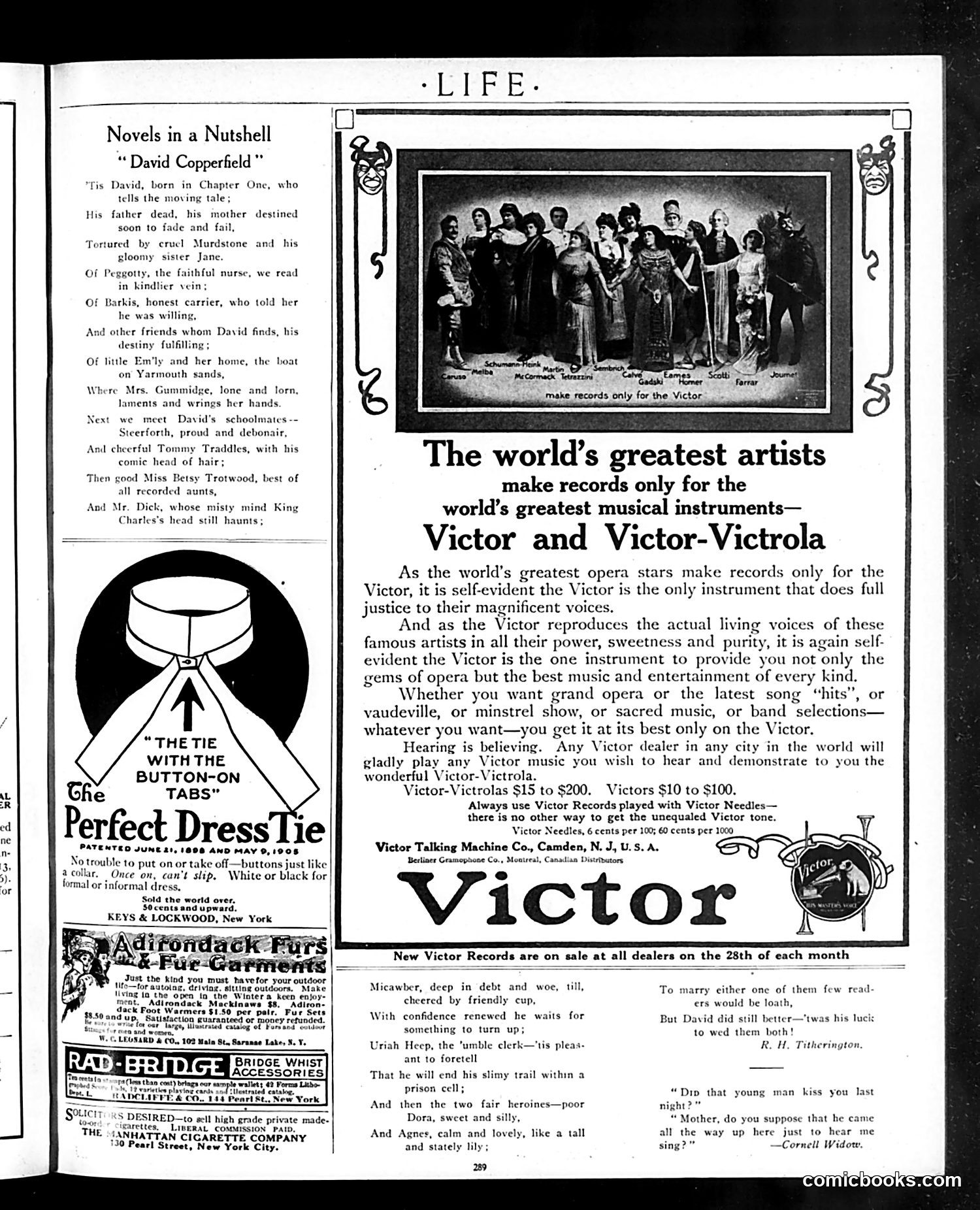
This page is **primarily advertising**, not satire or political commentary. The main content is a Victor Victrola advertisement featuring a group photograph of opera singers. The ad promotes Victor records and phonographs as the superior choice for reproducing classical music, claiming "the world's greatest artists make records only for the world's greatest musical instruments—Victor and Victor-Victrola." The left column contains a brief summary of Charles Dickens' *David Copperfield* under "Novels in a Nutshell"—not editorial commentary. Below that are conventional product advertisements: a necktie ("The Tie with the Button-On Tabs"), fur garments, and other accessories. This represents typical early-20th-century magazine content: serialized fiction summaries mixed with full-page branded advertisements targeting middle-class readers.
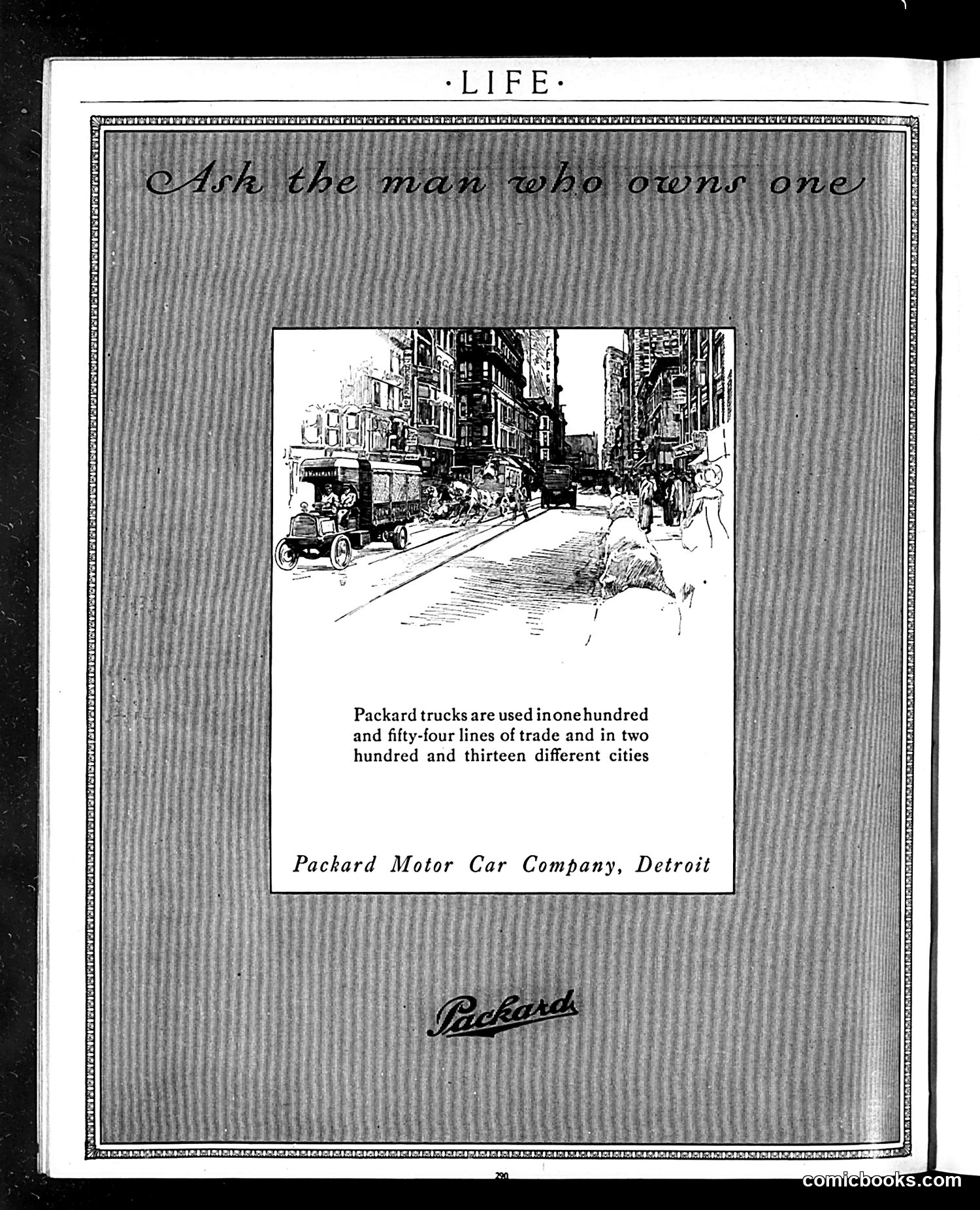
This page is primarily a **Packard Motor Car Company advertisement** from *Life* magazine, not political satire. The ad features a street scene sketch showing a Packard delivery truck amid urban commercial activity. The headline "Ask the man who owns one" was Packard's famous advertising slogan. The text claims Packard trucks operate on "one hundred and fifty-four lines of trade and in two hundred and thirteen different cities," emphasizing the vehicle's commercial reliability and widespread adoption. **No political cartoon or social satire is present.** This is straightforward early-20th-century automobile marketing designed to appeal to business owners by demonstrating the truck's proven utility across diverse industries and locations. The "LIFE" header indicates placement in a prestigious national magazine that accepted such advertisements.
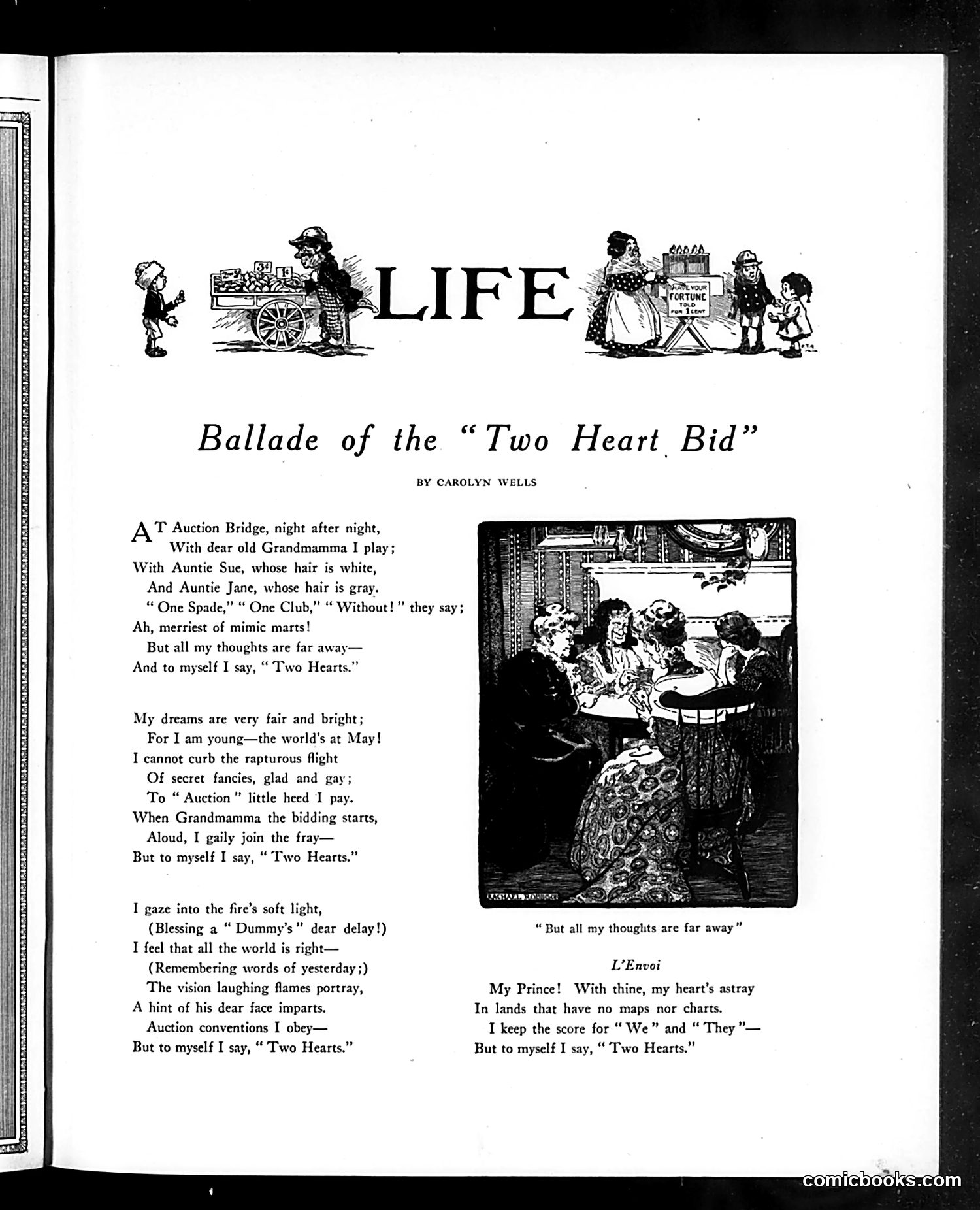
This page from *Life* magazine features a poem by Carolyn Wells accompanying an illustration. The poem describes a young woman at an "Auction Bridge" card game (a popular early 20th-century parlor game). While playing cards with elderly aunts and a grandmother, her mind wanders to thoughts of a romantic "Prince" in distant, unmapped lands. The satire contrasts the mundane social obligation of card-playing with society aunts against the narrator's secret romantic fantasies. The repeated refrain "Two Hearts" suggests divided loyalty—outwardly conforming to proper social conventions while inwardly yearning for love and adventure. The illustration shows women gathered around a card table, capturing this tension between surface propriety and hidden desire.
This *Life* magazine page satirizes Colonel Theodore Roosevelt's political ambitions and personality. The text criticizes Roosevelt's candidacy as self-serving manipulation, comparing him to a duck studied by the *Evening Post*—the *Post* "instinctively disapproves" while Roosevelt operates without regard for others' opinions. The satire mocks Roosevelt's unpredictability and stubbornness, suggesting he's difficult to control or predict. The piece questions whether Roosevelt genuinely wants to help Taft politically or is pursuing personal ambition. It portrays him as someone who ignores advice from friends and critics alike, making him simultaneously admirable and frustrating—a man of strong instincts but questionable judgment regarding his own political future.
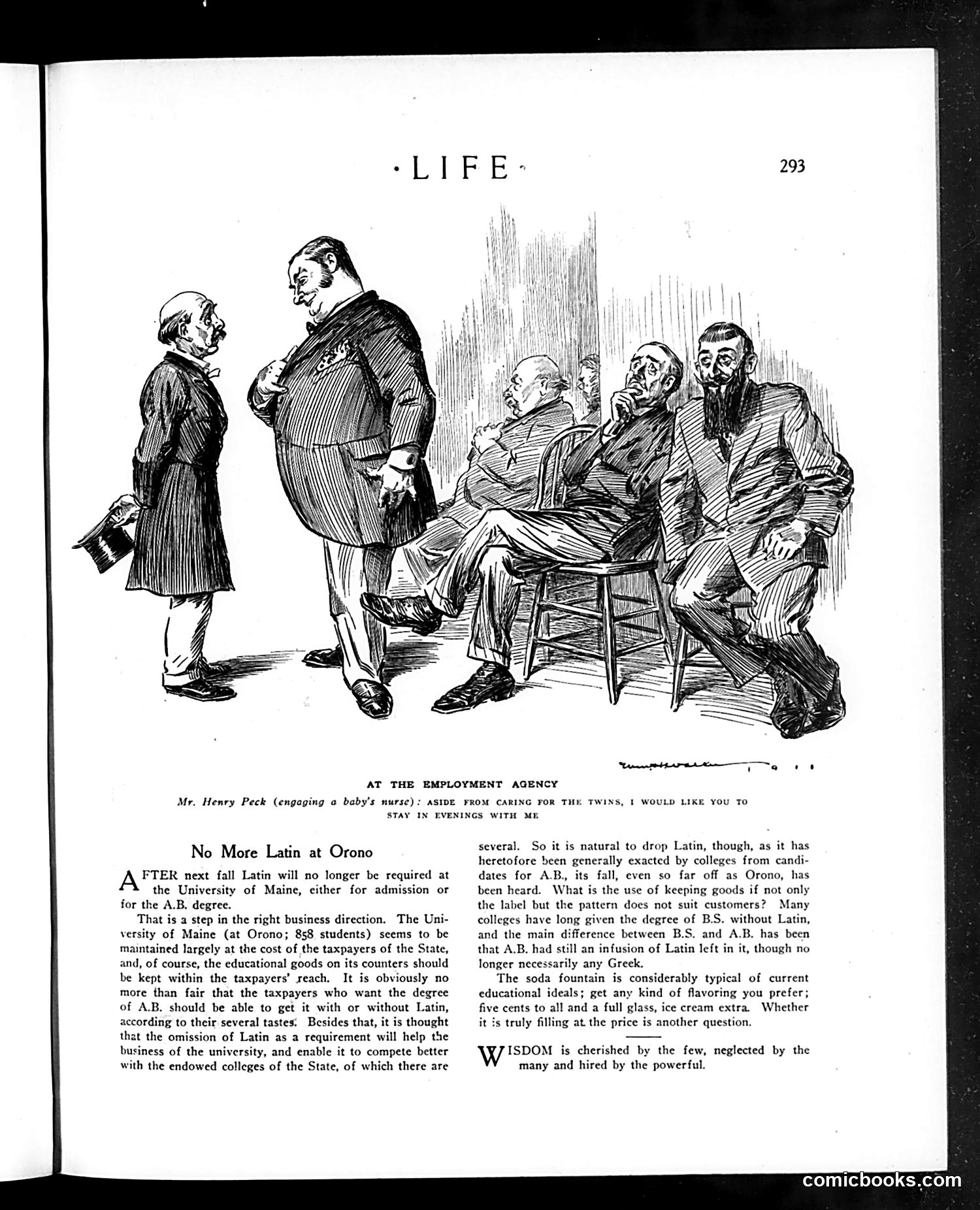
The cartoon depicts Mr. Henry Peck at an employment agency, apparently negotiating childcare arrangements. The caption reads: "engaging a baby's nurse: aside from caring for the twins, I would like you to stay in evenings with me"—a euphemistic reference to expected sexual availability, satirizing employer exploitation of domestic workers. The article "No More Latin at Orono" discusses the University of Maine's decision to drop Latin as a requirement for the A.B. degree. The piece debates whether this change reflects cost-cutting (keeping taxpayer expenses down) or practical educational reform, noting that many colleges had already eliminated Latin while maintaining Latin-free A.B. degrees. Both items critique institutional priorities—whether hiring practices or educational standards—through a lens of economic pressure and shifting social values.
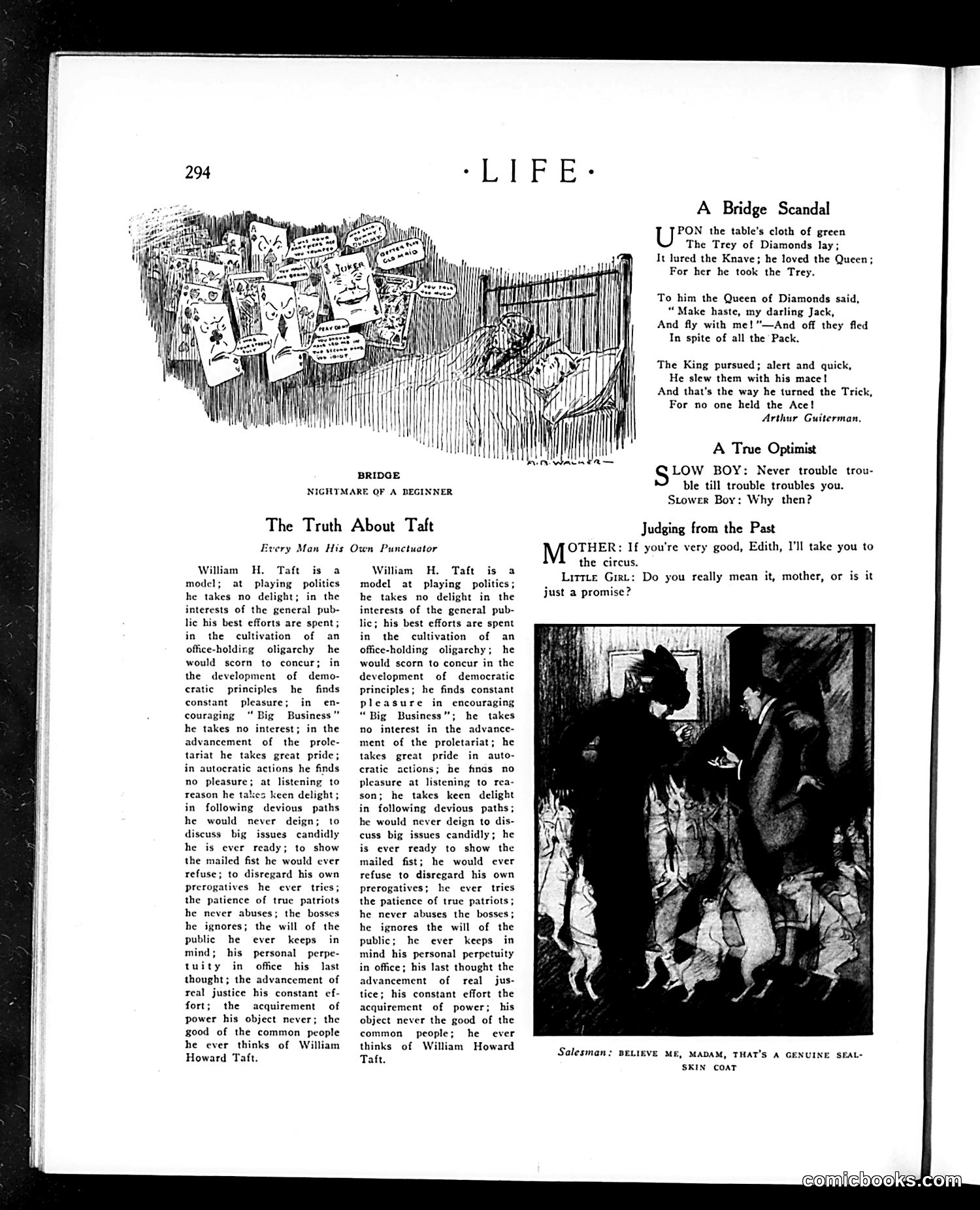
This page contains three separate satirical pieces: 1. **"A Bridge Scandal"** (top right): A poem by Arthur Guiterman about playing cards (the Jack, Knave, Queen, and Pack), using card game terminology as metaphor for some unspecified scandal. Without additional context, the specific scandal referenced is unclear. 2. **"The Truth About Taft"** (left column): A two-column text piece presenting contrasting descriptions of William H. Taft's character and political approach—essentially saying he's simultaneously devoted to and indifferent toward various principles depending on perspective. This appears to be satirical commentary on Taft's inconsistencies or perceived hypocrisy. 3. **"A True Optimist"** and **"Judging from the Past"** (right): Brief humorous dialogues about optimism and broken promises. 4. **Bottom illustration**: Shows a salesman pitching a "genuine seal-skin coat" to a woman, likely satirizing consumer fraud or deceptive sales tactics.
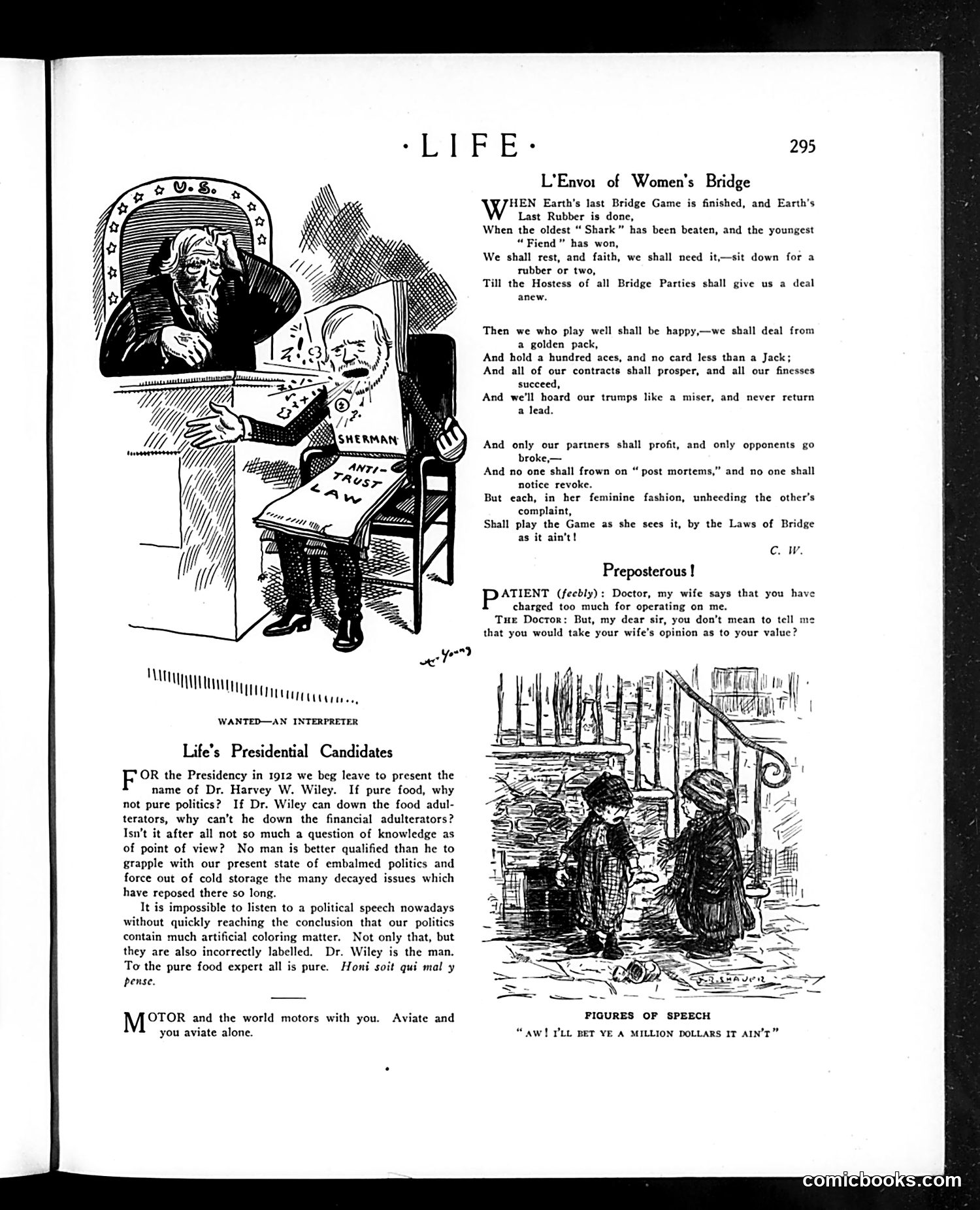
**Top Section - "L'Envoi of Women's Bridge":** A poem celebrating women bridge players, with an illustration showing a menacing figure (appears to be Death or the Devil, labeled "Sherman" and "Anti-Trust") looming over a woman playing cards. The satire suggests that bridge—a popular parlor game among upper-class women—will outlast serious concerns like business monopolies and financial regulation. **Bottom Section - "Preposterous!":** A brief comedic dialogue between a patient and doctor about medical fees, mocking the doctor's defensive position. **"Life's Presidential Candidates":** Satirical endorsement of Dr. Harvey W. Wiley for presidency, praising his expertise in food safety and regulation—suggesting he's more qualified than typical politicians to address real problems.
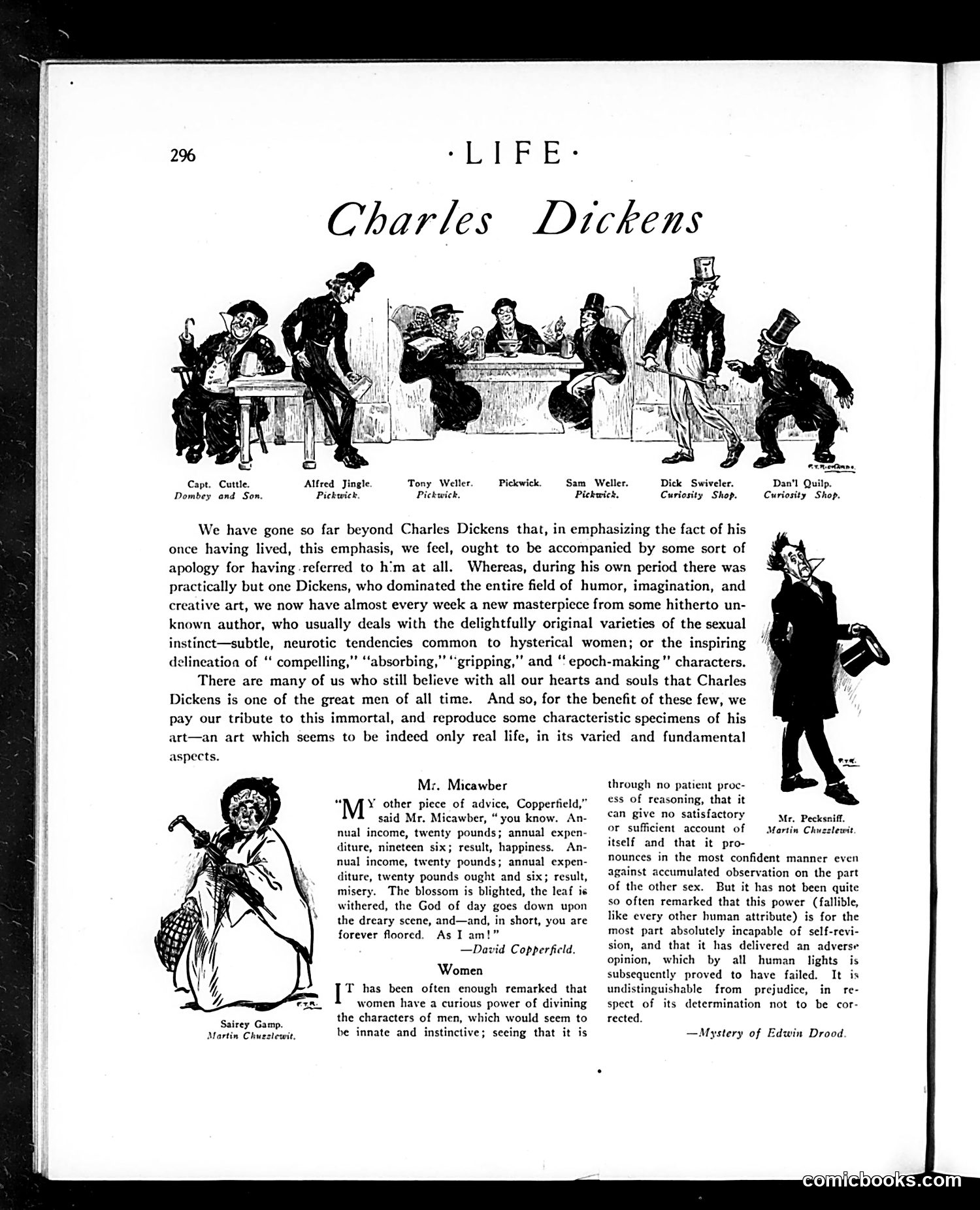
This is a tribute page to Charles Dickens featuring illustrations of his famous fictional characters. The top illustration shows eight characters in a bar scene, labeled with names like "Capt. Cuttle," "Alfred Jingle," "Tony Weller," and "Pickwick"—all recognizable Dickens creations. The page discusses Dickens's literary legacy, noting that during his lifetime he dominated English humor and imagination. It compares him favorably to contemporary authors who focus on sexual themes and neurotic female characters, positioning Dickens as superior for depicting "real life, in its varied and fundamental aspects." The lower sections include character sketches (Mr. Micawber, Sairey Gamp, Mr. Pecksniff) with quoted dialogue, celebrating Dickens's skill at creating memorable, distinctive personalities.
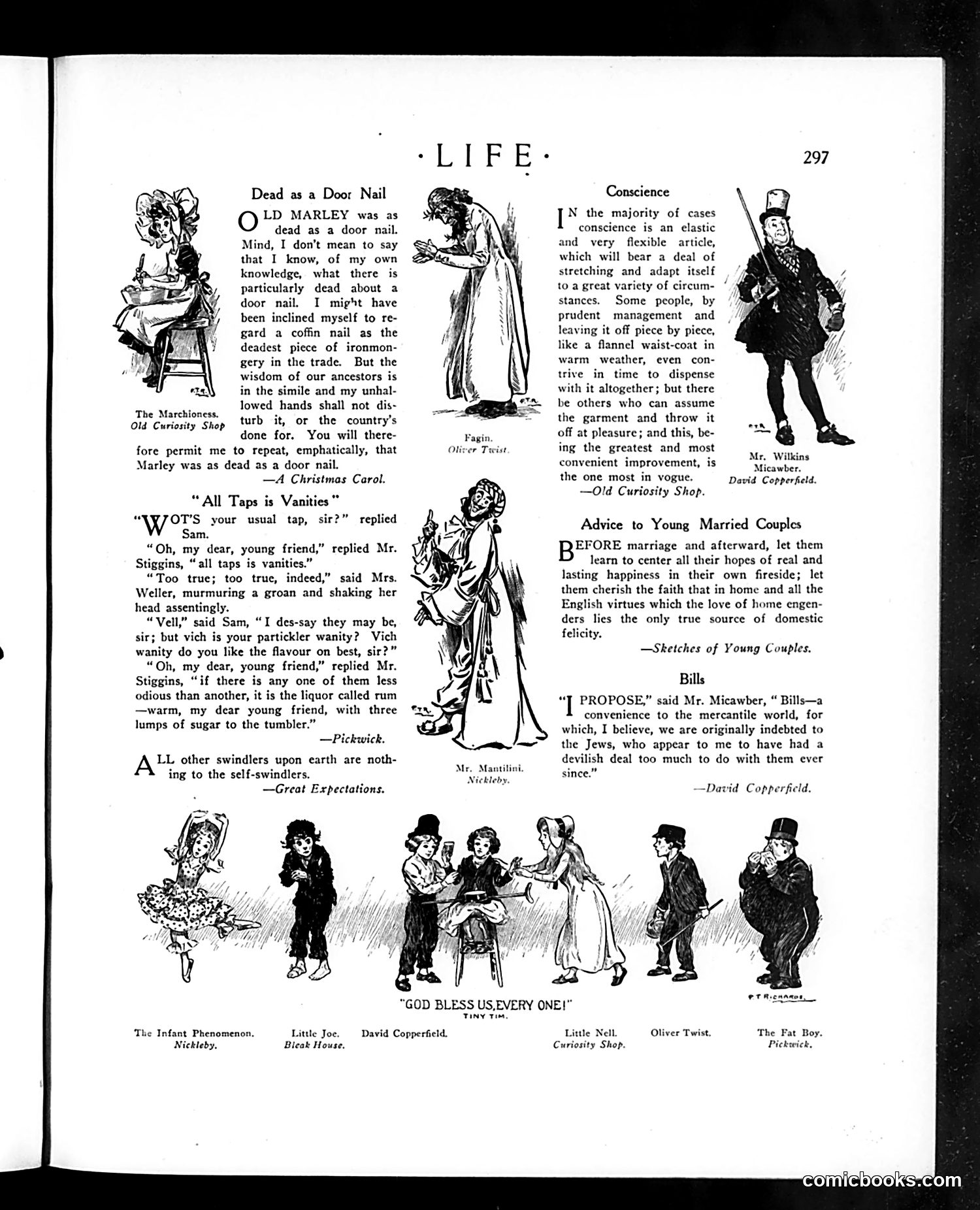
This page presents Dickensian literary references and social commentary. The top section quotes *A Christmas Carol*, mocking Marley as "dead as a door nail"—a phrase the text suggests was already clichéd. Below are character illustrations from Dickens novels, labeled with their names and source works: Fagin from *Oliver Twist*, Mr. Mantilini from *Nicholas Nickleby*, Mr. Wilkins Micawber from *David Copperfield*, and others. The bottom strip shows seven Dickens characters together, captioned "God Bless Us Every One!"—Tiny Tim's famous line from *A Christmas Carol*. The page also includes unrelated satirical quotes about conscience, marriage advice, and bills. Overall, it's a humorous celebration of Dickens' memorable characters while making light social observations through his archetypal figures.
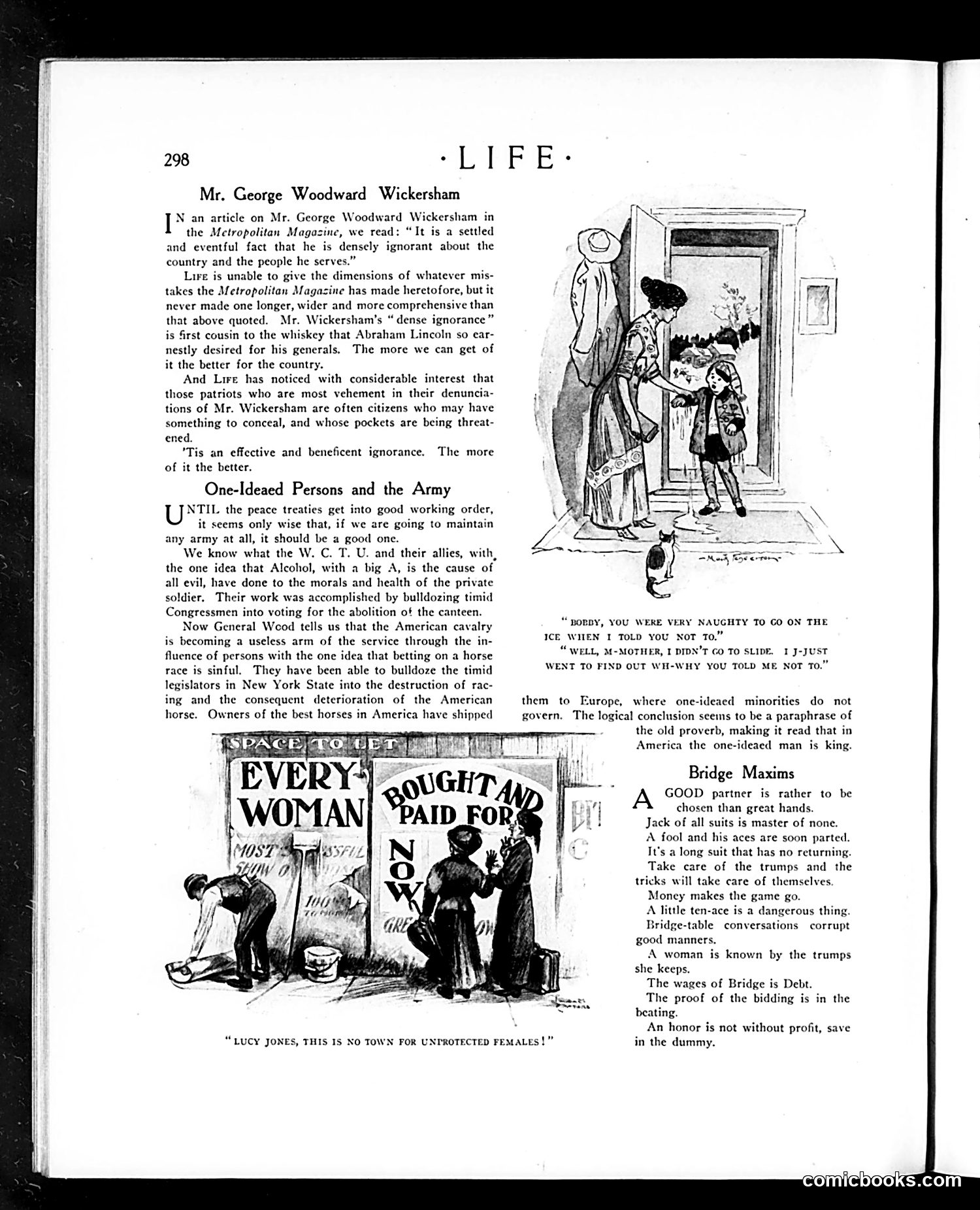
This page contains three distinct sections: **Top article** critiques George Woodward Wickersham (a real political figure) for claiming ignorance about the country he serves, labeling such "dense ignorance" as dangerous. **Middle section** titled "One-Idealed Persons and the Army" discusses military readiness, arguing that alcohol is blamed for soldiers' problems rather than addressing actual issues like poor horse conditions and race track betting. **Bottom cartoon** shows a woman at what appears to be a "Space Toilet" advertisement, with the caption mocking "unprotected females" in town. This likely satirizes both commercialism exploiting women's anxieties and inadequate public facilities. **Right section** "Bridge Maxims" offers satirical aphorisms about bridge card-playing, treating the game as a serious moral endeavor where honor and financial consequences intersect. The overall tone is satirical social and political commentary typical of *Life* magazine's era.
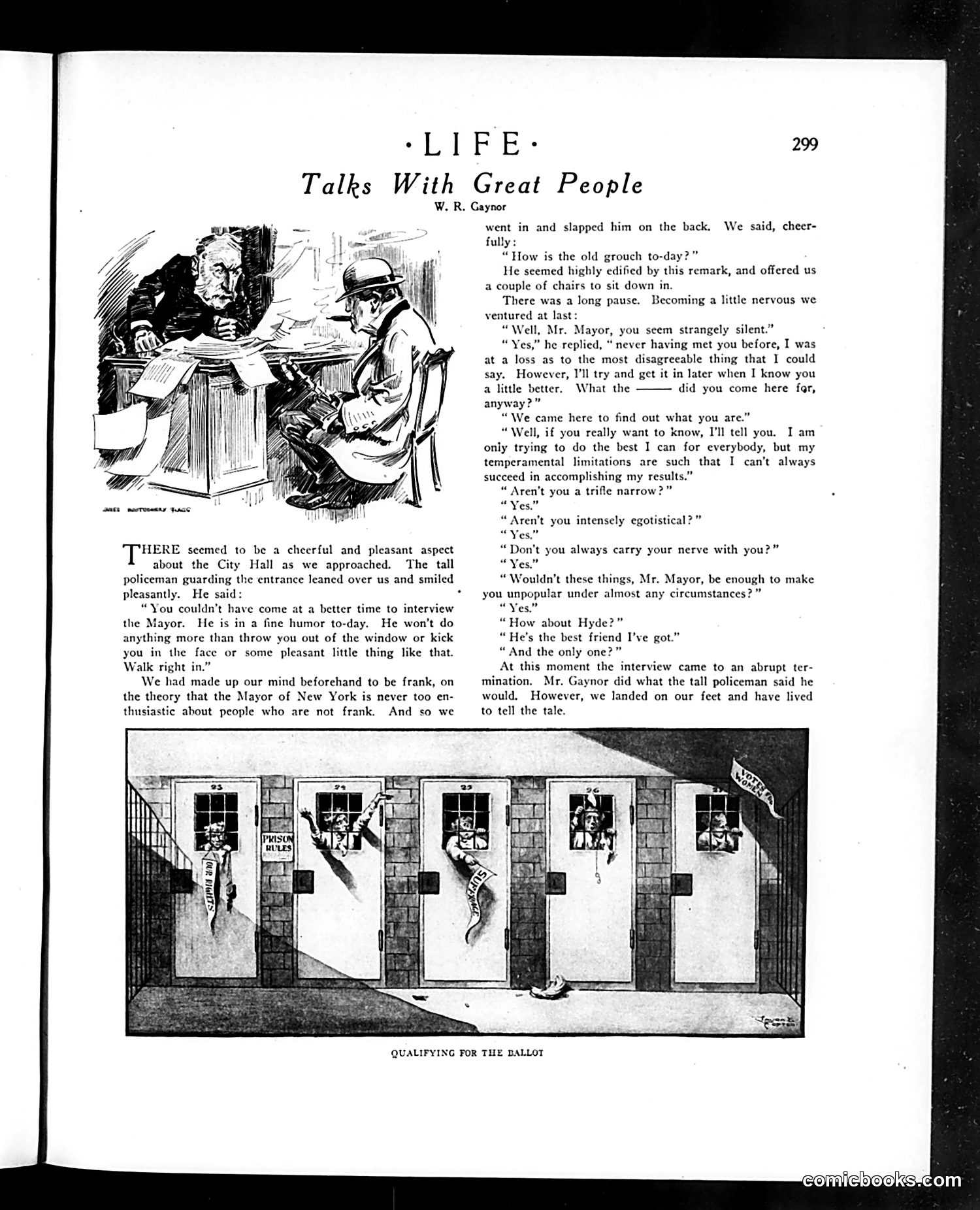
This is a satirical "interview" with W. R. Gaynor, New York City's Mayor (appears to be early 1900s based on the publication style). The humor relies on Gaynor's reputation for being irascible and confrontational. The text mocks the Mayor through a faux-interview where the interviewer asks increasingly blunt questions—calling him a "grouch," asking if he's "narrow" and "egotistical"—which Gaynor cheerfully admits to. The joke is that he's self-aware about his disagreeable nature yet unbothered by it. The bottom cartoon, "Qualifying for the Ballot," shows voting booths with figures visible through windows, apparently depicting candidates or politicians being "tested" or "qualified" for ballots—a commentary on electoral politics of the era. The overall piece uses Gaynor's well-known cantankerous personality as a vehicle for political satire about municipal leadership and democratic processes.
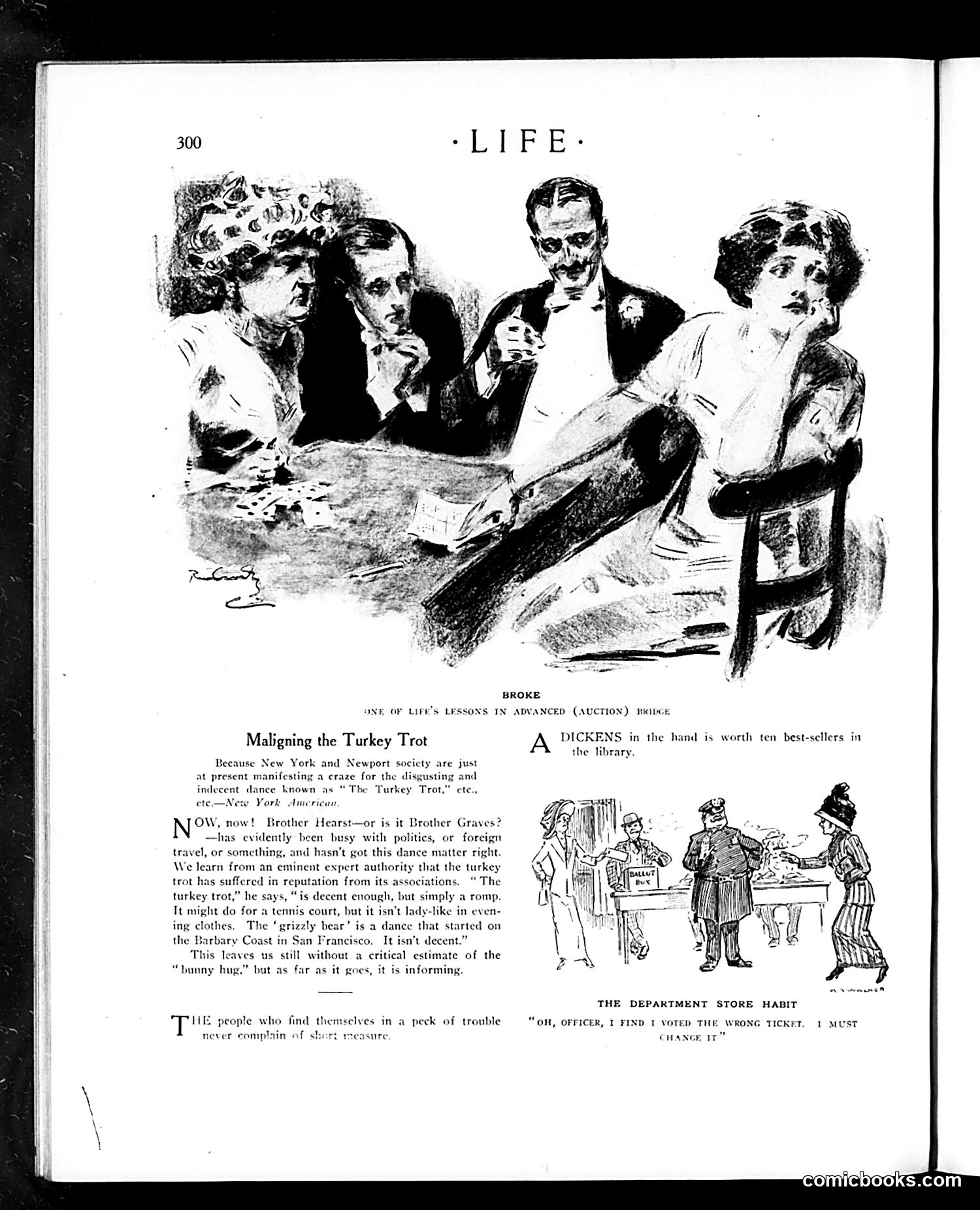
This *Life* magazine page satirizes early 1910s social anxieties about new dance crazes among wealthy New Yorkers and Newport society. The top cartoon depicts what appears to be a bridge game (titled "One of Life's Lessons in Advanced Auction Bridge"), illustrated as a social gathering. The main article mocks William Randolph Hearst's newspaper (*New York American*) for criticizing the "Turkey Trot"—a ragtime dance considered scandalous for its close partnering and hip movements. The piece humorously catalogs period dances ("grizzly bear," "bunny hug") and their supposed moral standings, satirizing both the dances themselves and society's hand-wringing about them. The bottom cartoon, "The Department Store Habit," depicts a voting mishap—someone claiming they voted for the wrong candidate and must "change it," suggesting voting fraud concerns or the absurdity of treating elections like returnable purchases. The satire targets upper-class moral panic about modern entertainment and changing social mores.
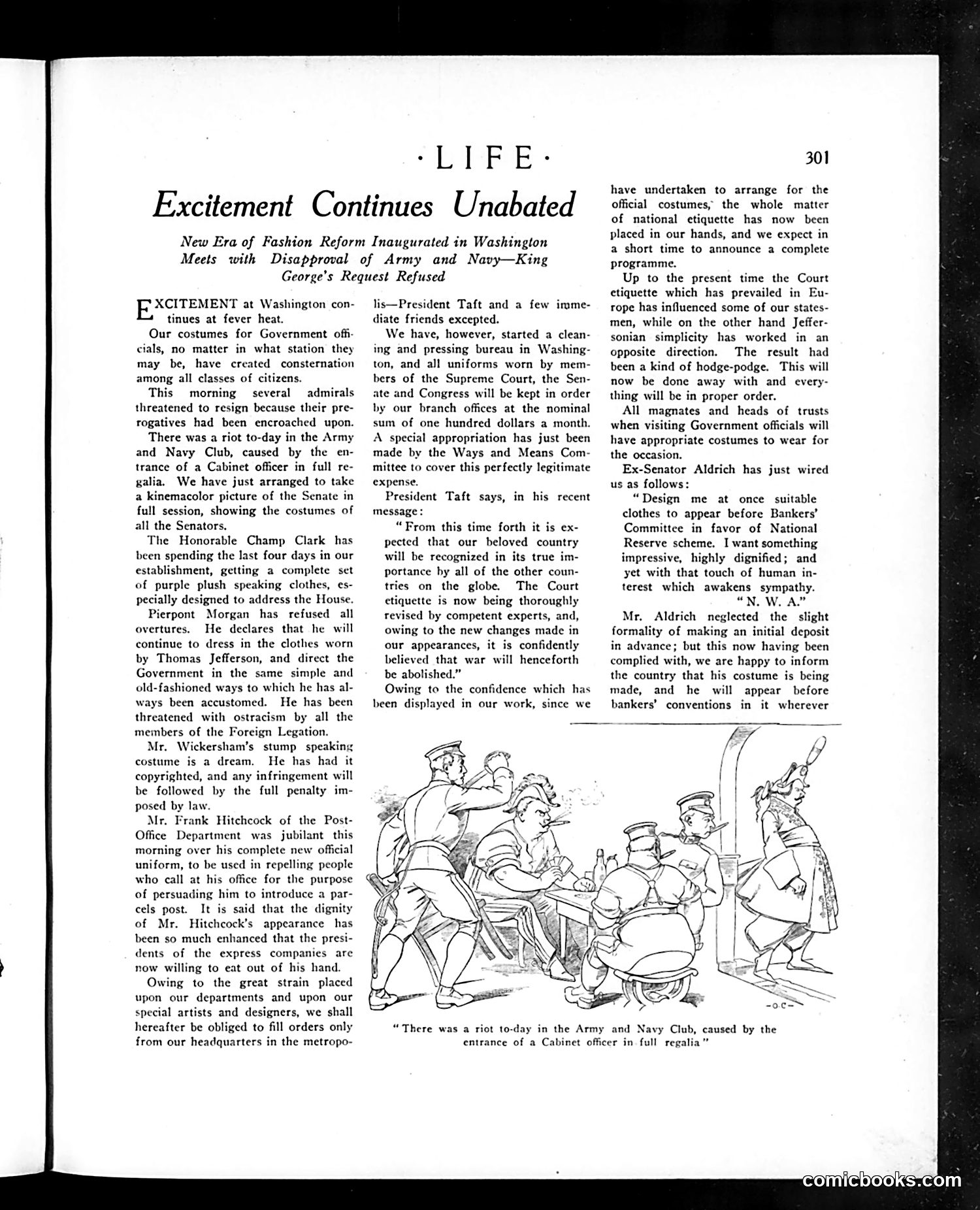
This piece satirizes President Taft's administration's supposed obsession with formal dress codes and court etiquette for government officials. The joke is that elaborate, expensive uniforms and ceremonial clothing have become so important that they're disrupting government operations—admirals threaten to resign, riots erupt at the Army-Navy Club, and Congress requires a special appropriation just to maintain uniforms. The cartoon illustrates the absurdity: a Cabinet officer in "full regalia" causes chaos simply by entering a club. The satire targets both the pretentiousness of formal ceremony and the Taft administration's perceived disconnect from practical governance. References to Pierpont Morgan's deliberate rejection of fancy dress (preferring Thomas Jefferson's simplicity) and the ironic claim that uniforms will abolish war underscore the mockery. The piece lampoons how superficial formality has allegedly eclipsed substantive government work.
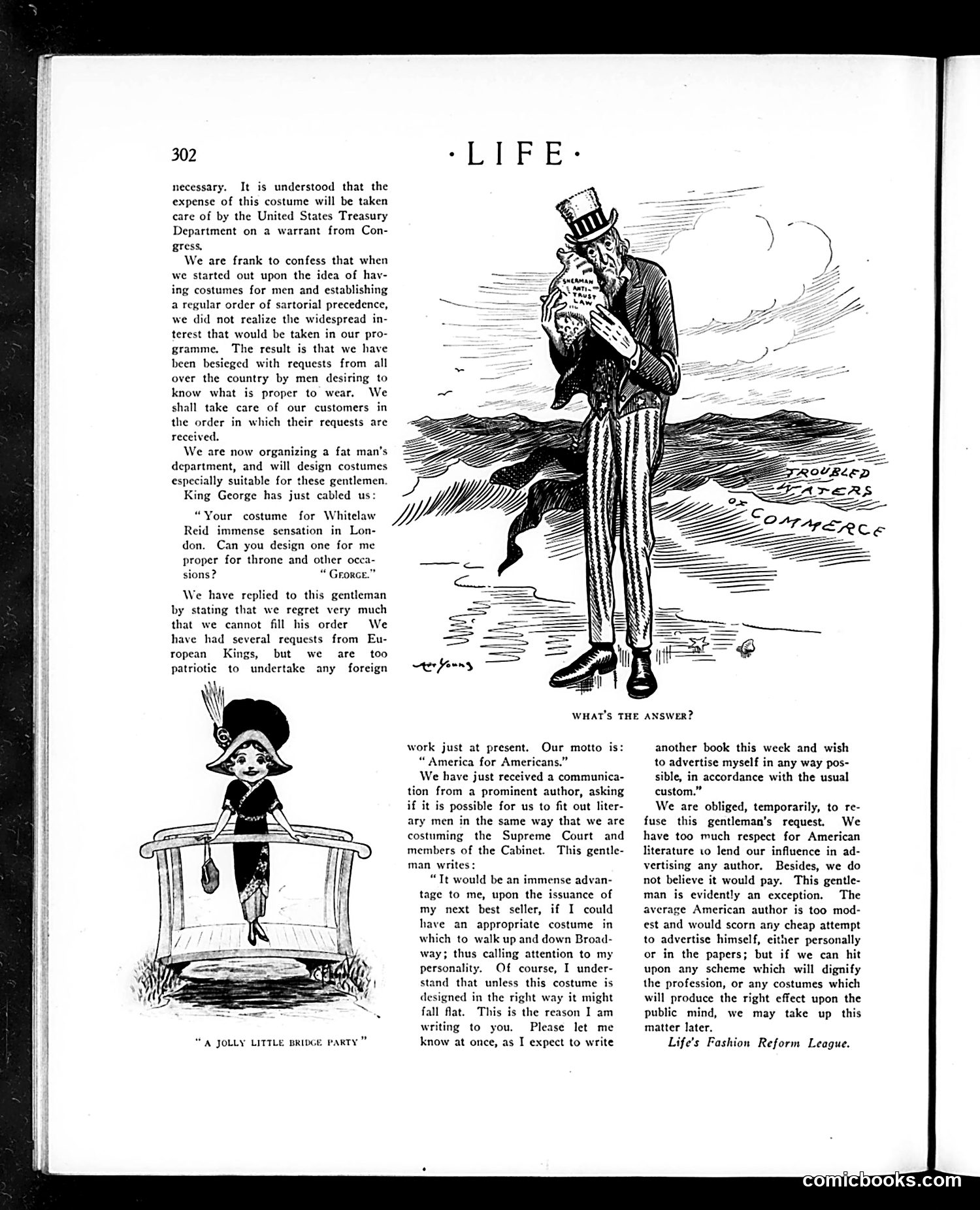
This page satirizes the early-20th-century American obsession with formal dress codes and official ceremonies. The main cartoon depicts Uncle Sam in top hat and striped trousers, labeled with references to "troubled waters" and "commerce"—suggesting government intervention in everyday life through costume regulation. The text mocks a fictional "Fashion Reform League" proposing standardized costumes for Supreme Court justices, Cabinet members, and other officials, with expenses covered by Congress. The satire escalates through absurd requests: King George asking for a throne costume, and an author wanting promotional attire to advertise his books on Broadway. The joke targets American pretension and conformity—the irony that a self-proclaimed "patriotic" organization refuses to serve foreign kings while pursuing elaborate domestic costume schemes. The "fat man's department" and dismissal of vain authors add layers of social mockery. The leftside cartoon titled "A Jolly Little Bridge Party" remains unclear without additional context.
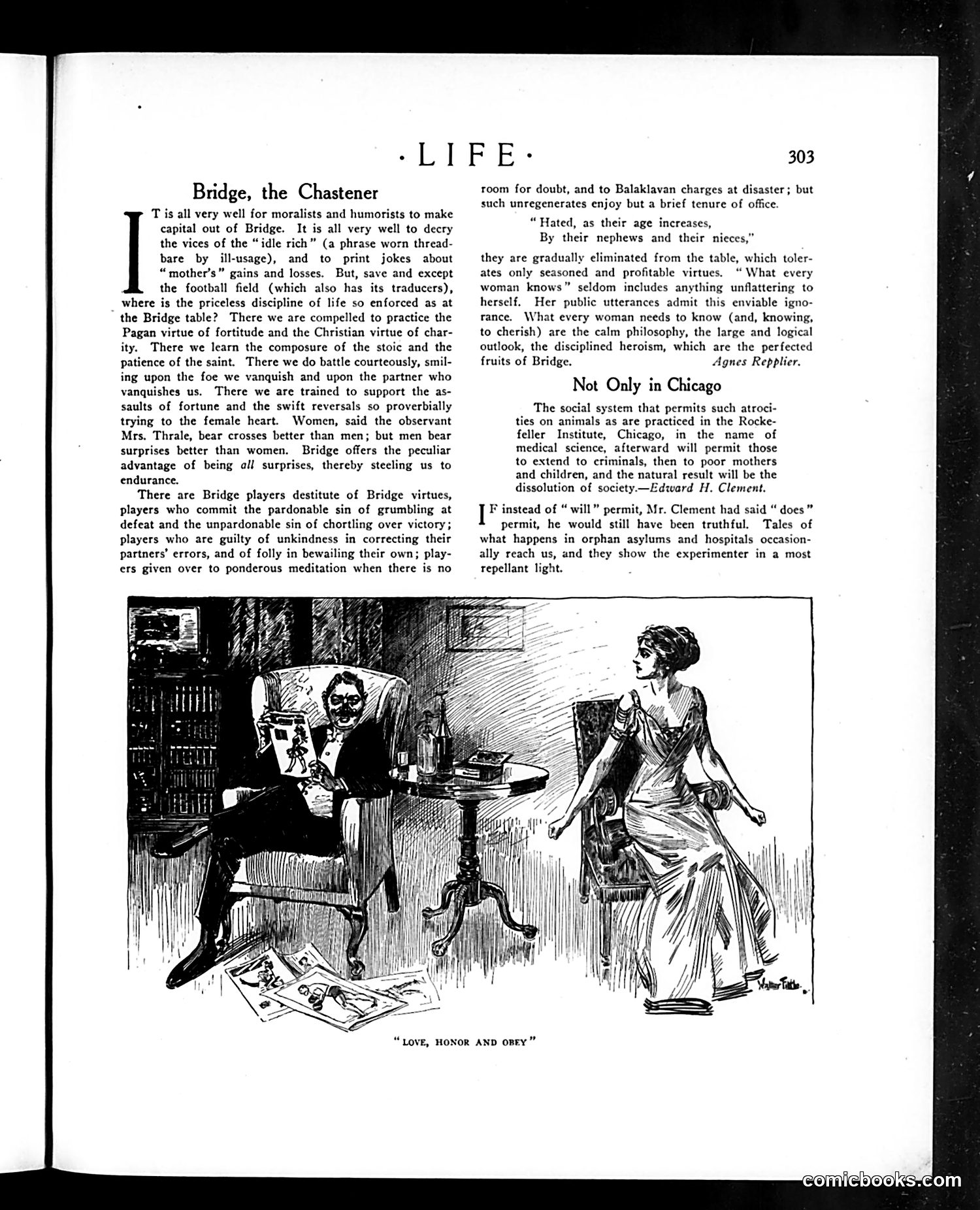
The page contains two distinct pieces of social commentary: **"Bridge, the Chastener"** (main article) sarcastically praises the card game Bridge as a moral teacher, claiming it instills virtues like fortitude, charity, and composure. The irony is that Bridge is actually associated with the leisured "idle rich" and gambling losses—vices the article pretends to defend. The piece gently mocks wealthy women by suggesting they learn emotional discipline from card games. **The accompanying illustration** ("Love, Honor and Obey") shows a man reading while a woman gestures—likely depicting marital discord over Bridge playing or gambling debts, reinforcing the article's satirical point about Bridge's real social consequences. **"Not Only in Chicago"** briefly critiques animal experimentation at the Rockefeller Institute, warning that permitting such practices on animals will eventually extend to human experimentation on vulnerable populations (criminals, the poor, children), leading to social dissolution. Both sections reflect early 20th-century anxieties about modern institutions, class behavior, and scientific ethics.
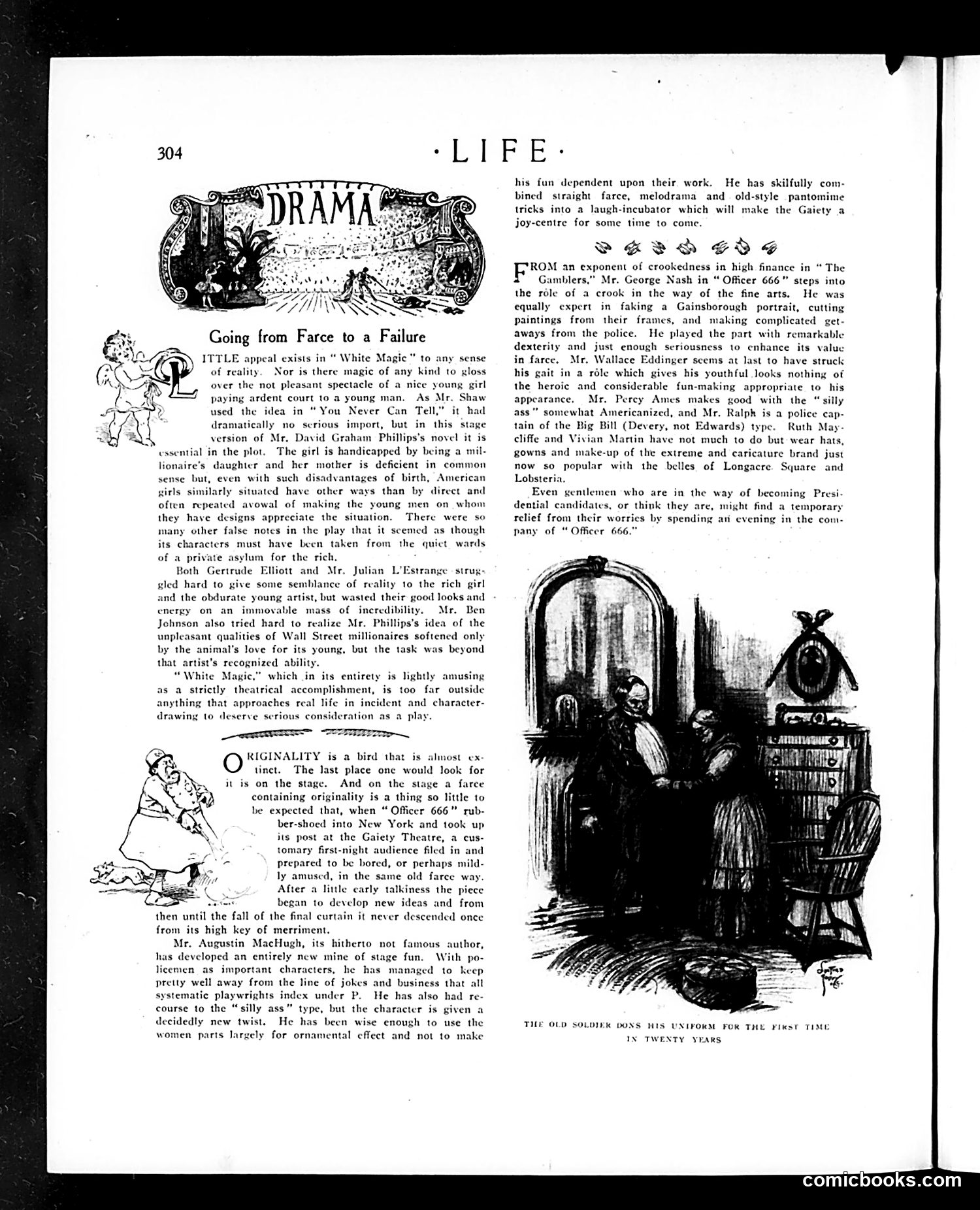
This page contains theatrical reviews from Life magazine's drama section. The main critiques discuss two plays: **"White Magic"** receives harsh dismissal as unrealistic and poorly executed. The reviewer criticizes the plot device of a wealthy young woman directly courting a man as implausible and undramatic, even though George Bernard Shaw had used similar material successfully. Actors Gertrude Elliott and Julian L'Estrange are blamed for trying to salvage an "immovable mass of incredibility." **"Officer 666"** is praised as genuinely original farce. The reviewer celebrates author Augustin MacHugh for creating fresh comic material centered on policemen rather than relying on tired theatrical conventions. Actor George Nash receives particular praise for his role as an art forger, while Wallace Eddinger is noted for finally finding a role suited to his youthful appearance. The illustration shows an elderly soldier in uniform encountering what appears to be a cuckoo clock or similar device—likely accompanying a separate theater review not fully visible here.
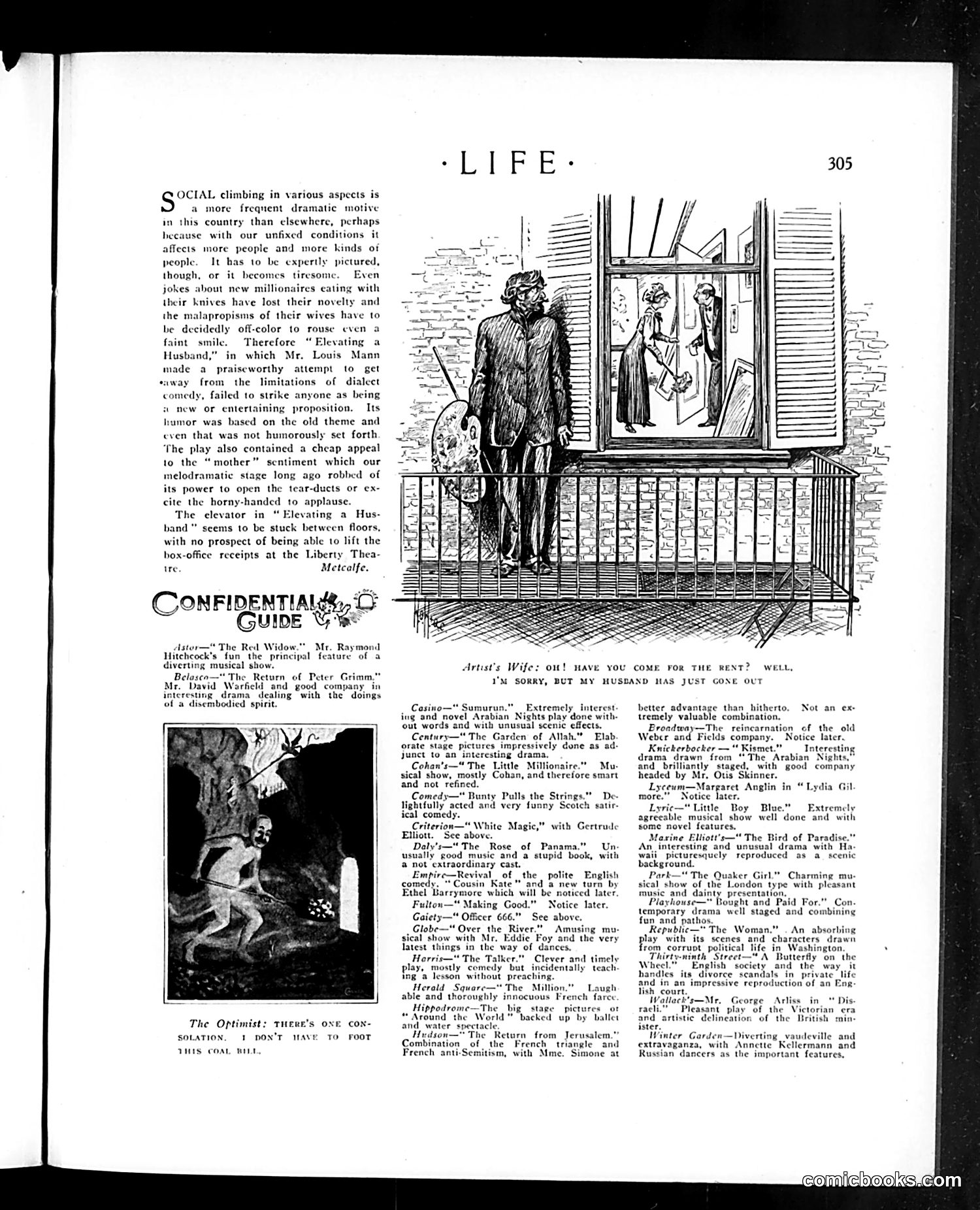
This page contains theater reviews and two cartoons satirizing social climbing and artistic pretension in early 20th-century America. **The Main Cartoon ("Artist's Wife"):** A man stands on a fire escape in shabby clothing while his wife leans from a window demanding rent. He apologizes that his husband has "just gone out"—a non-sequitur joke playing on the artist couple's poverty despite aspirations to refinement. The satire targets struggling artists who maintain pretenses of sophistication while unable to pay basic bills. **"The Optimist" Cartoon:** Shows a man confidently stating he won't pay his coal bill because he has "one consolation"—another absurdist joke mocking delusional optimism in financial hardship. **Context:** The opening essay criticizes the play "Elevating a Husband" for recycling tired "new money" jokes (millionaires with poor manners, wives who mangle language) that no longer amuse. The satire reflects Gilded Age anxiety about social mobility and the difficulty of depicting class climbing freshly—the comedy has worn thin because social climbing itself was so pervasive.
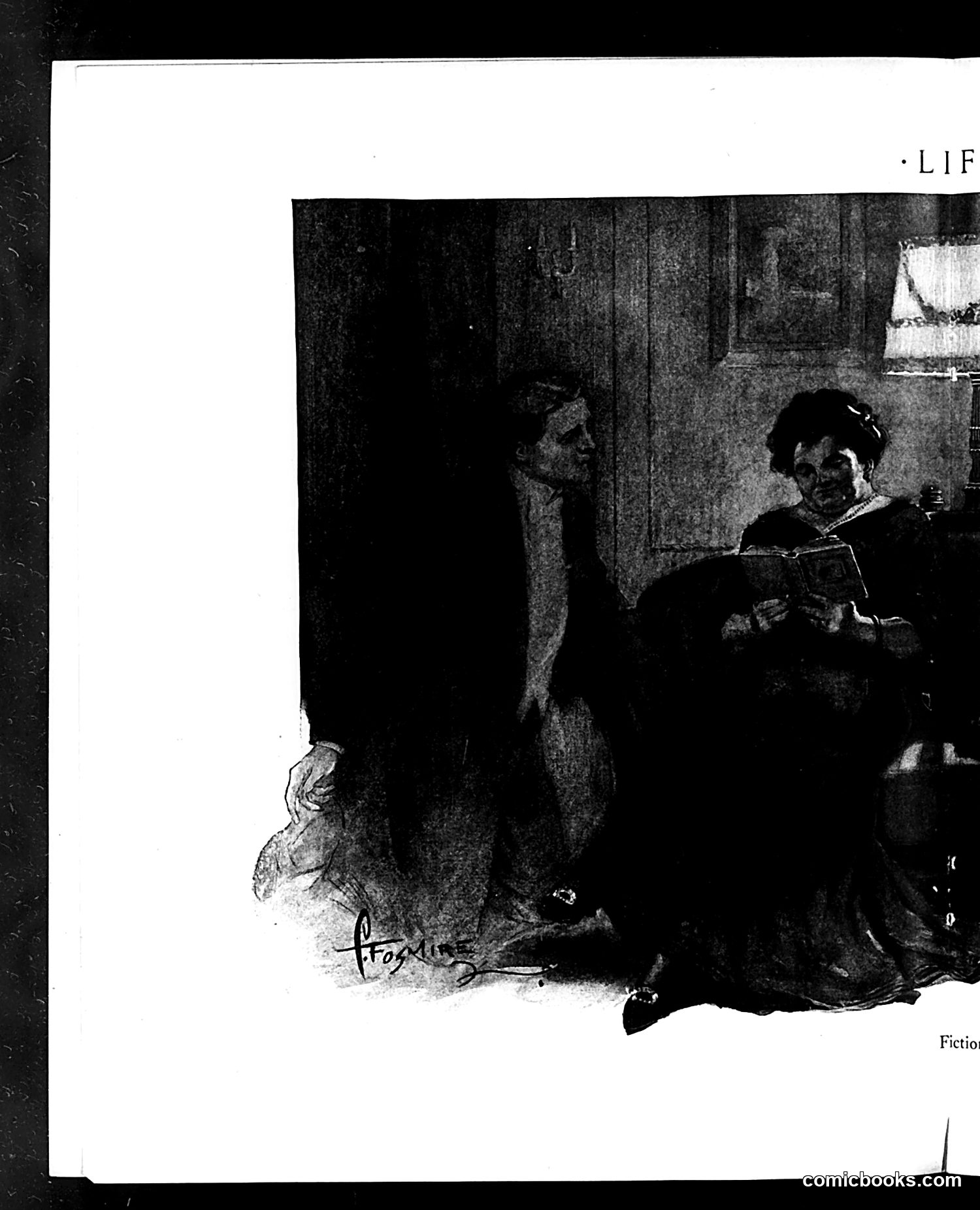
This appears to be an illustration (signed, likely by a staff artist) depicting an interior domestic scene. On the right, a woman sits reading what appears to be a magazine or publication. On the left, a man's profile is visible in shadow. The setting suggests a home interior with period furnishings. Without visible text identifying the specific figures or context, I cannot definitively state what political or social satire this represents. The image quality and black-and-white reproduction make precise identification difficult. The page appears to be labeled "Fiction" at the bottom, suggesting this may be an illustration accompanying a story rather than a political cartoon. More context or clearer text would be needed to explain the satirical intent to a modern reader.
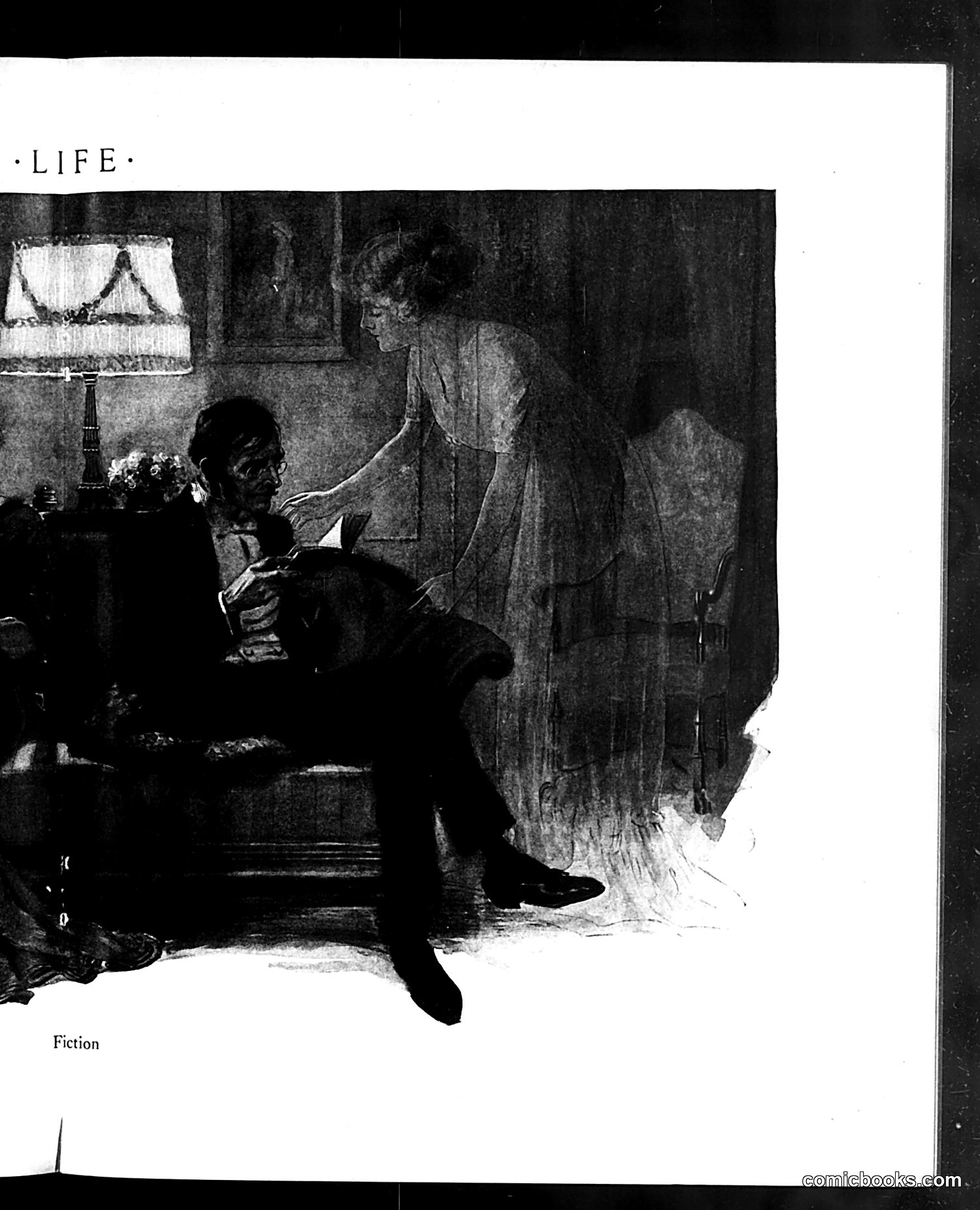
This page from *Life* magazine marks the "Fiction" section. The illustration depicts an indoor domestic scene rendered in dark, shadowy tones. A man sits reading while a woman in an elegant, flowing gown stands nearby. The room contains period furnishings including a lamp with decorative shade and flowers. The image appears to be satirizing genteel domestic life or perhaps the tension between spouses—a common theme in *Life's* social commentary. The woman's dramatic pose and ethereal dress contrast with the man's absorbed attention to his reading, suggesting commentary on disconnection or theatrical domesticity. The shadowy, dramatic rendering emphasizes the satirical tone typical of *Life's* fiction illustrations, which often mocked upper-class social conventions and marital dynamics of the era.
This satirical piece uses the metaphor of an Eagle (symbol of America) being X-rayed to critique how American history is traditionally portrayed versus reality. The joke: The Eagle, vain and pompous, sits for a portrait thinking it's visiting a fashionable photographer. Instead, A.M. Simons runs an X-ray machine on it, revealing the "skeleton" beneath—the unglamorous economic and industrial infrastructure supporting the nation. The satire targets romantic, sanitized versions of American history (previously depicted as "leaning against a cherry tree, draped in Patrick Henry's orations"). Simons's book "Social Forces in American History" promises instead a "skeleton history"—showing the bare economic bones and production systems underlying society, stripped of patriotic flourishes. The cartoon lampoons both American vanity about its own history and the conventional heroic narrative, suggesting the real story lies in unglamorous material and economic forces, not idealized mythology.
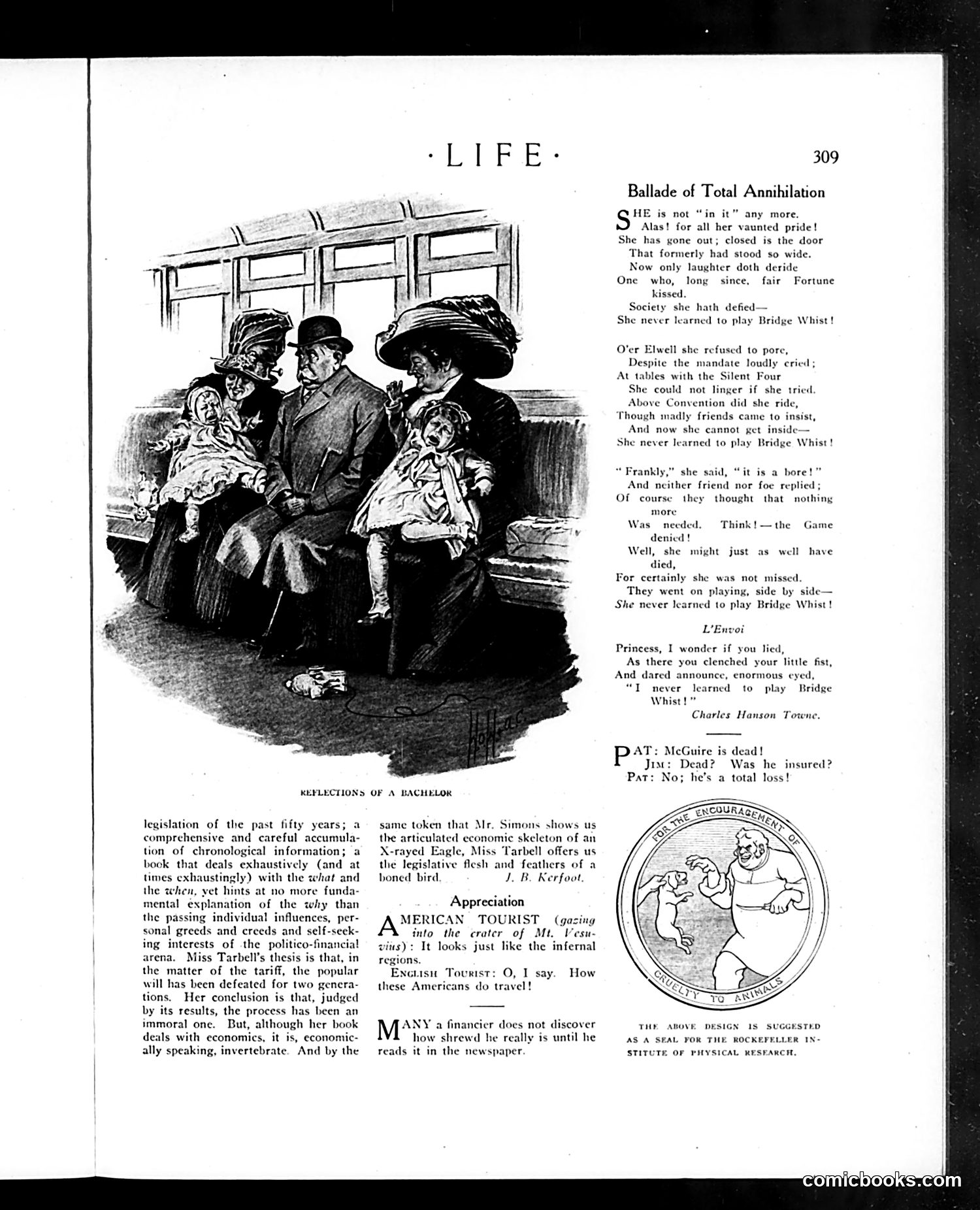
This page satirizes early 1900s American social conventions and economics through three pieces: **"Ballade of Total Annihilation"** mocks a society woman ruined by refusing to learn Bridge Whist (a card game). The poem's repeated refrain—"She never learned to play Bridge Whist!"—suggests that social ostracism followed her rejection of fashionable pastimes, ultimately destroying her social position. The satire targets rigid upper-class conformity: a woman's entire standing depends on mastering trivial parlor games. **The illustration** (captioned "Reflections of a Bachelor") shows a domestic scene, likely reinforcing bachelor commentary on marriage and society. **"Appreciation"** contains a brief joke contrasting American and English tourists at Mt. Vesuvius—the American's crude comparison and casual manner of travel amuse the English observer, reflecting period stereotypes about American vulgarity abroad. The page also reviews economics books by Miss Tarbell on tariffs, and includes a dark joke about an uninsured death ("McGuire is dead... he's a total loss"). Overall, the content reflects 1900s preoccupations: social conformity, gender roles, class distinction, and American character abroad.
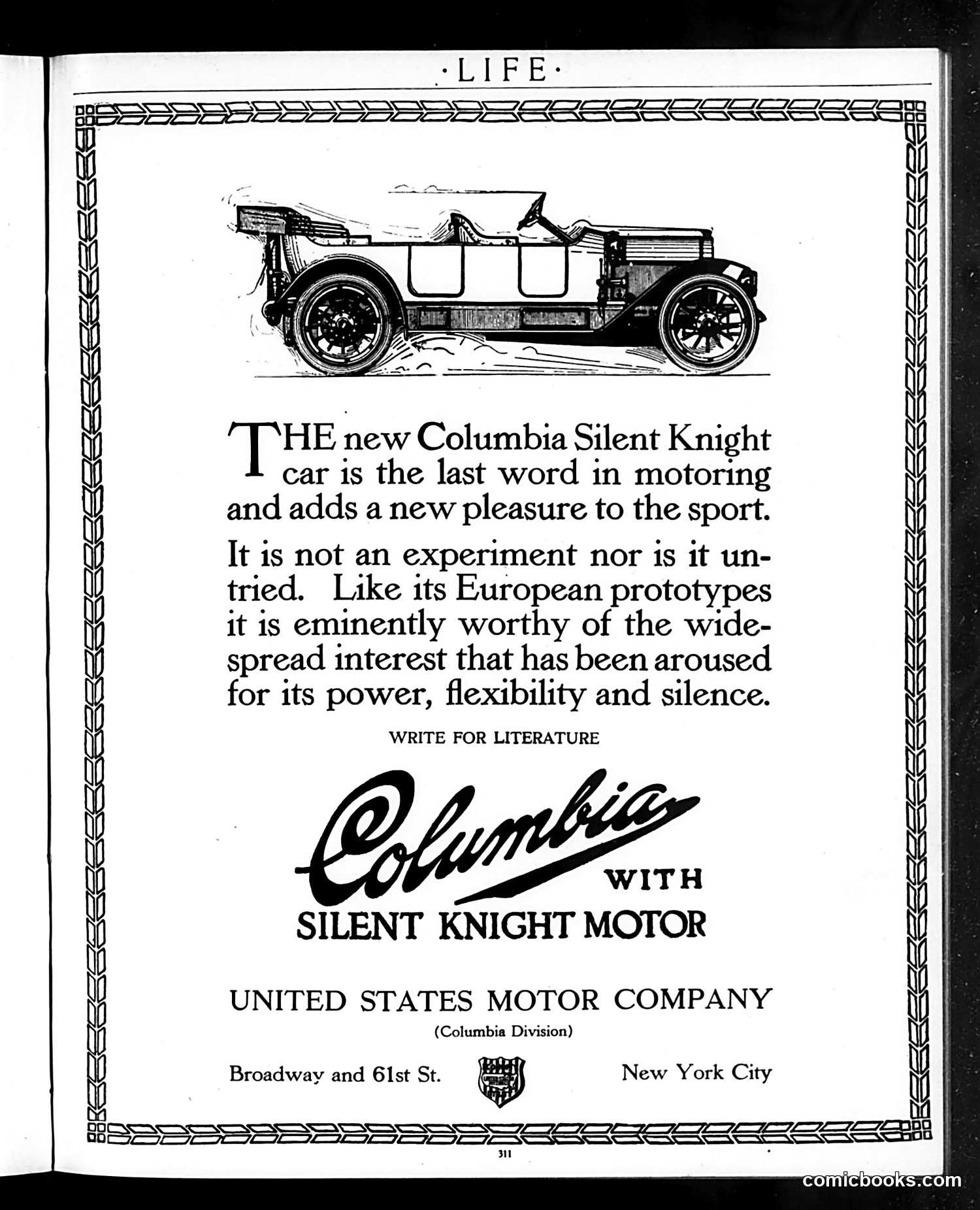
This is a straightforward **automobile advertisement**, not political satire. It promotes the Columbia Silent Knight car, manufactured by United States Motor Company's Columbia Division in New York City. The ad emphasizes the vehicle's three main selling points: **power, flexibility, and silence**—the latter being notable for early 1910s automobiles, which were notoriously loud. The "Silent Knight motor" appears to be a specific engine technology that was apparently well-regarded, with European prototypes already establishing credibility. The illustration shows a open-air touring car typical of the era. The copy addresses buyers interested in "motoring as a sport," suggesting this was marketed to relatively affluent consumers. The phrase "write for literature" was standard advertising practice of the period, inviting interested readers to request detailed product information by mail. There is no satire present—this is genuine period advertising from *Life* magazine.
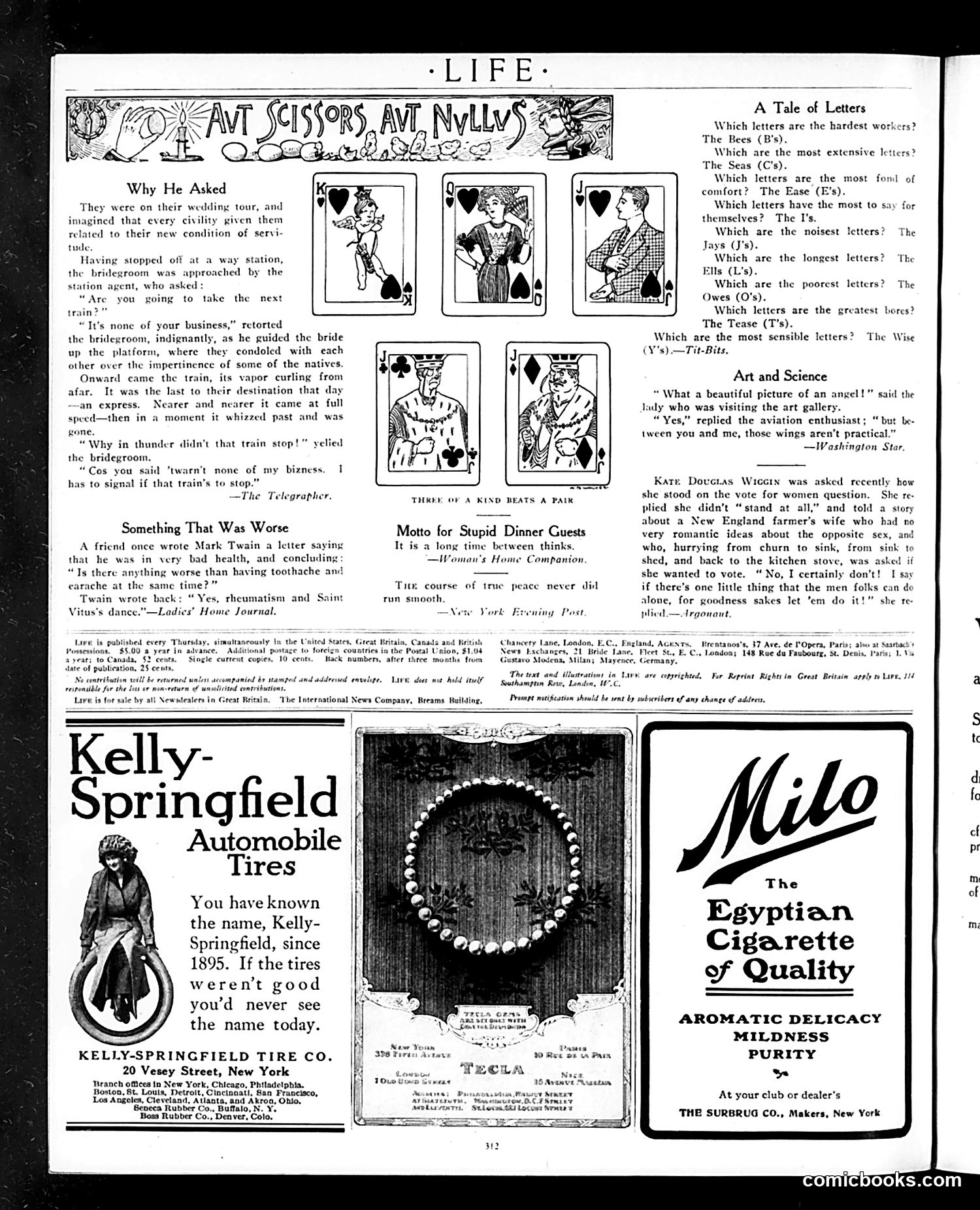
This page contains several brief humorous anecdotes and wordplay puzzles typical of early 20th-century American satirical magazines, interspersed with period advertisements. The main content includes: 1. **"Why He Asked"**: A joke about a newlywed bridegroom snapping at a station agent, then complaining when a train doesn't stop—the telegraph operator reveals he didn't signal the train because the groom said it was "none of [his] business." 2. **"A Tale of Letters"**: Pun-based riddles playing on homophones (B's/Bees, C's/Seas, I's/Eyes), typical of the era's wordplay humor. 3. **"Something That Was Worse"**: A Mark Twain anecdote comparing ailments. 4. **"Art and Science"**: A joke mocking aviation enthusiasts who critique angel paintings for impractical wings. 5. **Women's Suffrage reference**: A story about a New England farmer's wife opposing voting, presented as humorous resistance. The advertisements (Kelly-Springfield Tires, Milo Cigarettes) occupy roughly one-third of the page, standard for this publication.
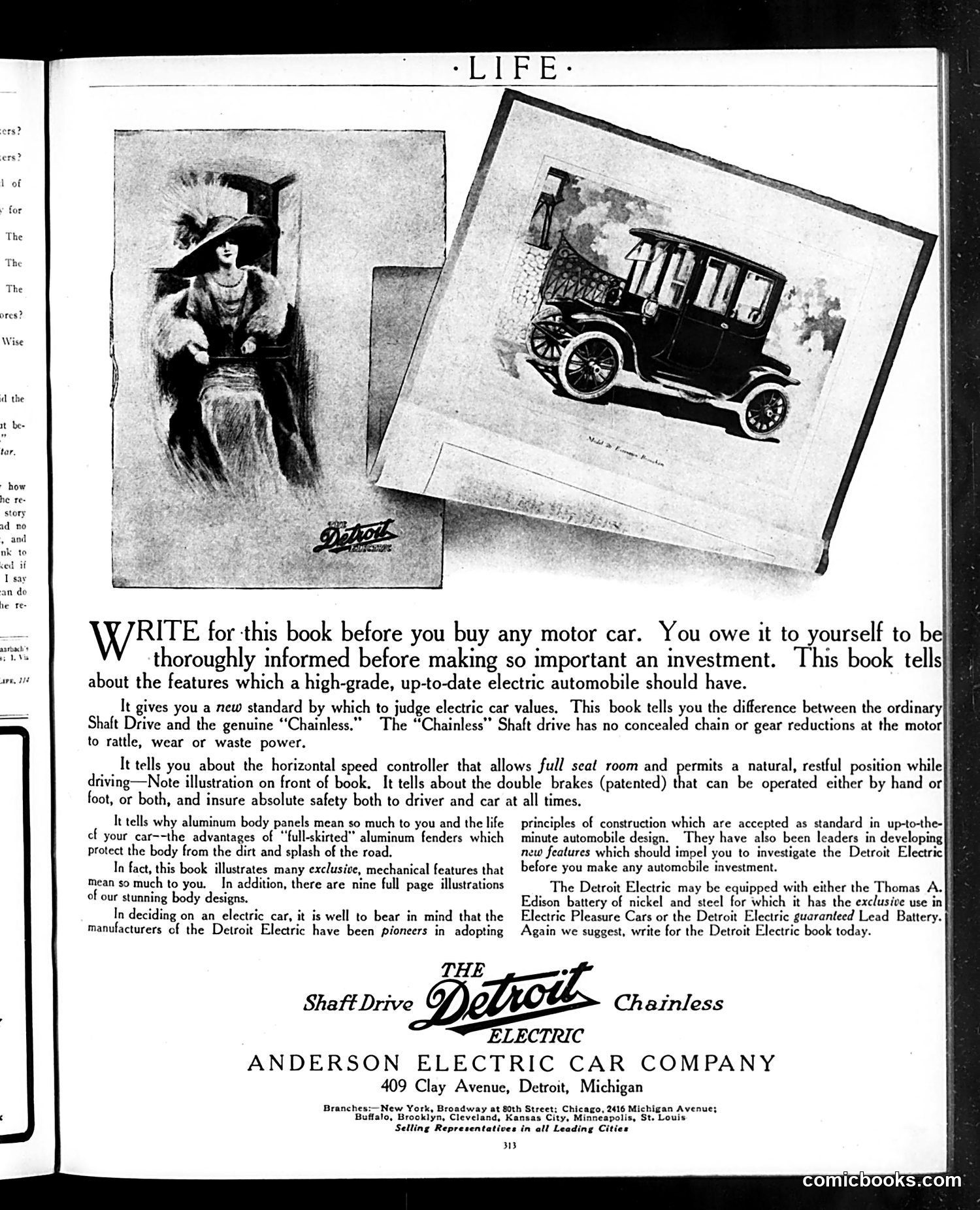
This page is primarily a **Detroit Electric automobile advertisement**, not satire or political commentary. The two images show: (left) a fashionably dressed woman in a hat and fur coat; (right) a Detroit Electric "Chainless" motorcar. The ad targets early-20th-century consumers considering automobile purchases, positioning the Detroit Electric as a sophisticated choice for upscale buyers—note the elegant female figure suggesting the car's appeal to wealthy women. The text emphasizes technical innovations: the "Chainless" shaft drive, aluminum body panels, horizontal speed controller, and patented double brakes. It references Edison batteries as an exclusive feature, leveraging Thomas Edison's famous name for credibility. This reflects the era when **electric vehicles competed seriously with gasoline cars**—a fact modern readers often forget. The ad's focus on quiet operation, ease of control, and stylish design reveals how electrics were marketed as refined alternatives to noisy, difficult-to-operate gas automobiles. The prominence of the well-dressed woman reflects marketing to affluent female consumers of the period.
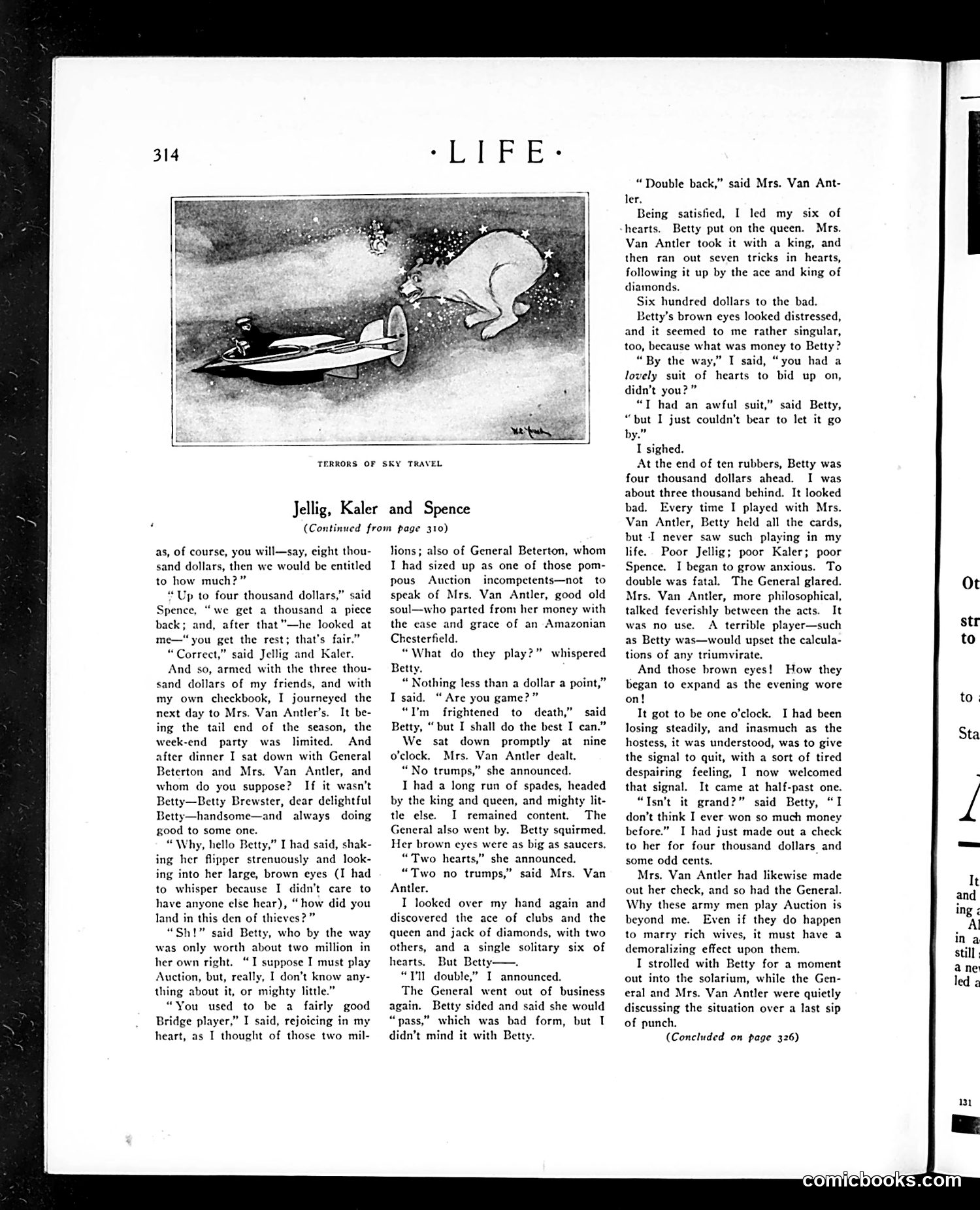
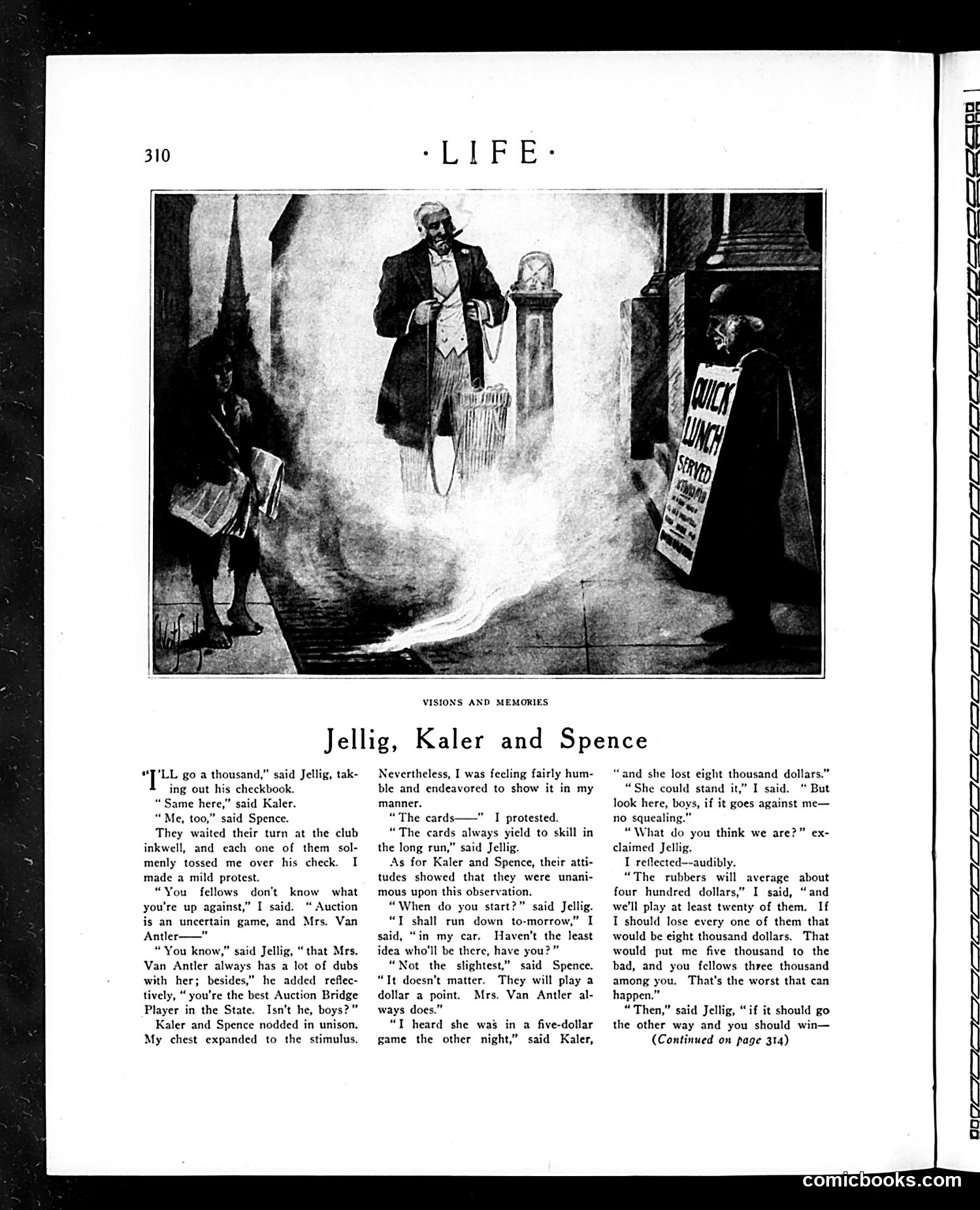
This page continues a serialized story about high-stakes Auction Bridge (a card game popular in the 1920s-30s). The cartoon at top illustrates "sky travel" anxieties—showing an airplane passenger in distress. The text describes a narrator who recruits friends' money to gamble at cards with wealthy socialites: General Beterton, Mrs. Van Antler, and the attractive "Betty Brewster" (worth two million dollars). The satire targets: - **Class aspirations**: The narrator schemes to exploit rich people at cards - **Women's economic power**: Betty, despite claiming ignorance of cards, systematically beats the men through superior play - **Gender stereotypes**: Her "brown eyes" and feminine charm mask shrewd card-playing ability; the men underestimate her - **Gambling culture**: The casual, escalating bets among the wealthy The joke is that the calculating narrator—confident in exploiting "incompetent" wealthy players—gets outplayed by a woman he dismissed as merely decorative.
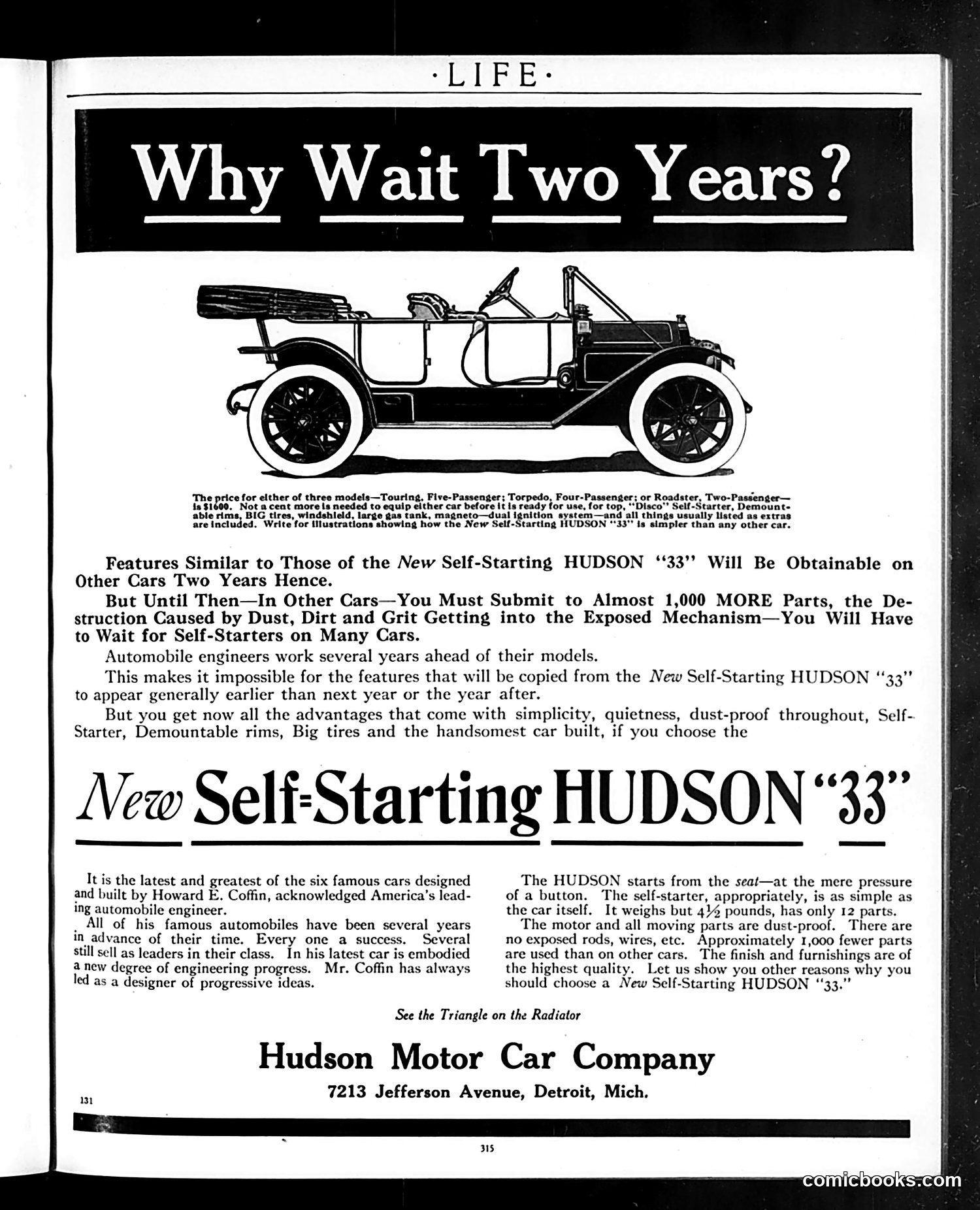
This is a **car advertisement**, not political satire. It promotes Hudson Motor Car Company's new "Self-Starting Hudson '33" automobile. The ad's central argument addresses consumer hesitation about buying a new model: "Why Wait Two Years?" It claims that while competitors will eventually copy Hudson's innovations (electric self-starter, dust-proof engine, demountable rims), buyers shouldn't delay. The text argues that other cars require "almost 1,000 MORE parts" and expose mechanisms to dust and dirt damage. The advertisement emphasizes Howard E. Coffin as Hudson's designer and appeals to buyers' desire for cutting-edge technology. The humor lies in the rhetorical framing—essentially: "Why wait for competitors to catch up when you can have superior engineering *now*?" The illustration shows the car itself as a straightforward product image, typical of early-1900s automotive advertising in *Life* magazine.
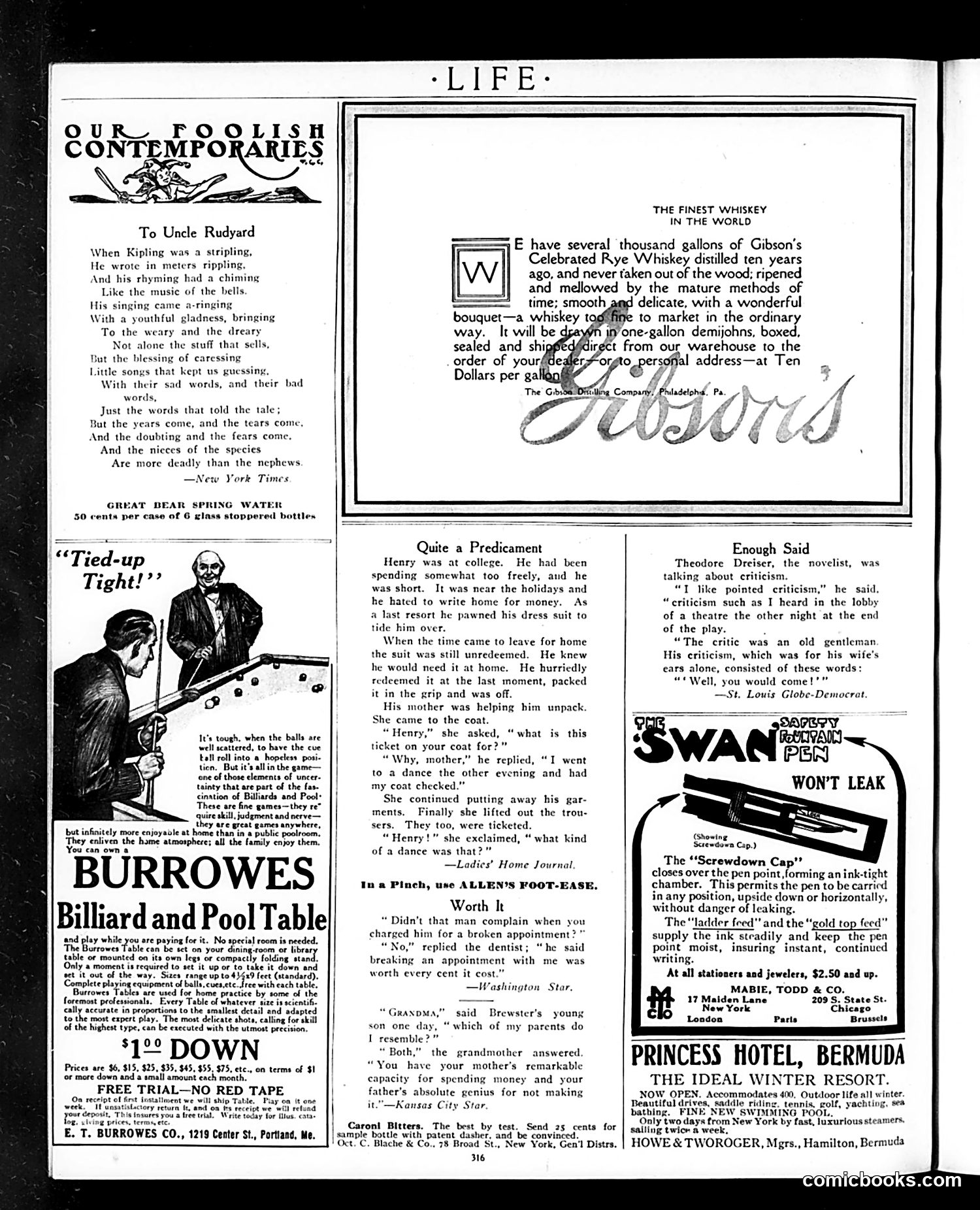
This page from *Life* magazine contains mostly **advertisements and humorous short stories** rather than political cartoons. The key content includes: **"To Uncle Rudyard"** — A poem mocking writer Rudyard Kipling's shift from serious, meaningful work ("Little songs that kept us guessing") to commercial writing. The satire suggests that as Kipling aged, his work became less artistically valuable ("the nieces of the species / Are more deadly than the nephews"). **"Quite a Predicament"** — A mild joke about a college student who pawned his dress suit and later hid pawn tickets from his mother by claiming he'd checked his coat at dances. The rest of the page features advertisements for whiskey, billiard tables, fountain pens, and other consumer goods—typical of *Life*'s revenue model. The publication mixed satire with advertising to appeal to middle-class readers. No specific political figures or events are referenced on this particular page.
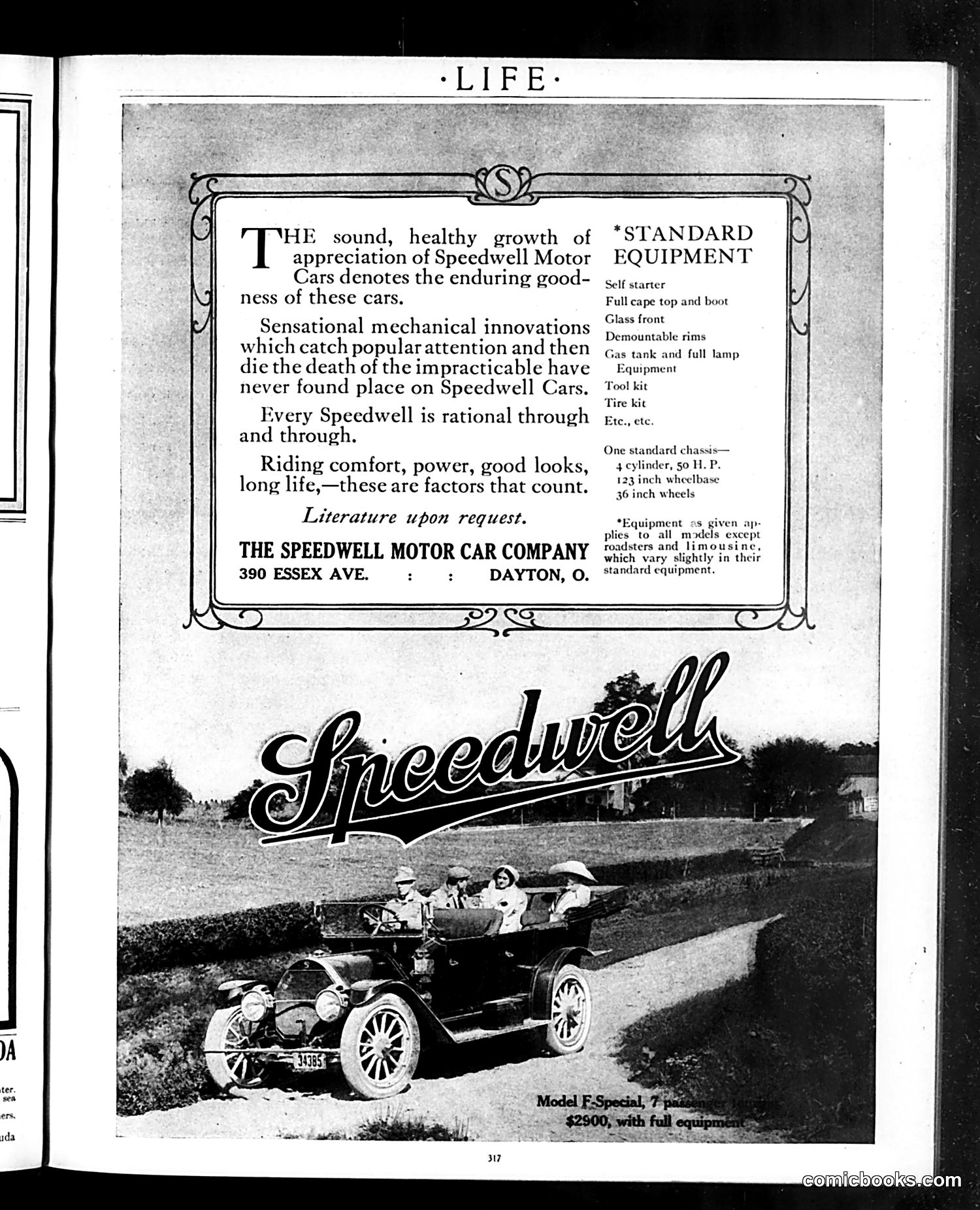
This page is primarily **automobile advertising**, not satire or political commentary. It features an advertisement for the Speedwell Motor Car Company of Dayton, Ohio, promoting their Model F-Special touring car (priced at $2,500 with full equipment). The ad's text emphasizes practical engineering—"rational through and through"—claiming Speedwell avoids impractical mechanical fads while delivering comfort, power, appearance, and longevity. The photograph shows the car on a country road with passengers, conveying reliability and leisure. There is **no cartoon or satirical content** visible on this page. The decorative border and classical typography are typical period advertising design. This represents standard early-20th-century automotive marketing in *Life* magazine, which regularly carried advertisements alongside its satirical content. The page is essentially a straightforward product promotion emphasizing engineering virtue over novelty.
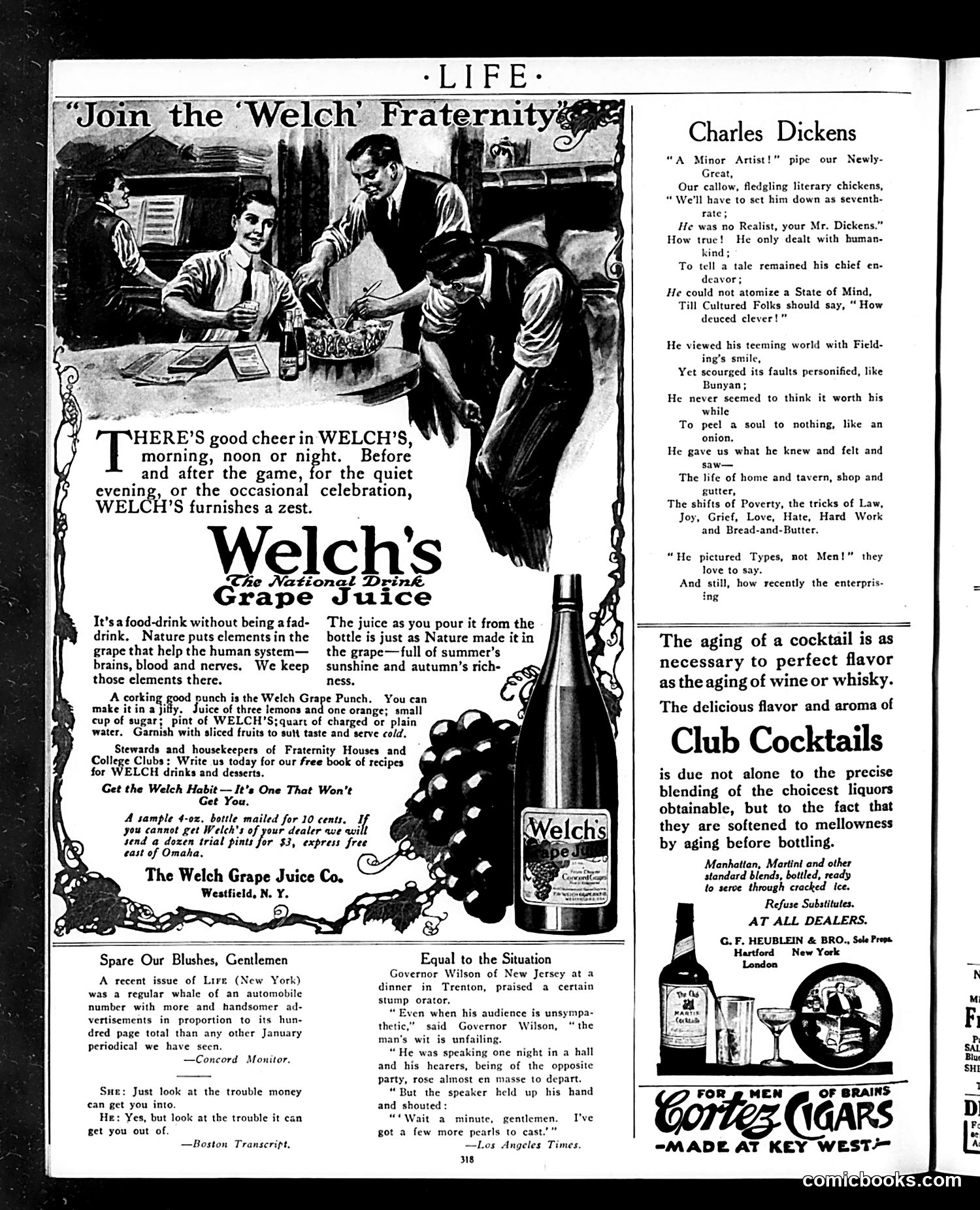
This page consists primarily of **advertisements** interspersed with light editorial content. The major ads are for Welch's Grape Juice (depicting a social fraternity scene) and Club Cocktails. The substantive content is a **poem praising Charles Dickens**, defending him against contemporary literary criticism. The poem argues that modern "cultured folks" dismiss Dickens as a mere "minor artist" and "type painter" rather than a serious psychological realist. The author defends Dickens's merit, contending he authentically captured human life—poverty, work, love, grief—without pretentious psychological dissection ("peeling a soul"). This reflects early-20th-century literary debates between realists/modernists and traditional novelists. The page also includes three brief humorous anecdotes under headings like "Spare Our Blushes, Gentlemen" and "Equal to the Situation," typical of Life's satirical comment on contemporary manners and politics.
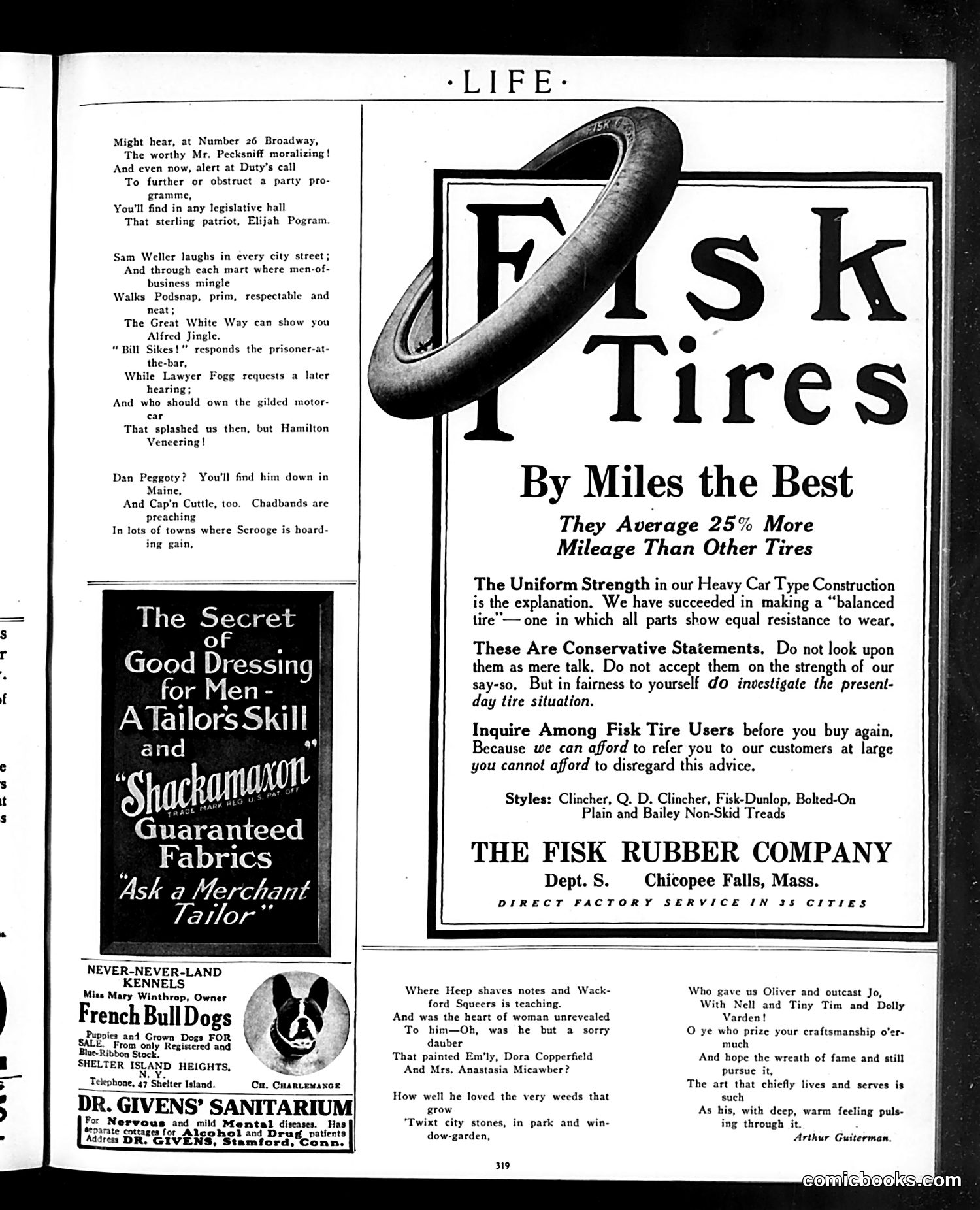
This page is primarily **advertising** for Fisk Tires, with a poetic tribute to Charles Dickens in the left column. The poem, attributed to Arthur Guiterman, celebrates Dickens by referencing his famous characters—Pecksniff, Elijah Pogram, Sam Weller, Podsnap, Scrooge, Bill Sikes, and others—showing how Dickens's creations populate American life ("You'll find him down in Maine," "preaching in lots of towns"). The tribute culminates in praising Dickens's artistic achievement and emotional depth over mere fame-seeking. The main advertisement features a large tire image with the Fisk Tires brand name and claims of 25% better mileage. The copy emphasizes "balanced tire" construction and encourages readers to investigate independently before buying. Additional small ads promote: Shackamaxon fabric for tailors, French Bulldogs from a kennel, and Dr. Givens' Sanitarium for nervous/alcohol-related conditions. The page reflects early 20th-century American consumer culture and literary appreciation.
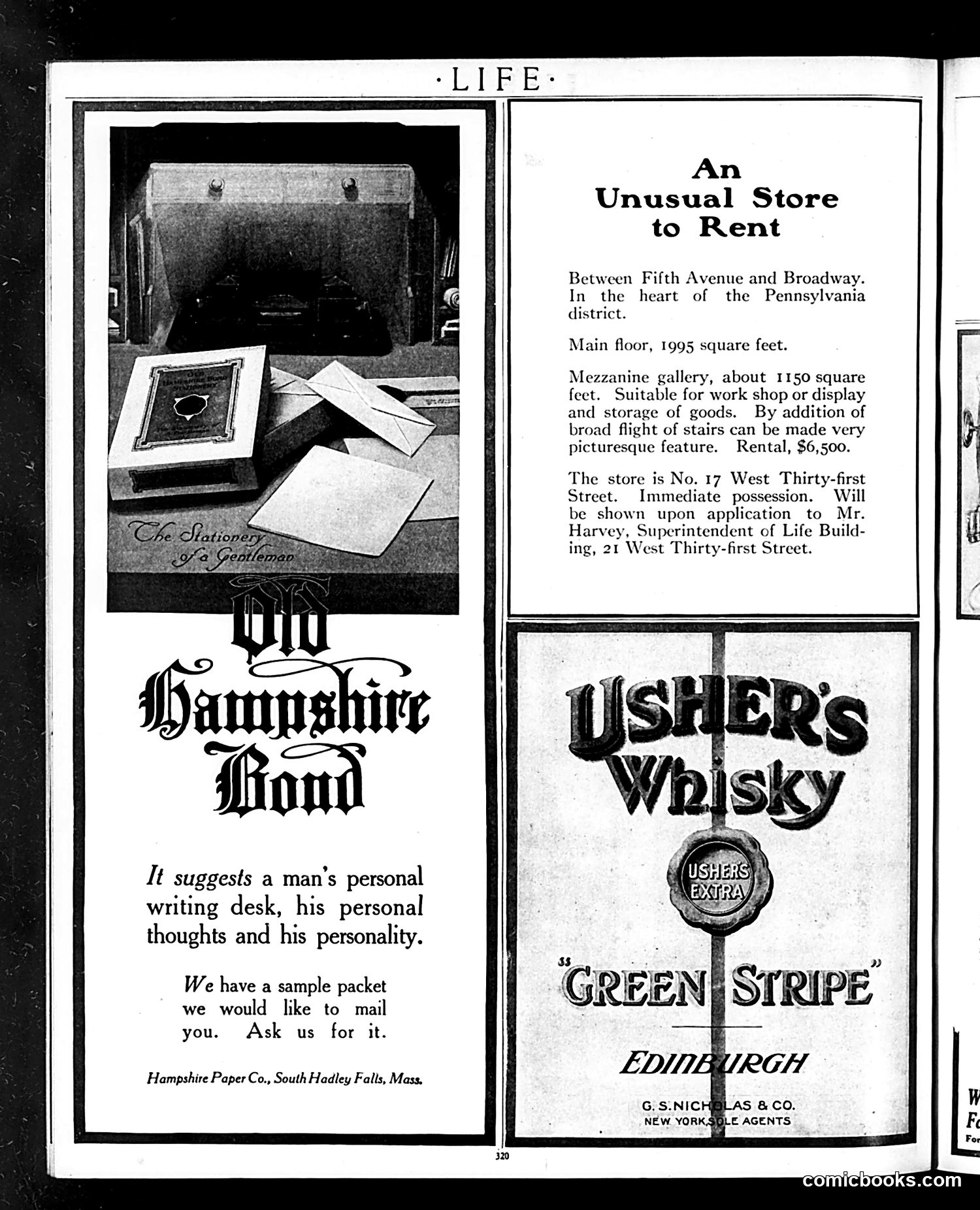
This page is primarily advertising, not satire or political commentary. It contains three ads: 1. **Hampshire Bond stationery** (left): Markets writing paper as reflecting a man's personality and taste, offering sample packets to interested readers. 2. **Real estate listing** (top right): A Life magazine property advertisement for a commercial store space in Manhattan (West 31st Street, near the Pennsylvania district), available for immediate rental at $6,500. 3. **Usher's Whisky** (bottom right): A Scottish whisky brand advertisement highlighting their "Green Stripe" variety, distributed by G.S. Nicholas & Co. in New York. There is no political cartoon or satirical content visible here—this is a standard magazine advertising page from an era when Life magazine derived revenue from commercial advertisements alongside its editorial content.
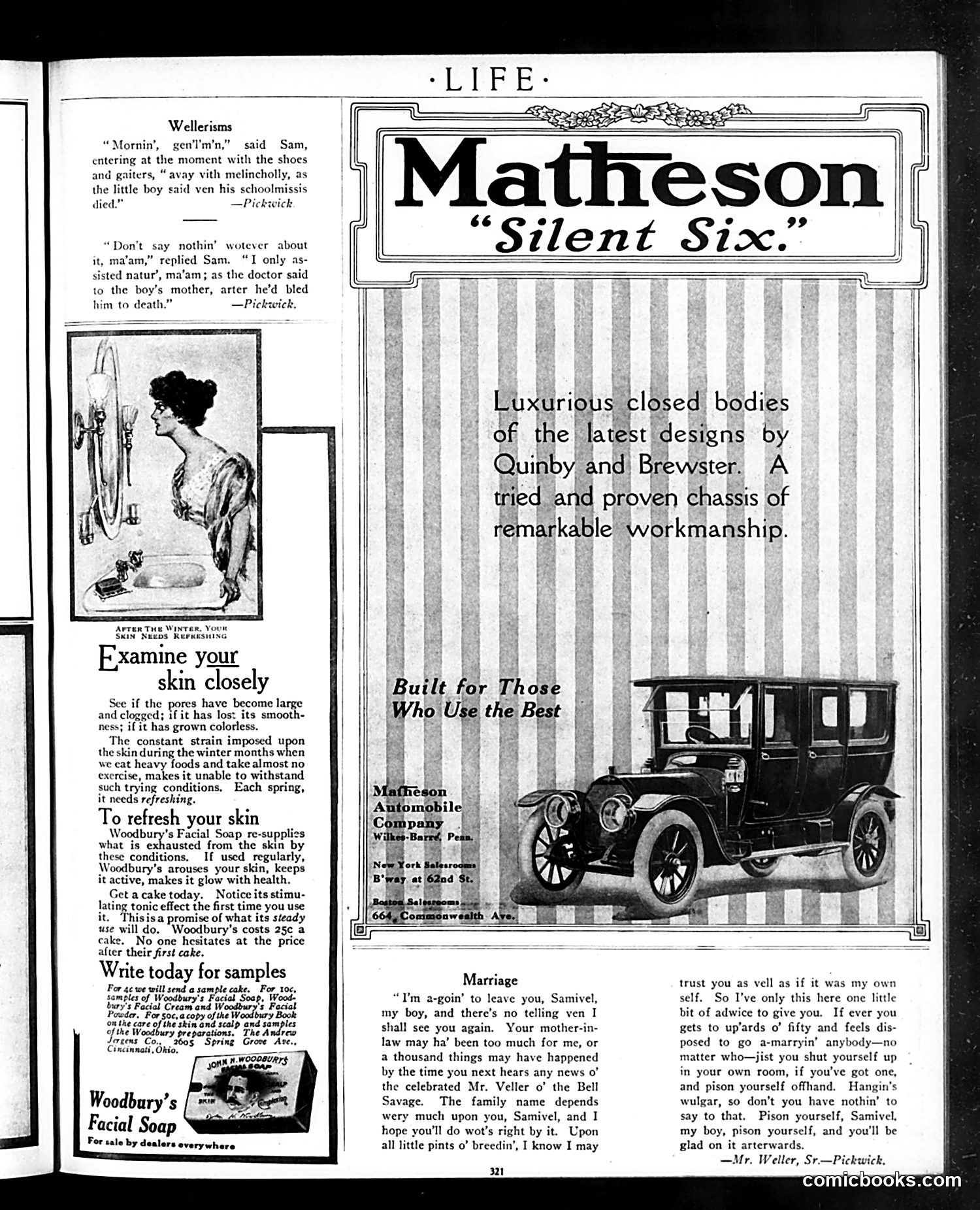
This page mixes two unrelated elements: **advertising** (Woodbury's Facial Soap and Matheson automobiles) and **literary content** featuring "Wellerisms"—humorous quotations from Charles Dickens's *Pickwick Papers*. The "Wellerisms" are comic dialogues attributed to Sam Weller, a character famous for mangling language and logic. The quoted passages showcase his malapropisms and deadpan absurdity (e.g., claiming he "assisted natur'" when helping someone die, comparing marriage to poisoning oneself). These were popular parlor entertainment in the early 20th century—readers enjoyed the character's intentional verbal fumbles and sardonic worldview. The extended "Marriage" passage presents Mr. Weller (Sam's father) dispensing cynical advice to his son about matrimony, culminating in his dark joke recommending suicide over marriage—humor based on exaggerated misogyny toward mothers-in-law. **Context**: Life magazine regularly reprinted literary excerpts alongside advertisements, blending "refined" culture with consumer goods for educated, middle-class readers.
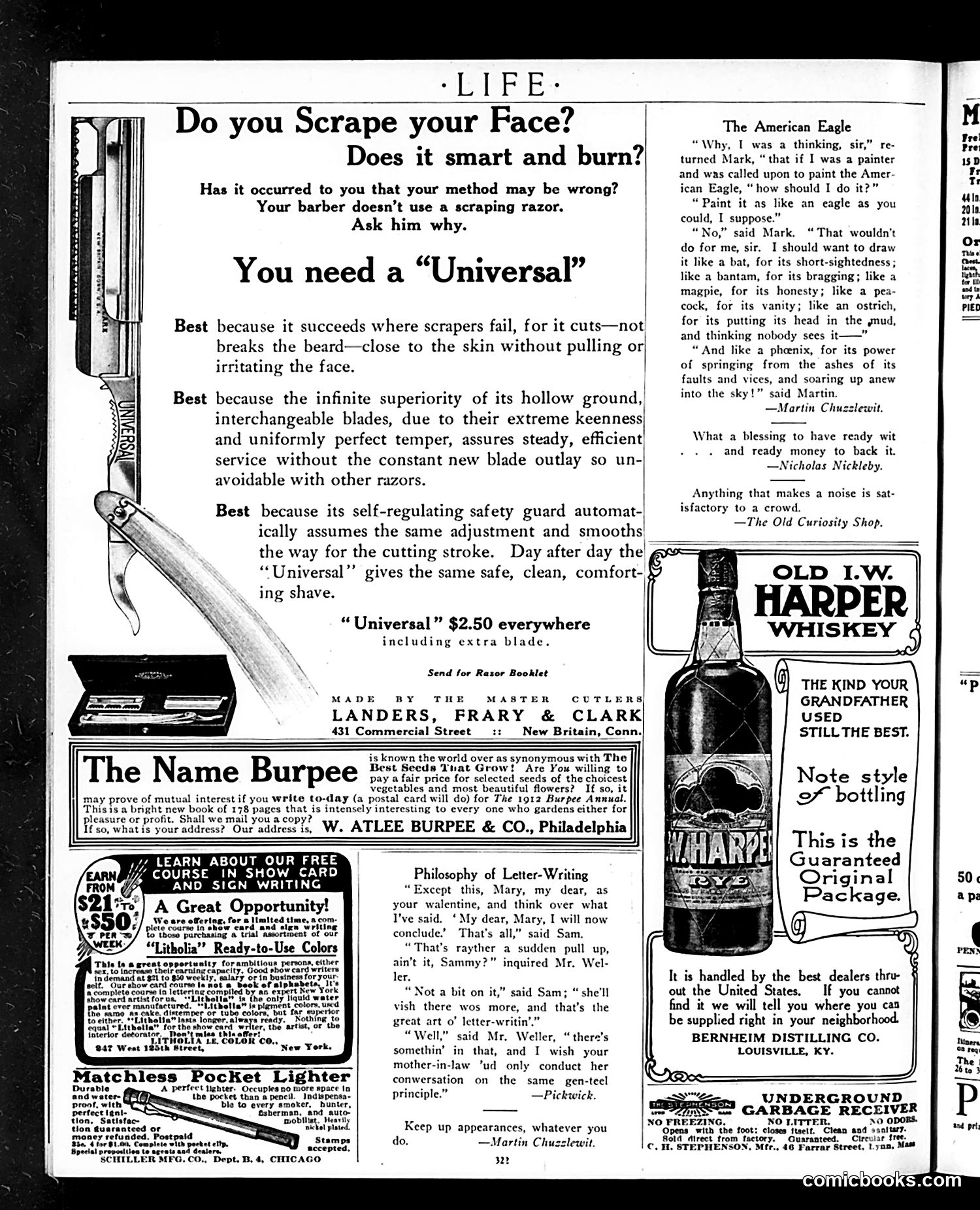
This page is primarily **advertisements interspersed with literary quotes**, rather than political satire. The main content includes: 1. **Universal Razor ad** (top): A product advertisement emphasizing the razor's superiority over scrapers, claiming it cuts close without pulling or irritating skin. 2. **Literary quotes**: Passages from Charles Dickens works (*Martin Chuzzlewit*, *Nicholas Nickleby*, *The Old Curiosity Shop*) appear scattered throughout, seemingly used decoratively or to fill space—a common magazine practice of the era. 3. **Other ads**: Burpee Seeds, show card writing course, Old I.W. Harper Whiskey, and a pocket lighter. The Dickens quotations don't appear to carry satirical purpose here; they're simply period-appropriate filler content. The page reflects early 1910s magazine layout conventions where advertising and literature coexisted without necessarily connecting thematically. No clear political cartoon or unified satirical message is evident.
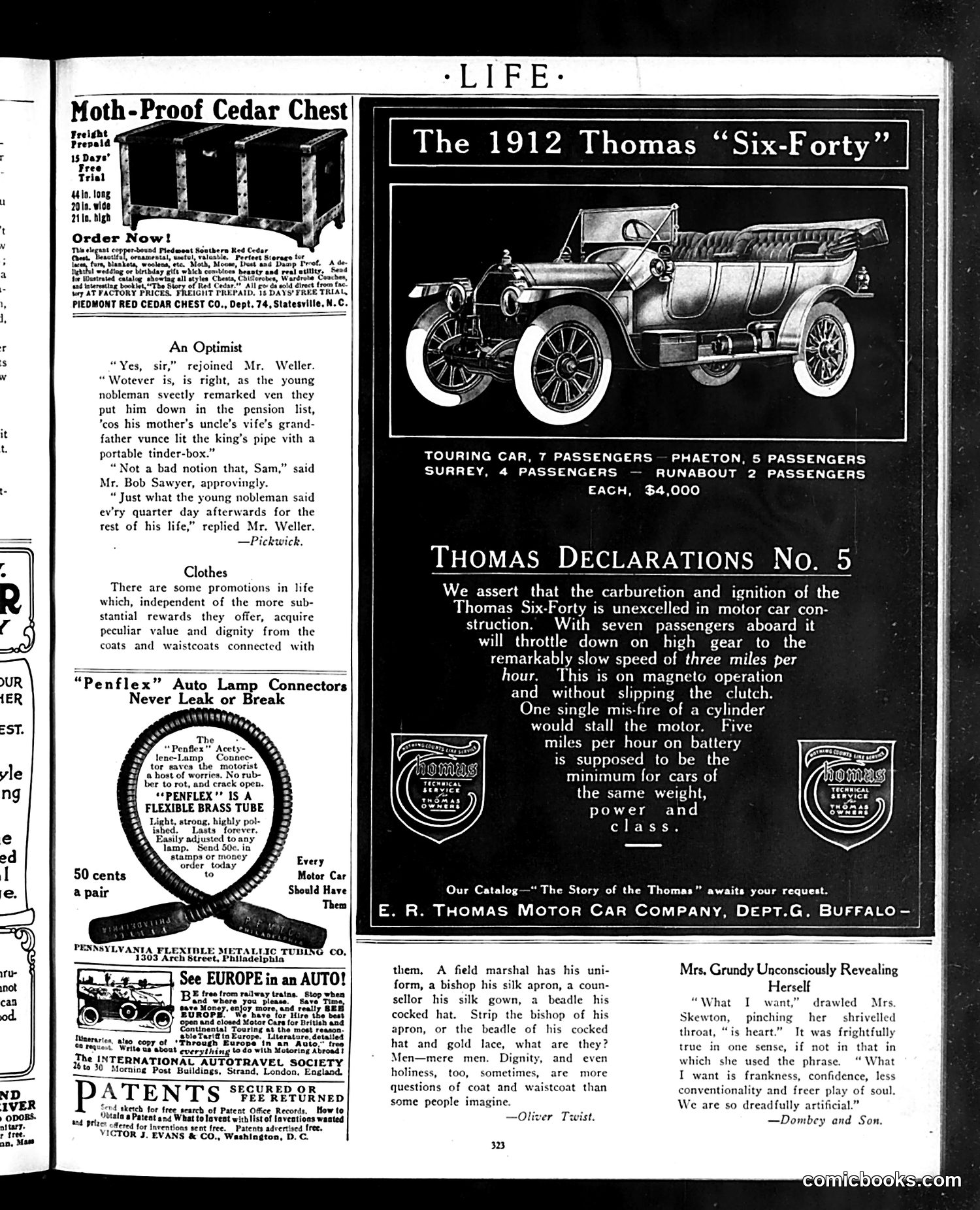
This page contains primarily **automobile and consumer product advertisements** rather than political cartoons. The main content features: **The 1912 Thomas "Six-Forty" automobile** — a luxury car priced at $4,000, advertised with technical specifications boasting superior carburetion and ignition. The ad emphasizes the car's ability to maintain three miles per hour on high gear with seven passengers, presented as a remarkable engineering achievement. **Literary excerpts** appear as filler content, including a passage from Dickens's *Pickwick Papers* about optimism, and another from (likely) Dickens's *Dombey and Son* discussing how clothing and position confer dignity on people. **Supporting advertisements** for cedar chests, auto lamp connectors, and patent services round out the page. This is **advertising-heavy content** typical of *Life* magazine's business model. No political satire or cartoon commentary is present — the page documents early automotive luxury marketing and period attitudes toward status symbols.
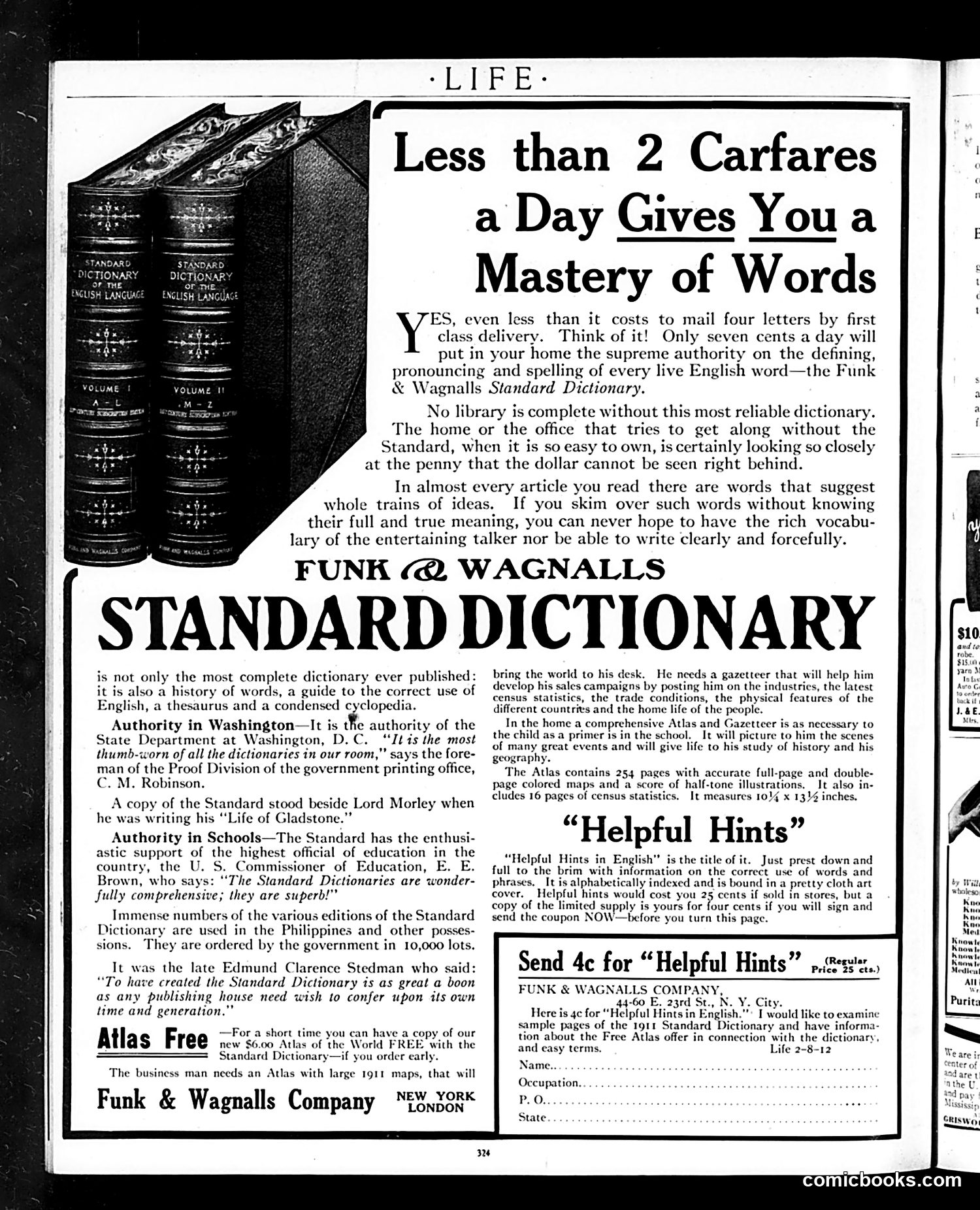
This is a **full-page advertisement** for the Funk & Wagnalls Standard Dictionary, not a political cartoon or satirical content. The ad promotes the dictionary as an affordable self-improvement tool—costing less than two streetcar fares (carfares) daily, or seven cents. It emphasizes authority by citing endorsements from the U.S. State Department, the Commissioner of Education, and historical figures like Lord Morley. The implicit message reflects **early-20th-century class anxieties**: mastering vocabulary and language is presented as essential for social and professional advancement. The ad assumes readers aspire to become "entertaining talker[s]" and successful business people. A secondary offer provides a free atlas "with large 1911 maps"—useful for businessmen and educators needing current geographic/economic information. This is **advertising content**, not satire, though it subtly mocks penny-pinching ("looking so closely at the penny that the dollar cannot be seen right behind").
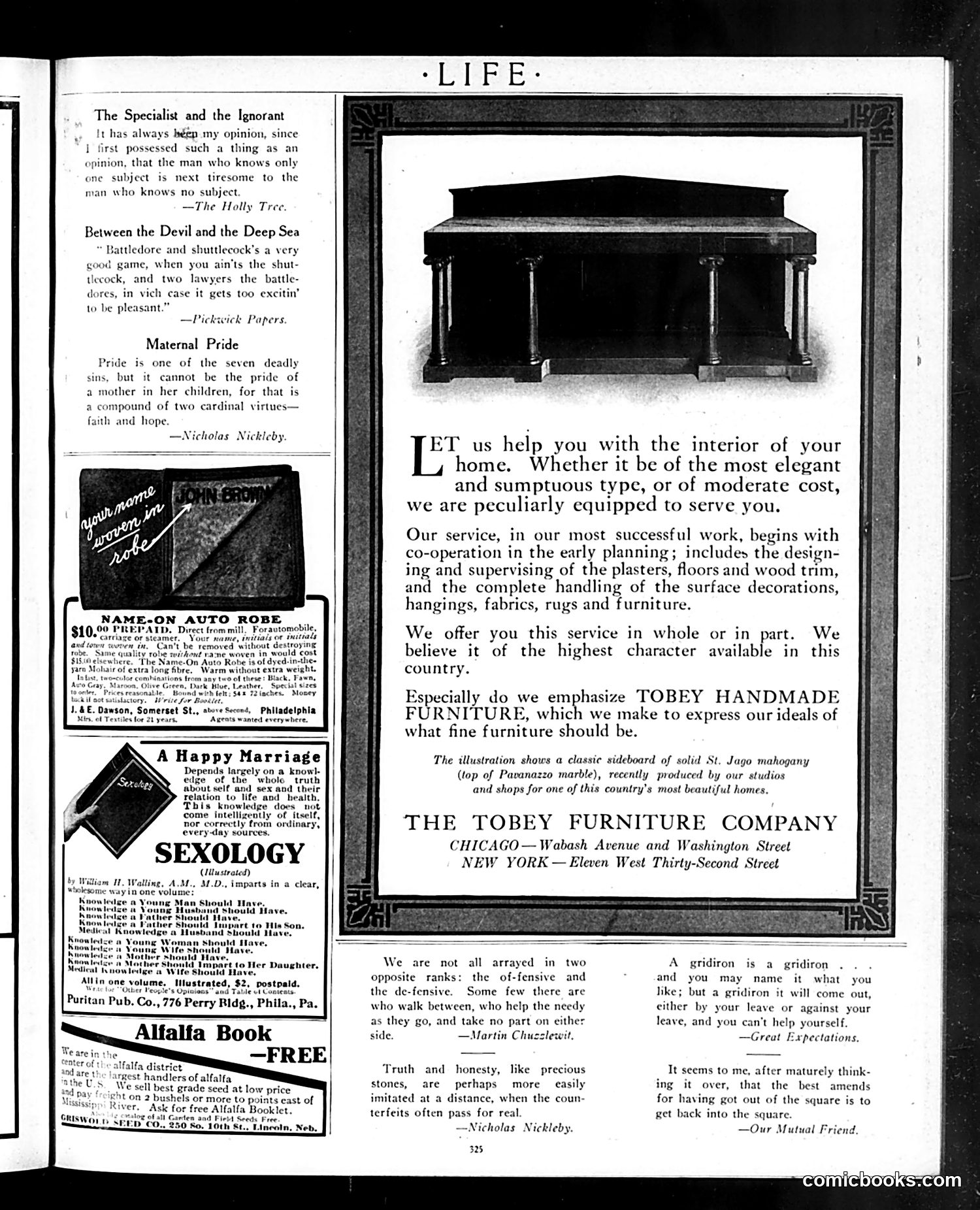
This page is primarily **advertising and filler content** rather than political satire. It features: **Left column:** Literary quotations from classic authors (Dickens, Nickleby) alongside small advertisements for consumer products: an auto robe with monogramming, a book on sexual education (*Sexology*), and alfalfa seed. **Right side:** A full-page advertisement for the Tobey Furniture Company, showcasing a mahogany sideboard. The ad emphasizes their "handmade furniture" and interior design services for wealthy clients. **Bottom:** Additional literary quotations (Dickens, *Great Expectations*, *Our Mutual Friend*) offering moral observations about virtue, honesty, and character. The page appears designed to appeal to genteel, educated readers through a mix of classical literature references and luxury goods. There is **no political cartoon or satirical commentary**—rather, it represents Life magazine's typical early-20th-century format combining literature, morality, and consumer advertising for middle-to-upper-class audiences.
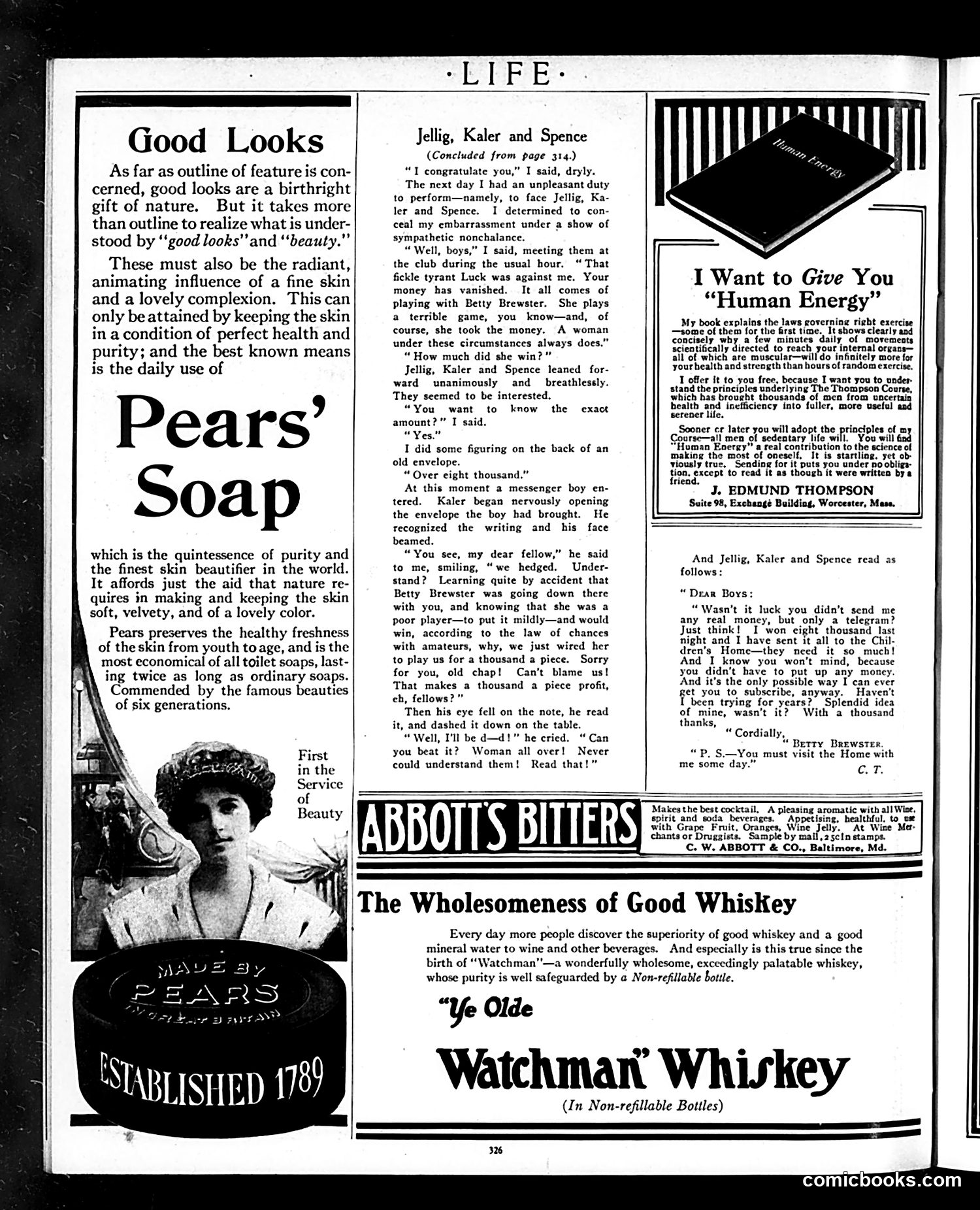
This page is primarily **advertising and serialized fiction**, not satire or political commentary. The left side features a **Pears' Soap advertisement** (established 1789) promoting beauty through skincare—typical Victorian/Edwardian marketing linking moral purity to physical appearance. The center contains the conclusion of a short story titled "Jellig, Kaler and Spence" about three men who bet money on a woman named Betty Brewster's card game. They attempted to hedge their bets by wagering directly with her, assuming she'd lose. However, she apparently won against them as well—the irony being their "clever" scheme backfired. The right side shows **"I Want to Give You Human Energy,"** an advertisement for an exercise course by Edmund Thompson promising health benefits from scientifically-directed movements. The bottom advertises **Abbott's Bitters** and **Ye Olde Watchman Whiskey**, promoting alcohol as wholesome beverages. There is **no political cartoon here**—just period advertisements and serialized entertainment typical of early 20th-century magazine content.
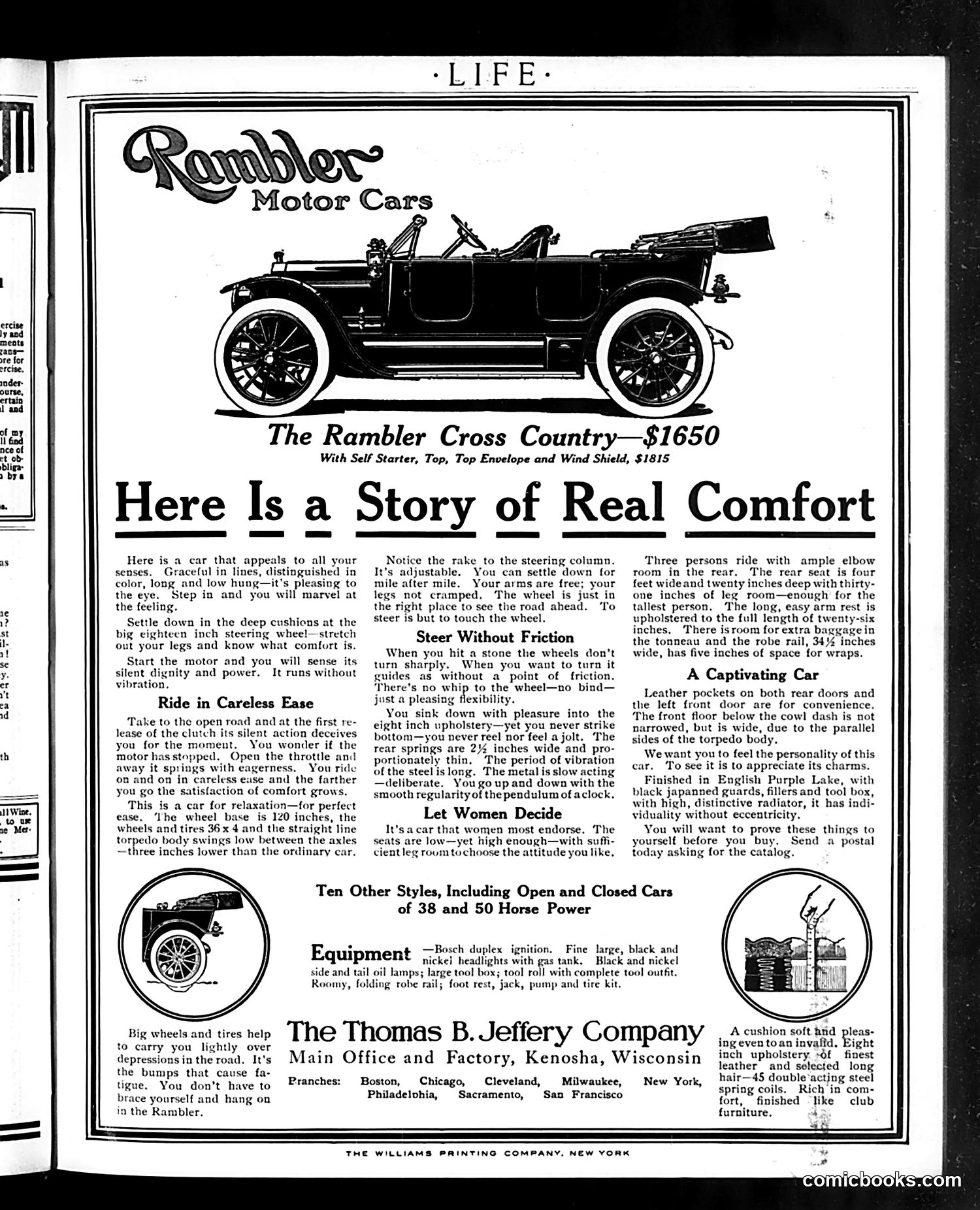
This page contains **no political cartoon or satire**—it's a straightforward automobile advertisement from Life magazine's early era (Life began as a humor magazine but carried substantial advertising). The Rambler Cross Country was a real car manufactured by the Thomas B. Jeffery Company. The advertisement emphasizes luxury features that would appeal to early 1900s buyers: a powerful engine, deep cushioning, adjustable steering, smooth suspension, and spacious seating for three passengers. The phrase "Let Women Decide" reflects early automotive marketing targeting female consumers as decision-makers—a progressive note for the era, though the appeal emphasizes comfort and convenience rather than mechanical capability. The technical specifications (120-inch wheelbase, 2½-inch springs, self-starter) represented genuine innovations in automobile comfort and reliability for the period. This is marketing copy, not satire.
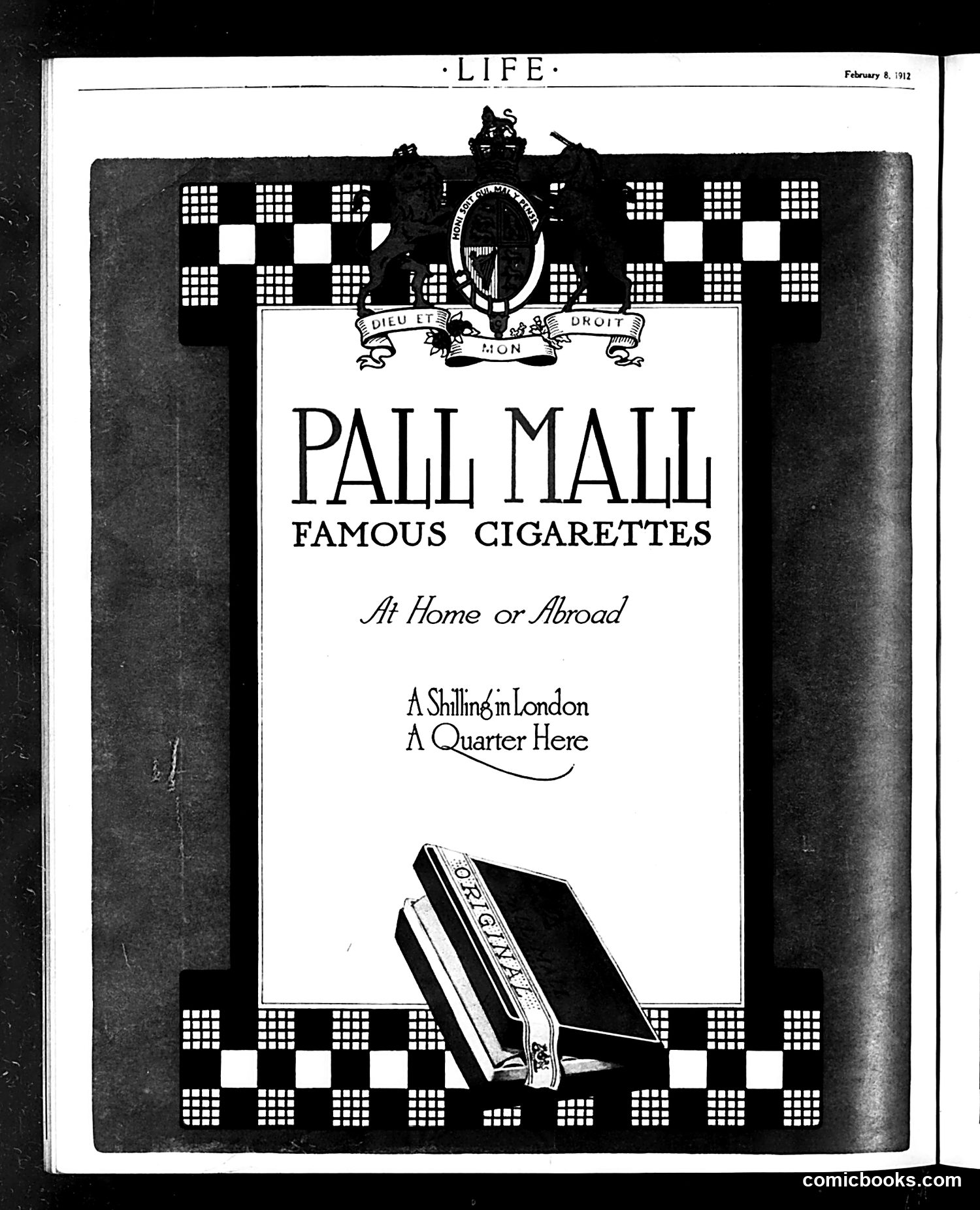
This is a **cigarette advertisement**, not political satire. The page from *Life* magazine (February 8, 1912) promotes Pall Mall "Famous Cigarettes." The ad emphasizes international pricing and accessibility: "A Shilling in London / A Quarter Here," highlighting that the product is available both domestically and abroad at competitive prices. The decorative border features a checkered pattern and heraldic crest, suggesting sophistication and prestige—common marketing strategies for cigarettes in the early 1900s. The image shows a cigarette package displayed prominently at the bottom. This straightforward commercial advertisement reflects the era when tobacco marketing was unrestricted and cigarettes were advertised in major publications without health warnings.