
Life, 1912-02-08 · page 8 of 44
Life — February 8, 1912 — page 8: what you’re looking at
What you’re looking at
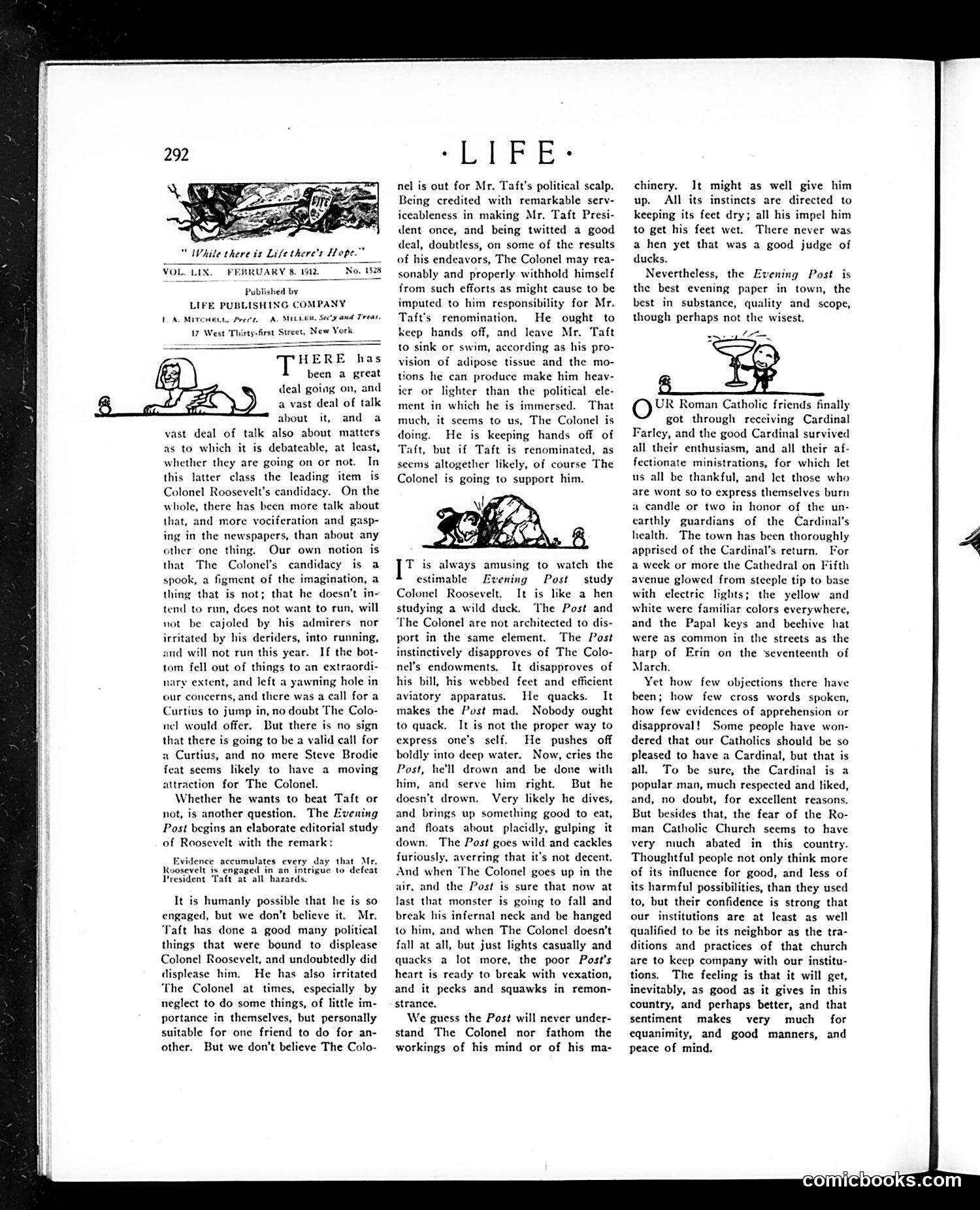
This *Life* magazine page satirizes Colonel Theodore Roosevelt's political ambitions and personality. The text criticizes Roosevelt's candidacy as self-serving manipulation, comparing him to a duck studied by the *Evening Post*—the *Post* "instinctively disapproves" while Roosevelt operates without regard for others' opinions. The satire mocks Roosevelt's unpredictability and stubbornness, suggesting he's difficult to control or predict. The piece questions whether Roosevelt genuinely wants to help Taft politically or is pursuing personal ambition. It portrays him as someone who ignores advice from friends and critics alike, making him simultaneously admirable and frustrating—a man of strong instincts but questionable judgment regarding his own political future.
📄 Transcribed text from this page (OCR, searchable)
Machine-transcribed from the original scan — historical spelling and the odd misread are preserved.
“ While there is Life there's Hope.” No. 182 VOL. LIX. FEBRUARY 8. 1912. Published by LIFE PUBLISHING COMPANY FAMICOM RELL, Prete A. MULLEM, Seety and Treas, 17 West Thirty-first Street, New York HERE has been a great deal going on, and a vast deal of talk about it, and a vast deal of talk also about matters as to which it is debateable, at least, whether they are going on or not. In this latter class the leading item is Colonel Roosevelt’s candidacy. On the whole, there has been more talk about that, and more vociferation and gasp- ing in the newspapers, than about any other one thing. Our own notion is that The Colonel's candidacy is a spook, a figment of the imagination, a thing that is not; that he doesn’t in- tend to run, does not want to run, will not be cajoled by his admirers nor irritated by his deriders, into running, and will not run this year. If the bot- tom fell out of things to an extraordi- nary extent, and left a yawning hole in our concerns, and there was a call for a Curtius to jump in, no doubt The Colo- nel would offer, But there is no sign that there is going to be a valid call for x Curtius, and no mere Steve Brodie feat seems likely to have a moving attraction for The Colonel. Whether he wants to beat Taft or not, is another question. The Evening Post begins an elaborate editorial study of Roosevelt with the remark: that Mr. Evidence accumulates every defeat Roosevelt is engaged in an intrigue t President Taft at all hazards. It is humanly possible that he is so engaged, but we don’t believe it. Mr. ‘Taft has done a good many political things that were bound to displease Colonel Roosevelt, and undoubtedly did displease him. He has also irritated The Colonel at times, especially by neglect to do some things, of little im- portance in themselves, but personally suitable for one friend to do for an- other. But we don’t believe The Colo- “PE nel is out for Mr. Taft's political scalp. Being credited with remarkable ser iceableness in making Mr. Taft Presi- dent once, and being twitted a good deal, doubtless, on some of the results of his endeavors, The Colonel may rea- sonably and properly withhold himself from such efforts as might cause to be imputed to him responsibility for Mr. Taft's renomination. He ought to keep hands off, and leave Mr. Taft to sink or swim, according as his pro- vision of adipose tissue and the mo- tions he can produce make him heav- ier or lighter than the political ele- ment in which he is immersed. That much, it seems to us, The Colonel is doing. He is keeping hands off of Taft, but if Taft is renominated, as seems altogether likely, of course The Colonel is going to support him. I" always amusing to watch the estimable Evening Post — study Colonel Roosevelt. It is like a hen studying a wild duck. The Post and The Colonel are not architected to dis- port in the same element. The Post instinctively disapproves of The Colo- nel’s endowments. It disapproves of his bill, his webbed feet and efficient aviatory apparatus. He quacks. It makes the Post mad. Nobody ought to quack. It is not the proper way to express one’s self. He pushes off boldly into deep water. Now, cries the Post, he'll drown and be done with him, and serve him right. But he doesn't drown. Very likely he dives, and brings up something good to eat, and floats about placidly, gulping it down. The Post goes wild and cackles furiously, averring that it's not decent. And when The Colonel goes up in the air, and the Post is sure that now at last that monster is going to fall and break his infernal neck and be hanged to him, and when The Colonel doesn’t fall at all, but just lights casually and quacks a lot more, the poor Post's heart is ready to break with vexation, and it pecks and squawks in remon- strance. We guess the Post will never under- stand The Colonel nor fathom the workings of his mind or of his ma- chinery. It might as well give him up. All its instincts are directed to keeping its feet dry; all his impel him to get his feet wet. There never was a hen yet that was a good judge of ducks. Nevertheless, the Evening Post is the best evening paper in town, the best in substance, quality and scope, though perhaps not the wisest. UR Roman Catholic friends finally got through receiving Cardinal Farley, and the good Cardinal survived all their enthusiasm, and all their af- fectionate ministrations, for which let us all be thankful, and Iet those who are wont so to express themselves burn a candle or two in honor of the un- earthly guardians of the Cardinal's health. The town has been thoroughly apprised of the Cardinal’s return. For a week or more the Cathedral on Fifth avenue glowed from steeple tip to base with electric lights; the yellow and white were familiar colors everywhere, and the Papal keys and bechive hat were as common in the streets as the harp of Erin on the seventeenth of March. Yet how few objections there have been; how few cross words spoken, how few evidences of apprehension or disapproval! Some people have won- dered that our Catholics should be so pleased to have a Cardinal, but that is all. To be sure, the Cardinal is a popular man, much respected and liked, and, no doubt, for excellent reasons. But besides that, the fear of the Ro- man Catholic Church seems to have very much abated in this country. Thoughtful people not only think more of its influence for good, and less of its harmful possibilities, than they used to, but their confidence is strong that our institutions are at least as well qualified to be its neighbor as the tra- ditions and practices of that church are to keep company with our institu- tions. The feeling is that it will get, inevitably, as good as it gives in this country, and perhaps better, and that sentiment makes very much for equanimity, and good manners, and peace of mind.