
Life, 1912-02-08 · page 30 of 44
Life — February 8, 1912 — page 30: what you’re looking at
What you’re looking at
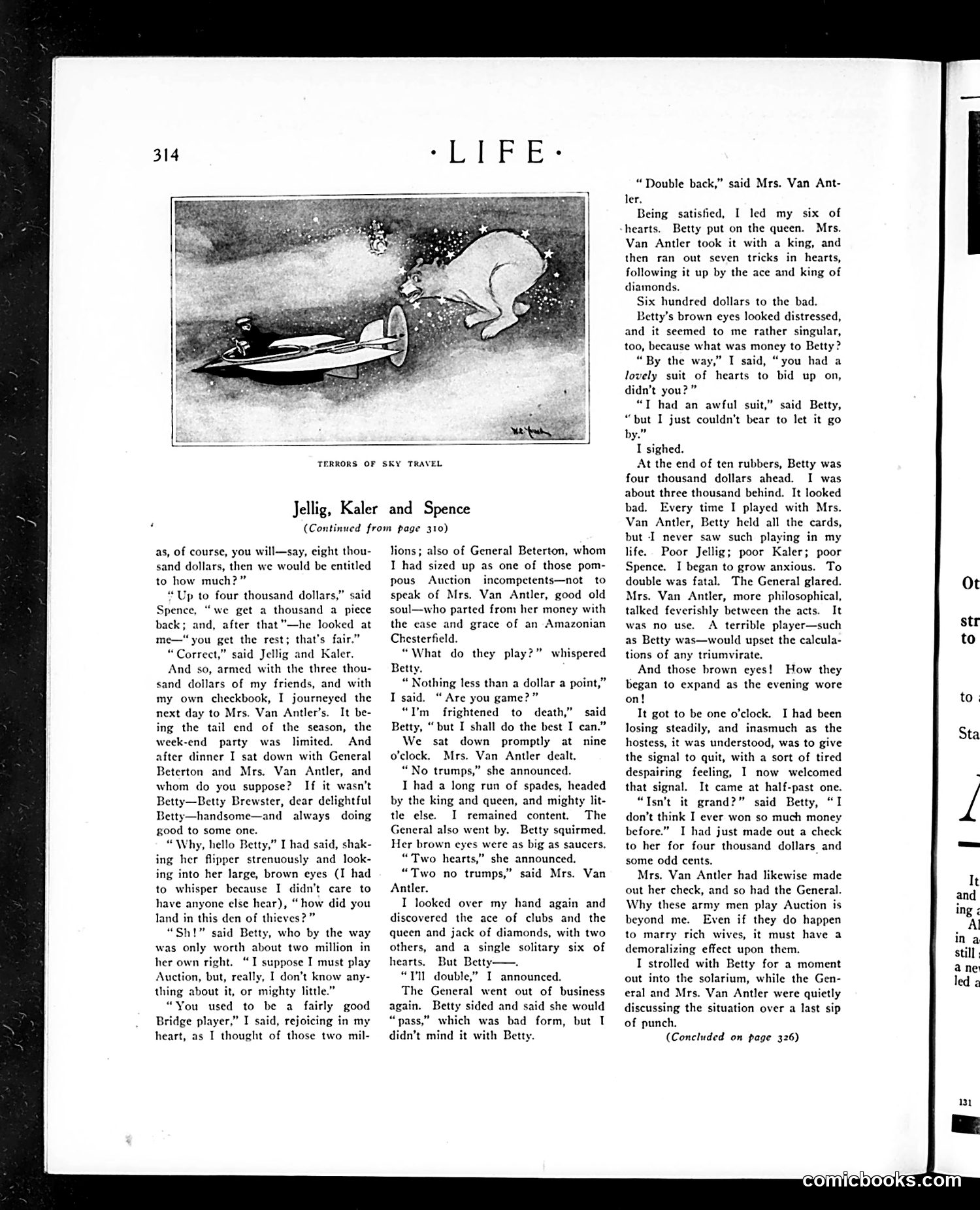
This page continues a serialized story about high-stakes Auction Bridge (a card game popular in the 1920s-30s). The cartoon at top illustrates "sky travel" anxieties—showing an airplane passenger in distress. The text describes a narrator who recruits friends' money to gamble at cards with wealthy socialites: General Beterton, Mrs. Van Antler, and the attractive "Betty Brewster" (worth two million dollars). The satire targets: - **Class aspirations**: The narrator schemes to exploit rich people at cards - **Women's economic power**: Betty, despite claiming ignorance of cards, systematically beats the men through superior play - **Gender stereotypes**: Her "brown eyes" and feminine charm mask shrewd card-playing ability; the men underestimate her - **Gambling culture**: The casual, escalating bets among the wealthy The joke is that the calculating narrator—confident in exploiting "incompetent" wealthy players—gets outplayed by a woman he dismissed as merely decorative.
📄 Transcribed text from this page (OCR, searchable)
Machine-transcribed from the original scan — historical spelling and the odd misread are preserved.
TERRORS OF SKY TRAVEL Jellig, Kaler and Spence (Continued from page 310) as, of course, you will—say, cight thou- sand dollars, then we would be entitled to how much?” “Up to four thousand dollars,” said Spence, “we get a thousand a piece back; and, after that"—he looked at me—“you get the rest; that’s fair.” “Correct,” said Jellig and Kaler. And so, armed with the three thou- sand dollars of my friends, and with my own checkbook, I journeyed the next day to Mrs. Van Antler’s. It be- ing the tail end of the season, the week-end party was limited. And after dinner I sat down with General Beterton and Mrs. Van Antler, and whom do you suppose? If it wasn’t Betty—Betty Brewster, dear delightful Betty—handsome—and always doing good to some one. “Why, hello Betty,” I had said, shak- ing her flipper strenuously and look- ing into her large, brown eyes (I had to whisper because I didn't care to have anyone else hear), “how did you land in this den of thieves?” “Sh!” said Betty, who by the way was only worth about two million in her own right. “I suppose I must play Auction, but, really, I don’t know any- thing about it, or mighty little.” “You used to be a fairly good Bridge player,” I said, rejoicing in my heart, as I thought of those two mil- lions; also of General Beterton, whom I had sized up as one of those pom- pous Auction incompetents—not to speak of Mrs. Van Antler, good old soul—who parted from her money with the ease and grace of an Amazonian Chesterfield. “What do they play?” whispered Betty. “ Nothing less than a dollar a point, I said. “Are you game?” “I'm frightened to death,” Betty, “but I shall do the best I can. We sat down promptly at nine o'clock. Mrs. Van Antler dealt. “No trumps,” she announced. I had a long run of spades, headed by the king and queen, and mighty lit- tle else. I remained content. The General also went by. Betty squirmed. Her brown eyes were as big as saucers, “Two hearts,” she announced. “Two no trumps,” said Mrs. Van Antler. I looked over my hand again and discovered the ace of clubs and the queen and jack of diamonds, with two others, and a single solitary six of hearts. But Betty-—. “Tl double,” I announced. The General went out of business again. Betty sided and said she would “pass,” which was bad form, but I didn’t mind it with Betty. said “Double back,” said Mrs. Van Ant- ler, Being satisfied, I led my six of hearts. Betty put on the queen. Mrs. Van Antler took it with a king, and then ran out seven tricks in hearts, following it up by the ace and king of diamonds. Six hundred dollars to the bad. Betty’s brown eyes looked distressed, and it seemed to me rather singular, too, because what was money to Betty? “By the way,” I said, “you had a lovely suit of hearts to bid up on, didn’t you?” “T had an awful suit,” said Betty, “but I just couldn't bear to let it go by.” I sighed. At the end of ten rubbers, Betty was four thousand dollars ahead. I was about three thousand behind. It looked bad. Every time I played with Mrs. Van Antler, Betty held all the cards, but I never saw such playing in my life. Poor Jellig; poor Kaler; poor Spence. I began to grow anxious. To double was fatal. The General glared. Mrs. Van Antler, more philosophical, talked feverishly between the acts. It was no use. A terrible player—such as Betty was—would upset the calcula- tions of any triumvirate. And those brown eyes! How they began to expand as the evening wore on! It got to be one o'clock. I had been losing steadily, and inasmuch as the hostess, it was understood, was to give the signal to quit, with a sort of tired despairing feeling, I now welcomed that signal. It came at half-past one. “Isn't it grand?” said Betty, “I don’t think I ever won so much money before.” I had just made out a check to her for four thousand dollars and some odd cents. Mrs, Van Antler had likewise made out her check, and so had the General. Why these army men play Auction is beyond me. Even if they do happen to marry rich wives, it must have a demoralizing effect upon them. I strolled with Betty for a moment out into the solarium, while the Gen- eral and Mrs. Van Antler were quietly discussing the situation over a last sip of punch. (Concluded on page 326)