
Life, 1912-02-08 · page 20 of 44
Life — February 8, 1912 — page 20: what you’re looking at
What you’re looking at
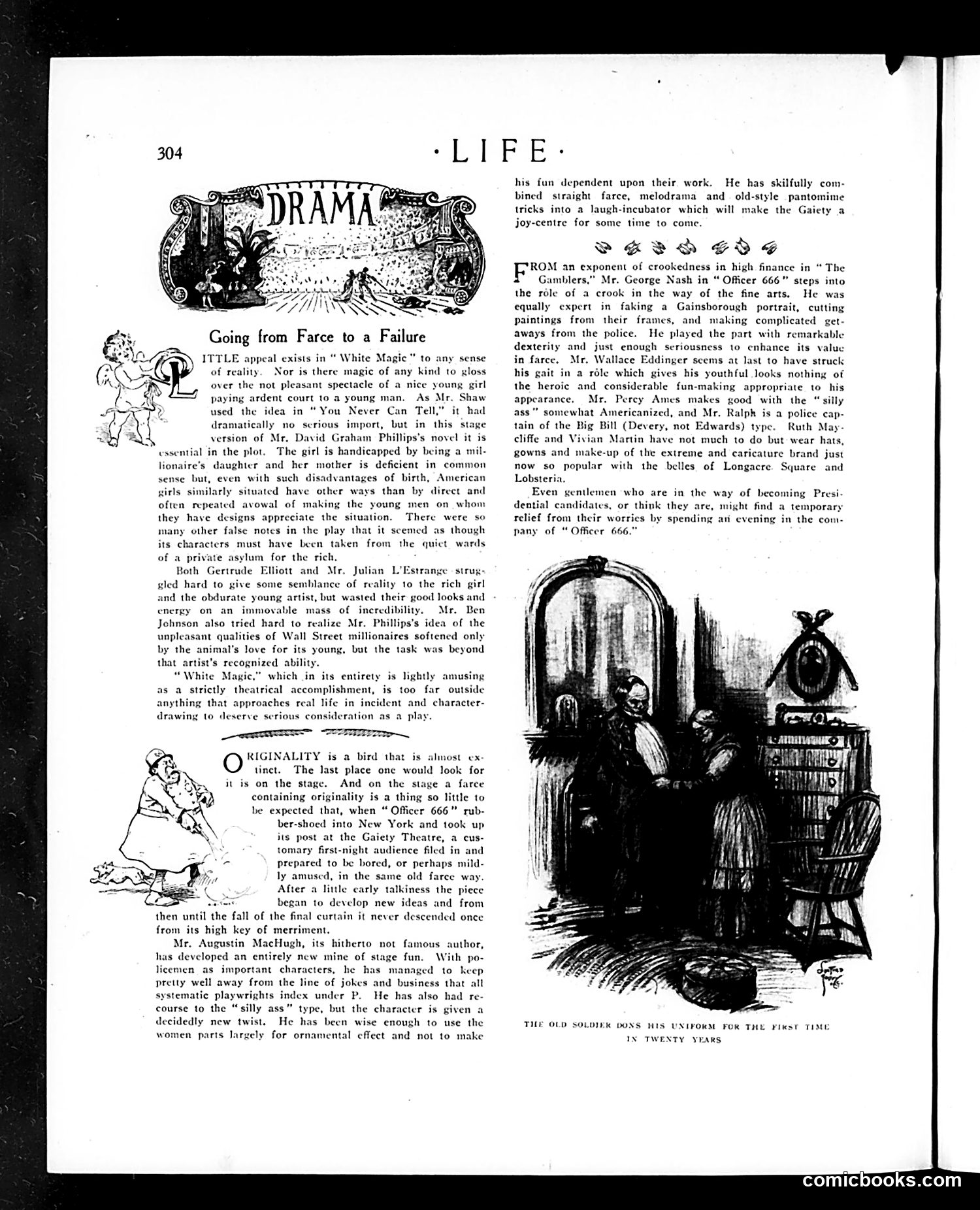
This page contains theatrical reviews from Life magazine's drama section. The main critiques discuss two plays: **"White Magic"** receives harsh dismissal as unrealistic and poorly executed. The reviewer criticizes the plot device of a wealthy young woman directly courting a man as implausible and undramatic, even though George Bernard Shaw had used similar material successfully. Actors Gertrude Elliott and Julian L'Estrange are blamed for trying to salvage an "immovable mass of incredibility." **"Officer 666"** is praised as genuinely original farce. The reviewer celebrates author Augustin MacHugh for creating fresh comic material centered on policemen rather than relying on tired theatrical conventions. Actor George Nash receives particular praise for his role as an art forger, while Wallace Eddinger is noted for finally finding a role suited to his youthful appearance. The illustration shows an elderly soldier in uniform encountering what appears to be a cuckoo clock or similar device—likely accompanying a separate theater review not fully visible here.
📄 Transcribed text from this page (OCR, searchable)
Machine-transcribed from the original scan — historical spelling and the odd misread are preserved.
‘L CPE : Going from Farce to a Failure = appeal exists in “ White Magic” to any sense of reality. Nor is there magic of any kind to gloss over the not pleasant spectacle of a nice young girl paying ardent court to a young man, As Mr. Shaw used the idea in “You Never Can Tell,” it had dramatically no scrious import, but in this stage version of Mr. David Graham Phillips's novel it is in the plot. The girl is handicapped by being a mil- lionaire’s daughter and her mother is deficient in common sense but, even with such disadvantages of birth, American girls similarly situated have other ways than by direct and often repeated avowal of making the young men on whom they have designs appreciate the situation, There were so many other false notes in the play that it scemed as though its characters must have been taken from the quict wards of a private asylum for the rich. Both Gertrude Elliott and Mr. Julian L’Estrange strug gled hard to give some semblance of reality 10 the rich girl and the obdurate young artist, but wasted their good looks and energy on an immovable mass of incredibility. Mr. Ben Johnson also tried hard to realize Mr. Phillips's idea of the unpleasant qualities of Wall Street millionaires softened only by the animal's love for its young, but the task was beyond that artist's recognized ability. “White Magic.” which in its entirety is lightly amusing as a strictly theatrical accomplishment, is too far outside anything that approaches real life in incident and character- drawing to deserve scrious consideration as a play. RIGINALITY is a bird that is almost ex tinct. The last place one would look for it is on the stage. And on the stage a farce containing originality is a thing so little to be expected that, when “ Officer 666" rub- ber-shoed into New York and took up its post at the Gaiety Theatre, a cus- tomary first-night audience filed in and prepared to be bored, or perhaps mild- ly amused, in the same old faree way. After a little carly talkiness the piece began to develop new ideas and from then until the fall of the final curtain it never descended once from its high key of merriment. Mr. Augustin MacHugh, its hitherto not famous author, has developed an entirely new mine of stage fun. With po- licemen as important characters, he has managed to keep pretty well away from the line of jokes and business that all jc playwrights index under P. He has also had re- course to the “silly ass” type, but the character is given a decidedly new twist. He has been wise enough to use the women parts largely for ornamental effect and not to make system his fan dependent upon their work. He has skilfully com- bined straight farce, melodrama and old-style pantomime tricks into a laugh-incubator which will make the Gaiety a joy-centre for some time to come. SEZBWA GG ROM an exponent of crookedness in high finance in * The Gamblers,” Mr. George Nash in “ Officer 666" steps into the role of a crook in the way of the fine arts. He was equally expert in faking a Gainsborough portrait, cutting paintings from their frames, and making complicated get- aways from the police. He played the part with remarkable dexterity and just enough seriousness to enhance its value in farce. Mr. Wallace Eddinger scems at last to have struck his gait in a réle which gives his youthful looks nothing of the heroic and considerable fun-making appropriate to his appearance. Mr. Percy Ames makes good with the “silly ass" somewhat Americanized, and Mr. Ralph is a police cap- tain of the Big Bill (Devery, not Edwards) type. Ruth May- cliffe and Vivian Martin have not much to do but wear hats, gowns and make-up of the extreme and caricature brand just now so popular with the belles of Longacre Square and Lobsteria, Even gentlemen who are in the way of becoming Presi dential candidates, or think they are, might find a temporary relief from their worries by spending ari evening in the com- pany of “ Officer 666." THE OLD SOLDIER DONS MIS UNIFORM FOR THE Flkst THAME IN TWENTY YEARS comicbooks.com