
Life, 1912-02-08 · page 19 of 44
Life — February 8, 1912 — page 19: what you’re looking at
What you’re looking at
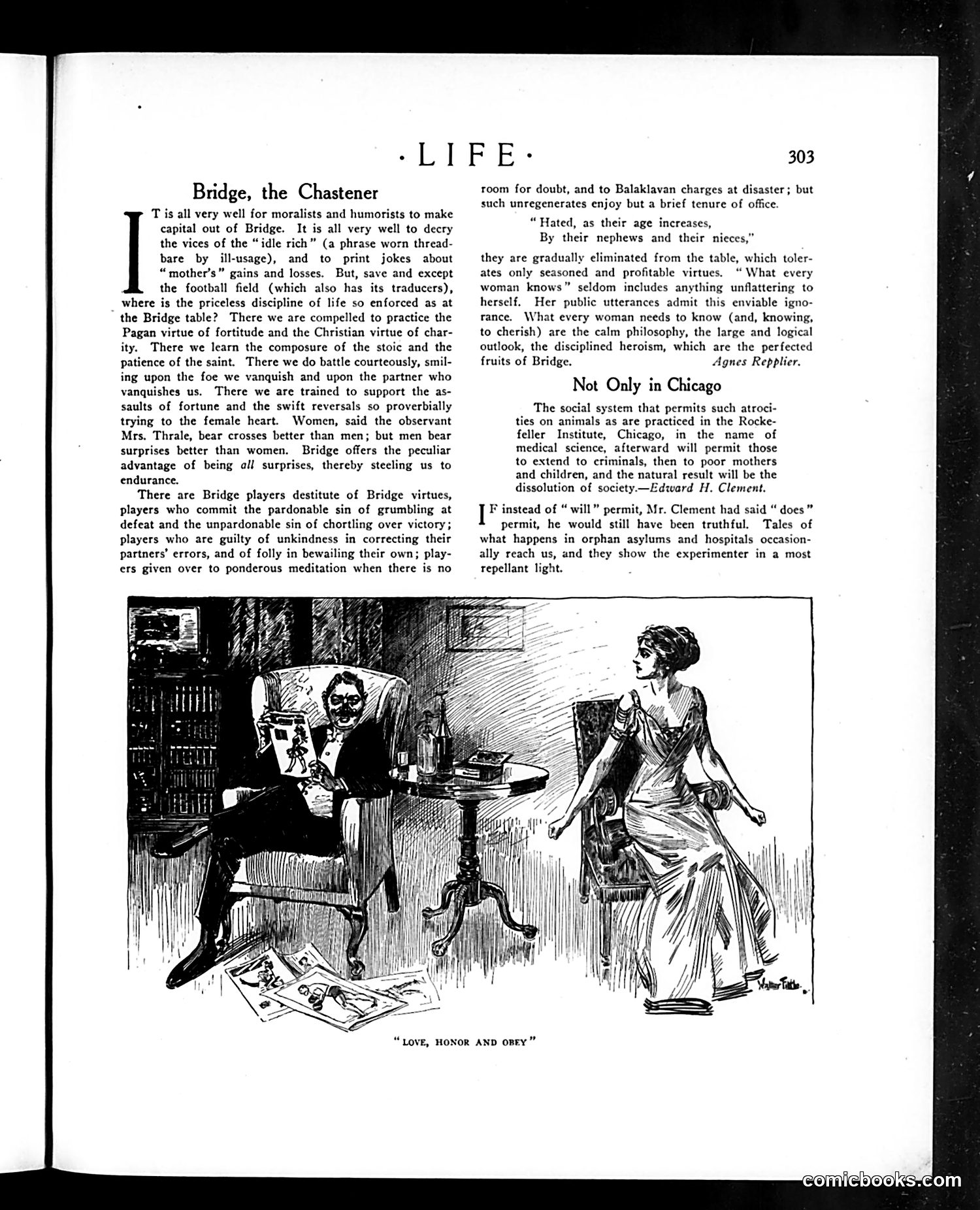
The page contains two distinct pieces of social commentary: **"Bridge, the Chastener"** (main article) sarcastically praises the card game Bridge as a moral teacher, claiming it instills virtues like fortitude, charity, and composure. The irony is that Bridge is actually associated with the leisured "idle rich" and gambling losses—vices the article pretends to defend. The piece gently mocks wealthy women by suggesting they learn emotional discipline from card games. **The accompanying illustration** ("Love, Honor and Obey") shows a man reading while a woman gestures—likely depicting marital discord over Bridge playing or gambling debts, reinforcing the article's satirical point about Bridge's real social consequences. **"Not Only in Chicago"** briefly critiques animal experimentation at the Rockefeller Institute, warning that permitting such practices on animals will eventually extend to human experimentation on vulnerable populations (criminals, the poor, children), leading to social dissolution. Both sections reflect early 20th-century anxieties about modern institutions, class behavior, and scientific ethics.
📄 Transcribed text from this page (OCR, searchable)
Machine-transcribed from the original scan — historical spelling and the odd misread are preserved.
~-LIFE- 303 Bridge, the Chastener T is all very well for moralists and humorists to make capital out of Bridge. It is all very well to decry the vices of the “idle rich” (a phrase worn thread- bare by ill-usage), and to print jokes about “mother’s” gains and losses. But, save and except the football field (which also has its traducers), where is the priceless discipline of life so enforced as at the Bridge table? There we are compelled to practice the Pagan virtue of fortitude and the Christian virtue of char- ity. There we learn the composure of the stoic and the patience of the saint. There we do battle courteously, smil- ing upon the foe we vanquish and upon the partner who vanquishes us. There we are trained to support the as- saults of fortune and the swift reversals so proverbially trying to the female heart. Women, said the observant Mrs. Thrale, bear crosses better than men; but men bear surprises better than women. Bridge offers the peculiar advantage of being all surprises, thereby steeling us to endurance. There are Bridge players destitute of Bridge virtues, players who commit the pardonable sin of grumbling at defeat and the unpardonable sin of chortling over victory; players who are guilty of unkindness in correcting their partners’ errors, and of folly in bewailing their own; play- ers given over to ponderous meditation when there is no room for doubt, and to Balaklavan charges at disaster; but such unregenerates enjoy but a brief tenure of office. “Hated, as their age increases, By their nephews and their nieces,” they are gradually eliminated from the table, which toler- ates only seasoned and profitable virtues. “What every woman knows” seldom includes anything unflattering to herself. Her public utterances admit this enviable igno- rance. What every woman needs to know (and, knowing, to cherish) are the calm philosophy, the large and logical outlook, the disciplined heroism, which are the perfected fruits of Bridge. Agnes Repplier. Not Only in Chicago The social system that permits such atroci- ties on animals as are practiced in the Rocke- feller Institute, Chicago, in the name of medical science, afterward will permit those to extend to criminals, then to poor mothers and children, and the natural result will be the dissolution of society—Edward H. Clement. I* instead of “ will” permit, Mr. Clement had said “ does” permit, he would still have been truthful. Tales of what happens in orphan asylums and hospitals occasion- ally reach us, and they show the experimenter in a most repellant light. “ Love, HONOR AND OBEY”