
Life, 1912-02-08 · page 24 of 44
Life — February 8, 1912 — page 24: what you’re looking at
What you’re looking at
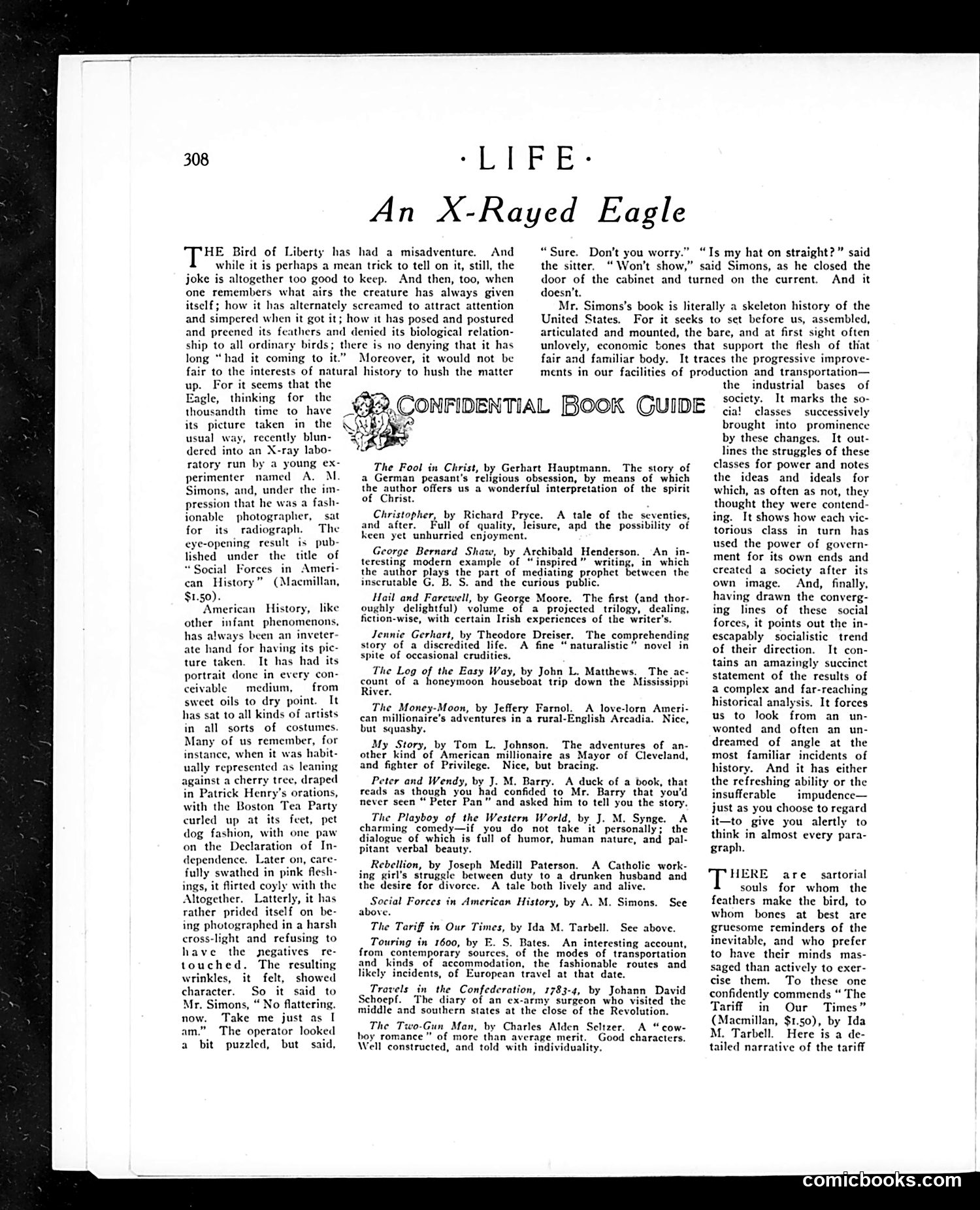
This satirical piece uses the metaphor of an Eagle (symbol of America) being X-rayed to critique how American history is traditionally portrayed versus reality. The joke: The Eagle, vain and pompous, sits for a portrait thinking it's visiting a fashionable photographer. Instead, A.M. Simons runs an X-ray machine on it, revealing the "skeleton" beneath—the unglamorous economic and industrial infrastructure supporting the nation. The satire targets romantic, sanitized versions of American history (previously depicted as "leaning against a cherry tree, draped in Patrick Henry's orations"). Simons's book "Social Forces in American History" promises instead a "skeleton history"—showing the bare economic bones and production systems underlying society, stripped of patriotic flourishes. The cartoon lampoons both American vanity about its own history and the conventional heroic narrative, suggesting the real story lies in unglamorous material and economic forces, not idealized mythology.
📄 Transcribed text from this page (OCR, searchable)
Machine-transcribed from the original scan — historical spelling and the odd misread are preserved.
*LIFE: An X-Rayed Eagle HE Bird of Liberty has had a misadventure. And while it is perhaps a mean trick to tell on it, still, the joke is altogether too good to keep. And then, too, when one remembers what airs the creature has always given itself; how it has alternately screamed to attract attention and simpered when it got it; how it has posed and postured and preened its feathers and denied its biological relation- ship to all ordinary birds; there is no denying that it has long “had it coming to it.” Morcover, it would not be fair to the interests of natural history to hush the matter up. For it seems that the Eagle, thinking for the thousandth time to have 2, CONFIDENTIAL BOOK GUIDE 3%, “Is my hat on straight?” said “Won't show,” said Simons, as he closed the And it “Sure. Don’t you worry.” the sitter. door of the cabinet and turned on the current. doesn’t. Mr. Simons’s book is literally a skeleton history of the United States. For it seeks to set before u sembled, articulated and mounted, the bare, and at first sight often unlovely, economic bones that support the flesh of thi fair and familiar body. It traces the progressive improve- ments in our facilities of production and transportation— the industrial bases of society. It marks the so- s successively usual way, recently blun- dered into an X-ray labo- ratory run by a young ©: perimenter named A. M Simons, and, under the im- pression that he w fash- ionable photographer, sat for its radiograph, The ye-opening result is pub- lished under the title of “Social Forces in Ameri- can History” (Macmillan, $1.50). ‘American History, lil other infant phenomenons, has always been an inveter- ate hand for having its pic- ture taken. It has had its portrait done in every con- ceivable = medium, — from sweet oils to dry point. It has sat to all kinds of artists in all sorts of costumes. Many of us remember, for instance, when it was habit- ually represented as leaning against a cherry tree, draped in Patrick Henry's orations, with the Boston Tea Party curled up at its feet, pet dog fashion, with one paw on the Declaration of In- dependence. Later on, care- fully swathed in pink flesh- ings, it flirted coyly with the Altogether. Latterly, it has rather prided itself on be- ing photographed in a harsh cross-light and refusing to have the negatives re- touched. The resulting wrinkles, it felt, showed character. So it said to Mr. Simons, “ No flattering. now. Take me just as I The operator looked puzzled, but said, a bit its picture taken in the is) ree SY The Fool in Christ, by Gerhart Hauptmann. The story of a German peasant’s religious obsession, by means of which oe aulhee offers us a wonderful interpretation of the spirit of Christ. Christopher, by Richard Pryce. A tale of the seventies, and after. Full of quality, leisure, apd the possibility of keen yet unhurried enjoyment. George Bernard Shaw, by Archibald Henderson. An. in- teresting modern example of “inspired” writing, in which the author plays the part of mediating prophet between the inscrutable G, B.S. and the curious public. Hail and Farewell, by George Moore. The first (and thor- oughly delightful) volume of a projected trilogy, dealing, fiction-wise, with certain Irish experiences of the writer's. Jennie Gerhart, by Theodore Dreiser. The comprehending story of a discredited life. A fine “naturalistic” novel in spite of occasional crudities. The Log of the Easy Way, by John L. Matthews. The ac- count of a honeymoon houseboat trip down the Mississippi River. The Money-Moon, by Jeffery Farnol. A love-lorn Ameri- can millionaire’s adventures in'a rural-English Arcadia. Nice, but squashy. My Story, by Tom L. Johnson. The adventures of an- other kind of American millionaire as Mayor of Cleveland, and fighter of Privilege. Nice, but bracing. Peter and Wendy, by J. M. Barry. A duck of a book, that reads as though you had confided to Mr. Barry that you'd never seen “ Peter Pan” and asked him to tell you the story. The Playboy of the Western World, by J. M. Synge. A charming comedy—if you do not take it personally; the dialogue of which is full of humor, human nature, and pal- pitant verbal beauty. Rebellion, by Joseph Medill Paterson. A Catholic work- ing girl’s struggle between duty to a drunken husband and the desire for divorce. A tale both lively and alive. joecel Forces in American History, by A. M. Simons. See above. The Tarif, in Our Times, by Ida M. Tarbell. See above. Touring in 1600, by Bates. An interesting account, from contemporary sources, of the modes of transportation and kinds of accommodation, the fashionable routes and likely incidents, of European travel at that date. Travels in the Confederation, 1783-4, by Johann. David Schoepf. The diary of an ex-army surgeon who visited the middle and southern states at the close of the Revolution. The Two-Gun Man, by Charles Alden Seltzer. A “cow- boy romance” of more than average merit. Good characters. Well constructed, and told with individuality. brought into prominence by these changes. It out- lines the struggles of these classes for power and notes the ideas and ideals for which, as often as not, they thought they were contend- ing. It shows how each vic- torious class in turn has used the power of govern- ment for its own ends and created a society after its own image. And, finally, having drawn the converg- ing lines of these social forces, it points out the in- escapably socialistic trend of their direction. It con- tains an amazingly succinct statement of the results of a complex and far-reaching historical analysis. It forces us to look from an un- wonted and often an un- dreamed of angle at the most familiar incidents of history. And it has either the refreshing ability or the insufferable — impudence— just as you choose to regard it—to give you alertly to think in almost every para- graph. HERE are sartorial souls for whom the feathers make the bird, to whom bones at best are gruesome reminders of the inevitable, and who prefer to have their minds mas- saged than actively to exer- cise them. To these one confidently commends “ The Tariff in Our Times” (Macmillan, $1.50), by Ida M. Tarbell. Here is a de- tailed narrative of the tariff comicbooks.com