
A complete issue · 50 pages · 1911
Life — October 26, 1911
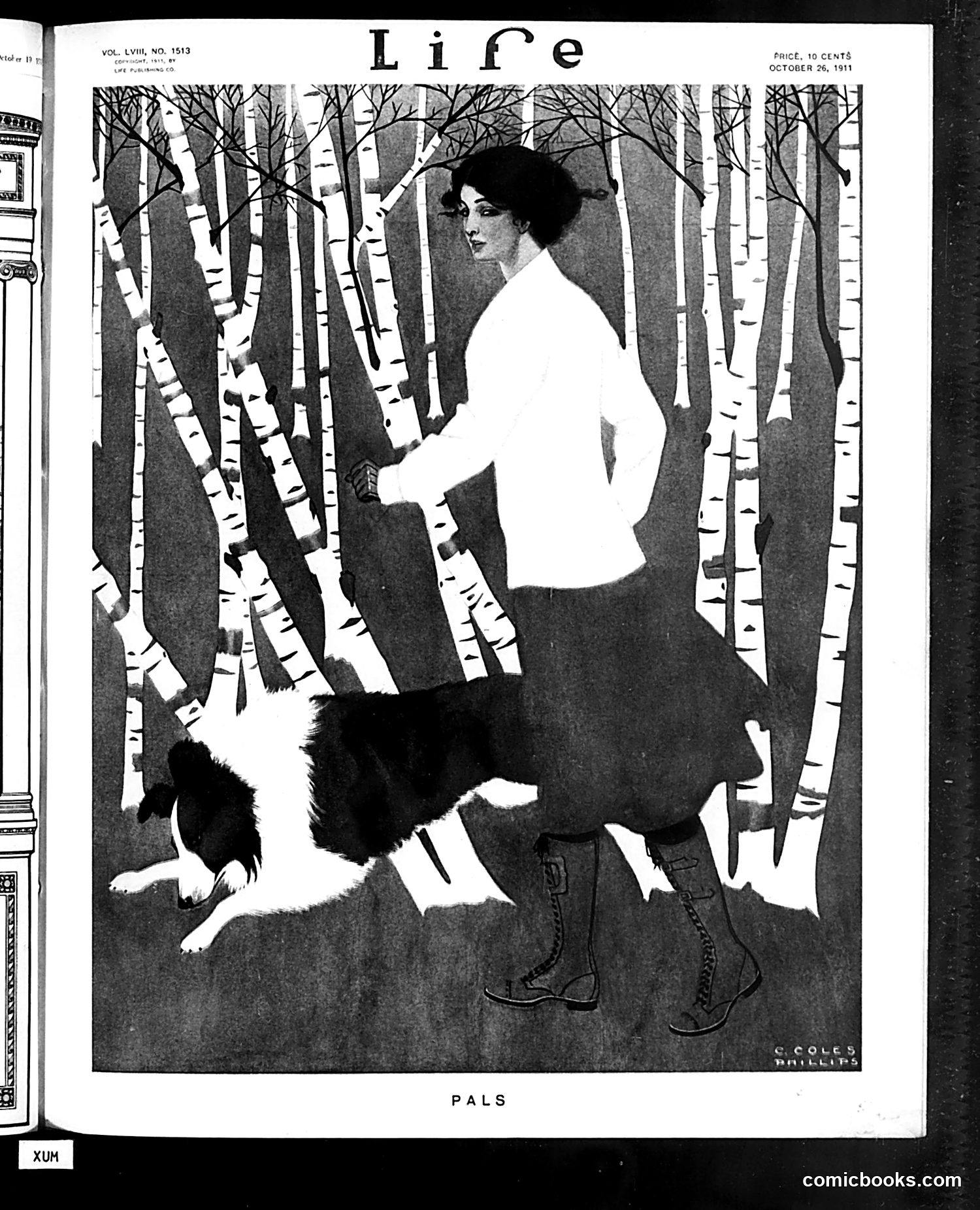
This cover illustration by C. Coles Phillips depicts a woman in a birch forest accompanied by a small black-and-white dog. The title "Pals" suggests companionship between the woman and her pet. The artwork exemplifies early 20th-century American magazine aesthetics, featuring Phillips' characteristic style: clean lines, dramatic contrast between light and shadow, and fashionable female figures. The woman wears a white blouse and dark skirt typical of the era. The image appears to be purely illustrative rather than political satire. It likely celebrates the bond between humans and pets—a genteel, sentimental theme common to Life magazine's content during this period. The birch forest setting suggests a romanticized, leisurely outdoor scene.
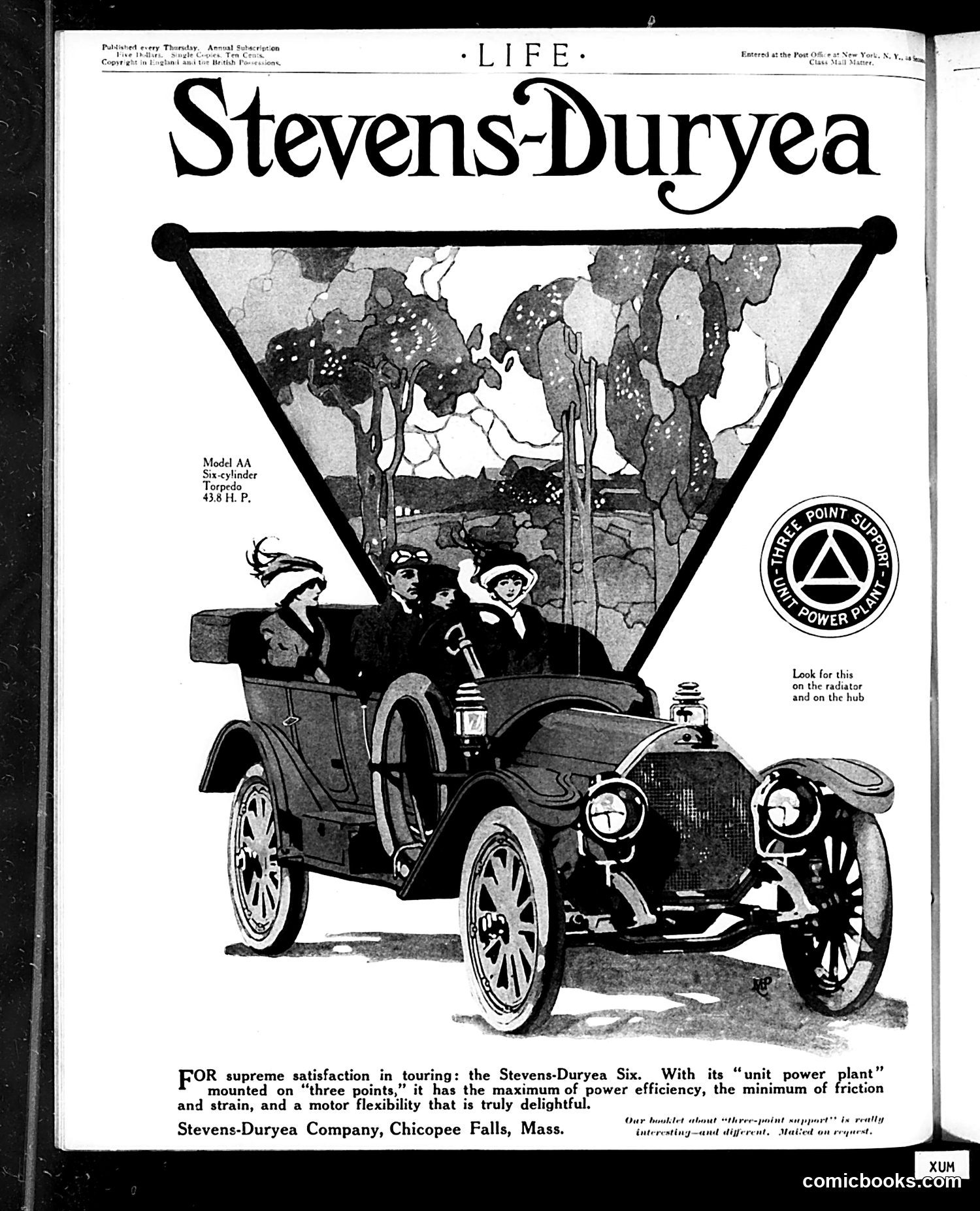
This is **not a political cartoon or satire**—it's a straightforward automobile advertisement for the Stevens-Duyea Six, published in *Life* magazine. The image shows an early-1910s touring car with three well-dressed passengers driving past desert scenery (cacti visible). The ad emphasizes the vehicle's engineering: a "unit power plant" mounted on "three points" for maximum efficiency and minimal friction. The "Three Point Support" logo appears on the radiator and hub. The ad copy targets leisure travelers, promising "supreme satisfaction in touring" through superior motor flexibility and reliability. This represents typical early automotive advertising—emphasizing technical innovation and the leisurely lifestyle new cars enabled for wealthy Americans. The desert scene suggests adventure and travel capability.
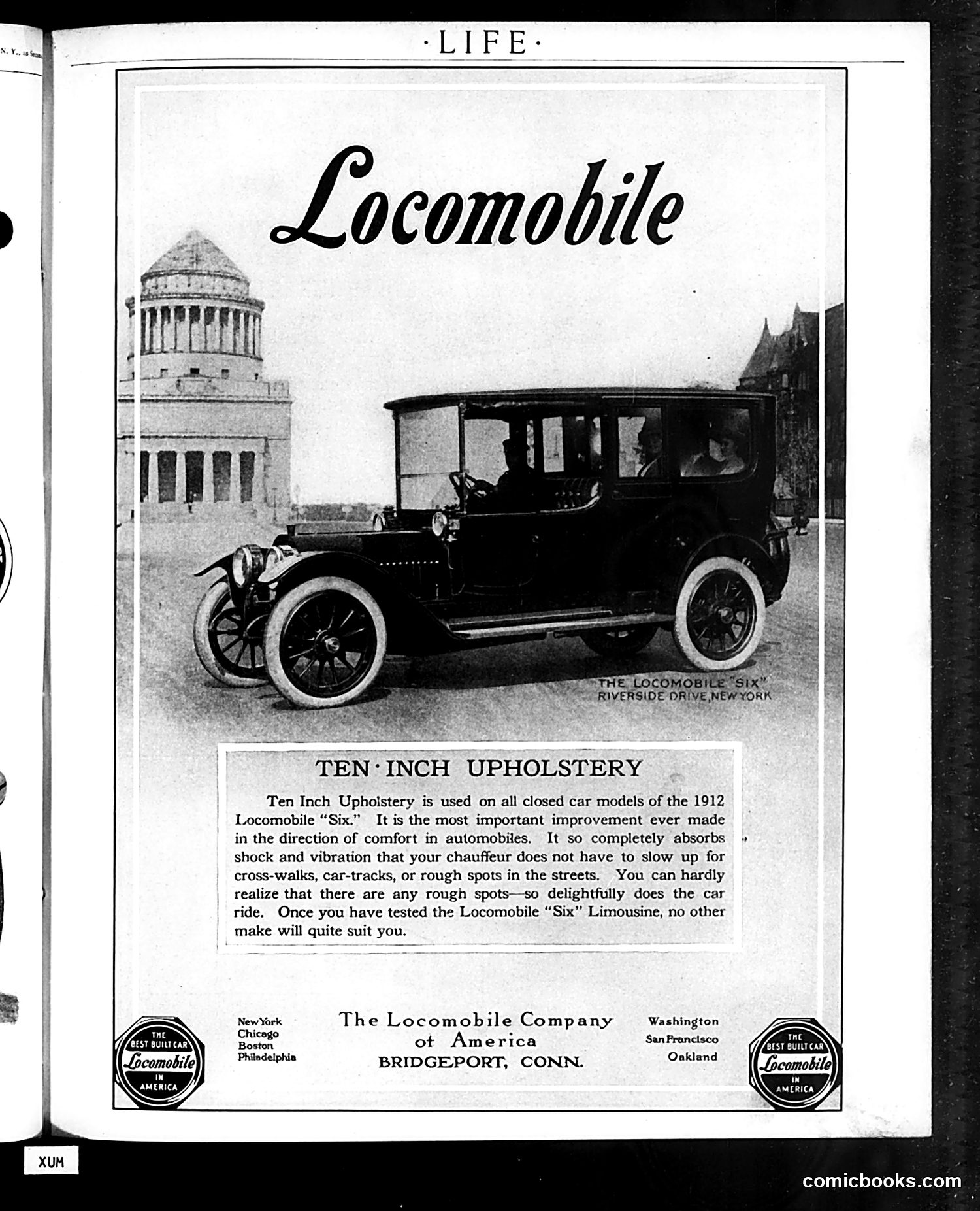
This is **not a cartoon or satire page** — it's a straightforward advertisement for the Locomotile automobile company. The page features a 1912 Locomotile "Six" model positioned before a classical civic building, accompanied by descriptive text highlighting the car's "Ten Inch Upholstery" as a major selling point. The ad emphasizes comfort as a key feature, claiming the upholstery absorbs shock so effectively that passengers needn't worry about rough roads or streetcar tracks. The copy suggests that once customers experience the Locomotile, "no other make will quite suit you." This represents early automotive advertising strategy — marketing luxury and comfort rather than mechanical specifications to appeal to affluent buyers.
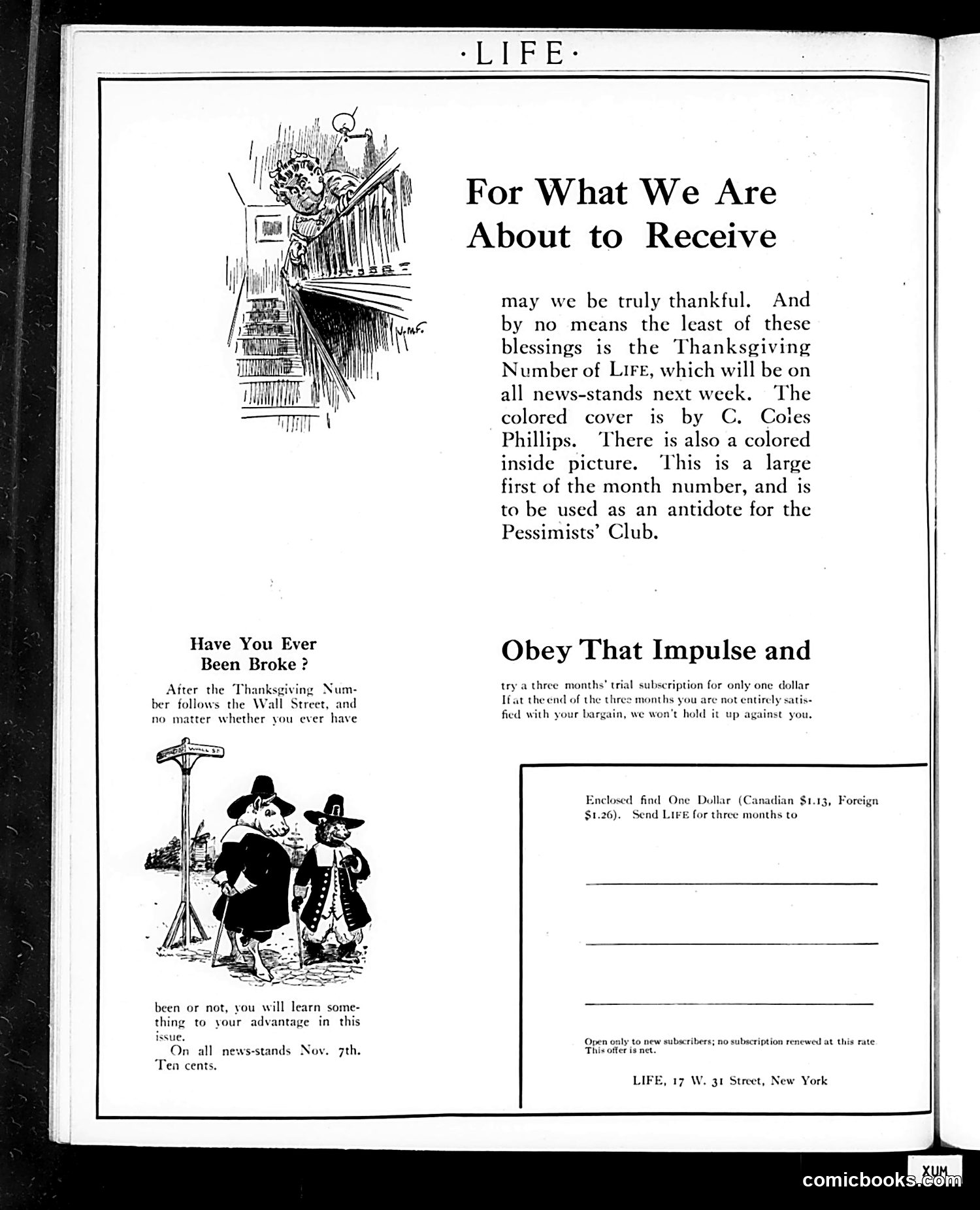
This page is primarily **advertising** for Life magazine's Thanksgiving issue, with two cartoon illustrations supporting the pitch. The top cartoon shows a cornucopia or harvest horn overflowing with abundance—a standard Thanksgiving symbol—emphasizing gratitude for blessings. The lower cartoon titled "Have You Ever Been Broke?" depicts two figures in apparent financial distress beside a bare pole (suggesting poverty or ruin). The caption suggests that reading Life's financial/business coverage will teach readers "something to your advantage." The ads promote Life's Thanksgiving Number (cover by C. Coles Phillips) as an "antidote for the Pessimists' Club" and offer a three-month trial subscription for one dollar—positioning the magazine as both entertaining and financially educational during economically uncertain times.
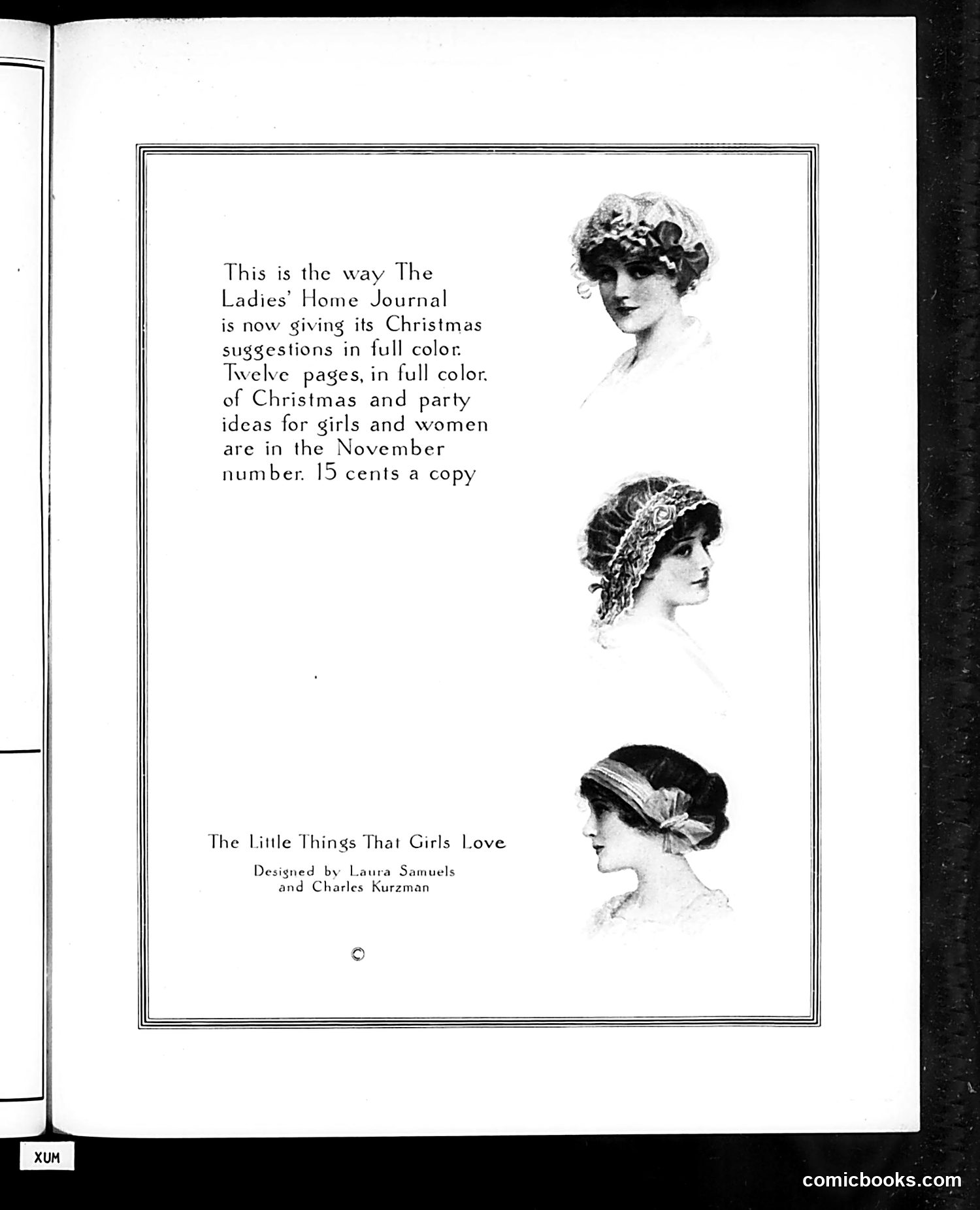
This page is primarily **advertising content**, not satire or political commentary. It promotes *The Ladies' Home Journal*'s November issue, highlighting twelve pages of Christmas and party ideas in full color, priced at 15 cents. The page features three portrait illustrations of women wearing different decorative headpieces—typical of early 20th-century fashion. These appear to be style suggestions rather than caricatures or commentary. Below is a section titled "The Little Things That Girls Love," credited to designers Laura Samuels and Charles Kurzman, likely promoting gift or decoration ideas featured in the magazine. There is no discernible political satire, social criticism, or editorial cartoon present on this page. It functions as a straightforward commercial advertisement for a women's lifestyle magazine.
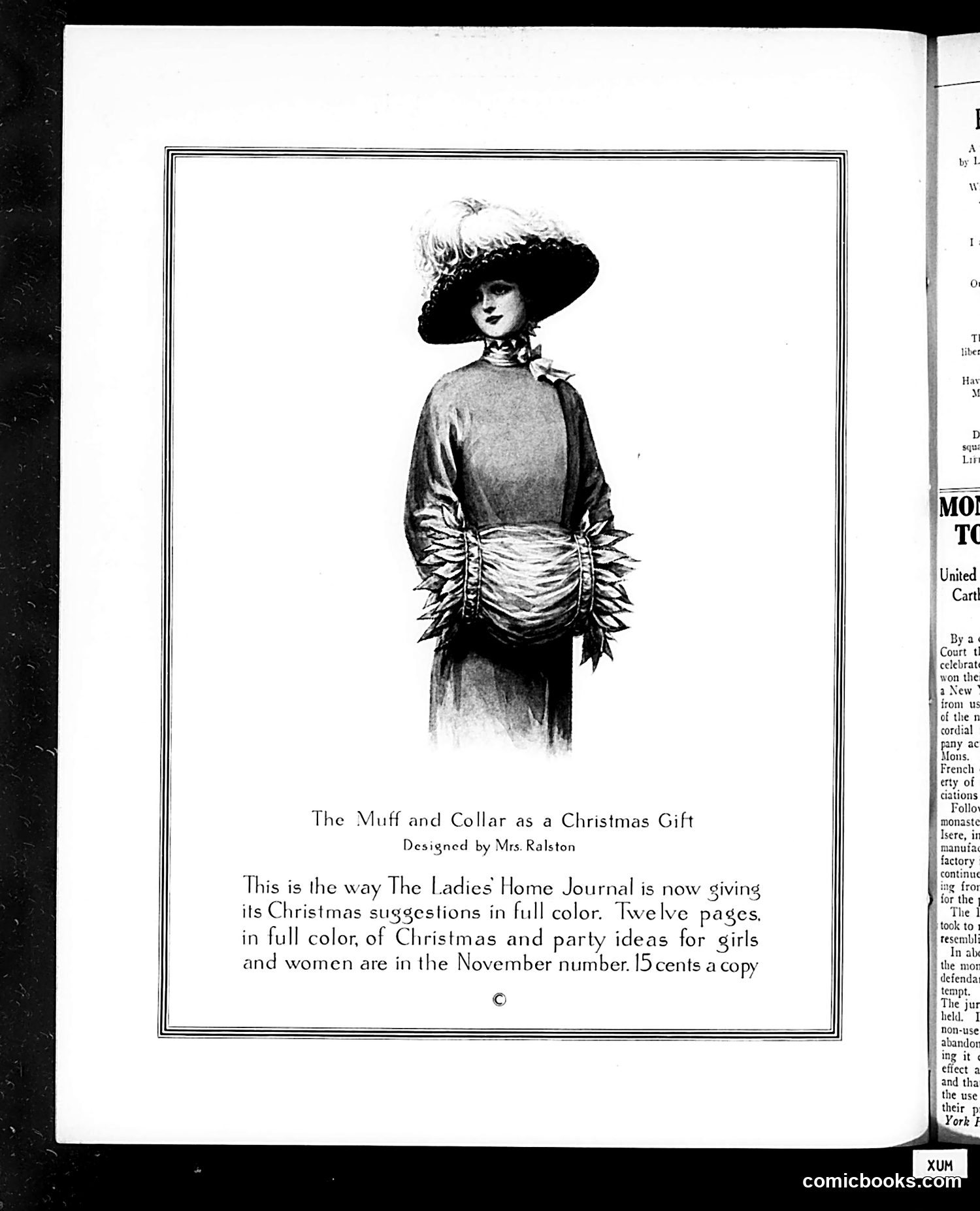
This page is primarily **advertising and promotion**, not satire or political commentary. It features a fashion illustration titled "The Muff and Collar as a Christmas Gift," designed by Mrs. Ralston. The image shows a woman in early 1900s attire wearing a large feathered hat, fitted dress with an ornate sash/muff detail at the waist. The text below advertises **The Ladies' Home Journal's** November issue, promoting twelve pages of Christmas and party suggestions in full color, priced at 15 cents. There is no apparent political or satirical content here—it's a straightforward period advertisement using fashion imagery to promote a women's magazine and showcase contemporary holiday gift ideas for female readers.
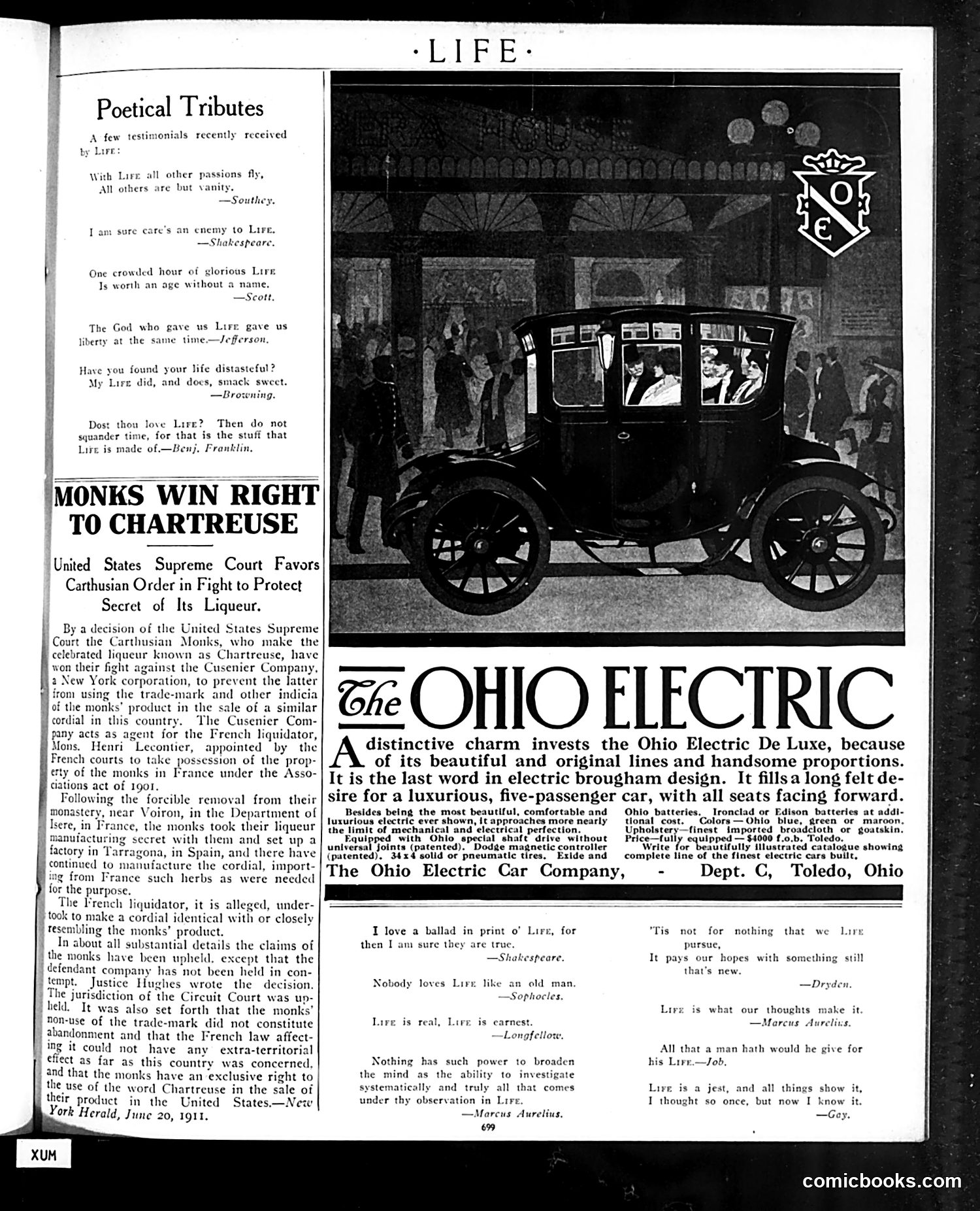
This page mixes satirical content with advertising. The main article, "Monks Win Right to Chartreuse," reports on a U.S. Supreme Court decision protecting a Carthusian monastery's right to produce and sell their secret liqueur recipe against a competing New York company. The monks successfully defended their trademark and exclusive manufacturing rights. The satire lies in the incongruity: religious monks engaged in a legal trademark battle over alcohol production—a mundane commercial dispute resolved at the highest court level. This highlights the absurdity of trademark law protecting even monastic liqueur secrets. The page also features a full-page advertisement for the Ohio Electric automobile, emphasizing luxury and innovation—typical early-1900s automotive marketing unrelated to the satire above.
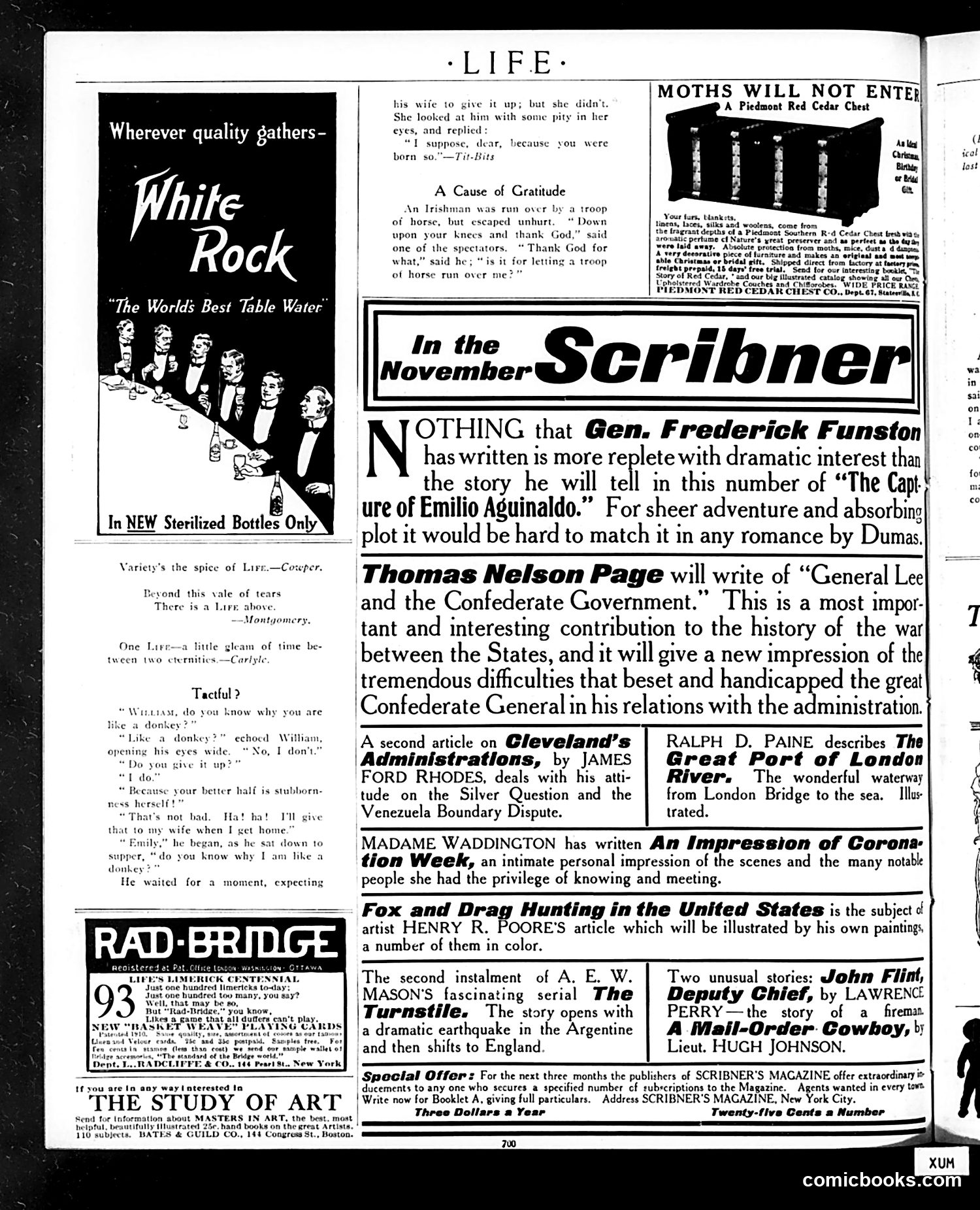
This page is primarily **advertising and editorial content** rather than political cartoons. The main items are: 1. **White Rock water advertisement** - promoting bottled table water with an illustration of well-dressed diners 2. **"In the November Scribner" section** - promotional text for upcoming Scribner's Magazine articles, including pieces by Gen. Frederick Funston on Emilio Aguinaldo, Thomas Nelson Page on General Lee, and others covering historical/political topics 3. **Various smaller advertisements** including Rad-Bridge (appears to be a medical product) and "The Study of Art" book promotion The page contains **no political cartoons or satirical illustrations**. Instead, it's a typical early-20th-century magazine page mixing editorial promotion with commercial advertisements, reflecting how publications funded themselves through paid advertising.
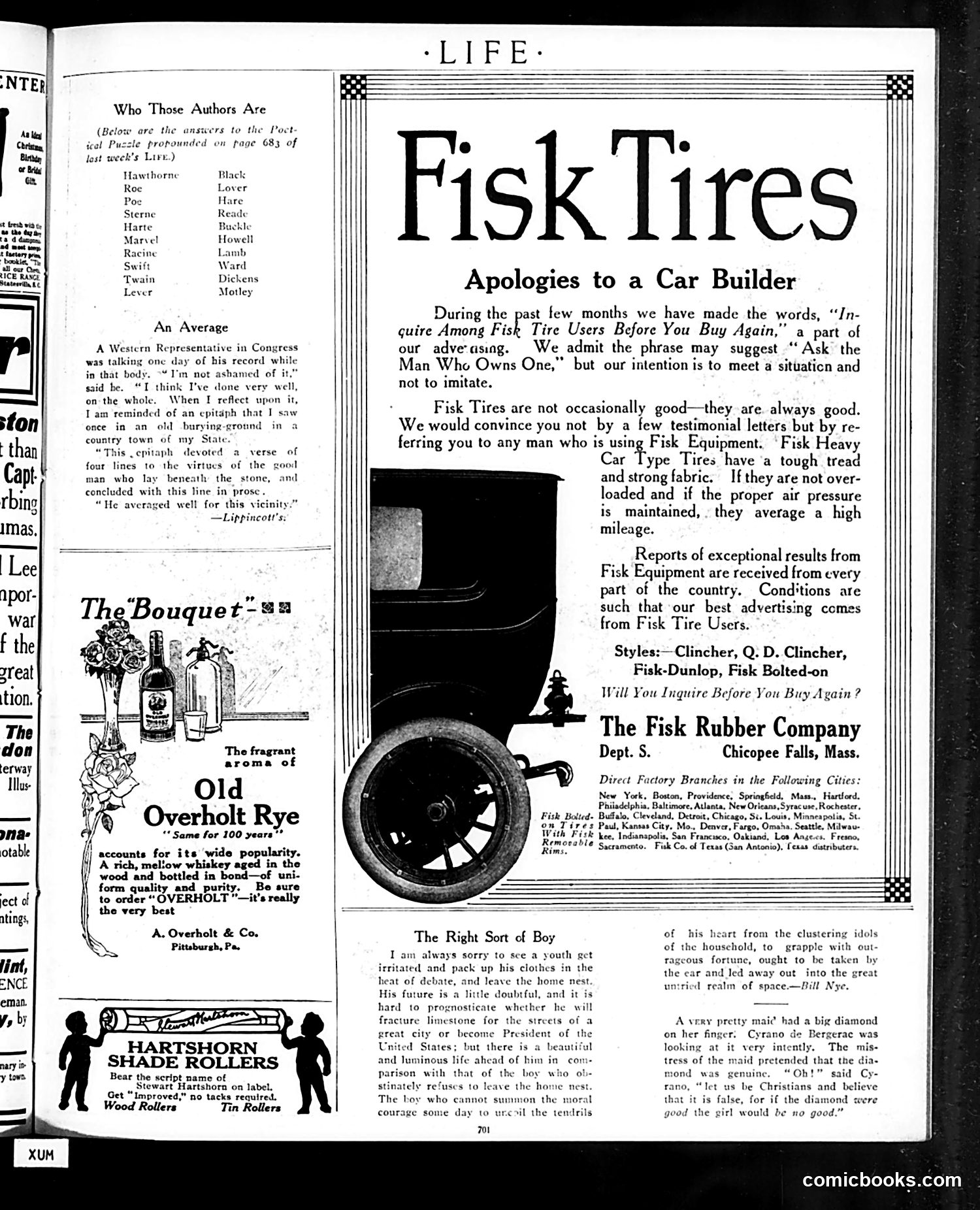
This page is primarily **advertising**, not satire or political commentary. The dominant content is a large Fisk Tires advertisement ("Fisk Tires: Apologies to a Car Builder") featuring an illustration of an automobile tire. The ad makes a humorous self-deprecating claim that Fisk Tires aren't just "occasionally good—they are always good," addressing the phrase "Amona Fisk Tire Users Before You Buy Again." The page also contains smaller ads: **Old Overholt Rye** whiskey and **Hartshorn Shade Rollers**. A brief article titled "The Right Sort of Boy" discusses youth character and discipline, but appears unrelated to the advertisements. The "Who Those Authors Are" section lists literary references to a puzzle from page 683. Overall, this is a standard **magazine advertising page** from the early 20th century, not satirical content.
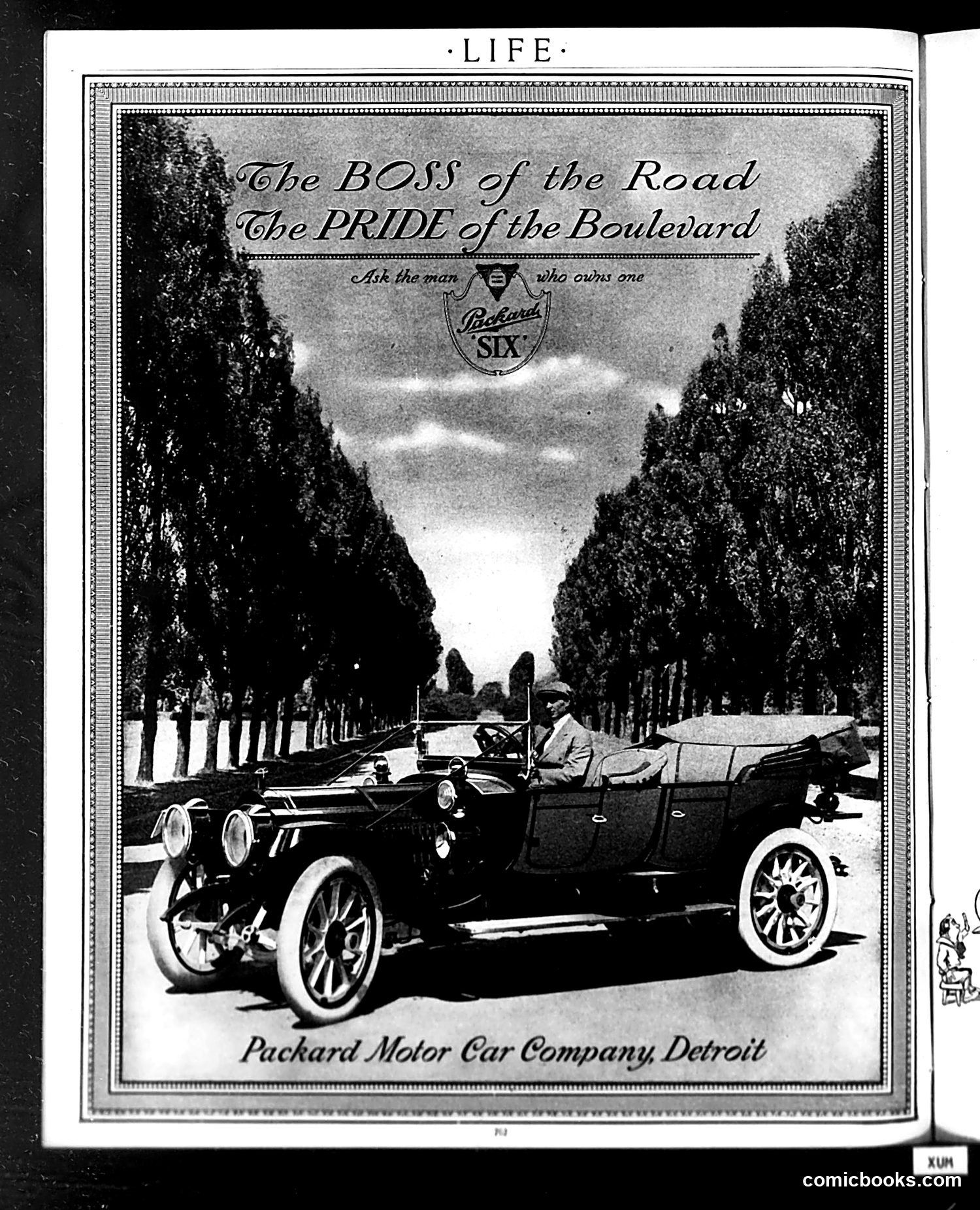
This is a **Packard automobile advertisement**, not political satire. The page appears from *Life* magazine and promotes the Packard Six motor car made by the Packard Motor Car Company in Detroit. The ad uses aspirational messaging: "The BOSS of the Road / The PRIDE of the Boulevard." It depicts an elegant open-air automobile on a tree-lined boulevard, suggesting wealth, status, and modern leisure. The tagline "Ask the man who owns one" was Packard's actual advertising slogan, implying owner satisfaction and prestige. The imagery appeals to early 20th-century automobile buyers by emphasizing the vehicle's dominance and social cachet rather than mechanical specifications. This reflects the era when owning a motorcar signaled success and refinement.
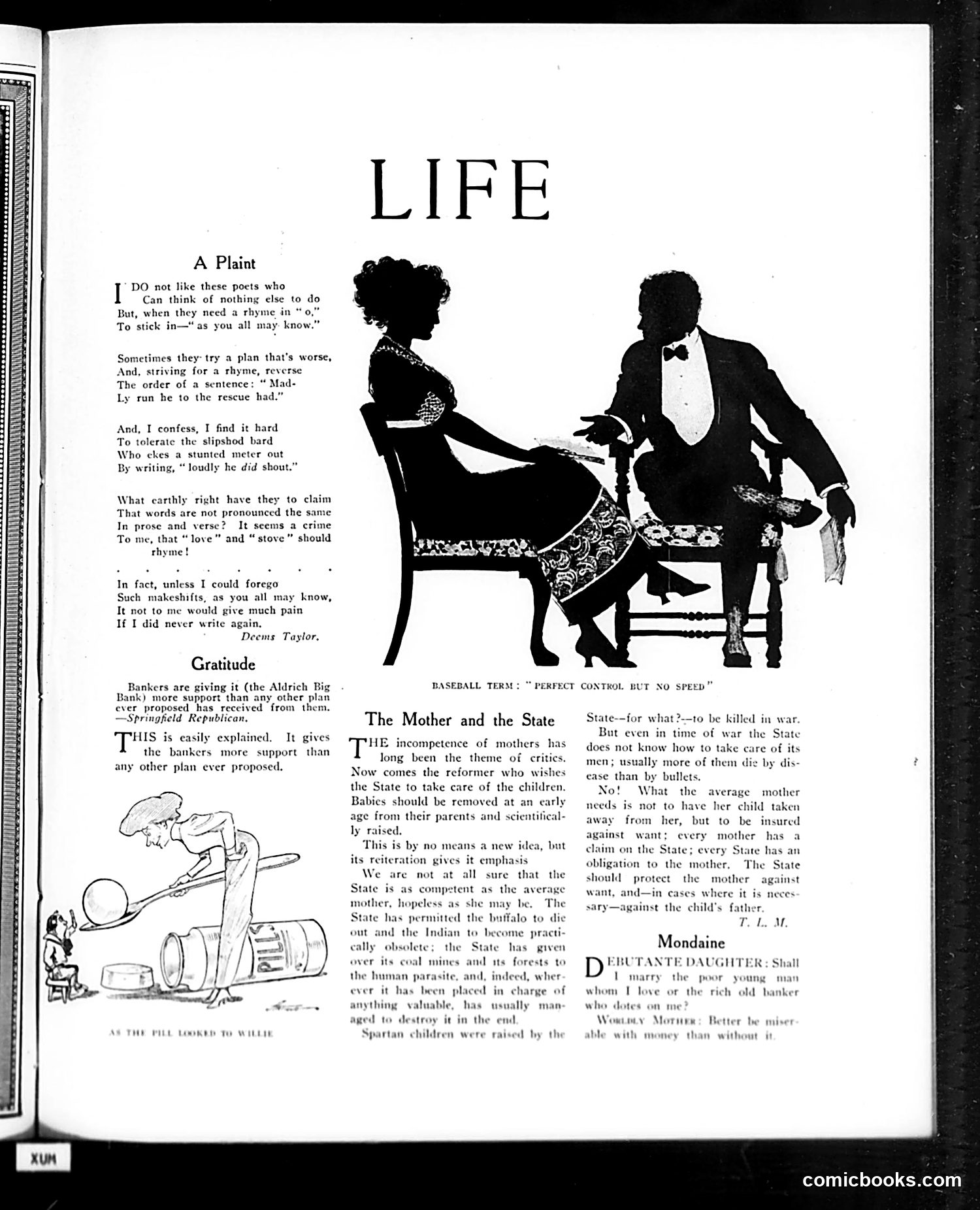
This page contains satirical poetry and social commentary typical of early 20th-century *Life* magazine. "A Plaint" mocks poets who force artificial rhymes (like "love" and "stove"), attributed to Deems Taylor. The illustrated section critiques bankers' self-congratulation over the "Aldrich Big Bill" financial plan. The main illustration shows a well-dressed couple—likely representing wealthy or influential figures—with a baseball caption: "Perfect control but no speed," apparently satirizing ineffectual authority. "The Mother and the State" debates whether governments should care for children, arguing mothers need protection from want rather than state intervention. "Mondaine" addresses marital economics humorously. The cartoons employ visual wit and wordplay to critique contemporary banking policies, gender roles, and class assumptions—common *Life* magazine themes.
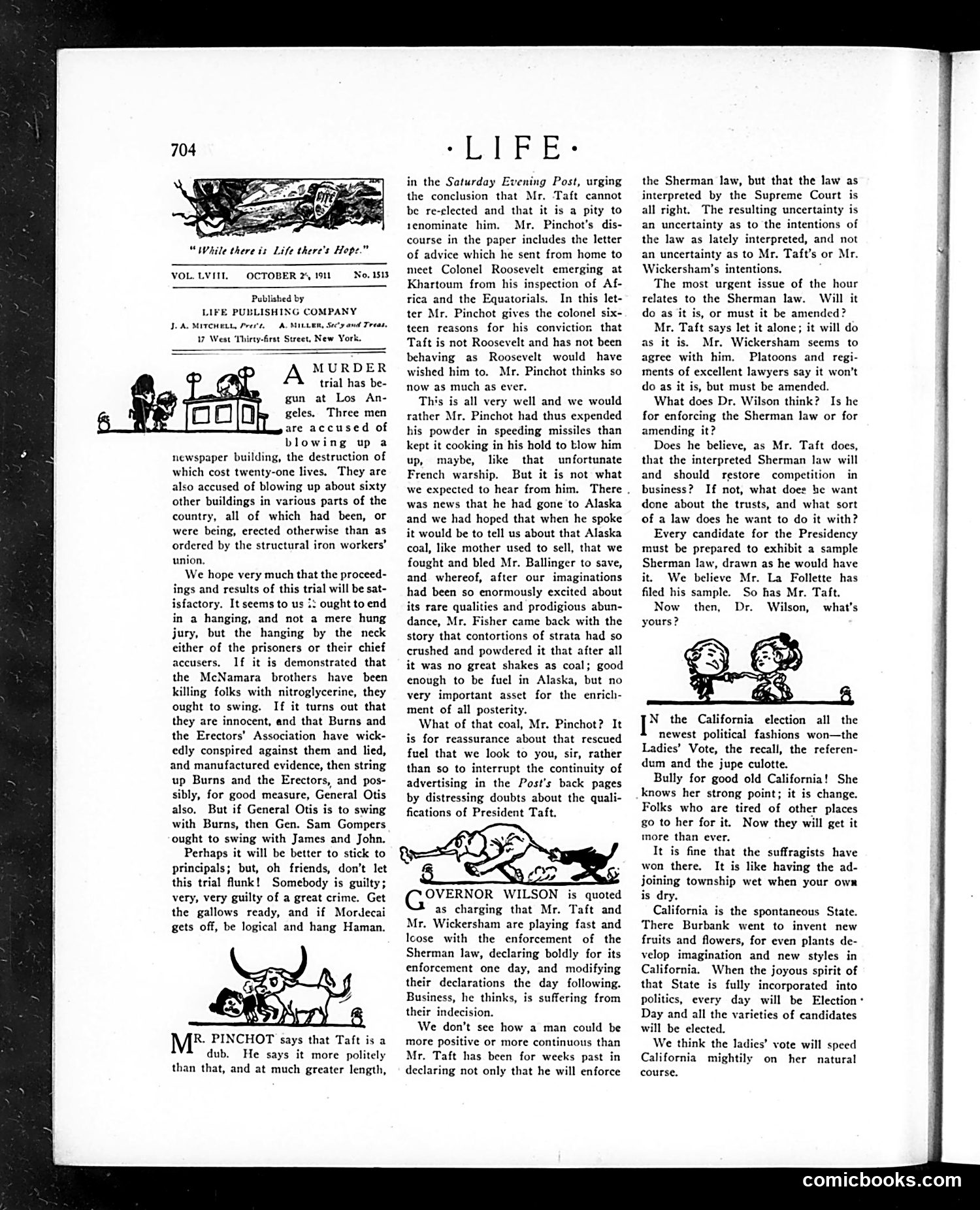
This page discusses a murder trial in Los Angeles involving accusations of bombing a newspaper building and destroying twenty-one lives. The text critiques various political figures' responses to the Sherman law (antitrust legislation). The cartoons mock President Taft, Governor Wilson, and Mr. Wickersham regarding their inconsistent positions on enforcing the Sherman law. One illustration shows figures in conflict, satirizing their political posturing. The text suggests these politicians are being evasive and contradictory—Taft claims he'll enforce the law while Wickersham seems to disagree, and Wilson offers vague assurances. The satire argues that every presidential candidate should present a clear Sherman law platform rather than offering ambiguous positions. The piece also briefly mentions California's women's suffrage election and its political implications.
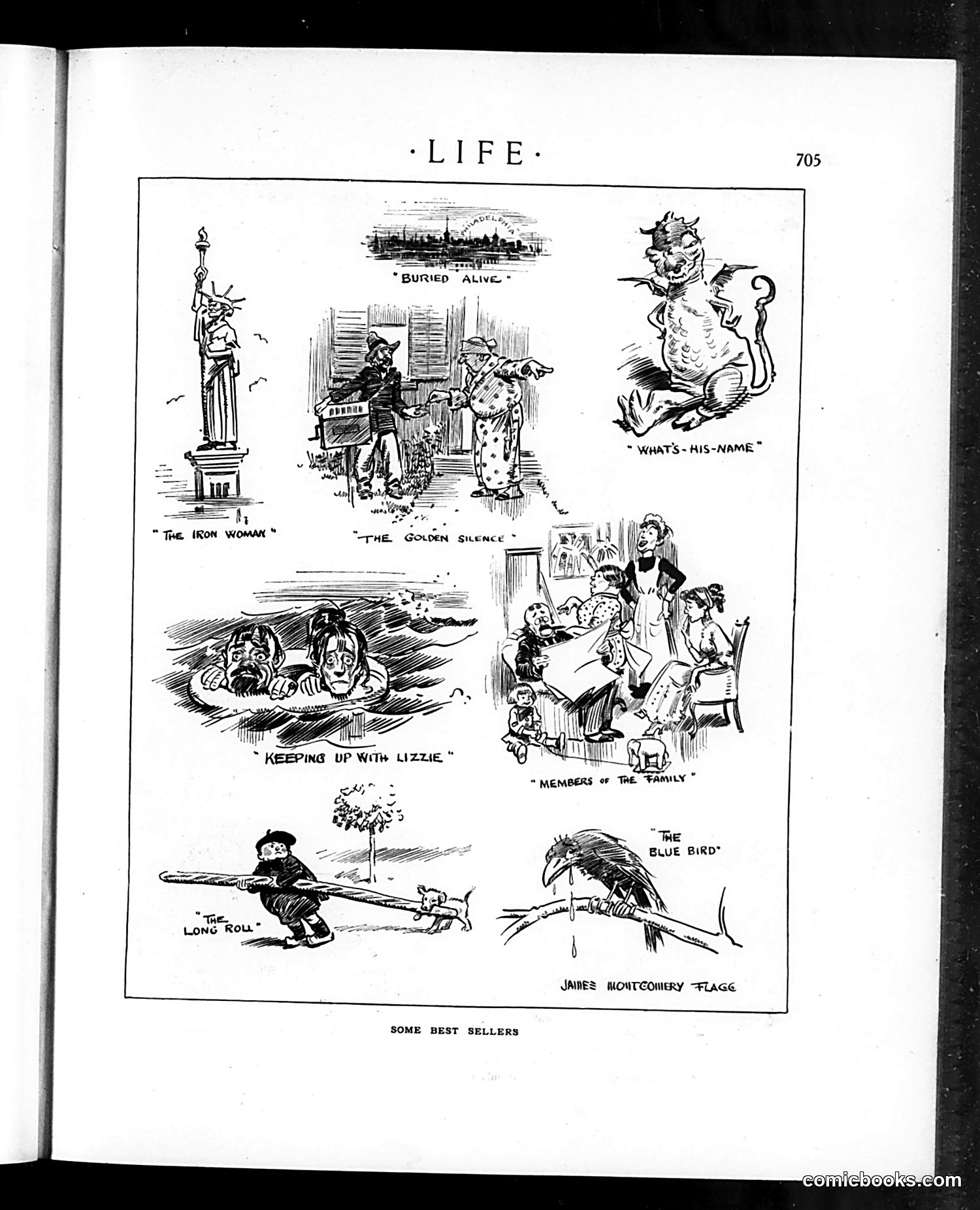
This page presents a collection of humorous illustrations by James Montgomery Flagg depicting "Some Best Sellers"—likely popular books or cultural references of the era. Each sketch satirizes well-known titles: - "The Iron Woman" and "The Golden Silence" appear to reference literary works - "Buried Alive," "What's-His-Name," and "Keeping Up with Lizzie" are titled cartoon vignettes - "Members of the Family," "The Long Roll," and "The Blue Bird" conclude the collection The illustrations use exaggerated caricature and visual humor to mock contemporary literary trends and social pretensions. Without specific publication dates, the exact books referenced remain unclear, but the satire targets popular fiction and domestic comedy of early-20th-century American publishing. The cartoonist uses grotesque figures and absurdist situations to lampoon these bestselling works.
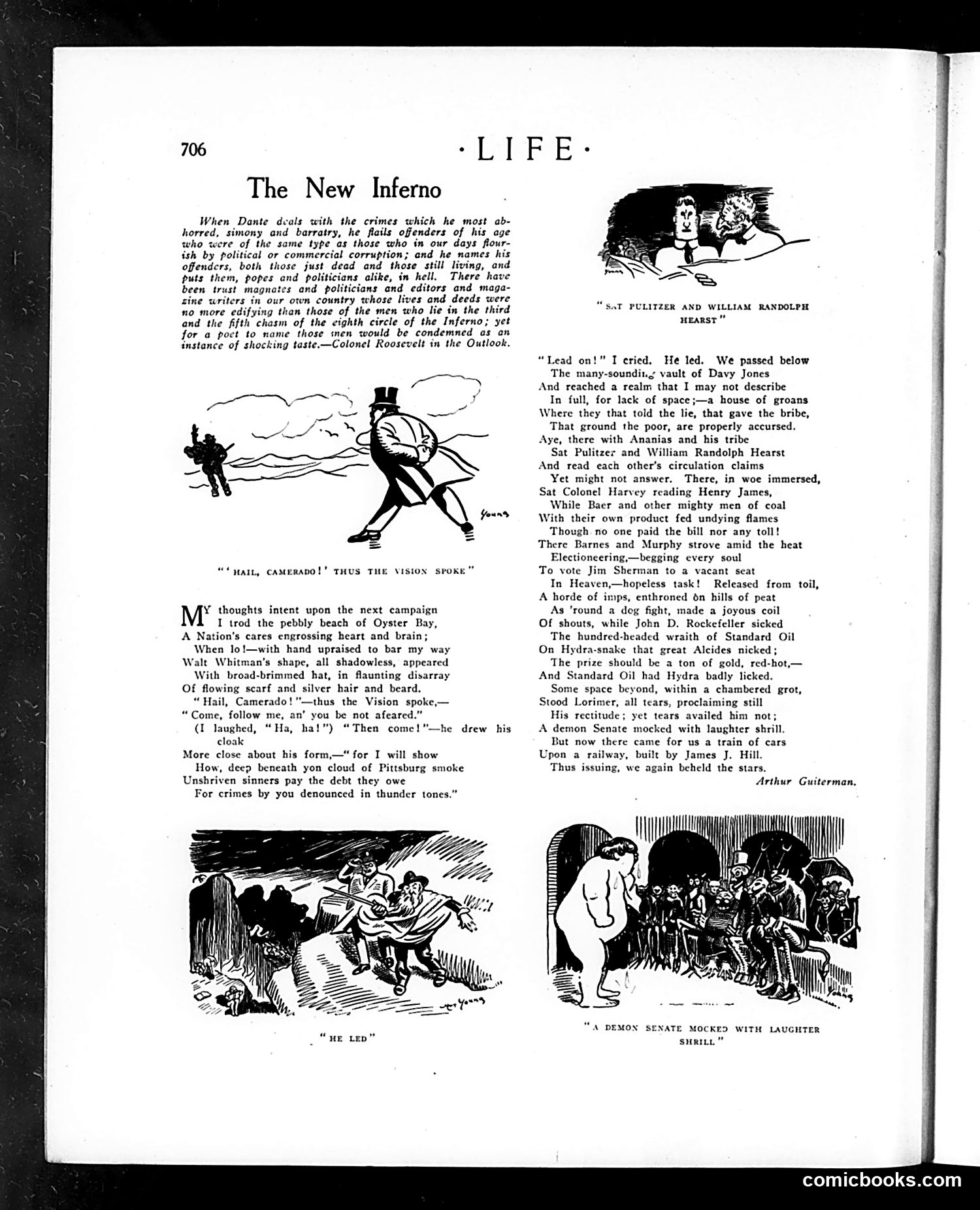
This satirical piece reimagines Dante's Inferno with contemporary (early 20th century) American political figures. The opening paragraph establishes the conceit: corrupt politicians, editors, and magazine writers belong in a modern hell alongside historical villains. The poem mocks specific figures through Dante-style punishments: Sat Pulitzer and William Randolph Hearst (newspaper moguls) read each other's "circulation claims"; Colonel Harvey reads Henry James; various corrupt politicians and businessmen suffer appropriate torments in this political underworld. The illustrations depict scenes from this modern inferno—demons tormenting the damned in classical style. The satire targets early-1900s corruption, corporate malfeasance, and journalistic dishonesty, using Dante's medieval framework to condemn contemporary American vice.
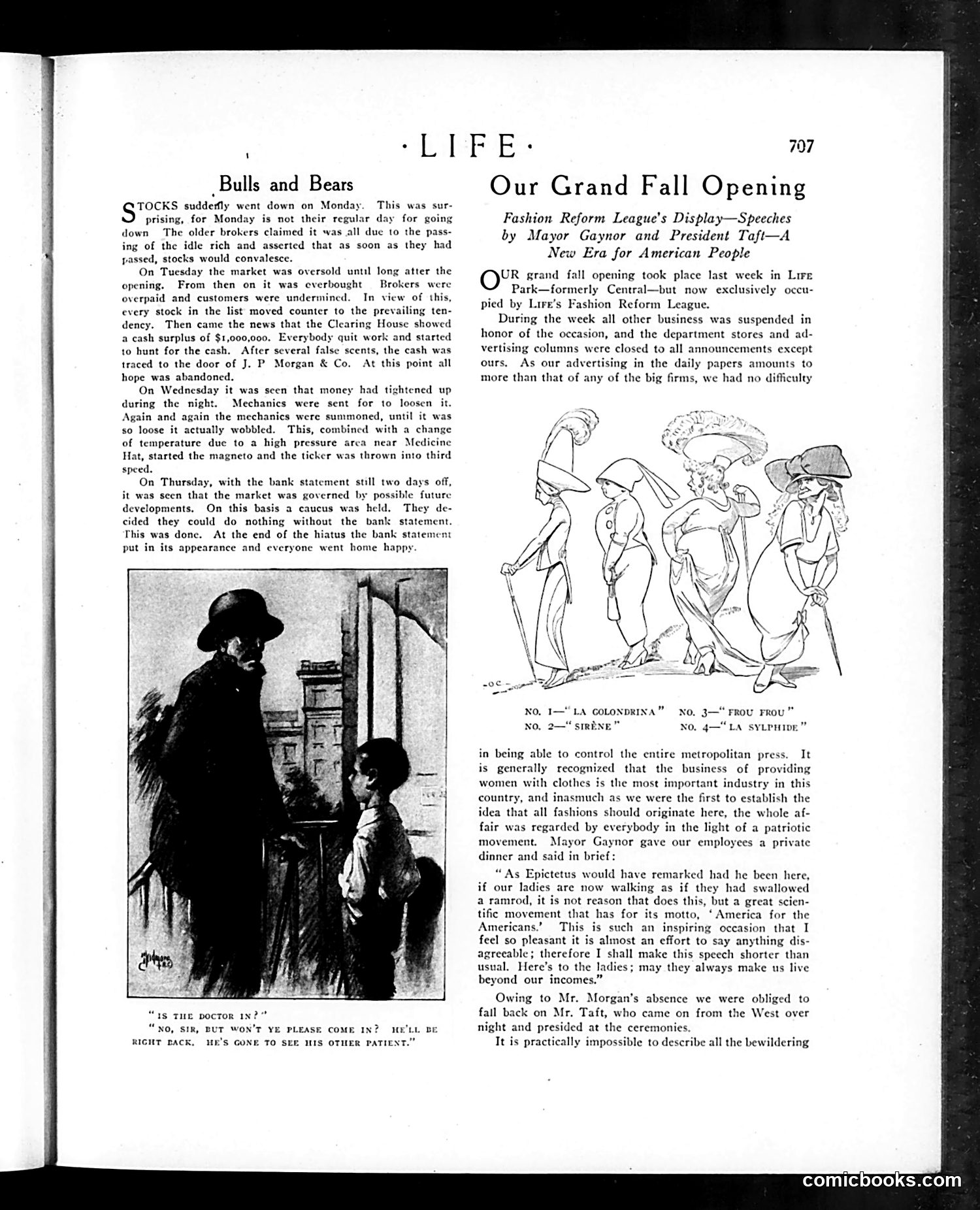
This page contains two satirical pieces from *Life* magazine: **"Bulls and Bears"** (left) mockingly describes stock market volatility, portraying brokers as confused and reactive. The humor relies on absurdist logic—stocks move "counter to prevailing tendency," mechanics are called to "loosen" tight money, and a $1 million surplus causes chaos. The accompanying cartoon shows a doctor's office scene with working-class Irish dialect, likely satirizing how even ordinary people got caught up in financial speculation. **"Our Grand Fall Opening"** (right) satirizes the Fashion Reform League's self-importance. The text boasts about controlling "the entire metropolitan press" through advertising dominance—a dig at media manipulation and corporate power. Mayor Gaynor's quoted speech, referencing the philosopher Epictetus, absurdly praises women adopting stiff posture as a "patriotic movement." The four fashion illustrations represent different styles being promoted. The satire targets wealthy institutions' ability to dominate public discourse and the grandiose language used to market trivial consumer goods.
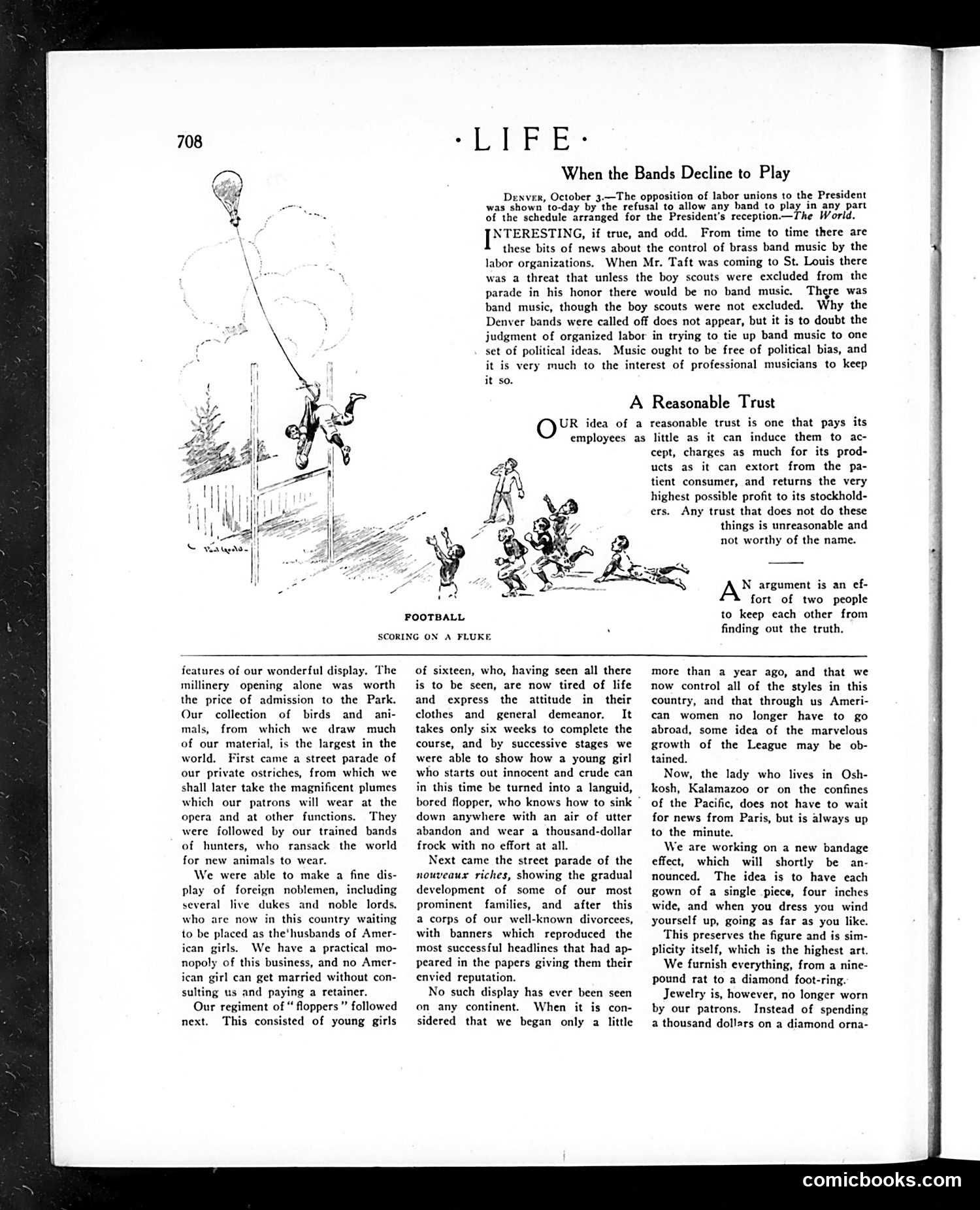
This page satirizes labor union power and political overreach during the Progressive Era (appears to reference President Taft's era based on context). **The Main Cartoon:** A small illustration labeled "Football - Scoring on a Fluke" shows children playing, seemingly unrelated to the text—typical of Life's approach to juxtapose serious commentary with frivolous images. **The Satire's Point:** Life mocks organized labor's attempt to control band music during Denver's presidential reception by refusing to participate. The magazine argues music should remain "free of political bias" and shouldn't be weaponized for labor politics—even while acknowledging the story may be "odd" or exaggerated. **The Irony:** Life simultaneously publishes a biting definition of "A Reasonable Trust" that sarcastically describes monopolistic practices (pay workers minimum, charge consumers maximum, maximize profits)—suggesting Life itself harbored skepticism toward *all* concentrated power, whether labor unions or corporate trusts. The page demonstrates early 20th-century anxiety about which groups—labor or capital—controlled American institutions.
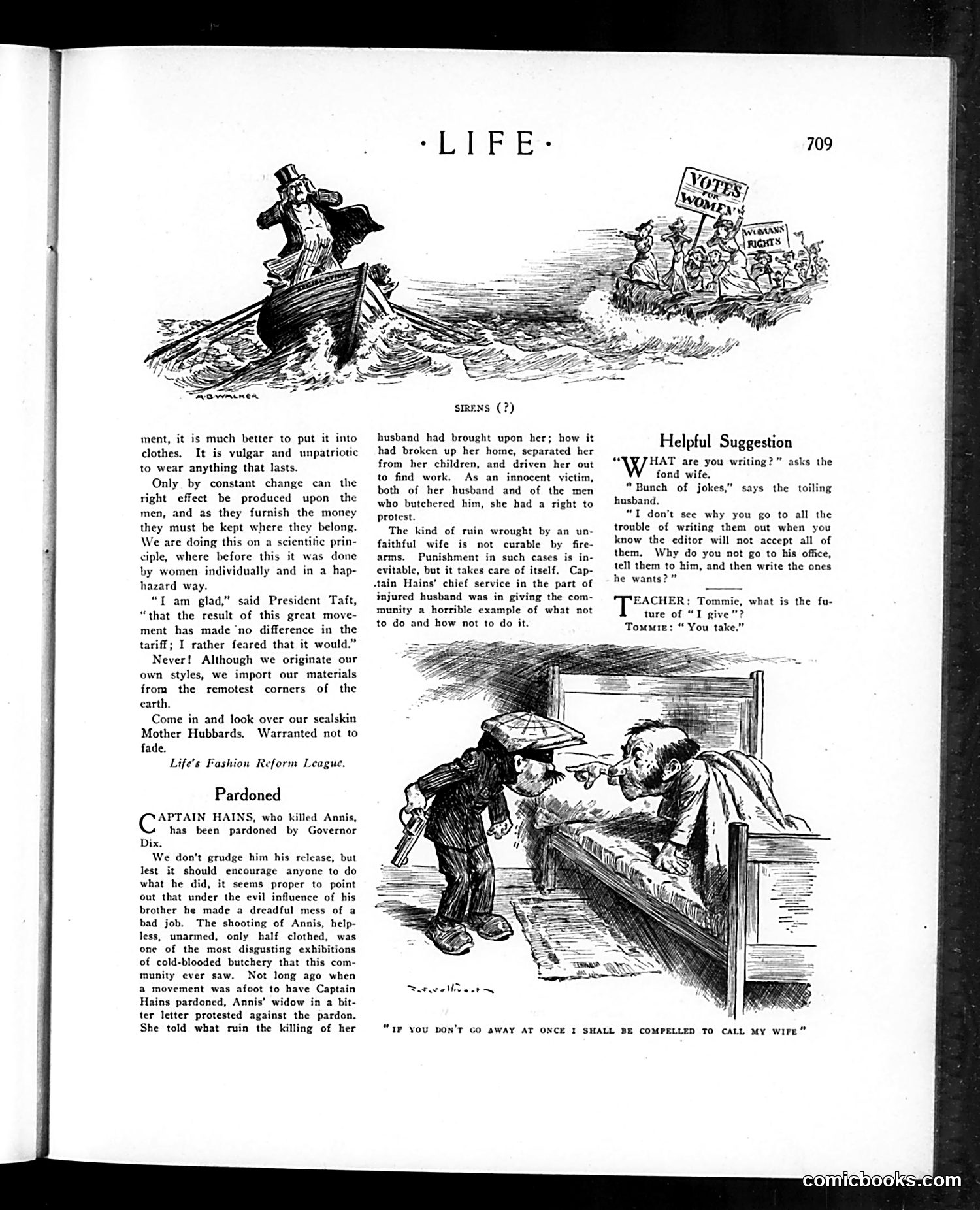
**Top Cartoon ("Sirens"):** Shows Uncle Sam in a boat being lured toward women's suffrage activists on shore holding "Votes for Women" signs. The satire suggests women's suffrage is a dangerous temptation that will shipwreck the nation—a common anti-suffrage argument of the era. **"Pardoned" Article:** Criticizes Governor Dix's pardon of Captain Hains, who killed an unarmed man (Annis). The piece acknowledges Annis's widow's legitimate suffering—her home destroyed, separated from children, forced to work—yet still opposes the pardon. The satire appears aimed at those defending Hains rather than the governor. **Humor Pieces:** Three brief jokes about marriage and writing. The final cartoon shows a man threatening to call his wife to scare away an unwanted visitor—satirizing wives as formidable domestic forces. **Context:** This reflects early 1900s anxieties about women's expanding social roles, suffrage activism, and changing marriage dynamics. The tone treats these as threats to masculine authority.
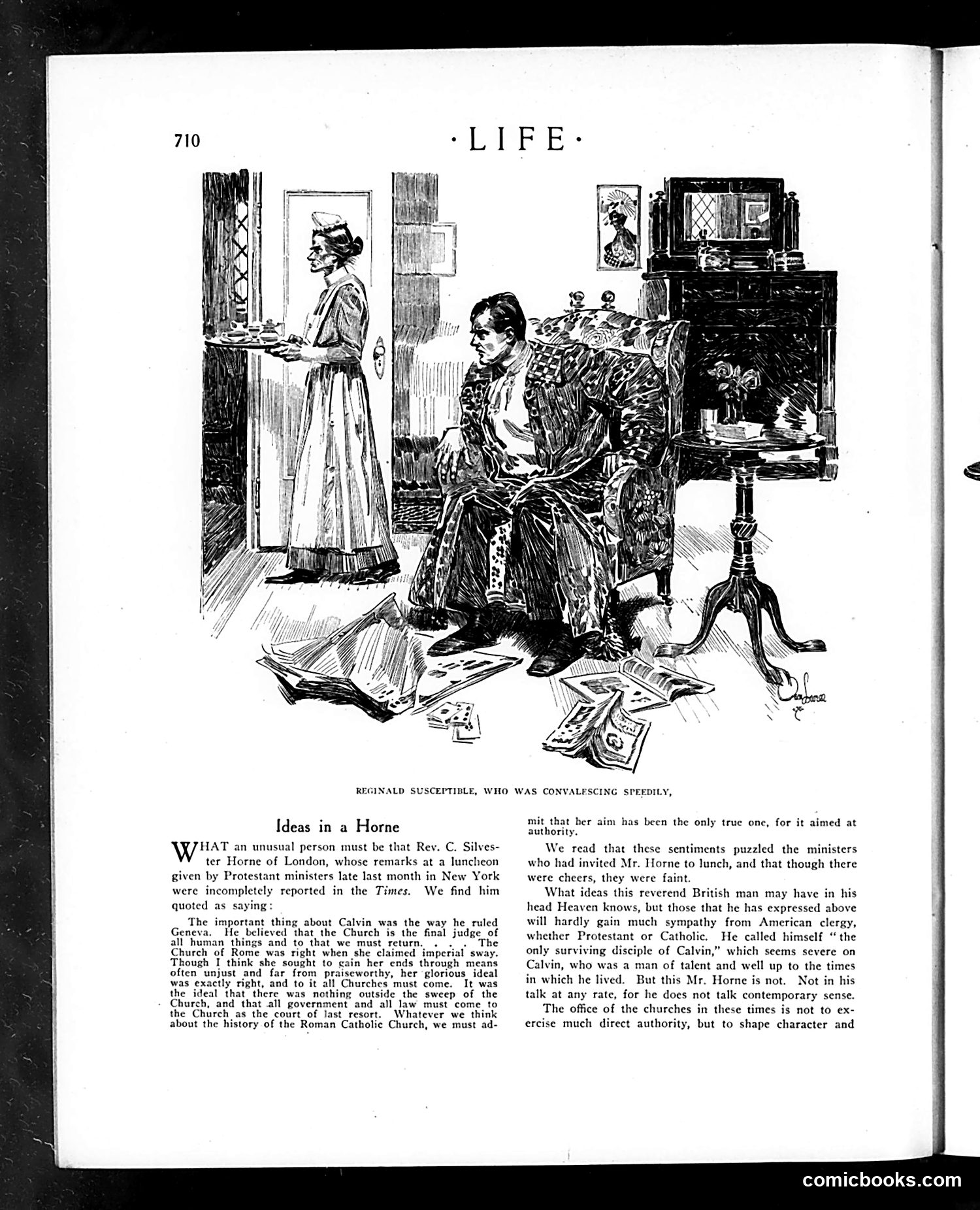
This page satirizes **Rev. C. Silvester Horne**, a British Protestant minister who spoke at a New York luncheon. The cartoon shows "Reginald Susceptible" convalessing—a visual pun on someone easily influenced while recovering. The satire targets Horne's controversial statements praising the Roman Catholic Church's historical claim to absolute authority over all government and law, despite acknowledging the Church used "unjust" means. Horne, who called himself "the only surviving disciple of Calvin," expressed views that directly contradicted his Protestant identity. Life mocks this as dangerously out-of-touch reasoning. The magazine argues that modern churches should shape character and guide morality—not exercise direct political authority—a position reflecting early 20th-century American Protestant liberalism's rejection of religious authoritarianism. The faint cheers from the assembled ministers underscore the audience's discomfort with such retrograde ecclesiastical claims.
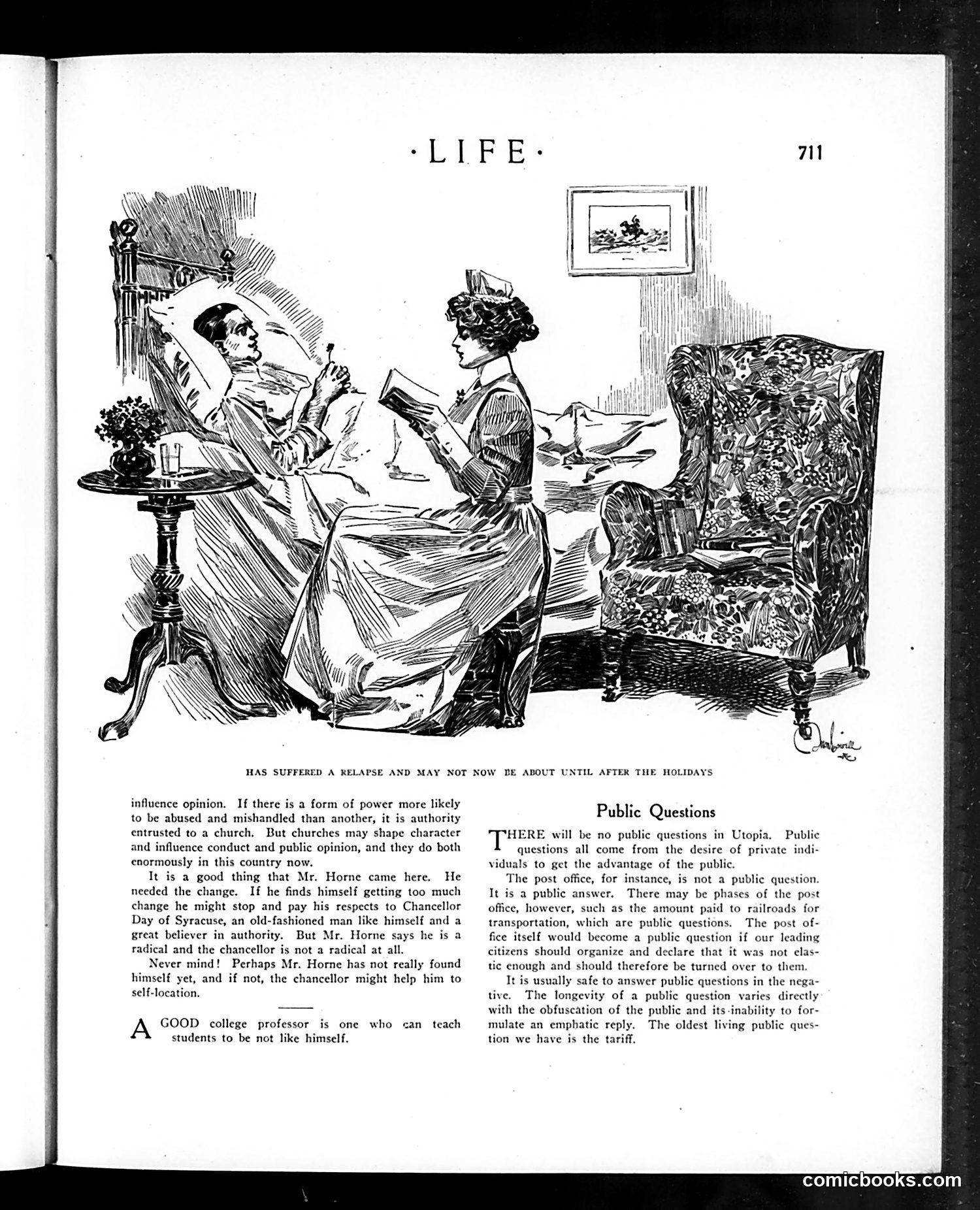
The cartoon depicts a domestic scene: a man reclines in a chair while a woman reads to him, with the caption "HAS SUFFERED A RELAPSE AND MAY NOT NOW BE ABOUT UNTIL AFTER THE HOLIDAYS." The satire appears to mock male hypochondria or malingering—the man feigns illness to avoid responsibilities, using the excuse of needing rest through the holiday period. The woman's dutiful attendance suggests she's enabling his behavior by reading to him during his "recovery." The accompanying text discusses church authority, education, and public policy questions. The professor aphorism ("A GOOD college professor is one who can teach students to be not like himself") reflects turn-of-the-century American educational debate about conformity versus individualism. The "Public Questions" essay critiques how public discourse operates, using the tariff as an example of an enduring political issue. Overall, the page satirizes institutional authority, male behavior, and the mechanics of public debate in early 20th-century America.
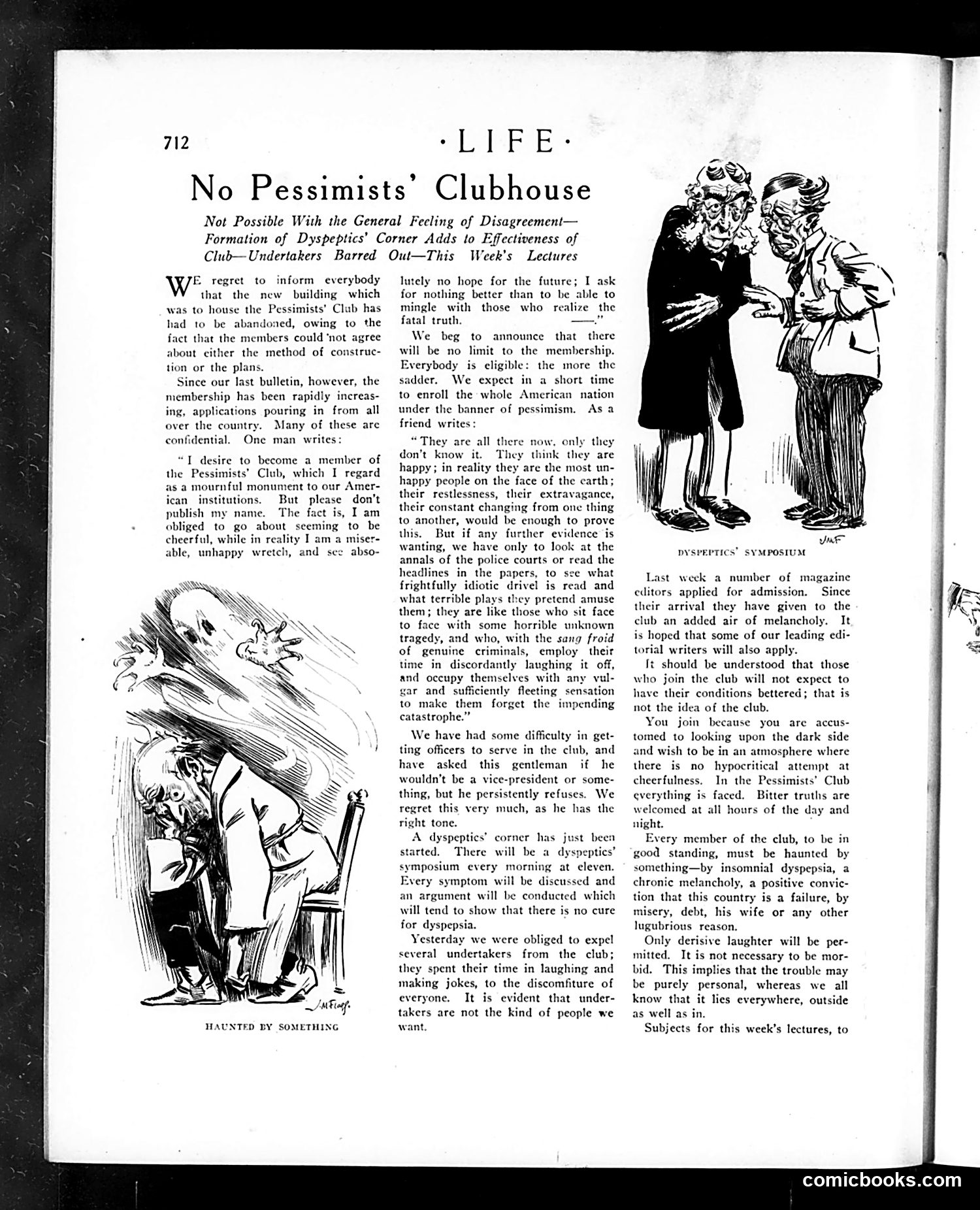
This article satirizes American pessimism and social malaise in the early 20th century. Life mocks the formation of a "Pessimists' Club"—a fictional organization for citizens who publicly pretend happiness while privately viewing life as hopeless. The satire targets multiple groups: ordinary people hiding depression behind forced cheerfulness; magazine editors and editorial writers characterized as chronically melancholic; and undertakers (excluded for inappropriate levity). A companion "Dyspeptics' Corner" features daily symposiums debating incurable indigestion. The cartoons illustrate dejected, haunted figures embodying this pessimistic worldview. Life's joke exposes the contradiction between American surface optimism and underlying social anxiety—crime, poor entertainment, restlessness—suggesting the entire nation secretly qualifies for membership. The irony: a club supposedly dedicated to honest negativity ironically becomes America's truest institution.
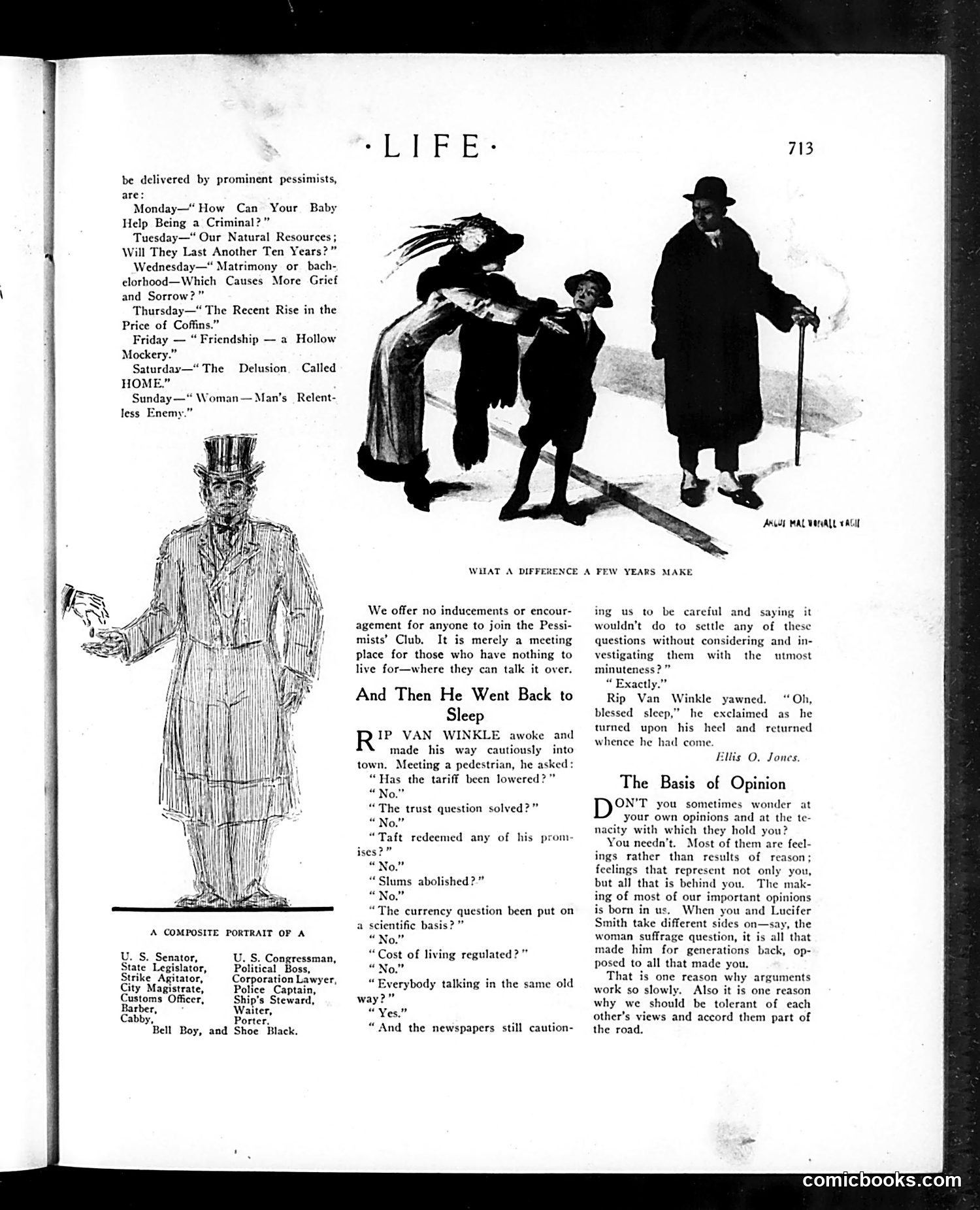
This *Life* magazine page contains two satirical pieces: **"The Pessimists' Club"** mocks gloomy public discourse by listing absurdly bleak lecture topics (babies as criminals, resource depletion, marriage causing sorrow, rising coffin prices). The accompanying caricature depicts a "composite portrait" of corrupt public officials—senators, politicians, police captains—unified as a single grotesque figure. The satire suggests these officials are interchangeable villains responsible for society's pessimism. **"Rip Van Winkle"** updates the classic tale: the sleeping character wakes to find nothing has changed. He asks about major reform issues (tariffs, trusts, Taft's promises, slum clearance, cost of living), receiving "No" to each. The newspapers still urge caution. Disgusted, he returns to sleep. This satirizes Progressive Era reform rhetoric—constant debate without actual progress, suggesting the public should give up on change. Both pieces express cynicism about American politics and social improvement circa the 1910s-1920s.
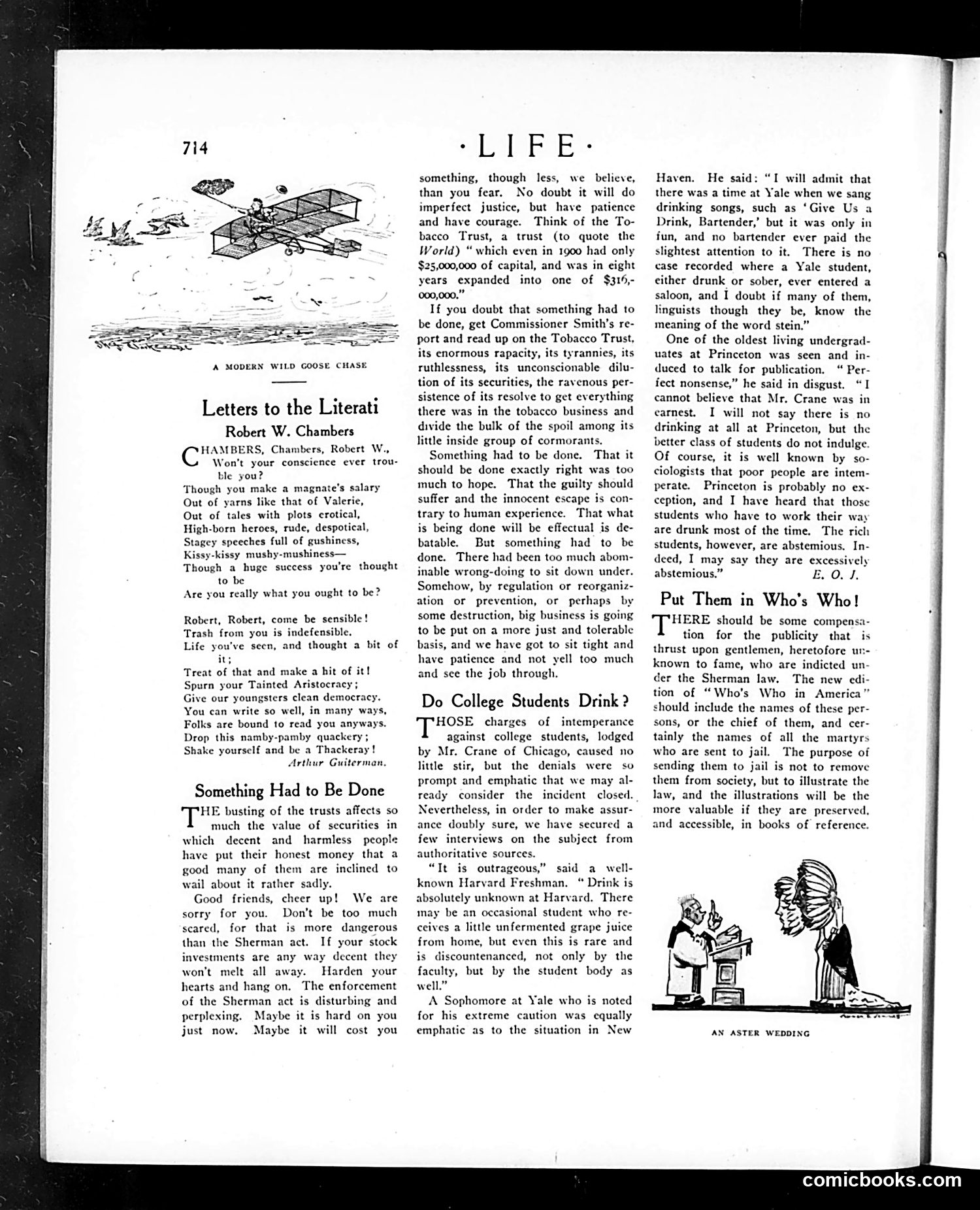
The cartoon depicts an early-1900s airplane or flying machine crash-landing, labeled "A Modern Wild Goose Chase." This satirizes the pursuit of trust-busting and antitrust enforcement under Theodore Roosevelt's administration. The page's articles address contemporary anxieties: trust dissolution (particularly the Tobacco Trust's breakup), and college drinking denials. The airplane image suggests that enforcing the Sherman Antitrust Act is a wild, chaotic, ultimately futile venture—literally crashing. Though the text argues trust-busting was necessary due to corporate "rapacity" and "tyrannies," the visual implies the remedy itself is problematic and ineffective. The piece questions whether perfectly just outcomes are achievable, acknowledging collateral damage to innocent investors while defending the effort as morally necessary. The "wild goose chase" framing expresses skepticism about whether regulation can actually solve monopolistic abuses.
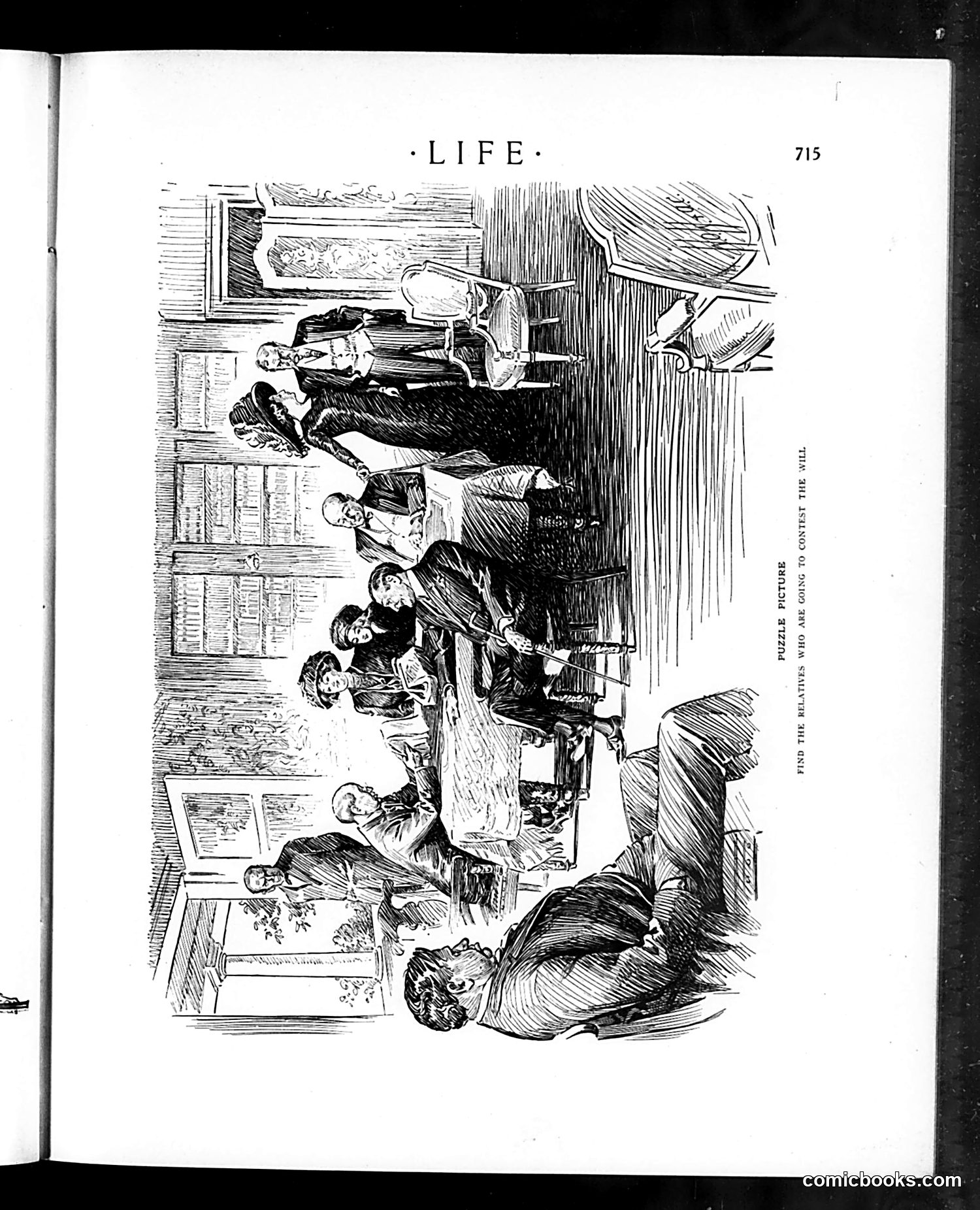
This page features a single satirical illustration titled "Puzzle Picture" with the caption "Find the Relatives Who Are Going to Contest the Will." The cartoon depicts a deceased person lying in state, surrounded by numerous figures in Victorian-era dress—apparently relatives gathered for the funeral. The satire targets the common social phenomenon of distant family members suddenly appearing after someone's death, motivated by potential inheritance rather than genuine grief. The "puzzle" asks readers to identify which figures are the scheming relatives anticipating the will's reading. The crowded composition and exaggerated expressions emphasize the unseemly scramble for assets that often follows death in families. This reflects 19th-century *Life* magazine's frequent mockery of greed, social pretense, and family dynamics.
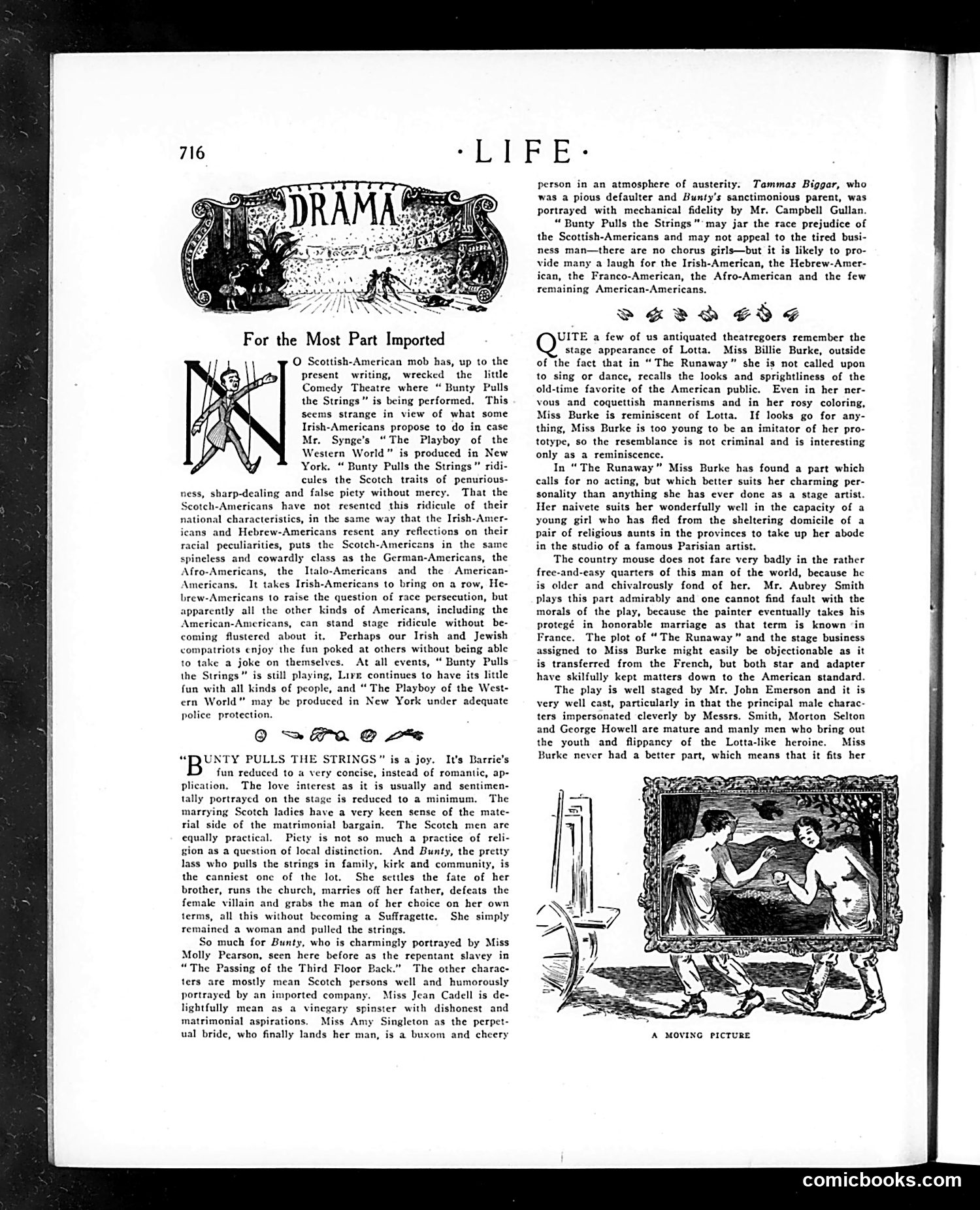
This page reviews the Scottish comedy "Bunty Pulls the Strings," which satirizes Scottish character traits—stinginess, sharp dealing, and false piety. The article's satirical point is comparative: it praises Scottish-Americans for *not* rioting over ethnic mockery, contrasting them unfavorably with Irish-Americans and Jewish-Americans, who actively protested theatrical portrayals deemed offensive (like Synge's "Playboy of the Western World"). Life's tongue-in-cheek argument suggests Scottish-Americans lack the political assertiveness of these groups. The play itself celebrates its title character, Bunty, as a pragmatic woman who manipulates family and community through intelligence rather than activism—notably "without becoming a Suffragette," a dig at contemporary women's rights movements. The review functions as both entertainment critique and ethnic commentary, reflecting early 20th-century American anxieties about immigrant communities and their cultural sensitivities.
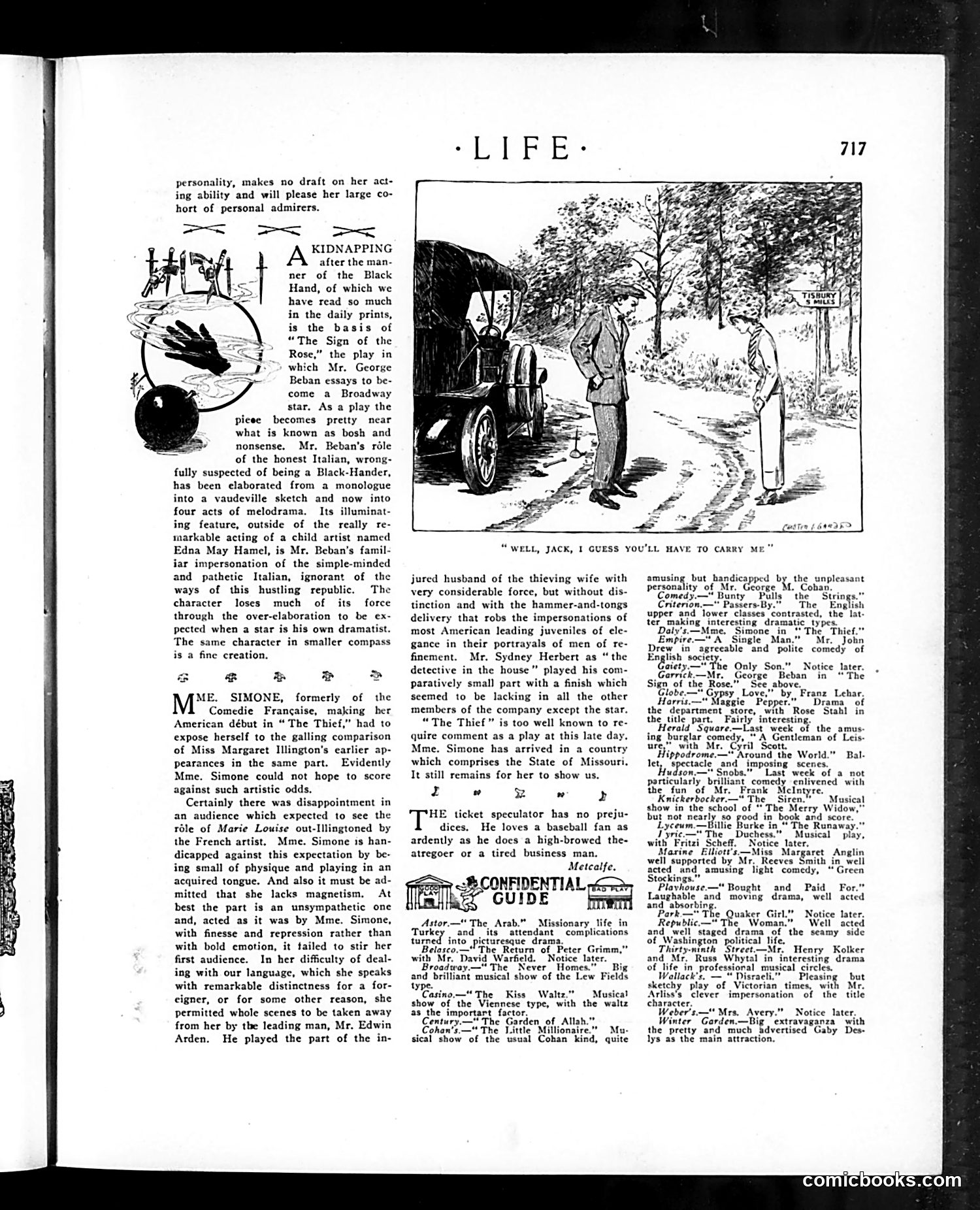
This page from *Life* magazine contains theater reviews and a small cartoon. The main cartoon (upper right) depicts a man standing beside a car with the caption "Well, Jack, I guess you'll have to carry me"—likely satirizing either the unreliability of early automobiles or gender dynamics of the era (a woman expecting to be carried/assisted). The text focuses on Broadway theater reviews, particularly criticizing French actress Mme. Simone's American debut in "The Thief" as disappointing compared to earlier American actress Margaret Illington's performance. The reviewer notes Simone's small stature, acquired English pronunciation, and lack of "magnetism" as handicaps. Other reviews mention actor George Beban in "The Sign of the Rose," which exploits contemporary anxiety about "Black Hand" Italian organized crime for melodramatic effect—reflecting real nativist concerns of the era about Italian immigrants. The "Confidential Guide" section lists various theatrical productions with brief dismissive or approving comments about their quality and performers.
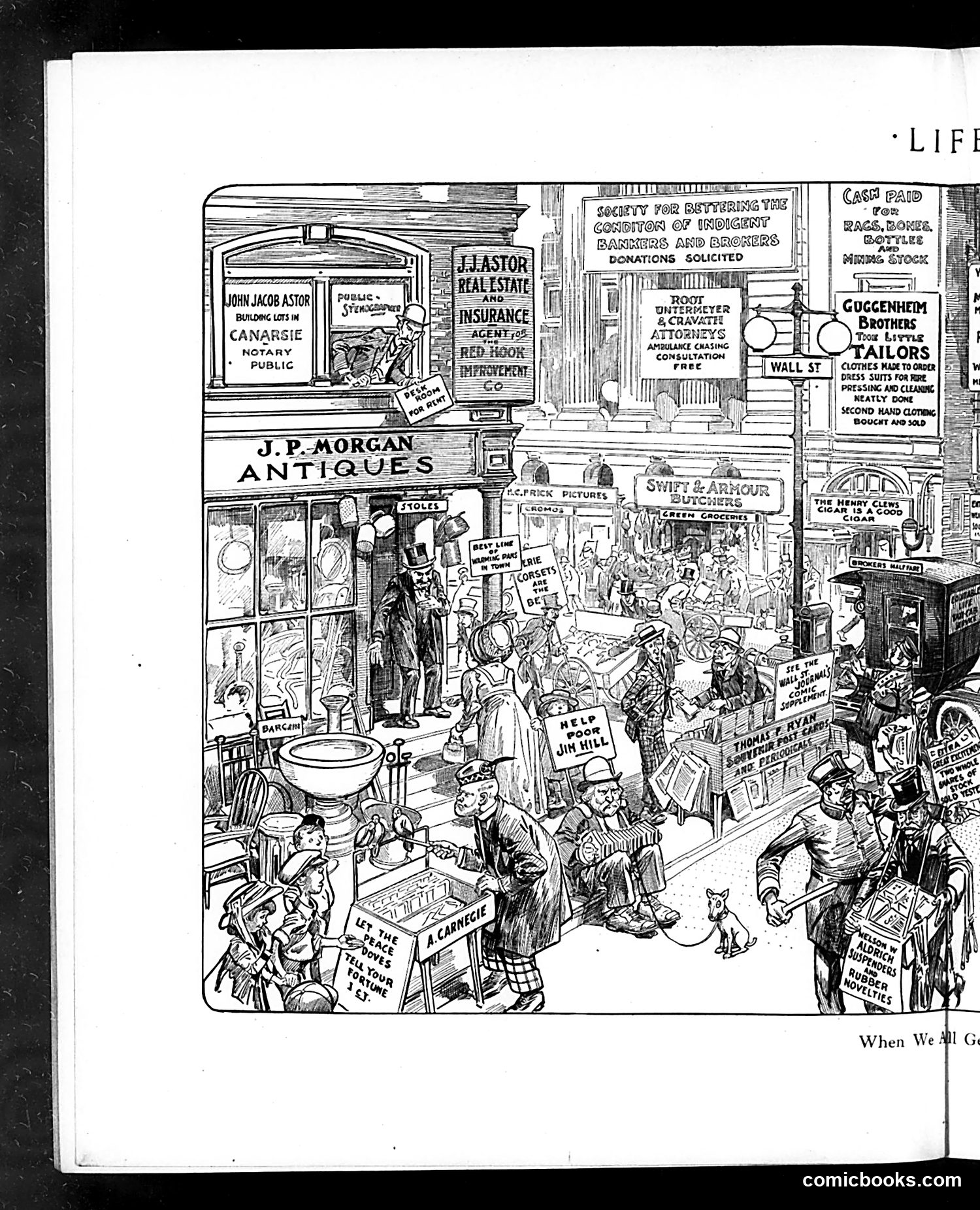
This is a satirical street scene from Life magazine depicting a crowded urban marketplace or fair. The central joke appears to target wealthy financiers and business owners through a fake "Society for Bettering the Condition of Indigent Bankers and Brokers"—satirizing charitable organizations by suggesting even rich bankers need assistance. The busy street scene includes numerous shops (J.P. Morgan Antiques, Swift & Armour butchers) and various characters engaged in commerce and street life. The humor lies in the contrast between the dignified-sounding charitable society and the actual thriving commercial activity surrounding it, mocking both pretentious philanthropy and the wealthy elite's self-regard during what appears to be the early 20th century.
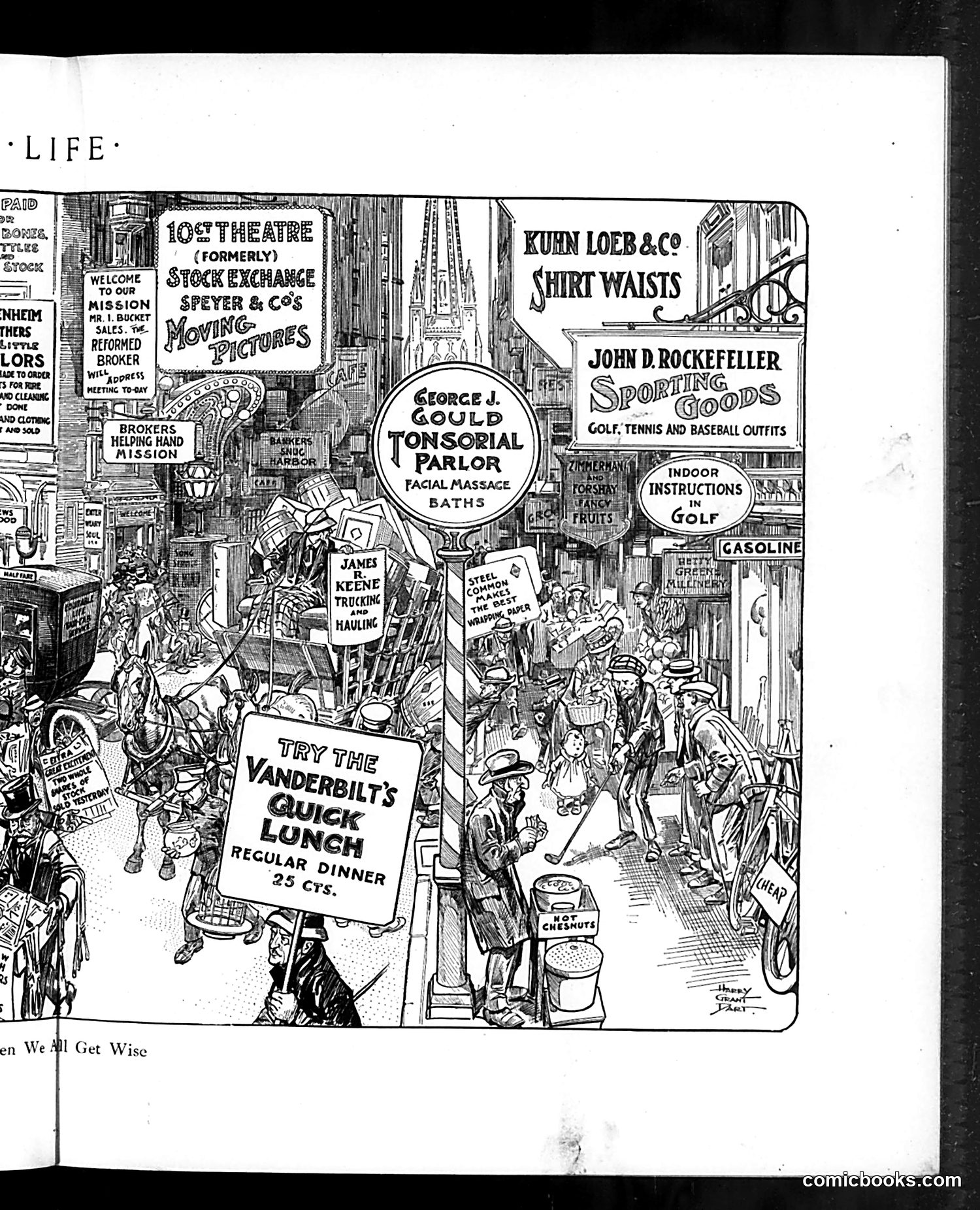
This is primarily a **full-page advertisement collage** rather than a political cartoon. It depicts a crowded urban street scene packed with commercial advertisements from early 20th-century businesses: a theatre, shirt waists company, sporting goods store, tonsorial parlor, and a lunch counter. The only satirical element appears to be the bottom caption: "When We All Get Wise," which suggests ironic commentary on consumer culture and advertising saturation. The dense, chaotic composition of competing advertisements may itself be the joke—illustrating how commercialism overwhelms public space. The businesses advertised (hairdressing, clothing, sports equipment, food) represent typical urban commercial enterprises of the era. Without additional context, the specific satirical target remains unclear, though the overall effect mocks the commercial cacophony of city life.
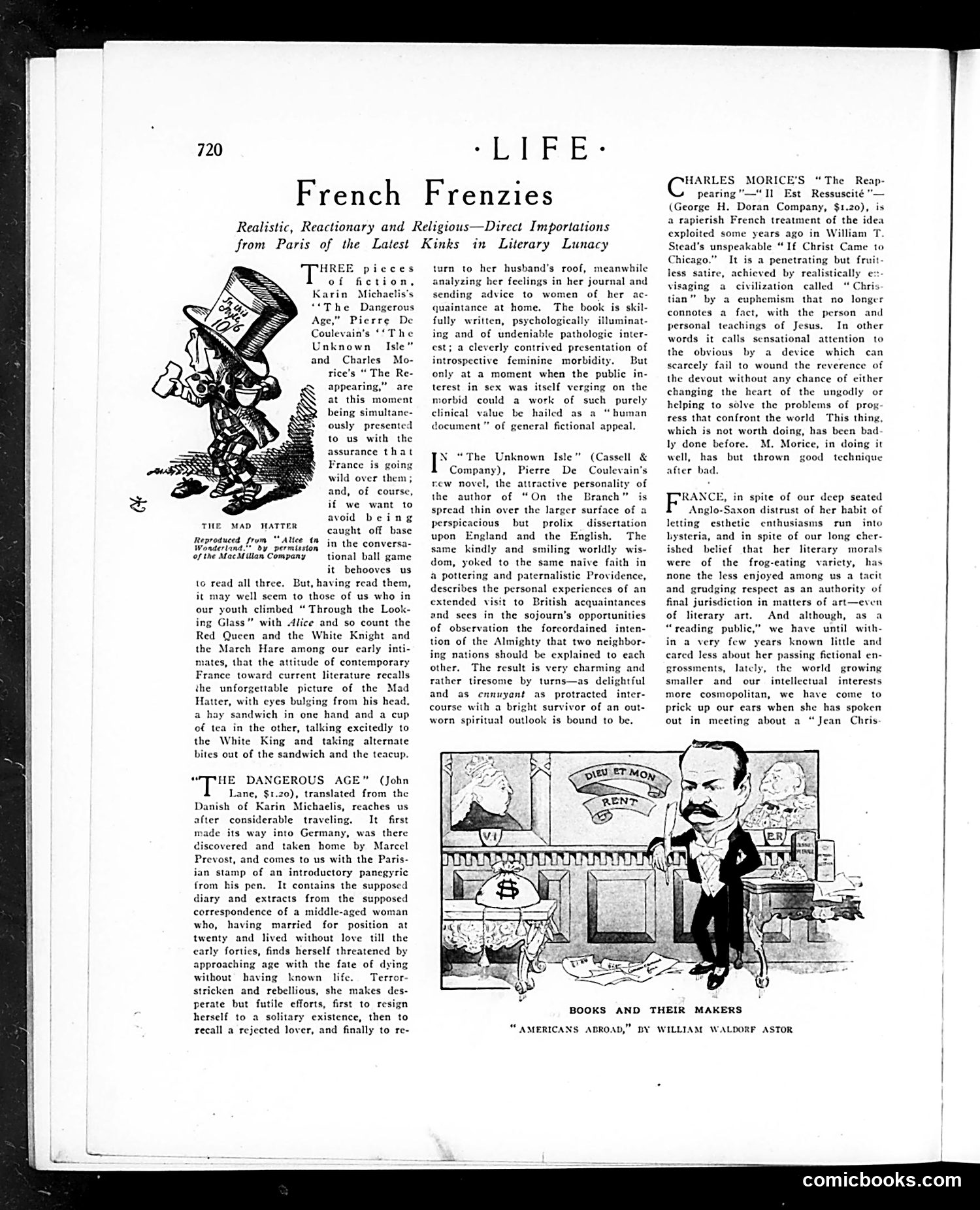
This page reviews three contemporary French novels being imported to America, using satirical language to mock what the critic sees as pretentious European literary trends. The author compares France's enthusiasm for these psychologically introspective, morally ambiguous books to Lewis Carroll's "Mad Hatter"—suggesting French literary culture has become unmoored from reason. The three novels discussed explore controversial themes: female sexual desire and aging ("The Dangerous Age"), Anglo-French cultural comparison ("The Unknown Isle"), and religious satire ("The Reappearing"). The critic acknowledges their technical skill but dismisses them as overly clinical, morbid, or tedious—examples of France's current literary "lunacy." The illustration of the Mad Hatter reinforces this critique: just as Carroll's character speaks nonsense while eating simultaneously, the critic implies French authors produce overwrought, self-indulgent fiction that American readers shouldn't blindly follow simply because Paris endorses it.
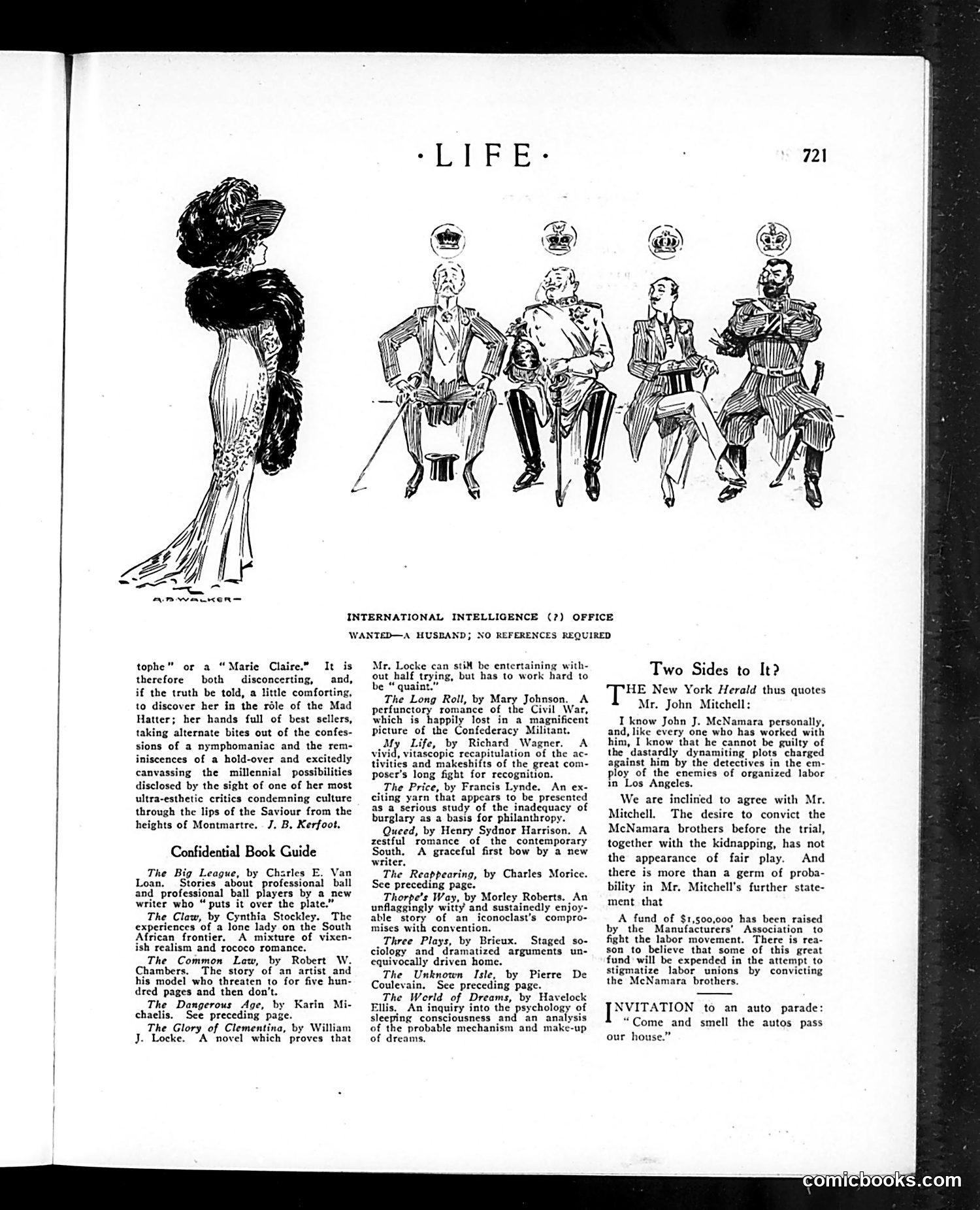
The cartoon satirizes the "International Intelligence Office"—likely a fictional marriage bureau or matchmaking service. Five crowned male figures (appearing to be European royalty or nobility based on their crowns and military uniforms) sit like candidates awaiting interview, while a fashionably dressed woman on the left evaluates them as potential husbands. The satire targets wealthy American women of the era who married European aristocrats for titles and prestige, while those men sought American fortunes. The phrase "no references required" mocks how such marriages often ignored character or compatibility in favor of financial and social advantage. This reflects early 20th-century anxieties about transatlantic "marriages of convenience" between American heiresses and impoverished European nobility—a common phenomenon of the Gilded Age that satirists frequently ridiculed.
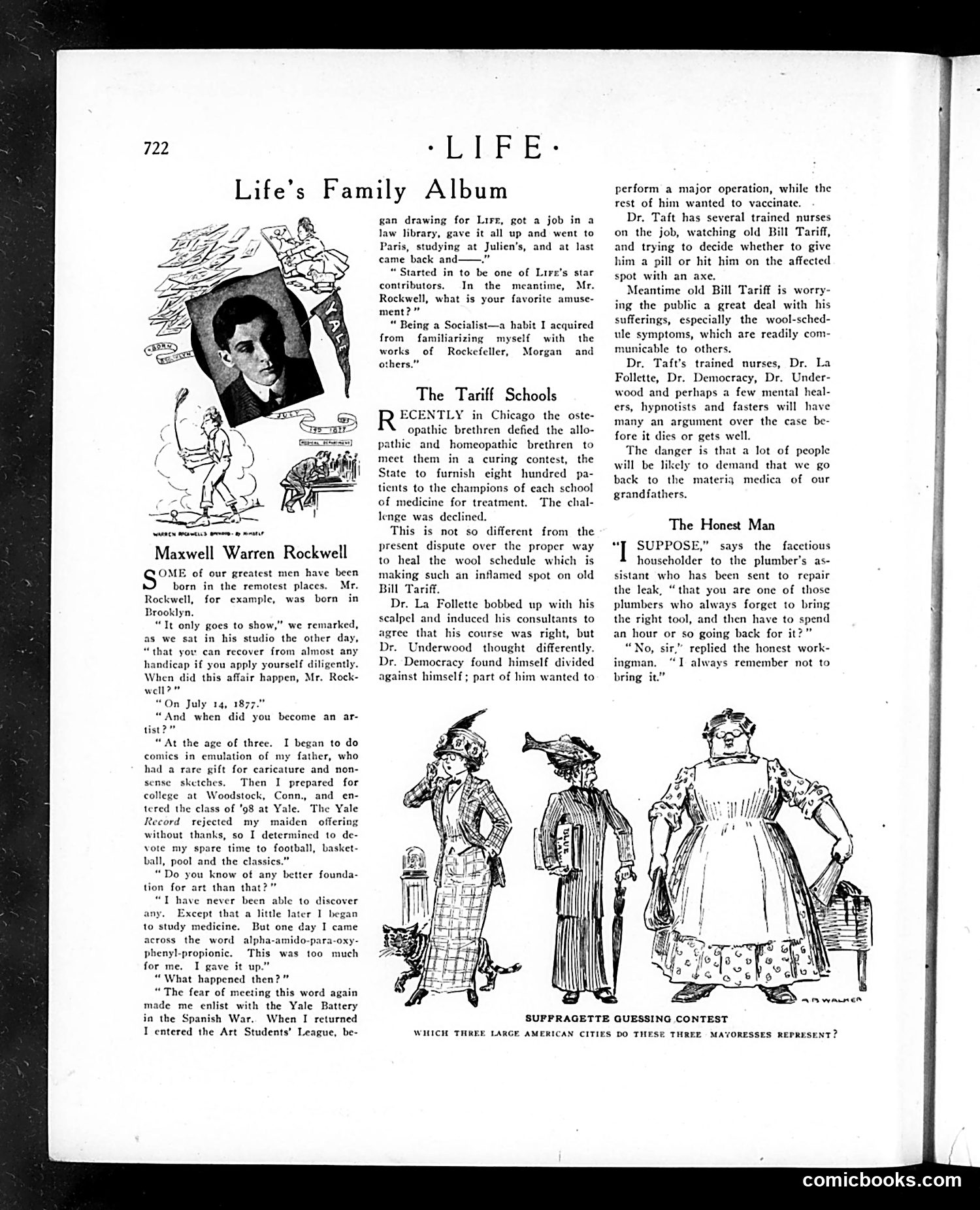
This page from Life presents satirical profiles and commentary on early 1900s American politics and society. **Maxwell Warren Rockwell** section is a humorous biographical interview with an artist, satirizing his eclectic education (art, medicine, law, military service) and his claim to be a "Socialist" influenced by studying wealthy industrialists like Rockefeller and Morgan—the joke being that studying the rich made him radical. **"The Tariff Schools"** is political satire comparing medical schools' disputes over treatment methods to the contemporary tariff debate. Various political figures are cast as "doctors": La Follette, Underwood, and President Taft represent different approaches to "healing" the wool tariff schedule (a contentious trade issue). The metaphor suggests political disagreement about economic policy mirrors medical quackery. **"The Honest Man"** is a brief joke about a dishonest plumber's assistant who admits he deliberately forgets his tools to ensure repeat business. The page concludes with a "Suffragette Guessing Contest" asking readers to identify three American cities represented by illustrated women—reflecting contemporary suffrage movement debates.
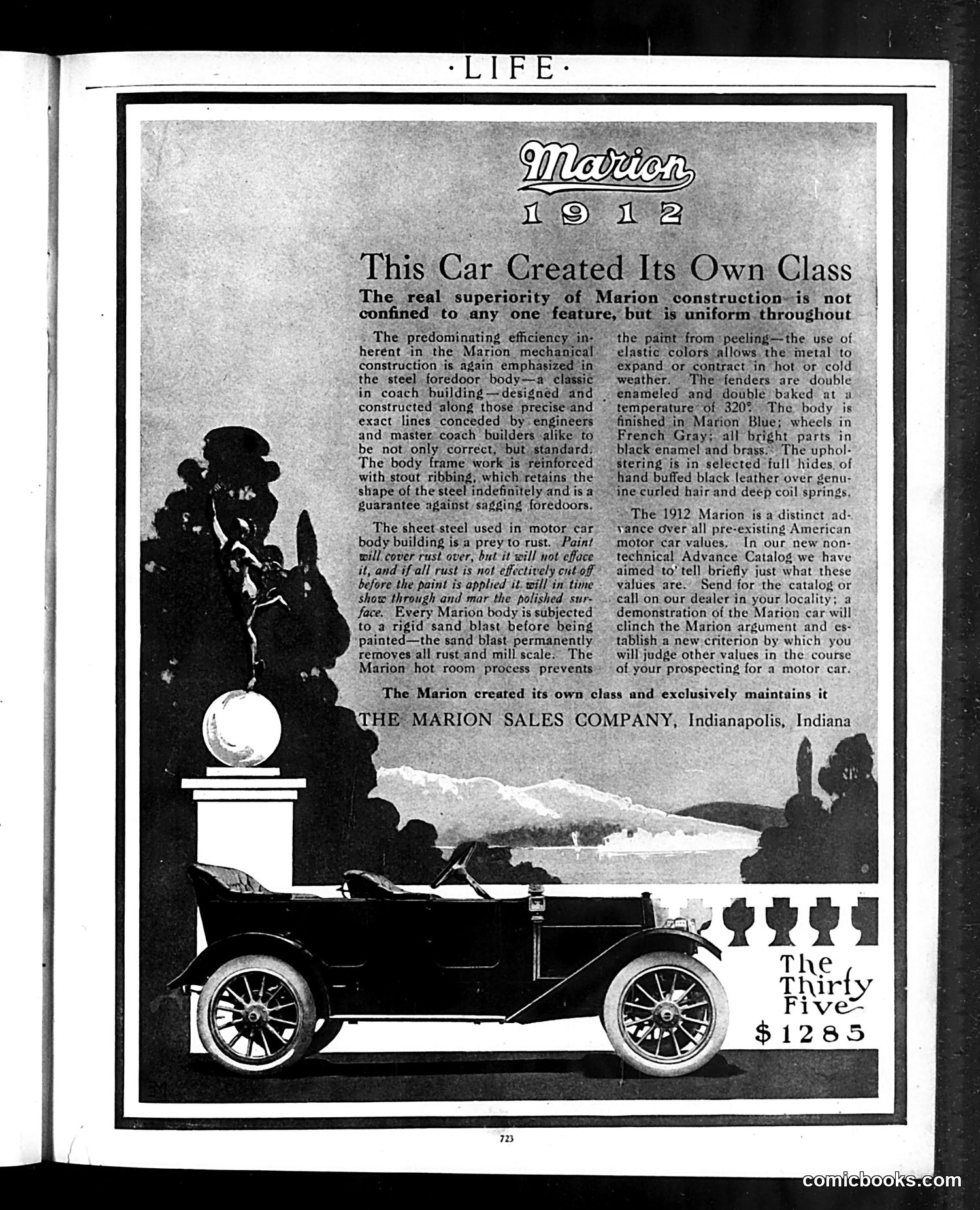
This is **not a cartoon or satire**—it's a straightforward automobile advertisement from *Life* magazine, circa 1912. The page promotes the Marion motor car, manufactured by the Marion Sales Company in Indianapolis. The ad emphasizes the vehicle's superior construction: rust-resistant steel body, reinforced frame, double-enameled fenders, and quality leather upholstery. The decorative imagery (classical bust, mountain landscape, silhouettes) serves as ornamental framing typical of early 20th-century advertising, not satirical commentary. The "Thirty-Five" model is priced at $1,285—positioning it as a luxury vehicle. The text claims Marion "created its own class," suggesting it occupied a premium market segment. The ad reflects the era's automotive marketing approach: emphasizing durability and craftsmanship rather than speed or style. There is no political or social satire present; this is commercial messaging in a magazine that, while satirical in other content, carried paid advertisements.
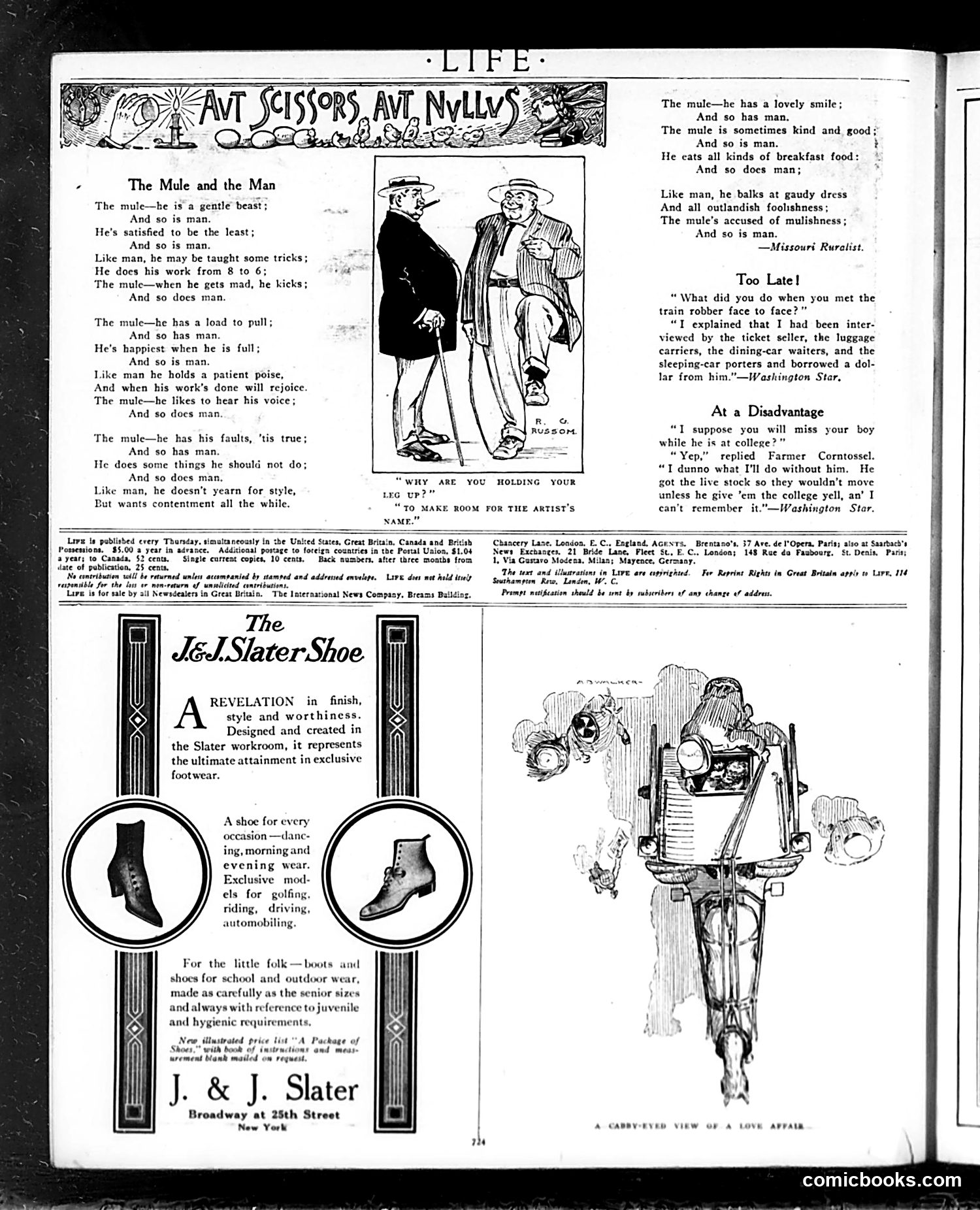
This page features a humorous poem comparing mules to humans, satirizing human nature through animal comparison. The central cartoon shows two men—one formally dressed, one casual—with the caption explaining the artist needed leg space, a meta-joke about editorial constraints. The poem itself is gentle social satire: it lists parallels between mules and men (both work 8-to-6 jobs, both kick when angry, both prefer contentment over style), ultimately suggesting humans aren't particularly exceptional or superior to beasts of burden. This reflects early 20th-century American rural humor—the poem's attribution to "Missouri Ruralist" emphasizes its rural, folksy perspective. The accompanying anecdotes ("Too Late!" and "At a Disadvantage") continue this theme with working-class characters outwitted by circumstances, mocking both train robbers and educated farmers. The page is primarily advertising for J. & J. Slater shoes, with the satire filling remaining space—typical Life magazine layout of the era.
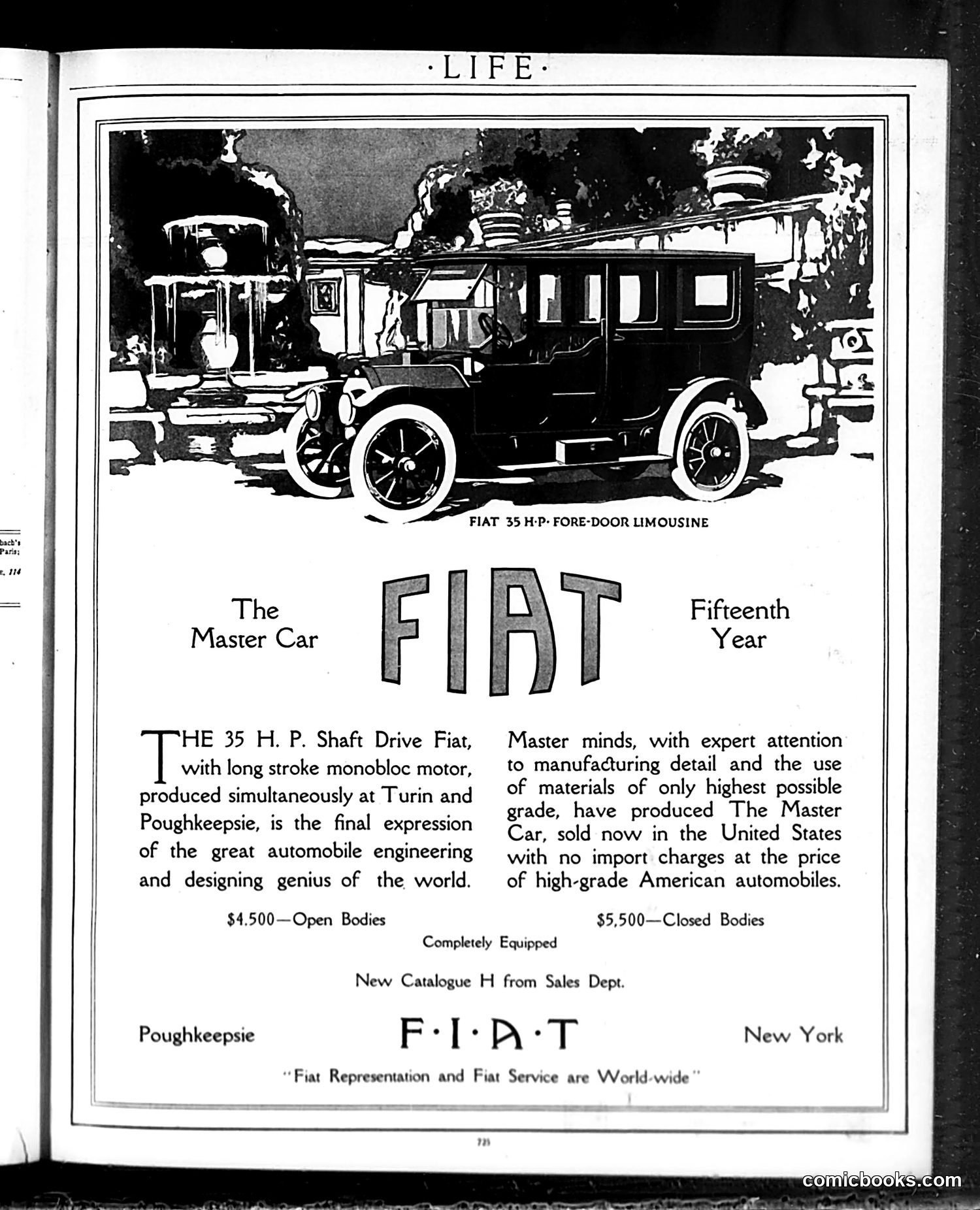
This is a **straightforward automobile advertisement**, not satire or political commentary. It appears in *Life* magazine's fifteenth year (circa 1909) promoting the Fiat 35 H.P. four-door limousine. The ad emphasizes that Fiat—an Italian manufacturer—now produces cars in Poughkeepsie, New York alongside its Turin factory. The marketing pitch targets American buyers by claiming Fiat's "Master Car" offers European engineering excellence at American automobile prices, without import duties. Pricing is listed as $4,500 for open bodies and $5,500 for closed bodies. The tagline "Fiat Representation and Fiat Service are World-wide" underscores the company's global reach. This reflects early-twentieth-century automotive competition when European brands actively marketed American-manufactured versions to bypass tariffs and appeal to domestic consumers.
This page contains reader letters to *Life* magazine addressing three topics: **"From Canada"** criticizes *Life*'s editorial stance on a failed Canadian-American reciprocity trade agreement, arguing the U.S. rejected it when Canada needed it, and now wants it when America needs Canadian resources. **"The Recall of Umpires"** sarcastically proposes that if democratic "recall" principles apply to elected officials (referencing progressive reforms of the era), they should also apply to baseball umpires—mocking populist democracy by showing its absurd extension to sports. **"Homeless Naval Officers"** raises concerns about Navy Department policies causing officer resignations and suicides, particularly restrictions on marriage and post-marriage station assignments that prevent establishing stable homes. All three letters reflect early 1900s progressive-era debates: trade policy, democratic accountability, and labor/military personnel conditions.
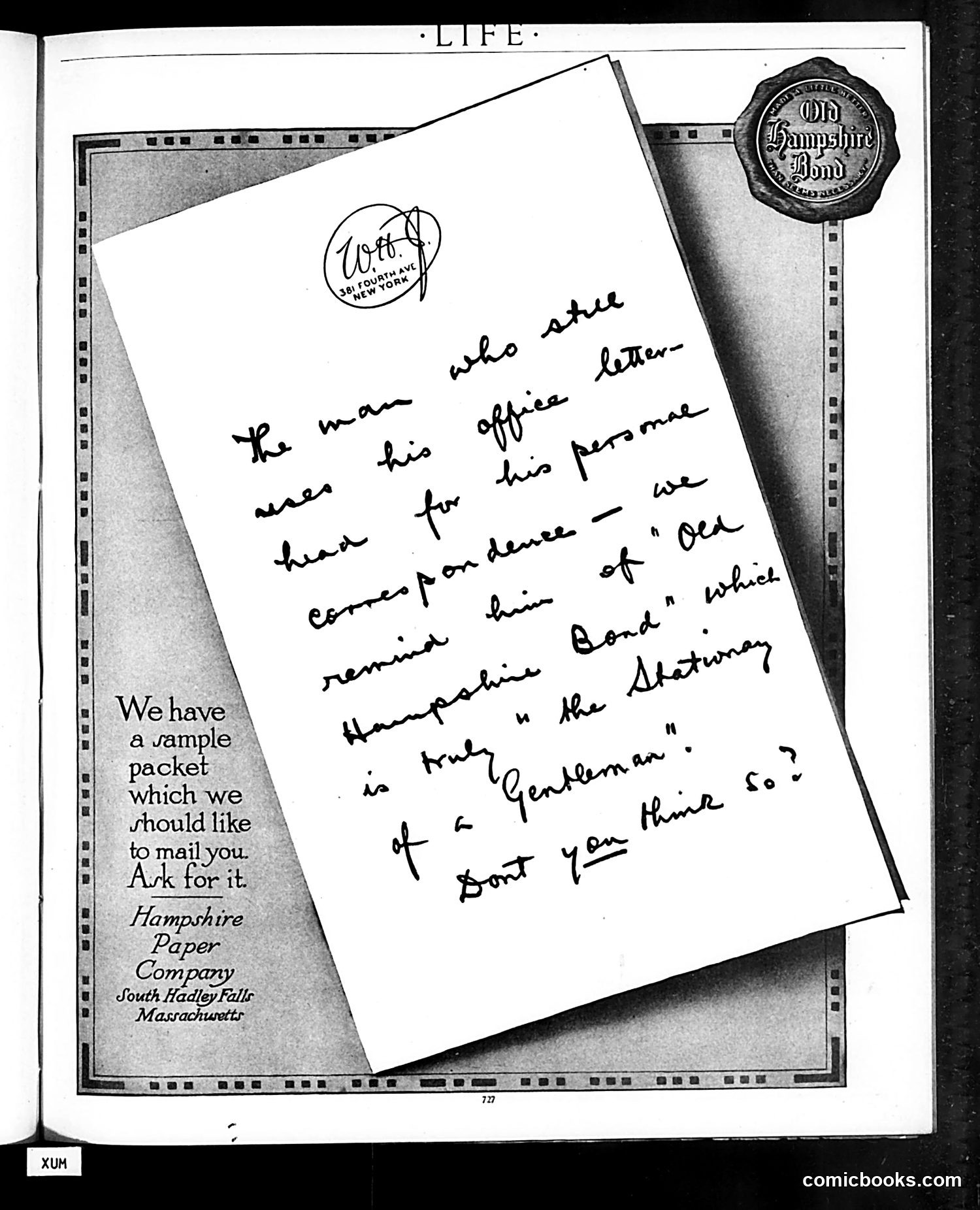
This is primarily a **product advertisement**, not a political cartoon. The page features a handwritten letter displayed as the central image, with a wax seal marked "Old Hampshire Bond" in the upper right. The letter itself appears to be a testimonial from a satisfied customer praising Hampshire Paper Company's quality—specifically commending their bond paper for business correspondence. The surrounding text is advertising copy from the **Hampshire Paper Company** (South Hadley Falls, Massachusetts) inviting readers to request a sample packet of their paper products. The message emphasizes that their paper is suitable for professional office use. This is a vintage **print advertisement** using the strategy of showing an authentic-looking customer letter as proof of product quality—a common marketing technique in early-to-mid 20th century magazines.
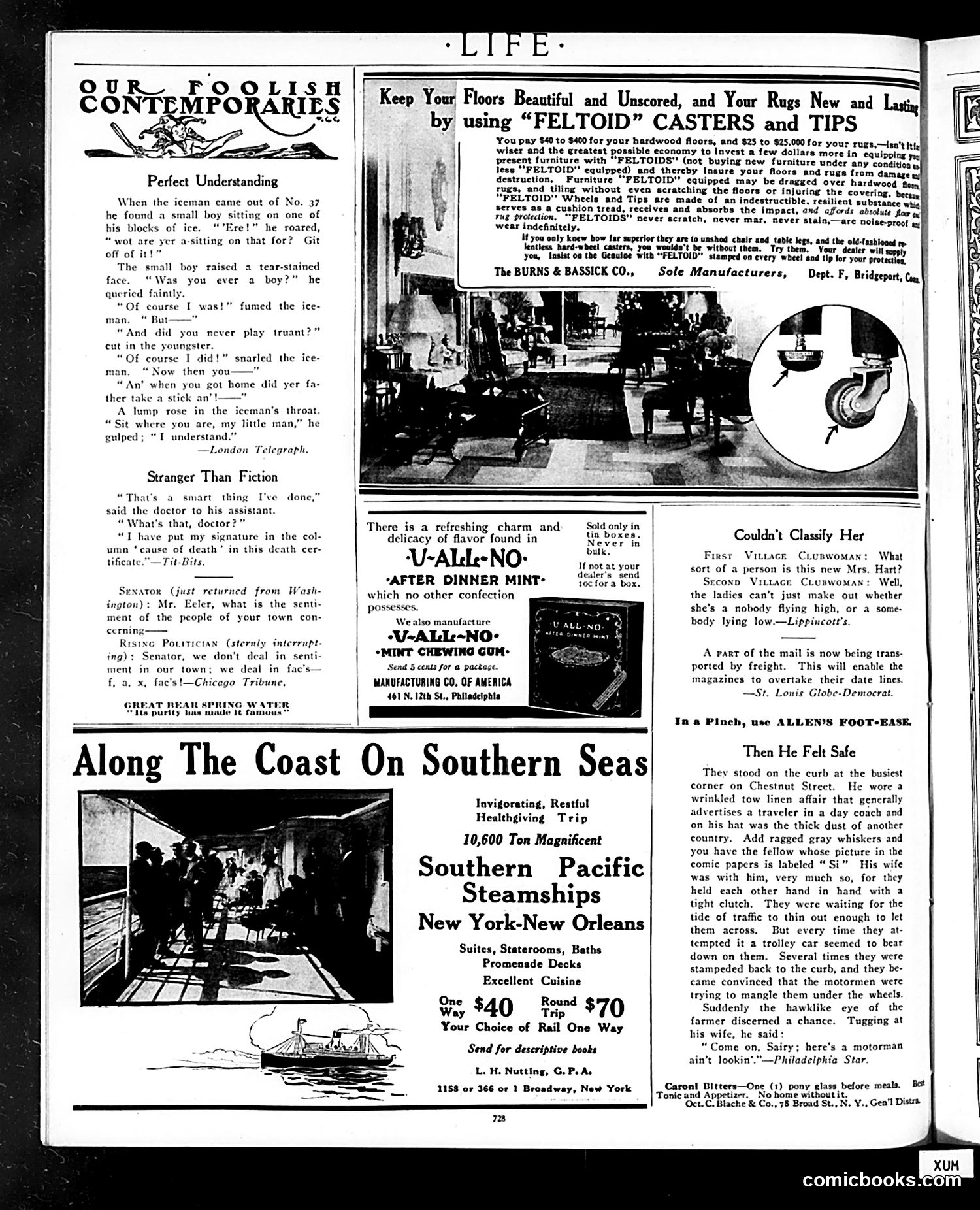
This page is primarily **advertising and humor columns**, not political cartoons. The content includes: **Humor Pieces:** - "Perfect Understanding": A sentimental anecdote about an iceman who, remembering his own childhood, allows a boy to sit on ice rather than scold him - "Stranger Than Fiction": Brief joke about a doctor signing a death certificate - Three short jokes about politics, social class, and marital life **Advertisements:** The page features large ads for Feltoid casters/furniture tips, U-Ahl-No mints and chewing gum, Southern Pacific steamships, and Allen's Foot-Ease. **No clear political satire:** While one piece mentions a "rising politician" discussing town sentiment, it's merely a joke setup, not partisan commentary. The page reflects early 20th-century magazine format: mixing light humor with commercial content aimed at middle-class readers interested in home furnishings and travel.
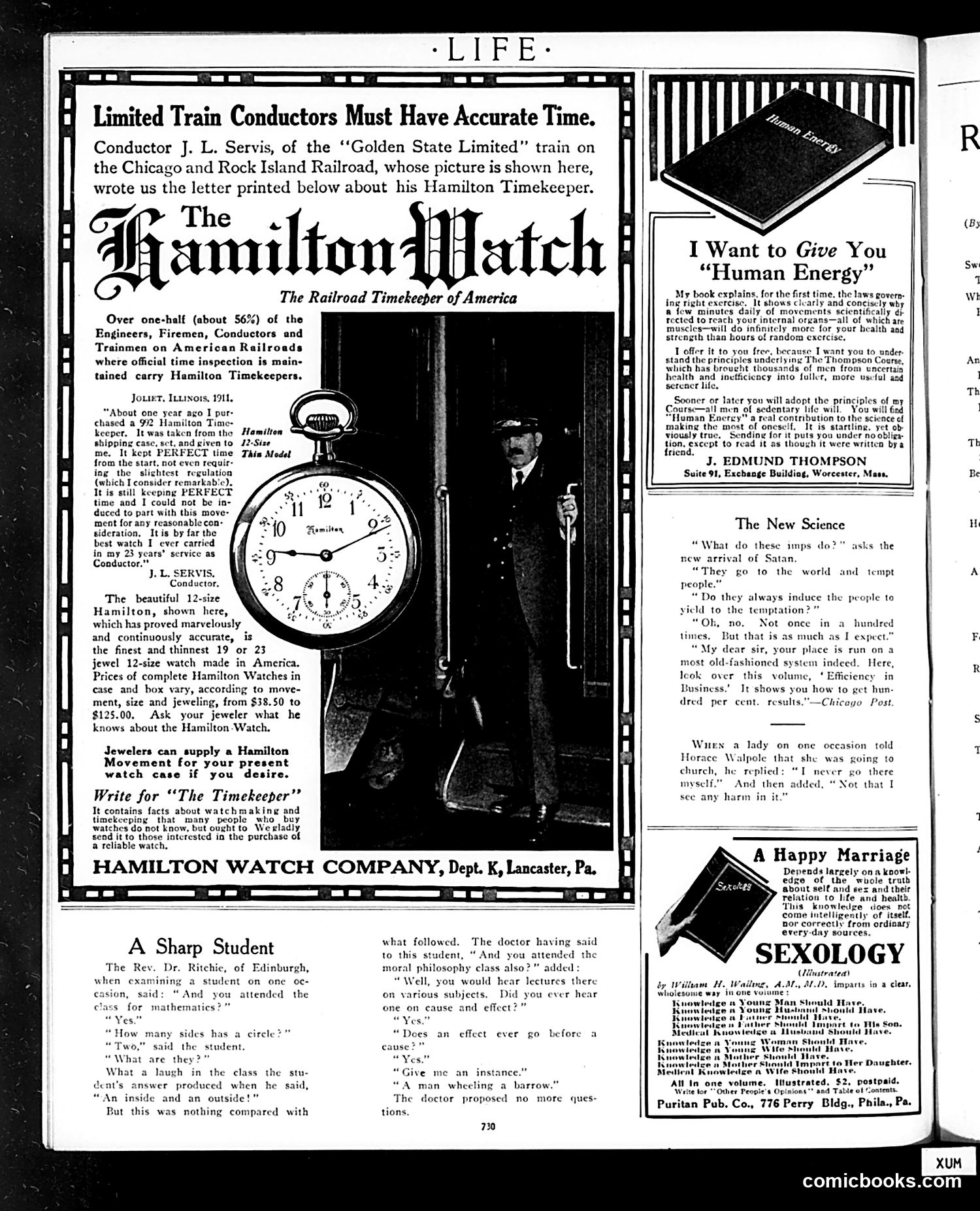
This page is primarily **advertising** for Hamilton Watches, featuring a testimonial from railroad conductor J.L. Servis about his Hamilton timekeeper's reliability. **Main Advertisement Content:** The large left section promotes Hamilton's "12-size" pocket watch as "The Railroad Timekeeper of America," citing that over half of American railroad engineers, firemen, conductors, and trainmen use them. Servis's letter testifies that his Hamilton kept "PERFECT time" for 23 years of service—crucial for train conductors who must coordinate schedules precisely. **Secondary Content:** The right side contains unrelated advertisements and short humorous pieces: - "Human Energy" book promotion by J. Edmund Thompson - A satirical joke titled "The New Science" about Hell's inefficient demon operations - "A Sharp Student," a joke about a dim theology student **Historical Context:** This reflects the early 20th-century railroad industry's obsession with accurate timekeeping—essential for safety and coordination. The advertisement leverages professional credibility through conductor testimonials to sell luxury watches as *necessary tools*, not mere accessories.
This page from *Life* contains literary reviews and advertisements rather than political cartoons. The left column reviews "The Fruitful Vine" by Robert Hichens—a novel apparently about a childless marriage and infidelity set in Rome. Reviewer Arthur Guiterman mocks the book as morally permissive "Apostle" literature, comparing it unfavorably to sensational works like "Three Weeks," while sarcastically praising its euphemistic language ("clothing wolves in snowy fleeces"). The right side features advertisements for the *Ladies' Home Journal*, promoting Rudyard Kipling's poem "The Female of the Species" (which controversially depicts women as more dangerous than men) and an unnamed article about women's health. Both ads link to contemporary feminist discourse—the suffrage movement ("Votes for Women") and women's medical advice. The page reflects early 20th-century anxieties about modern literature's morality, female independence, and women's health.
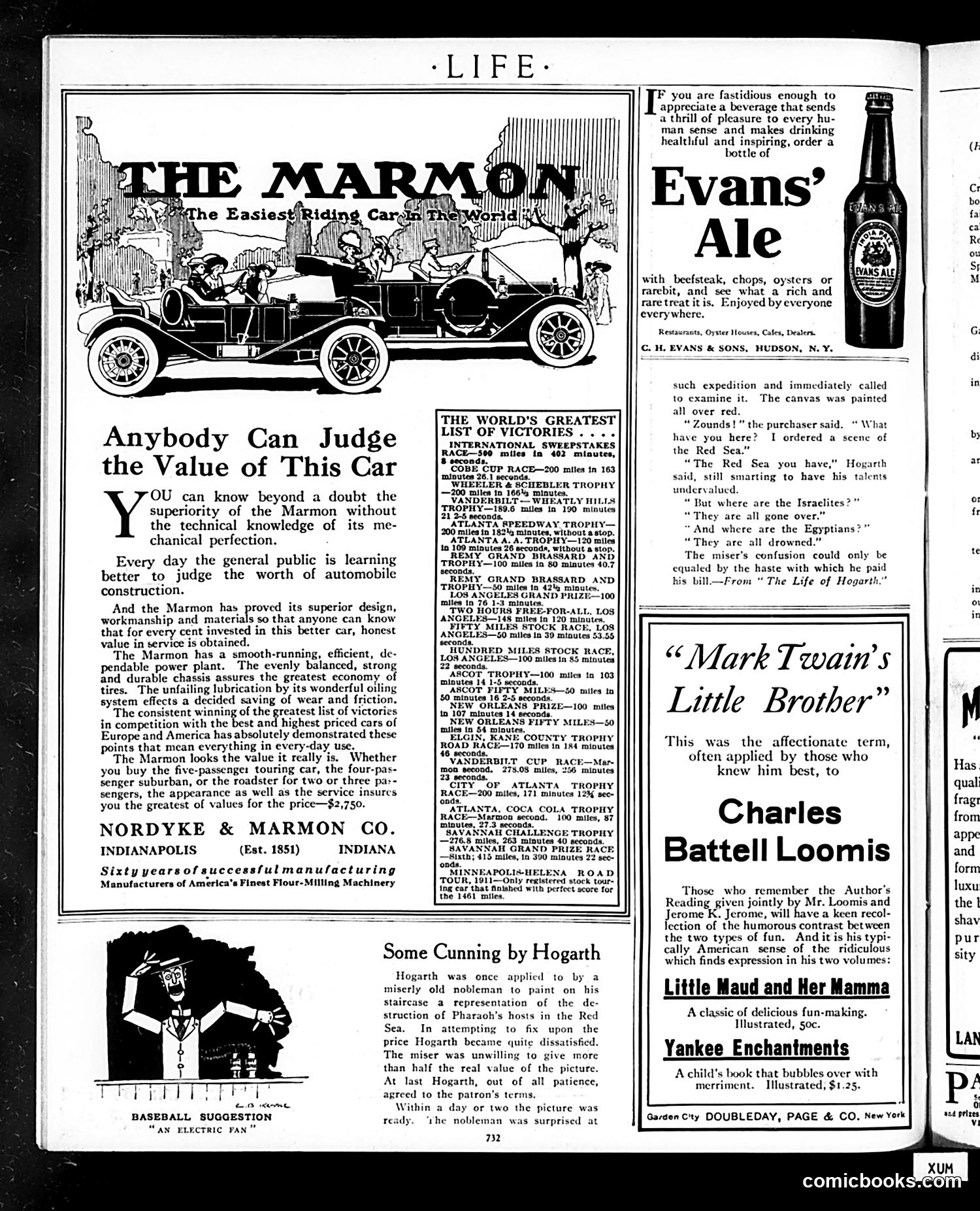
This page is primarily **advertisements and filler content** rather than political satire. The main elements are: **Advertisements:** - Marmon automobile (with extensive racing trophy list claiming superiority) - Evans' Ale beer **Editorial Content:** A brief anecdote about painter **William Hogarth** (18th-century English artist) and a miserly nobleman. The story illustrates Hogarth's wit: when underpaid to paint the Red Sea with Pharaoh's destruction, he depicted only the empty sea—the Israelites had "gone over" and the Egyptians had "drowned." The miser, confused and embarrassed at being outwitted, quickly paid the full price. **Small cartoon:** A baseball suggestion featuring "An Electric Fan"—likely a visual pun about cooling off during games. The page reflects *Life*'s typical mix of consumer advertising, classical anecdotes about artistic integrity, and mild visual humor. There's no contemporary political commentary visible.
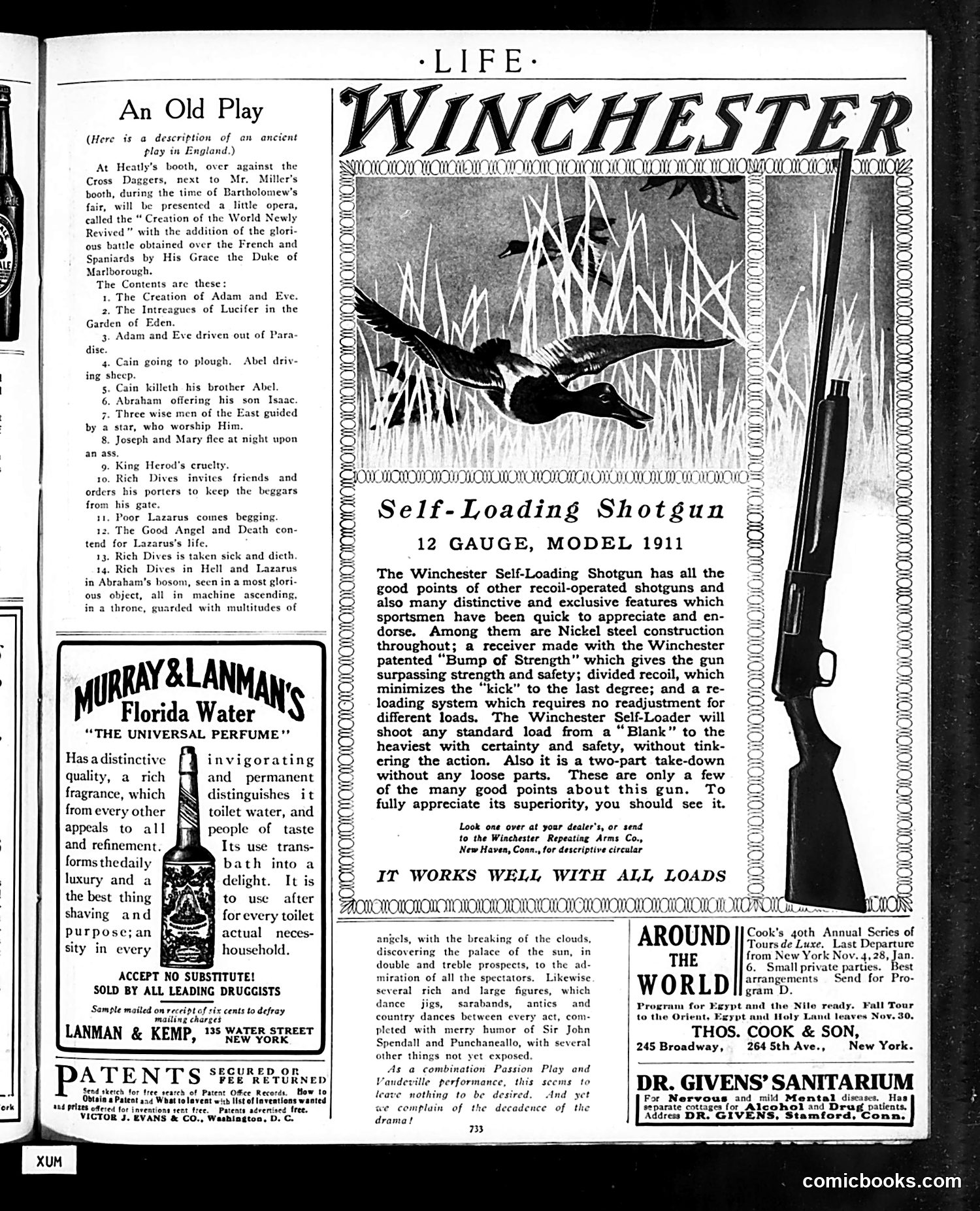
This page is primarily **advertising**, with a historical curiosity as its main content feature. The centerpiece is "An Old Play"—a reprinted historical advertisement from an 18th-century English Bartholomew's Fair, describing a theatrical production called "Creation of the World Newly Revived." The play combined biblical narratives (Adam and Eve, Abraham, Christ's nativity) with contemporary political content: a battle sequence celebrating the Duke of Marlborough's victories over the French and Spanish. This exemplifies how entertainment of that era mixed religious instruction with nationalist propaganda. The advertisement is presented as a historical artifact of interest to Life's readers—essentially saying "look how they mixed entertainment and politics back then." The page's **dominant content** is actually advertisements for unrelated products: Winchester self-loading shotguns, Murray & Lanman's perfume, patent services, Cook's travel tours, and Dr. Givens' Sanitarium. These reflect early 1900s consumer culture.
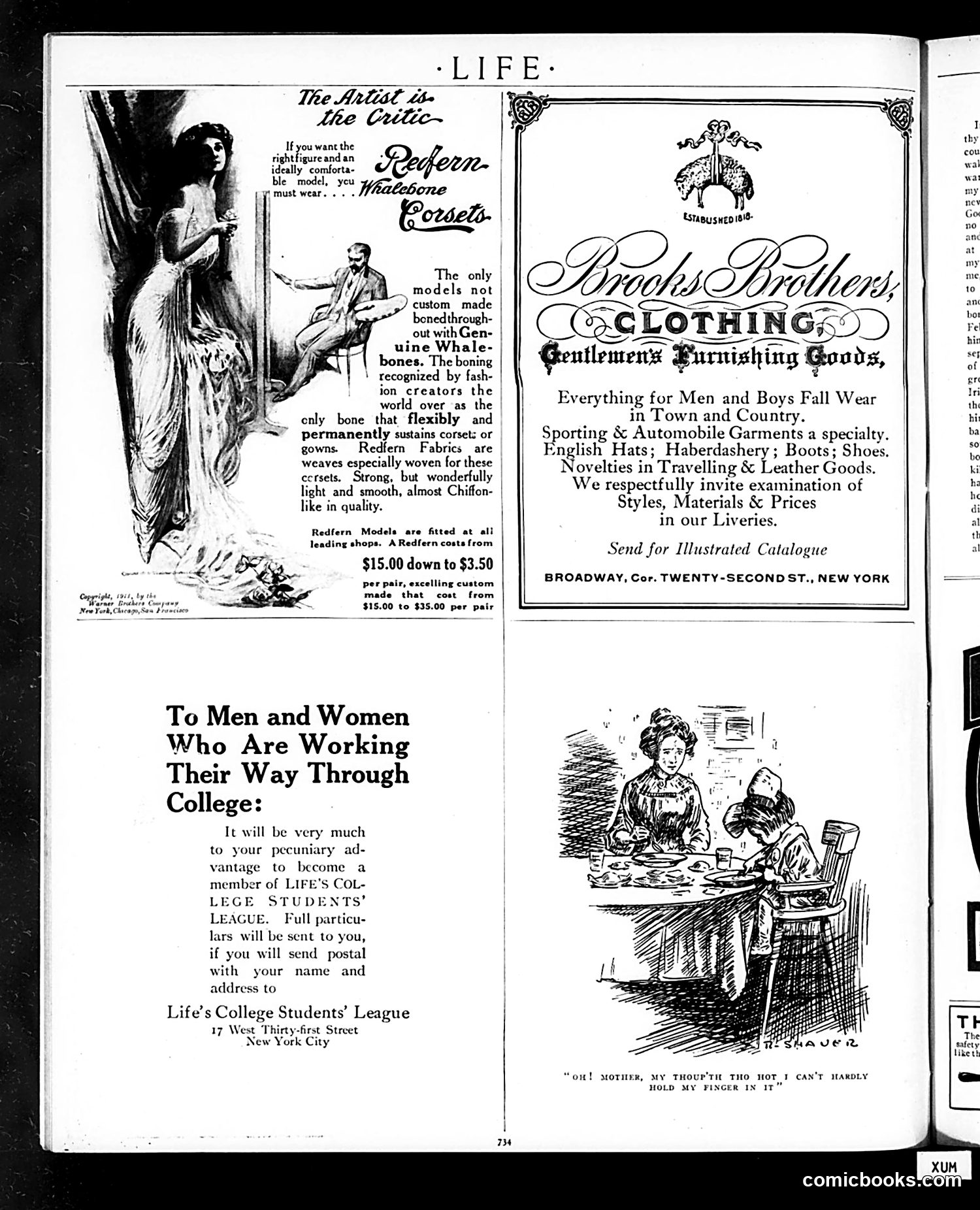
This page contains **primarily advertisements** with one small cartoon. **The Main Cartoon** (bottom right): Shows a child at a meal telling their mother the food is too hot to touch. The humor is visual/domestic rather than political—it's a relatable moment of childhood impatience at mealtime, illustrated by cartoonist Cesare (signature visible). **The Advertisements**: - **Redfern Corsets** (top left): Features an illustrated woman in classical pose. The ad emphasizes "Reform" corsets as practical for artists' models, claiming they use whalebone that flexibly supports garments without restriction—a selling point that suggests contemporary debates about women's comfort and fashion. - **Brooks Brothers** (top right): Standard men's clothing advertisement. - **Life's College Students' League** (bottom left): Recruitment for a student membership organization offering financial benefits. **Historical Context**: The corset ad's emphasis on "reform" reflects early 20th-century discussions about women's fashion moving toward less restrictive designs, though still promoting corsetry itself. The page is predominantly commercial rather than satirical or political.
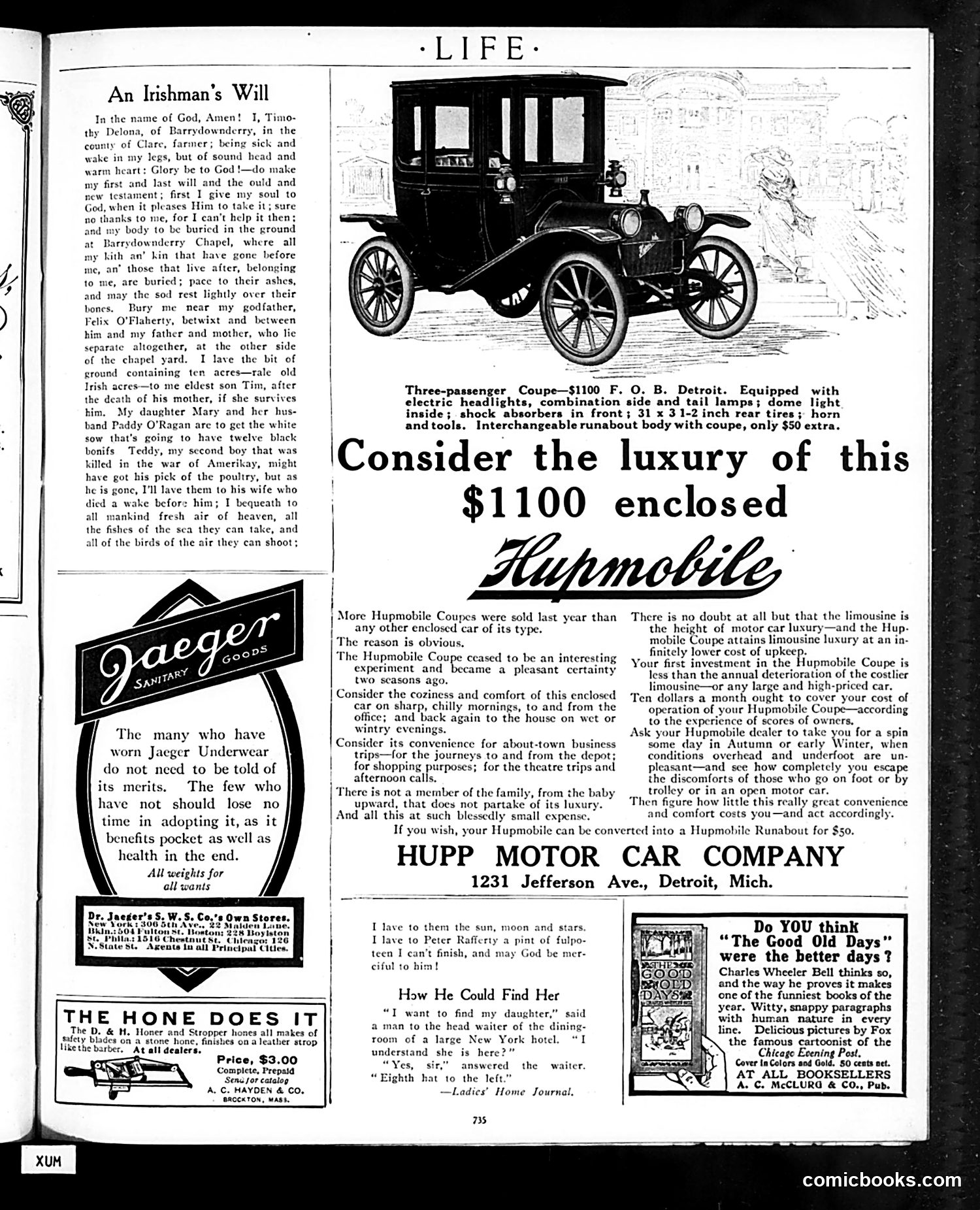
This page contains **primarily advertisements** rather than political cartoons. The main content is a Hupmobile automobile advertisement (center-right) promoting a $1,100 enclosed coupe as a luxury vehicle for middle-class families. The ad emphasizes comfort, convenience, and affordability compared to expensive limousines. Supporting advertisements include: - **Jaeger Underwear** (left): Appeals to existing customers' loyalty - **Hone Stropper** (bottom left): A sharpening tool for safety razors - **Charles Wheeler Bell Cartoons** (right): Book advertisement The page opens with **"An Irishman's Will,"** a humorous Irish dialect piece detailing an eccentric farmer's bequests, which appears to be entertainment/humor content typical of Life magazine's satirical approach. The piece uses stereotypical Irish speech patterns and wry observations about death and inheritance. This is fundamentally an **advertising-heavy magazine page** from the early automotive era, with light satirical humor rather than pointed political commentary.
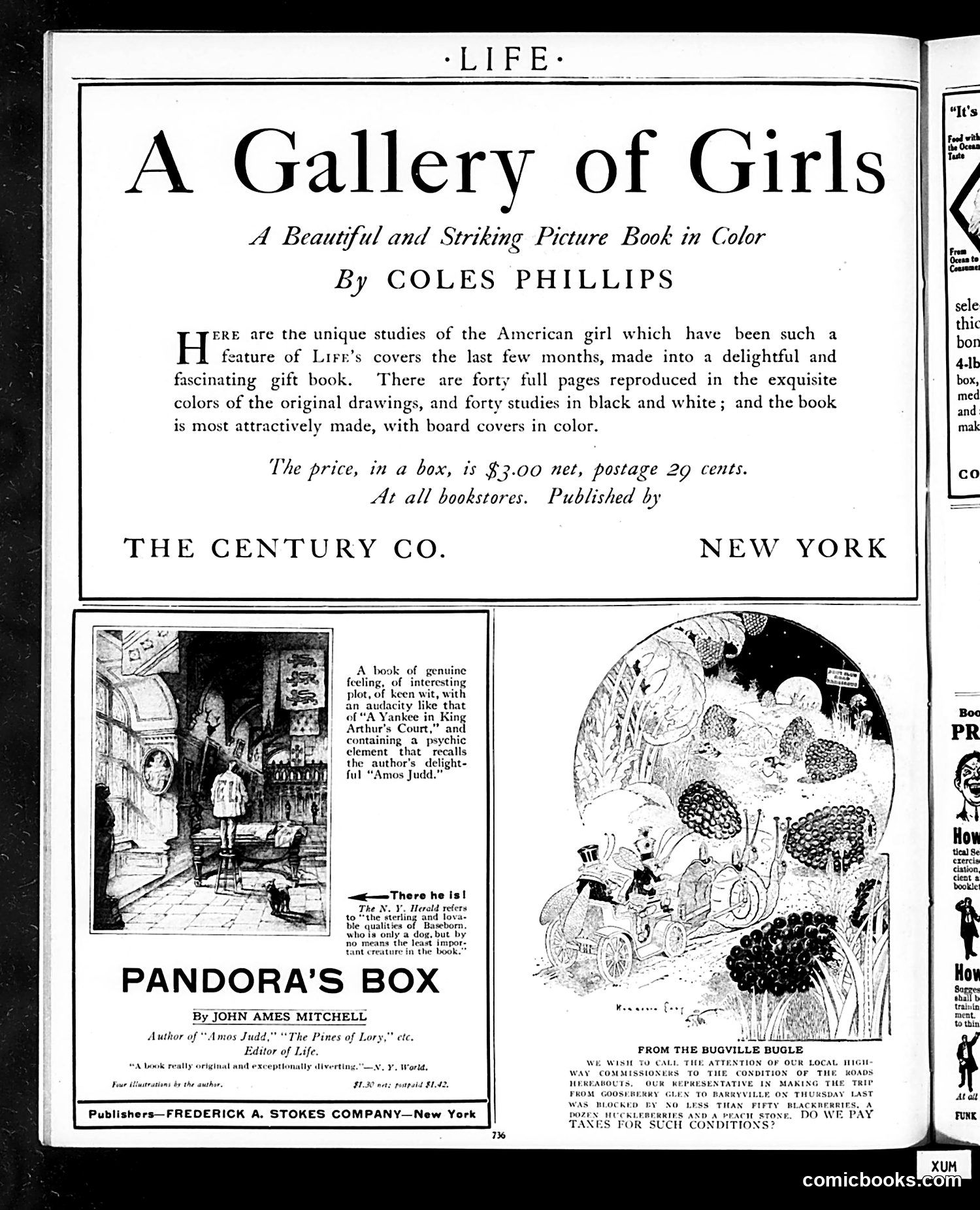
This is primarily **advertising content**, not political satire. The page promotes two books: 1. **"A Gallery of Girls"** by Coles Phillips — a picture book featuring Phillips's signature illustrations of American girls, published by Century Co. at $3.00. 2. **"Pandora's Box"** by John James Mitchell — described as witty and original fiction with a dog character named Baseborn, published by Frederick A. Stokes Company at $1.30. The bottom section, **"From the Bugville Bugle,"** appears to be humorous filler — a mock newspaper item about insects (blackberries, muckleberries, a peach stone) blocking a road, sarcastically questioning whether taxpayers should fund road maintenance. This is gentle, whimsical satire typical of *Life* magazine's lighter content, not serious political commentary. The illustrations shown are representative samples from these books.
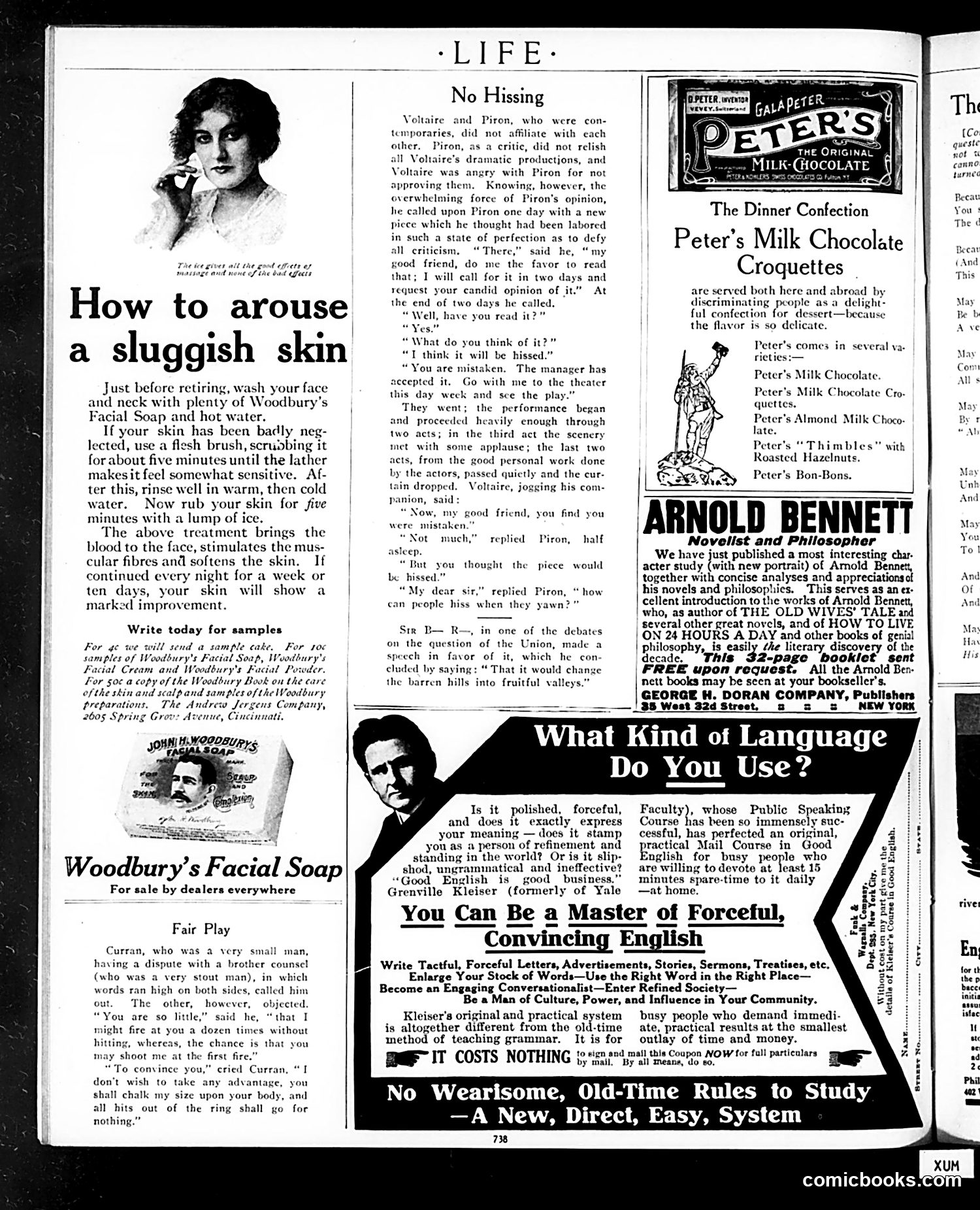
This page is primarily **advertising**, not political satire. The main content consists of: 1. **"No Hissing"** — An anecdote about 18th-century French writers Voltaire and Piron. Voltaire brings Piron a new theatrical work for criticism; Piron attends the performance, finds it poorly received, and falls asleep. When Voltaire asks if he'll "hiss" (disapprove), Piron replies he won't—because he was asleep and didn't see it. The joke mocks pretentious literary criticism. 2. **Advertisements** dominating the page: Woodbury's Facial Soap ("How to arouse a sluggish skin"), Peter's Milk Chocolate Croquettes, an Arnold Bennett book promotion, and a mail-order English course ("Master of Forceful, Convincing English"). The Voltaire/Piron anecdote is the only humor content—satirizing false literary judgment rather than contemporary politics. The page reflects early 20th-century consumer culture and self-improvement marketing.
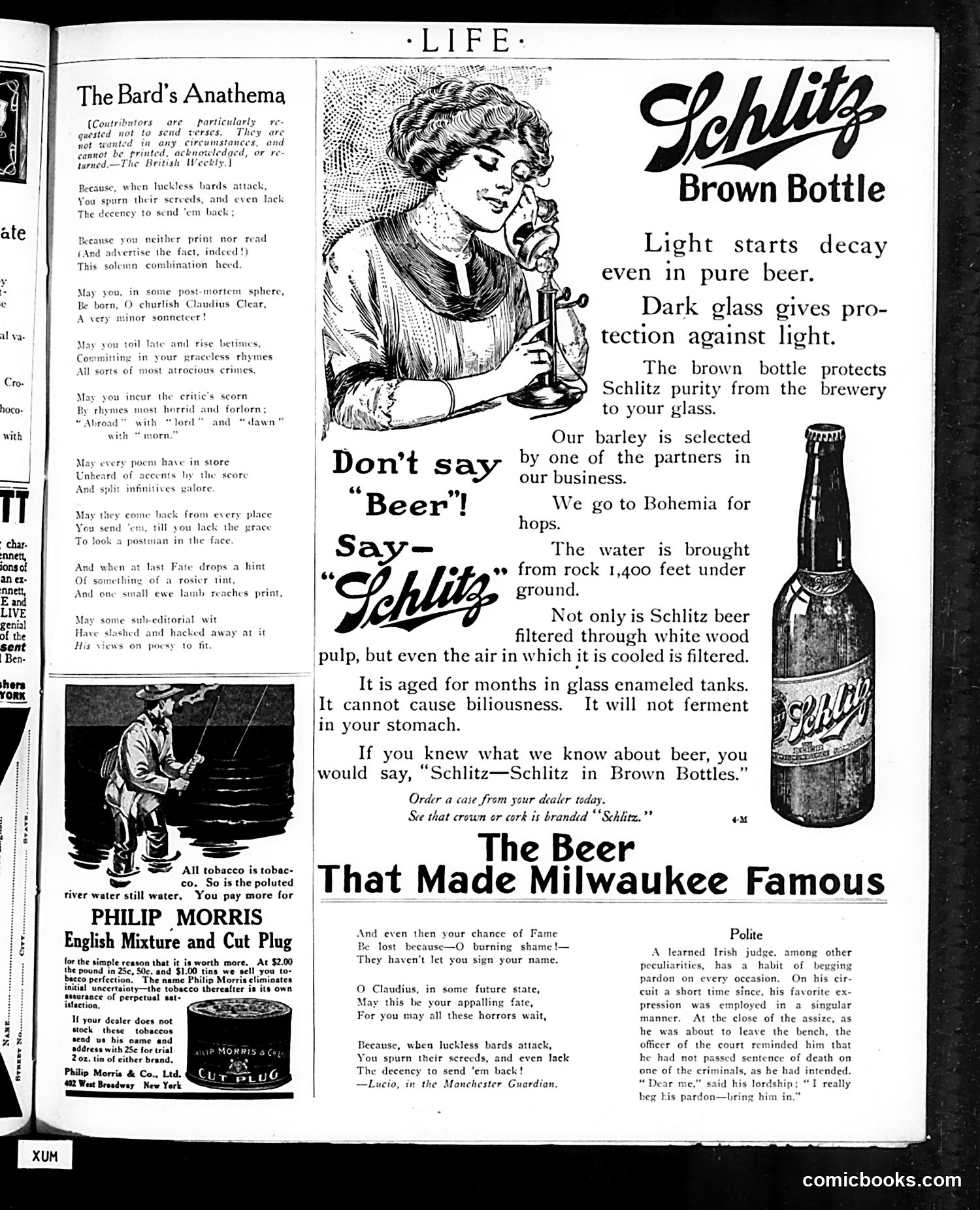
This page combines **satirical poetry** with **product advertising**. **"The Bard's Anathema"** (left column) is a mock-serious poem cursing writers and critics who don't advertise or get published. It uses archaic language ("May you...") to humorously condemn poets and literary figures to various indignities—poor reviews, obscurity, rejection. The satire targets the pretension of serious literature and the publishing world's gatekeeping. **The Schlitz Beer advertisement** dominates the right side, using scientific claims (brown bottles protect from light decay, water from 1,400 feet underground, white-wood filtration) to market beer as pure and health-conscious. This reflects early 20th-century advertising that emphasized industrial processing as quality assurance. **Lower sections feature:** - A Philip Morris tobacco ad with similar pseudo-scientific messaging - A brief anecdote about an Irish judge ("Polite") who habitually begs pardon—gentle social satire about manners and legal proceedings The page exemplifies *Life* magazine's blend of satirical humor targeting cultural institutions alongside contemporary advertising.
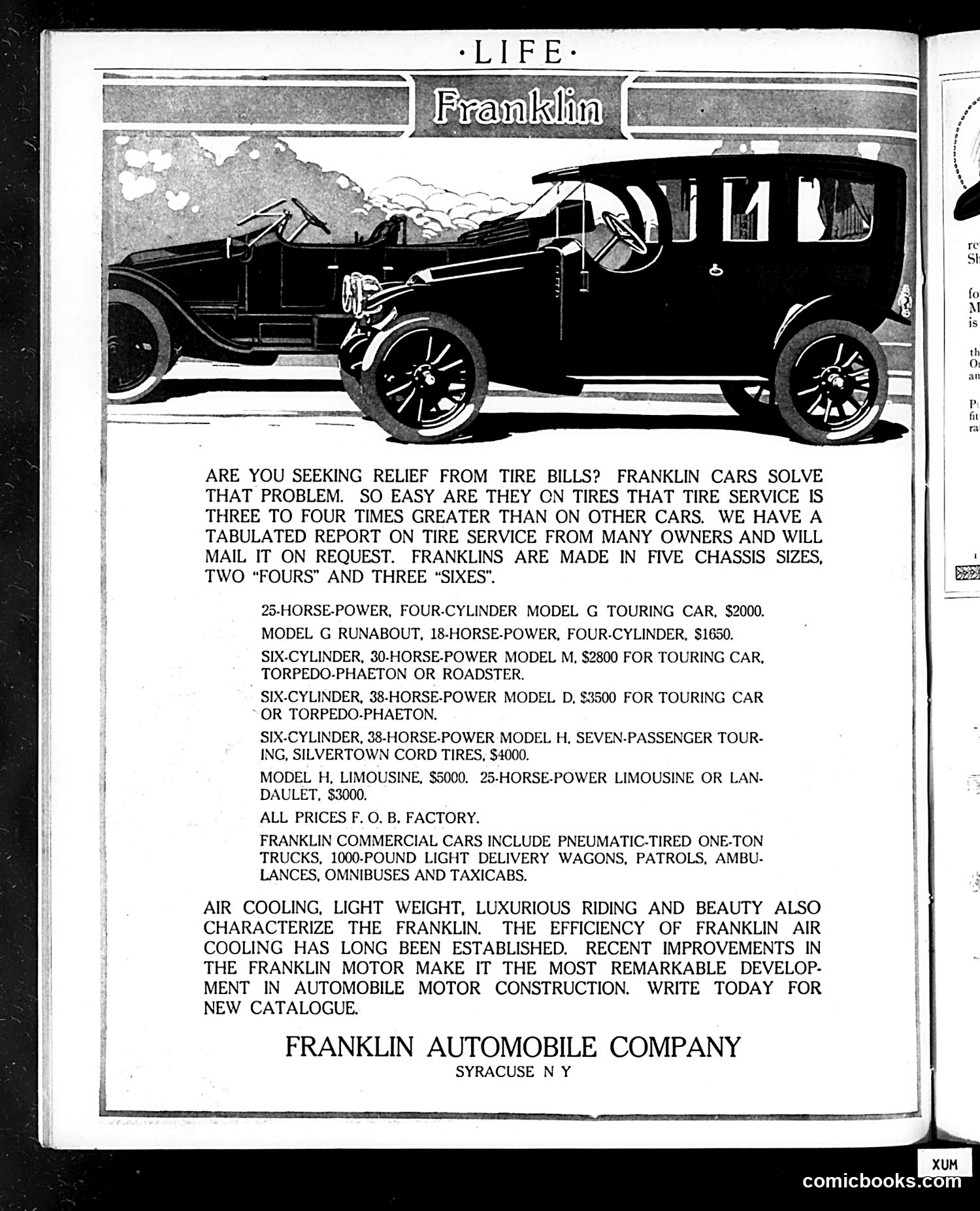
This is a full-page advertisement for Franklin automobiles, not satirical content. It appears in *Life* magazine and promotes Franklin cars' key selling points to early automotive consumers. The ad emphasizes that Franklin vehicles are exceptionally gentle on tires—claiming tire service needs are three to four times *greater* than competitors, meaning tires last longer, reducing owner expenses. This addresses a genuine consumer concern of the era, when tire costs were substantial. The advertisement lists multiple models with various engine sizes (four and six-cylinder options), prices ranging from $1650 to $5000, and body styles (touring cars, roadsters, limousines). It highlights Franklin's distinctive air-cooling technology and light weight as luxury features. The illustration shows a side-profile of a Franklin touring car, a typical early 1900s automobile design. This is straightforward commercial advertising rather than political satire or editorial cartooning.
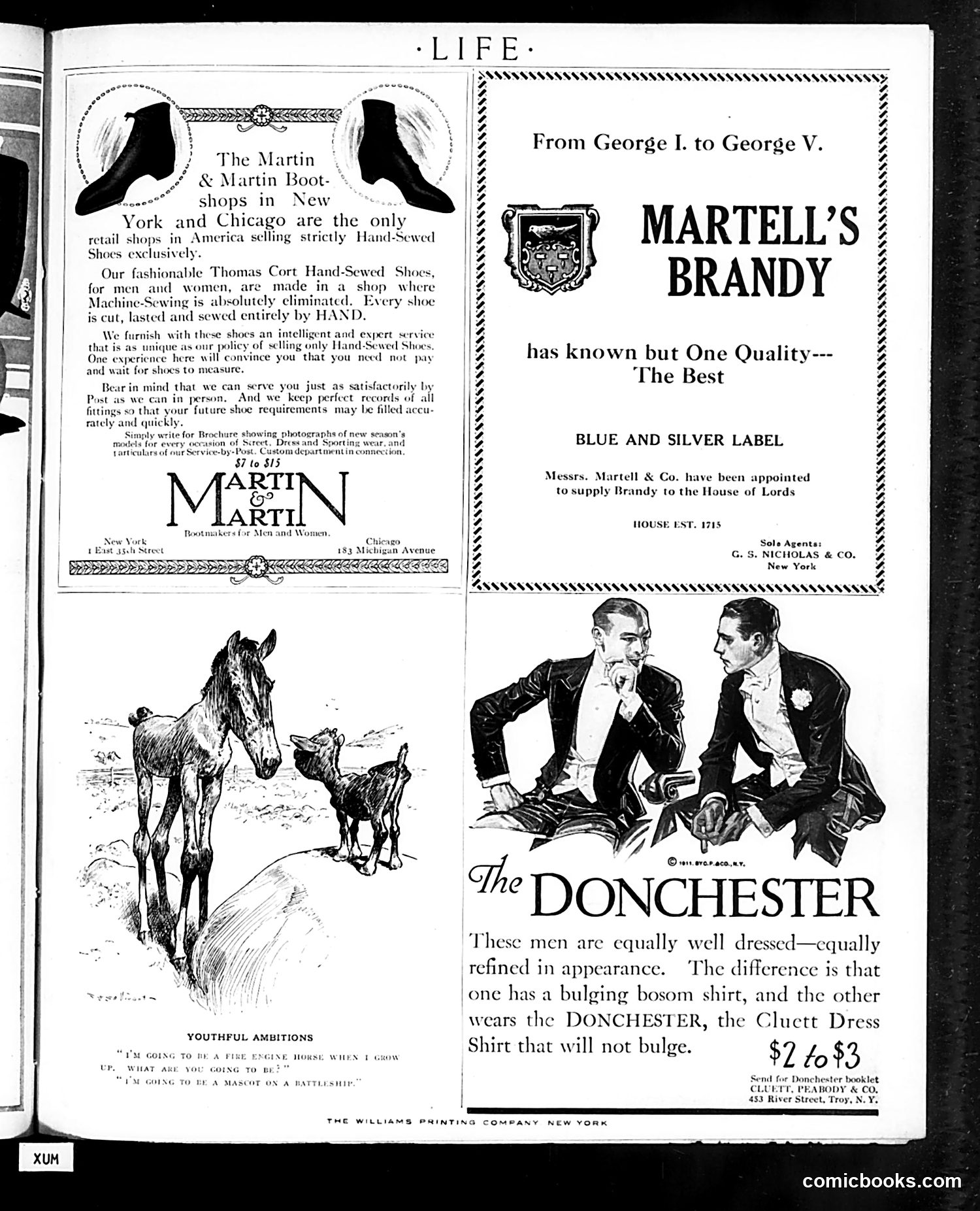
This page is **primarily advertisements** with one small cartoon. The ads promote luxury goods—hand-sewn shoes (Martin & Martin), brandy (Martell's), and dress shirts (Donchester)—reflecting early 20th-century affluent consumer culture. The only cartoon, titled "Youthful Ambitions," shows a young boy with a horse and dog. The caption quotes the child: "I'm going to be a fire engine when I grow up. What are you going to be? I'm going to a masque on a battleship." This appears to be **gentle satire on children's aspirational fantasies**—the boy conflates realistic career ambitions (firefighter) with absurd, fantastical scenarios (becoming a masquerade party on a battleship), mocking the illogical dreams of childhood. The humor relies on the contrast between sensible and nonsensical ambitions. The Martell's brandy ad notably references British royal patronage ("House of Lords," "House Est. 1715"), using heritage and exclusivity to market luxury goods to American readers.
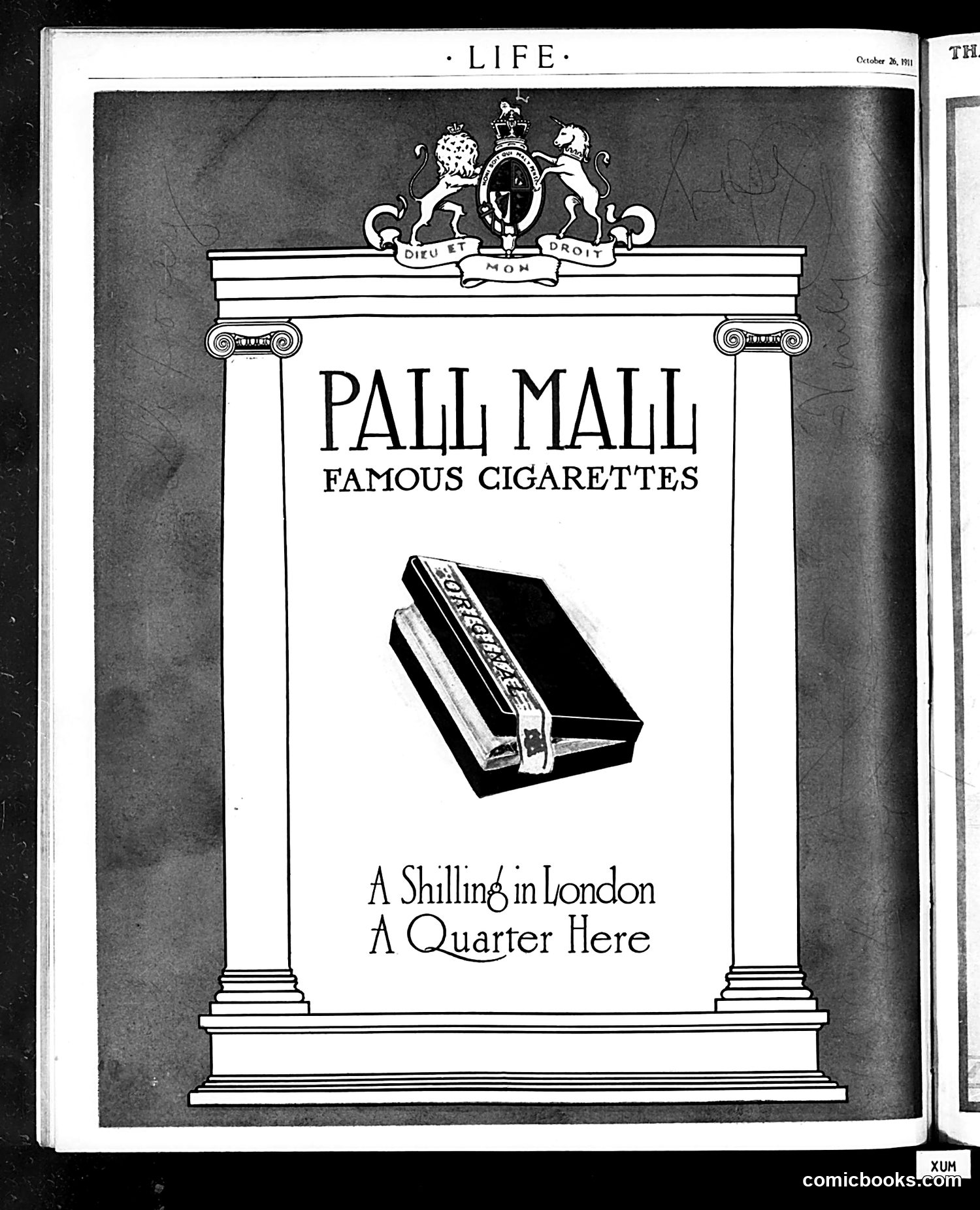
This is a **full-page advertisement**, not political satire or editorial cartoon. It promotes Pall Mall cigarettes using a classical architectural frame with a heraldic crest at top (appearing to reference British royal imagery with lions and a coat of arms). The ad's humor lies in a **price comparison joke**: Pall Mall cigarettes cost one shilling in London but only a quarter (25 cents) in America—implying the product is significantly cheaper in the US market, making it an attractive value proposition for American readers. The formal, columned design mimics official proclamations or high-class branding, lending prestige to the product through visual authority rather than satirical commentary.