
Life, 1911-10-26 · page 25 of 50
Life — October 26, 1911 — page 25: what you’re looking at
What you’re looking at
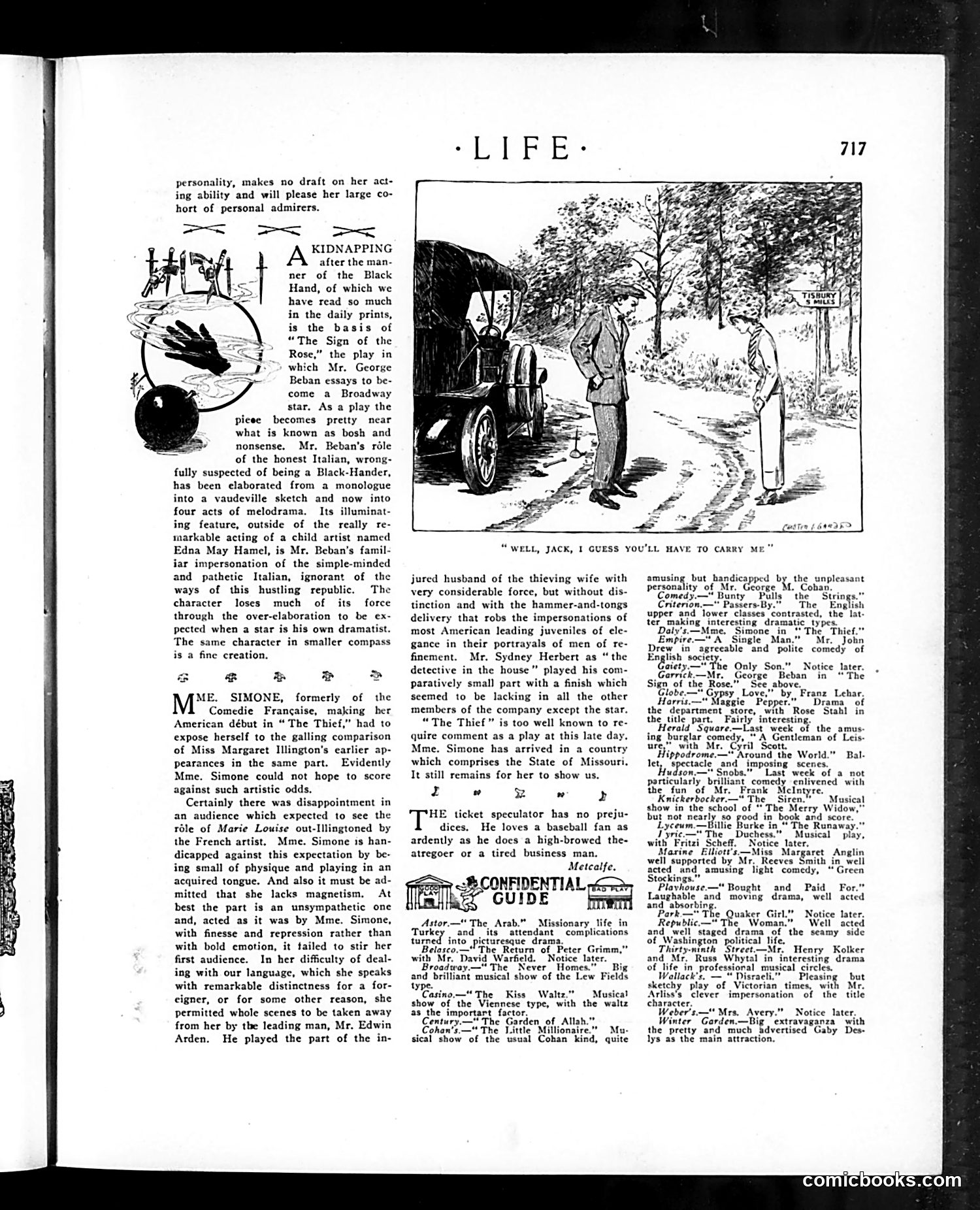
This page from *Life* magazine contains theater reviews and a small cartoon. The main cartoon (upper right) depicts a man standing beside a car with the caption "Well, Jack, I guess you'll have to carry me"—likely satirizing either the unreliability of early automobiles or gender dynamics of the era (a woman expecting to be carried/assisted). The text focuses on Broadway theater reviews, particularly criticizing French actress Mme. Simone's American debut in "The Thief" as disappointing compared to earlier American actress Margaret Illington's performance. The reviewer notes Simone's small stature, acquired English pronunciation, and lack of "magnetism" as handicaps. Other reviews mention actor George Beban in "The Sign of the Rose," which exploits contemporary anxiety about "Black Hand" Italian organized crime for melodramatic effect—reflecting real nativist concerns of the era about Italian immigrants. The "Confidential Guide" section lists various theatrical productions with brief dismissive or approving comments about their quality and performers.
📄 Transcribed text from this page (OCR, searchable)
Machine-transcribed from the original scan — historical spelling and the odd misread are preserved.
personality, makes no draft on her act- ing ability and will please her large co- hort of personal admirers. os =a oz KIDNAPPING after the man- ner of the Black Hand, of which we have read so much in the daily prints, is the basis of “The Sign of the Rose,” the play in which Mr. George Beban essays to be- come a Broadway star. As a play the picee becomes pretty near what is known as bosh and nonsense. Mr. Beban's réle of the honest Italian, wrong- fully suspected of being a Black-Hander, has been elaborated from a monologue into a vaudeville sketch and now into four acts of melodrama. Its illuminat- ing feature, outside of the really re- markable acting of a child artist named Edna May Hamel, is Mr. Beban’s famil- iar impersonation of the simple-minded and pathetic Italian, ignorant of the ways of this hustling republic. The character loses much of its force through the over-elaboration to be ex- pected when a star is his own dramatist. The same character in smaller compass is a fine creation. s & ME. SIMONE, formerly of the Comedie Francaise, making her American début in “ The Thief,” had to expose herself to the galling comparison of Miss Margaret Illington’s earlier ap- pearances in the same part. Evidently Mme. Simone could not hope to score against such artistic odds. Certainly there was disappointment in an audience which expected to see the role of Marie Louise out-Illingtoned by the French artist. Mme. Simone is han- dicapped against this expectation by be- ing small of physique and playing in an acquired tongue. And also it must be ad- mitted that she lacks magnetism. At best the part is an unsympathetic one and, acted as it was by Mme. Simone, with finesse and repression rather than with bold emotion, it failed to stir her first audience. In her difficulty of deal- ing with our language, which she speaks with remarkable distinctness for a for- cigner, or for some other reason, she permitted whole scenes to be taken away from her by the leading man, Mr. Edwin Arden. He played the part of the in- » > eB “WELL, JACK, I GUESS You'LL jured husband of the thieving wife with very considerable force, but without dis- tinction and with the hammer-and-tongs delivery that robs the impersonations of most American leading juveniles of ele- gance in their portrayals of men of re- finement. Mr, Sydney Herbert as “the detective in the house” played his com- paratively small part with a finish which seemed to be lacking in all the other members of the company except the star. “The Thief” is too well known to re- quire comment as a play at this late day. Mme. Simone has arrived in a country which comprises the State of Missouri. It still remains for her to show us. Zz ” vd oe . HE ticket speculator has no preju- dices, He loves a baseball fan as ardently as he docs a high-browed the- atregoer or a tired business man. Metcalfe. eae cre eX GUIDE : Astor.—" The Arab." Missionary life in Turkey and its attendant complications turned into picturesque drama, 7 Belasco.—" The Return of Peter Grimm,” with Mr. David Warfield. Notice later. Broad: “The Never Homes.” | Big and brilliant musical show of the Lew Fields type. Casino.—" The Kiss Waltz.” Musical show of the Viennese type, with the waltz as the importart factor, den of Allah. “The Little Millionaire.” Mu- sical show of the usual Cohan kind, quite HAVE TO CARRY ME” amusing but handicapped by the unpleasant personality of Mr. George M. Cohan. Comedy. Bunty Pulls the Strings.” Criterion.—" Passers-By.” The English upper and lower classes contrasted, the lat- ter making interesting dramatic types. Daly's.—Mme, Simone in‘ The Thie Empire—" A’ Single Man.” Mr. Jolin Drew in agreeable and polite comedy of English soci. aiety.—" The Only Son.” Notice later. Garrick —Mr. George Beban in “The Sign of the Rose.” See, above. Globe.—" Gypsy Love,” by, Franz Lear, Harris. faggie Pepper.” Drama of the department store, with Rose Stahl in the title part. Fairly’ interesting. . Herald Square.—Last week of the amus- rglar comedy, A Gentleman of Leis- . Cyril ‘Scott. Around the World.” Bal- and imposing scenes. judson.—" Snobs." Last week of a not particularly brilliant comedy enlivened with the fun of Mr. Frank McIntyre. Knickerbocker.—" The_ Siren.” Musical show in the school of * The Merry Widow,” but not nearly so good in book and score. Lyceum-—Lilhe Burke in," The Runaway.” Tyric.—" The Duchess.” Musical play, with Fritzi Scheff. Notice later. Marine Elliott’ 3 Margaret Anglin well supported by Mr, Reeves Smith in well acted und, amusing light comedy, “Green Stockings.” Playhowse-—" Bought and Paid For.” Laughable and moving drama, well acted and absorbing. Pork —" The Quaker Girl" Notice later. Republic.—" The Woman.” Well acted and well staged drama of ‘the seamy side of Washington political life, Thirty-ninth Street.—Mr. Henry Kolker and Mr. Russ Whytal in interesting drama of life in professional musical circles. Wallack's, — “Disraeli.” Pleasin sketchy play of Victorian times, with Arliss’s clever impersonation of the character, Weber's." Mrs. Avery.” Notice later. Winter Garden.—Big extravaganza with the pretty and much advertised Gaby Des- lys as the main attraction. but Mr. title comicbooks.com