
Life, 1911-10-26 · page 34 of 50
Life — October 26, 1911 — page 34: what you’re looking at
What you’re looking at
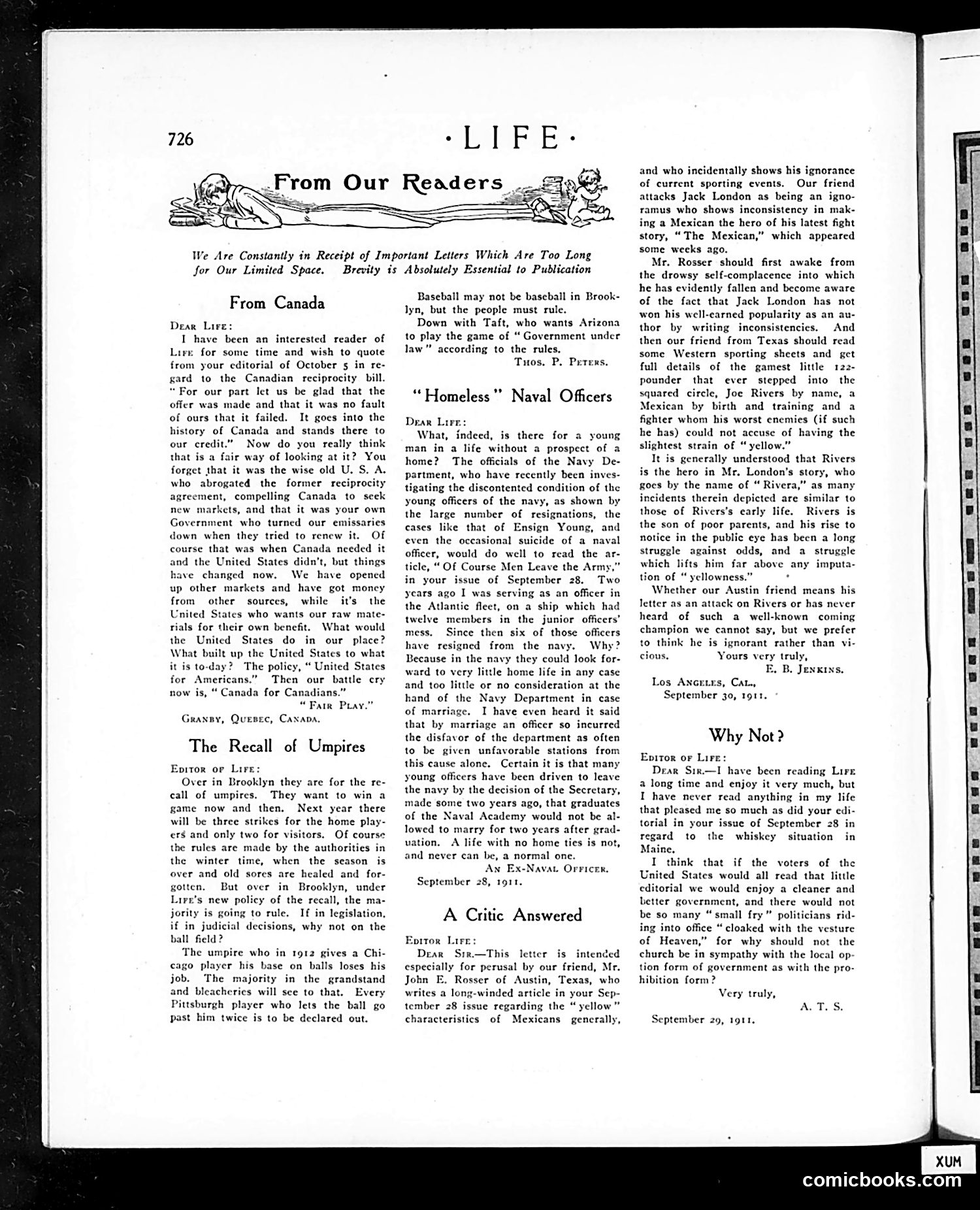
This page contains reader letters to *Life* magazine addressing three topics: **"From Canada"** criticizes *Life*'s editorial stance on a failed Canadian-American reciprocity trade agreement, arguing the U.S. rejected it when Canada needed it, and now wants it when America needs Canadian resources. **"The Recall of Umpires"** sarcastically proposes that if democratic "recall" principles apply to elected officials (referencing progressive reforms of the era), they should also apply to baseball umpires—mocking populist democracy by showing its absurd extension to sports. **"Homeless Naval Officers"** raises concerns about Navy Department policies causing officer resignations and suicides, particularly restrictions on marriage and post-marriage station assignments that prevent establishing stable homes. All three letters reflect early 1900s progressive-era debates: trade policy, democratic accountability, and labor/military personnel conditions.
📄 Transcribed text from this page (OCR, searchable)
Machine-transcribed from the original scan — historical spelling and the odd misread are preserved.
We Are Constantly in Receipt of Important Letters Which Are Too Long for Our Limited Space. From Canada Dear Lire: I have been an interested reader of Lire for some time and wish to quote from your editorial of October in re- gard to the Canadian reciprocity bill. “For our part Ict us be glad that the offer was made and that it was no fault of ours that it failed. It goes into the history of Canada and stands there to our credit." Now do you really think that is a fair way of looking at it? You forget that it was the wise old U. S. A. who abrogated the former reciprocity agreement, compelling Canada to seek new markets, and that it was your own Government who turned our emissaries down when they tried to renew it. Of course that was when Canada needed it and the United States didn’t, but things © changed now. We have opened up other markets and have got money from other sources, while it’s the United States who wants our raw mate- rials for their own benefit. What would the United States do in our place? What built up the United States to what is to-day? The policy, “ United States for Americans.” Then our battle cry now is, “ Canada for Canadians.” “Fair Pray.” Granny, Quesec, Caxapa. The Recall of Umpires Eprtor or Lire: Over in Brooklyn they are for the re- call of umpires, They want to win a game now and then. Next year there will be three strikes for the home play- erg and only two for visitors. Of course the rules are made by the authorities in the winter time, when the season is over and old sores are healed and for- gotten, But over in Brooklyn, under Lirs’s new policy of the recall, the ma- jority is going to rule. If in legislation, if in judicial decisions, why not on the ball field ? The umpire who in 1912 gives a Chi- ‘0 player his base on balls loses his job. The majority in the grandstand and bleacheries will sce to that. Every Pittsburgh player who lets the ball go past him twice is to be declared out. Brevity is Absolutely Essential to Publication Baseball may not be baseball in Brook- lyn, but the people must rule. Down with Taft, who wants Arizona to play the game of “ Government under law” according to the rules. Tuos, P. Peters. “Homeless” Naval Officers Dear Lire. What, indeed, is there for a young man in a life without a prospect of a home? The officials of the Navy De- partment, who have recently been inves- tigating the discontented condition of the young officers of the navy, as shown by the large number of resignations, the cases like that of Ensign Young, and even the occasional suicide of a naval officer, would do well to read the ar- ticle, “ Of Course Men Leave the Army, in your issue of September 28. Two years ago I was serving as an officer in the Atlantic fleet, on a ship which had twelve members in the junior officers’ mess. Since then six of those officers have resigned from the navy. Why? Because in the navy they could look for- ward to very little home life in any case and too little or no consideration at the hand of the Navy Department in case of marriage. I have even heard it said that by marriage an officer so incurred the disfavor of the department as often to be given unfavorable stations from this cause alone, Certain it is that many young officers have been driven to leave the navy by the decision of the Secretary, made some two years ago, that graduates of the Naval Academy would not be al- lowed to marry for two years after grad- uation. <A life with no home ties is not, and never can be, a normal one. Aw Ex-Navat Orricer. September 28, 1911. A Critic Answered Eprtor Lire: Dear Six.—This is intended especially for perusal by our friend, Mr. John E, Rosser of Austin, Texas, who writes a long-winded article in your Sep- tember 28 issue regarding the “ yellow” characteristics of Mexicans gencrall and who incidentally shows his ignorance of current sporting events. Our friend attacks Jack London as being an igno- ramus who shows inconsistency in mak- ing a Mexican the hero of his latest fight story, “The Mexican,” which appeared some weeks ago. Mr. Rosser should first awake from the drowsy self-complacence into which he has evidently fallen and become aware of the fact that Jack London has not won his well-earned popularity as an au- thor by writing inconsistencies. And then our friend from Texas should read some Western sporting sheets and get full details of the gamest little 122- pounder that ever stepped into the squared circle, Joe Rivers by name, a Mexican by birth and training and a fighter whom his worst enemies (if such he has) could not accuse of having the slightest strain of “ yellow.” It is generally understood that Rivers is the hero in Mr. London's story, who gocs by the name of “ Rivera,” as many incidents therein depicted are similar to those of Rivers’s early life. Rivers is the son of poor parents, and his rise to notice in the public eye has been a long struggle against odds, and a struggle which lifts him far above any imputa- tion of “ ycllowness.” f- Whether our Austin friend means his letter as an attack on Rivers or has never heard of such a well-known coming champion we cannot say, but we prefer to think he is ignorant rather than vi- cious, Yours very truly, E, B, Jenxins. Los Axcrrs, Can, September 30, 1911. Why Not? Epitor or Lire: Dear Sir.—I have been reading Lire a long time and enjoy it very much, but I have never read anything in my life that pleased me so much as did your edi- torial in your issue of September 28 in regard to the situation in Maine, I think that if the voters of the United States would all read that little editorial we would enjoy a cleaner and better government, and there would not be so many “small fry” politicians rid- ing into office “ cloaked with the vesture of Heaven,” for why should not the church be in sympathy with the local op- tion form of government as with the pro- hibition form? Very truly, whiskey AOT.S. ptember 29, 1911. comicbooks.com