
Life, 1911-10-26 · page 24 of 50
Life — October 26, 1911 — page 24: what you’re looking at
What you’re looking at
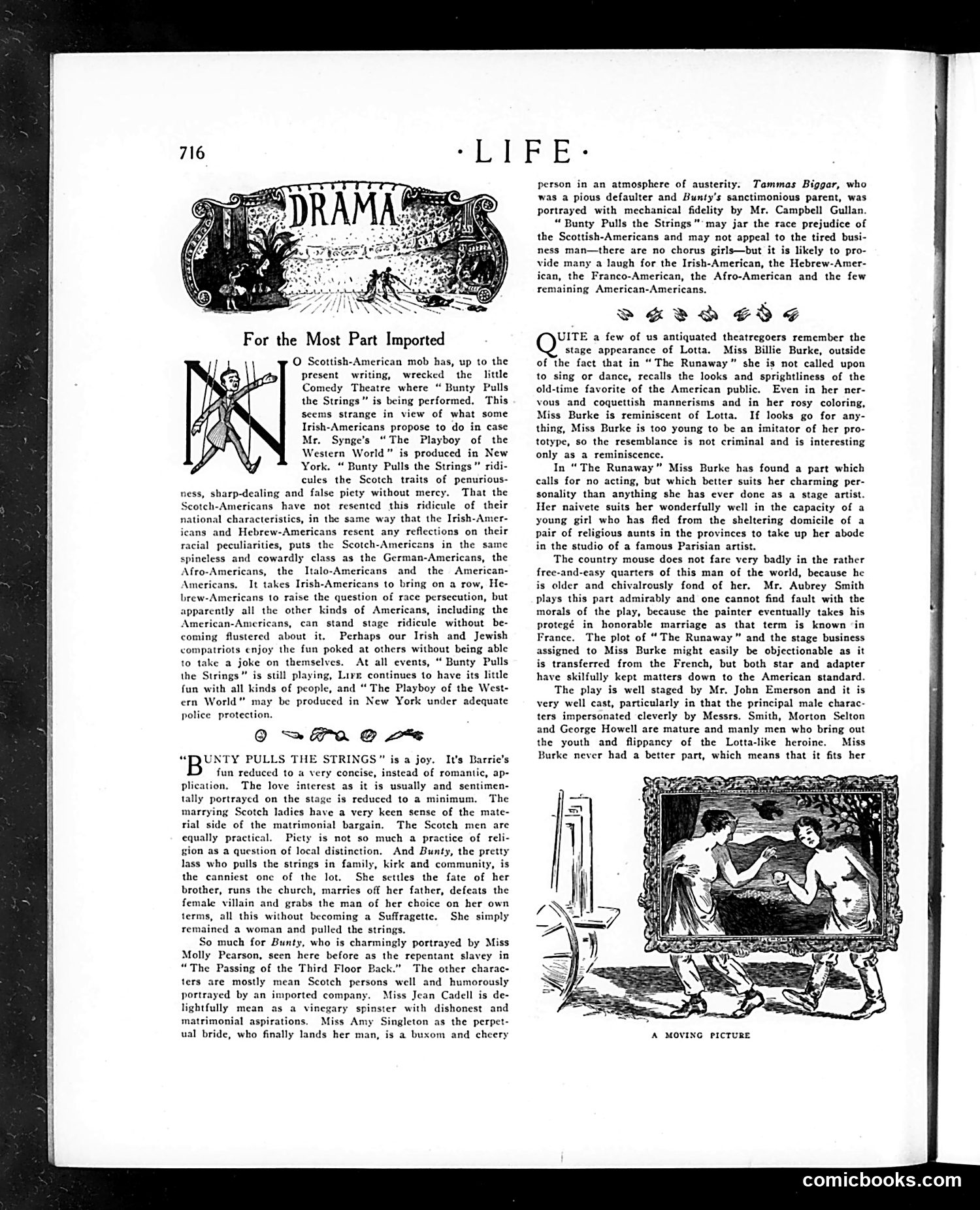
This page reviews the Scottish comedy "Bunty Pulls the Strings," which satirizes Scottish character traits—stinginess, sharp dealing, and false piety. The article's satirical point is comparative: it praises Scottish-Americans for *not* rioting over ethnic mockery, contrasting them unfavorably with Irish-Americans and Jewish-Americans, who actively protested theatrical portrayals deemed offensive (like Synge's "Playboy of the Western World"). Life's tongue-in-cheek argument suggests Scottish-Americans lack the political assertiveness of these groups. The play itself celebrates its title character, Bunty, as a pragmatic woman who manipulates family and community through intelligence rather than activism—notably "without becoming a Suffragette," a dig at contemporary women's rights movements. The review functions as both entertainment critique and ethnic commentary, reflecting early 20th-century American anxieties about immigrant communities and their cultural sensitivities.
📄 Transcribed text from this page (OCR, searchable)
Machine-transcribed from the original scan — historical spelling and the odd misread are preserved.
“LTP E For the Most Part Imported O Scottish-American mob has, up to the present writing, wrecked the little Comedy Theatre where “ Bunty Pulls the Strings” is being performed, This seems strange in view of what some Irish-Americans propose to do in case Mr. Synge’s “The Playboy of the Western World” is produced in New York. “Bunty Pulls the Strings” ridi- cules the Scotch traits of penurious- ness, sharp-dealing and false piety without mercy. That the Scotch-Americans have not resented this ridicule of their national characteristics, in the same way that the Irish-Amer- icans and Hebrew-Americans resent any reflections on their racial peculiarities, puts the Scotch-Americens in the same spineless and cowardly class as the German-Americans, the Afro-Americans, the Italo-Americans and the American- Americans. It takes Irish-Americans to bring on a row, He- brew-Americans to raise the question of race persecution, but apparently all the other kinds of Americans, including the American-Americans, can stand stage ridicule without be- coming flustered about it, Perhaps our Irish and Jewish compatriots enjoy the fun poked at others without being able to take a joke on themselves. At all events, “ Bunty Pulls the Strings” is still playing, Live continues to have its little {un with all kinds of people, and “The Playboy of the West- ern World” may be produced in New York under adequate police protection. 0 > Fo. @ 2s “DQUNTY PULLS THE STRINGS” is a joy. It's Barrie's fun reduced to a very concise, instead of romantic, ap- plication, The love interest as it is usually and sentimen- tally portrayed on the stage is reduced to a minimum, The marrying Scotch ladies have a very keen sense of the mate- rial side of the matrimonial bargain. The Scotch men are equally practical. Piety is not so much a practice of reli- gion as a question of local distinction. And Bunty, the pretty lass who pulls the strings in family, kirk and community, is the canniest one of the lot. She settles the fate of her brother, runs the church, marries off her father, defeats the female villain and grabs the man of her choice on her own terms, all this without becoming a Suffragette. She simply remained a woman and pulled the strings. So much for Bunty, who is charmingly portrayed by Miss Molly Pearson, seen here before as the repentant slavey in “The Passing of the Third Floor Back.” The other charac- ters are mostly mean Scotch persons well and humorously portrayed by an imported company. Miss Jean Cadell is de- lightfully mean as a vinegary spinster with dishonest and matrimonial aspirations. Miss Amy Singleton as the perpet- ual bride, who finally lands her man, is a buxom and cheery person in an atmosphere of austerity: Tammas Biggar, who was a pious defaulter and Bunty’s sanctimonious parent, was portrayed with mechanical fidelity by Mr. Campbell Gullan. “ Bunty Pulls the Strings” may jar the race prejudice of the Scottish-Americans and may not appeal to the tired busi- ness man—there are no chorus girls—but it is likely to pro- vide many a laugh for the Irish-American, the Hebrew-Amer- ican, the Franco-American, the Afro-American and the few remaining American-Americans. SaZYxDa ESE UITE a few of us antiquated theatregoers remember the stage appearance of Lotta. Miss Billie Burke, outside of the fact that in “The Runaway” she is not called upon to sing or dance, recalls the looks and sprightliness of the old-time favorite of the American public. Even in her ner- vous and coquettish mannerisms and in her rosy coloring, Miss Burke is reminiscent of Lotta. If looks go for any: thing, Miss Burke is too young to be an imitator of her pro- totype, so the resemblance is not criminal and is interesting only as a reminiscence. In “The Runaway” Miss Burke has found a part which calls for no acting, but which better suits her charming per- sonality than anything she has ever done as a stage artist. Her naivete suits her wonderfully well in the capacity of a young girl who has fled from the sheltering domicile of a pair of religious aunts in the provinces to take up her abode in the studio of a famous Parisian artist. The country mouse does not fare very badly in the rather free-and-easy quarters of this man of the world, because he is older and chivalrously fond of her. Mr. Aubrey Smith plays this part admirably and one cannot find fault with the morals of the play, because the painter eventually takes his protegé in honorable marriage as that term is known ‘in France. The plot of “The Runaway” and the stage business assigned to Miss Burke might easily be objectionable as it is transferred from the French, but both star and adapter have skilfully kept matters down to the American standard. The play is well staged by Mr. John Emerson and it is very well cast, particularly in that the principal male charac- ters impersonated cleverly by Messrs. Smith, Morton Selton and George Howell are mature and manly men who bring out the youth and flippancy of the Lotta-like heroine. Miss Burke never had a better part, which means that it fits her A MOVING PICTURE comicbooks.com