
Life, 1911-10-26 · page 14 of 50
Life — October 26, 1911 — page 14: what you’re looking at
What you’re looking at
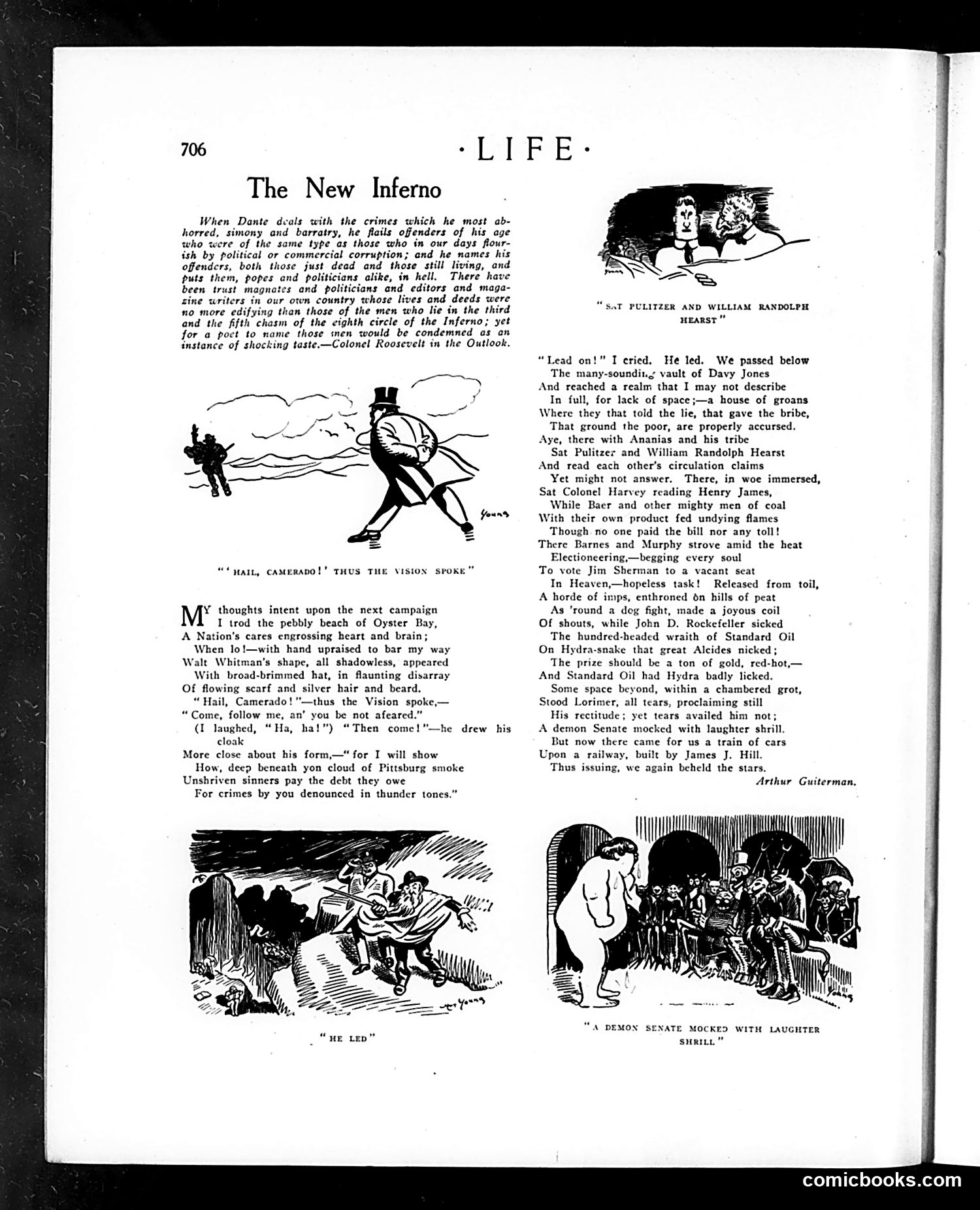
This satirical piece reimagines Dante's Inferno with contemporary (early 20th century) American political figures. The opening paragraph establishes the conceit: corrupt politicians, editors, and magazine writers belong in a modern hell alongside historical villains. The poem mocks specific figures through Dante-style punishments: Sat Pulitzer and William Randolph Hearst (newspaper moguls) read each other's "circulation claims"; Colonel Harvey reads Henry James; various corrupt politicians and businessmen suffer appropriate torments in this political underworld. The illustrations depict scenes from this modern inferno—demons tormenting the damned in classical style. The satire targets early-1900s corruption, corporate malfeasance, and journalistic dishonesty, using Dante's medieval framework to condemn contemporary American vice.
📄 Transcribed text from this page (OCR, searchable)
Machine-transcribed from the original scan — historical spelling and the odd misread are preserved.
HIMESE = The New Inferno When Dante deals with the crimes which he most ab- horred, simony and barratry, he fails offenders of his age who were of the same type as those who in our days flour- ish by political or commercial corruption; and he names his offenders, both those just dead and those still living, and puts them, popes and politicians alike, in hell. There have been trust magnates and politicians and editors and maga- zine writers in our own country whose lives and deeds were no more edifying than those of the men who lie in the third and the fifth chasm of the eighth circle of the Inferno; yet for a poct to name those nen would be condemned as an instance of shocking taste.—Colonel Roosevelt in the Outlook. “wait, CAMERADO!’ THUS THE VISION SPOKE” 'Y thoughts intent upon the next campaign I trod the pebbly beach of Oyster Bay, A Nation's cares engrossing heart and brain; When lo!—with hand upraised to bar my way Walt Whitman’s shape, all shadowless, appeared With broad-brimmed hat, in flaunting disarray Of flowing scarf and silver hair and beard. “Hail, Camerado!"—thus the Vision spoke,— “Come, follow me, an’ you be not afeared.” (I laughed, “Ha, ha!") “Then come!"—he drew his cloak More close about his form,—" for I will show How, deep beneath yon cloud of Pittsburg smoke Unshriven sinners pay the debt they owe For crimes by you denounced in thunder tones.” “we Lep” T PULITZER AND WILLIAM RANDOLPH, HEARST" “Lead on!" I cried. He led. We passed below The many-soundit.¢ vault of Davy Jones And reached a realm that I may not describe In full, for lack of space;—a house of groans Where they that told the lie, that gave the bribe, That ground the poor, are properly accursed. Aye, there with Ananias and his tribe Sat Pulitzer and William Randolph Hearst And read each other’s circulation claims Yet might not answer, There, in woe immersed, Sat Colonel Harvey reading Henry James, While Baer and other mighty men of coal With their own product fed undying flames Though no one paid the bill nor any toll! There Barnes and Murphy strove amid the heat Electioneering,—begging every soul To vote Jim Sherman to a vacant seat In Heaven,—hopeless task! Released from toil, A horde of imps, enthroned 6n hills of peat As ‘round a dog fight, made a joyous coil Of shouts, while John D. Rockefeller sicked The hundred-headed wraith of Standard Oil On Hydra-snake that great Alcides nicked ; The prize should be a ton of gold, red-hot,— And Standard Oil had Hydra badly licked. Some space beyond, within a chambered grot, Stood Lorimer, all tears, proclaiming still His rectitude; yet tears availed him not; A demon Senate mocked with laughter shrill. But now there came for us a train of cars Upon a railway, built by James J. Hill. Thus issuing, we again beheld the stars. Arthur Guiterman, “\\ DEMON SENATE MOCKED WITH LAUGHTER suri.” comicbooks.com