
Life, 1911-10-26 · page 29 of 50
Life — October 26, 1911 — page 29: what you’re looking at
What you’re looking at
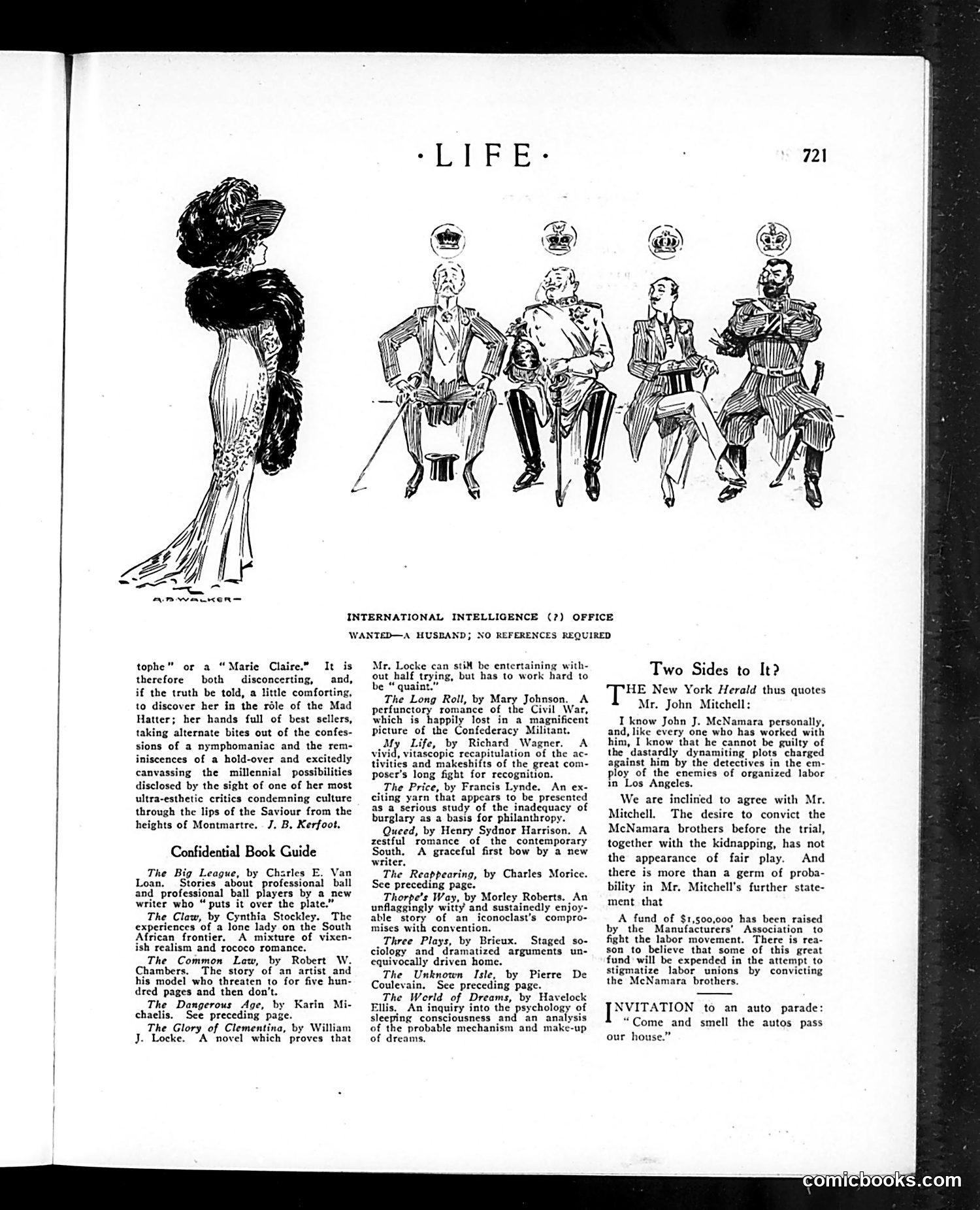
The cartoon satirizes the "International Intelligence Office"—likely a fictional marriage bureau or matchmaking service. Five crowned male figures (appearing to be European royalty or nobility based on their crowns and military uniforms) sit like candidates awaiting interview, while a fashionably dressed woman on the left evaluates them as potential husbands. The satire targets wealthy American women of the era who married European aristocrats for titles and prestige, while those men sought American fortunes. The phrase "no references required" mocks how such marriages often ignored character or compatibility in favor of financial and social advantage. This reflects early 20th-century anxieties about transatlantic "marriages of convenience" between American heiresses and impoverished European nobility—a common phenomenon of the Gilded Age that satirists frequently ridiculed.
📄 Transcribed text from this page (OCR, searchable)
Machine-transcribed from the original scan — historical spelling and the odd misread are preserved.
INTERNATIONAL INTELLIGENCE (?) OFFICE WANTED—A HUSBAND; NO REFERENCES REQUIRED tophe” or a “Marie Claire.” It is therefore both disconcerting, and, if the truth be told, a little comforting, to discover her in the role of the Mad Hatter; her hands full of best sellers, taking alternate bites out of the confes- sions of a nymphomaniac and the rem- iniscences of a hold-over and excitedly canvassing the millennial possibilities disclosed by the sight of one of her most ultra-esthetic critics condemning culture through the lips of the Saviour from the heights of Montmartre. J. B. Kerfoot. Confidential Book Guide The Big League, by Charles E, Van Loan. Stories about professional ball and professional ball players by a new writer who “ puts it over the plate.” The Claw, by Cynthia Stockley. The experiences of a lone lady on the South African frontier. A mixture of vixen- ish realism and rococo romance. The Common Law, by Robert W. Chambers. The story of an artist and his model who threaten to for five hun- dred pages and then don’t. The Dangerous Age, by Karin Mi- chaclis. See preceding’ page. The Glory of Clementina, by William J. Locke. “A novel which’ proves that Mr. Locke can stiM be entertaining with- out half trying, but has to work hard to be “ quaint.” The Long Roll, by Mary Johnson. A perfunctory romance of the Civil War, which is happily lost in a magnificent picture of the Confederacy Militant. ife, by Richard Wagner. A ‘ascopic recapitulation of the ac- jes and makeshifts of the great com- poser’s long fight for recognition. The Price, by Francis Lynde. An ex- citing yarn that appears to be presented as a serious study of the inadequacy of burglary as a basis for philanthropy. Queed, by Henry Sydnor Harrison. A zestful romance of the contemporary South, A graceful first bow by a new writer, The Reappearing, by Charles Morice. Sce preceding page. Thorpe’s Way, by Morley Roberts. An unflaggingly witty and sustainedly enjoy- able story of an iconoclast’s compro- mises with convention. Three Plays, by Brieux. Staged so- ciology and dramatized arguments un- equivocally driven home. The Unknown Isle, by Pierre De Coulevain. See preceding page. The Werld of Dreams, by Havelock Ellis. An inquiry into the psychology of sleeping consciousness and an ana of the probable mechanism and make-up of dreams, Two Sides to It? HE New York Herald thus quotes Mr. John Mitchell: I know John J. McNamara personally, and, like every one who has worked with him, I know that he cannot be guilty of the ‘dastardly dynamiting plots charged against him by the detectives in the em- ploy of the enemies of organized labor in Los Angeles. We are inclined to agree with Mr. Mitchell. The desire to convict the McNamara brothers before the trial, together with the kidnapping, has not the appearance of fair play. And there is more than a germ of proba- bility in Mr. Mitchell's further state- ment that A fund of $1,500,000 has been raised by the Manufacturers’ Association to fight the labor movement. There is rea- son to believe that some of this great fund will be expended in the attempt to stigmatize labor unions by convicting the McNamara brothers. [SYITATION to an auto parade: “Come and smell the autos pass our house.”