
Life, 1911-10-26 · page 28 of 50
Life — October 26, 1911 — page 28: what you’re looking at
What you’re looking at
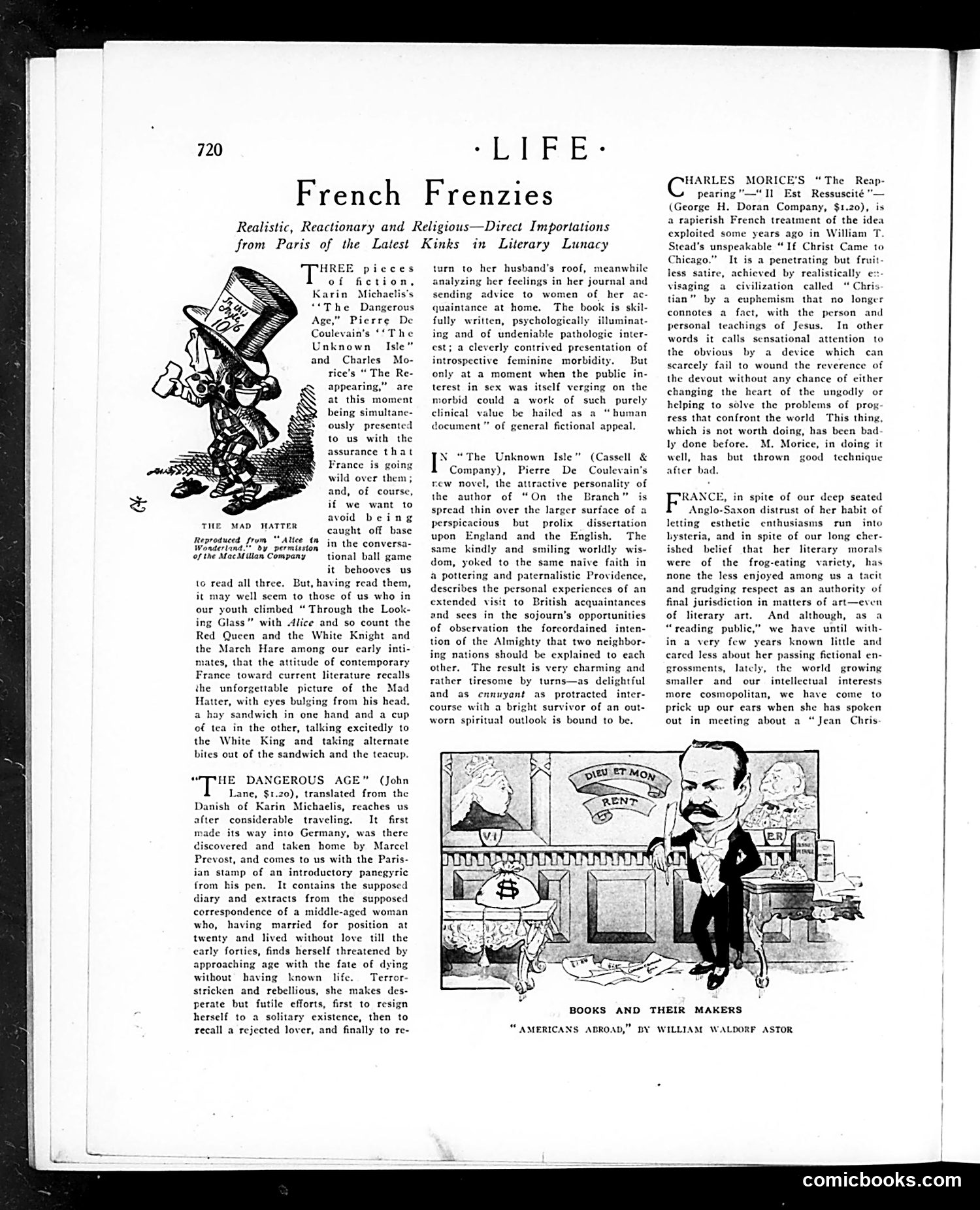
This page reviews three contemporary French novels being imported to America, using satirical language to mock what the critic sees as pretentious European literary trends. The author compares France's enthusiasm for these psychologically introspective, morally ambiguous books to Lewis Carroll's "Mad Hatter"—suggesting French literary culture has become unmoored from reason. The three novels discussed explore controversial themes: female sexual desire and aging ("The Dangerous Age"), Anglo-French cultural comparison ("The Unknown Isle"), and religious satire ("The Reappearing"). The critic acknowledges their technical skill but dismisses them as overly clinical, morbid, or tedious—examples of France's current literary "lunacy." The illustration of the Mad Hatter reinforces this critique: just as Carroll's character speaks nonsense while eating simultaneously, the critic implies French authors produce overwrought, self-indulgent fiction that American readers shouldn't blindly follow simply because Paris endorses it.
📄 Transcribed text from this page (OCR, searchable)
Machine-transcribed from the original scan — historical spelling and the odd misread are preserved.
“= AESE = French Frenzies Realistic, Reactionary and Religious—Direct Importations from Paris of the Latest Kinks in Literary Lunacy HREE pieces of fiction, Karin Michaelis’s “The Danger Pierre De ain's (‘The Unknown Isle” and Charles Mo- rice’s “ The Re- appearing,” are at this moment being simultane- ously presented to us with the assurance that France is going wild over them ; and, of course, if we want to avoid being caught off base Reproduced from “* Alice tn j, 7 i. Wonderland.” by permisston 1 the conversa: ofthe MacMiian Company tional ball game it behooves us to read all three. But, having read them, it may well seem to those of us who in our youth climbed “ Through the Look- ing Glass” with Alice and so count the Red Queen and the White Knight and the March Hare among our early inti- mates, that the attitude of contemporary France toward current literature recalls the unforgettable picture of the Mad Hatter, with eyes bulging from his head, a hay sandwich in one hand and a cup of tea in the other, talking excitedly to the White King and taking alternate bites out of the sandwich and the teacup. THE MAD HATTER “"THE DANGEROUS AGE” (John Lane, $1.20), translated from the Danish of Karin Michaelis, reaches us after considerable traveling, It first made its way into Germany, was there Ciscovered and taken home by Marcel Prevost, and comes to us with the Paris- jan stamp of an introductory panegyric from his pen. It contains the supposed diary and extracts from the supposed correspondence of a middle-aged woman who, having married for position at twenty and lived without love till the carly forties, finds herself threatened by approaching age with the fate of dying ithout having known life. Terror- stricken and rebellious, she makes des- perate but futile efforts, first to resign herself to a solitary existence, then to recall a rejected lover, and finally to re- turn to her husband's roof, meanwhile analyzing her feelings in her journal and sending advice to women of her ac- quaintance at home. The book is skil- fully written, psychologically illuminat- ing and of undeniable pathologic inter- a cleverly contrived presentation of introspective feminine morbidity. But only at a moment when the public in- terest in sex was itself verging on the morbid could a work of such purely clinical value be hailed as a “ buman document" of general fictional appeal. “The Unknown Isle” (Cassell & Company), Pierre De Coulevain’s rew novel, the attractive personality of the author of “On the Branch” is spread thin over the larger surface of a perspicacious but prolix dissertation upon England and the English. The same kindly and smiling worldly wis- dom, yoked to the same naive faith in a pottering and paternalistic Providence, describes the personal experiences of an extended visit to British acquaintances and sees in the sojourn’s opportunities of observation the forcordained inten- tion of the Almighty that two neighbor- ing nations should be explained to each other, The result is very charming and rather tiresome by turns—as delightful and as ennuyant as protracted inter- course with a bright survivor of an out- worn spiritual outlook is bound to be. HARLES MORICE’S “The Reap- pearing"—" Il Est Ressuscité "— (George H. Doran Company, $1.20), is a rapierish French treatment of the idea exploited some years ago in William T. Stead’s unspeakable “If Christ Came to Chicago.” It is a penetrating but fruit- less satire, achieved by realistically e: visaging a civilization called“ Chris. tian” by a euphemism that no longer connotes a fact, with the person and personal teachings of Jesus. In other words it calls sensational attention to the obvious by a device which can scarcely fail to wound the reverence of the devout without any chance of cither changing the heart of the ungodly or helping to solve the problems of pro ress that confront the world This t which is not worth doing, has been bad ly done before. M. Morice, in doing it well, has but thrown good technique after bad. RANCE, in spite of our deep seated Anglo-Saxon distrust of her habit of letting esthetic cnthusiasms run into hysteria, and in spite of our long cher- ished belief that her literary morals were of the frog-eating varicty, has none the less enjoyed among us a tacit and grudging respect as an authority of final jurisdiction in matters of art—even of literary art. And although, as a “reading public,” we have until with- in a very few years known little and cared less about her passing fictional en- grossments, lately, the world growing smaller and our intellectual interests more cosmopolitan, we have come to prick up our ears when she has spoken out in meeting about a “Jean Chris BOOKS AND THEIR MAKERS “AMERICANS ADROAD,” DY WILLIAM WALDORF ASTOR comicbooks.com